
LinkedIn branding is built through useful conversations, not a company logo alone. Using LinkedIn for B2B branding means sharing relevant expertise, joining industry discussions, and helping buyers understand what your business stands for. That steady engagement gives decision-makers a reason to recognize and trust your brand before they’re ready to buy.
You already know that B2B decisions take consideration and input from more than one person. A polished page can introduce your business, but trust grows when the people behind it show up with clear, helpful perspectives. This guide explains how to turn LinkedIn activity into a consistent brand presence, from community participation to employee voices and storytelling.
Explore practical ways to strengthen your company page, engage the right audience, and learn from recognizable B2B brand examples. You’ll also see how decision-makers use LinkedIn and how to shape stories that make your expertise memorable without making every post a sales pitch.
Key Takeaways
- Build trust through useful conversations and consistent participation, not company announcements alone.
- Make your LinkedIn Page a clear credibility hub with messaging that explains who you help and how.
- Study how established B2B brands use LinkedIn, then adapt the underlying tactics to your audience and goals.
- Reach buying groups with relevant content for different decision-makers, rather than treating every prospect alike.
- Use employee perspectives and specific stories to make your expertise more relatable and memorable.
1. Community engagement and relationship building
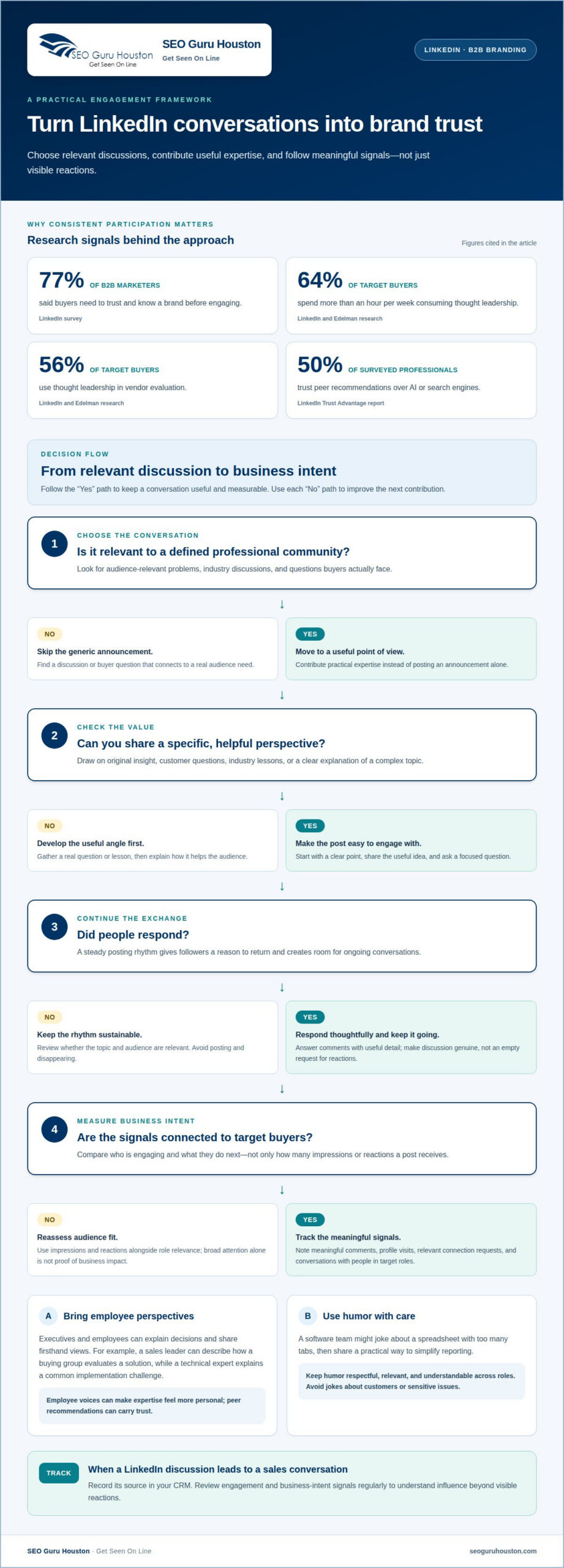
Using LinkedIn for B2B branding starts with a clear commitment: help a defined professional community solve relevant problems. Share practical expertise, join industry discussions, and answer comments with useful detail. LinkedIn’s survey found that 77% of B2B marketers said buyers need to trust and know a brand before engaging. Trust grows through consistent contributions, not announcements alone.
Choose a posting rhythm your team can maintain. A steady presence gives followers a reason to return and makes room for ongoing conversations. Share original insight, customer questions, industry lessons, and clear explanations of complex topics. LinkedIn and Edelman research found that 64% of target buyers spend more than an hour per week consuming thought leadership, while 56% use it in vendor evaluation.
Executives and employees can build thought leadership by sharing firsthand perspectives, explaining decisions, and commenting thoughtfully on industry conversations. For example, a sales leader might describe how a buying group evaluates a solution, while a technical expert explains a common implementation challenge. LinkedIn’s Trust Advantage report found that 50% of surveyed professionals trust peer recommendations over AI or search engines. Employee voices can make expertise feel more personal.
To increase organic reach, make every company post relevant to a defined audience and encourage genuine discussion. Start with a clear point, share a useful idea, and ask a focused question. Respond thoughtfully to comments and keep the conversation going rather than posting and disappearing. This builds meaningful engagement; avoid empty prompts that ask for reactions without offering value.
Measure business intent as well as engagement. Track meaningful comments, profile visits, relevant connection requests, and conversations with people in target roles. Compare these signals with impressions and reactions to see whether posts reach potential buyers or attract broad attention. When a LinkedIn discussion leads to a sales conversation, record its source in your CRM. This helps marketing assess influence beyond visible reactions.
Humor can make a brand more approachable when it reflects the audience’s working life. A software team, for example, might joke about a spreadsheet with too many tabs, then share a practical way to simplify reporting. Keep humor respectful, relevant, and easy for different roles to understand. Avoid jokes about customers or sensitive issues. Aim for a human moment that opens a useful conversation.
A disciplined approach to using LinkedIn for B2B branding turns engagement into a repeatable marketing practice. Identify relevant conversations, contribute useful expertise, and follow up thoughtfully with people who respond. Review engagement and business-intent signals regularly. This helps businesses build relationships that executives and buying groups can remember.
2. Company page optimization and credibility
Your LinkedIn company page should answer three buyer questions quickly: what you do, whom you help, and why your expertise matters. According to LinkedIn’s 2026 Global B2B Marketing Outlook, 83% of B2B marketers said credibility matters more than traditional brand messaging. Make that principle visible through specific services, useful proof points, and consistent language across your page.
Start with the essentials: use a recognizable logo and banner, then write a concise description that names your audience, expertise, and business value. Add relevant specialties and a clear next step, such as exploring a case study or contacting your team. Check that the page’s wording matches your website, so buyers encounter a consistent message in both places.
Strong B2B company page examples clarify value rather than relying on design alone. Picture a cybersecurity provider whose banner identifies its focus, while its overview explains the risks it helps address. Its posts might share threat-prevention guidance, leadership commentary, and customer lessons. These specific points give visitors a reason to follow the page and understand its value.
Optimization is an ongoing strategy, not a one-time profile task. Review the page whenever your services, audience, or market position changes. Keep the overview current, use language buyers recognize, and ensure recent posts demonstrate genuine expertise. For example, a manufacturing company discussing supply-chain trends should connect each update to its capabilities rather than simply repeat industry headlines.
Build credibility with valuable details that support your claims. Explain your process, show how your team approaches common challenges, and share useful perspectives from leaders closest to the work. Keep claims precise and avoid broad superlatives that buyers cannot assess. An authentic page sounds like the people behind the business, not a collection of polished slogans.
Use page analytics to assess whether your strategy attracts the right audience. Look for patterns in visitor roles, post engagement, and clicks on key page elements. If a leadership post draws relevant comments but few page visits, test a clearer profile description or a stronger next step. Treat these signals as prompts for focused improvements, not as proof of business impact on their own.
If your LinkedIn presence needs to connect more clearly with the experience buyers find on your site, website development and landing pages can help align those touchpoints. A consistent message across the company page and a relevant landing page makes the next step easier to understand.
Logos and colors alone are not enough for B2B brands to stand out. Give visual choices a supporting role by pairing them with a distinctive point of view and practical information that helps visitors understand how the company thinks. A page feels more memorable when its presentation and content reinforce the same expertise, rather than asking visual polish to carry the whole message.
Before publishing an update, consider whether it gives prospective customers useful context and sounds clearly connected to the business. Specific examples, plain language, and a consistent voice can make the page easier to recognize and trust. Keep the goal practical: help the right visitors find a relevant perspective and a credible reason to continue the conversation, rather than simply presenting a polished brand.
3. Examples of B2B brands using LinkedIn
Study what established companies make visible, then adapt the tactic to your own target audience. Microsoft has more than 29 million LinkedIn followers, while GE Vernova has more than 4 million. Established B2B brands can build a substantial following on LinkedIn. These figures show their broad platform presence, not a guaranteed result for smaller businesses.
Use these examples to assess brand consistency, not just follower totals. Microsoft, GE Vernova, Citi, and Abbott operate in distinct sectors, so their messaging serves different professional audiences. Consider what expertise each company highlights, how its posts reflect its business, and which themes recur. Then adapt relevant observations into a strategy suited to your own buyers.
Individual contributions offer another model. A single LinkedIn post helped Ross close a $70,000 deal, and an SDR booked six meetings in under two hours from one post. These examples illustrate how a relevant point of view can start a business conversation. They don’t establish a typical outcome; the practical lesson is to connect useful content with a clear audience and timely follow-up.
Organic posts and LinkedIn ads serve different awareness needs. Organic thought leadership and community engagement build a presence through useful, ongoing contributions; ads can amplify a message and target people by job function. A B2B brand can use organic content to explore a topic, then use paid promotion to extend a specific message to a selected professional audience.
For branded content, distinguish company messaging from an employee’s personal perspective. For sponsored posts, make the business relationship clear to readers. For employee advocacy, give colleagues approved facts and key points while letting them express those ideas authentically. Treat these as practical principles for building trust, not as claims about a specific LinkedIn policy.
LinkedIn campaign costs depend on the audience, bidding competition, campaign objective, format, and delivery settings. Targeting options can include professional attributes such as job function, helping brands reach relevant roles rather than a broad audience. Set the campaign objective first, define the target group, then assess costs in relation to the reach and engagement the campaign is designed to generate.
Avoid copying a large brand’s volume or tone without considering whether it fits your business. Microsoft’s scale does not make every corporate announcement effective for a specialist supplier. Skip vague messages, unsupported claims, and engagement prompts that offer no value. Before publishing, check the audience, business purpose, factual accuracy, and next step. This keeps social media activity focused on brand awareness and buyer relevance.
4. LinkedIn audience size and decision-makers
LinkedIn’s scale creates reach, but audience size alone won’t build a qualified B2B presence. The platform has 1.2 billion members, including 180 million senior-level influencers and more than 130 million decision-makers. Treat those figures as context, not your target market. Effective B2B marketing starts by identifying the professionals involved in your buyers’ decisions.
B2B purchases are often complex, high-value, and long-term, with up to eight internal stakeholders involved. A technical evaluator may prioritize integration, while a finance leader weighs business value. Procurement may focus on risk, and an executive may assess strategic fit. Map these roles before planning content, then address each person’s priorities without changing your core brand promise.
Start with a simple buying-group map. Identify the job functions that influence a purchase, the problems each role needs to solve, and the evidence each needs to move forward. For example, a cybersecurity company might share risk-management insights for security leaders and business-continuity perspectives for executives. This makes audience targeting and content choices more deliberate.
LinkedIn’s professional context supports sharing expertise that helps buyers evaluate options. An Edelman-LinkedIn survey found that 55% of decision-makers review thought leadership content as part of their vetting process. Use that insight to create useful posts for different roles, such as implementation guidance for technical teams and clear business cases for senior leaders.
Build audience segments around relevant professional attributes, such as job function and seniority, rather than broad assumptions about industries. LinkedIn Ads can amplify messages to selected professional audiences, while organic posts help your team develop themes through regular sharing. Match each message to a role, then review whether the people engaging align with the intended audience.
Measure more than follower growth. Compare post engagement and company-page visits with signals from target roles, such as relevant comments, profile views, and sales conversations. If a post attracts broad attention but few intended buyers, refine the topic or audience. If a specific insight sparks discussion among decision-makers, develop that theme further.
Large audiences don’t replace precision. Use LinkedIn’s reach to make relevant ideas visible, then tailor the message to the buying group’s actual concerns. A disciplined audience map helps marketers connect content with decision-makers, support internal consensus, and build a brand presence that remains useful throughout a long B2B purchase.
Check the audience map against who already follows the page. B2B purchases are usually high-value, long-term, complex, and often involve multiple decision-makers, so follower totals can conceal a mismatch between broad reach and the people shaping a buying group. A company audit found that 23% of its LinkedIn followers matched its target roles. Treat that as a reason to review follower composition, not as a universal benchmark: compare the roles represented with those your own offers require, then adjust content and targeting where gaps appear.
Organic visibility can help keep useful expertise discoverable: LinkedIn posts receive an estimated 17.6 million monthly organic visits. Use that potential to share role-relevant material consistently, while judging success by whether the right professionals engage and progress into meaningful conversations.
5. Storytelling and brand humanization
Stories make a B2B brand easier to understand because they show decisions in context. Use a simple arc: identify a customer challenge, explain the choice your team made, and show what changed. For example, an operations specialist might describe how a plant team handled a recurring scheduling bottleneck. Keep the account specific, accurate, and useful to the reader.
Make the people behind the work visible. An engineer can explain why a design decision mattered, while a project manager can describe how teams coordinated a complex delivery. These first-person details give employees a natural voice and help audiences connect expertise with real experience. Protect customer confidentiality and get approval before sharing identifiable details.
Choose a format that fits the story. Research by Ipsos and LinkedIn found that 78% of B2B marketers use video. LinkedIn research says video posts are shared 20 times more than any other content type on the platform. A short native video can show an expert explaining one useful lesson, while a text post can unpack the context and invite discussion.
Start employee advocacy with 3-5 team members who already have valuable client conversations. Give them a clear topic, relevant facts, and room to speak in their own voice. For example, a consultant might share a recurring client question, then explain the thinking behind a practical answer. This creates thought leadership without making every employee sound like a corporate press release.
Anchor storytelling in 2-4 core belief areas. A logistics company might focus on reliability, operational visibility, and responsible growth. Build posts around those themes, using customer questions, lessons learned, and leadership perspectives as evidence. Repeated, relevant themes help people recognize what the brand stands for, rather than encountering disconnected updates.
A 40-40-10-5-5 distribution framework can help balance a content plan: 40% asset distribution, 40% thought leadership, 10% culture, 5% lead generation, and 5% trendjacking. Treat it as a planning option, not a rule. A smaller team might prioritize useful expertise and employee stories, then adjust the mix based on audience response.
Turn each story into a conversation, not a finished sales pitch. End with a focused prompt, such as asking how other teams handle the same workflow challenge. Reply with details, acknowledge different experiences, and use recurring questions to shape future posts. Those exchanges make LinkedIn storytelling more human and give B2B companies fresh insights for their next content format.
If your LinkedIn stories need a clear destination for interested buyers, build a focused landing page that carries the same message from social post to next step.
SEO Guru Houston
SEO Guru Houston helps businesses connect LinkedIn activity with a broader B2B growth strategy. Turn to its comprehensive B2B Marketing and Social Media Marketing services when your team needs a clearer plan for community engagement, thought leadership, and reaching decision-makers. Inbound Marketing solutions can help align useful content with the buyer journey, while professional SEO services can support visibility beyond LinkedIn. The right mix depends on your audience, message, and business goals. Contact SEO Guru Houston to discuss how to strengthen your B2B brand strategy through effective digital channels.
Turn LinkedIn attention into lasting brand momentum
A LinkedIn presence becomes more valuable when it has a clear role in your wider growth plan. Choose the audience you want to earn trust with, decide what you want them to understand, and make each post or conversation reinforce that direction. That discipline keeps using LinkedIn for B2B branding connected to real business priorities, rather than activity for its own sake. A focused strategy also gives your team a stronger basis for deciding what to share next.
SEO Guru Houston can help businesses shape that direction through Houston B2B Marketing, Houston SEO Services, and Houston PPC Services. The right starting point depends on the challenge you need to solve, from clarifying your brand strategy to connecting visibility with demand.
Ready to turn your ideas into a more deliberate plan? Discuss your B2B growth strategy with SEO Guru Houston. Keep showing up with purpose, and give the right buyers a clear reason to remember your brand.
Frequently Asked Questions
What Is LinkedIn B2B Marketing?
LinkedIn B2B marketing uses the platform to help businesses reach professional audiences, build brand familiarity, and develop business relationships. For example, a cybersecurity firm could publish an expert’s explanation of a new operational challenge, then promote a related resource to relevant roles. The approach combines company content, employee participation, and paid promotion when useful. Its focus is helping business buyers understand a brand before a sales conversation begins.
How can B2B marketers measure LinkedIn brand awareness and engagement?
Measure awareness and engagement separately. For awareness, monitor reach, impressions, and changes in relevant follower activity over a consistent reporting period. For engagement, review reactions, comments, shares, and clicks, then assess whether those interactions come from your intended professional audience. Compare results by post theme and format. For example, if expert explainers draw substantive comments from target roles, use that insight to guide future content.
What are the current costs and targeting options for LinkedIn brand awareness campaigns?
Costs depend on the audience, bidding competition, campaign objective, format, and delivery settings. Targeting can use professional attributes such as job function to reach relevant roles. Define the objective and audience before assessing costs.

