Category Archives: Uncategorized

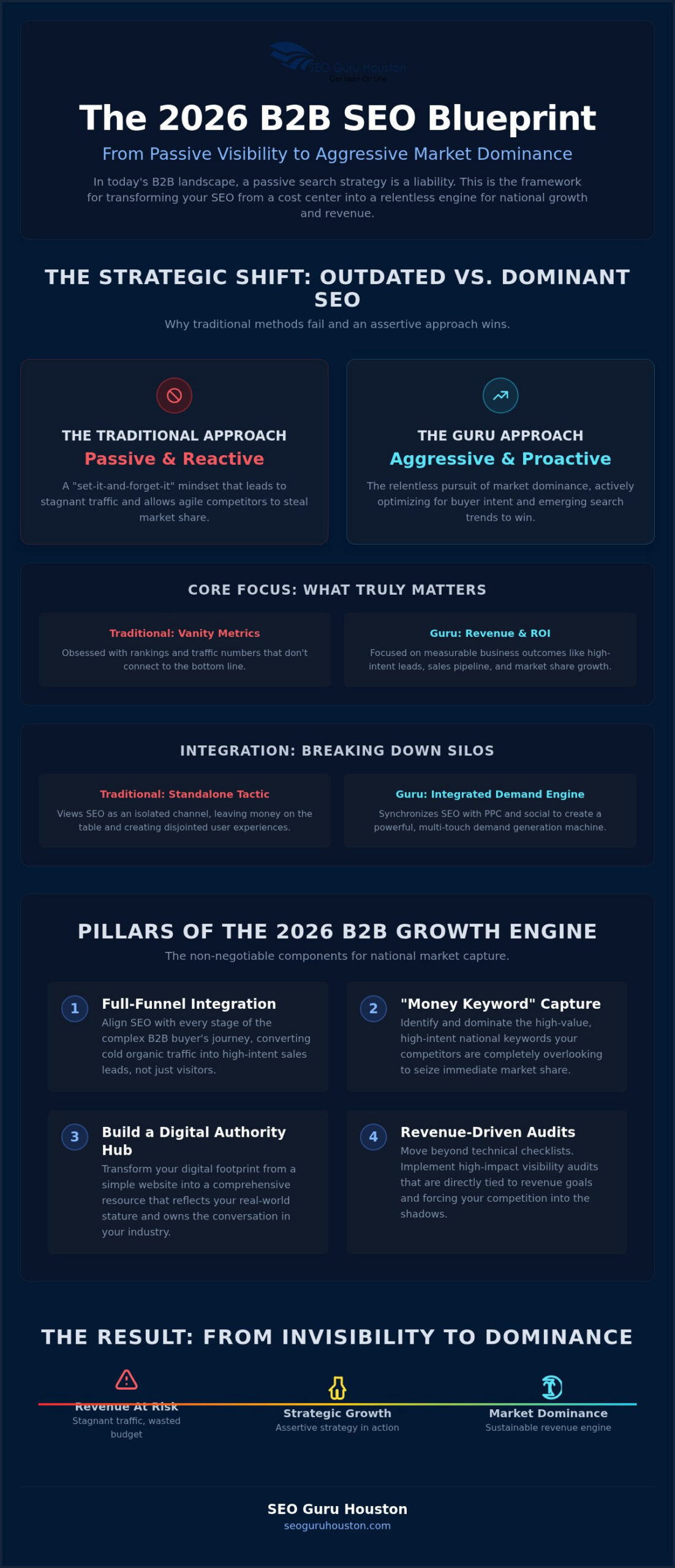
Directive Consulting Alternatives: Dominating B2B Demand Gen in 2026

If your agency retainer feels more like a mortgage payment than a growth engine, you aren’t just overpaying; you’re falling behind. Most B2B leaders tolerate high fees and sluggish execution because they believe enterprise agencies possess a secret sauce that more agile firms lack. It’s a frustrating reality when your PPC spend climbs while your pipeline velocity remains frozen. You’ve likely felt the sting of disconnected landing page strategies and the slow realization that your current partner is light-years behind on the latest AI-driven search trends.

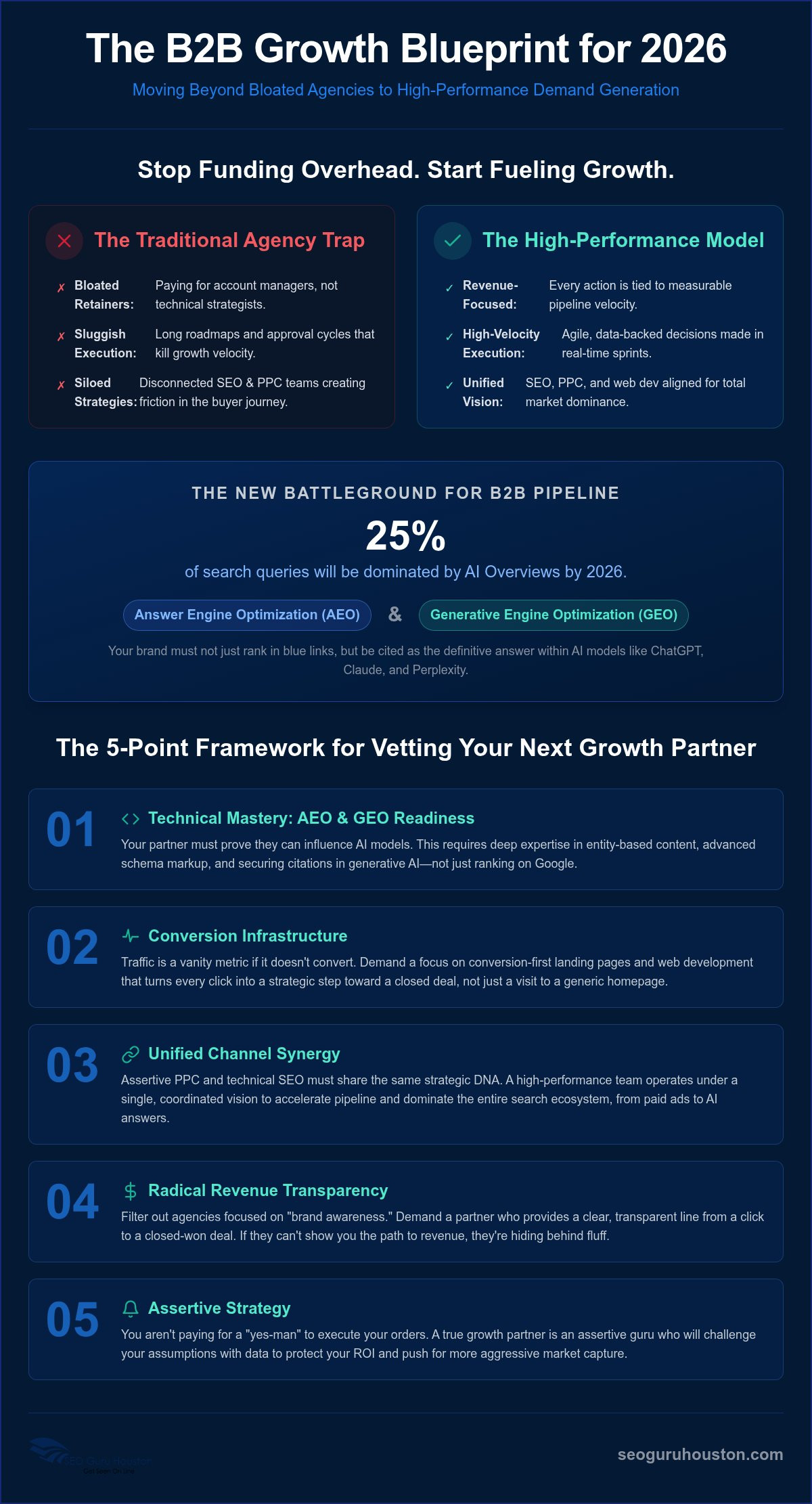
Finding the right directive consulting alternatives is about more than just cutting costs; it’s about survival in a 2026 market where 25% of queries are dominated by AI Overviews. We’ll show you how to transition to a high-performance model that prioritizes technical dominance and aggressive revenue growth over agency bloat. This article previews the shift toward Answer Engine Optimization (AEO) and Generative Engine Optimization (GEO), ensuring your brand doesn’t just rank but dominates the entire search ecosystem. It’s time to stop funding an agency’s overhead and start investing in a shorter, more transparent path to revenue.

Key Takeaways

  • Stop funding agency overhead and start prioritizing high-velocity execution that turns your digital presence into a measurable revenue engine.
  • Discover how to vet directive consulting alternatives using a 5-point framework that emphasizes technical mastery over generic account management.
  • Pivot your strategy toward Answer Engine Optimization (AEO) and Generative Engine Optimization (GEO) to secure your brand’s prominence in 2026 AI-driven search results.
  • Accelerate your path to pipeline by aligning technical SEO, assertive PPC strategies, and high-converting web development under a single, coordinated vision.
  • Leverage video marketing and conversion-first landing pages to ensure every click is a strategic step toward total market dominance.

Why B2B Leaders Seek Directive Consulting Alternatives in 2026

Most B2B marketing departments are suffocating under the weight of bloated agency retainers. If your monthly invoice covers more account managers than technical strategists, you’re subsidizing bureaucracy instead of pipeline. This is why the search for directive consulting alternatives has reached a fever pitch in 2026. Companies no longer have the luxury of waiting six months for a strategic roadmap that yields zero leads. Market dominance requires a partner that treats your growth as a fundamental necessity, not just a line item in a portfolio.

Modern demand generation requires a unified front. Siloed SEO and PPC teams simply can’t move fast enough to capture intent in an environment where AI Overviews dominate 25% of queries. When your search and paid strategies don’t talk to each other, you create friction in the buyer journey. Velocity has become the ultimate competitive edge; if you aren’t testing and pivoting weekly, you’re losing ground to more agile competitors who treat every search result as a battleground.

The Cost of Diminishing Returns in Large Agency Models

Look closely at the ratio of thinkers to doers in your current partnership. Large agencies often staff accounts with junior account coordinators who act as expensive messengers between you and the actual experts. This model is built for agency stability, not client results. In technical SEO, being best-in-class often means being the slowest to pivot because every change requires three layers of approval. Assertive leadership means making bold, data-backed decisions in real time. Bureaucracy kills growth. You need experts who are authorized to execute, not just report on why goals were missed. For businesses requiring senior marketing leadership and AI consulting, you can visit Sean Brightman to discover strategic roadmapping that eliminates agency bloat.

Generic SaaS playbooks are failing industrial and manufacturing sectors because they ignore the complexity of long-cycle B2B sales. You don’t need another agency that only knows how to optimize for software keywords. You need technical mastery that understands how to influence a committee of engineers and procurement officers through specialized content. The Agency Velocity Gap of early 2026 refers to the catastrophic failure of traditional agencies to adapt content for generative AI models within a single sprint cycle. If your agency isn’t moving at the speed of the market, they’re effectively anchors on your growth. Demand dominance requires a shift from passive inbound waiting to assertive market capture.

The 5-Point Framework for Evaluating High-Performance Demand Gen Agencies

Selecting from the pool of directive consulting alternatives isn’t about finding a cheaper version of what you already have. It’s about upgrading to a technical elite that understands the mechanics of revenue. If your current agency spends more time on “brand awareness” than on pipeline velocity, you have a structural problem. High-performance demand generation in 2026 requires a partner that operates with the precision of a surgeon and the aggression of a growth equity firm. You need a framework that filters out the fluff and identifies the masters of the digital landscape.

Your evaluation must center on five critical pillars. First, technical mastery; they must prove they can influence AI models. Second, conversion infrastructure; traffic is useless if it doesn’t stick. Third, channel synergy; SEO and PPC must share the same DNA. Fourth, revenue transparency; you need to see the straight line from a click to a closed-won deal. Finally, assertive strategy; you aren’t paying for a “yes-man,” you’re paying for a guru who will challenge your assumptions to protect your ROI.

Evaluating Technical Depth: AEO and GEO Readiness

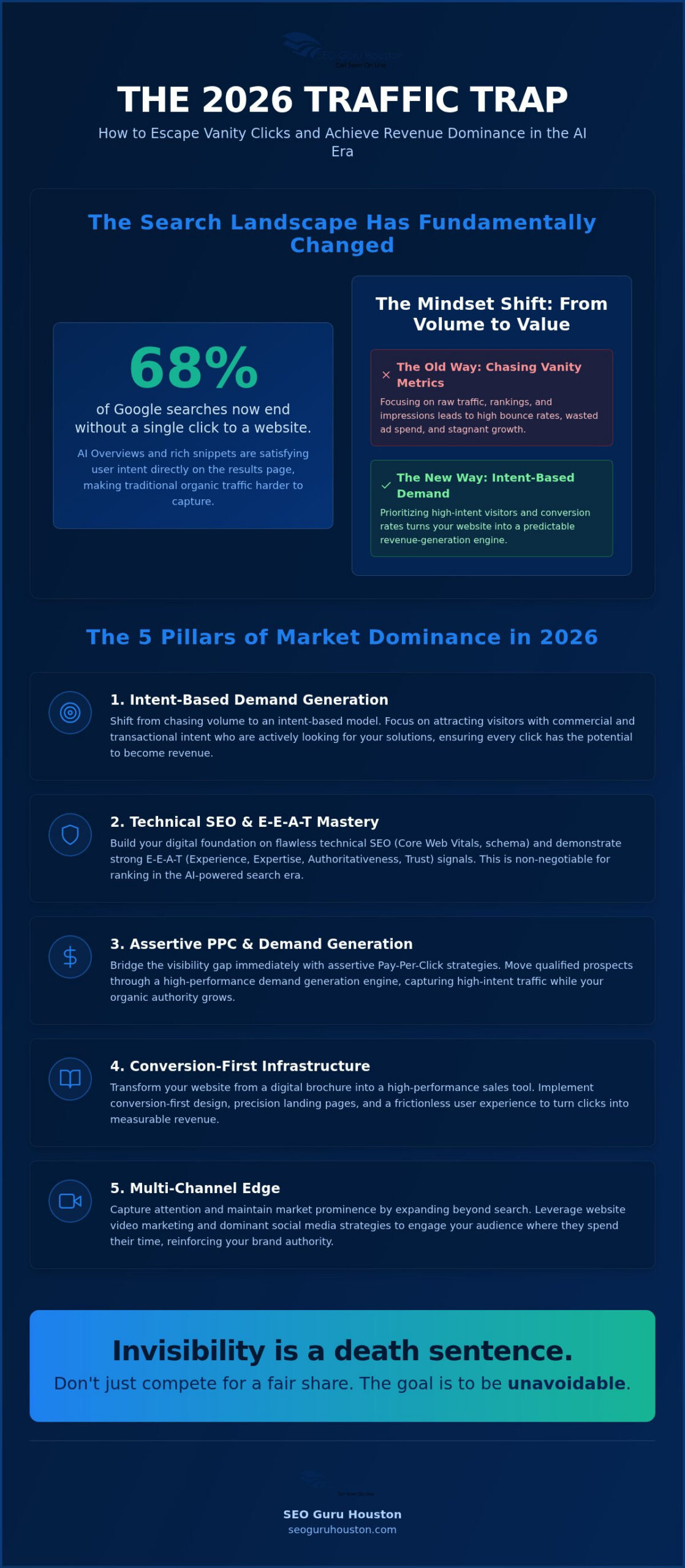
Search has evolved beyond simple blue links. With AI Overviews appearing on 25% of queries, your agency must be experts in Answer Engine Optimization (AEO) and Generative Engine Optimization (GEO). Ask them specifically how they plan to secure citations in ChatGPT, Claude, and Perplexity. If they don’t discuss entity-based content and advanced structured data, they’re living in the past. Technical SEO is no longer a “nice-to-have” specialty; it’s the fundamental foundation of visibility in an AI-driven search environment. You need a partner who treats schema markup as a weapon for market dominance.

Conversion Infrastructure: The Landing Page Litmus Test

Driving traffic to a generic homepage is a recipe for high bounce rates and wasted spend. A dominant agency must own the high converting landing page design process. This involves more than just “clean” layouts. It requires technical optimization for sub-second load speeds and the strategic integration of website video marketing to capture attention immediately. Video is the highest-leverage asset in your funnel; it builds trust at scale and clarifies complex B2B value propositions in seconds. If your agency isn’t building these high-performance assets, they’re leaving your revenue to chance. For those ready to stop guessing, it’s time to consult with an expert at seoguruhouston.com who understands how to build for conversion.

Strategic Alternatives: Niche Experts vs. Full-Service Giants

Choosing between directive consulting alternatives requires a cold, hard look at your agency’s DNA. You aren’t just buying hours; you’re buying a philosophy of growth. Large, full-service giants often pitch “synergy” but deliver siloed departments that move at the speed of a glacier. On the other hand, niche experts offer deep knowledge but can become trapped in “cookie-cutter” playbooks that your competitors are already using against you. To dominate in 2026, you need a partner that combines surgical technical expertise with an assertive, results-oriented mindset that prioritizes your pipeline over their own headcount.

SaaS-Specific Agencies: Pros and Cons

SaaS-specific agencies understand the nuances of software metrics like CAC, LTV, and churn. They speak the language of your board deck and know how to scale a subscription model. But there’s a significant risk: when an agency specializes too deeply in one vertical, their strategies become predictable. If they’re running the same LinkedIn ad patterns for every client in your space, you’re competing for the same attention with the same creative. These specialists also often miss massive cross-channel opportunities. Many B2B hardware and industrial firms find that software-focused agencies completely ignore amazon marketing services houston, leaving a vacuum that more assertive competitors quickly fill.

The Assertive Growth Partner: A New Category

Industrial and manufacturing sectors demand a more specialized, technical touch. You aren’t selling fifty-dollar subscriptions; you’re selling high-value equipment and long-term contracts. This requires a b2b demand generation agency that understands complex engineering specs and procurement hurdles. The “Guru” model bridges this gap by prioritizing technical mastery and performance over sheer headcount. It’s a high-energy approach that treats every dollar of your ad spend as a strategic investment in market dominance.

The Assertive Growth Partner represents a new category of agency. This hybrid model is the most effective professional seo services choice for national scaling because it doesn’t wait for permission to win. It integrates SEO, PPC, and advanced web development into a single, cohesive engine. By synchronizing these channels, you eliminate the integration gaps that plague larger directive consulting alternatives. You get the depth of a specialist with the muscle of a full-service giant, ensuring your pipeline remains full regardless of how many times the search ecosystem shifts.
Directive Consulting Alternatives: Dominating B2B Demand Gen in 2026

Mastering AEO and GEO: The New Battleground for B2B Pipeline

The search engine landscape has fractured. If you’re still obsessing over “position one” for a traditional keyword, you’re playing a game that ended years ago. In 2026, market dominance is measured by Answer Engine Optimization (AEO). This isn’t just about traffic; it’s about being the definitive solution provided by Google’s AI Overviews. When evaluating directive consulting alternatives, you must prioritize agencies that treat AEO as a core competency rather than a futuristic theory. Specialized firms like Arokia IT LLC are leading this transition by focusing on AI-driven search and GEO. Your pipeline depends on being the answer, not just a link in a list.

AI doesn’t guess. It calculates authority. The relationship between E-E-A-T (Experience, Expertise, Authoritativeness, and Trustworthiness) and AI citations is now the most critical factor in your digital strategy. Generative models like ChatGPT and Perplexity prioritize sources that demonstrate deep, verifiable expertise. To win, you must audit your brand’s “AI Footprint” by questioning how these models perceive your technical documentation, case studies, and executive leadership. If the bots don’t trust you, the buyers won’t find you.

Optimizing for the “Zero-Click” B2B Buyer

B2B buyers are increasingly finding what they need without ever leaving the search results page. Capturing visibility in Google’s AI Overviews requires a radical shift in content architecture. Your inbound marketing strategy for b2b must now prioritize “Short Answer Block” content that provides immediate, high-value data to generative engines. Generative Engine Optimization (GEO) is the tactical evolution of SEO for 2026, focusing on how generative AI models perceive, categorize, and cite your brand. By structuring your technical insights for machine readability, you secure a spot in the zero-click ecosystem where your competitors are currently invisible.

Building Brand Authority for LLM Citations

Influencing Large Language Models (LLMs) requires more than just good copy. It demands a sophisticated seo marketing company approach that integrates digital PR with technical schema. Authoritative backlinks and mentions in industry-standard publications act as the “training data” that tells an LLM your brand is a leader. We are moving toward a world where “Citation Share” is the only B2B KPI that matters. If your agency isn’t tracking how often Perplexity or Claude cites your white papers versus your competitors, they aren’t managing your reputation; they’re just watching it fade. Secure your brand’s future by partnering with a technical demand generation expert who understands the mechanics of AI influence.

Why SEO Guru Houston is the Assertive Choice for National Dominance

Growth isn’t an optional luxury; it’s a fundamental necessity for survival. While other directive consulting alternatives focus on maintaining status quo retainers, we focus on total market dominance. We don’t just manage accounts. We engineer revenue engines that prioritize technical mastery and aggressive velocity. Our philosophy is simple: if you aren’t the dominant force in your sector, you’re invisible. We bridge the gap between abstract marketing theories and the practical realities of industrial commerce by integrating technical SEO, high-converting web development, and assertive ppc management houston strategies into a single, unstoppable funnel.

Our expertise is specifically calibrated for the Industrial and B2B Manufacturing sectors. We understand that your sales cycles are complex and your buyers are technical. You don’t need a generalist agency that only knows how to sell software subscriptions. You need a partner that understands engineering specs, procurement hurdles, and the high-stakes world of industrial lead generation. By leveraging website video marketing and conversion-first design, we ensure that every visitor is met with an authoritative, persuasive experience that drives them toward the pipeline.

Our High-Energy Approach to Demand Generation

We operate as high-performance coaches, not just service providers. This means we move your brand from invisibility to prominence by taking decisive action based on real-time data. We prioritize business outcomes over abstract metrics. If a strategy isn’t directly contributing to your bottom line, we pivot. The “Guru” advantage lies in this unique combination of technical nuance and savvy business strategy. We don’t just follow trends; we set them. Whether it’s optimizing for the latest AI search behaviors or restructuring your entire inbound engine, we provide the specialized knowledge required to stay ahead of a rapidly changing digital landscape.

Dominating Every Channel: From Search to Amazon

Market dominance requires a presence everywhere your buyers look. Our comprehensive suite of services includes SEO, PPC, Social Media Marketing, and specialized Amazon Marketing. We recognize that for B2B hardware and industrial components, Amazon is a critical but often neglected channel. We integrate website development into the core of your marketing funnel to ensure your digital infrastructure is fast, responsive, and built to convert. This holistic approach eliminates the friction caused by siloed strategies and ensures a seamless path to revenue. It’s time to stop settling for average results and start demanding excellence. Transform your digital standing and dominate your market today!

Secure Your Pipeline Dominance in the AI Era

The 2026 digital landscape doesn’t reward hesitation. If your current marketing strategy relies on legacy playbooks and bloated agency retainers, you’re effectively funding your own obsolescence. Dominating the market requires a pivot to technical mastery and rapid execution. By choosing the right directive consulting alternatives, you move beyond mere visibility and start commanding the search ecosystem through advanced AEO and GEO strategies. You need a partner that treats your revenue growth as a fundamental necessity, not an optional luxury.

SEO Guru Houston stands as the assertive choice for companies ready to scale. As national B2B demand generation specialists, we bring a proven track record in both industrial and SaaS sectors. Our results-oriented technical experts don’t just drive traffic; we build high-converting infrastructure that shortens your path to pipeline. Stop tolerating diminishing returns and start investing in a strategy designed for total market prominence. It’s time to take decisive action and outpace your competition with a unified, high-velocity approach.

Dominate Your Market: Get a High-Energy Strategy Audit Now!

Your transformation from invisibility to prominence starts today. Let’s build the engine that drives your future success!

Frequently Asked Questions

How does SEO Guru Houston differ from Directive Consulting?

SEO Guru Houston prioritizes technical dominance and aggressive revenue growth over the layered bureaucracy of larger firms. Unlike traditional agencies that fund account managers, we provide direct access to technical experts who execute with high velocity. We are one of the premier directive consulting alternatives because we integrate SEO, PPC, and web development into a single, cohesive engine designed for market dominance. Our model eliminates the “Agency Velocity Gap” that often plagues enterprise-level partnerships.

What is the “Guru” framework for B2B demand generation?

The “Guru” framework is a results-oriented methodology that treats your pipeline as a fundamental necessity. It centers on technical mastery, conversion-first infrastructure, and total channel synergy. We don’t just drive traffic; we build high-converting assets and leverage website video marketing to capture intent immediately. This framework moves your brand from invisibility to prominence by focusing on influenced pipeline and actual ROI rather than abstract marketing theories or vanity metrics.

Can you handle national B2B campaigns for industrial manufacturers?

We specialize in high-stakes national B2B demand generation for the industrial and manufacturing sectors. Our team understands complex engineering specifications and the procurement hurdles common in long-cycle sales. We don’t use generic SaaS playbooks for industrial clients. Instead, we deploy assertive strategies that include technical SEO and specialized PPC management to ensure your brand dominates the search ecosystem across the entire country. We treat your growth as a fundamental business requirement.

How do you incorporate AEO and GEO into your SEO strategy?

We integrate AEO and GEO by optimizing your content for zero-click visibility and AI citations. Our strategy involves structuring your technical documentation and white papers to be discoverable by generative models like ChatGPT and Perplexity. With AI Overviews appearing on 25% of queries in 2026, we prioritize entity-based content and advanced structured data. This ensures your brand isn’t just ranking but is cited as the authoritative answer within the AI-driven search ecosystem.

Why is high-converting landing page design essential for PPC ROI?

High-converting landing page design is the bridge between a paid click and actual revenue. Driving expensive PPC traffic to a generic homepage is a recipe for wasted spend. We build technical assets optimized for sub-second load speeds and immediate engagement. By integrating website video marketing into these pages, we clarify complex B2B value propositions in seconds. This assertive approach ensures every dollar of your ad spend is a strategic investment in pipeline growth.

Do you offer specialized services for B2B Amazon sellers?

We provide specialized Amazon services tailored for B2B hardware and industrial component manufacturers. Many directive consulting alternatives ignore the massive cross-channel opportunities on Amazon, but we treat it as a critical battleground for market dominance. Our team handles everything from technical listing optimization to assertive Amazon PPC management. We ensure your products are visible where your buyers are searching, providing a seamless path to revenue regardless of the platform.

What metrics do you use to measure demand generation success?

We move beyond basic MQLs to track influenced pipeline, actual ROI, and “Citation Share” within AI models. Our focus is on measurable revenue outcomes that reflect your actual business growth. We use revenue transparency to show the straight line from a technical SEO improvement or a PPC campaign to a closed-won deal. By monitoring how often your brand is cited by generative engines, we provide a comprehensive view of your market dominance in 2026.

How quickly can we expect to see a lift in pipeline velocity?

You can expect to see a lift in pipeline velocity within the first sprint cycle because we prioritize rapid execution over strategic theorizing. We identify and fix the technical gaps in your conversion infrastructure immediately. Our coach-led model focuses on high-impact wins like landing page optimization and assertive PPC adjustments. We don’t believe in six-month roadmaps that yield zero leads. Instead, we move with the urgency required to dominate a competitive digital landscape.
Marketing KPIs: 2026 Blueprint for Executive Reporting

Your CEO doesn’t care about your click-through rates or your social media impressions. While you’re celebrating a 6.6% search CTR, the boardroom is looking at a balance sheet where B2B acquisition costs have hit record highs in 2026. If you can’t translate your activity into financial velocity, you’re not a growth driver; you’re just an expensive line item. It’s frustrating to watch high-performing campaigns get dismissed because the data stays trapped in silos that nobody upstairs understands. You know the value is there, but if the reporting doesn’t speak the language of the C-suite, it doesn’t exist.

We’re going to fix that. This guide will help you master the high-impact marketing kpis for executive reporting that turn marketing spend into a measurable revenue engine. You’ll move past vanity metrics to secure absolute executive buy-in and transform your department from a cost center into a profit powerhouse. We’re providing a streamlined reporting framework that takes ten seconds to digest and gives you the leverage to demand a higher budget for 2027. We’ll cover the Boardroom Five metrics, from LTV:CAC ratios to pipeline velocity, ensuring your strategy is seen as a fundamental necessity for market dominance.

Key Takeaways

  • Stop wasting boardroom time with vanity metrics like clicks; learn to translate every marketing action into a direct financial signal that the CFO respects.
  • Master the “Boardroom Five” framework to establish the definitive marketing kpis for executive reporting that prove long-term business viability and financial velocity.
  • Streamline your reporting with a three-tier dashboard architecture that filters out 90% of the noise, delivering a strategic overview executives can digest in seconds.
  • Leverage AI-driven predictive performance to shift the conversation from historical spending to future revenue generation, catching budget bleed before it impacts your bottom line.
  • Discover how to bridge the gap between technical execution and executive-level ROI reporting to secure the massive budget increases required for 2027 market dominance.

Why Most Marketing KPIs Fail in the Boardroom

If you walk into a board meeting talking about impressions or engagement rates, you’ve already lost the room. In 2026, executives don’t have time for the “Vanity Metric Trap.” According to Gartner, 83% of executive teams now expect marketing to demonstrate clear ROI and business impact through data-driven dashboards. Your CEO doesn’t care about a 3.5% click-through rate; they care about how that activity translates into cash flow. When you dump a 50-page data report on their desk, you aren’t being thorough. You’re being ignored. Effective marketing kpis for executive reporting are filtered strategic signals that cut through the noise to show financial velocity.

The 2026 reality is brutal. Fragmented data silos and evolving privacy laws have made simple tracking a relic of the past. To survive this landscape, you must stop acting like a cost center. You need to be recognized as a high-performance growth engine. This requires a reporting framework that aligns every dollar of spend directly with revenue growth.

The Psychology of the C-Suite

The C-suite operates on the “10-second rule.” If an executive can’t understand the financial impact of your slide in ten seconds, they’ll dismiss it. They prioritize financial velocity, which is the speed at which your marketing spend turns into realized revenue. They don’t want tactical updates; they want to know if the engine is working. Poor reporting creates a perception of waste. In a high-cost B2B market, that perception leads directly to budget cuts and missed opportunities for 2027.

Metrics vs. Strategic KPIs

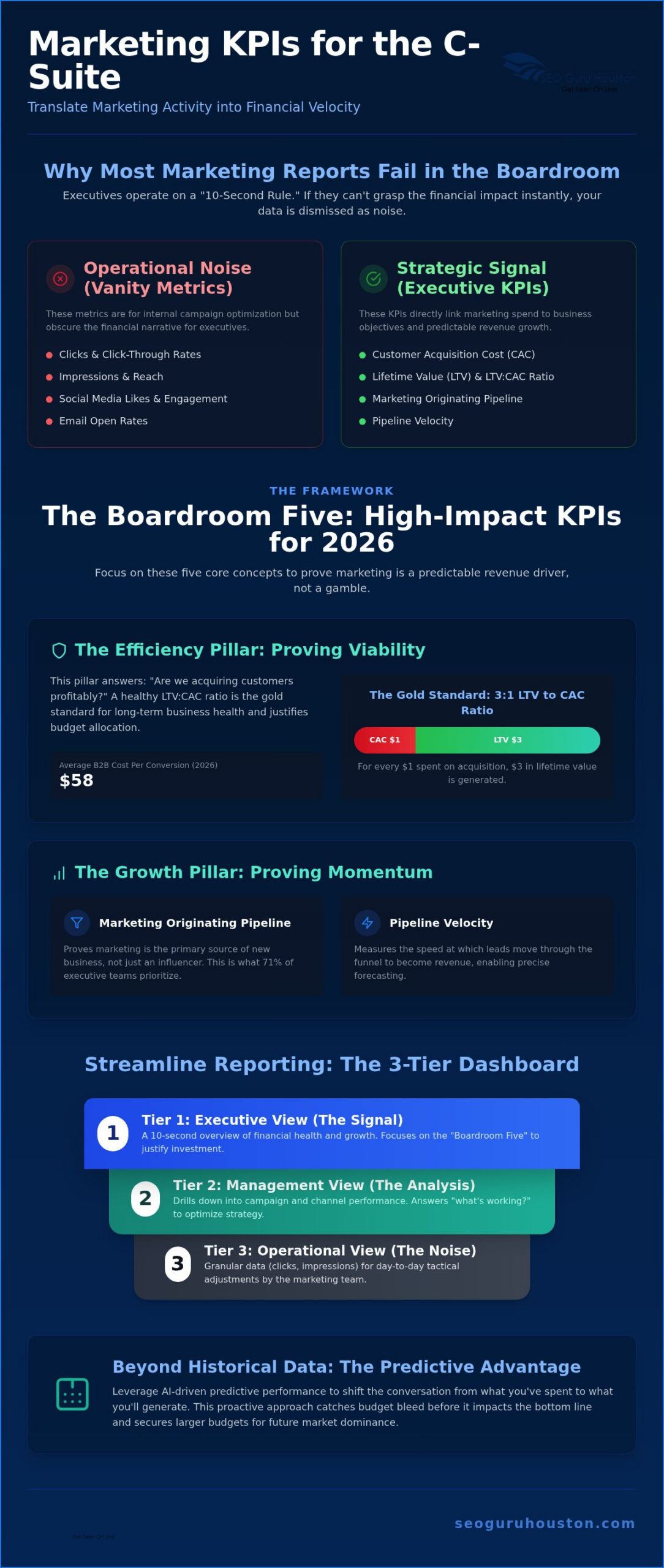
Don’t confuse operational noise with strategic signal. Your internal team needs granular data to optimize daily campaigns, but your board needs a narrative to justify the investment. A Key Performance Indicator (KPI) is a measurable value that demonstrates how effectively a company is achieving key business objectives. While HubSpot reports that 71% of executive teams prioritize pipeline generation and revenue influence, many marketers still lead with engagement metrics that provide zero insight into the bottom line. You must separate the “how” from the “how much.”

  • Operational Noise: Clicks, likes, impressions, and open rates.
  • Strategic Signal: Customer Acquisition Cost (CAC), pipeline velocity, and revenue influence.
  • The Goal: Use marketing kpis for executive reporting to prove that marketing is a predictable revenue driver, not a gamble.

The Boardroom Five: High-Impact KPIs for 2026

Executives ignore data dumps because they lack a narrative. To secure buy-in, you must distill your performance into the “Boardroom Five.” These are the high-impact marketing kpis for executive reporting that translate technical execution into financial results. Forget impressions; we are talking about metrics that dictate your 2027 budget. If you can’t show how your activity moves the needle on the balance sheet, your strategy is invisible to the C-suite.

The Efficiency Pillar: CAC and LTV

Efficiency is about survival. In 2026, WordStream reports that the average B2B cost per conversion is approximately $58. If your Customer Acquisition Cost (CAC) exceeds your revenue velocity, you’re burning cash. A healthy 3:1 LTV:CAC ratio remains the gold standard for long-term viability. It proves that for every dollar you spend, you are creating three dollars of future value. If you want to scale these numbers without breaking the bank, partnering with a specialized B2B Demand Generation Agency is the fastest way to compress your CAC payback period. Your CFO wants to see that every dollar spent returns to the company in months, not years. Reducing this window is the most aggressive move you can make to justify a higher spend.

The Growth Pillar: Pipeline and Velocity

Growth is measured by the pipeline you build, not just the traffic you influence. While many marketers lean on “Marketing Influenced” revenue, 71% of executive teams now prioritize pipeline generation as the most critical metric. You need to track Marketing Originating Pipeline to prove that your campaigns are the primary source of new business. Calculating pipeline velocity allows you to forecast revenue with surgical precision. It measures how quickly a lead moves through your funnel to become cash. Referencing essential marketing KPIs from Harvard Business School can help you refine these definitions for your specific industry. Attribution modeling is no longer a luxury; it’s a requirement to prove marketing’s role in the complex B2B sales cycle of 2026.

In 2026, Share of Search has become the ultimate proxy for brand health and market dominance. It correlates directly with market share, providing a real-time look at how much of the conversation you own compared to your rivals. If your Share of Search is dropping, your future revenue is at risk. Mastering these metrics ensures you aren’t just spending a budget; you are investing in a competitive advantage. If you are ready to dominate, it’s time to refine your demand generation strategy to focus on these high-impact signals.

Marketing KPIs: 2026 Blueprint for Executive Reporting

Architecting the Executive Dashboard: Noise vs. Signal

Executives don’t have time to hunt for insights. If your dashboard requires a tutorial, you’ve already failed. To win in 2026, you must implement a three-tier reporting framework that separates the daily grind from the strategic signal. Your operational layer is for the team. Your tactical layer is for the managers. But your executive layer? That’s a command center. It should only contain the top 10% of your data, filtered through a lens of financial impact. If a metric doesn’t directly explain revenue movement, it doesn’t belong on the final slide.

Visualizing this narrative requires moving beyond stagnant bar charts. High-performance teams are now using “Financial Velocity” maps. These visualizations show the speed of capital as it moves from your initial marketing spend into realized revenue. While automation tools like Domo or Qlik provide the necessary data plumbing, they can’t provide the “Guru” layer of human insight. A machine can show you a dip in conversion, but it can’t explain the strategic pivot needed to fix it. You must provide the context that translates raw numbers into a business case for market dominance.

The 10-Second Executive Dashboard

Designing for instant comprehension is a fundamental necessity. We recommend the “Red-Yellow-Green” status methodology. It’s the universal language of the C-suite. At a glance, an executive should know exactly where the strategy stands. Your reporting must answer three questions: What happened? What does it mean for the bottom line? What are we doing next? This level of clarity requires perfect alignment with your conversion assets. If your marketing kpis for executive reporting are built on flawed data, your credibility is at risk. This is why high converting landing page design is critical. If your landing pages aren’t capturing the right signals from the start, your dashboard is nothing more than a polished lie.

Attribution Modeling in a Privacy-First Era

The 2026 privacy landscape has made third-party tracking a relic of the past. First-party data is now your only reliable source for high-stakes reporting. You must own your data ecosystem to maintain accurate conversion numbers, which is why high-quality web design st louis is essential for capturing every lead interaction. For B2B enterprises, multi-touch attribution is no longer optional. The sales cycle is too complex for “last-click” models to hold any weight in the boardroom. You need to show how six different touchpoints over four months converged to create a high-value client. When you can prove exactly how each dollar of spend contributed to the final sale, you stop being a cost center and start being a growth driver. This is how you secure the trust and the budget needed for 2027.

Looking at last month’s data is like driving while staring at the rearview mirror. In 2026, the boardroom has no patience for post-mortems. They want to know what happens next. You need to shift the conversation from “What did we spend?” to “What will we earn?” This transition requires integrating AI-driven marketing kpis for executive reporting that transform raw data into a crystal ball for revenue. For healthcare organizations, specialized agencies like Future Marketing para Saúde provide the industry-specific context needed to turn patient data into actionable forecasts. Predictive lead scoring is the new standard. By analyzing historical conversion paths, AI can assign a probability of closure to every lead in your CRM. This turns your reporting from a simple list of names into a weighted revenue forecast, allowing you to report on pipeline quality long before the deals actually close. If you can’t forecast the revenue impact of today’s leads, you’re not reporting; you’re just documenting history.

Leveraging AI for Anomaly Detection

Budget bleed is the silent killer of marketing credibility. If a campaign misfires or a platform algorithm shifts, you can’t afford to wait for the monthly audit to find out. AI-driven anomaly detection acts as a proactive defense mechanism, catching irregularities in real-time. This is especially critical for high-stakes PPC Management where automated alerts prevent programmatic waste before it turns into a disaster. When you present these reports, you aren’t just showing performance. You’re demonstrating a secure, automated environment where the company’s investment is shielded from market volatility. Proving that your tech stack is a proactive defense mechanism builds immense trust with the CFO.

The Future of Forecasting

Strategic planning sessions in 2026 demand “What-If” scenario models. Executives need to see how a 10% increase in spend affects the bottom line over the next twelve months. By using historical data to predict seasonal fluctuations in B2B demand, you can build a growth model based on current marketing velocity. Integrating these predictive marketing kpis for executive reporting is how you secure buy-in for experimental high-growth channels. When you can forecast ROI with documented accuracy, the C-suite stops seeing your department as a cost center and starts seeing it as a high-yield investment. It’s about moving from defensive reporting to offensive strategy. To achieve this level of precision, you need a partner that understands how to translate technical data into financial outcomes. Explore our demand generation services to start building your 2027 growth model today.

SEO Guru Houston: Bridging the Gap Between Tech and ROI

You don’t need another agency that hides behind clicks and impressions. You need an assertive partner that understands market dominance is built on financial velocity. At SEO Guru Houston, we’ve spent years refining an approach that translates complex digital activity into the strategic signals your board demands. We don’t just execute campaigns; we architect growth engines. Invisibility is a choice, and in the high-stakes B2B landscape of 2026, it’s a choice your company can’t afford. Our B2B demand generation strategies are engineered to feed your executive dashboard with high-impact data that proves marketing is your most powerful revenue driver.

We stop the revenue leak by prioritizing the bottom line in every SEO and PPC initiative. While other firms might celebrate a spike in traffic, we’re looking at the quality of the pipeline and the speed of the conversion. We speak the language of the C-suite because we know that marketing kpis for executive reporting are only valuable if they justify your 2027 budget. If you’re hungry for prominence, you need a partner that treats your marketing spend with the same financial rigor as your CFO.

Our Reporting Philosophy

Our philosophy is built on total transparency combined with strategic coaching. We don’t just send a report; we ensure your board understands the cumulative value of your digital assets. We build custom executive reports that focus on strategic advantage and financial return, eliminating the operational noise that clutters typical dashboards. This result-oriented growth is the core of our professional SEO services. We provide the “Guru” layer of human insight that turns raw numbers into a persuasive business case for continued investment. You’ll never have to explain “what this means” again because the ROI will be undeniable.

Take Decisive Action for 2026

Don’t let your marketing department be dismissed as a cost center. It’s time to transform your strategy into a high-performance growth engine that commands respect in the boardroom. The margin for error in 2026 is zero. Rising acquisition costs and fragmented data require a sophisticated reporting framework that aligns your digital strategy with your financial goals. Contact SEO Guru Houston today to start building a reporting structure that secures your seat at the table. If you’re ready for market dominance, let’s build your 2026 marketing kpis for executive reporting together. The path from invisibility to prominence starts with a single decisive action.

Secure Your Market Dominance in 2027

The era of hiding behind engagement metrics is over. In 2026, your survival depends on your ability to translate every marketing action into a clear financial signal. By mastering the Boardroom Five and architecting a dashboard that prioritizes signal over noise, you move from being a cost center to a high-performance growth engine. You’ve learned how to leverage predictive AI to catch budget bleed and forecast revenue velocity with surgical precision. These are the definitive marketing kpis for executive reporting that turn technical execution into absolute boardroom buy-in.

Don’t let your hard work be dismissed because of fragmented data silos or poor visualization. You need a partner that speaks the language of the C-suite and has a proven track record of market dominance. Our results-oriented SEO and PPC specialists are B2B demand generation experts dedicated to your financial success. It’s time to align your digital strategy with your revenue goals and stop settling for invisibility. You have the blueprint; now you need the execution.

Stop Bleeding Budget and Start Scaling: Get Your Custom ROI Strategy Now!

Take the lead today and build the future your business deserves.

Frequently Asked Questions

What are the most important marketing KPIs for executive reporting in 2026?

The Boardroom Five are the most critical marketing kpis for executive reporting in 2026. These include Customer Acquisition Cost (CAC), the LTV:CAC ratio, Marketing-Originating Pipeline, Pipeline Velocity, and Share of Search. These metrics move past vanity numbers like clicks to show how marketing spend translates into financial velocity. By focusing on these five signals, you provide the C-suite with the data they need to justify your 2027 budget and long-term growth strategy.

How often should I present marketing reports to the executive team?

You should present a comprehensive strategic report once a month, with a high-level executive summary delivered quarterly. While your team monitors live dashboards daily, the C-suite doesn’t have time for tactical noise. Monthly reporting allows enough data to accumulate to show meaningful trends in your marketing kpis for executive reporting. This cadence ensures you remain aligned with the company’s financial goals without overwhelming the board with irrelevant operational updates.

What is the difference between a marketing dashboard and an executive report?

A marketing dashboard is a live tool used for daily operational and tactical adjustments by your internal team. In contrast, an executive report is a filtered strategic narrative designed for the C-suite. It removes 90% of the data noise to focus on the top 10% of metrics that impact revenue. While dashboards track the “how,” executive reports explain the “how much” and the “what next” regarding financial return.

How do I calculate the LTV:CAC ratio for B2B marketing?

Calculate the LTV:CAC ratio by dividing the total gross profit you expect from a customer over the duration of your relationship by the total cost spent to acquire them. In 2026, a 3:1 ratio is the benchmark for B2B success. If your ratio is lower, your acquisition costs are too high or your retention is failing. This metric is the gold standard for proving that your demand generation efforts are creating sustainable value.

What is pipeline velocity and why does the board care about it?

Pipeline velocity measures the speed at which your leads move through the sales funnel to become realized revenue. The board cares about this because it allows them to forecast quarterly revenue with surgical precision. If your velocity slows, your future cash flow is at risk. By reporting on this metric, you demonstrate that you aren’t just generating leads; you’re driving the momentum that keeps the company’s financial engine running at peak performance.

Can AI really predict marketing performance for my executive reports?

AI is now a fundamental necessity for accurate reporting. It uses anomaly detection to catch budget bleed in PPC campaigns and predictive lead scoring to weight the quality of your pipeline. This technology shifts your boardroom conversation from historical post-mortems to future revenue forecasts. By integrating AI-driven insights, you can present a 12-month growth model that secures buy-in for experimental high-growth channels and aggressive market dominance strategies.

How do I handle negative marketing data when reporting to the CEO?

Never hide negative data; own it with a strategic pivot. Use the Red-Yellow-Green methodology to highlight the issue instantly. Explain what happened, what it means for the bottom line, and exactly what your team is doing next to correct the course. Executives respect transparency and decisive action. Turning a failure into a proactive defense mechanism builds more credibility than a polished report that ignores obvious budget leaks or declining conversion rates.

Why should I prioritize first-party data in my 2026 reporting strategy?

Privacy laws in 2026 have made third-party data unreliable for high-stakes decision-making. First-party data, gathered directly from your own assets like high-converting landing pages, is the only source of truth left. Prioritizing this data ensures your attribution models are accurate and your ROI reporting is based on verified customer interactions. It protects your reporting from platform volatility and provides the board with the confidence they need to scale your budget.

Measuring B2B Marketing ROI: The Guru Blueprint for Market Dominance in 2026

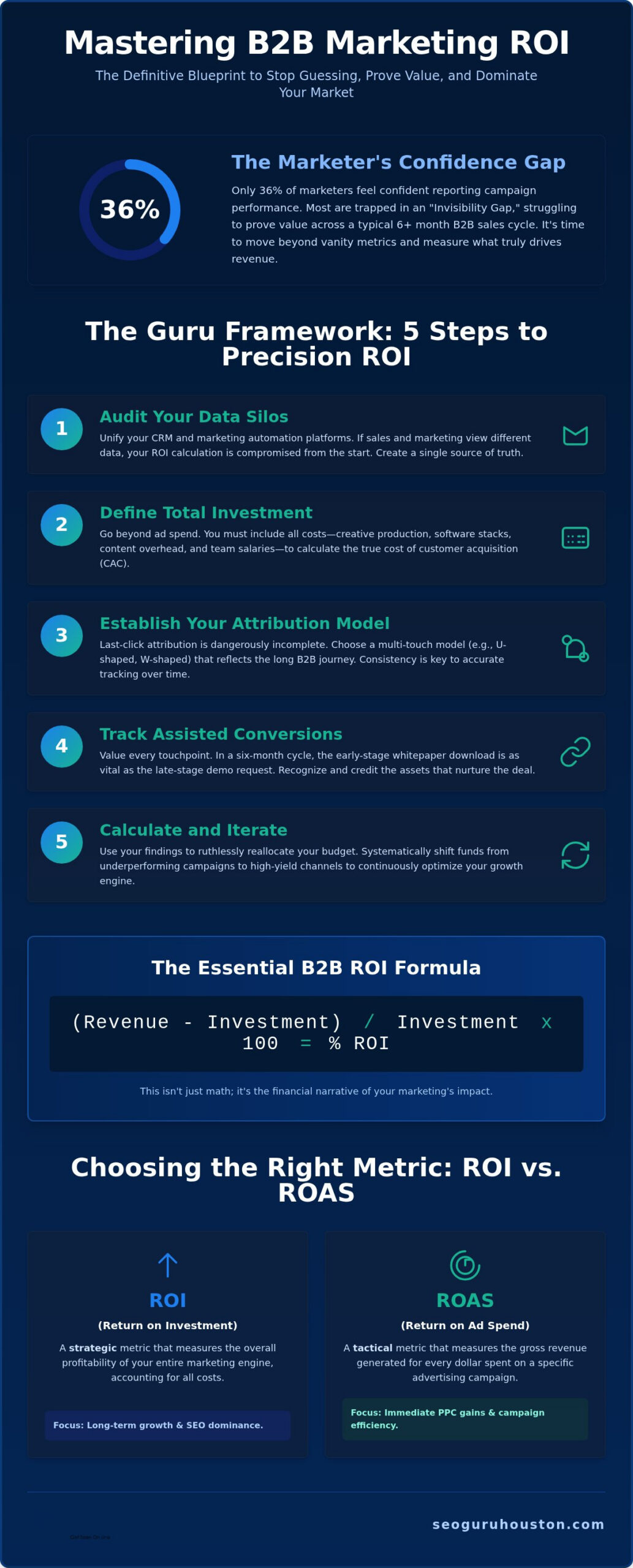
Only 36% of marketers actually feel confident when they report campaign performance to the board. If you’re tired of defending your budget while staring at a six month sales cycle that feels like a black hole, you aren’t alone. Most leaders are drowning in vanity metrics while real revenue stays hidden behind complex multi channel attribution hurdles. Mastering the science of measuring b2b marketing roi isn’t just about spreadsheets; it’s about survival in a 2026 market where Google Ads CPCs have climbed to an average of $5.58. You need more than just traffic to win.

You know that high performance marketing should be your greatest profit engine, but proving that value to skeptical leadership is a constant battle. This guide provides the exact blueprint you need to stop guessing and start dominating. We’re handing you the definitive formula to calculate, prove, and explode your returns while ruthlessly eliminating wasted ad spend. You’ll move from defensive reporting to confident scaling, backed by a clear framework that turns technical data into a strategic narrative for the boardroom. It’s time to bridge the gap between digital visibility and measurable financial return.

Key Takeaways

  • Stop chasing vanity metrics and learn to bridge the “Invisibility Gap” by tracking leads across long, complex sales cycles.
  • Master the definitive five-step framework for measuring b2b marketing roi to unify your data silos and prove technical impact.
  • Distinguish between tactical ROAS for immediate PPC gains and strategic ROI for long-term SEO dominance to optimize every dollar spent.
  • Deploy high-converting landing pages and website video marketing as non-negotiable tools to slash your sales cycle and explode engagement.
  • Shift your marketing from an optional luxury to a fundamental growth engine by focusing on high-impact revenue drivers rather than lead volume.

Beyond Vanity Metrics: Why Most B2B ROI Calculations Are Dangerously Incomplete

Most B2B leaders are flying blind. They rely on surface-level data that suggests their marketing is working, yet the bank account tells a different story. If you’re only looking at ad spend versus immediate sales, your model for measuring b2b marketing roi is broken. This “Invisibility Gap” occurs because a typical B2B sales cycle spans six months or longer. Traditional models ignore the dozens of touchpoints that happen before a lead ever hits your CRM. You can’t just track a click; you have to track the entire journey from initial awareness to final signature.

Stop worshipping Marketing Qualified Leads (MQLs). Lead volume is a deceptive metric that often masks a lack of real growth. A thousand “cheap” leads that never close are a liability, not an asset. You must also account for hidden costs like creative production, software stacks, and internal overhead. Ignoring these creates a false sense of profitability. Additionally, “Dark Social” and word-of-mouth recommendations are silent killers of traditional models. They drive massive value but rarely show up in your dashboard. When you’re measuring b2b marketing roi, you have to look beyond what your software can easily tag.

The Failure of Single-Touch Attribution

Last-click attribution is a lie. It gives all the credit to the “closer” and completely ignores the “opener” that actually started the conversation. If you cut budgets for top-of-funnel awareness campaigns because they don’t show immediate conversions, you’re effectively sabotaging your future pipeline. Modern B2B buying requires a multi-touch reality. You need a system that recognizes the cumulative effect of every interaction. Understanding the broader Return on Marketing Investment (ROMI) helps you see the forest, not just the last tree. Only 36% of marketers feel they can accurately measure this, which is why an assertive, data-first approach is mandatory for survival.

Defining “Real” Revenue in a B2B Context

Real revenue isn’t just a signed contract. You need to distinguish between Pipeline Value, Annual Recurring Revenue (ARR), and Customer Lifetime Value (LTV). If your ROI calculation doesn’t account for deal velocity and the sheer length of the sales cycle, you’re making decisions based on incomplete math. You should be looking at how marketing activities shorten the time it takes for a lead to become a customer. B2B Marketing ROI is the total financial impact of marketing on the entire customer lifecycle. High-performance teams focus on how marketing accelerates deals and increases the total value of the account over time, not just how many names it puts on a list.

The Guru Framework: 5 Steps to Measuring B2B Marketing ROI with Precision

Precision isn’t a luxury; it’s a requirement for survival. If you want to dominate your market in 2026, you have to stop guessing which campaigns are driving profit. The Guru Framework is designed to strip away the fluff and focus on hard financial outcomes. Measuring b2b marketing roi requires a systematic approach that connects every dollar spent to a specific stage of the revenue cycle. You can’t manage what you don’t measure with absolute clarity.

  • Step 1: Audit your data silos. Unify your CRM and marketing automation platforms immediately. If your sales and marketing teams are looking at different numbers, your ROI calculation is already compromised.
  • Step 2: Define your total investment. Go beyond ad spend. You must include creative production, technical stack costs, and content overhead to see the true cost of acquisition.
  • Step 3: Establish your attribution model. Decide now whether you’ll use W-shaped or U-shaped frameworks. Consistency is more important than perfection.
  • Step 4: Track the “Assisted Conversion.” Value the touchpoints that nurture the deal. In a six month cycle, the whitepaper download in month two is just as vital as the demo request in month five.
  • Step 5: Calculate and Iterate. Use your findings to aggressively reallocate budget from underperformers to high-yield channels.

The Essential ROI Formula for B2B Growth

The standard math is simple: (Total Revenue – Total Marketing Investment) / Total Marketing Investment x 100. However, B2B leaders must adjust for Customer Lifetime Value (LTV). A lead that costs $1,000 might seem expensive, but it’s a bargain if that client stays for five years and generates six figures in revenue. You should also track “Marketing Influenced Pipeline.” In most successful B2B companies, marketing should source 30% to 50% of the total pipeline. Don’t forget to include sales-enablement content costs in your investment pool. Total transparency is the only way to build trust with the board.

Choosing Your Attribution North Star

Your choice of model dictates which channels will appear profitable. W-Shaped attribution is often the gold standard for complex demand generation because it gives equal weight to the first touch, the lead conversion, and the opportunity creation. If you prefer to value the final push without ignoring the foundation, a Time-Decay model might serve you better. If you’re ready to optimize your strategy for maximum impact, our experts in Houston PPC services can help you implement these advanced tracking frameworks to ensure every cent of your budget is working toward market dominance.

ROI vs. ROAS: Choosing the Right Metric to Scale Your Growth Engine

You can’t confuse a tactical battle plan with a total war strategy. ROAS is your tactical view, essential for optimizing Houston PPC services to ensure your daily spend isn’t evaporating. ROI is the strategic view, the only metric that truly validates professional SEO services over a multi-year horizon. If you’re measuring b2b marketing roi correctly, you’ll realize that a high ROAS can actually be a warning sign. It often signals you’re caught in the “cheap lead” trap. This happens when you capture low-intent traffic that clogs your sales pipeline without ever converting to real revenue. High ROAS looks great on a spreadsheet, but it doesn’t always pay the bills.

When to Obsess Over ROAS

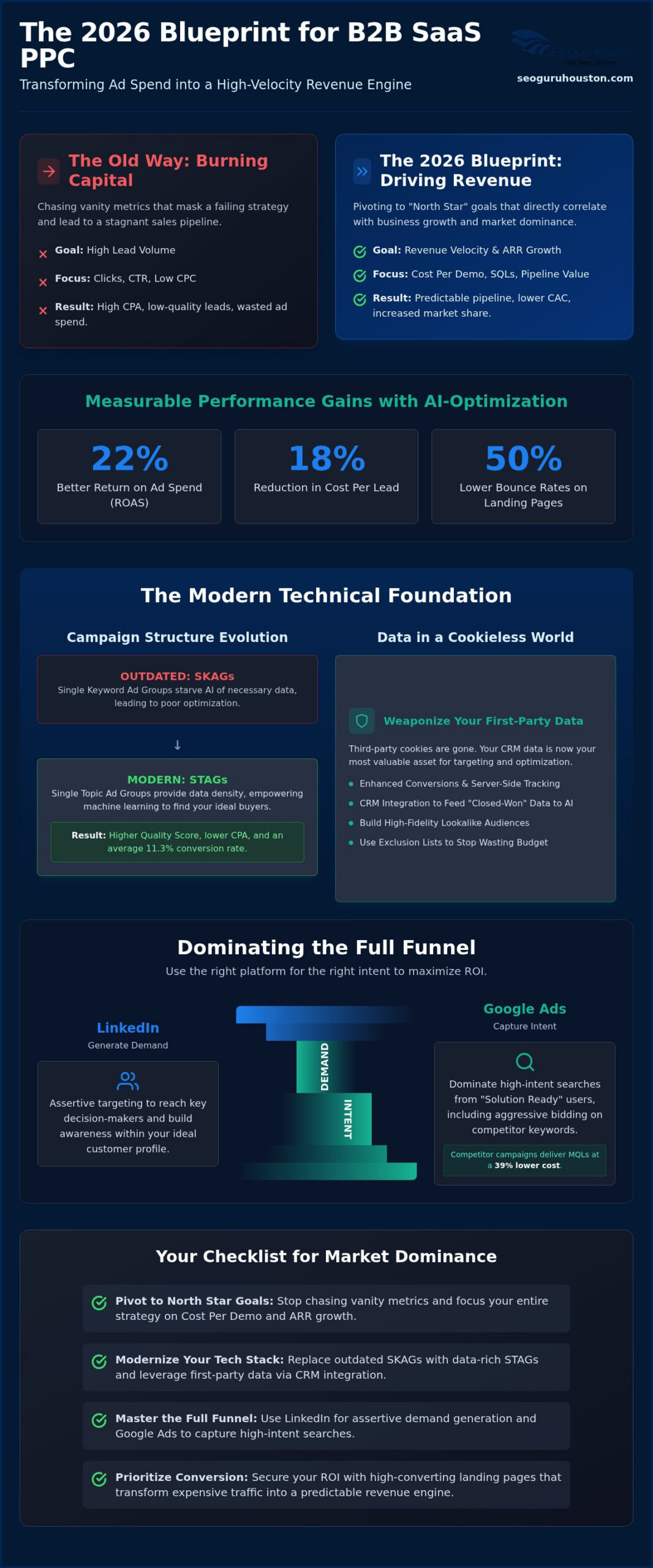
Obsess over ROAS when you need an immediate pipeline injection. Use it to scale Google Ads and LinkedIn campaigns where speed is the primary objective. It’s your best diagnostic tool for landing page performance and ad creative. If an ad set is “bleeding” cash, kill it. With B2B CPCs hitting an average of $5.58 in 2026, you don’t have the luxury of patience. You must identify failing segments before they drain your quarterly budget. ROAS allows you to make these split-second decisions with confidence, ensuring your tactical execution remains sharp and profitable. It’s about efficiency in the moment. It tells you exactly which lever to pull to keep the engine running.

Why ROI is the Only Metric That Matters to the CEO

Your CEO doesn’t care about click-through rates or cost-per-click. They care about the bottom-line profitability of the enterprise. This is why a sophisticated b2b demand generation agency prioritizes ROI over vanity clicks every single time. ROI accounts for the full cost of doing business, including the long sales cycles and multi-touch journeys typical of industrial commerce. It justifies aggressive expansion into new search markets because it proves that every dollar invested returns as profit. When you master measuring b2b marketing roi, you stop being a cost center. You become a primary revenue driver with the data to prove it. Balance your short-term wins with this long-term view to achieve true market dominance. This is how you move from invisibility to prominence.

Measuring B2B Marketing ROI: The Guru Blueprint for Market Dominance in 2026

Strategic Optimization: Turning Low-Yield Campaigns into High-Impact Revenue Drivers

Optimization is where market leaders are made. If you’re simply measuring b2b marketing roi without acting on the insights, you’re just documenting your own stagnation. High-performance marketing requires a ruthless focus on the variables that actually move the needle. You must identify where your “leaky funnel” is costing you money and pivot your resources toward the channels that demonstrate proven scalability.

Landing Pages: The Foundation of Conversion

A high converting landing page design is the non-negotiable foundation of any profitable campaign. Sending expensive PPC traffic to your homepage is an ROI death sentence. Partnering with a specialized provider like Dulyfixed Small Business Solutions for mobile-first design ensures you don’t waste that investment. You have exactly three seconds to communicate your unique value proposition before a prospect bounces. If you don’t grab them immediately, you’ve wasted your ad spend. Rigorous A/B testing can lead to a 200% increase in lead quality by filtering out tire-kickers and focusing on high-intent decision-makers who are ready to talk business.

Professional website video production is a force multiplier for complex industrial explanations. It builds trust before your sales team even picks up the phone. Some industry professionals report that strategic video content can slash the sales cycle by up to 30% by answering critical technical questions early in the buyer journey. Use video engagement data as a high-intent signal for lead scoring. If a prospect watches 90% of your product teardown, they’re ready for a conversation. This data point is essential for accurately measuring b2b marketing roi across multi-touch journeys.

Demand Gen: Winning the 97% of the Market Not Currently Buying

Most of your competitors are fighting over the 3% of the market currently looking to buy. They’re ignoring the 97% who aren’t in-market today but will be tomorrow. This is where demand generation beats simple lead generation. An assertive inbound marketing strategy for b2b creates compounding ROI over time. By positioning yourself as the authoritative “Guru” in your niche, you build brand equity that naturally lowers your customer acquisition costs. You aren’t just capturing demand; you’re creating it. This long-term focus ensures your pipeline stays full even when competitors are struggling with rising CPCs.

Ready to stop chasing low-quality leads and start dominating your industry? Let us build your custom demand generation engine to secure your market position for 2026 and beyond.

Scale to Dominance: Partnering with a Result-Oriented Growth Engine

Market dominance is not a happy accident; it is the result of a calculated, high-energy offensive. To win in 2026, an assertive marketing partner is a fundamental necessity, not an optional luxury. While your competition is distracted by minor tactical tweaks, you need a team that focuses intensely on the bottom line. Measuring b2b marketing roi becomes a weapon only when you have the expertise to act on the data with precision. You need a high-performance coach, not just another vendor, to navigate this complex landscape.

The Guru Difference is built on proactive strategic coaching. Most agencies hide behind passive monthly reports that highlight meaningless clicks or impressions. A true growth engine moves beyond reporting to identify the critical gaps in your current digital standing. We vet every tactic against your specific revenue goals and deal velocity. If a channel isn’t contributing to market dominance, it’s a distraction. Reclaiming your market share starts with a partner who is as committed to your financial return as you are. Taking decisive action today is the only way to secure your lead and leave the competition behind.

The Danger of “Affordable” SEO

Low-cost firms are the silent killers of ROI. They rely on generic strategies and poor execution that leave your brand invisible to high-value decision-makers. The true cost of “cheap” SEO isn’t just the invoice; it’s the six to twelve months of lost time while your competitors scale their visibility. In a competitive digital landscape, you cannot afford to wait for results that will never come. You should invest in growth partners who understand that professional SEO is a high-yield asset, not a monthly expense. Settling for less is a guaranteed way to bleed market share and waste your potential.

Your Blueprint for 2026 Market Dominance

Dominance requires setting aggressive yet measurable KPIs for the next twelve months. You need to focus on pipeline-sourced revenue and customer lifetime value rather than simple lead counts. Your scaling strategy must integrate technical SEO with high-performance PPC to capture and create demand simultaneously. This dual-engine approach ensures that you aren’t just measuring b2b marketing roi, but actively exploding it. Stop guessing at your digital standing. It is time to take decisive action and implement a framework that turns your marketing spend into a proven profit center. Start dominating your industry today by partnering with a team that values results over activity.

Claim Your Market Share: The Path to 2026 Profitability

The era of defending vague budgets is over. To achieve market dominance, you must bridge the invisibility gap by moving beyond surface-level metrics and embracing a multi-touch attribution reality. We’ve laid out the framework for measuring b2b marketing roi with surgical precision, from unifying your data silos to leveraging high-impact website video marketing that slashes sales cycles. By distinguishing between tactical ROAS and strategic ROI, you position your brand as a primary revenue driver rather than a cost center.

Success in the industrial and manufacturing sectors requires a partner who understands the nuances of high-converting demand generation. With our results-oriented SEO and PPC expertise, we help you stop burning ad spend on low-yield traffic and start scaling high-performing channels. Don’t let your competition dictate the digital landscape. Stop guessing and start scaling; get your assertive B2B marketing strategy from the Gurus today!

You have the blueprint. Now, it’s time to take decisive action and transform your digital presence into a dominant growth engine. Your future market share depends on the choices you make today. Let’s start winning.

Frequently Asked Questions

What is a good ROI for B2B marketing in 2026?

A strong ROI varies by channel, but 2026 benchmarks show SEO leading with a 748% return. For paid efforts, Google Ads averages 200%, while LinkedIn campaigns typically see around 229%. You should aim for marketing to source 30% to 50% of your total pipeline. If your returns fall below these industry standards, your strategy likely lacks the technical precision required for market dominance. Focus on high-impact channels to ensure every dollar works.

How long does it take to see a positive ROI from SEO?

SEO is a long-term profit engine that typically requires six to twelve months to show positive returns. This timeline aligns with the standard B2B sales cycle, which often involves multiple decision-makers. While PPC offers immediate visibility, SEO builds compounding equity that eventually delivers the highest ROI in the digital ecosystem. You aren’t just buying traffic; you’re building a permanent market position that lowers your customer acquisition costs over time.

Can I measure ROI without expensive marketing attribution software?

You can start measuring b2b marketing roi by unifying your existing CRM and marketing automation data. While complex attribution software provides deeper insights, a disciplined manual audit of your data silos often reveals the most critical gaps. Focus on tracking “Marketing Influenced Pipeline” and deal velocity within your CRM. This assertive approach allows you to prove value and justify future investments in more sophisticated tech stacks once you’ve established a baseline.

How do I calculate ROI for B2B content marketing?

Calculate content ROI by dividing the total revenue generated from content-led leads by your total content investment. This investment must include creative production, software costs, and distribution spend. Because B2B buying journeys are complex, you should also factor in Customer Lifetime Value. A single high-value whitepaper might influence a six-figure deal that lasts five years. Use this long-term perspective to prove that content is a fundamental necessity for growth, which is why many firms partner with Content Marketing SG to optimize their output for modern search environments.

ROAS is a tactical metric used to measure the immediate efficiency of ad spend, while ROI is the strategic view of total business profitability. In 2026, with B2B CPCs averaging $5.58, a high ROAS doesn’t always mean your business is growing. You might be capturing “cheap leads” that never close. measuring b2b marketing roi requires looking at the total financial impact across the entire customer lifecycle, including overhead and technical costs.

How do I prove marketing ROI to a skeptical CEO?

Proving value to a skeptical CEO requires shifting the conversation from vanity metrics to hard revenue. Present the “Marketing Influenced Pipeline” and show how marketing activities accelerate deal velocity. Use specific data, such as the fact that global ad spend is growing by 5.1% in 2026, to highlight the competitive necessity of an assertive digital strategy. When you connect marketing spend directly to bottom-line profit, you move from being a cost center to a revenue leader.

Why is my B2B lead generation ROI lower than expected?

Low ROI often stems from the “cheap lead” trap or a “leaky funnel” where high-quality traffic is lost due to poor nurture strategies. If your visitor-to-lead conversion rate is below the 2.3% industry average, your messaging or targeting is likely off. Additionally, ignoring “Dark Social” or multi-touch attribution can make your campaigns look less effective than they actually are. You must audit your entire journey to identify where potential revenue is slipping away.

How does landing page design impact my marketing ROI?

Landing page design is the non-negotiable foundation of your conversion engine. If you’re sending traffic to a generic homepage, you’re effectively destroying your ROI. A professional, high-converting design communicates value within three seconds and can increase lead quality by up to 200%. In a market where B2B website conversion rates average 2.9%, even a small improvement in your landing page performance can lead to a massive explosion in total financial return.

How to Create a B2B Marketing Funnel: The Assertive Blueprint for 2026 Market Dominance

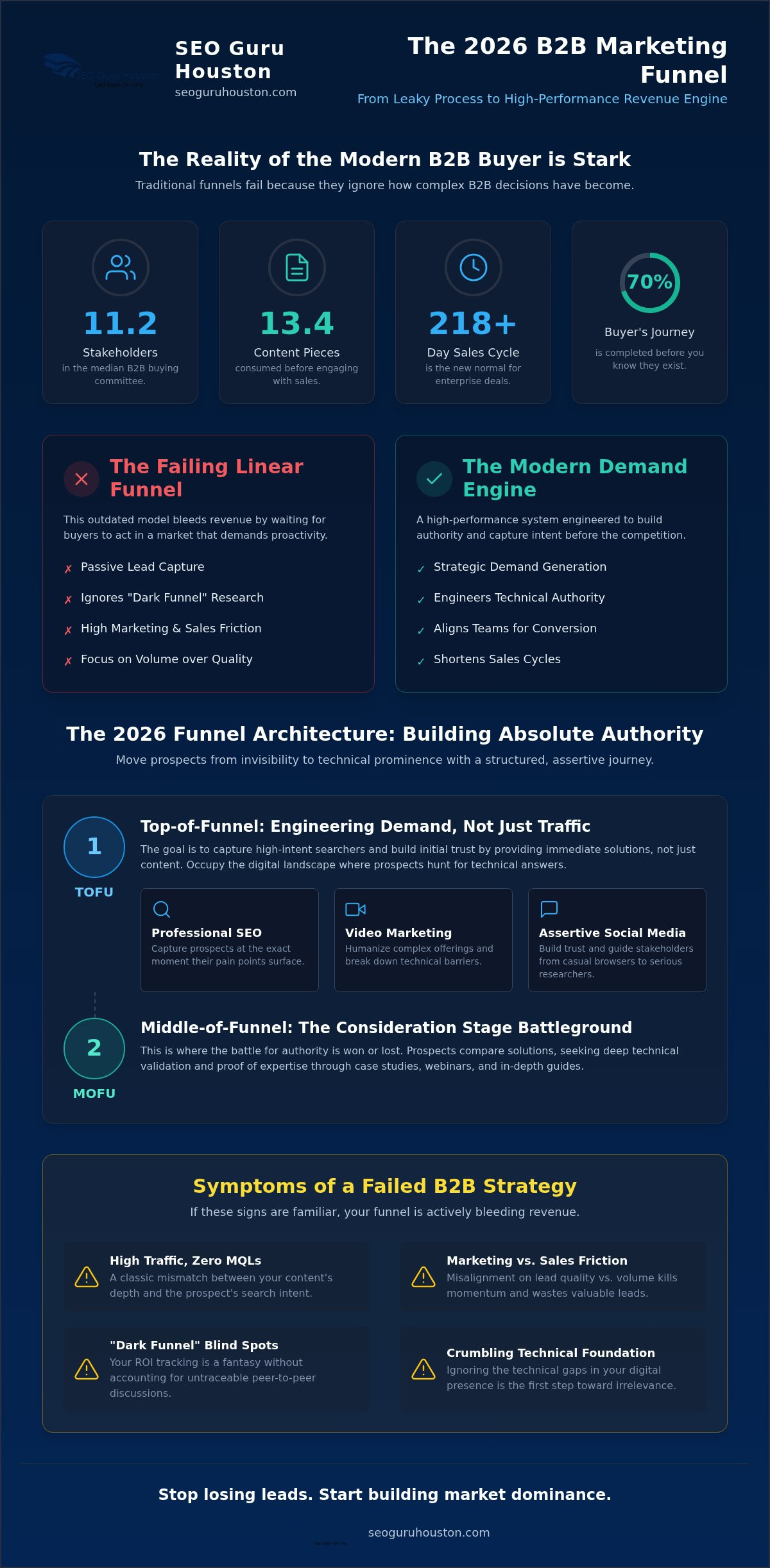
Why are you still betting your revenue on a linear sales process when the median B2B buying committee has ballooned to 11.2 stakeholders? In 2026, buyers consume an average of 13.4 pieces of content before they even think about talking to your team. You need to master how to create a b2b marketing funnel that doesn’t just capture emails but actually engineers technical authority before a discovery call is even booked.

We know the pain of watching your cost-per-lead skyrocket while your sales cycle stretches past the 218-day mark for enterprise deals. It’s exhausting to manage the friction between marketing and sales when outcomes don’t match the investment. This article is your assertive blueprint to stop losing leads to a leaky system and start building a high-performance engine that scales revenue. We’ll break down the exact engineering required to shorten your sales cycles, align your teams, and establish absolute market dominance through strategic demand generation and AI-assisted workflows. Prepare to move from invisibility to prominence by building a predictable lead generation machine that crushes the competition.

Key Takeaways

  • Stop losing prospects to a leaky process by shifting your focus from passive lead capture to a comprehensive demand-generation strategy that builds technical authority.
  • Master how to create a b2b marketing funnel that engages the modern buying committee and engineers trust through technical prominence before the first discovery call.
  • Discover why tactical lead generation is no longer enough and why creating brand desire through strategic demand generation is the fundamental necessity for growth.
  • Learn to engineer a high-conversion engine by mapping your content assets to the specific psychological triggers and technical pain points of your ideal customer profile.
  • Shorten your sales cycles and establish absolute market dominance by integrating high-intent paid strategies with a robust inbound marketing framework.

Why Your Current B2B Marketing Funnel is Bleeding Revenue

Your current strategy is likely a relic. If you’re still relying on a traditional, passive marketing funnel concept, you’re handing your market share to competitors who are more aggressive. In 2026, the reality is stark. B2B buyers consume an average of 13.4 pieces of content before they ever engage with a sales team. This self-directed journey means prospects are often 70% of the way through their decision process before you even know they exist. If your engine isn’t built to capture this invisible intent, you’re bleeding revenue at every stage of the journey.

Passive inbound models fail because they wait for the buyer to initiate contact. In hyper-competitive sectors, that’s business suicide. Learning how to create a b2b marketing funnel that actually converts requires a shift from simply catching leads to actively generating demand. This is why partnering with a professional b2b demand generation agency is a fundamental necessity for growth. You need an assertive system that commands attention and establishes technical authority before the buyer even realizes they have a problem.

The Death of the Linear Buyer Journey

The path to purchase is no longer a straight line. It’s a complex web of “Dark Social” interactions and “Dark Funnel” research. Buyers are discussing your brand in private Slack groups and peer networks where your tracking pixels can’t reach. Without sophisticated multi-touch attribution, your ROI tracking is a fantasy. You’ll see fragmented search intent where prospects look for technical solutions long before they search for a vendor. If you don’t map your content to these specific, high-intent technical queries, your conversion rates will crater. You must understand how to create a b2b marketing funnel that accounts for these invisible touchpoints.

Symptoms of a Failed B2B Strategy

Are you seeing high traffic but zero MQLs? That’s a classic symptom of a mismatch between search intent and content depth. It’s a sign that your technical foundation is crumbling. Sales and marketing alignment isn’t just a corporate buzzword; it’s the difference between a closed deal and a wasted lead. Friction between these teams kills the momentum required to close high-ticket accounts. If your marketing team is focused on lead volume while sales demands lead quality, your funnel is broken. Diagnosing these leaks and fixing the technical gaps is the first step toward absolute market prominence. Stop ignoring the technical foundation of your digital presence and start engineering for results.

The 2026 B2B Funnel Architecture: Awareness to Absolute Authority

The linear path is dead. To dominate your sector, you must view your architecture not as a leaky bucket, but as a high-velocity engine. While many still cling to static models, the evolution of the traditional funnel suggests a more cyclical, momentum-based approach is necessary for 2026. This isn’t about passive observation; it’s about engineering an assertive journey that moves prospects from complete invisibility to technical prominence. When you’re figuring out how to create a b2b marketing funnel that actually scales, you must prioritize demand generation over simple lead capture.

TOFU: Engineering Demand, Not Just Traffic

Top-of-funnel (TOFU) activities in 2026 require more than just “brand awareness.” You need to occupy the search landscape where your prospects are hunting for technical answers. Leveraging professional seo services allows you to capture high-intent searchers at the exact moment their pain points surface. Don’t just give them a blog post; give them a solution. Use video marketing to humanize complex B2B offerings and break down technical barriers quickly. Assertive social media isn’t for “likes”; it’s for building the initial trust required to move a stakeholder from a casual browser to a serious researcher. If your current architecture feels stagnant, it’s time to consult with an expert in demand generation to realign your strategy.

MOFU: The Consideration Stage Battleground

Middle-of-funnel (MOFU) is where the battle for authority is won or lost. In 2026, buyers are savvy and skeptical. Your inbound marketing strategy for b2b must pivot from generic promotion to deep-dive education. This is the stage for expert comparison guides and white papers that don’t just list features, but solve architectural problems. Use interactive tools and webinars to capture intent data that your sales team can actually use. You aren’t just nurturing a lead; you’re educating a future partner. When you master how to create a b2b marketing funnel, you ensure that every MOFU touchpoint reinforces your position as the only logical choice in the market.

Bottom-of-funnel (BOFU) requires an assertive close. This is not the time for subtlety. You need to present undeniable social proof and concrete ROI projections that speak directly to the 11.2 stakeholders involved in the buying committee. In 2026, the assertive close is built on technical certainty. If your funnel hasn’t already established you as an absolute authority by this stage, you’ve already lost. Use case studies that mirror your ICP’s exact environment to remove any lingering doubt and push the deal across the finish line.

Demand Generation vs. Lead Generation: Which Growth Engine Wins?

Stop treating your prospects like prey. Lead generation is a tactical hunt for contact information, often resulting in a database full of low-intent names that your sales team despises. Demand generation is the strategic creation of brand desire. It’s about engineering an environment where the market already wants what you sell before you ever ask for a meeting. If you want to know how to create a b2b marketing funnel that actually scales, you must realize that a name in a database isn’t a customer. It’s just a data point.

In 2026, capturing a lead without pre-built trust is a waste of resources. If you’re learning how to create a b2b marketing funnel, you must realize that a hybrid approach is the only way to achieve rapid scaling. You need the precision of lead capture combined with the authority of demand generation. The Guru perspective is clear: a lead is just a number; a relationship built on technical prominence is an asset. Capturing a lead is useless if they don’t already respect your expertise. This is why professionals like Frank Novak argue that many businesses fail because they ignore the human element of authority in their automation.

Gated content is losing its effectiveness. Buyers are tired of trading their privacy for surface-level white papers. When you force a gate too early, you end up with high-volume, low-quality outcomes that tank your sales team’s productivity. The cost of chasing these low-intent leads is hidden in the hours your reps spend on discovery calls that go nowhere. You’re paying for a high cost-per-lead while your revenue remains stagnant. Measuring real ROI means looking past the vanity metrics of lead volume and focusing on pipeline velocity. If your sales cycle is stretching toward that 218-day enterprise average, your lead gen strategy is likely the culprit.

Building a Demand-First Machine

Prioritize ungated value. By giving away your best insights, you build market-wide authority that competitors can’t touch. This demand-first approach is what actually shortens the average sales cycle. When the buyer finally enters your funnel, they are already sold on your expertise. Integrating high-performance PPC services with a robust SEO strategy ensures you are visible exactly when the market’s technical pain points peak. You aren’t just filling a funnel; you’re building a predictable lead generation machine that converts at a higher rate because the trust is already established. This is a fundamental necessity for those hungry for market dominance. Don’t just collect emails; command the market’s attention.

How to Create a B2B Marketing Funnel: The Assertive Blueprint for 2026 Market Dominance

Step-by-Step: Engineering Your High-Conversion B2B Funnel

Building a high-performance engine isn’t about hope; it’s about precision. When you master how to create a b2b marketing funnel, you stop guessing and start calculating ROI with cold, hard certainty. This process requires a move from generic awareness to technical prominence. Follow these five steps to engineer a funnel that crushes your competition:

  • Step 1: Define your ICP and psychological triggers. Move beyond basic demographics. Identify the specific business survival and growth triggers that keep your ideal customer awake at night.
  • Step 2: Map content assets to technical pain points. Ensure your content addresses the specific architectural or operational hurdles your prospects face at each stage.
  • Step 3: Deploy high-performance architecture. Use high converting landing page design for every offer to ensure your traffic doesn’t just visit, but converts.
  • Step 4: Fuel the engine. Integrate assertive PPC management to inject high-intent traffic into your funnel immediately while your organic authority builds.
  • Step 5: Automate with precision. Utilize autonomous AI marketing agents to streamline lead generation and content creation, ensuring your nurture sequences use technical data to deliver the right message at the exact moment of need.

Psychological Trigger Mapping for B2B

In 2026, you aren’t just selling to a person; you’re selling to a committee of 11.2 stakeholders. You must distinguish between the ‘Decision Maker’ who cares about the bottom line and the ‘Influencer’ who cares about technical feasibility. Your copy must speak the language of business survival and aggressive growth. Use an assertive tone that creates urgency. If your messaging feels like an optional luxury, you’ve already lost. Position your solution as a fundamental necessity for their continued market existence. Ready to build a system that commands respect? Partner with an expert B2B marketing team to dominate your sector today.

The Technical Stack: CRM and Automation

Your technical stack is the backbone of your revenue engine. Your CRM must be the single source of truth for all ROI tracking. If your data is siloed, your strategy is blind. Implement lead scoring to prioritize ‘hot’ prospects who exhibit high-intent behaviors, such as visiting your pricing page or downloading a technical comparison guide. Use behavioral triggers to automate hyper-personalized follow-ups. When a prospect engages with a specific technical asset, your system should automatically deliver the logical next step in their journey. This level of automation ensures no high-value lead drops through the cracks of a leaky funnel. Precision in your stack leads to prominence in your market.

Scaling to Dominance: Integrating Inbound and Paid Strategies

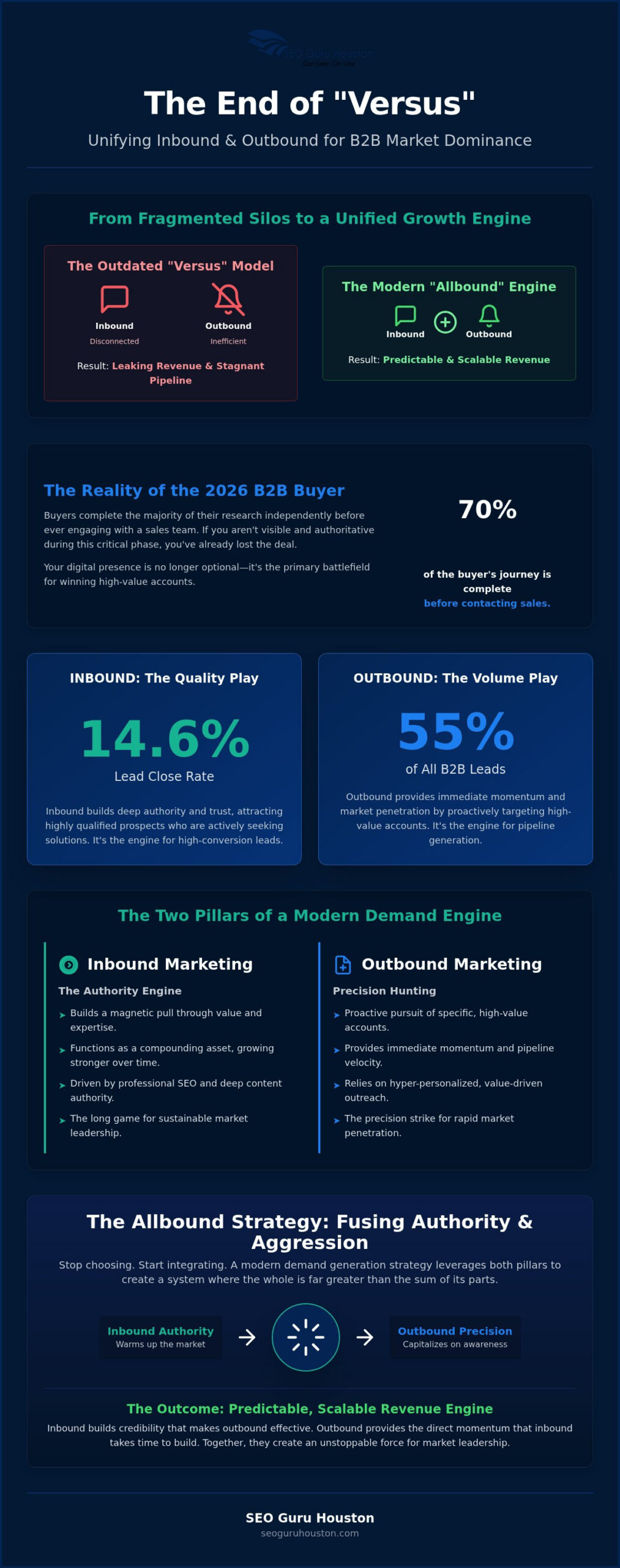
Organic SEO is your foundation, but relying on it alone for rapid 2026 growth is a strategic error. You need immediate visibility to fuel your engine. Mastering how to create a b2b marketing funnel requires a dual-threat approach where paid and organic strategies feed each other. While SEO builds your long-term technical authority, assertive ppc management provides the instant momentum needed to dominate high-intent keywords. This isn’t an optional luxury. It’s a fundamental necessity for businesses hungry for market prominence.

Aggressive Paid Search for B2B

Stop playing defense. Use paid search to target competitor brand terms and surgically steal market share from established players. In 2026, surgical targeting on platforms like LinkedIn allows you to put your solution directly in front of C-suite executives who have the power to sign high-ticket contracts. Don’t fall into the trap of optimizing for vanity metrics like clicks or impressions. Your ad spend must be ruthlessly focused on revenue generation. If a campaign isn’t contributing to your pipeline velocity, cut it. An assertive strategy demands that every dollar works toward your bottom line. You’re not just buying traffic; you’re buying market share.

The Final Conversion: Turning Leads into Partners

The bottom of your funnel is where technical certainty meets emotional commitment. At this stage, your prospects need more than just a sales pitch. They need proof. Implementing website video marketing at the BOFU stage humanizes your solution and breaks down complex technical barriers in seconds. Combine this with high-impact case studies that provide undeniable ROI evidence. Your goal is to remove every shred of doubt. When you understand how to create a b2b marketing funnel, you know that the final step isn’t a request for information. It’s a move toward a strategic partnership.

The multiplier effect is real. When your paid ads capture intent and your organic content builds trust, you create a lead generation machine that’s nearly impossible to disrupt. This level of market dominance isn’t achieved by accident. It requires the specialized knowledge of a veteran team. Partnering with a result-oriented SEO marketing company is the final piece of the puzzle. It allows you to focus on scaling your operations while experts engineer your digital prominence. Don’t settle for invisibility when absolute authority is within reach. Take decisive action and command your market today.

Command Your Market: The Era of Assertive B2B Growth

The days of passive inbound marketing are over. In 2026, market dominance belongs to those who engineer trust through technical authority and strategic demand generation. You’ve seen that a modern engine requires more than just catching leads; it demands the creation of brand desire before the first discovery call. By integrating high-intent paid strategies with deep-dive technical content, you can bypass the noise and speak directly to the stakeholders who control the budget.

Mastering how to create a b2b marketing funnel is a fundamental necessity for your business survival and aggressive growth. You don’t have to navigate this complex landscape alone. Our expertise in expert B2B demand generation and data-driven ROI focus ensures you move from invisibility to prominence. We help you establish a dominant market presence that your competitors cannot ignore. Stop wasting resources on low-quality outcomes and start building a predictable revenue engine.

Stop Guessing and Start Scaling: Get Your Custom B2B Funnel Blueprint Today!

The path to market leadership is clear. Take decisive action now and watch your revenue engine crush the competition. You’ve got the blueprint; it’s time to build your legacy.

Frequently Asked Questions

How do you create a B2B marketing funnel from scratch?

You begin by ruthlessly defining your Ideal Customer Profile (ICP) and mapping their specific technical pain points. This isn’t a suggestion; it’s the foundation of your revenue engine. Once your ICP is locked, you must engineer high-converting landing pages and deploy assertive PPC management to fuel the funnel with high-intent traffic. Success requires moving from invisibility to technical prominence through a structured, data-driven approach that prioritizes demand generation over passive lead capture.

What are the 4 stages of a B2B marketing funnel in 2026?

The modern funnel consists of Awareness, Consideration, Intent, and Decision. In 2026, these stages are redefined by technical authority. Awareness is now about achieving technical prominence in your sector. Consideration involves expert solution comparisons that prove your superiority. Intent is the validation stage where stakeholders scrutinize your technical stack and past performance. Finally, the Decision stage requires an assertive close built on undeniable ROI evidence and social proof that speaks to the entire buying committee.

How long does it take for a B2B marketing funnel to show ROI?

You should expect to see immediate momentum if you integrate assertive PPC management to capture existing demand. However, building a predictable lead generation machine through organic SEO typically takes six to nine months of consistent execution. This timeline is a fundamental reality of the B2B landscape, where the average sales cycle is 121 days for mid-market deals. Decisive action today ensures you aren’t left behind by competitors who started their engineering months ago.

What is the difference between a B2B and B2C marketing funnel?

The primary difference lies in stakeholder complexity and the length of the sales cycle. B2C funnels often target emotional, individual decisions with short paths to purchase. Conversely, B2B funnels must address an average of 11.2 stakeholders and focus on business survival and long-term ROI. When you learn how to create a b2b marketing funnel, you’re engineering a psychological journey that builds technical trust over months across a diverse buying committee rather than chasing a quick impulse buy.

What are the most important metrics to track in a B2B funnel?

Stop obsessing over vanity metrics like clicks and focus on pipeline velocity and MQL to SQL conversion rates. You need to know exactly how fast prospects are moving through your engine and at what cost. Tracking Customer Acquisition Cost (CAC) against the lifetime value of a partner is essential for maintaining a result-oriented strategy. If your CRM isn’t providing a single source of truth for these metrics, your growth is built on guesswork rather than data.

Can a small business create an effective B2B marketing funnel?

Absolute market authority isn’t reserved for enterprise giants. Small businesses can dominate their niche by being more surgical and assertive than their larger, slower competitors. By focusing on demand generation and high-converting web development, you can punch above your weight class. You don’t need a massive budget; you need a precise strategy that prioritizes technical prominence and addresses the specific pain points of a well-defined Ideal Customer Profile to achieve growth.

Is content marketing still effective for B2B funnels in 2026?

Content marketing is the lifeblood of the 2026 funnel, but only if it provides deep technical value. Passive, surface-level blog posts are useless in a market where buyers consume 13.4 pieces of content before engaging sales. You must produce expert white papers, comparison guides, and website video marketing that establishes you as a guru in your field. If your content doesn’t solve a complex problem or prove ROI, it’s just noise that prospects will ignore.

How do I align my sales and marketing teams within the funnel?

Alignment requires a shared focus on revenue rather than individual department targets. You must establish a unified definition of a Sales Qualified Lead (SQL) and implement technical lead scoring within your CRM. When both teams are incentivized by closed deals and pipeline velocity, friction disappears. Learning how to create a b2b marketing funnel that works means ensuring marketing delivers the technical authority sales needs to close the deal with confidence and scale your revenue.

B2B Digital Marketing Plan Template: The 2026 Assertive Blueprint for Market Dominance

88% of digital marketers are now using AI daily to drive a staggering 300% average ROI, yet most B2B firms are still flushing their ad spend down the drain on random acts of marketing. You’re likely exhausted by the technical complexity of the 2026 digital landscape and the lack of a proven b2b digital marketing plan template to align your activities with actual sales outcomes. It’s frustrating to watch your budget disappear into a black hole of low-quality leads while your competitors scale toward a $36 trillion B2B e-commerce market.

You don’t have to settle for invisibility or guesswork anymore. This guide provides the high-performance execution framework designed to transform your digital presence into a predictable revenue-generating engine. We’re going to strip away the fluff and build a roadmap for market dominance that includes demand generation frameworks, AI search integration, and reporting structures that command respect in the boardroom. It’s time to stop playing defense and start winning.

Key Takeaways

  • Stop the bleed on low-quality leads by mastering ICP deep-dives and brutal competitive gap analysis to identify market weaknesses.
  • Implement a high-performance b2b digital marketing plan template that transforms static documents into dynamic, revenue-generating execution engines.
  • Leverage professional SEO and aggressive PPC strategies to dominate the 2026 search ecosystem and capture high-intent traffic immediately.
  • Solve the complexity of dark social and multi-device journeys with advanced attribution modeling and a single source of truth for your data.
  • Secure your seat at the executive table with boardroom-ready reporting structures that prioritize bottom-line growth over vanity metrics.

Beyond the Document: Why Your 2026 B2B Marketing Plan Must Be an Execution Engine

A b2b digital marketing plan template isn’t a static PDF you bury in a shared drive. It’s a high-performance execution engine. In 2026, the divide between market dominators and struggling firms is defined by one thing: clarity of action. If you’re still committing “random acts of marketing”—launching sporadic LinkedIn posts or disjointed email blasts—you’re effectively subsidizing your competitors’ growth. Digital dominance isn’t a luxury for the Fortune 500; it’s a fundamental necessity for any business that wants to survive this decade. You need a “Guru” mindset that rejects abstract theories in favor of aggressive, bottom-line results.

The High Cost of a Passive Marketing Strategy

Invisibility is the fastest path to irrelevance. In competitive industrial and B2B sectors, a passive approach leads to rapid market share erosion. While your team debates “safe” corporate messaging, assertive competitors are capturing the high-intent traffic that should be yours. You can’t afford to wait for the market to come to you. You must go to the market with a strategy that commands attention and forces a response. This requires shifting away from outdated digital marketing strategies that focus on maintenance rather than growth. An Execution Engine is a dynamic, data-driven framework that continuously converts market intelligence into measurable revenue growth.

Shifting from Vanity Metrics to Revenue Realities

Stop reporting on “likes,” “shares,” or “impressions” as if they were currency. They aren’t. In the 2026 landscape, the only metrics that matter are pipeline velocity, cost per acquisition, and total contract value. Your marketing activities must have a direct, traceable link to sales outcomes. This is where demand generation beats simple lead generation every time. By building a plan focused on revenue realities, you ensure that every tactical move—from SEO to PPC—serves the ultimate goal of financial return.

  • Pipeline Velocity: Focus on how fast prospects move from the initial touchpoint to a closed-won deal.
  • Demand Generation: Create a hunger for your specific solution before the first sales call even happens.
  • Scalable Logic: Build a framework where you can increase spend and expect a predictable, non-linear increase in revenue.

If your current plan can’t answer these questions with hard data, it isn’t a plan. It’s a wish list. A professional b2b digital marketing plan template provides the rigid structure needed to turn those wishes into a predictable, scalable reality. You don’t need more “activity.” You need more impact.

Phase 1: Market Intelligence and High-Converting Funnel Architecture

Market dominance doesn’t happen by accident. It’s the result of superior intelligence and a funnel built like a fortress. If you’re using a generic b2b digital marketing plan template that treats every lead the same, you’ve already lost. In 2026, your strategy must be fueled by a deep understanding of Market Intelligence and High-Converting Funnel Architecture to stay ahead of the curve. You need to know exactly who your Ideal Customer Profile (ICP) is and, more importantly, exactly what keeps them up at 2:00 AM.

  • Step 1: ICP Deep-Dive. Move beyond job titles. Identify the specific business pressures and technical hurdles your personas face daily.
  • Step 2: Brutal Competitive Gap Analysis. Don’t just watch your competitors; dissect them. Find the keywords they’re ignoring and the service gaps they’re too slow to fill.
  • Step 3: Infrastructure Audit. Check your site for “conversion friction.” If it takes more than two clicks to find a solution, you’re losing revenue; technical experts like SEOSkinny can help audit and refine these digital touchpoints to eliminate friction and maximize conversion potential.
  • Step 4: Journey Mapping. The 2026 buyer journey is messy. Map out every touchpoint from the first search to the final advocate referral.

Defining Your Absolute Authority in the Market

Your value proposition must do more than inform; it must demand attention. In a sea of “me-too” services, your brand needs an emotional hook that resonates with professional B2B buyers. This starts with high converting landing page design. If your landing pages look like a 2015 brochure, you’re signaling to the market that you’re out of touch. Your foundation must be built on precision and authority. It’s about creating a presence that makes your competitors look like amateurs.

Building the Lead Generation Infrastructure

Data is the lifeblood of your execution engine. You must integrate your CRM with sophisticated marketing automation to ensure a seamless flow of information. A robust inbound marketing strategy for b2b is critical for capturing high-intent traffic before your competitors even know they’re in the market. Your tech stack should be lean, integrated, and focused entirely on accelerating pipeline velocity. To truly scale, you need a partner who understands how to turn these technical requirements into demand generation results that actually move the needle.

Phase 2: Deploying High-Energy Channels for Demand Generation and SEO

Intelligence is a paper tiger without the firepower to back it up. Now that you’ve mapped your funnel, you must deploy high-energy channels that force the market to acknowledge your presence. Your b2b digital marketing plan template must integrate SEO and PPC as a single, unified demand generation engine. In the 2026 landscape, where 47% of keywords now trigger AI Overviews, your strategy cannot just be about “ranking.” It must be about total footprint dominance. Professional SEO services provide the long-term compounding interest your brand needs to stay ahead of competitors who are still chasing yesterday’s algorithms.

Dominating the Search Ecosystem

Conquering the search results requires more than basic keyword stuffing. It demands an SEO marketing company mindset that treats search results as real estate to be conquered. High-performing B2B brands are shifting budgets toward video marketing to increase dwell time and build the trust necessary for high-value contracts. If your content doesn’t position you as the undisputed “Guru” in your niche, you’re just adding to the digital noise. You need to provide original research and technical insights that AI cannot replicate. This establishes the authority needed to turn a casual searcher into a loyal advocate.

High-Impact PPC and Paid Search Management

High-impact PPC is where you capture high-intent traffic immediately. Stop wasting your budget on broad terms that bring in window shoppers. We use an assertive approach to PPC management that targets buyers at the exact moment they’re ready to solve a problem. Paid search isn’t just for quick leads; it’s the ultimate validation tool for your long-term SEO investment. By identifying which keywords actually drive revenue, you can focus your organic efforts on the terms that matter most. Retargeting strategies then ensure your brand remains top-of-mind throughout the long, complex B2B sales cycle. Don’t let a prospect forget you just because they weren’t ready to buy on day one.

The synergy between paid visibility and organic authority creates a “surround sound” effect. When prospects see you at the top of the ads and the top of the organic results, your credibility doubles. This isn’t just marketing. It’s a strategic takeover of your industry’s digital landscape. You’re not just participating in the market; you’re defining it. Every click should be a step toward total market dominance.

B2B Digital Marketing Plan Template: The 2026 Assertive Blueprint for Market Dominance

Phase 3: Measuring What Matters—ROI, Attribution, and Scaling Logic

Stop measuring activities. Start measuring outcomes. If your b2b digital marketing plan template treats marketing as a cost center rather than a revenue engine, you’ve already lost the boardroom. You must establish a “Single Source of Truth” where marketing data and sales outcomes live in the same ecosystem. In the 2026 landscape, this is harder than ever. Research shows that while 88% of marketers use AI daily, only 19% are actually tracking AI-specific KPIs. Don’t be part of that gap. You need a data-driven framework that bridges the divide between a click and a contract.

Attribution in 2026 is a complex battlefield. Your prospects are moving through dark social channels like Slack communities and private DMs, making their journey nearly invisible to traditional tracking. They’re switching between mobile research and desktop demos across multiple devices. The Guru formula for ROI rejects simple “last-click” logic. We calculate return based on total pipeline contribution and the impact on total contract value (TCV). You’ll know it’s time to scale when your cost per acquisition remains stable while your pipeline velocity begins to accelerate. These are the signals of a high-performance machine.

The Metrics that Drive Executive Decisions

Executives don’t care about your click-through rate. They care about the relationship between Cost Per Lead (CPL) and Customer Acquisition Cost (CAC). A low CPL is a vanity metric if those leads never convert into paying customers. You must demonstrate exactly how much revenue marketing “touched” throughout the entire buyer journey. Measuring the velocity from the initial touchpoint to a signed contract reveals the true efficiency of your demand generation engine. This “Time to Conversion” metric is the ultimate indicator of your brand’s authority and its alignment with the sales team’s goals. For service-based firms ready to optimize these results, Tools N Tactics | Local SEO & Digital Marketing Solutions provides a Growth Partner Program that implements the integrated marketing engines required to drive scalable, high-performance growth.

Scaling isn’t just about throwing more money at a campaign. It’s about the strategic reinvestment of profits into high-yield digital channels that have already proven their worth. Many businesses fall into the “scaling trap” where efficiency plummets as soon as they increase their volume. To avoid this, you need the technical infrastructure and strategic oversight to maintain surgical precision at scale. Partnering with a b2b demand generation agency ensures you have the expertise to manage this rapid growth without sacrificing your ROI. You’re building a legacy, not just a campaign.

Ready to see the hard numbers behind your digital presence? Request a comprehensive demand generation audit to identify the exact levers you need to pull for market dominance.

The SEO Guru B2B Digital Marketing Template: Implementation and Next Steps

Dominance is a choice. This b2b digital marketing plan template is not a suggestion; it’s a mandate for survival in a 2026 market that rewards speed and punishes hesitation. Your executive summary is simple: we are moving from passive participation to aggressive market capture. Our vision is to own the search results and the buyer’s mindshare simultaneously. By linking every KPI to revenue growth rather than vanity metrics, you turn your marketing department into a high-performance profit center.

Your tactical roadmap follows a relentless 12-month rhythm. The first 90 days focus on infrastructure, fixing conversion friction, and launching aggressive PPC campaigns to capture immediate intent. Months four through eight are dedicated to building organic authority through professional SEO and original research that positions you as the niche “Guru.” The final stretch is about scaling what works and expanding your footprint into every corner of the digital ecosystem. Budgeting follows the 2026 Gartner benchmark of 7.7% of total revenue, with a heavy 25-30% allocation toward SEO and content to ensure long-term compounding returns.

How to Use This Template for Maximum Impact

Generic plans fail because they ignore the nuances of industrial and manufacturing sectors. You must customize this framework to speak the specific language of your niche’s pain points. Set 12-month growth targets that are uncomfortable but achievable with the right execution engine. To stay ahead of shifting algorithms and competitor moves, you must conduct quarterly “Guru Audits.” These aren’t just status updates; they are strategic pivots based on hard data and pipeline velocity. If a channel isn’t contributing to the bottom line, cut it and reinvest in the winners.

Taking Decisive Action

Speed to market is your greatest competitive advantage. While your competitors are stuck in committee meetings, you should be deploying landing pages and capturing leads. When pitching this plan to stakeholders, don’t talk about “brand awareness.” Talk about market share, pipeline contribution, and the cost of inaction. Show them the roadmap to a $36 trillion B2B e-commerce market and explain that this budget is the fuel for that journey. You don’t ask for permission to grow; you present the blueprint for how it’s going to happen.

Ready to dominate? Partner with SEO Guru Houston to execute your blueprint and turn your digital presence into a revenue-generating engine today.

Seize Your Market Dominance Now

The divide between market leaders and struggling firms in 2026 is defined by the transition from static planning to a high-performance execution engine. You’ve seen the roadmap. You understand why disjointed marketing activities are a budget killer and how a structured b2b digital marketing plan template aligns your technical SEO and aggressive PPC efforts with actual revenue outcomes. It’s time to stop settling for mere visibility and start demanding dominance through data-backed strategies that prioritize pipeline velocity over vanity metrics.

Success requires more than just a document; it demands the specialized expertise of a partner with a proven track record of industrial and B2B growth. We deliver the assertive, high-ROI management necessary to turn your digital presence into a non-stop lead generation machine. Don’t let your competitors capture the high-intent traffic that belongs to you. Take the first step toward total market prominence today.

Download Your Assertive B2B Marketing Blueprint and Scale Your Revenue!

You have the blueprint. Now, you just need the drive to execute. Let's start winning.

Frequently Asked Questions

What is a B2B digital marketing plan template?

It’s a structured execution framework that defines how a business will capture market share and generate revenue through digital channels. It moves beyond a simple document to become a dynamic roadmap for growth. It includes market intelligence, funnel architecture, and tactical execution steps. Using a professional b2b digital marketing plan template ensures that every marketing activity is linked to a specific business outcome rather than being a random act of marketing.

How is a B2B marketing plan different from a B2C plan?

B2B plans prioritize longer sales cycles and multiple decision-makers rather than impulsive consumer purchases. The focus shifts from emotional brand appeal to technical authority and ROI-driven messaging. You’re not just selling a product; you’re solving complex business problems. This requires a strategy built on demand generation and inbound marketing that nurtures leads over months. B2C plans often focus on immediate conversion and high-volume transactions, which doesn’t work for high-value industrial contracts.

What are the essential components of a 2026 B2B marketing plan?

A 2026-ready plan must integrate AI search optimization, advanced attribution modeling, and a high-converting digital infrastructure. Key pillars include deep ICP analysis, competitive gap assessments, and a unified SEO and PPC strategy. You need a tech stack that bridges the gap between marketing activity and sales outcomes. Without a single source of truth for your data, your plan will struggle to adapt to the technical complexities of the modern digital landscape.

How do I calculate the ROI of my B2B digital marketing strategy?

Calculate ROI by measuring total pipeline contribution and customer acquisition cost against total contract value. Don’t get distracted by vanity metrics like impressions or likes. Look at the time to conversion and how effectively your inbound efforts are shortening the sales cycle. A successful strategy shows a clear, non-linear increase in revenue as you scale your spend. It’s about bottom-line financial return, not just maintaining a digital presence.

How often should I update my B2B digital marketing template?

You should perform a Guru Audit every quarter to pivot based on real-time performance data and market shifts. While your core goals might stay the same for 12 months, the tactical execution must remain agile. The digital landscape moves too fast for annual reviews. Regularly updating your b2b digital marketing plan template allows you to reinvest profits into high-yield channels and cut underperforming tactics before they drain your budget.

Why do most B2B marketing plans fail to deliver results?

Most plans fail because they lack alignment between marketing activities and actual sales outcomes. They often focus on safe corporate messaging instead of assertive market positioning. If your plan is just a list of tasks without a clear revenue roadmap, it becomes a cost center. Failure also stems from a lack of technical expertise in professional SEO and PPC management, leading to wasted ad spend on low-quality leads that never convert.

Can I use this template for industrial or manufacturing marketing?

Yes, this framework is specifically designed for high-stakes industrial and manufacturing sectors where technical authority is paramount. These niches require a specialized approach to demand generation that addresses complex buyer pain points. The template helps you move from invisibility to prominence by showcasing your expertise through website video marketing and original research. It’s about proving you are the most reliable partner in a competitive national market where trust is the primary currency.

Should I hire an agency to implement my B2B marketing plan?

Hiring an expert agency is a strategic necessity if you want to scale rapidly without the scaling trap of dropping efficiency. Internal teams often struggle with the technical nuances of 2026 SEO and PPC management. An agency like SEO Guru Houston provides the assertive, data-backed execution needed for market dominance. You gain access to a track record of success and specialized knowledge that turns your marketing plan into a revenue-generating engine.

B2B Inbound vs Outbound: 2026 Market Dominance Guide

The “inbound vs outbound marketing for b2b” debate is officially dead. If you’re still treating these as separate silos, you’re bleeding revenue and handing your market share to the competition. You’ve likely felt the frustration of pouring budget into “fluff” content that never converts, or watching your sales team burn through cold lists with zero authority to back them up. It’s a high-stakes environment where stagnant pipeline growth is the first sign of an obsolete strategy. You don’t need more busy work; you need a high-performance engine that produces measurable results.

We know you’re hungry for market dominance and tired of a high cost-per-acquisition. This guide reveals how to fuse aggressive outbound tactics with authority-driven inbound strategies to stop the leaks and start scaling your enterprise. Recent data from Landbase shows that while inbound leads close at a 14.6% rate, outbound still generates 55% of all B2B leads. You can’t afford to ignore either side of the coin. We’re providing a clear framework for budget allocation and a demand generation strategy that turns invisible companies into industry leaders. It’s time to build a pipeline that actually closes.

Key Takeaways

  • Transition from fragmented silos to a unified “allbound” strategy that maximizes lead volume without sacrificing the quality of your pipeline.
  • Build a compounding authority engine through professional SEO that transforms your digital presence from an optional luxury into a fundamental business necessity.
  • Master the art of precision hunting by replacing mass-blasting with hyper-personalized outreach to penetrate high-value accounts in record time.
  • Discover the optimal budget allocation for inbound vs outbound marketing for b2b to ensure your marketing spend fuels scalable growth rather than “fluff” content.
  • Implement a strategic demand generation blueprint that fuses authority with aggression to dominate your market and eliminate wasted marketing spend.

B2B Marketing in 2026: Why the Inbound vs. Outbound Debate is Obsolete

The “versus” mindset is a relic of the past that’s actively gutting your growth potential. If you’re still choosing between one or the other, you’re leaving massive revenue on the table. In 2026, market leaders don’t pick a side; they build an integrated machine. Inbound marketing is about creating a magnetic pull through authority and value. It’s the long game where you become the trusted advisor before a prospect even knows your name. Conversely, outbound is the proactive pursuit of specific, high-value accounts that match your ideal customer profile. It’s the precision strike. You need both to dominate.

The 2026 reality is brutal for those who rely on outdated playbooks. Buyers are now 70% through their journey before they ever engage with a salesperson. They’ve already read your whitepapers, checked your LinkedIn reviews, and compared your technical specs. If you aren’t visible and authoritative during that first 70%, you’ve already lost the deal. This fundamental shift makes the old inbound vs outbound marketing for b2b debate completely obsolete. You must be present at every touchpoint or risk total invisibility.

The Shift in B2B Buyer Behavior

AI-driven search engines and decentralized social proof have fundamentally changed how buyers find solutions. Prospects are no longer passive recipients of information. They’re actively avoiding generic outreach that doesn’t provide immediate value. If your outreach feels like a template, it’s going straight to the trash. You must be visible where they’re looking, whether that’s in AI search results or industry-specific forums. This Digital Marketing Overview highlights how complex this ecosystem has become. Visibility is no longer a luxury; it’s a requirement for survival in a crowded marketplace.

Defining the Modern Demand Generation Engine

Modern marketing has moved beyond the vanity metric of “leads.” Your primary KPI must be revenue. Inbound and outbound serve as the two high-pressure cylinders of a single growth engine. Inbound builds the credibility that makes your outbound efforts effective. Outbound provides the immediate momentum that inbound often lacks in the early stages. When these forces combine, you create a $ result that competitors can’t touch. Stop thinking about “channels” and start thinking about the total revenue outcome.

Demand Generation is the strategic fusion of authority-driven inbound content and assertive outbound outreach to create a predictable, scalable revenue stream.

By leveraging inbound vs outbound marketing for b2b as a unified front, you stop hoping for growth and start engineering it. This isn’t just about being found; it’s about being chosen. You’re building an engine that captures attention and converts it into cold, hard cash.

Inbound Marketing: Building an Unstoppable Authority Engine

Content isn’t just about “being helpful” anymore. In the 2026 B2B ecosystem, your content is the foundation of trust and the primary driver of market dominance. If your strategy lacks authority, you’re essentially invisible to the 70% of buyers who research solutions before contacting sales. While a basic Inbound Marketing Definition focuses on attracting customers, we view it as a high-performance engine designed to crush the competition. Professional SEO isn’t a marketing expense; it’s a compounding asset that shortens your sales cycle by answering technical questions before they’re even asked.

The internal debate regarding inbound vs outbound marketing for b2b often misses the point of how authority functions. Inbound creates the gravitational pull that makes your brand the obvious choice. When your website functions as a high-converting lead generation machine, you stop chasing leads and start selecting partners. This transition from invisibility to prominence is what separates stagnant companies from market leaders. You don’t need more content; you need content that asserts your expertise and demands attention.

Strategic SEO and Content Authority

Generic blogs are dead. If your content doesn’t provide deep, technical insights, it won’t rank in an AI-driven search environment. You need pillar pages that dominate competitive search markets and signal absolute authority to both users and algorithms. This is where Professional SEO Services become a fundamental necessity. By focusing on high-intent keywords and technical excellence, you build a moat around your business that competitors can’t easily cross. It’s about precision, not volume.

High-Converting Landing Pages as Your 24/7 Sales Team

Your landing pages shouldn’t look like digital brochures. They need to be assertive blueprints that lead a prospect toward a specific revenue-generating action. Conversion rate optimization is the silent driver of your bottom line. If you’re driving traffic to a weak page, you’re lighting money on fire. Utilizing High Converting Landing Page Design ensures that every click has the highest possible chance of becoming a high-quality lead. It’s about turning passive visitors into active opportunities through strategic design and persuasive copy.

Building this engine is the first step toward scaling your B2B enterprise and securing long-term growth. Without a solid inbound foundation, your outbound efforts will always struggle to find traction in a skeptical market.

Outbound Marketing: Precision Hunting for High-Value Targets

If inbound is the magnet that attracts the crowd, outbound is the spear that strikes the target. While authority-driven content builds your long-term foundation, outbound marketing remains the fastest way to penetrate new markets and secure high-value accounts. For brands that need to dominate major industry events or conventions, high-impact solutions from VIP Outdoor Media ensure your message is impossible to ignore. You don’t have time to wait for the algorithm to find you when revenue targets are looming. In 2026, the successful “guru” approach to outbound isn’t about being a nuisance; it’s about acting as a high-performance coach who provides immediate solutions to critical business pains. Mass-blasting is a suicide mission for your brand reputation. Precision is the only path to dominance.

Paid search is your primary tool for forcing visibility in saturated markets. It allows you to capture high-intent buyers the exact moment they search for a solution. However, most businesses bleed budget on generic keywords that never convert. You need a data-driven approach that stops the waste and focuses on high-ROI opportunities. Implementing professional PPC Management is a fundamental necessity for stopping budget leaks. We don’t just buy clicks; we acquire market share by dominating the top of the search results with surgical precision.

Account-Based Marketing (ABM) as the Ultimate Outbound

ABM is how you target the “whales” of your industry. This isn’t marketing to a crowd; it’s marketing to a specific list of the top 1% of your market. We use a synergy of hyper-personalized video marketing and direct outreach to ensure your message isn’t just seen, but felt. Assertive follow-up is the non-negotiable growth engine here. If you stop after the first touch, you’ve already failed. Research shows that modern outbound has shifted from quantity to quality, focusing on personalized, data-driven outreach that treats every prospect like a strategic partner. This assertive stance ensures you’re not just another voice in the inbox; you’re the only solution they need.

B2B Inbound vs Outbound: 2026 Market Dominance Guide

The Comparison: Choosing Your Weapon or Building an Arsenal?

To implement this level of precision in your own outreach, you can learn more about Virtual Sales Limited and their expert approach to B2B appointment setting.

Stop treating inbound vs outbound marketing for b2b as a binary choice. It’s not a competition; it’s an arsenal. If you’re only using one, you’re fighting with one hand tied behind your back. Speed of results is the outbound advantage, providing the immediate velocity needed to hit quarterly targets. Long-term asset value is the inbound prize, building a foundation that reduces your dependency on paid channels over time. You don’t just pick a strategy. You engineer a revenue machine that utilizes both.

Industrial and manufacturing sectors require a unique balance. These buyers don’t make impulsive decisions; they buy based on technical specifications and proven reliability. This is where an “Inbound-Led Outbound” strategy wins. You use authority-driven content to warm up the market, making your cold outreach feel like a welcome consultation rather than an interruption. It’s about looking at the real ROI, which factors in both the immediate cost-per-lead and the total lifetime value of the account.

When to Prioritize Inbound

If your industry is plagued by skepticism, authority and trust are your primary barriers to entry. You must prioritize B2B Inbound Marketing when you need to build a defensive moat against competitors with massive advertising budgets. Inbound methods cost 62% less per lead on average, making them the superior choice for sustainable, long-term growth. It’s the strategy for those who want to be sought out as the definitive expert in their field.

When to Unleash Outbound

There are moments when waiting isn’t an option. You unleash outbound when rapid scaling is required for new product launches or during aggressive funding rounds. It’s the tool for breaking into “Fortress” accounts where decision-makers aren’t actively searching for solutions because they don’t yet realize a better way exists. This requires an assertive mindset. You don’t wait for the market to come to you; you go out and take your share of it with precision and persistence.

The real ROI of inbound vs outbound marketing for b2b is found in the “allbound” approach. To start building your integrated growth engine, you need a partner who understands strategic demand generation as a fundamental necessity for survival.

Strategic Demand Generation: How SEO Guru Houston Fuses Both for Growth

Market leadership in 2026 isn’t achieved through hope or guesswork. It’s engineered through a blueprint that combines the magnetic pull of authority with the surgical precision of aggressive outreach. We’ve moved past the simplistic inbound vs outbound marketing for b2b comparison to create a unified front. This isn’t just about having a website or an email list. It’s about building an integrated funnel that captures attention at the moment of intent and converts it into a closed deal. If you want to dominate your sector, you need a strategy that balances the long-term value of authority with the immediate impact of precision hunting.

Stop looking for a service provider and start looking for a growth partner. A service provider checks boxes; a growth partner builds a revenue engine. We act as a high-performance coach, identifying the tactical gaps in your current strategy and providing the technical expertise to bridge them. In a landscape where buyers are more skeptical than ever, your digital presence must be a fundamental necessity, not an optional luxury. We don’t settle for visibility. We demand prominence.

The Demand Generation Framework

Our framework aligns your SEO, PPC, and content into a single, high-pressure revenue engine. We don’t care about vanity metrics like “impressions” or “clicks” if they don’t lead to financial returns. By positioning your firm as a B2B Demand Generation Agency, we ensure every marketing dollar is focused on measurable progress. We use data to track the transition from a cold prospect to a loyal client, optimizing every touchpoint along the way. This integrated approach ensures that your inbound authority supports your outbound aggression, creating a compounding effect that competitors simply cannot match.

Your Next Move for Market Dominance

The diagnostic approach is the first step toward transformation. We identify exactly where your pipeline is leaking and implement the assertive lead generation strategies needed to fix it. Waiting is the most expensive mistake a B2B firm can make in this competitive environment. Every day you spend debating inbound vs outbound marketing for b2b is another day your competitors are taking your market share. You have the choice to remain invisible or to take decisive action. It’s time to build the arsenal that secures your future. Contact SEO Guru Houston to dominate your market today and turn your growth goals into a predictable reality.

Secure Your 2026 Market Dominance: The Allbound Mandate

The era of choosing sides is over. In 2026, your business survival depends on a unified strategy that leverages both the pull of authority and the push of precision outreach. We’ve shown you that while inbound builds the defensive moat of trust, outbound provides the offensive velocity required to capture high-value accounts. Relying on “fluff” content or generic mass-blasting is a recipe for stagnation. You need a high-performance engine that converts every touchpoint into measurable revenue.

Navigating inbound vs outbound marketing for b2b requires more than just tools; it requires a partner who understands the technical nuances of industrial and manufacturing sectors. As your ambition-focused growth partners, we specialize in high-ROI demand generation and expert B2B search strategy. Don’t let another quarter slip away with a leaking pipeline. It’s time to transform your digital presence from an optional luxury into an unstoppable revenue driver. Ready to dominate your market? Get an assertive B2B growth strategy from SEO Guru Houston today! Your path to prominence starts with a single, decisive move.

Frequently Asked Questions

What is the main difference between inbound and outbound marketing for B2B?

Inbound marketing attracts prospects through technical authority and value while outbound involves the proactive pursuit of specific high-value accounts. The main difference lies in the direction of engagement and the level of intent. Inbound builds a magnetic presence that captures buyers during their self-serve research phase. Outbound uses precision hunting to force visibility on accounts that match your ideal profile. Both are essential cylinders in a modern demand generation engine.

Is inbound marketing more cost-effective than outbound in the long run?

Inbound marketing is significantly more cost-effective over a long-term horizon. Research indicates that inbound methods cost 62% less per lead than traditional outbound tactics. This happens because high-quality content and professional SEO create compounding assets that continue to generate leads without additional spend. While outbound offers immediate results, inbound builds a defensive moat that reduces your long-term cost-per-acquisition and increases the lifetime value of every customer you close.

Can a B2B company survive using only inbound marketing in 2026?

Survival on inbound alone is a risky gamble in a competitive 2026 market. While 76% of companies use inbound strategies, relying solely on pull marketing leaves you vulnerable to competitors who are aggressively hunting your top prospects. You need outbound to penetrate Fortress accounts where decision-makers aren’t actively searching. A pure inbound approach often lacks the velocity required to hit aggressive revenue targets during product launches or rapid market expansions.

How do I know if my business needs more outbound or inbound focus?

Your business needs an outbound focus if you require immediate pipeline growth or are entering a niche market with few active searchers. Conversely, prioritize inbound if high cost-per-acquisition or a lack of brand trust is stalling your sales cycle. Evaluating your current digital standing is the first step. If your sales team is burning through cold lists with zero authority to back them up, you must double down on your inbound foundation.

What are the best outbound marketing channels for industrial B2B companies?

Industrial B2B companies find the most success with Account-Based Marketing (ABM) and precision-targeted paid search. Personalized video marketing and technical webinars are also high-impact outbound channels that establish immediate credibility. These methods allow you to reach the top 1% of your market with a message that resonates. Avoid mass-blasting; instead, use data-driven outreach to position your firm as a savvy business strategist rather than a nuisance.

How long does it take to see real revenue from a B2B inbound strategy?

Real revenue from a B2B inbound strategy typically takes 6 to 12 months to manifest as a consistent stream. This timeline accounts for the time search engines need to index your technical content and establish your site as an authority. However, high-converting landing pages can shorten this window by capturing intent-driven traffic immediately. It’s a fundamental necessity to view this as a long-term investment that builds compounding brand equity.

What is the ROI of combining inbound and outbound marketing?

Combining these methods creates an allbound synergy that can increase conversion rates by up to 21%. When you use inbound vs outbound marketing for b2b as a unified front, your outbound efforts become more effective because prospects already recognize your authority. This integrated strategy delivers higher quality leads that actually close. It moves your marketing from a fragmented expense to a strategic advantage that fuels predictable and scalable revenue growth.

How does AI change the inbound vs outbound marketing landscape?

AI has killed passive marketing and generic outreach. Search engines now prioritize deep, technical intent, making generic blogs a waste of budget. On the outbound side, AI allows for hyper-personalization at scale, meaning your prospects now expect every message to be relevant to their specific business pains. Staying ahead of these digital trends requires an assertive stance and a commitment to using advanced data for every lead generation tactic.

What is Demand Generation Marketing? The Assertive Growth Blueprint for 2026

If your sales team is fighting for every scrap of attention in a saturated market, your current strategy isn’t just failing; it’s obsolete. You’re likely exhausted by stagnant pipeline growth and the high cost of low-quality leads that never convert. It’s a brutal reality when 52% of marketers now rank driving a qualified pipeline as their absolute top priority. To survive, you must master what is demand generation marketing to shift from total invisibility to industry dominance. This isn’t an optional luxury. It’s the assertive groundwork that makes your eventual sales inevitable.

You already know that traditional lead gen is broken. You’re ready for a predictable engine that generates revenue and builds deep prospect trust long before the first sales call. This guide provides the blueprint for 2026 market control. We’ll explore how to combine SEO and PPC into a high-performance growth machine. We’ll also examine the shift from lead volume to pipeline quality and the specific tactics you need to lower your acquisition costs while scaling your brand’s authority to new heights. If you’re hungry for $$$ and market share, it’s time to build a strategy that actually delivers.

Key Takeaways

  • Learn exactly what is demand generation marketing and how to build a holistic engine that generates intense interest for your solutions.
  • Identify the critical distinction between tactical lead capture and strategic cultivation to stop wasting budget on low-quality inquiries.
  • Master the integration of SEO and PPC to dominate search intent and position your brand as the undisputed technical authority.
  • Shift your focus from vanity metrics to high-impact revenue indicators like pipeline velocity and measurable financial returns.
  • Discover the competitive advantage of an assertive marketing partner in maintaining the high-performance pace required for 2026 market dominance.

Defining Demand Generation: The Engine of Market Dominance

Demand generation isn’t just a marketing buzzword; it’s the fundamental engine for business survival. If you’re tired of cold calling and begging for attention, you need to understand what is demand generation marketing. It’s the strategic bridge between total invisibility and market prominence. Instead of chasing leads, you’re building a system that attracts them through intense interest and buzz. In 2026, dominance belongs to those who own the conversation before a prospect even identifies their own problem. You don’t wait for the market to move; you force the market to move toward you.

Why Demand Gen is Non-Negotiable in 2026

We’ve moved past the era of information scarcity. Your prospects are drowning in information overload. To cut through the noise, you need an assertive brand voice that demands attention. Demand generation creates a competitive moat around your business. It makes your brand the default choice. By consistently delivering high-value technical insights, you establish yourself as the Guru of your industry. This psychological positioning ensures that when a need arises, your name is the only one that matters. Competitors can’t cross a moat built on years of established trust and authority. If you aren’t building demand, you’re merely surviving on the scraps left by those who do.

The Core Objectives of a High-Performance Program

A results-oriented program focuses on three critical outcomes that drive revenue. First, you must establish absolute authority within your specific B2B niche. This isn’t about being a choice; it’s about being the only logical choice. Second, you must educate the market. Most of your future customers don’t know they have a problem yet. Your job is to move them from unaware to solution-ready through strategic, high-value touchpoints. Finally, you must reduce friction in the sales cycle. A high-performance engine pre-qualifies prospects through content, meaning your sales team spends less time explaining and more time closing. To achieve this, you’ll need to leverage professional seo services and targeted PPC to dominate search intent. This approach ensures your brand is visible exactly when and where your prospects are looking for answers. You’re not just creating awareness; you’re creating a predictable pipeline for growth.

Demand Generation vs. Lead Generation: Why the Distinction Matters

Stop treating lead generation and demand generation as interchangeable synonyms. They aren’t. While lead generation is a tactical exercise in data capture, understanding what is demand generation marketing requires a broader, more strategic perspective on market cultivation. If you only focus on the capture, you’re essentially trying to harvest a crop you never planted. This lead-only approach results in bleeding budgets and a sales floor cluttered with low-quality inquiries that go nowhere. Demand generation is the strategic cultivation that ensures your lead generation engine actually has high-quality fuel to burn, which can be supplemented by specialized providers like ClosrLeads to maintain short-term sales momentum.

Relying solely on lead generation is a recipe for stagnation. When you target cold prospects without any prior brand affinity, your customer acquisition cost (CAC) skyrockets. Without the foundation of demand generation, your PPC and SEO efforts become twice as expensive. You’re forced to outbid every competitor for the same tiny sliver of bottom-funnel intent. You’re trapped in a transactional cycle that rewards the deepest pockets rather than the best solutions. To break free, you must move toward a transformational market presence where prospects are pre-sold on your expertise before they even fill out a form. Many firms find that high-energy B2B marketing is the missing link that finally makes their lead capture profitable.

Comparison: Scope, Goals, and Outcomes

The differences between these two methodologies are found in their execution and their ultimate impact on your bottom line. To dominate your industry, you must master the balance between them.

  • Scope: Lead generation is narrow, focusing strictly on capturing specific contact information. Demand generation is broad, focusing on market education, psychological positioning, and owning the industry narrative.
  • Goals: Lead gen seeks short-term conversion targets to hit monthly quotas. Demand gen builds long-term brand equity and authority that competitors cannot replicate through simple ad spend.
  • Outcomes: A lead-only strategy produces erratic spikes and high churn. A demand-first strategy creates a predictable, high-velocity pipeline where prospects move faster through the sales cycle.

Don’t fall for the misconception that demand generation lacks measurable ROI. It’s actually the primary driver of revenue efficiency. By warming the market, you improve every downstream metric, from click-through rates to sales close rates. You aren’t just getting more leads; you’re getting leads that are ready to buy because they already trust your brand. This is how you move from fighting for scraps to total industry dominance.

The Pillars of a Result-Oriented Demand Generation Strategy

Implementing an assertive Lead Generation Solution ensures you stop fighting for scraps and start owning your market share through high-quality pipeline growth and improved ROI.

To truly grasp what is demand generation marketing, you must view it as a multi-pronged offensive rather than a single campaign. It is the coordinated execution of four critical pillars that move your brand from the shadows to center stage. If you miss even one of these components, your pipeline will leak revenue and your growth will stall. You need a strategy that doesn’t just ask for attention but commands it through technical superiority and relentless visibility. This is the only way to build a brand that prospects already trust before the first sales call.

Content as a Strategic Weapon

Content isn’t just filler; it’s a strategic weapon used to dismantle competitor influence. You need to create ‘un-ignorable’ assets that address the high-stakes, practical realities your prospects face every day. This is where your inbound marketing strategy for b2b proves its worth. By producing deep technical guides and industry-shifting insights, you turn passive traffic into a predictable revenue stream. An assertive content approach moves prospects through the ‘unaware’ phase at record speed. Don’t waste time on surface-level fluff that your competitors are already churning out. Be direct, be authoritative, and be the Guru your industry needs to solve its most complex problems.

The Technical Foundation: SEO and PPC Integration

Your growth engine requires a technical foundation that supports long-term scaling. Combining professional seo services with aggressive paid search management is the fastest way to dominate search intent. PPC acts as the catalyst, generating immediate demand and visibility while your organic presence builds. Meanwhile, SEO captures ‘problem-aware’ searchers who are looking for experts to guide them. This integration ensures you own the top results for every high-value keyword in your niche. Remember, even the best SEO strategy fails if it leads to a weak destination. Your high converting landing page design must be built to handle the pressure of elite traffic and convert interest into action.

Social media, specifically LinkedIn, provides the platform for high-energy brand building. It keeps you top-of-mind with decision-makers who aren’t yet in a buying cycle. Pair this with website video marketing to provide the immediate value that modern B2B audiences crave. Video bridges the gap between a faceless corporation and a trusted advisor. It humanizes your technical expertise and accelerates the trust-building process. In 2026, if they can’t see your value in under sixty seconds, they’ll find someone else who shows it better. High-performance demand generation leaves no room for hesitation.

What is Demand Generation Marketing? The Assertive Growth Blueprint for 2026

Measuring Success: Demand Generation Metrics That Drive Revenue

Stop celebrating clicks and impressions. If your marketing dashboard is filled with vanity metrics, you’re measuring activity, not impact. To understand what is demand generation marketing in a high-performance context, you must look at the hard numbers that correlate directly with financial growth. You need a system that tracks how effectively you are moving prospects from total anonymity to a closed deal. This requires a shift in focus toward metrics that actually matter to the C-suite; specifically, pipeline velocity and the total contribution to revenue.

Pipeline velocity is the heartbeat of your growth engine. It measures the speed at which prospects move through your funnel, from the moment they first engage with your brand to the moment they become a sales opportunity. A high-velocity pipeline indicates that your demand generation is working as intended. It’s educating and pre-qualifying prospects so they don’t linger in the ‘maybe’ zone. Over time, an effective strategy also drives down your Customer Acquisition Cost (CAC). By building brand authority before the sales conversation starts, you reduce the friction and the expensive manual labor required to close a deal. This is why partnering with a specialized b2b demand generation agency is a fundamental necessity for companies that want to scale efficiently.

The ROI of Brand Authority

Being the ‘first choice’ in your market isn’t just a status symbol; it’s a massive financial advantage. When prospects trust your brand before they even speak to a representative, your sales team sees a significant spike in close rates. They aren’t fighting to prove value. They’re simply finalizing the terms of a solution the prospect already wants. To track this, we look at Marketing Influenced Revenue. In 2026, Marketing Influenced Revenue is defined as the total dollar value of won deals where the prospect engaged with demand generation touchpoints prior to becoming a formal sales lead. This is the gold standard for measuring the true impact of your assertive growth blueprint.

Advanced Tracking in the AI Era

Modern tracking requires more than just basic analytics. You need data-driven insights that account for the complex, non-linear B2B buyer journey. This includes monitoring ‘Dark Social,’ which refers to the brand mentions and recommendations that happen in private Slack channels, podcasts, and direct messages. While these aren’t easily tracked by traditional models, they are powerful indicators of growing demand. You must use cross-channel attribution to see the full picture of how your SEO, PPC, and content efforts work together. If you’re ready to stop guessing and start growing, it’s time to implement a result-oriented tracking system that proves your marketing ROI every single month.

Scaling with an Assertive B2B Marketing Partner

Most internal marketing teams are built for maintenance, not for market war. They often lack the aggressive, high-performance coach pace required to keep up with the 2026 digital ecosystem. If you want to truly master what is demand generation marketing, you need a partner that lives and breathes technical strategy. A specialized agency stays ahead of rapidly shifting trends, ensuring you aren’t just reacting to the market but actively shaping it. This level of focus allows your internal team to handle operations while your partner builds the engine of dominance.

Success in 2026 requires the total integration of demand generation, SEO, and PPC into a single, cohesive growth engine. Treating these as separate silos is a recipe for wasted budget and fragmented messaging. When these elements work in harmony, they create a cumulative effect of authority and visibility that competitors cannot easily replicate. You must identify a partner that focuses on measurable progress and financial returns over abstract fluff. If they can’t show you how their strategy impacts your bottom line, they aren’t the right fit for an assertive growth plan.

The SEO Guru Approach

Our methodology is built on transformation. We don’t settle for minor improvements; we move your business from market invisibility to undisputed prominence. With a proven track record of success in highly competitive industrial and B2B markets, we provide direct, results-oriented strategies. We treat your growth as a fundamental necessity for business survival. By leveraging deep technical expertise, we ensure that every campaign is optimized for high-impact results and measurable financial gain. We don’t just provide a service; we act as the savvy business strategist your brand needs to win.

Next Steps for Market Dominance

Achieving total industry dominance requires more than just a theoretical understanding of what is demand generation marketing. It requires decisive action and a brutal evaluation of your current digital standing. Start by looking at your existing awareness and education strategies with a critical eye. Where are the gaps that allow prospects to slip through to your competitors? Once you identify these weaknesses, you must take immediate steps to bridge the gap between your current reality and your ambitious revenue goals. The market in 2026 moves fast. If you aren’t leading the conversation, you’re already falling behind. It’s time to build a predictable engine for growth that makes your sales inevitable.

Command Your Industry: The Path to 2026 Dominance

Market dominance is never an accident. It’s the result of precision engineering and strategic foresight. You now understand that mastering what is demand generation marketing is the only way to move from industry invisibility to total prominence. By shifting your focus from simple lead capture to holistic market cultivation, you create a moat that competitors cannot cross. You have the pillars. You have the metrics. Now, you need the execution.

The 2026 market doesn’t reward the hesitant. It rewards the bold. As high-energy, results-oriented B2B experts, we specialize in market dominance strategies for the most competitive industries. Our proven track record shows that technical expertise, when paired with an assertive growth mindset, leads to undeniable financial returns. Don’t let your pipeline stagnate while your rivals scale. Stop guessing and start scaling with an assertive B2B demand generation strategy. Your transformation from a participant to a market leader starts today. Take the leap and own your future.

Frequently Asked Questions

What is the primary difference between demand generation and lead generation?

Demand generation focuses on creating intense interest and awareness across a broad audience, while lead generation is the specific act of capturing contact information. If lead gen is the harvest, demand gen is the soil preparation and cultivation. You can’t capture high-quality leads if nobody knows or trusts your brand yet. Demand generation builds long-term authority and desire, ensuring that when you finally ask for a lead, the prospect is already pre-sold.

How long does it take to see results from a demand generation campaign?

Expect to see initial engagement shifts within three to six months, though total market dominance takes longer. This isn’t a short-term hack; it’s a fundamental business strategy for survival. While PPC can drive immediate traffic, the deep psychological trust required for B2B sales builds over time. You’ll notice improved click-through rates and shorter sales cycles as your brand authority scales. Consistency is the only way to turn these efforts into a predictable revenue engine.

Is demand generation only for large B2B enterprises?

No, demand generation is a necessity for any business hungry for growth, regardless of size. In fact, smaller firms often benefit more by using assertive strategies to punch above their weight class. By establishing yourself as a technical Guru in a specific niche, you can outmaneuver larger competitors who rely on bloated budgets rather than precision. Every company needs a strategy to move from invisibility to prominence to survive the 2026 market.

What are the most effective channels for demand generation in 2026?

The most effective channels integrate technical expertise with high-energy engagement. SEO and PPC remain the foundational pillars for capturing search intent. However, website video marketing and LinkedIn social strategies are now essential for building trust at scale. B2B buyers in 2026 demand immediate value and visual proof of expertise. Combining these channels into a single growth machine ensures you stay top-of-mind throughout the entire buyer journey and effectively teaches you what is demand generation marketing in practice.

Can you do demand generation without a large content budget?

You can succeed by focusing on quality and technical depth over sheer volume. Most firms waste money on fluff that nobody reads. Instead, create a few ‘un-ignorable’ assets that solve your prospects’ most painful problems. Use your technical expertise to build authority in a narrow niche. When you understand what is demand generation marketing, you realize that one high-impact technical guide or video is worth more than a hundred generic blog posts produced by competitors.

How do I measure the ROI of my demand generation efforts?

Measure success through pipeline velocity and Marketing Influenced Revenue rather than vanity metrics like impressions. You need to track how quickly prospects move from their first touchpoint to a closed deal. While clicks are nice, they don’t pay the bills. Look for a measurable reduction in your Customer Acquisition Cost (CAC) over time. If your sales team is closing deals faster and with less manual effort, your demand generation strategy is delivering a real financial return.

Why is sales and marketing alignment critical for demand generation success?

Alignment ensures that the demand you create actually translates into revenue. If marketing generates interest but sales isn’t prepared to handle pre-qualified prospects, the entire engine stalls. Both teams must agree on what defines a high-quality opportunity and how to nurture it. This synergy reduces friction in the sales cycle and ensures a seamless experience for the prospect. Without alignment, you’re just burning budget on activity that doesn’t scale or drive market dominance.

What role does SEO play in a modern demand generation strategy?

SEO is the technical foundation that ensures your brand is visible when prospects are searching for solutions. It’s not just about rankings; it’s about owning the narrative for high-value keywords. By dominating search results, you position your firm as the undisputed authority in your field. This organic visibility builds passive trust and feeds your lead generation engine with high-intent traffic. It’s a critical component of any assertive growth blueprint for those looking to dominate their market.

How to Increase Website Traffic: 2026 Growth Guide

Did you know that 68% of Google searches in 2026 now end without a single click to a website? If you’re constantly asking how to increase website traffic for my business while AI Overviews swallow your organic visibility, you’re facing a cutthroat market reality. Most brands are currently hemorrhaging marketing budgets on low-quality traffic that never converts. It’s an exhausting cycle of invisible search presence and wasted spend that leaves your growth stagnant. You don’t need more vanity hits. You need high-intent visitors who fuel your bottom line.

We agree that the 2026 algorithm shifts have made traditional tactics obsolete for serious competitors. This guide promises to stop the guesswork and show you how to flood your site with traffic that actually generates revenue. We’ll preview the technical precision required to master the $5.42 average CPC environment and leverage AI content signals for total market dominance. It’s time to move from invisibility to prominence with a strategy built for measurable ROI. Let’s get to work.

Key Takeaways

  • Shift from chasing vanity metrics to an intent-based demand generation model that prioritizes revenue over raw visitor volume.
  • Discover the specific technical SEO and E-E-A-T requirements of the 2026 AI era to learn how to increase website traffic for my business that actually converts.
  • Bridge the visibility gap immediately using assertive PPC strategies designed to move prospects through a high-performance demand generation engine.
  • Transform your website from a digital brochure into a high-performance sales tool by implementing conversion-first infrastructure and precision landing page design.
  • Leverage website video marketing and dominant multi-channel strategies to capture attention and maintain market prominence in a zero-click search environment.

Why Generic Traffic is a Vanity Metric in 2026

Stop chasing shadows. In 2026, raw numbers are a lie. You can drive 10,000 hits to your site today, but if they are “junk traffic” looking for a free definition, your business stays broke. This is the Traffic Trap. It’s a dangerous delusion where volume masks a lack of performance. True growth requires a shift from volume-based metrics to intent-based demand generation. If your visitors don’t convert into revenue, they are just a drain on your server and your sanity.

Professional intervention isn’t a luxury; it’s a fundamental necessity for market survival. If you’re asking how to increase website traffic for my business, you need to understand that the search landscape has fundamentally changed. You aren’t just fighting for attention; you’re fighting for a dominant market position against AI Overviews and zero-click search results. Ignoring this reality leads to “Invisible Business” syndrome, where your brand exists but remains irrelevant to your bottom line.

Intent Over Volume: The New Gold Standard

Not all visitors are created equal. Informational intent is nice for brand awareness, but commercial and transactional intent pay the bills. You must map your content to the buyer’s journey with surgical precision. If you flood your site with low-intent visitors, you actually hurt your long-term authority. Search engines see high bounce rates and low engagement, signaling that your site doesn’t satisfy the user’s needs. Success starts with understanding web traffic at a granular level. You need to distinguish between someone browsing for “what is SEO” and someone ready to buy professional B2B marketing services. One is a student; the other is a client. Focus on the latter.

The Cost of Invisibility in a Competitive Market

Invisibility is a death sentence. Every day you linger on page two, your competitors are winning the leads you deserve. The opportunity cost is staggering. Think about the lifetime value of a single lost client. Now multiply that by the hundreds of high-intent searches you’re missing every month. This isn’t just about a missing link; it’s about a missing future for your company. Your competitors aren’t smarter; they are just more visible where it matters most.

To win, you must make a psychological shift from “trying” to “dominating.” You don’t want a fair share of the market; you want the lion’s share. Dominance isn’t about being present; it’s about being unavoidable. When a high-intent prospect searches for your solution, your brand must be the definitive answer. Anything less is just noise. High-performance growth requires a commitment to being the authority in your niche, turning every click into a measurable step toward ROI. For those ready to scale aggressively, Peter Montoya provides the specialized SEO performance marketing and growth coaching required for total market dominance.

Mastering Search Engine Optimization for Absolute Dominance

You can’t dominate a market with a broken foundation. Technical SEO is the non-negotiable bedrock of your digital infrastructure. While many business owners look for savvy online marketing tactics, the reality is that 2026 algorithms demand surgical precision. If your site architecture is a mess, search engines won’t just ignore you; they’ll bury you. You need professional seo services to ensure your infrastructure can handle the volatility of the modern search ecosystem. Trust is the currency of the AI era, and your technical health is your first deposit.

Technical Precision: More Than Just Meta Tags

Speed is a survival factor. In 2026, Core Web Vitals and mobile-first indexing are the baseline. If your site takes more than two seconds to load, you’ve already lost the lead. Beyond speed, you must leverage structured data and schema markup. This helps AI-powered search engines understand your specific value proposition. A clean, logical site architecture ensures that crawl bots can index your most valuable pages without getting lost. If you’re serious about how to increase website traffic for my business, your technical setup must be flawless. AI search signals now evaluate editorial oversight and strategic intent, meaning your backend must prove you are a legitimate authority.

Content Authority: Writing for Humans and Algorithms

Ranking for a single keyword is a relic of the past. Today, you need to own the entire market conversation. Topic clusters and pillar pages allow you to establish undeniable authority across broad subject areas. An seo marketing company doesn’t rely on guesswork; we use data-driven content strategies to map out every touchpoint of your buyer’s journey. This is how you build E-E-A-T. Experience, Expertise, Authoritativeness, and Trustworthiness are the criteria Google uses to separate leaders from followers. Your content must provide original insights that AI cannot simply hallucinate.

Backlinks remain the ultimate votes of confidence. High-quality, relevant links from authoritative domains tell search engines that your brand is a trusted source. In a landscape filled with automated noise, a robust link profile is your competitive moat. If you want to stop being invisible, you must earn the respect of the web’s most established players. It’s about building a reputation that the algorithms cannot ignore. Ready to stop guessing? Partner with an agency that understands the technical nuances of high-performance SEO and start your transformation from invisible to prominent.

Precision Scaling with PPC and Demand Generation

SEO is your long-term moat, but aggressive PPC is the bridge that crosses the visibility gap today. If you’re asking how to increase website traffic for my business in a market where organic clicks are shrinking, you can’t wait months for results. You need immediate, high-intent visibility. With the average Google Ads CPC rising 12% in 2026 to $5.42, “trying out” ads is a recipe for financial disaster. You need a high-performance engine that converts expensive clicks into predictable revenue. Scaling requires precision, not just a bigger budget.

Stopping the “budget bleed” is the first priority. Most businesses lose 40% of their ad spend to poor targeting and “junk” search terms that don’t align with commercial intent. Success in 2026 means moving beyond basic lead generation. You need a comprehensive strategy from a b2b demand generation agency that focuses on creating market desire, not just chasing it. This is how you transform a volatile marketing expense into a scalable growth asset.

Paid Search Management: The Assertive Growth Engine

Google Ads in 2026 is a different beast. AI-powered features like generative asset creation and automated bidding are now the default settings. If you don’t have expert oversight, you’re essentially handing your credit card to an algorithm designed to maximize Google’s profit, not yours. Professional ppc management is required to navigate these automated waters and maintain editorial control. We focus on:

  • High-Precision Targeting: Bypassing the $33.92 average CPC in marketing or $71.64 in legal by finding untapped, high-intent long-tail opportunities.
  • Strategic Retargeting: Capturing the “lost” visitors who didn’t convert on their first visit, keeping your brand top-of-mind until they’re ready to act.
  • AI Disclosure Compliance: Ensuring all AI-generated visuals include mandatory “How This Ad Was Made” labels to avoid account suspension.

B2B Demand Generation: Creating Markets, Not Just Following Them

Traditional inbound marketing often fails because it waits for the customer to realize they have a problem. Demand generation is assertive. It identifies industrial and B2B decision-makers before they even hit the search bar. While demand capture focuses on users searching for specific solutions, demand creation builds the case for your brand’s necessity. In 2026, traffic from AI search platforms converts at 3.49%, which is 22% higher than traditional organic search. Our goal is to position your business as the cited authority in these AI Overviews, ensuring that when the market is ready to buy, they’re already looking for you.

How to Increase Website Traffic: 2026 Growth Guide

Conversion-First Infrastructure: Turning Clicks into Revenue

Traffic without conversion is just an expensive hobby. If you’re obsessing over how to increase website traffic for my business but neglecting your conversion architecture, you’re building your growth on sand. In 2026, the median website conversion rate across all industries sits at a meager 2.35%. That’s unacceptable for a business hungry for market dominance. To win, your website must function as a high-performance sales tool, not a static digital brochure. Conversion Rate Optimization (CRO) is the silent engine that determines whether your marketing budget is a waste or a wealth-builder. You must remove every ounce of friction and guide visitors toward decisive action with surgical precision.

Landing Page Excellence: The Blueprint for Conversion

A landing page isn’t just a place for someone to land; it’s where the deal is sealed. Successful brands utilize a high converting landing page design that commands immediate attention. This requires more than just “clean” aesthetics. It demands a psychological blueprint that triggers action through authoritative copy and logical flow. We don’t guess what works. We use AI-powered A/B testing that reaches statistical significance 31% faster than traditional methods. This discipline of constant improvement ensures your site evolves with your audience. Professional, assertive design beats generic templates every time because it’s built for your specific bottom line.

Inbound Marketing: The Long-Term Revenue Play

While PPC bridges the immediate visibility gap, a comprehensive inbound marketing strategy for b2b builds an indestructible revenue foundation. It’s about creating a trust-based digital ecosystem. You aren’t just capturing leads; you’re nurturing decision-makers through automated, high-value content sequences. This moves prospects from “just looking” to “ready to sign” without manual intervention. In a market where mobile conversion rates lag significantly behind desktop, your infrastructure must be optimized for every device and every stage of the buyer’s journey. High-quality inbound content proves your authority and justifies your premium position in the market.

Ready to stop losing leads to a mediocre website? Let’s transform your site into a revenue machine with our high-performance inbound marketing and specialized landing page services. Your growth depends on it.

The Multi-Channel Edge: Video and Social Dominance

In 2026, a single-channel strategy is a suicide mission. If you’re still asking how to increase website traffic for my business while ignoring the power of visual and social authority, you’re leaving your market share to the competition. Dominance requires an integrated digital marketing strategy where every channel feeds the other. You need a cumulative effect. One where your SEO authority is amplified by your social presence and cemented by the trust only video can build. This isn’t about being everywhere; it’s about being dominant where your high-intent buyers actually live.

Website Video Marketing: The Ultimate Trust Builder

Website video marketing is no longer optional. It’s the #1 engagement booster because it humanizes your technical expertise. Video content significantly increases time-on-site, which directly signals to search algorithms that your content is valuable and relevant. Every B2B site needs a strategic mix of explainers, case studies, and thought leadership. Professional production signals authority and precision. In contrast, low-quality DIY efforts often signal a lack of resources, which can damage your brand’s reputation in high-stakes industrial markets. When you integrate high-quality video, you aren’t just showing a product; you’re proving a solution.

Strategic Social Dominance for B2B

Stop “posting” and start dominating LinkedIn. In 2026, LinkedIn is a demand generation powerhouse, not a digital rolodex. With global social media ad spend projected to reach $338.75 billion, the noise is deafening. You must align your social messaging with your SEO and PPC goals to create a unified front. The average CPM for social ads sits between $4 and $10, making it a cost-effective way to stay top-of-mind. However, generic content is a waste of capital. Success requires an assertive presence that cuts through the noise.

The “Guru” method involves repurposing your high-authority pillar content into snackable social insights. This ensures you maintain multi-channel visibility without reinventing the wheel. When your social presence mirrors the technical authority of your website, you create a seamless experience for decision-makers. You aren’t just following the market; you’re creating it. This integrated approach is the most assertive answer to how to increase website traffic for my business: it’s about building a single, high-performance growth engine that leaves the competition in the dust.

Secure Your Market Dominance Now

The digital landscape of 2026 doesn’t reward participation; it rewards dominance. You’ve seen why chasing vanity metrics is a recipe for stagnation. Success requires a shift toward high-intent demand generation and a conversion-first infrastructure that turns every click into a measurable asset. If you’re still wondering how to increase website traffic for my business, the answer lies in the aggressive integration of technical SEO authority, high-precision PPC management, and strategic website video marketing. Invisibility is a choice. You can either settle for the crumbs your competitors leave behind or you can build a high-performance engine that commands the lion’s share of your market.

We specialize in moving brands from the shadows to prominence through expert B2B demand generation and high-ROI digital strategies. Don’t let another lead slip through a mediocre funnel. It’s time to stop losing revenue and start winning. Stop Losing Revenue and Start Dominating Your Market Today! We’re ready to help you transform your digital presence into a dominant revenue machine. Your future growth starts with a single, decisive action.

Frequently Asked Questions

How long does it take to see an increase in website traffic from SEO?

You should expect significant results within four to twelve months. SEO is a long-term compound interest play, not a quick fix. Your timeline depends on technical infrastructure and existing domain authority. If your site has a weak foundation, you must fix it first. In the 2026 search environment, editorial oversight and original content signals are mandatory for ranking. Patience is required, but the result is a dominant, sustainable market position.

Is paid search (PPC) better than organic SEO for quick growth?

PPC is undeniably faster for immediate visibility. While SEO builds a long-term moat, paid search allows you to bridge the gap and capture demand today. With the average CPC on the Google Search Network hitting $5.42 in 2026, you can’t afford to guess. Success requires assertive management to ensure you aren’t wasting budget on low-intent clicks. Use PPC for speed and SEO for lasting authority.

How much should I spend on digital marketing to see real ROI?

Your investment should be dictated by your growth targets and the lifetime value of your customers. Arbitrary budgets lead to mediocre results. High-performance marketing requires enough capital to compete in aggressive auctions, especially in industries where search costs are high. Focus on your return on ad spend rather than the raw cost. If your marketing isn’t generating a measurable ROI, you’re just subsidizing the platform’s profit.

Why is my website traffic increasing but my sales are staying the same?

You are likely caught in the Traffic Trap where you’re attracting low-intent visitors who have no intention of buying. High volume is a vanity metric if your conversion-first infrastructure is broken. If you’re researching how to increase website traffic for my business, you must prioritize intent over raw hits. Check your landing page design and user experience. If your site doesn’t guide visitors toward a decisive action, your traffic is just a server expense.

Do I really need professional video marketing for my business website?

Professional video is a fundamental necessity for business survival in 2026. It’s the most effective tool for building trust and keeping visitors on your site longer. High-quality video signals authority and technical expertise that grainy, DIY content simply can’t match. Since time-on-site is a major ranking signal, video directly impacts your search performance. If you want to dominate your niche, you need a visual strategy that proves your market leadership.

What is the difference between lead generation and demand generation?

What is the difference between lead generation and demand generation?

Lead generation captures people already looking for a solution, while demand generation creates the desire for your solution before the search starts. Lead gen is reactive; demand gen is assertive. In the 2026 ecosystem, you need both to survive. Demand generation positions your brand as the definitive expert, ensuring that when prospects are finally ready to buy, you’re the only logical choice they consider. It’s about owning the market conversation. For home service providers looking to lead in their space, learn more about Lighthouse Lead Generation and their expertise in visibility.

Small businesses can absolutely outmaneuver national brands by being more precise and agile. Large corporations often rely on generic authority, leaving gaps in specialized topic clusters. By focusing on technical excellence and deep expertise, you can win high-intent searches that the giants overlook. You don’t need a national budget to achieve a dominant position in your specific niche. Success is about strategic precision and out-executing the competition on a technical level.

How do I know if my current SEO agency is actually delivering results?

Your agency is delivering results if your revenue and high-quality lead flow are increasing. Stop looking at impressions or keyword movements as the primary success metrics. A real partner focuses on the bottom line and provides transparent data on ROI. If you’re asking how to increase website traffic for my business and they only offer vague reports without commercial context, they are failing you. Demand accountability and focus on measurable business growth.

PPC for B2B SaaS: 2026 Blueprint for Market Dominance

If your SaaS growth strategy is still optimized for form-fills instead of closed-won revenue, you’re essentially burning capital to fund your competitors’ market share. It’s frustrating to watch your Cost Per Acquisition climb while your sales team complains about leads that never had a chance of converting. You know that simply increasing spend isn’t the answer when the gap between a click and actual ARR feels like a canyon. This guide provides the definitive 2026 blueprint to master ppc for b2b saas, transforming your ad accounts from cost centers into high-velocity revenue engines that dominate the search results.

You’re going to learn how to leverage AI-optimized campaigns that have shown an 18% reduction in cost per lead and 22% better ROAS. We’ll explore the aggressive shift from simple lead volume to revenue velocity, the technical transition from SKAGs to Single Theme Ad Groups (STAGs), and the specific landing page strategies that drop bounce rates by half. Prepare to stop chasing clicks and start capturing market dominance. If you’re ready to scale your predictable pipeline and slash your CAC, it’s time to execute with precision.

Key Takeaways

  • Stop chasing vanity metrics and pivot your strategy toward “North Star” goals like cost per demo and actual ARR growth.
  • Modernize your technical foundation by replacing outdated SKAGs with Single Topic Ad Groups (STAGs) and leveraging first-party data for a cookieless world.
  • Master a full-funnel approach that captures high-intent demand on Google while using assertive LinkedIn targeting to reach key decision-makers.
  • Secure your ROI by prioritizing high-converting landing pages that transform expensive traffic into a predictable revenue engine.
  • Scale with confidence by integrating your strategy for ppc for b2b saas with technical SEO and demand generation for total market dominance.

Why Most B2B SaaS PPC Strategies Fail (and How to Pivot)

Most Software as a Service (SaaS) companies are addicted to lead volume. It feels productive to report 1,000 monthly leads, but if that traffic doesn’t convert to actual ARR, your marketing budget is just a donation to Google. Traditional ppc for b2b saas strategies are failing in 2026 because they prioritize vanity quantity over revenue quality. If you’re seeing high lead counts but stagnant pipeline, you’ve fallen into the Lead Volume Trap. You need a pivot from broad targeting to high-intent Buyer Persona mapping. This requires an assertive, data-first approach that treats every dollar as an investment in market dominance.

Is your current strategy building a moat or just bleeding cash? Most SaaS leaders can’t answer that because they lack clear attribution. You must identify the gap between what you spend and what you earn. If your PPC isn’t integrated with your CRM to track down-funnel conversions, you’re flying blind. This isn’t just about running ads; it’s about business survival. Winning in 2026 demands that you stop chasing clicks and start capturing intent with surgical precision.

Vanity Metrics vs. Revenue Velocity

High CTR and low CPC are secondary metrics that often mask a failing strategy. You can’t pay your developers with clicks. In the high-stakes world of ppc for b2b saas, your core KPI must be Revenue Velocity. Revenue Velocity is the measurable speed at which a prospect moves through your sales funnel to become realized revenue. Audit your account immediately. Look for budget leakage in broad keywords that attract “tire-kickers” rather than decision-makers. If your ads aren’t driving SQLs and increasing your pipeline value, they are actively draining your resources.

The Intent-First Framework

Winning requires categorizing search queries by intent. “Problem Aware” users are just starting their journey; “Solution Ready” users have their credit cards out. You must dominate the latter. Aggressive bidding on competitor terms is a fundamental necessity for growth. While competitor keywords often carry a higher CPC, research shows they deliver MQLs at a 39% lower cost than generic campaigns. This assertive positioning aligns your paid efforts with a high-performance b2b demand generation agency model. You aren’t just buying traffic; you’re building a competitive advantage. Stop settling for visibility when you could be securing dominance.

The 2026 Technical Foundation: First-Party Data and STAGs

If you’re still clinging to Single Keyword Ad Groups (SKAGs), you’re sabotaging your own algorithms. In 2026, ppc for b2b saas relies on data density. Single Topic Ad Groups (STAGs) have emerged as the superior evolution because they provide the volume necessary for machine learning to actually work. AI-optimized campaigns have shown a 22% improvement in Return on Ad Spend (ROAS) when they have enough data to identify patterns. By grouping keywords by theme rather than exact syntax, you give the platform the signal strength it needs to find your buyers.

The death of third-party cookies isn’t a future threat; it’s your current reality. First-party data is your only survival strategy. Relying on basic browser tracking will leave you blind to 40% of your customer journey. You need a technical foundation that includes enhanced conversions and server-side tracking to recapture that lost data. Most importantly, your CRM must be integrated with your ad platforms. Feeding “Closed-Won” revenue data back into the system allows the AI to bid for profit, not just for volume.

Implementing STAGs for SaaS Precision

Success starts with grouping keywords by intent and theme to maximize Ad Strength. When your ad copy and landing page align perfectly with a specific topic, your Quality Score climbs. The math is undeniable. Higher relevance scores drive down your CPA by reducing the penalty you pay for misaligned traffic. Research from June 2026 shows that campaigns aligning funnel stage with search intent achieve an average conversion rate of 11.3%. Don’t fall into the “set and forget” trap. That’s a death sentence for your SaaS margins. You must constantly prune underperforming themes to keep your account lean and aggressive.

Weaponizing Your First-Party Data

Your existing customer list is a goldmine for scaling. Upload these lists to build high-fidelity “Lookalike” audiences on LinkedIn and Google to find prospects who mirror your best accounts. Simultaneously, you must use exclusion lists to stop paying for clicks from current users who are simply trying to find your login page. This level of technical data hygiene is a hallmark of elite ppc management houston. If you want to dominate the market, you must be surgical with your spend. Predictive bidding only works if the data you feed it is clean and focused on revenue. If you aren’t sure if your tracking is capturing the full picture, it’s time to audit your server-side setup before your competitors outpace your data capabilities.

Platform Selection: Dominating the Full Funnel

Dominance isn’t achieved by being everywhere; it’s achieved by being exactly where your buyer is when they’re ready to act. You must balance “Demand Capture” on Google with “Demand Creation” on social platforms. If your budget is 100% focused on search, you’re fighting for a finite pool of prospects. If it’s 100% on social, you’re missing the immediate revenue from high-intent searches. A winning ppc for b2b saas strategy in 2026 splits spend based on your current market maturity and pipeline needs.

Google is your high-intent engine. You must master Bottom of Funnel (BOFU) keywords like “Best [Category] Software” while aggressively avoiding low-intent terms like “Free [Category] Tool” that attract non-paying users. Competitor conquesting is a fundamental necessity here. While the average CPC for these campaigns is high at $22.21, they deliver MQLs at a 39% lower cost than generic terms. Your professional seo services should inform this list, identifying the gaps where your organic presence is weak but the revenue potential is high.

Google Ads: The High-Intent Engine

Success on Google requires surgical precision with your keyword list. You’re bidding on intent, not just words. If you aren’t bidding on your competitors’ brand names, you’re leaving the most qualified traffic on the table for someone else to grab. This is about capturing the moment of search. Use your SEO data to find high-converting terms that are too competitive to rank for organically in the short term. This synergy ensures your brand remains prominent across the entire search engine results page.

LinkedIn and Reddit: Precision Social

LinkedIn and Reddit provide the precision social layer for ppc for b2b saas, allowing you to target by role rather than just intent. LinkedIn allows for assertive targeting of decision-makers by job title and company size. While the CPM is high, ranging from $45 to $120, the quality is unmatched. The cost per qualified meeting on LinkedIn typically sits between $1,200 and $4,800, a price worth paying for enterprise deals. However, don’t overlook Reddit in 2026. It’s the most undervalued platform for reaching technical buyers. Subreddit targeting allows you to speak directly to niche communities where prospects look for unfiltered advice.

Your ad copy must shift from generic corporate speak to a high-performance coach persona. Use UGC-style creatives, which outperform polished brand ads by 41% in click-through rate and 19% in conversion rate. Speak directly to the pain of high CPA and low-quality leads. If you want to dominate, your social ads shouldn’t look like ads; they should look like essential insights for business survival. Combining LinkedIn’s firmographic precision with Reddit’s community-driven trust creates a powerful engine for demand generation.

PPC for B2B SaaS: 2026 Blueprint for Market Dominance

Step-by-Step: Launching a High-ROI SaaS Campaign

Launching a successful campaign for ppc for b2b saas isn’t a guessing game. It’s a sequence of tactical strikes designed to move prospects from curiosity to commitment. First, you must define your “North Star” metric. If you’re still optimizing for Cost per Click, you’ve already lost the battle for efficiency. High-performance SaaS brands optimize for Cost per Demo or Cost per SQL. Once your goal is locked in, you must map your STAG structure to specific buyer stages. Top-of-funnel themes should educate, while bottom-of-funnel themes should sell. Deploy assertive, results-oriented ad copy that highlights the bottom line. Don’t just list features; show the financial transformation your software provides. Finally, commit to rigorous A/B testing. Does a “Free Trial” or a “Personalized Demo” drive more long-term ARR? You won’t know until you test the math.

The Landing Page: Where ROI is Won or Lost

Sending your hard-earned PPC traffic to your homepage is a cardinal sin that kills margins. Your homepage is a directory; your landing page is a closing tool. To dominate, you need a high converting landing page design that matches the specific intent of your STAGs. Research from June 2026 shows that landing pages matched to keywords have a 34% bounce rate, compared to 67% for generic homepages. You must include undeniable social proof, a single clear CTA, and frictionless forms that don’t exhaust the prospect. The SEO Guru secret is integrating video marketing. Pages with strategic video content can see 80% higher engagement, providing the technical demonstration your prospects need to convert. If your current pages aren’t converting, upgrade your landing page architecture before spending another dollar on ads.

Continuous Optimization and Scaling

Scaling requires discipline, not just a larger credit limit. Follow the 7-day rule. Do not touch the algorithm until you have at least a week of data, or you’ll trap your campaign in a perpetual “Learning Phase.” When you find a winner, scale your budget in 20% increments to avoid shocking the system. The Rule of 100 dictates that you should not declare an ad variation a winner until it has reached at least 100 conversions or enough impressions to ensure statistical significance. This methodical approach ensures your ppc for b2b saas strategy remains a predictable revenue engine. You aren’t just running ads; you’re managing a financial asset. Treat it with that level of precision.

Scaling to Dominance: The SEO Guru Houston Advantage

Scaling your SaaS requires more than just a larger ad budget. It demands an assertive, technical partner who treats your capital with the same intensity a high-performance coach treats an athlete’s potential. Generic agencies will sell you on “awareness” and “impressions,” but in the competitive landscape of 2026, those are luxuries you can’t afford. You need a fundamental necessity: a strategy that prioritizes business survival and aggressive growth. Waiting to optimize your ppc for b2b saas is the most expensive mistake you can make. Every day your campaigns underperform, your competitors are capturing the ARR that should be yours.

You’ve seen the data on STAGs and first-party data integration. Now, you must decide if you want to manage those complexities alone or leverage a veteran team that has already mastered the technical nuances. Moving from invisibility to prominence isn’t a slow crawl; it’s a series of decisive, data-backed strikes. We don’t just run ads. We build high-velocity revenue engines that turn your ad spend into a predictable pipeline.

Integrated Demand Generation

True market dominance happens at the intersection of immediate results and long-term equity. While PPC feeds the top of your funnel with instant traffic and data, your partnership with an elite seo marketing company builds a sustainable moat around your brand. This synergy ensures you aren’t just visible; you’re prominent. We position your SaaS as the authoritative leader in your vertical by using PPC data to inform SEO content strategies and vice versa. This “Guru” quality, specialized knowledge combined with decisive action, is what moves you from an industry participant to a market dominator.

Measuring What Matters

We don’t report on vanity metrics that look good in a slide deck but fail to show up in your bank account. Our reporting focuses exclusively on the metrics that drive your board meetings: SQLs, sales opportunities, and actual ARR. By connecting every ad dollar to a specific pipeline outcome, we eliminate the guesswork that plagues most SaaS marketing departments. If a keyword or campaign isn’t contributing to your revenue velocity, we kill it and reallocate that capital to what works. Stop guessing and start scaling with a results-oriented partner who is as committed to your bottom line as you are. The transformation from invisibility to prominence starts with a single, assertive decision to dominate your search results.

Execute Your Blueprint for 2026 Dominance

The window for mediocre marketing has closed. Dominating ppc for b2b saas in 2026 requires a radical shift from chasing vanity clicks to capturing high-velocity revenue. You’ve seen how technical mastery of STAGs and first-party data can slash your CAC and build a predictable pipeline. It’s time to stop treating your ad spend like a gamble and start managing it like the high-yield asset it is. Your competitors are already optimizing for intent; every day you wait is a day they secure more of your market share.

Success depends on the synergy between technical demand generation and high-converting landing page design. SEO Guru Houston acts as your high-performance coach to move you from invisibility to prominence. Our results-oriented social media and digital strategies are designed to turn your ad spend into a powerful growth engine. Don’t let your sales team settle for low-quality leads when market leadership is within reach. Dominante your market: Get a Result-Oriented PPC Strategy Now. You have the blueprint. Now, take the decisive action required to win.

Frequently Asked Questions

What is the average CAC for B2B SaaS PPC in 2026?

Average acquisition costs vary by vertical, but the cost per qualified meeting typically ranges from $1,200 to $4,800 on LinkedIn Ads. On Google Ads, the cost per sales qualified lead (SQL) sits between $280 and $1,400. Lowering your CAC requires a fundamental shift from lead volume to revenue velocity. Optimizing for qualified meetings instead of simple form-fills can reduce your cost per SQL by as much as 41%.

How much budget do I need to start a B2B SaaS PPC campaign?

Your starting budget depends on your specific vertical and competitive landscape. For example, competitor conquesting campaigns in the SaaS space carry an average CPC of $22.21, while generic campaigns average $6.27. To gather enough data for AI-driven optimization, you need a budget that allows for at least 100 conversions within a reasonable timeframe. Sufficient initial investment is a fundamental necessity for bypassing the learning phase and securing market dominance quickly.

Which is better for SaaS: Google Ads or LinkedIn Ads?

Neither is better in isolation; they serve different funnel stages. Google Ads is the high-intent engine used to capture prospects at the moment of search, especially for bottom-of-funnel terms. LinkedIn Ads allows for assertive targeting based on firmographics like job title and company size. A dominant ppc for b2b saas strategy integrates both platforms to balance demand capture with demand creation, ensuring you reach decision-makers across the entire buyer journey.

How do I track revenue attribution from my PPC ads?

Revenue attribution requires deep integration between your ad platforms and your CRM. You must implement server-side tracking and enhanced conversions to bypass the limitations of a cookieless world. By feeding “Closed-Won” data back into your bidding algorithms, you move beyond vanity metrics like CTR. This technical foundation allows you to attribute every ad dollar to actual ARR, ensuring your PPC spend functions as a high-velocity revenue engine.

What are STAGs and why should I use them for my SaaS?

Single Topic Ad Groups (STAGs) are the 2026 evolution of the outdated SKAG model. Instead of targeting one keyword per group, STAGs group keywords by a specific theme or intent. This approach provides the data density required for modern machine learning algorithms to optimize effectively. Using STAGs improves your Ad Strength and Quality Score by ensuring your copy and landing pages remain highly relevant to the searcher’s specific problem or solution.

Can PPC help with B2B demand generation or just lead gen?

PPC is a critical component of assertive demand generation, not just a tool for capturing leads. While lead gen focuses on immediate form-fills, demand generation uses targeted ads to educate the market and position your SaaS as the authoritative leader. By layering intent data with firmographic targeting, you create awareness among prospects who aren’t yet searching for a solution. This proactive approach builds long-term equity and ensures a steady pipeline.

How long does it take to see ROI from B2B SaaS PPC?

While you might see initial leads within days, significant ROI typically requires a full sales cycle to manifest in your ARR. You must follow the 7-day rule, allowing the algorithm to gather sufficient data before making major adjustments. Most high-performance campaigns reach their peak efficiency after three to six months of continuous optimization and scaling. Patience during the initial learning phase is essential for building a predictable and sustainable revenue engine.

Should I bid on my competitors’ brand names in Google Ads?

Bidding on competitor terms is a fundamental necessity for ppc for b2b saas growth. Competitor conquesting campaigns often deliver Marketing Qualified Leads (MQLs) at a 39% lower cost than generic campaigns, despite having a higher CPC. This assertive strategy allows you to intercept high-intent buyers who are already considering a solution. It’s a bold move that positions your software as the superior alternative at the exact moment a prospect is making a decision.

B2B SEO Agency Houston: The Assertive Path to National Market Dominance in 2026

In 2026, a passive search strategy isn’t just a missed opportunity; it’s a slow-motion liquidation of your market share. You’ve likely watched your organic traffic plateau while competitors snatch up high-intent national keywords. It’s frustrating to pour budget into a b2b seo agency houston that treats B2B like a simple retail transaction, completely ignoring the nuanced complexity of your actual sales cycle. You know your product is superior, yet you remain invisible in the high-value search markets that drive real growth.

This is your roadmap to transformation. We’re going to show you how to convert your digital presence from a static, optional luxury into an aggressive engine for national dominance. You’ll discover the exact framework for integrating SEO with high-performance demand generation to secure measurable ROI and revenue growth. We’re moving past vanity metrics. This guide breaks down the technical precision and strategic moves required to own page one and force your competition into the shadows. If you’re ready to stop playing defense and start dominating your vertical, this is how you win.

Key Takeaways

  • Stop treating search visibility as an optional luxury and start leveraging it as a fundamental engine for aggressive national growth and market survival.
  • Learn how to integrate SEO with high-performance demand generation and inbound marketing to convert cold organic traffic into high-intent sales leads.
  • Understand why an assertive b2b seo agency houston provides a strategic advantage over traditional firms by focusing on revenue-driving technical nuances.
  • Identify the specific “money keywords” your national competitors are overlooking to capture immediate market share in high-value sectors.
  • Master the 2026 blueprint for high-impact visibility audits that move your brand from digital invisibility to national prominence.

Redefining the B2B SEO Agency Houston Landscape for 2026

In the high-stakes environment of 2026, treating search visibility as a side project is a fast track to irrelevance. For industrial and enterprise leaders, an assertive Search engine optimization (SEO) strategy has evolved from a marketing luxury into a fundamental engine for survival. You don’t just need a partner; you need a b2b seo agency houston that operates with the precision and energy of a high-performance coach. While many firms focus on local maps and small-scale wins, we view our Houston headquarters as a strategic command center for national market capture. The goal isn’t just to appear in search results. It’s to dominate the national stage where your highest-value buyers are searching.

The industrial and professional sectors have moved beyond the era of simple keyword tracking. Today, your digital footprint must function as a comprehensive authority hub that reflects your real-world stature. If your search presence is stagnant, your revenue is at risk. We specialize in transforming invisible brands into market leaders by leveraging the technical nuances that generalist agencies overlook. Our approach is built for businesses hungry for growth, focusing on the aggressive pursuit of market share rather than passive reporting.

Why Passive SEO is a Recipe for Revenue Loss

Traditional agencies often sell you a “set-it-and-forget-it” dream that quickly ends in a nightmare of stagnant traffic and wasted budget. In a fast-paced B2B environment, slow-moving strategies allow agile competitors to out-maneuver you and steal your leads before you even realize they’re gone. If you aren’t actively optimizing for shifting buyer intent and emerging search trends, you’re losing money every single day. Assertive SEO is the proactive pursuit of search dominance that refuses to settle for second place.

The 2026 Shift: From Visibility to Market Dominance

Simple visibility is no longer the benchmark for success in a crowded digital landscape. The search ecosystem has become a winner-takes-most arena where the top three positions capture the vast majority of commercial intent. You need more than just “rankings.” You need a comprehensive authority that covers every stage of the complex B2B buyer’s journey. This requires professional SEO services that prioritize revenue and market share over vanity metrics. A specialized b2b seo agency houston understands that in the enterprise sector, your search presence must be an undeniable force. It’s about owning the conversation, capturing the demand, and forcing your competition to play catch-up.

Integrating Demand Generation with B2B SEO for Maximum ROI

If you view search visibility as a standalone tactic, you’re leaving money on the table. In 2026, SEO is the tip of the spear for a comprehensive demand generation strategy. To dominate your market, you need a b2b seo agency houston that understands how to synchronize organic search with PPC and social media. When these channels work in tandem, they don’t just capture traffic; they create a multi-touch environment where your brand becomes the obvious choice. This integration ensures that every organic click feeds into a broader machine designed to scale national brand recognition and capture demand before your competitors even wake up.

A high-performing search strategy turns your website into a fundamental engine for growth. By focusing on high-converting landing pages, we ensure that the traffic we drive doesn’t just bounce. We build funnels that respect the length and complexity of the B2B sales cycle. This isn’t about quick wins. It’s about building a sustainable, aggressive pipeline that converts cold search queries into high-value partnerships.

Breaking the Silos: SEO as a Demand Gen Weapon

Search data is a goldmine for understanding buyer behavior. It tells you exactly what your prospects are worried about and what solutions they’re hunting for. This is why a specialized b2b demand generation agency offers a massive advantage over standard SEO firms. We don’t just “rank pages”; we align search intent with every stage of the B2B buyer journey. Whether a prospect is researching a problem or comparing specific vendors, your brand must provide the definitive answer. This alignment is what turns anonymous traffic into high-intent sales leads.

Scaling Inbound Revenue with Strategic Content

Authoritative content is the bedrock of market leadership. You can’t dominate national search without content that proves your technical expertise and industry authority. We also leverage website video marketing to increase engagement and conversion rates. Video isn’t a luxury; it’s a conversion multiplier that simplifies complex industrial concepts and builds trust instantly. This holistic approach forms the core of a winning inbound marketing strategy for b2b. If you’re ready to stop settling for vanity metrics and start demanding revenue, it’s time to implement aggressive demand generation tactics that prioritize your bottom line.

Guru vs. Traditional: Why an Assertive B2B Agency Outperforms

Stop settling for a partner that hides behind monthly PDF reports and vague metrics. Most traditional firms operate on a passive, “check-the-box” methodology that prioritizes safe rankings over aggressive revenue growth. They’ll tell you your visibility is up while your sales pipeline remains bone-dry. In contrast, an assertive b2b seo agency houston operates like a high-performance growth coach. We don’t just suggest improvements; we demand technical excellence and strategic precision. This results-focused approach is the only way to move from digital invisibility to absolute market prominence in a competitive 2026 landscape.

For industrial companies selling specialized components or enterprise services, the stakes are even higher. You need a partner that understands the technical nuances of your industry. This includes leveraging Amazon Services for B2B procurement, ensuring your components are visible exactly where your buyers are looking. We treat your search presence as a fundamental engine for business survival, not an optional marketing expense. If your current agency isn’t pushing you to dominate every available channel, they’re costing you market share.

Metrics That Matter: Revenue Over Rankings

Rankings are vanity; revenue is reality. If your agency is celebrating a “top 10” position for a keyword that doesn’t drive leads, they’re wasting your time. You need to challenge your team to look beyond simple visibility and focus on actual lead volume and conversion rate optimization. This is the silent revenue driver that separates the winners from the losers. By integrating a comprehensive digital marketing strategy that includes aggressive PPC management, we capture high-intent demand immediately. We don’t wait for the algorithm to catch up; we force the market to respond to your brand.

The Technical Edge: Why Your Infrastructure Must Be SEO-First

Web development isn’t just about aesthetics; it’s about building a search-first architecture that competitors can’t replicate. Your site’s infrastructure must prioritize search logic from day one. If your technical foundation is weak, even the best content won’t save you. We focus on the non-negotiable elements of enterprise-level performance:

  • Core Web Vitals: Ensuring your site meets the highest standards for speed and stability.
  • Site Speed: Eliminating every millisecond of lag that could cost you a high-value lead.
  • Search Architecture: Designing a logical hierarchy that allows search engines to crawl and index your most profitable pages instantly.

Technical excellence is a competitive advantage. When your site is faster, cleaner, and more authoritative than the competition, you don’t just rank better; you win the trust of the B2B buyer. An assertive b2b seo agency houston ensures your site isn’t just a brochure, but a high-performance machine built for national dominance.

B2B SEO Agency Houston: The Assertive Path to National Market Dominance in 2026

Success in the B2B sector requires a shift from passive observation to aggressive execution. If you aren’t following a proven blueprint, you’re essentially gambling with your market share. Our framework for national dominance begins with a high-impact audit of your current visibility. We don’t just look at your site; we tear down your competitors’ strategies to find the gaps they’ve left wide open. As a leading b2b seo agency houston, we then identify high-intent “money keywords” that are often overlooked by generalist firms. These are the specific, high-value terms that signal a buyer is ready to pull the trigger on a massive contract.

Once we’ve identified the targets, we deploy an assertive content and backlink strategy designed to force your rankings upward. We don’t wait for permission from the algorithm. We build the authority that demands attention. Finally, we optimize your landing pages for maximum lead capture. Every element of your site must function as a part of a larger demand generation machine, turning anonymous visitors into concrete sales opportunities. This is how you transform search from a cost center into a revenue engine.

Dominating Industrial Lead Generation

For manufacturers and industrial suppliers, the digital landscape is the primary battleground for procurement. Specialized search strategies are no longer optional for complex B2B products. You need to be visible at every stage of the technical research phase. We also integrate Amazon Services into our industrial blueprint. For distributors of specialized components, Amazon seller marketing is a critical channel for capturing buyers who have shifted their purchasing habits toward e-commerce platforms. If you aren’t owning these technical search corridors, you’re invisible to the next generation of procurement officers.

Professional Services: Capturing High-Value Enterprise Leads

In high-stakes markets like legal, healthcare, and consulting, visibility alone isn’t enough. You must establish absolute authority. This means integrating expert branding and video testimonials directly into your search funnel. High-value enterprise leads need to see proof of your expertise before they’ll even consider a discovery call. Our blueprint for professional services focuses on building an authoritative persona for your brand that commands respect. By combining technical SEO with high-converting video content, we ensure your firm isn’t just another option, but the only logical choice. If you’re ready to stop losing leads to less capable competitors, it’s time to partner with a b2b seo agency houston that delivers measurable revenue growth.

Why SEO Guru Houston is the Non-Negotiable Engine for Your Growth

Choosing a b2b seo agency houston is a decision that dictates your revenue trajectory for the next decade. At SEO Guru Houston, we don’t offer generic advice or templated reports. We provide the specialized knowledge and technical grit required to dismantle your competition. Since 2017, we’ve built a track record of industrial lead generation that turns invisible brands into national powerhouses. We’re the partner for businesses that are tired of being “just another option” and are ready to become the definitive market leader. Our confidence is built on a history of moving the needle for complex, high-stakes industrial and professional sectors.

We don’t just understand the 2026 search ecosystem; we help define it. By leveraging our expertise in demand generation and website video marketing, we ensure your brand captures attention at every stage of the funnel. This isn’t about safe, incremental gains. It’s about aggressive market capture. We possess the “Guru” quality, a rare blend of technical mastery and savvy business strategy reserved for those ready to take decisive action. We move your search presence from a passive, optional expense to a fundamental engine for business survival and national growth.

Your Transformation from Invisible to Industry Leader

The transition from invisibility to prominence is more than just a ranking shift; it’s a fundamental business transformation. You move from the frustration of stagnant organic traffic that doesn’t convert to the confidence of a predictable, high-intent lead engine. We act as your high-performance growth coach, ensuring every technical nuance, from core web vitals to search architecture, is aligned with your bottom line. Guessing with SEO is a luxury you can no longer afford. You need a strategic partner that treats your growth as a non-negotiable mission rather than a monthly reporting checklist.

Take Decisive Action: The Path to 2026 Dominance Starts Here

Your competitors are already moving. Every day you wait is another day of lost revenue and ceded market share. The assertive path to 2026 dominance requires decisive action and a total rejection of passive, slow-moving marketing strategies. A consultation with our team is the first step toward reclaiming your territory and scaling your national presence across the entire country. Don’t let your brand be a footnote in the search results while others dominate the conversation. Secure your position at the top and force the market to respond to your authority. Stop Guessing and Start Scaling with SEO Guru Houston.

Secure Your National Market Dominance in 2026

The enterprise landscape of 2026 has no room for passive players. You’ve seen how integrating technical precision with aggressive demand generation creates an undeniable force for revenue. By moving beyond traditional, slow-moving reporting and embracing an assertive blueprint, you position your brand to capture high-value national leads that competitors are currently overlooking. This is about survival and growth in a winner-takes-most market.

Partnering with an assertive b2b seo agency houston is the non-negotiable first step toward this transformation. Since 2017, we’ve delivered national-scale results for enterprise and industrial clients by focusing on high-ROI demand generation rather than empty vanity metrics. We don’t just suggest improvements; we build the fundamental engine that drives your bottom line. Stop letting your competitors dictate the rules of engagement. It’s time to take command of your digital footprint and claim your prominence.

Dominate Your Market: Get Your Assertive B2B Growth Blueprint Now

Your path to industry leadership is ready. Take the decisive action your business deserves today.

Frequently Asked Questions

Why is an assertive B2B SEO agency better than a traditional one?

An assertive b2b seo agency houston moves beyond the passive “check-the-box” mentality of traditional firms. While standard agencies hide behind safe rankings and vague reports, an assertive partner acts as a high-performance growth coach. We demand technical excellence and prioritize revenue-driving “money keywords” over vanity metrics. This proactive approach identifies market gaps before your competitors do, ensuring your brand doesn’t just participate in search but dominates the entire vertical.

How does demand generation differ from standard lead generation?

Standard lead generation often relies on capturing existing, finite interest through simple forms. Demand generation is an aggressive strategy that creates awareness and interest where none existed before. It utilizes multi-channel tactics like website video marketing and authoritative content to educate prospects throughout their journey. By the time a buyer reaches your sales team, they’re already convinced of your value. This holistic approach ensures your pipeline stays full even in competitive national markets.

What is the real ROI of professional B2B SEO services in 2026?

The real ROI of professional B2B SEO services in 2026 is measured by your increase in market share and total contract value. Traffic is a vanity metric if it doesn’t convert. Our results-oriented framework focuses on high-intent search corridors that drive actual revenue. By transforming your site into a fundamental engine for growth, you reduce your reliance on expensive, short-term ad spend and build a self-sustaining asset that compounds in value over time. To see how expert teams implement these strategies, learn more about AM Rankings and their comprehensive search engine optimization services.

Absolutely. While we operate from our strategic hub, our focus is entirely on national-scale results for enterprise and industrial clients. We specialize in identifying high-value search ecosystems across the country, ensuring your brand establishes absolute authority in every region you serve. Our assertive blueprint is designed for businesses hungry for market dominance. We move you from local invisibility to a prominent national presence by leveraging deep technical expertise and aggressive demand generation.

Why should web development be “SEO-first” for B2B companies?

Why should web development be “SEO-first” for B2B companies?

Infrastructure is the foundation of your search visibility. If you treat web development as a separate project from SEO, you’re building a house on sand. An SEO-first approach ensures that search architecture, site speed, and core web vitals are integrated from day one. This prevents technical debt and ensures your site is ready to rank the moment it goes live. In 2026, a technically superior site is a competitive advantage your rivals can’t easily replicate. To ensure your business starts with a powerful digital foundation, you can learn more about ProGroup and their professional web creation services.

Industrial procurement has shifted, and many B2B buyers now use Amazon to source specialized components and supplies. Amazon Services allow you to capture this high-intent demand directly on the platform where buyers are already active. Integrating Amazon marketing into your broader search strategy ensures your products are visible across the entire digital landscape. This multi-channel presence reinforces your authority and captures revenue that traditional SEO-only strategies often miss entirely.

What makes a landing page “high-converting” for B2B enterprise leads?

A high-converting landing page for enterprise leads must align perfectly with the prospect’s specific search intent. It needs to provide immediate technical value, authoritative social proof, and clear paths to engagement. We focus on high-converting landing page design that respects the complexity of the B2B sales cycle. By integrating video testimonials and expert branding, we build trust instantly. This turns anonymous search traffic into high-intent sales leads that are ready for a serious conversation.

How long does it take to see results from an assertive SEO campaign?

You’ll typically see initial technical wins and shifts in visibility within the first 90 days. However, achieving absolute market dominance is a cumulative process that requires consistent, assertive execution over six to twelve months. SEO isn’t a quick fix; it’s a fundamental business transformation. As your b2b seo agency houston, we focus on building a sustainable engine that compounds in authority. The goal is to create a gap between you and your competitors that becomes impossible to close.

© Copyright 2001 - 2026 seoguruhouston All Rights Reserved.

Call ButtonCall Button