
If your marketing strategy still treats your complex engineering as a digital brochure, you’ve already lost the 2026 market to a competitor who treats it as a weapon. Most industrial b2b marketing agencies fail because they don’t understand your technical specifications or the nuance of a high-stakes sale. You’re likely exhausted by long sales cycles that stall out and an online presence that remains invisible to your best prospects. You need a partner that speaks the language of your shop floor and your balance sheet.
This trend analysis shows how top-tier firms are evolving in 2026 to turn technical complexity into a high-velocity revenue engine. With AI adoption for personalization hitting 80% and the expiration of B2B data privacy exemptions, the rules of engagement have changed. We’ll break down the strategic shift from passive visibility to aggressive market dominance. You’ll discover how to build a predictable pipeline and establish authority that forces the search results to respect your niche. It’s time to stop blending in and start dominating.
Key Takeaways
- Learn why 80% of the industrial procurement journey now happens digitally and how to build a demand engine that captures these high-intent leads.
- Discover why generalist industrial b2b marketing agencies often fail and how to vet partners for the technical literacy required to communicate complex engineering.
- Identify the 2026 tech stack essentials, from generative AI search optimization to using video marketing as a fundamental tool for product demonstrations.
- Uncover the five non-negotiable criteria for selecting a growth partner capable of navigating multi-month, high-stakes industrial sales cycles.
- Move from digital invisibility to market dominance by adopting an assertive strategy that prioritizes RFQs and sales pipeline over vanity metrics.
The Death of Traditional Industrial Sales: Why 2026 Demands a New Engine
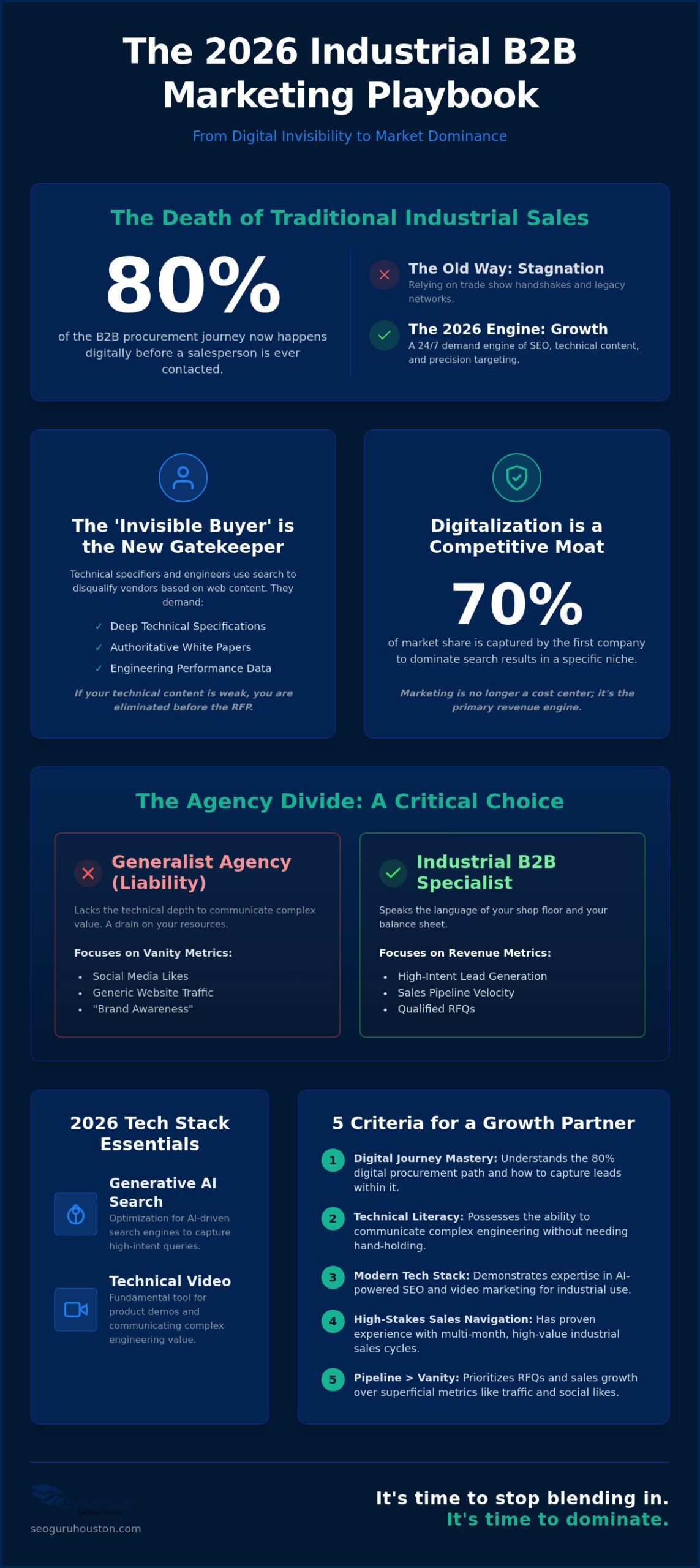
The traditional industrial sales model didn’t just fade away; it hit a wall. If your growth strategy still relies on trade show handshakes and legacy networks, you’re building your future on sand. By 2026, the reality is stark: 80% of the B2B buying journey happens digitally before a human salesperson is ever contacted. This isn’t a minor shift. It’s a total overhaul of how Industrial marketing functions. You aren’t just selling a machine or a component; you’re competing for the attention of a buyer who has already decided whether you’re worth their time before you even know they exist.
Relying on the old school “Relationship Model” alone is a recipe for stagnation. While your competitors are building high-velocity demand engines, you’re stuck waiting for the phone to ring. Leading industrial b2b marketing agencies now focus on creating synchronized systems where SEO, technical content, and precision targeting work in a 24/7 loop. This is the 2026 Industrial Demand Engine. It’s the difference between being a market ghost and a market leader. If you aren’t visible where your prospects are researching, you don’t exist. Your choice of industrial b2b marketing agencies determines whether you adapt to this digital reality or simply disappear from the conversation.
The Rise of the ‘Invisible Buyer’
Technical specifiers are the new gatekeepers. These engineers and procurement officers use search engines to eliminate vendors with surgical precision long before a discovery call. If your website lacks deep technical specifications or authoritative white papers, you’re disqualified before the first round. Being findable isn’t enough anymore. You must be the undisputed authority in your niche. If you don’t capture early-stage intent through technical content, you’ll never see the RFP. You need content that answers the “how” and “why” of your engineering, not just the “what.”
Digitalization as a Competitive Moat
The gap between digital leaders and laggards is widening into a canyon. In the manufacturing sector, the first company to dominate search results for a specific niche typically captures 70% of the available market share. This isn’t just about traffic; it’s about revenue. You must stop viewing marketing as a cost center and start seeing it as your primary revenue engine. Companies that invest in a robust digital presence create a moat that competitors can’t easily cross with a bigger sales team. It’s about owning the digital real estate that matters most to your bottom line and your future growth.
Industrial Demand Generation is the fundamental necessity for 2026 business survival, turning technical complexity into a predictable pipeline of high-intent leads.
Why Generalist Marketing Firms Are a Liability for Industrial Brands
Hiring a generalist marketing firm for a manufacturing or engineering brand isn’t just a mistake; it’s a strategic liability. These agencies are built to sell consumer goods and simple software, not specialized heavy machinery or precision components. They operate on a broad and shallow level, lacking the technical depth required to communicate your value proposition to a room full of skeptical engineers. While they might produce a visually appealing website, they consistently fail to bridge the technical gap. You end up spending your valuable time teaching them the basics of your industry instead of scaling your revenue. This is a drain on your resources and a gift to your more agile competitors.
The difference in results is measurable and immediate. Generalist firms obsess over vanity metrics like social media likes or generic website traffic. These numbers look great in a monthly report but do absolutely nothing for your bottom line. Top-tier industrial b2b marketing agencies focus on industrial metrics: RFQs, sales pipeline velocity, and high-intent lead generation. A specialist understands that one qualified procurement officer is worth more than ten thousand random visitors. If your current agency can’t explain the difference between a lead and a technical specifier, they’re costing you market share every single day.
The Danger of ‘Fluff’ in Technical Markets
Industrial buyers have a zero-tolerance policy for generic marketing speak. When a technical specifier lands on your page, they’re looking for tolerances, material certifications, and performance data. Fluff kills trust instantly. Generalist SEO strategies often fail because they target broad, B2C-style keywords that bring in the wrong audience. You need engineering-grade content that addresses the specific pain points of technical personas. Without this level of precision, your digital presence remains a hollow shell that fails to convert high-value prospects.
Long Sales Cycles vs. Short-Term Tactics
Most marketing firms optimize for immediate, impulsive conversions. In the industrial world, where sales cycles can stretch to 18 months or longer, these short-term tactics are useless. You need a b2b demand generation agency that understands multi-touch attribution and long-term lead nurturing. Success in this sector requires building an ecosystem that survives the long haul, keeping your brand top-of-mind from the initial research phase to the final contract signature. If you’re ready to stop wasting budget on shallow strategies, it’s time to partner with an authoritative industrial growth coach who understands the technical complexity of your specific market.
The 2026 Industrial Marketing Tech Stack: Dominating the Digital Ecosystem
Stop treating your martech stack as a digital filing cabinet. For mid-market firms, the total annual cost of a sophisticated marketing technology stack now ranges between $200,000 and $600,000. If you aren’t seeing a direct line from this investment to closed-won revenue, you’re hemorrhaging cash. Elite industrial b2b marketing agencies use this stack as a strategic weapon to close the loop between initial discovery and final contract. By the end of 2026, over 80% of B2B marketers will utilize AI for deep personalization. You must integrate generative engines into your discovery process now or risk being filtered out by AI-driven search algorithms that prioritize technical depth over surface-level keywords.
The 2026 SEO blueprint has pivoted. It’s no longer about broad industry terms; it’s about “Specifier’s Intent.” This means targeting the exact technical queries an engineer types when they’re hunting for a specific tolerance, material grade, or load capacity. Dominance requires a synchronized ecosystem where your CRM isn’t just a database for sales, but a feedback loop for marketing. If your data isn’t moving seamlessly between these systems, you’re losing high-intent leads to more agile competitors who have already automated their technical discovery. Partnering with a specialized manufacturing marketing agency that understands these technical nuances is the fastest path to closing that gap.
Website Video Marketing for Technical Products
Video is the only medium that effectively communicates the precision of complex industrial automation or heavy machinery. It reduces sales friction by answering critical technical questions before they’re even asked. When you integrate high-quality, spec-heavy video into a high converting landing page design, you build immediate credibility with engineers who don’t have time for a 30-minute discovery call. It’s about showing your engineering prowess in seconds, not paragraphs. In 2026, video is a fundamental necessity for building trust in high-stakes technical markets.
AI and Predictive Lead Scoring
Standard lead scoring is obsolete. In 2026, predictive AI identifies which technical leads are ready for human intervention based on granular behavioral data and historical patterns. This allows your sales team to stop chasing ghosts and focus exclusively on high-intent prospects. Leading industrial b2b marketing agencies leverage these tools to automate personalized content delivery at scale. This is how a specialized b2b content marketing agency maintains engineering-grade quality while significantly increasing output. If you aren’t using AI to score leads, you’re wasting your most expensive resource: your sales team’s time.
5 Non-Negotiable Criteria for Selecting an Industrial B2B Agency
Selecting the wrong partner is more than a budget leak; it’s a strategic setback that hands your market share to competitors. If you’re interviewing industrial b2b marketing agencies, you must look past the flashy slide decks and focus on technical substance. You need a partner that understands the high-stakes nature of a seven-figure industrial contract. Don’t settle for a vendor that treats your business like a retail brand. You require a growth coach who understands your shop floor and your sales cycle. Average marketing doesn’t survive in high-stakes technical markets.
- Proven Expertise in Complex Sales: Demand to see a multi-month lead-to-revenue map. If they can’t visualize a 12-month industrial sales cycle, they don’t understand your business.
- Technical Literacy: Their team must include writers who understand manufacturing and engineering. If they can’t explain your product’s tolerances or load capacities, they can’t sell it to an engineer.
- SEO and PPC Dominance: Ask for proof of first-page results for competitive industrial terms. If they can’t dominate the search results for their own niche, they won’t do it for yours.
- Full-Funnel Capability: A true b2b digital agency handles everything from high-level strategy to granular technical implementation and demand generation.
- Performance-Based Reporting: Stop looking at “Impressions” or “Likes.” Your reports should focus on “Industrial Pipeline Value” and the number of qualified RFQs generated.
Vetting for Technical Depth
Use the RFP process to expose surface-level agencies. Ask them to explain a specific engineering challenge your customers face or to critique your current technical specifications. Request samples of their most technical white papers or case studies. If the content feels like generic AI-generated fluff, walk away immediately. You need expert-led insights that build immediate trust with technical personas. In 2026, technical depth is the only way to capture the attention of the invisible buyer.
The ‘Assertive Partner’ Test
You don’t need a “yes man” who just takes orders. You need an agency that challenges your assumptions and pushes you toward market dominance. A true growth coach is obsessed with your ROI and your move from invisibility to prominence. Evaluate the agency’s own digital presence as a proof of concept. If they aren’t leading the pack in their own field, they lack the DNA to lead you to the top of yours. If you’re ready to stop playing it safe and start dominating your niche, it’s time to partner with an assertive industrial growth expert who understands the bottom line.
Scaling Industrial Revenue: Why an Assertive Growth Partner is Your Only Option
By 2026, the digital margin for error has vanished. There is no room for ‘average’ in industrial search results. If you aren’t in the top three positions for your core technical terms, you’re effectively invisible to the buyers who research exclusively online. Most industrial b2b marketing agencies play it safe with generic strategies that yield generic results. You don’t need a safe pair of hands; you need an assertive growth partner that moves you from digital invisibility to absolute prominence. Scaling revenue in a technical niche requires a relentless focus on market dominance, not just maintenance.
To see how digital architecture can be specifically engineered for this kind of growth, you can discover The Palm Group and their performance-focused communication systems.
The roadmap to dominance is built on three pillars: Strategy, Execution, and Aggressive Optimization. You must position your brand as the ‘Guru’ of your specific industrial niche. This means owning the technical conversation and providing the depth that specifiers crave. When you dominate the digital ecosystem, you aren’t just participating in the market; you’re setting the standards. An assertive manufacturing marketing agency doesn’t just wait for leads; they engineer a system that captures demand before your competitors even realize the game has changed. It’s about precision, movement, and a refusal to settle for second place.
Turning Your Website into a 24/7 Sales Machine
Stop thinking of your website as a digital brochure. In 2026, it must function as a high-energy conversion engine. This shift requires moving beyond ‘brochureware’ to a platform that speaks directly to technical pain points. The ROI of professional seo services in the manufacturing sector is found in the ability to capture high-intent traffic at the exact moment of need. By optimizing for technical intent, you turn your site into a 24/7 sales machine that qualifies prospects and generates RFQs while your sales team focuses on closing deals. Dominating your niche requires this level of digital aggression.
The SEO Guru Houston Advantage
SEO Guru Houston provides an assertive approach to industrial lead generation and demand generation that generalist firms can’t match. We are your growth coaches, intensely focused on the bottom line: Growth, Visibility, and Market Dominance. Our framework is designed specifically for the complex sales cycles of the manufacturing and engineering sectors. We don’t linger on abstract theories; we move methodically through the processes that deliver measurable financial returns. Stop losing revenue to more agile competitors who are already claiming your digital real estate. It is time to take decisive action and secure your position at the top of the search results.
Secure Your Market Dominance in the 2026 Industrial Landscape
The 2026 industrial market doesn’t reward participation; it rewards dominance. You’ve seen how the digital landscape has shifted toward the invisible buyer and why technical depth is now your most valuable asset. Relying on outdated relationship models or generalist firms is a strategy for decline. To win, you must deploy a synchronized demand engine that speaks the language of engineering and procurement with absolute authority. Your technical complexity isn’t a hurdle; it’s your greatest competitive advantage when wielded correctly.
Choosing between industrial b2b marketing agencies is the most critical strategic decision your firm will make this year. You need a partner that doesn’t just manage your presence but aggressively scales your revenue. At SEO Guru Houston, we provide a specialized industrial demand generation framework and proven 2026 SEO strategies designed to turn your expertise into a high-velocity lead machine. It’s time to stop letting more agile competitors claim your digital territory. Our assertive, results-oriented growth coaching ensures your brand moves from invisibility to prominence. The future of your market share depends on the actions you take right now.
Dominate Your Industrial Niche—Partner with SEO Guru Houston Today!
Frequently Asked Questions
What does an industrial B2B marketing agency do differently?
Specialized agencies bridge the technical gap between complex engineering and market-ready communication. Unlike generalists, industrial b2b marketing agencies understand specifier intent and the reality of multi-month sales cycles. They focus on generating RFQs and pipeline value rather than vanity metrics like likes or shares. This deep technical expertise ensures your value proposition isn’t lost in translation when communicating with skeptical engineers.
Why is SEO so important for manufacturing and industrial companies in 2026?
SEO is the primary engine for capturing the “invisible buyer” who now completes 80% of their journey digitally. Search dominance for specific technical niches allows you to capture the lion’s share of your market. If you aren’t visible when an engineer searches for specific tolerances or material grades, you’re disqualified before the first call. It’s about owning the digital real estate where your prospects conduct their research.
How long does it take to see ROI from an industrial marketing campaign?
You should expect to see measurable engagement and lead flow within the first 90 days, but full ROI typically aligns with your standard sales cycle. Because industrial sales often take 12 to 18 months, your marketing must function as a long-term demand engine. We track leading indicators like pipeline velocity and high-intent lead volume. This approach ensures you’re building a predictable revenue stream rather than chasing short-term spikes.
Can an agency really understand my highly technical product?
A specialized agency employs technical strategists who speak the language of the shop floor. We don’t just skim the surface; we dive into your spec sheets, performance data, and CAD files. This technical literacy is what separates elite industrial b2b marketing agencies from the rest of the pack. If an agency can’t explain your engineering value proposition, they simply can’t sell it to your technical audience.
What is the difference between lead generation and demand generation for industrial brands?
Lead generation captures existing interest, while demand generation creates a preference for your brand before a buyer is even in-market. Lead gen is the net, but demand gen is the reason they swim toward it. In 2026, you need both to dominate your niche. Demand generation builds the authority that makes your firm the only logical choice when an RFP finally hits your desk.
How much should an industrial company spend on digital marketing in 2026?
Average marketing budgets in 2026 represent approximately 7.8% of total company revenue. Within that allocation, paid media accounts for 31.4% of the spend, marking a five-year high for the industry. You must allocate sufficient resources to remain competitive in a crowded digital landscape. Under-investing in your digital engine is a recipe for invisibility while your competitors aggressively capture your market share.
Is LinkedIn advertising effective for industrial B2B marketing?
LinkedIn is a powerhouse for industrial targeting because it allows you to reach specific job titles and technical roles with surgical precision. It’s exceptionally effective for account-based marketing and promoting deep technical white papers. By targeting specifiers and procurement officers directly, you bypass the noise of general social platforms. It’s a fundamental component of any high-performance demand engine designed for market dominance.

