
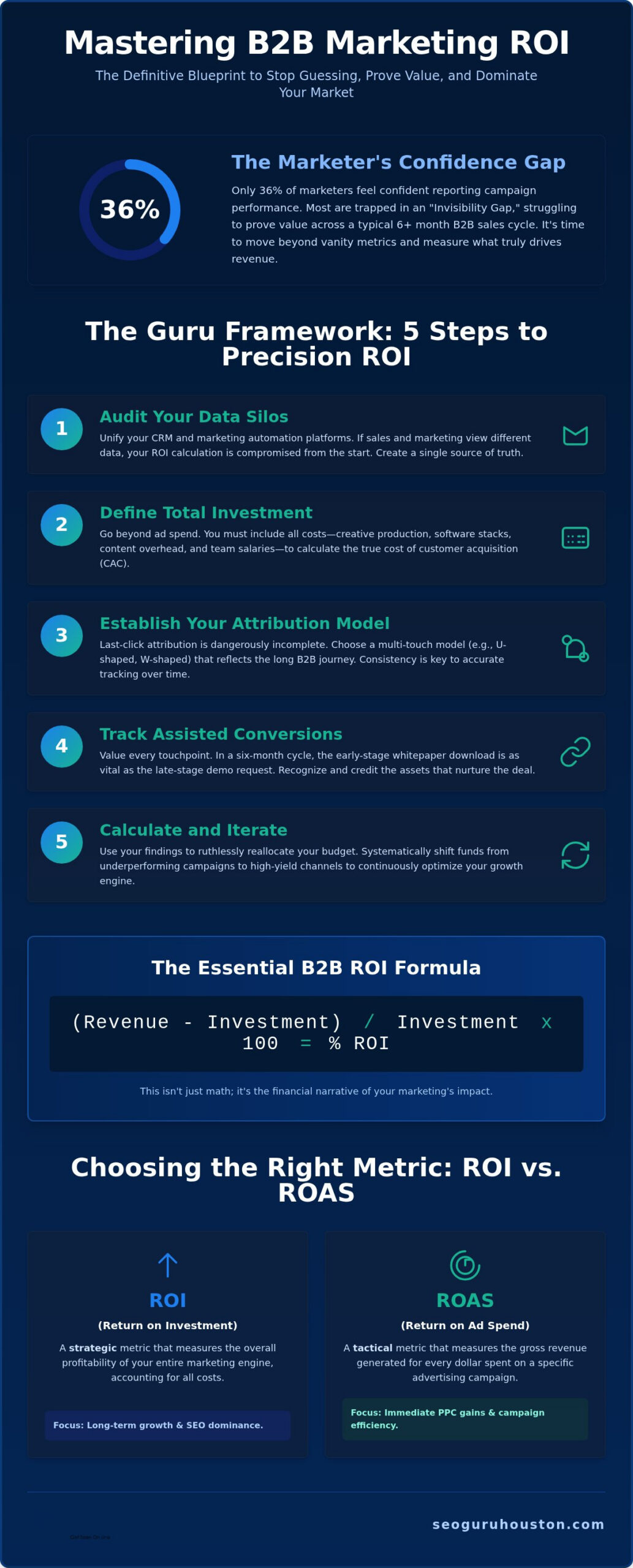
Only 36% of marketers actually feel confident when they report campaign performance to the board. If you’re tired of defending your budget while staring at a six month sales cycle that feels like a black hole, you aren’t alone. Most leaders are drowning in vanity metrics while real revenue stays hidden behind complex multi channel attribution hurdles. Mastering the science of measuring b2b marketing roi isn’t just about spreadsheets; it’s about survival in a 2026 market where Google Ads CPCs have climbed to an average of $5.58. You need more than just traffic to win.
You know that high performance marketing should be your greatest profit engine, but proving that value to skeptical leadership is a constant battle. This guide provides the exact blueprint you need to stop guessing and start dominating. We’re handing you the definitive formula to calculate, prove, and explode your returns while ruthlessly eliminating wasted ad spend. You’ll move from defensive reporting to confident scaling, backed by a clear framework that turns technical data into a strategic narrative for the boardroom. It’s time to bridge the gap between digital visibility and measurable financial return.
Key Takeaways
- Stop chasing vanity metrics and learn to bridge the “Invisibility Gap” by tracking leads across long, complex sales cycles.
- Master the definitive five-step framework for measuring b2b marketing roi to unify your data silos and prove technical impact.
- Distinguish between tactical ROAS for immediate PPC gains and strategic ROI for long-term SEO dominance to optimize every dollar spent.
- Deploy high-converting landing pages and website video marketing as non-negotiable tools to slash your sales cycle and explode engagement.
- Shift your marketing from an optional luxury to a fundamental growth engine by focusing on high-impact revenue drivers rather than lead volume.
Beyond Vanity Metrics: Why Most B2B ROI Calculations Are Dangerously Incomplete
Most B2B leaders are flying blind. They rely on surface-level data that suggests their marketing is working, yet the bank account tells a different story. If you’re only looking at ad spend versus immediate sales, your model for measuring b2b marketing roi is broken. This “Invisibility Gap” occurs because a typical B2B sales cycle spans six months or longer. Traditional models ignore the dozens of touchpoints that happen before a lead ever hits your CRM. You can’t just track a click; you have to track the entire journey from initial awareness to final signature.
Stop worshipping Marketing Qualified Leads (MQLs). Lead volume is a deceptive metric that often masks a lack of real growth. A thousand “cheap” leads that never close are a liability, not an asset. You must also account for hidden costs like creative production, software stacks, and internal overhead. Ignoring these creates a false sense of profitability. Additionally, “Dark Social” and word-of-mouth recommendations are silent killers of traditional models. They drive massive value but rarely show up in your dashboard. When you’re measuring b2b marketing roi, you have to look beyond what your software can easily tag.
The Failure of Single-Touch Attribution
Last-click attribution is a lie. It gives all the credit to the “closer” and completely ignores the “opener” that actually started the conversation. If you cut budgets for top-of-funnel awareness campaigns because they don’t show immediate conversions, you’re effectively sabotaging your future pipeline. Modern B2B buying requires a multi-touch reality. You need a system that recognizes the cumulative effect of every interaction. Understanding the broader Return on Marketing Investment (ROMI) helps you see the forest, not just the last tree. Only 36% of marketers feel they can accurately measure this, which is why an assertive, data-first approach is mandatory for survival.
Defining “Real” Revenue in a B2B Context
Real revenue isn’t just a signed contract. You need to distinguish between Pipeline Value, Annual Recurring Revenue (ARR), and Customer Lifetime Value (LTV). If your ROI calculation doesn’t account for deal velocity and the sheer length of the sales cycle, you’re making decisions based on incomplete math. You should be looking at how marketing activities shorten the time it takes for a lead to become a customer. B2B Marketing ROI is the total financial impact of marketing on the entire customer lifecycle. High-performance teams focus on how marketing accelerates deals and increases the total value of the account over time, not just how many names it puts on a list.
The Guru Framework: 5 Steps to Measuring B2B Marketing ROI with Precision
Precision isn’t a luxury; it’s a requirement for survival. If you want to dominate your market in 2026, you have to stop guessing which campaigns are driving profit. The Guru Framework is designed to strip away the fluff and focus on hard financial outcomes. Measuring b2b marketing roi requires a systematic approach that connects every dollar spent to a specific stage of the revenue cycle. You can’t manage what you don’t measure with absolute clarity.
- Step 1: Audit your data silos. Unify your CRM and marketing automation platforms immediately. If your sales and marketing teams are looking at different numbers, your ROI calculation is already compromised.
- Step 2: Define your total investment. Go beyond ad spend. You must include creative production, technical stack costs, and content overhead to see the true cost of acquisition.
- Step 3: Establish your attribution model. Decide now whether you’ll use W-shaped or U-shaped frameworks. Consistency is more important than perfection.
- Step 4: Track the “Assisted Conversion.” Value the touchpoints that nurture the deal. In a six month cycle, the whitepaper download in month two is just as vital as the demo request in month five.
- Step 5: Calculate and Iterate. Use your findings to aggressively reallocate budget from underperformers to high-yield channels.
The Essential ROI Formula for B2B Growth
The standard math is simple: (Total Revenue – Total Marketing Investment) / Total Marketing Investment x 100. However, B2B leaders must adjust for Customer Lifetime Value (LTV). A lead that costs $1,000 might seem expensive, but it’s a bargain if that client stays for five years and generates six figures in revenue. You should also track “Marketing Influenced Pipeline.” In most successful B2B companies, marketing should source 30% to 50% of the total pipeline. Don’t forget to include sales-enablement content costs in your investment pool. Total transparency is the only way to build trust with the board.
Choosing Your Attribution North Star
Your choice of model dictates which channels will appear profitable. W-Shaped attribution is often the gold standard for complex demand generation because it gives equal weight to the first touch, the lead conversion, and the opportunity creation. If you prefer to value the final push without ignoring the foundation, a Time-Decay model might serve you better. If you’re ready to optimize your strategy for maximum impact, our experts in Houston PPC services can help you implement these advanced tracking frameworks to ensure every cent of your budget is working toward market dominance.
ROI vs. ROAS: Choosing the Right Metric to Scale Your Growth Engine
You can’t confuse a tactical battle plan with a total war strategy. ROAS is your tactical view, essential for optimizing Houston PPC services to ensure your daily spend isn’t evaporating. ROI is the strategic view, the only metric that truly validates professional SEO services over a multi-year horizon. If you’re measuring b2b marketing roi correctly, you’ll realize that a high ROAS can actually be a warning sign. It often signals you’re caught in the “cheap lead” trap. This happens when you capture low-intent traffic that clogs your sales pipeline without ever converting to real revenue. High ROAS looks great on a spreadsheet, but it doesn’t always pay the bills.
When to Obsess Over ROAS
Obsess over ROAS when you need an immediate pipeline injection. Use it to scale Google Ads and LinkedIn campaigns where speed is the primary objective. It’s your best diagnostic tool for landing page performance and ad creative. If an ad set is “bleeding” cash, kill it. With B2B CPCs hitting an average of $5.58 in 2026, you don’t have the luxury of patience. You must identify failing segments before they drain your quarterly budget. ROAS allows you to make these split-second decisions with confidence, ensuring your tactical execution remains sharp and profitable. It’s about efficiency in the moment. It tells you exactly which lever to pull to keep the engine running.
Why ROI is the Only Metric That Matters to the CEO
Your CEO doesn’t care about click-through rates or cost-per-click. They care about the bottom-line profitability of the enterprise. This is why a sophisticated b2b demand generation agency prioritizes ROI over vanity clicks every single time. ROI accounts for the full cost of doing business, including the long sales cycles and multi-touch journeys typical of industrial commerce. It justifies aggressive expansion into new search markets because it proves that every dollar invested returns as profit. When you master measuring b2b marketing roi, you stop being a cost center. You become a primary revenue driver with the data to prove it. Balance your short-term wins with this long-term view to achieve true market dominance. This is how you move from invisibility to prominence.
Strategic Optimization: Turning Low-Yield Campaigns into High-Impact Revenue Drivers
Optimization is where market leaders are made. If you’re simply measuring b2b marketing roi without acting on the insights, you’re just documenting your own stagnation. High-performance marketing requires a ruthless focus on the variables that actually move the needle. You must identify where your “leaky funnel” is costing you money and pivot your resources toward the channels that demonstrate proven scalability.
Landing Pages: The Foundation of Conversion
A high converting landing page design is the non-negotiable foundation of any profitable campaign. Sending expensive PPC traffic to your homepage is an ROI death sentence. Partnering with a specialized provider like Dulyfixed Small Business Solutions for mobile-first design ensures you don’t waste that investment. You have exactly three seconds to communicate your unique value proposition before a prospect bounces. If you don’t grab them immediately, you’ve wasted your ad spend. Rigorous A/B testing can lead to a 200% increase in lead quality by filtering out tire-kickers and focusing on high-intent decision-makers who are ready to talk business.
Professional website video production is a force multiplier for complex industrial explanations. It builds trust before your sales team even picks up the phone. Some industry professionals report that strategic video content can slash the sales cycle by up to 30% by answering critical technical questions early in the buyer journey. Use video engagement data as a high-intent signal for lead scoring. If a prospect watches 90% of your product teardown, they’re ready for a conversation. This data point is essential for accurately measuring b2b marketing roi across multi-touch journeys.
Demand Gen: Winning the 97% of the Market Not Currently Buying
Most of your competitors are fighting over the 3% of the market currently looking to buy. They’re ignoring the 97% who aren’t in-market today but will be tomorrow. This is where demand generation beats simple lead generation. An assertive inbound marketing strategy for b2b creates compounding ROI over time. By positioning yourself as the authoritative “Guru” in your niche, you build brand equity that naturally lowers your customer acquisition costs. You aren’t just capturing demand; you’re creating it. This long-term focus ensures your pipeline stays full even when competitors are struggling with rising CPCs.
Ready to stop chasing low-quality leads and start dominating your industry? Let us build your custom demand generation engine to secure your market position for 2026 and beyond.
Scale to Dominance: Partnering with a Result-Oriented Growth Engine
Market dominance is not a happy accident; it is the result of a calculated, high-energy offensive. To win in 2026, an assertive marketing partner is a fundamental necessity, not an optional luxury. While your competition is distracted by minor tactical tweaks, you need a team that focuses intensely on the bottom line. Measuring b2b marketing roi becomes a weapon only when you have the expertise to act on the data with precision. You need a high-performance coach, not just another vendor, to navigate this complex landscape.
The Guru Difference is built on proactive strategic coaching. Most agencies hide behind passive monthly reports that highlight meaningless clicks or impressions. A true growth engine moves beyond reporting to identify the critical gaps in your current digital standing. We vet every tactic against your specific revenue goals and deal velocity. If a channel isn’t contributing to market dominance, it’s a distraction. Reclaiming your market share starts with a partner who is as committed to your financial return as you are. Taking decisive action today is the only way to secure your lead and leave the competition behind.
The Danger of “Affordable” SEO
Low-cost firms are the silent killers of ROI. They rely on generic strategies and poor execution that leave your brand invisible to high-value decision-makers. The true cost of “cheap” SEO isn’t just the invoice; it’s the six to twelve months of lost time while your competitors scale their visibility. In a competitive digital landscape, you cannot afford to wait for results that will never come. You should invest in growth partners who understand that professional SEO is a high-yield asset, not a monthly expense. Settling for less is a guaranteed way to bleed market share and waste your potential.
Your Blueprint for 2026 Market Dominance
Dominance requires setting aggressive yet measurable KPIs for the next twelve months. You need to focus on pipeline-sourced revenue and customer lifetime value rather than simple lead counts. Your scaling strategy must integrate technical SEO with high-performance PPC to capture and create demand simultaneously. This dual-engine approach ensures that you aren’t just measuring b2b marketing roi, but actively exploding it. Stop guessing at your digital standing. It is time to take decisive action and implement a framework that turns your marketing spend into a proven profit center. Start dominating your industry today by partnering with a team that values results over activity.
Claim Your Market Share: The Path to 2026 Profitability
The era of defending vague budgets is over. To achieve market dominance, you must bridge the invisibility gap by moving beyond surface-level metrics and embracing a multi-touch attribution reality. We’ve laid out the framework for measuring b2b marketing roi with surgical precision, from unifying your data silos to leveraging high-impact website video marketing that slashes sales cycles. By distinguishing between tactical ROAS and strategic ROI, you position your brand as a primary revenue driver rather than a cost center.
Success in the industrial and manufacturing sectors requires a partner who understands the nuances of high-converting demand generation. With our results-oriented SEO and PPC expertise, we help you stop burning ad spend on low-yield traffic and start scaling high-performing channels. Don’t let your competition dictate the digital landscape. Stop guessing and start scaling; get your assertive B2B marketing strategy from the Gurus today!
You have the blueprint. Now, it’s time to take decisive action and transform your digital presence into a dominant growth engine. Your future market share depends on the choices you make today. Let’s start winning.
Frequently Asked Questions
What is a good ROI for B2B marketing in 2026?
A strong ROI varies by channel, but 2026 benchmarks show SEO leading with a 748% return. For paid efforts, Google Ads averages 200%, while LinkedIn campaigns typically see around 229%. You should aim for marketing to source 30% to 50% of your total pipeline. If your returns fall below these industry standards, your strategy likely lacks the technical precision required for market dominance. Focus on high-impact channels to ensure every dollar works.
How long does it take to see a positive ROI from SEO?
SEO is a long-term profit engine that typically requires six to twelve months to show positive returns. This timeline aligns with the standard B2B sales cycle, which often involves multiple decision-makers. While PPC offers immediate visibility, SEO builds compounding equity that eventually delivers the highest ROI in the digital ecosystem. You aren’t just buying traffic; you’re building a permanent market position that lowers your customer acquisition costs over time.
Can I measure ROI without expensive marketing attribution software?
You can start measuring b2b marketing roi by unifying your existing CRM and marketing automation data. While complex attribution software provides deeper insights, a disciplined manual audit of your data silos often reveals the most critical gaps. Focus on tracking “Marketing Influenced Pipeline” and deal velocity within your CRM. This assertive approach allows you to prove value and justify future investments in more sophisticated tech stacks once you’ve established a baseline.
How do I calculate ROI for B2B content marketing?
Calculate content ROI by dividing the total revenue generated from content-led leads by your total content investment. This investment must include creative production, software costs, and distribution spend. Because B2B buying journeys are complex, you should also factor in Customer Lifetime Value. A single high-value whitepaper might influence a six-figure deal that lasts five years. Use this long-term perspective to prove that content is a fundamental necessity for growth, which is why many firms partner with Content Marketing SG to optimize their output for modern search environments.
ROAS is a tactical metric used to measure the immediate efficiency of ad spend, while ROI is the strategic view of total business profitability. In 2026, with B2B CPCs averaging $5.58, a high ROAS doesn’t always mean your business is growing. You might be capturing “cheap leads” that never close. measuring b2b marketing roi requires looking at the total financial impact across the entire customer lifecycle, including overhead and technical costs.
How do I prove marketing ROI to a skeptical CEO?
Proving value to a skeptical CEO requires shifting the conversation from vanity metrics to hard revenue. Present the “Marketing Influenced Pipeline” and show how marketing activities accelerate deal velocity. Use specific data, such as the fact that global ad spend is growing by 5.1% in 2026, to highlight the competitive necessity of an assertive digital strategy. When you connect marketing spend directly to bottom-line profit, you move from being a cost center to a revenue leader.
Why is my B2B lead generation ROI lower than expected?
Low ROI often stems from the “cheap lead” trap or a “leaky funnel” where high-quality traffic is lost due to poor nurture strategies. If your visitor-to-lead conversion rate is below the 2.3% industry average, your messaging or targeting is likely off. Additionally, ignoring “Dark Social” or multi-touch attribution can make your campaigns look less effective than they actually are. You must audit your entire journey to identify where potential revenue is slipping away.
How does landing page design impact my marketing ROI?
Landing page design is the non-negotiable foundation of your conversion engine. If you’re sending traffic to a generic homepage, you’re effectively destroying your ROI. A professional, high-converting design communicates value within three seconds and can increase lead quality by up to 200%. In a market where B2B website conversion rates average 2.9%, even a small improvement in your landing page performance can lead to a massive explosion in total financial return.

