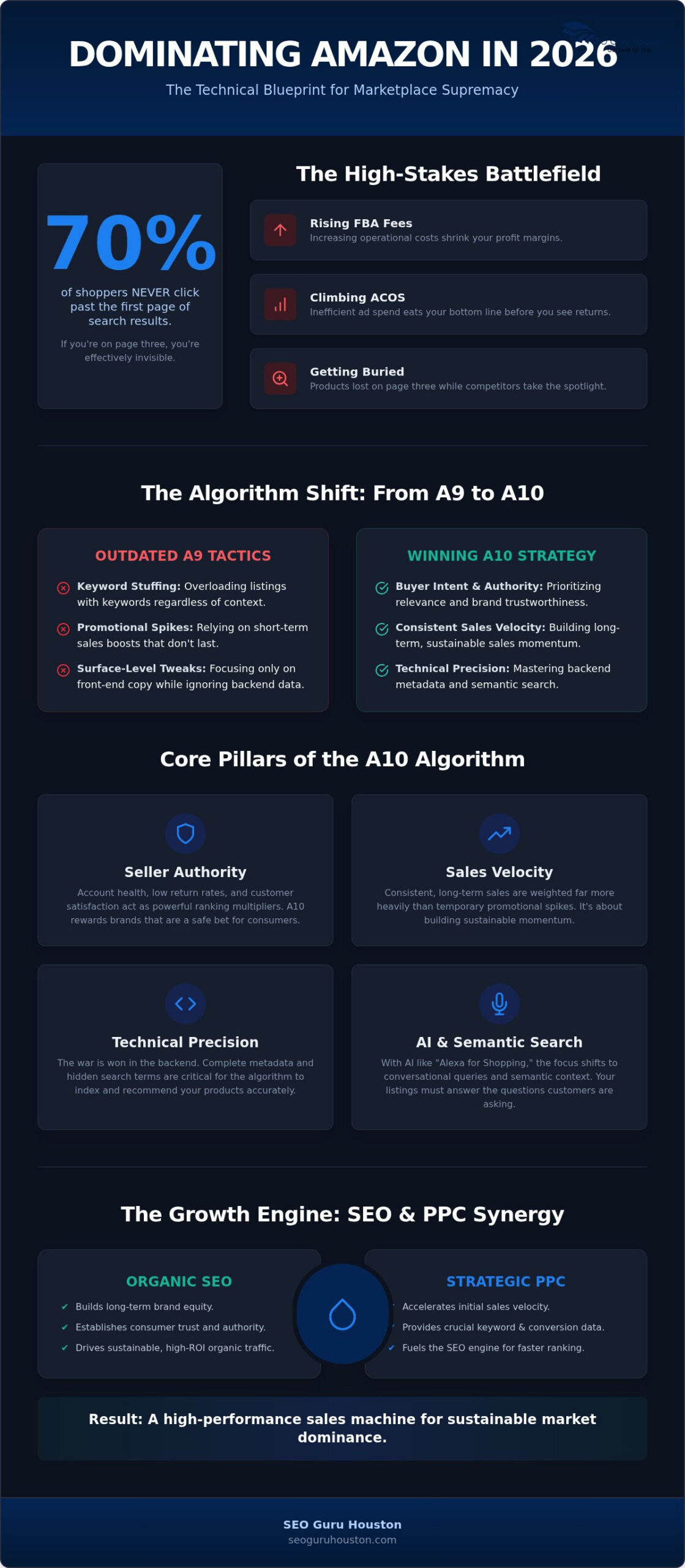
In 2026, a mediocre Amazon listing isn’t just a missed opportunity; it’s a slow-motion business suicide. You’ve likely watched your ACOS climb while your organic visibility sinks, leaving your brand buried under competitors who mastered the new 75-character title limit and assertive amazon product listing optimization months ago. It’s exhausting to fight for scraps while you’re still guessing what the current A9 algorithm actually wants from your product data. This is a brutal market that rewards precision and punishes hesitation.
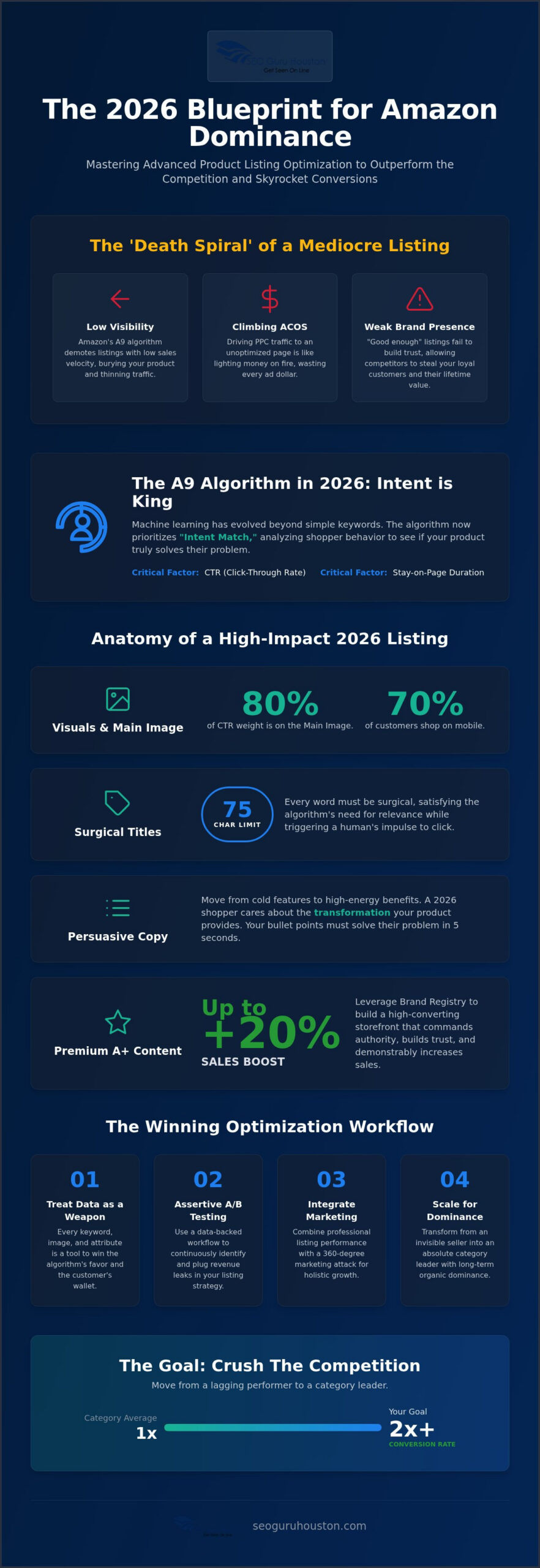
This is where the guesswork ends. You’re about to master the strategies required to crush the competition and skyrocket your conversion rates to 2x the category average. We’ll break down the 2026 blueprint for market dominance, from leveraging the new searchable Item Highlights field to securing Premium A+ content that can boost sales by up to 20%. We’ll also explore how to navigate the 3.5% fuel and logistics surcharge while protecting your bottom line. This is your definitive guide to transforming from an invisible seller into an absolute category leader.
Key Takeaways
- Reverse the “Death Spiral” of low visibility by treating your product data as a competitive weapon rather than a simple administrative task.
- Master the strategic placement of high-intent keywords within the 2026 title constraints and Item Highlights to dominate your amazon product listing optimization.
- Unlock the power of Premium A+ Content and Brand Registry to build a high-converting storefront that commands authority and boosts sales by up to 20%.
- Implement a data-backed optimization workflow that uses assertive A/B testing to identify and plug revenue leaks in your current listing strategy.
- Scale your market share by integrating professional listing performance with a 360-degree marketing attack designed for long-term organic dominance.
Beyond the Basics: Why Generic Amazon Listings are Revenue Killers
Stop treating your Amazon presence like a digital filing cabinet. In the hyper-competitive landscape of 2026, amazon product listing optimization isn’t an optional luxury or a simple data entry task; it’s a tactical siege on the marketplace. If you’re still approaching your listing with a “set it and forget it” mentality, you’re essentially handing your market share to the competition. High-performance brands recognize that every word, every image, and every backend attribute is a weapon designed to win the algorithm’s favor and the customer’s wallet.
The greatest threat to your brand growth is invisibility. When your conversion rates lag behind the category average, you enter the “Death Spiral.” This is a brutal feedback loop where Amazon’s algorithm notices your lack of sales velocity and systematically demotes your organic ranking. As your visibility drops, your traffic thins, and your ability to recover becomes exponentially more expensive. You can’t just spend your way out of a bad listing with PPC; you need a foundation that converts at a high level to prove your worth to the system. This is why professional Search engine optimization (SEO) principles are now the bedrock of Amazon success.
The Evolution of the Amazon A9 Algorithm in 2026
Machine learning has fundamentally changed the rules of engagement. By 2026, the algorithm has moved beyond primitive exact-match keywords to prioritize “intent match.” It analyzes complex patterns in shopper behavior to determine if your product truly solves the user’s problem. Metrics like click-through rate (CTR) and stay-on-page duration are now critical ranking factors. If your 2024 strategy relied on high-volume keywords without considering relevance, that approach is already obsolete. You must align your content with the specific psychological triggers that drive a 2026 shopper to click and buy. The machines are watching how humans interact with your brand, and they’re rewarding the listings that provide the most seamless experience.
The Real Cost of Mediocrity
Mediocrity is the most expensive mistake you can make in the Amazon ecosystem. When you drive traffic to a non-optimized landing page, you’re effectively lighting your ad spend on fire. Every bounce is a wasted dollar and a signal to the algorithm that your product isn’t a winner. Beyond the immediate financial loss, “good enough” listings suffer from a weak brand presence that fails to build trust. In a marketplace where shoppers have infinite choices, a lack of professional polish allows competitors to steal your loyal customers. You aren’t just losing a single sale; you’re losing the long-term lifetime value of a customer who no longer sees you as an authority in your niche. Masterful amazon product listing optimization is the only way to protect your margins and secure your territory.
The Anatomy of a High-Impact Listing: Keywords, Copy, and Conversion
A high-impact listing isn’t a technical manual; it’s a high-energy sales pitch. If your visuals don’t stop the scroll, your keywords simply won’t matter. Your main image carries 80% of the weight in the click-through rate (CTR) battle. In 2026, mobile-first optimization is mandatory because over 70% of your customers are shopping on handheld devices. If your listing looks cluttered or your text is unreadable on a smartphone, you’ve already lost the sale. You must design for the thumb, not the desktop.
Persuasive copywriting is about moving from cold features to high-energy benefit statements. Stop listing technical specs and start selling a transformation. A 2026 shopper doesn’t care about the material of your product as much as they care about the time it saves them or the status it confers. If you fail to hit the reader’s emotional core immediately, they’ll bounce to a competitor who does. This level of precision is the cornerstone of effective amazon product listing optimization.
Mastering the Title and Bullet Siege
Effective titles in 2026 must be surgical. With the strict 75-character limit implemented in July, every word must fight for its place. You need to satisfy the algorithm’s need for relevance while triggering a human’s impulse to click. Indexation is the definitive gateway to organic traffic, ensuring the algorithm recognizes your product as a relevant match for specific search queries. Once they click, your bullets must deliver a “Benefit-First” structure. Solving the customer’s problem in five seconds is the only way to maintain momentum. If the shopper doesn’t see a solution to their pain point within the first two bullets, they’re gone.
Backend Search Terms and Hidden Metadata
The invisible side of your amazon product listing optimization strategy is where you capture the traffic your competitors ignore. You have a 250-character limit in the backend search terms field. Use it wisely. Don’t repeat words already in your title or “Item Highlights.” Instead, leverage Spanish keywords and common misspellings to tap into massive, unserved audiences. This isn’t about keyword stuffing; it’s about expanding your reach. Fill out every “Subject Matter” and “Intended Use” field to tell the algorithm exactly where your product belongs. This hidden metadata is the secret to niche relevance and long-tail dominance. Mastering these technical nuances is the difference between a hobby and a high-performance business. If you’re ready to stop guessing, our Amazon services provide the tactical precision required to dominate.
Leveraging Brand Registry and A+ Content for Absolute Authority
Amazon Brand Registry is the non-negotiable foundation for any brand seeking more than just survival. In the 2026 marketplace, selling without a registered trademark (®) is a liability. This program doesn’t just provide a badge; it unlocks the full arsenal of amazon product listing optimization tools required to defend your territory. If you aren’t enrolled, you’re effectively fighting with one hand tied behind your back while competitors use advanced analytics and protection tools to systematically dismantle your market share.
A+ Content transforms a static page into a high-converting storefront. While basic A+ Content can increase sales by up to 8%, securing Premium A+ Content can skyrocket your conversions by up to 20%. To qualify for this elite status in 2026, you must have a published Brand Story across all listings and at least five approved A+ submissions within the last 12 months. This is about more than aesthetics. It’s about using every pixel to justify your price point and crush buyer hesitation before it starts.
The Strategic Advantage of A+ Content
Comparison tables are your most effective tool for keeping customers within your brand ecosystem. Instead of letting shoppers click away to a competitor’s product page to compare features, you provide that data right on your listing. This keeps the transaction focused on your catalog. High-energy lifestyle imagery allows you to justify premium pricing by showing your product in action, solving real-world problems. Additionally, detailed A+ modules set accurate expectations, which directly reduces return rates. When customers know exactly what they’re buying, your brand health remains pristine.
Brand Protection and Global Dominance
Winning the “Buy Box” battle is impossible without the assertive enforcement tools provided by Brand Registry. You can’t allow unauthorized resellers to bleed your margins or tarnish your reputation with inferior service. Use your Amazon Storefront as a dedicated destination for external traffic from social media or email campaigns, creating a controlled, high-conversion environment. This isn’t just about protection; it’s about global dominance. By integrating video marketing directly into your listing, you’ll explode engagement rates and leave static competitors in the dust. You have the tools to protect your intellectual property and scale your visibility. Use them.
The Guru’s Optimization Workflow: Testing, Iterating, and Scaling
Optimization is not a one-time event; it’s a relentless cycle of refinement. To achieve market dominance in 2026, you must adopt a high-performance workflow that moves beyond intuition and relies on cold, hard data. Phase 1 begins with a Baseline Audit. You must identify exactly where your listing is bleeding revenue. Is it a low click-through rate on your main image, or are customers bouncing because your “Item Highlights” fail to answer their core questions? Once you’ve identified the leak points, you move into the offensive phase of amazon product listing optimization.
Rigorous A/B Testing for Market Dominance
You must test one variable at a time to achieve statistically significant results. If you change your title and your price simultaneously, you’ll never know which move actually drove the result. Start with your main image. This is the fastest way to lower your customer acquisition cost (CAC). A 2026 shopper decides to click in milliseconds; your image must be the most professional and informative in the search results. Next, conduct price elasticity testing. Don’t just race to the bottom. Find the “sweet spot” where you maximize both volume and margin. This assertive approach ensures you aren’t leaving money on the table.
The Review Loop: Social Proof as a Conversion Engine
Social proof is the ultimate conversion multiplier. For new product launches in 2026, leveraging Amazon Vine is a fundamental necessity to jumpstart your review velocity and secure early organic ranking stability. However, the real “guru” move is analyzing your competitors’ negative reviews. These complaints are a goldmine for identifying “Gap Keywords” and pain points that other brands have ignored. By addressing these gaps in your own listing, you position your brand as the superior alternative. This feedback loop turns customer dissatisfaction into your strategic advantage. If your current strategy feels stagnant, it’s time to partner with an expert who understands these technical nuances. Our Amazon services provide the data-backed roadmap you need to scale.
Scaling is the final phase of the blueprint. Once you’ve perfected your domestic listing, you must expand into international marketplaces. This isn’t a simple translation task. It requires localized amazon product listing optimization that respects regional search habits and cultural nuances. Dominance isn’t just about winning one category; it’s about owning the global marketplace through precision and persistent iteration.
Partnering for Growth: Why Professional Amazon Optimization is Non-Negotiable
Success on Amazon in 2026 isn’t about checking boxes; it’s about tactical dominance. There’s a massive gulf between basic “listing services” that simply upload data and a high-performance growth partner that engineers revenue. A freelancer might get your product live, but a veteran strategist builds a scalable asset that survives algorithm shifts and aggressive competitor poaching. For B2B manufacturers, this specialized approach is even more critical. You aren’t just selling a unit; you’re managing complex specifications and high-volume procurement expectations that require a sophisticated 360-degree attack.
To win, you must integrate your organic amazon product listing optimization with a robust strategy for Amazon Marketing Services. Invisibility is a choice. If you aren’t leveraging professional expertise to bridge the gap between your technical data and your sales performance, you’re leaving your brand’s future to chance. The marketplace moves too fast for “good enough.” You need a partner who views your account through the lens of measurable ROI and long-term financial return.
Synergy Between Organic SEO and Amazon PPC
Your ad spend is only as effective as the page it lands on. When you invest in elite amazon product listing optimization, you’re directly lowering your PPC Advertising Cost of Sales (ACOS). A high-converting listing signals to the algorithm that your traffic is valuable, which often leads to lower bid costs and better ad placements. Additionally, your PPC data is a goldmine for organic discovery. We use your highest-converting ad keywords to refine your title and backend metadata, creating a virtuous cycle of visibility and profit. See our guide on Amazon PPC Management for more on how we synchronize these two forces for maximum impact.
The ROI of Assertive Management
Maintenance is just another word for slow failure. Market leaders don’t just maintain their positions; they aggressively expand them. The long-term value of owning your category on the world’s largest retailer is worth millions in brand equity and sustainable cash flow. Transitioning from a “standard seller” to a category authority requires decisive action and a commitment to technical excellence. Stop guessing why your competitors are winning and start executing a plan that puts you on top. The marketplace waits for no one. It’s time to stop bleeding revenue. Contact SEO Guru Houston for a professional Amazon audit and claim your spot at the top of the search results today.
Claim Your Territory in the 2026 Amazon Marketplace
The era of passive selling is dead. You’ve seen how the 2026 A9 updates and strict title limits have redefined the landscape. Success now requires a surgical approach to amazon product listing optimization that blends technical indexation with high-energy conversion psychology. If you aren’t aggressively iterating your A+ content and leveraging every byte of backend metadata, you’re essentially handing your market share to a more prepared competitor.
Don’t let your brand become a casualty of the “Death Spiral.” You need more than a listing; you need a high-performance engine that drives sustainable organic growth and crushes the competition. We bring specialized B2B and industrial expertise to every account, ensuring your results-oriented growth strategy is built for the long haul. It’s time to transform your visibility into absolute market dominance and secure the financial return your brand deserves.
Dominate the Marketplace: Get Your Amazon Optimization Blueprint from SEO Guru Houston
Your future as a category leader starts with a single decisive move. Take action today and lead your market into 2027 and beyond.
Frequently Asked Questions
What is Amazon product listing optimization?
It’s the strategic process of enhancing every element of a product page to maximize search visibility and conversion rates. This includes title refinement, bullet point persuasion, and backend metadata management. In 2026, it’s a fundamental necessity for business survival. You aren’t just filling out forms; you’re building a competitive weapon to crush rivals and claim absolute market share. This requires a surgical approach to data and psychology.
How long does it take to see results from Amazon SEO?
You should expect to see initial indexing changes within 24 to 48 hours, but meaningful organic ranking shifts typically take three to six weeks. This timeline depends on your sales velocity and the competitiveness of your category. Persistent iteration is key. If you don’t see a significant lift in conversion within the first month, your data likely needs more assertive testing to find the right intent match.
Is Amazon Brand Registry required for listing optimization?
While you can technically edit a listing without it, Brand Registry is a non-negotiable requirement for high-performance brands. It unlocks advanced tools like A+ Content, Brand Stories, and the ability to upload video marketing assets. Without these features, your amazon product listing optimization remains incomplete. You’ll struggle to defend your territory from unauthorized resellers and lose the ability to build long-term customer loyalty through visual storytelling.
Can I optimize my Amazon listing without professional help?
You can certainly attempt it, but the cost of a “good enough” listing is often wasted ad spend and lost revenue. Professional optimization requires deep technical expertise in machine learning and conversion psychology. Most sellers lack the time or tools to conduct the rigorous A/B testing needed for market dominance. Partnering with a seasoned veteran ensures your listing is a precision-engineered sales tool rather than a generic data entry task.
How does the Amazon A9 algorithm work in 2026?
In 2026, the A9 algorithm prioritizes “intent match” and shopper behavior signals over simple keyword frequency. It analyzes metrics like click-through rate, stay-on-page duration, and conversion history to determine relevance. The system is designed to reward products that provide a seamless customer experience. If your content doesn’t align with what the shopper actually wants to find, the algorithm will systematically demote your organic rank to protect the user experience.
What is the difference between Amazon SEO and Amazon PPC?
Amazon SEO focuses on long-term organic visibility through content and metadata refinement, while Amazon PPC involves paying for immediate traffic through sponsored placements. They’re two halves of the same coin. Strategic amazon product listing optimization lowers your PPC ACOS by improving the conversion rate of paid visitors. Conversely, PPC data provides the high-converting keyword insights you need to refine your organic strategy for a total 360-degree marketplace attack.
How often should I update my Amazon product listings?
You should review your listing data at least once per quarter, but high-volume categories require monthly audits. The marketplace is volatile. Competitors change their strategies, and Amazon frequently updates its policies, such as the 75-character title limit introduced in 2026. If you treat your listing as a static document, you’re inviting irrelevance. Regular testing of main images and pricing strategies is the only way to maintain category leadership.
Does A+ content help with my organic ranking on Amazon?
A+ Content doesn’t directly impact the indexing of keywords, but it indirectly skyrockets your organic ranking by increasing your conversion rate. When more shoppers buy your product after viewing your enhanced brand content, the algorithm notices the increased sales velocity. This positive feedback loop signals that your product is a winner. This leads the system to reward you with higher visibility and more prominent placement in the search results.