Tag Archives: B2B Marketing

Is Facebook Advertising Effective for B2B? Assess the Fit

Facebook can be an effective B2B advertising channel, but only when the campaign is built around how business buyers discover, evaluate, and choose solutions. The answer to whether Facebook advertising is effective for B2B depends on fit: the right audience, a relevant offer, and messaging matched to the buyer’s stage matter more than simply running ads. Treat it as a strategic channel, not a shortcut to instant sales.

It’s fair to question whether a platform often associated with consumer brands can support a longer, more considered business purchase. The opportunity is there when your audience uses Facebook, your campaign gives them a useful reason to engage, and your landing page carries the conversation forward. This guide explains when Facebook can fit a B2B brand, how its strategy differs from B2C, and how precise targeting and funnel-stage messages can strengthen campaign effectiveness. You’ll also learn what to measure beyond clicks, so you can judge whether your ads are attracting the right prospects and helping move them toward a meaningful next step.

Key Takeaways

  • Assess whether Facebook can reach the people involved in your B2B buying process before committing campaign budget.
  • Adapt B2B creative to build trust and support a considered decision, rather than relying on consumer-style, immediate-purchase messaging.
  • Use custom and lookalike audiences to shape who sees your ads, then refine targeting based on the prospects who engage.
  • Match each message and landing-page experience to the buyer’s next step, including smaller actions that signal growing interest.
  • Measure campaign performance against business outcomes, so clicks alone don’t disguise whether your ads are contributing to conversions.

1. Should Your B2B Brand Advertise on Facebook?

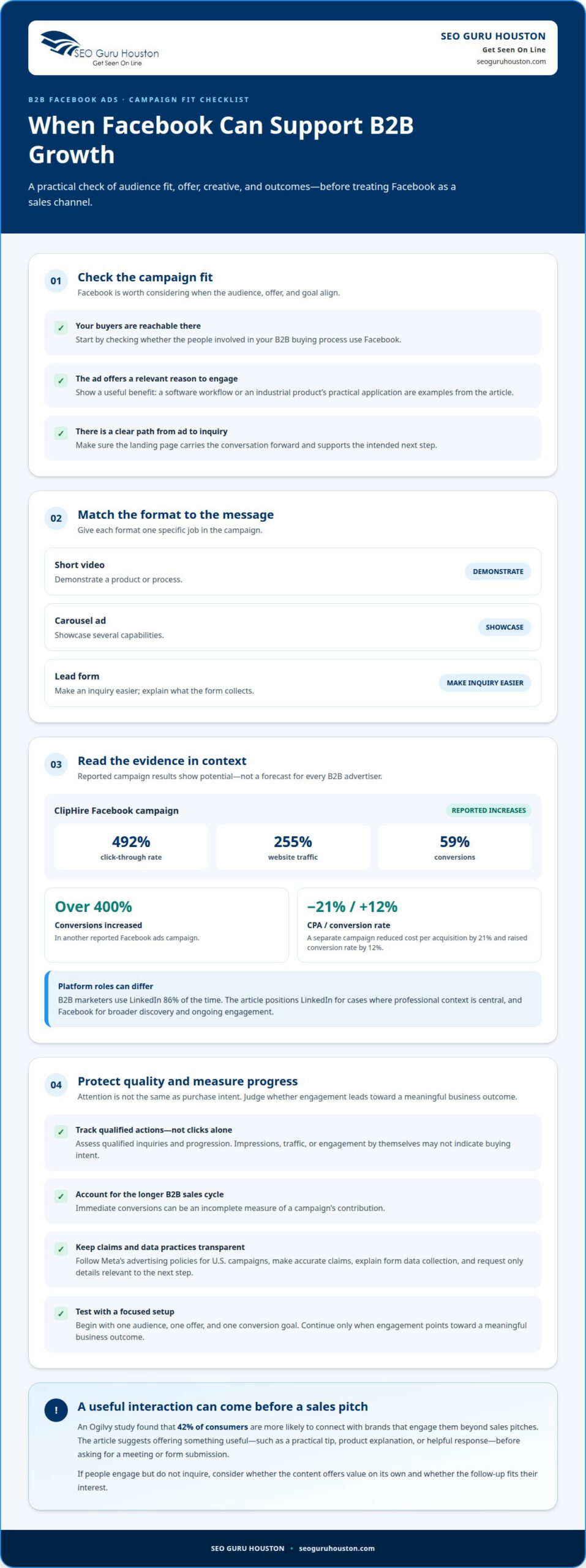
Facebook can support B2B growth when its audience, offer, and campaign goal align. The results from ClipHire show why the channel deserves a measured test: its Facebook campaign increased click-through rate by 492%, website traffic by 255%, and conversions by 59%. So, is Facebook advertising effective for B2B? It can be, when you judge performance by qualified actions, not attention alone.

No single industry automatically performs best. The strongest fit comes when buyers are reachable on Facebook and an ad can show a relevant benefit. For example, a software company can demonstrate a product workflow, while an industrial supplier can spotlight a practical application. Both need a clear path from ad to inquiry.

Campaign outcomes can vary sharply by offer and execution. In another reported campaign, Facebook ads increased a client’s conversions by over 400%. A separate campaign reduced cost per acquisition by 21% and raised conversion rate by 12%. These examples show potential, not a forecast for every B2B advertiser.

Facebook and LinkedIn can serve different roles. B2B marketers use LinkedIn 86% of the time, while Facebook can broaden discovery and support ongoing engagement. Use LinkedIn when professional context is central; consider Facebook for reaching prospects with useful content and following up with people who showed interest.

Choose the ad format to suit the message. Short video can demonstrate a product or process; carousel ads can showcase several capabilities; lead forms can make inquiries easier. Give each format a specific purpose, such as presenting a software demo, a customer-use scenario, or a downloadable guide.

For U.S. campaigns, follow Meta’s advertising policies and use data transparently. Make claims accurate, explain what a form collects, and request only details relevant to the next step. Avoid copy that implies you know someone’s sensitive or private circumstances.

There are limits. Facebook engagement doesn’t automatically mean purchase intent, and a broad audience can produce low-quality clicks. Long B2B sales cycles also make immediate conversions an incomplete measure. Track qualified inquiries and progression, not just impressions or traffic.

Start with one audience, one offer, and one conversion goal. For example, promote a case study to relevant decision-makers and assess whether they take the intended next step. Continue the test only if engagement points toward a meaningful business outcome.

That makes the quality of the interaction worth considering alongside the offer. An Ogilvy study found that 42% of consumers are more likely to connect with brands that engage them beyond sales pitches. For B2B advertisers, that can mean giving prospects something useful before asking for a meeting or submitting a form. A practical tip, a product explanation, or a helpful response can make the brand’s presence feel relevant rather than purely promotional.

Use this principle to shape both the ad and the response that follows. Offer information that addresses a genuine business question, then make the next step clear without making it feel like a demand. If people engage but do not inquire, assess whether the content offers value on its own and whether the follow-up matches their interest. The goal is a useful exchange that builds trust and gives the campaign a measurable purpose.

2. Differences between B2B and B2C ad strategies

A B2C ad often sells a product directly to an individual buyer. A B2B ad usually supports a decision involving several people, business needs, and follow-up. For example, a project-management platform may need to persuade a department lead and earn approval from finance. That changes the offer, message, and campaign goal.

Start with the buying decision, not the product category. A consumer furniture ad might lead with a new sofa and a purchase prompt. A commercial furniture company could instead show how configurable workstations suit a growing office. The B2B message connects the offer to a business task, such as planning a workspace or comparing specifications.

The audience also changes the creative. A consumer campaign can focus on personal preference, convenience, or an immediate need. A B2B campaign should make its business relevance clear. For instance, an accounting software ad can highlight invoice workflows for finance teams, while avoiding claims that every company shares the same process.

Proof matters in different ways, too. A consumer may respond to a product demonstration or a straightforward feature comparison. A business buyer may need evidence to explain a decision internally. A case study, implementation overview, or product demonstration can give prospects material to discuss with colleagues. Keep every claim specific and supportable.

The conversion action should fit the amount of commitment. A direct purchase prompt may suit a low-cost consumer product. A B2B prospect evaluating enterprise software may prefer a demo request or a detailed guide first. Make the next step explicit: explain what the person receives after submitting a form, and keep the requested details relevant.

Campaign timing follows the same distinction. A consumer promotion may focus on a seasonal purchase window. A business campaign can support research over a longer decision process, with separate messages for learning, evaluating, and taking action. For example, introduce a checklist before offering a product demonstration.

Use different success measures for each objective. A B2C campaign may prioritize completed purchases. For a B2B campaign, assess whether inquiries fit the intended customer profile and progress toward a sales conversation. A high click rate with irrelevant inquiries signals a mismatch between the ad promise and the offer.

Build the campaign in sequence: define the business problem, write a buyer-focused message, choose an appropriate next step, and align the landing page. A cybersecurity provider, for instance, could offer a risk-assessment guide instead of asking for an immediate sale. This gives prospects a useful first action while keeping the campaign connected to a business need.
Is Facebook Advertising Effective for B2B? Assess the Fit

3. Effectiveness of Facebook ads for B2B brands

Facebook campaign effectiveness depends on the business result you measure. A campaign may attract attention without generating suitable inquiries, while a smaller audience may produce prospects worth pursuing. A software firm, for example, should distinguish guide downloads from demo requests and sales-qualified leads. Each action signals a different level of commercial intent.

There isn’t one typical conversion rate that applies across B2B Facebook campaigns. A guide download, demo request, and qualified inquiry are different conversions, so compare rates only when the action and audience match. A campaign offering a product demonstration shouldn’t be benchmarked against one offering an introductory checklist.

Set a measurable objective before launching. If a cybersecurity company wants demo requests, its primary measure should be completed requests from relevant businesses, not video views. If the goal is to introduce a new service, meaningful engagement with an explanatory page may be an earlier signal. The objective determines which campaign events matter.

Connect ad activity to the landing-page action. A mismatch can weaken performance: an ad promising a practical procurement guide should lead to that guide, not a generic homepage. Track the steps from ad click to form completion and review where prospective buyers leave. This gives you a clearer diagnosis than clicks alone.

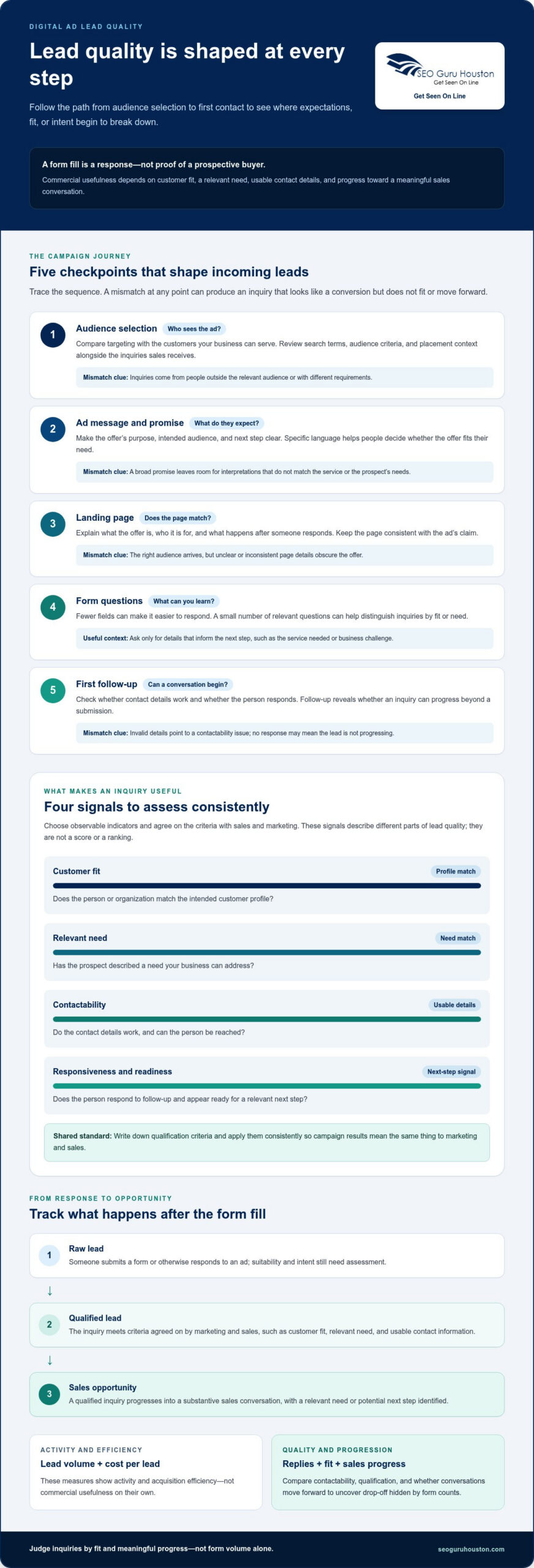
Lead quality matters as much as volume. A student’s form submission for an assignment is different from an inquiry by a company evaluating vendors. Define useful qualification criteria, such as business type, role, or stated need, then assess which ads generate matching inquiries. Don’t treat every completed form as an equal sales opportunity.

Facebook campaign results can change when the audience, creative, offer, or landing page changes. Test one meaningful variable at a time. For example, a manufacturing supplier could compare a production-process video with a downloadable equipment checklist while keeping the audience and next step consistent. This makes the comparison more informative.

Review performance across the full path to revenue. A strong click-through rate may conceal weak lead quality, while an early-stage campaign may support later decisions without generating immediate inquiries. Compare engagement with qualified leads and sales progression, using consistent definitions. This keeps reporting focused on business outcomes.

Use the findings to make a deliberate adjustment: refine the audience, sharpen the offer, or improve the landing page. If prospects click but don’t submit the form, review the page’s relevance and friction. If submissions rarely qualify, refine the message to attract businesses with a matching need. Then measure the revised campaign against its original goal.

There is no single typical conversion rate for B2B Facebook ads; results vary with the audience and the action being measured. Compare rates only for campaigns with the same conversion goal and audience.

4. Facebook targeting with custom and lookalike audiences

An effective B2B Facebook campaign starts with a defined business goal, a focused audience, and a relevant offer. Custom audiences can reconnect with people who already engaged, while lookalike audiences help find new users resembling a selected source audience. For example, a software firm might reach past site visitors, then seek similar prospects.

A custom audience uses a business’s existing audience signals, such as customer records, website activity, or engagement with a Facebook or Instagram account. Each source serves a different purpose: a customer list can support retention, while product-page visitors may be suitable for follow-up advertising.

Choose the source according to the campaign’s next step. A company promoting a product demo could focus on visitors to its demo information page. A firm introducing a new service might target people who engaged with its social content. Avoid combining unrelated interactions, such as webinar viewers and existing customers, into one audience without a clear reason.

Lookalike audiences extend a useful source audience to reach new people with similar characteristics. A B2B advertiser could use its qualified customer records as the source, rather than every form submission. The source quality matters: if it contains poor-fit leads, the resulting audience may reflect that weakness.

Keep audience groups distinct enough to interpret the results. For example, separate recent product-page visitors from people who watched a general brand video. Tailor the message to each group: the first may need a detailed comparison, while the second may benefit from an introductory explanation.

Use customer data responsibly and keep audience inputs relevant to the campaign. Consider how records were collected and whether their use aligns with your privacy commitments. Ad copy should address business needs without implying knowledge of sensitive personal details.

Evaluate an audience by the quality of the resulting actions, not its size alone. Compare qualified inquiries from customer-based targeting with those from a lookalike audience. If the lookalike audience brings broad interest but few relevant prospects, refine the source, offer, or message before expanding the campaign.

5. Funnel-stage messaging and micro-conversions

A B2B buyer rarely moves from first impression to sales conversation in one click. A facilities manager discovering a maintenance platform needs different information from a manager comparing vendors. Map each Facebook ad to the buyer’s current question, then offer one clear next action. This keeps the message useful instead of demanding a decision too soon.

At the awareness stage, introduce the problem and explain its business impact. A logistics company, for example, could promote a guide to reducing delivery delays. Use plain language in the ad, then direct readers to a page that delivers the promised guidance. A hard sales pitch can feel premature to someone still defining the problem.

Consideration-stage messages help prospects evaluate possible approaches. A manufacturing software provider might share a process comparison, product walkthrough, or case study. Each asset should answer a specific question, such as how a workflow changes or which teams use the tool. The next step could be viewing a demonstration rather than immediately booking a sales call.

Decision-stage creative can make the commercial next step more direct. A prospect who has reviewed a product page may be ready to request a consultation or tailored demonstration. Match the ad’s promise to the form and follow-up. If the ad offers a product walkthrough, the landing page should make it easy to understand and request.

Micro-conversions are smaller actions that show progress before a final inquiry. Examples include watching a product video, opening a comparison page, or downloading a checklist. Track them separately from qualified leads. A video view signals attention, but not the same intent as a completed demo request.

Build a sequence that reflects those actions. Someone who reads an introductory guide could later see a detailed comparison. A visitor to a pricing or product page could receive a demonstration offer. Exclude people who already completed the intended action, where campaign setup allows, so follow-up messages remain relevant rather than repetitive.

Keep the landing page aligned with each funnel stage. An ad for a guide should open the guide’s page, while a demonstration ad should explain what the demonstration covers. Remove unrelated navigation or competing offers when they distract from the chosen action. Then review the path from ad engagement to form completion and qualified inquiry.

Set a distinct success measure for each message: guide downloads for awareness, comparison engagement for consideration, and qualified requests for decision-stage campaigns. Review these actions together to see where prospects advance or stall. Turn your funnel map into a focused campaign sequence, with each ad earning the next step through relevant information.

Track every interaction—whether it involves a document download, comparison view, or demonstration request. Tailor each message to its funnel stage, and optimize its landing page to convert ad-generated traffic. Review whether the page makes that stage’s next action clear and easy.

SEO Guru Houston

SEO Guru Houston helps B2B brands assess whether Facebook advertising supports their audience, goals, and sales process. If you’re unsure how paid social fits alongside search and lead generation, comprehensive B2B Marketing, PPC Services, and Inbound Marketing solutions can connect campaign planning with the broader path from discovery to inquiry. Professional SEO Services can also support visibility when prospects research solutions beyond social platforms.

Turn to SEO Guru Houston when your ads attract attention but don’t clearly support qualified inquiries, or when you need a more connected strategy across channels. Share your audience, campaign goals, and current challenges to start a focused conversation. Contact SEO Guru Houston to discuss the right next step for your B2B marketing.

Turn Your Facebook Strategy Into a Measurable Next Step

Turn your campaign idea into a clear test. Decide which business outcome matters, define the audience that can influence it, and choose an action that signals genuine interest. Then align the ad, landing page, and follow-up around that same goal.

Whether Facebook advertising is effective for B2B depends on how well the campaign advances a real business objective. Treat each launch as a learning opportunity: use the results to sharpen the message, improve the audience fit, and guide prospects toward a useful next conversation. A disciplined approach gives your team a stronger basis for deciding what to refine or scale.

If you’re ready to shape a focused plan around your B2B goals, contact SEO Guru Houston today. Take the next step with clarity, and build a campaign strategy that keeps your business moving forward.

Frequently Asked Questions

Should Your B2B Brand Advertise on Facebook?

Yes, if your prospective buyers use Facebook and you can connect their attention to a relevant business need. For example, a company selling specialized inventory software could test an educational resource for operations teams, then assess whether resulting inquiries represent suitable organizations. If your audience is difficult to reach there or the offer needs a highly specific professional context, prioritize channels that better match those conditions.

How effective is Facebook advertising for B2B lead generation?

Facebook can generate B2B leads, but the useful measure is whether those leads fit your sales criteria and advance into real conversations. For example, a training provider could separate inquiries from companies seeking team instruction from individual requests for personal courses. Align the form questions with that distinction, then review lead feedback with sales. This helps identify whether the campaign attracts prospective buyers, rather than simply collecting contact details.

Which B2B industries perform best with Facebook advertising?

No single B2B industry automatically performs best. Facebook is a stronger fit when buyers are reachable there and the ad can show a relevant benefit, such as a software workflow or an industrial application.
B2B Negative Keyword List: Exclude Irrelevant Google Ads Traffic

More clicks won’t help if the searches behind them have no chance of becoming customers. A negative keyword list for B2B is a set of words and phrases that tells Google Ads which searches to exclude, such as job-seeking or purely informational queries. The rule is simple: exclude a term when it consistently attracts traffic that doesn’t fit your offer or sales goals.

It’s tempting to block broad terms like “free,” “support,” or “training” straight away. But a term that wastes one campaign’s budget may signal real buying intent in another, so review each against your ideal customer and the purpose of the campaign. This guide shows how to build and organize a practical list, which employment, education, support, and other searches may be worth excluding, and where to apply negatives in Google Ads. You’ll also learn how to judge search terms by lead quality, not just clicks or cost, so you can cut irrelevant traffic without shutting out valuable prospects.

Key Takeaways

  • Judge search terms by whether they produce qualified leads and meaningful CRM outcomes, not just by clicks or cost.
  • Review generic negative keyword suggestions against your ideal customer profile before applying them; a term that blocks one campaign may attract useful prospects in another.
  • Consider employment, education, support, and location-related searches as potential exclusions, while checking whether each theme fits your offer.
  • Use account-level or shared lists for exclusions that apply broadly, and campaign- or ad-group-level negatives for terms that depend on context.
  • Keep refining exclusions as search behavior and campaign results change, so irrelevant traffic is filtered without blocking valuable intent.

1. How do you review search terms by lead quality, not cost?

A low-cost click can still become a valuable B2B opportunity. Review Google Ads’ Search Terms Report alongside CRM outcomes, then judge each query by whether it produced a qualified lead, sales conversation, or opportunity. Cost matters, but it doesn’t tell you whether a prospect fits your target market.

Use a consistent decision process for every search phrase:

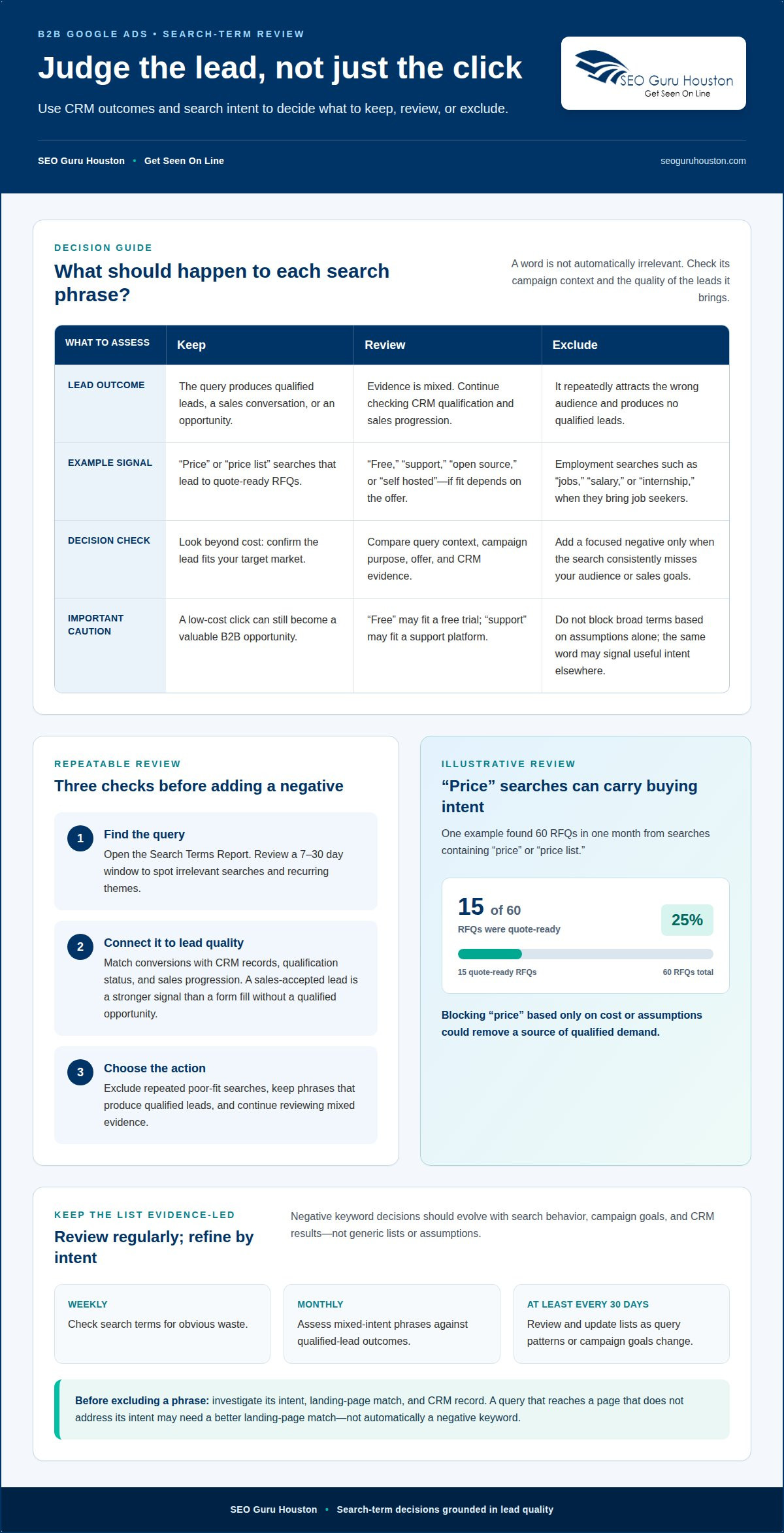
  1. Find the query. Open the Search Terms Report to see searches that triggered your ads. Review a 7-30 day window to spot irrelevant queries and recurring themes.
  2. Connect it to lead quality. Match conversions with CRM records, including qualification status and sales progression. A form fill without a qualified opportunity is a weaker signal than a lead accepted by sales.
  3. Choose the action. Exclude a phrase when it repeatedly attracts the wrong audience. Keep it when it produces qualified leads, and continue reviewing it when the evidence is mixed.

For example, one illustrative review found 60 RFQs in one month from searches containing “price” or “price list.” Of those, 15 were quote-ready RFQs, meaning 25% of RFQs from those searches were quote-ready. Blocking “price” based only on cost or assumptions could have removed a source of qualified demand. Apply the same logic to your own CRM outcomes before adding a negative.

Separate employment intent from buying intent. Searches containing “jobs,” “career,” “salary,” “internship,” or “resume” often come from job seekers, not potential customers. If the Search Terms Report repeatedly shows these phrases and they produce no qualified leads, add the relevant terms as negatives. Keep exclusions focused: the same word may also appear in a useful product or service query.

Software and technology searches need the same scrutiny. “Open source” and “self hosted” can be useful negatives for B2B SaaS campaigns when those options don’t match the product being promoted. But a technology provider offering open-source services could attract qualified buyers with the same phrase. Review query context, campaign target, and CRM evidence before excluding it.

Build a repeatable review cadence: check search terms weekly for obvious waste, then assess mixed-intent phrases monthly against qualified-lead outcomes. A negative keyword list for B2B should evolve with those findings, not with assumptions. If a phrase draws clicks but no qualified leads, investigate its intent, landing-page match, and CRM record before deciding whether exclusion is the right move.

2. What are negative keywords?

Negative keywords are words or phrases that prevent an ad from showing for searches containing those terms. Positive keywords help target searches; negative keywords define which searches to avoid. The distinction sounds simple, but applying a generic downloaded list without reviewing its terms can block relevant prospects while leaving wasted spend untouched.

Which negative keywords should B2B companies add to Google Ads? Start with search terms that clearly signal a different audience, such as “jobs,” “salary,” “course,” or “free,” then compare each term with your offer and campaign goal. A word isn’t automatically irrelevant just because it appears on a general B2B list. For example, “free” may be unwanted for a paid software campaign, but useful when promoting a free trial.

Google Ads offers broad, phrase, and exact match types for negative keywords. Broad negatives can exclude searches containing all the negative terms, phrase negatives apply when the phrase appears in the same order, and exact negatives target the matching search without additional terms. Choose the narrowest match that filters unwanted intent. For example, a broad exclusion for “support” could block a prospect researching a support platform.

Which B2B negative keywords should be excluded for jobs, free resources, and consumers? Consider “career,” “job openings,” “salary,” and “internship” for employment intent; “free,” “tutorial,” and “how to” for resource-seeking searches; and “personal,” “home,” or “for consumers” when those audiences don’t fit your target. Review the phrase in context first: a query for a free business guide may still reveal a potential buyer.

General B2B and B2C lists can help identify themes, but industry-specific terms need a separate review. A SaaS advertiser might test “open source” or “self hosted” as negatives when those options don’t match its product. A provider serving those needs could lose valuable traffic by excluding them. Before adding a downloaded list, compare every entry with your campaign structure, customer profile, and actual search queries.

How often should B2B advertisers review and update negative keyword lists? Review search terms regularly, including at least once every 30 days, and update exclusions as query patterns or campaign goals change. Keep recurring account-wide exclusions in shared negative keyword lists; use campaign-level lists for terms that apply only to one offer or audience. If a relevant query lands on a page that doesn’t address its intent, align the landing-page experience before treating the keyword as wasted traffic.

Location exclusions should reflect where a business can actually serve customers. If a campaign targets buyers in specific regions, searches naming places outside its service area may be irrelevant. Review the full query before excluding a location: a prospect might search for a supplier in one city while needing service in another. Exclude location terms only when they consistently attract leads the business cannot serve.

Support-related searches often come from existing users rather than new buyers. Terms such as “login,” “help desk,” “knowledge base,” “customer service,” “phone number,” “portal,” “complaints,” and “cancel” can signal account support or troubleshooting. They may be suitable negatives for a customer-acquisition campaign. But a company selling help-desk software could attract relevant prospects with “help desk,” so let the offer and search-term context guide each decision.

Education and training queries can signal research rather than purchasing intent. Look for phrases containing “course,” “school,” “university,” or “training.” A business selling professional training should not automatically exclude them; a software vendor seeking enterprise buyers might find introductory course queries less relevant. Distinguish people seeking instruction from organizations evaluating a commercial solution before changing which searches trigger ads.

Free-resource and DIY terms call for the same care. “Free,” “tutorial,” “how to,” and “DIY” may attract people who want to solve a problem without buying. Yet “free trial” or “free demo” could be an intentional conversion path. Software campaigns should also assess “open source” and “self hosted” against the product: exclude them when those options do not fit the offer, but retain them when they describe what the business provides.

Employment searches are easier to identify when the query explicitly signals hiring intent. Terms such as “jobs,” “careers,” “job openings,” “internships,” “recruiters,” “resumes,” and “salary” can help filter job seekers from customer prospects. Add relevant exclusions when those searches do not lead to buyer inquiries. A recruiting company, by contrast, may want employment-related traffic, so avoid using a blanket list.

Refine exclusions using conversion and CRM data, not assumptions. For each recurring search term, compare the query with its landing page, lead status, and sales outcome. If “login” produces support requests rather than new opportunities, it may belong on an acquisition campaign’s negative list. If “training” generates qualified business inquiries, keep it. This ongoing review protects reach while removing searches that attract the wrong audience.

B2B Negative Keyword List: Exclude Irrelevant Google Ads Traffic

4. Account-level, shared-list, campaign, and ad-group negatives

To add a negative keyword list to a Google Ads campaign, create or select a shared list, add the exclusions, then apply the list to the campaign. Use account-level exclusions only for terms that should block traffic across the account; narrower intent belongs at the campaign or ad-group level.

Think of negative keyword placement as a control system with three practical levels: shared lists, campaign-level negatives, and ad-group-level negatives. A shared list suits recurring terms irrelevant across campaigns, such as employment searches when the account targets buyers only. Campaign-level negatives fit exclusions tied to a particular offer or audience. Ad-group negatives resolve tighter conflicts, such as separating searches for “enterprise accounting software” from an ad group focused on small businesses.

Account-wide exclusions have broad consequences. The Google Ads account-level negative keyword list limit is 1,000 terms per account, so reserve this level for terms that almost never match your commercial intent. A term like “careers” may suit an account-wide list if none of its campaigns recruit. A word like “free” needs more caution because one campaign may promote a paid product while another offers a free trial.

Use campaign-level negatives when the same phrase has different relevance across campaigns. For example, a software company could exclude “self hosted” from a cloud-only campaign while retaining it in a campaign for self-hosted solutions. This aligns the exclusion with the actual offer instead of allowing a broad shared list to remove useful searches. Review affected campaigns before applying a shared list, especially when bidding uses conversion signals from several product lines.

At the ad-group level, exclude terms that create overlap between closely related themes. If separate ad groups target “CRM for healthcare” and “CRM for real estate,” negative terms can direct each search toward the more relevant group. Keep exclusions specific: a general negative such as “CRM” would block both groups, while a qualifying phrase tied to one industry can preserve the other ad group’s reach.

Before applying a list, define its scope, purpose, and owner. Label a shared list by function, such as “job seeker queries,” then record which campaigns use it. After making changes, review actual search terms for unexpected exclusions and shifts in relevant traffic. If a phrase has mixed intent, test it at campaign level before applying it account-wide. This structure makes it easier to reverse a negative when sales evidence changes, rather than searching through unrelated lists to find its source.

5. How negative keywords prevent irrelevant Google Ads traffic

Google Ads uses negative keywords to stop an ad from serving when a search query matches an excluded term. That filter can keep a B2B campaign from paying for clicks from people seeking jobs, basic courses, or unrelated consumer products. The goal isn’t to block every unfamiliar phrase. It’s to separate buyer intent from searches that don’t fit the offer.

Consider a company advertising enterprise accounting software. Searches for “accounting jobs” point to employment, while “accounting software for small business” may identify a different buyer segment. Adding “jobs” as a negative can filter the first query without excluding the second. Excluding “small business,” however, makes sense only if that audience is genuinely outside the campaign’s target.

The filter matters even more when a campaign uses Broad Match or AI-driven expansion. These methods give Google more freedom to identify related searches, bringing in both useful variations and irrelevant queries. A negative keyword list helps define boundaries around that broader reach. Review the query context before adding exclusions, since a shared word can appear in searches with very different intent.

Exclusions also affect the signals used by automated bidding. If ads repeatedly attract searches that produce low-quality conversions, those actions can muddy the conversion data bidding systems rely on. Excluding a clearly irrelevant theme can help focus that data on prospects who fit the offer. But an overly broad negative can remove qualified searches and reduce useful signals, too.

Use a practical review cycle: inspect Google Ads search queries, group them by intent, compare conversions with lead quality, then add only clear exclusions. For example, “free accounting course” may signal research or education traffic for a software vendor. “Free accounting software trial” could indicate product interest instead. The word “free” alone is not enough to judge intent; the complete query and campaign structure matter.

After making changes, watch for both wasted spend and unintended losses in reach. Clicks without sales do not, on their own, prove that a term should be excluded. Check whether the query matches the offer and whether the conversion was qualified. Review actual search behavior after each change, then adjust the negative’s scope if relevant queries disappear. This keeps the filter precise as new search patterns emerge.

Negative keywords can improve click-through and conversion rates by limiting mismatched impressions, but they cannot replace a relevant landing page or offer. A prospect searching for enterprise accounting software should land on a page that explains the business solution, not a generic course description. Align query intent, ad message, and landing-page content to turn better-targeted traffic into meaningful opportunities.

SEO Guru Houston

SEO Guru Houston helps national businesses connect Google Ads targeting with the quality of leads their sales teams need. When irrelevant searches keep triggering ads, professional PPC services can support a more focused campaign strategy, from reviewing search intent to refining exclusions. Specialized B2B marketing and inbound marketing strategies can also align paid search with broader demand-generation goals.

Turn to SEO Guru Houston when your negative keyword decisions need to fit your audience, campaign structure, and lead-generation priorities. A well-built landing page also helps ensure that qualified searchers find content aligned with their intent.

Contact SEO Guru Houston to discuss your national B2B advertising goals.

Make your next campaign decision count

Turn search-term reviews into a feedback loop between advertising and sales. When sales qualification reveals a mismatch, use that insight to refine your targeting and shape the next campaign test. A negative keyword list for B2B works best as part of that ongoing improvement, not as a fixed document forgotten after launch.

SEO Guru Houston can connect this work with Houston SEO Services, Houston PPC Services, and Houston B2B Marketing. That broader view helps keep paid search aligned with the audiences and growth goals your business is pursuing.

Ready to sharpen your B2B campaign strategy? Contact SEO Guru Houston to discuss your next step. Clearer targeting starts with a focused plan, and each thoughtful adjustment can move your campaigns toward stronger alignment with real business goals.

Frequently Asked Questions

What are negative keywords?

Negative keywords are exclusions that keep Google Ads from showing an ad for searches containing specified terms. For example, a business selling industrial software might exclude “dating” or “recipe” if those searches have no connection to its offer. The best exclusions reflect the actual audience and campaign purpose, not just words that seem unrelated at first glance.

How do you review search terms by lead quality, not cost?

Compare search queries with lead records and sales outcomes, not just spend or clicks. For example, distinguish sales-qualified inquiries from students, vendors, and people seeking employment, then look for patterns in the query wording. A phrase with modest spend may deserve to stay if it produces genuine opportunities, while a cheap query can still waste budget if it repeatedly attracts the wrong audience.

What is a negative keyword list in B2B advertising?

It’s a set of search terms a business excludes from campaigns aimed at other businesses. A company could consider filtering investor research, political searches, or adult-content queries when they don’t relate to its offer. The right list depends on the product, ideal customer, and campaign goal. Review each term before applying it, since a phrase that’s irrelevant to one B2B advertiser may matter to another.

How do negative keywords differ for B2B and B2C campaigns?

The difference is the audience and buying context, not a universal set of terms. B2B campaigns may filter job seekers, students, or individual consumers when those groups aren’t buyers. A B2C advertiser may have different exclusions based on its product and customer. For instance, “enterprise” could be unhelpful for a consumer-only offer but valuable for a business software campaign.

How to find negative keywords from Google Ads search term reports?

Open the Search Terms Report and review the queries that triggered ads. Group unrelated searches by theme, such as recruiting, coursework, or customer login, then compare those themes with campaign goals and lead outcomes. Look for repeated patterns instead of reacting to a single unfamiliar phrase. Add exclusions only when a query clearly conflicts with the offer or attracts the wrong audience.

How to organize B2B negative keywords into shared lists by campaign?

Keep exclusions that apply across the account in a shared list, such as employment searches when none of the campaigns recruit. Put offer-specific exclusions in the relevant campaign list, then use ad-group negatives to separate closely related themes. Give each list a clear purpose-based name and record which campaigns use it. This makes later reviews more precise.

What are common mistakes and risks when using negative keywords in B2B ads?

A common mistake is applying a downloaded list without checking every term against the offer. Broad exclusions can block valuable searches because the same word may signal different intent in different queries. For example, excluding “free” could remove searches for a free trial as well as resource seekers. Other risks include leaving lists unchanged as campaigns evolve and failing to notice when useful queries stop receiving impressions.

How to Build a Full-Funnel PPC Campaign Structure for B2B

Paid search can work for B2B, but a campaign built only to capture immediate leads can miss buyers who need time to evaluate a solution. The average B2B sales cycle involves 8 touchpoints, so a scalable ppc campaign structure for b2b should connect search intent, useful follow-up, and sales outcomes across the journey.

If clicks are coming in but qualified opportunities aren’t, the issue may be how campaigns are organized and measured, not simply how much you spend. B2B buying groups take time to research, compare options, and reach a decision. Your campaign needs to reflect that reality.

This guide shows you how to assess paid search for B2B, choose metrics that matter beyond clicks and form fills, and connect ad activity to conversions across longer sales cycles. Then you’ll learn how to organize campaigns around buyer intent and funnel stage, so you can identify what’s working and make smarter decisions about where to scale.

Key Takeaways

  • Match search, display, placements, keywords, and audience targeting to the buyers and intent you want to reach.
  • Look beyond clicks and form fills by tracking lead quality, pipeline progress, and revenue alongside campaign metrics.
  • Connect ad interactions to CRM outcomes so long sales cycles don’t make valuable campaigns look ineffective.
  • Build campaigns around funnel stage and buying intent, then use performance data to guide where to refine and scale.
  • Align ad messaging, landing pages, and follow-up so each touchpoint moves qualified prospects toward a decision.

Does paid search work for B2B?

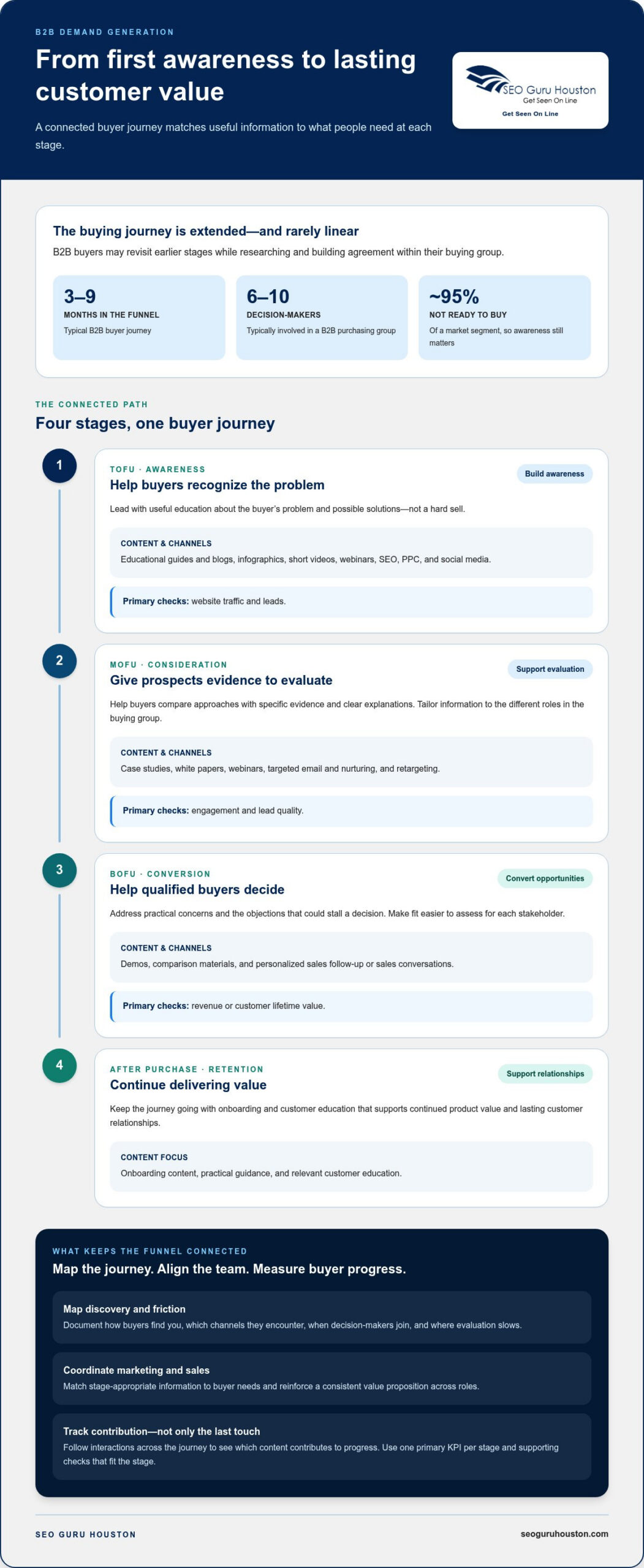
Yes. B2B companies generate an average of $2 for every $1 invested in Google Ads, according to the market data in this brief. Gartner reports that complex B2B solutions typically involve buying groups of 6 to 10 decision-makers. Structure campaigns to reach their different questions, not just one lead form.

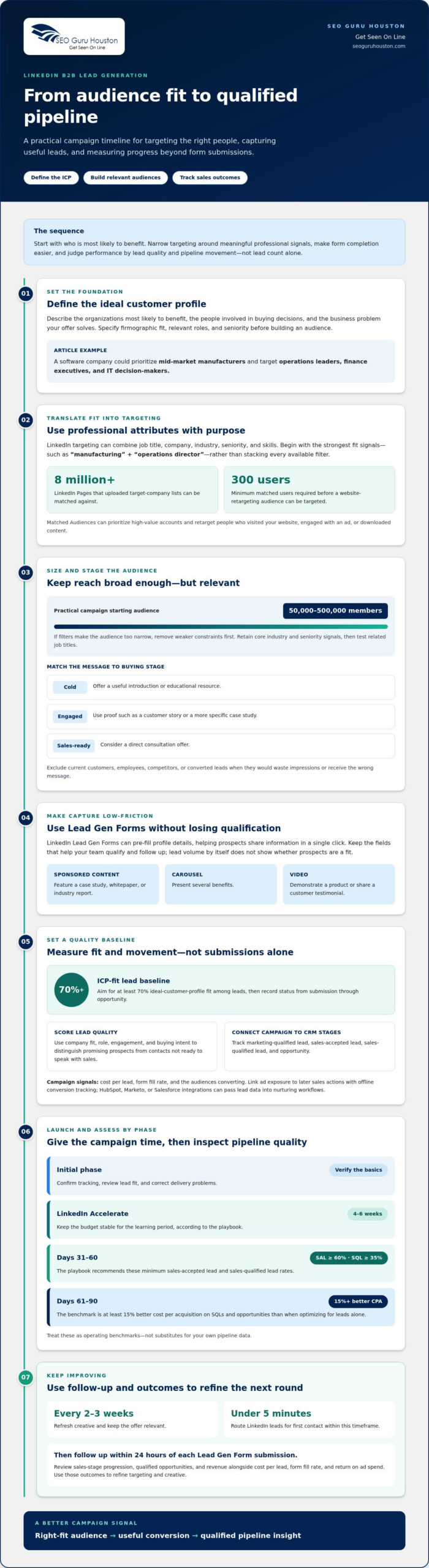
Google and Microsoft campaigns typically organize around search intent and keyword themes. LinkedIn Ads can target professional audiences by role and industry. Separate campaigns by buyer stage to tailor each message, then compare qualified outcomes across platforms.

Group keywords by intent first: brand, problem, solution, and comparison terms. Separate match types into different ad groups or campaigns when they need distinct budgets, messaging, or query controls. Mixing them too broadly can obscure which searches generate relevant leads.

Common risks include grouping unrelated services together, targeting too broadly, and judging success by clicks alone. A generic “business software” keyword may attract research traffic, while a solution-specific query can signal clearer intent. Review search terms and audience results to identify wasted spend.

  1. Define buyer personas before selecting placements. List each high-value persona by role, industry, and buyer stage. A finance leader comparing vendors needs different proof from an operations manager researching a workflow problem. Use those distinctions to choose search, display, or audience-based placements, and align each ad with a relevant landing page.
  2. Separate search campaigns by intent and theme. Build focused groups for brand terms, pain-point searches, solution categories, and competitor-comparison intent. Keep closely related keywords together, but separate themes when the offer or landing page changes. For example, “reduce invoice processing time” and “invoice automation platform” suggest related needs, but different stages of research.
  3. Match platform structure to its targeting strength. On Google Ads, organize around keyword themes and use available targeting such as demographics, location, device, and interests. Apply a similar search-intent structure in Microsoft Ads, then compare performance separately. On LinkedIn Ads, segment by role and industry, with distinct campaigns for awareness and active consideration.
  4. Use display and remarketing to reconnect. Build display audiences from meaningful site behavior, such as visiting a solution page or viewing a case study. Exclude converted leads when the message is no longer relevant. Remarketing campaigns often achieve conversion rates 50-100% higher than cold traffic campaigns, according to the market data in this brief.
  5. Review targeting and placements as one system. Check search terms, audience segments, and placement reports together. If an industry segment clicks but produces poor-fit leads, refine its message or targeting. Test search, display, and video formats against the same buyer need, then shift effort toward the placements that create sales-relevant engagement.

What metrics should be tracked in B2B paid ads?

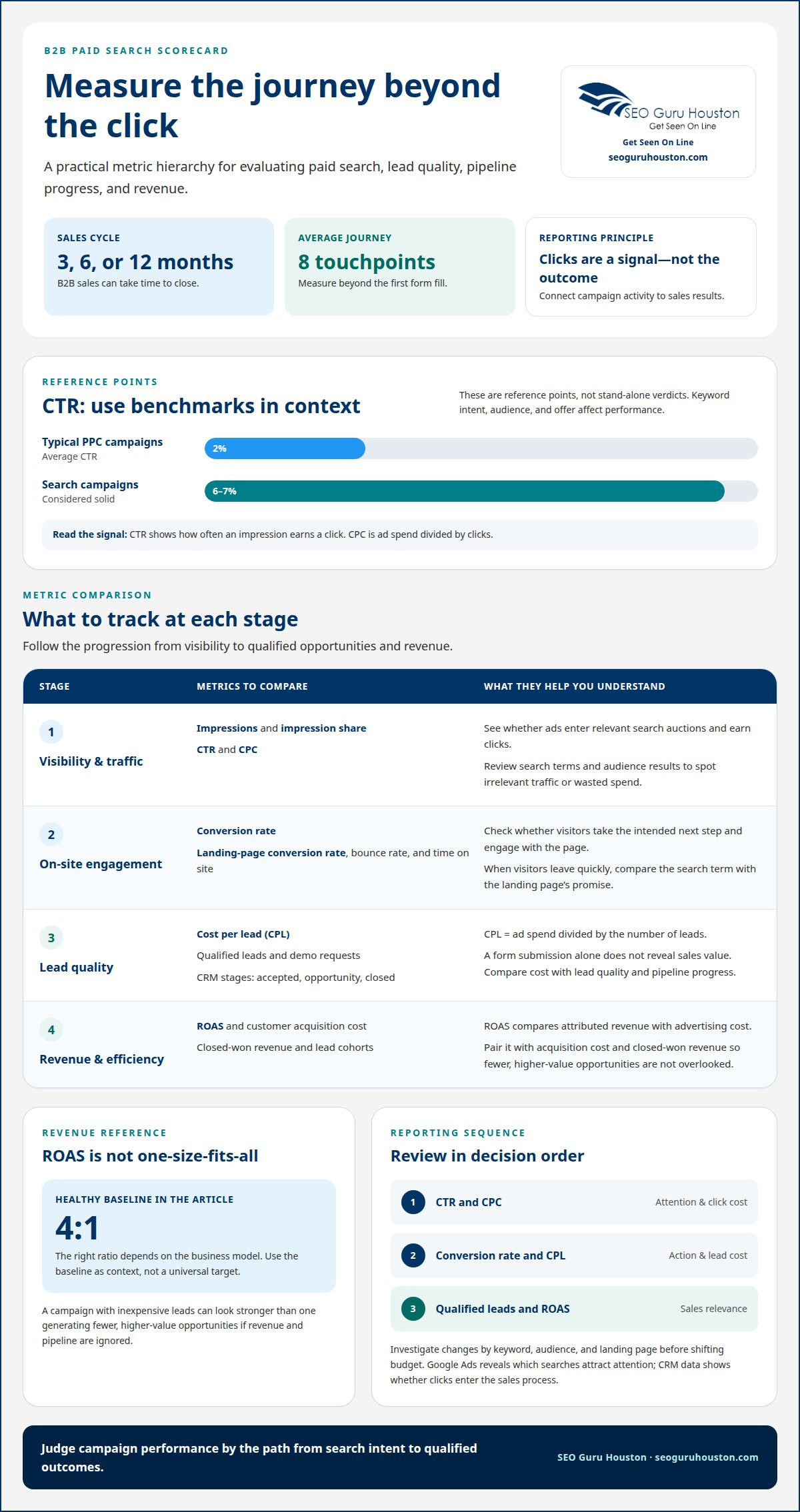
  1. Track the full path from impression to lead. Start with impressions and impression share to see whether Google Ads enters relevant Google Search auctions. Then measure click-through rate (CTR), cost per click (CPC), and conversion rate. CTR shows how often an impression earns a click; CPC is ad spend divided by clicks. A 6-7% CTR is considered solid for search campaigns, while the average CTR for typical PPC campaigns is 2%. Treat these as reference points, not isolated verdicts: keyword intent, audience, and offer all affect performance.
  2. Measure what happens after the click. Track landing-page conversion rate, bounce rate, and time on site to see whether visitors engage with the next step. If a campaign earns clicks but visitors leave quickly, compare the search term with the page’s promise. For example, an ad for a product demo should lead to a page that explains the demo and makes requesting one clear. Segment results by campaign, keyword, device, and demographics so strong averages don’t hide a weak audience or page.
  3. Separate lead volume from lead quality. Cost per lead (CPL) divides ad spend by the number of leads, but a form submission alone doesn’t reveal sales value. Track qualified leads and demo requests separately, then connect those records with CRM stages such as accepted, opportunity, and closed. Compare costs with lead quality and pipeline progress rather than treating an average as a universal target.
  4. Evaluate revenue against spend. Return on ad spend (ROAS) compares attributed revenue with advertising cost. A 4:1 ROAS is a healthy baseline, but the right ratio depends on the business model. Pair ROAS with customer acquisition cost and closed-won revenue; otherwise, a campaign generating inexpensive leads may appear stronger than one producing fewer, higher-value opportunities. Review results by campaign and lead cohort to identify which sources contribute to actual sales.
  5. Use a consistent review sequence. In each reporting cycle, compare CTR and CPC first, then conversion rate and CPL, followed by qualified leads and ROAS. Investigate changes by keyword, audience, and landing page before shifting budget. Google Ads data can show which searches attract attention; CRM data helps reveal whether those clicks enter the sales process. A clear metric hierarchy turns reports into decisions, not just dashboards.

Conversion tracking and attribution for long sales cycles

Track the journey beyond the first form fill. B2B sales can take 3, 6, or 12 months, with an average of 8 touchpoints.

  1. Set Up Conversion Tracking

    Record each meaningful action, from a landing-page inquiry to a sales-qualified lead and closed deal. Connect ad interactions with CRM stages so campaigns aren’t judged only by their earliest conversion. Check that each event fires once and maps to the right campaign. Don’t treat repeat visits or low-intent downloads as equivalent to sales opportunities. Digital marketing teams like Barlo Digital often emphasize starting with comprehensive tracking and measurement audits to ensure search data accurately reflects pipeline value.

  2. Preserve campaign context through the sales journey. Capture the campaign, keyword, and landing page associated with each lead, then retain that information as the record advances through sales stages. This lets you compare first-touch and later interactions without crediting every touch with a full conversion. For example, an initial search click may introduce a solution, while a later visit prompts a demo request.
  3. Assess Lead Quality and Conversion Costs

    Compare conversion volume with sales acceptance, opportunity creation, and closed revenue. Treat CTR and CPC as diagnostic signals, not final outcomes: strong click engagement can still produce poor-fit leads. Calculate cost per conversion for each meaningful milestone, then compare it with the resulting ROI. Don’t optimize for the cheapest form submission if those contacts rarely progress.

  4. Align the landing page with the tracked action. Keep the ad promise, page content, and conversion event consistent. A demo campaign should direct visitors to a page explaining the demo, with a clear call to action and a streamlined form. Track form completions separately from later qualification, so page tests improve lead generation without disguising low-quality submissions as success.
  5. Review attribution against actual sales outcomes. Compare platform-reported conversions with CRM opportunities and closed-won records by campaign and lead cohort. This shows why conversion counts need sales context: investigate lead sources, qualification, and follow-up before scaling spend.
  6. Use mature data to guide optimization. Long sales cycles delay revenue signals, so keep early indicators visible while opportunities progress. Review whether search terms reach the right accounts, whether landing pages generate qualified inquiries, and whether those leads advance. Use that evidence to refine targeting and messaging instead of making a major change after a brief spike in form submissions.

How to Build a Full-Funnel PPC Campaign Structure for B2B

Full-funnel PPC strategy for B2B buying journeys

Organize campaigns by buyer stage and audience, then match each segment with a relevant offer and message. Gartner research indicates approximately 80% of the B2B buying journey happens without direct vendor contact. A ppc campaign structure for b2b should therefore support independent research and guide prospects toward useful next steps.

  1. Map the B2B Buying Journey to Funnel Stages

    Define awareness, consideration, and decision stages by the questions buyers ask at each point. Awareness audiences may need educational content about a business problem; consideration audiences need solution comparisons; decision-stage prospects need a clear next step. Make sure these stages reflect the real buying process, not just website actions. A product-page visit, for example, signals interest but doesn’t establish readiness for a sales conversation.

  2. Assign PPC Roles Across the Funnel

    Give each campaign a distinct job, such as introducing a problem, helping buyers evaluate options, or generating qualified inquiries. Search can capture active research, while display and paid social can reconnect with relevant audiences between searches. LinkedIn can reach professional audiences by role and industry with stage-specific content. Don’t expect every campaign to produce an immediate sales-ready lead.

  3. Organize Campaigns by Stage and Audience

    Separate campaigns by funnel stage, audience, and offer so results remain actionable. For example, create distinct groups for operations leaders researching efficiency and finance leaders evaluating cost control. On LinkedIn, use professional audience attributes; on search, align keyword themes with the same buyer need. Keep campaign names consistent, such as “consideration, operations, efficiency,” and exclude converted leads from messages intended for first-time prospects.

  4. Tailor Ads to Each Funnel Stage

    Write awareness messaging around the business problem, not a hard sales pitch. For consideration, explain outcomes such as cost savings, efficiency gains, or risk reduction, then offer a useful comparison or guide. At the decision stage, make the next action clear and match the landing page to the ad. Use interests and audience signals to improve relevance, not as substitutes for clear intent or compelling messaging.

  5. Set a measurable planning goal. Connect stage-specific activity to a business outcome, then review how audiences advance. A sample B2B lead-generation goal is 75 qualified leads per month within four months, with cost per acquisition under $65. Treat this as a planning example, not a universal benchmark. Use the ppc campaign structure for b2b to assess whether each campaign supports that goal, then refine its audience or offer when engagement fails to progress.

Campaign structure designed to scale

The best ppc campaign structure for b2b separates campaigns by business goal, product or service, and buyer intent. There’s no fixed campaign or ad-group count; create separate Google Ads campaigns when products need distinct budgets, audiences, or outcomes, then group closely related keywords together.

  1. Separate Campaigns by Product or Service

    Build a separate Google Ads campaign for each product or service that needs its own budget, audience, or outcome. A company selling analytics software and implementation support, for example, could separate them because buyers search for different solutions. Give each campaign a matching landing page and conversion goal. Don’t combine offers just because they belong to the same company; mixed intent makes performance harder to interpret and scale.

  2. Set the Number of Campaigns and Ad Groups

    Start with the simplest structure that gives you useful control, then expand when performance or business needs call for it. Create an ad group for a tightly related keyword theme, such as “inventory analytics” and closely related searches, rather than grouping every product term together. Add campaigns when budget, geography, audience, or funnel goals need independent management. Avoid creating extra groups that split similar traffic without changing your decisions.

  3. Keep the campaign hierarchy consistent. Use a naming pattern that shows platform, product, intent, and audience. A Google Ads campaign might be labeled “Search | Analytics | Solution | Operations,” with ad groups for closely related search themes. Apply the same logic to Microsoft Ads while retaining platform-specific reporting. Clear names help teams find valuable traffic and understand each campaign’s purpose.
  4. Build for controlled expansion. Launch with core high-intent search campaigns, then add awareness or remarketing campaigns when you have a defined audience and relevant message. Keep search, display, and social activity distinct enough to compare results. For example, a display campaign for product-page visitors should have a different goal from search ads aimed at new prospects.
  5. Protect budget and learning signals. Avoid spreading limited traffic across near-identical campaigns. If two ad groups target the same keyword theme and landing page, combine them unless they need separate controls. Review search terms, audience fit, and conversion quality before adding another layer. Each campaign should address a business need, not simply make the account look more detailed.
  6. Scale what supports a purchase decision. Expand by adding a product line, buyer intent, or audience only when it creates a meaningful new opportunity. Keep awareness messaging distinct from decision-stage offers, and connect each route to the right page. A ppc campaign structure for b2b should make the next growth decision clear. To turn that structure into a practical growth plan, plan scalable PPC campaigns.

SEO Guru Houston: Houston SEO Services

SEO Guru Houston can help when your B2B campaigns need clearer structure, stronger measurement, or better alignment with sales goals. Its comprehensive PPC Services support paid-search planning, while B2B Marketing and Inbound Marketing services can connect campaign activity with broader demand generation.

Turn to SEO Guru Houston when campaigns target overlapping audiences, landing pages don’t match ad intent, or lead volume isn’t translating into qualified opportunities. PPC management includes campaign creation, ad copy optimization, keyword and geographic targeting, conversion tracking, ongoing account management, monthly calls, and reporting. Specialized SEO services can complement paid search by supporting visibility beyond ads.

Ready to discuss your campaign goals? Contact SEO Guru Houston or visit seoguruhouston.com.

Turn Your Campaign Plan Into a Growth System

Start with a business priority and turn it into a focused campaign plan. Decide which audience, offer, and sales outcome deserve attention first. Assign an owner to each decision so campaign changes have a clear purpose rather than becoming disconnected tests.

A durable ppc campaign structure for B2B should make the next move easier to see. Set criteria for expanding a campaign, refining its message, or pausing an approach. Then use those criteria consistently as new opportunities emerge. This creates a practical framework your team can adapt as products, audiences, and sales priorities change.

Bring marketing and sales into the planning process early. Agreeing on what makes an opportunity valuable helps both teams act on the same signals and keeps campaign decisions tied to business priorities.

SEO Guru Houston can help you turn your campaign priorities into a coordinated plan. Contact SEO Guru Houston today to discuss your next step. Build with focus, learn from each decision, and keep moving toward sustainable growth.

Frequently Asked Questions

What is the difference between B2C and B2B paid ads?

B2C paid ads often target individual consumers, while B2B ads address people evaluating purchases for an organization. That changes the message and the conversion path. A consumer ad might promote a product purchase; a B2B ad could offer a product walkthrough to a technical evaluator and business-case material to a budget owner. For teams executing across both sectors, performance marketing agencies such as peytondigital.com illustrate how data-driven strategies adjust to distinct buyer journeys. Build creative around the audience’s role in the decision, not just the company’s industry.

What Is B2B PPC?

B2B PPC is paid advertising where a business pays when someone clicks an ad promoting its products or services to other businesses. A software provider, for example, might use paid search to reach companies researching a specific operational challenge. The click is only the start: the campaign should connect the ad’s promise with a relevant next step, such as a consultation request or product information.

What about the middle of the funnel?

Middle-funnel campaigns help prospects compare approaches after recognizing a problem but before choosing a vendor. Offer useful decision-support content, such as a feature comparison, implementation overview, or case study. Someone who downloaded a guide, for example, could later see an ad addressing integration questions. Keep follow-up relevant to that earlier action, and don’t push for a sales conversation before the prospect has enough context.

How should B2B PPC budgets and bids be allocated across campaigns?

Prioritize campaigns by business value, audience relevance, and observed lead progression. Maintain coverage for high-intent searches that reach active buyers, then allocate testing budget to new audiences or messages with a clear learning goal. Review spend alongside qualified opportunities, not click volume alone. If a campaign attracts traffic but few relevant prospects, adjust its targeting or offer before increasing its budget.

Which conversion actions should B2B PPC campaigns track?

Track actions that show meaningful progress, from a completed inquiry form to a qualified opportunity or closed sale. Choose events based on how prospects engage with your business: a demo request may suit a complex software offer, while a detailed consultation request may fit a professional service. Keep low-commitment actions, such as content downloads, separate from actions that signal stronger buying intent.

How should B2B landing pages align with campaigns and ad groups?

Make sure each landing page matches the campaign’s promise and audience. An ad group focused on compliance software should lead to a page explaining that solution, not a general company homepage. Match headlines, proof points, and calls to action to the visitor’s likely question. Keep the form focused on information needed for follow-up, and remove competing links that distract from the intended action.

Google Ads Strategy for B2B Services: How Much Should You Spend

A focused Google Ads strategy for B2B services then puts most of that budget behind high-intent search, while reserving spend for remarketing and experiments. The right allocation depends on whether your ads attract the decision-makers and qualified leads your business needs.

It makes sense to want a clear budget before investing. But spend alone won’t fix campaigns that target the wrong searches or send prospects to a landing page that doesn’t match the ad. This guide explains how to set goals, identify audiences, structure campaigns, and refine keywords and bidding. It also shows why persuasive ad copy and relevant landing pages matter: they help turn advertising spend into meaningful opportunities, not just clicks.

Key Takeaways

  • Set campaign goals around qualified business outcomes, then target the roles, companies, and audiences most likely to influence a purchase.
  • Use keyword research and search-term data to focus spend on relevant intent and exclude searches that attract poor-fit clicks.
  • Match campaign messages and assets to each stage of the buyer journey, from early research to solution evaluation.
  • Align ad copy, keywords, and landing-page content so prospects see a clear, relevant next step after clicking.
  • Use expert PPC services and B2B marketing strategies to connect campaign execution with demand generation and long-term business growth goals.

B2B campaign goals and audience identification

Start with the business outcome, not the campaign setting. A clear goal helps connect Google Ads spend to the prospects and actions that can advance a B2B sale.

Campaign Goal Setting

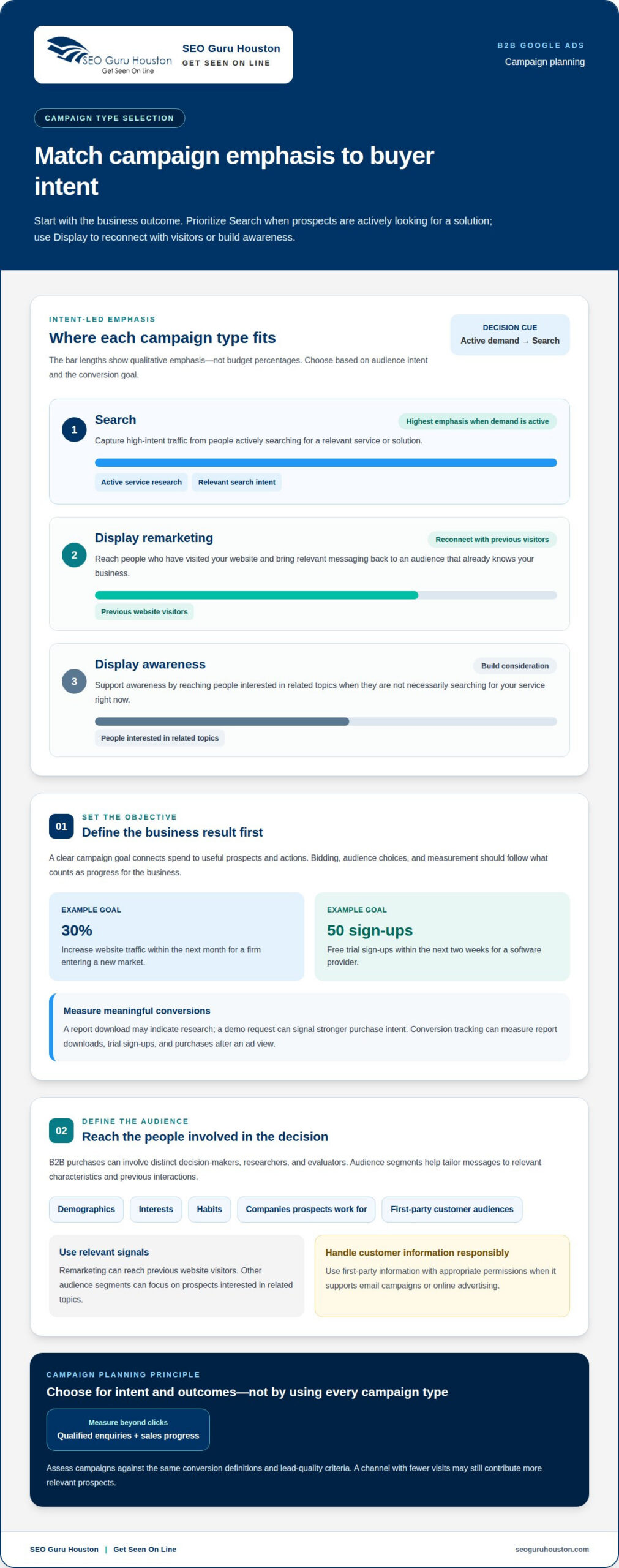
A campaign goal defines the business result advertising should support, such as qualified enquiries or relevant website visits. It matters because bidding, audience choices, and measurement all depend on what counts as progress. For example, a firm entering a new market might aim to increase website traffic by 30% within the next month. A software provider could instead aim for 50 free trial sign-ups within the next two weeks.

Choose a conversion that reflects genuine buyer interest, then distinguish it from lighter engagement. A report download may indicate research, while a demo request can signal stronger purchase intent. Google Ads conversion tracking can measure report downloads, trial sign-ups, and purchases after an ad view. Comparing these actions helps campaign managers assess keywords and ads against the outcomes that matter.

Audience Targeting Segments

Audience segments group potential buyers by relevant characteristics or prior interactions, including first-party audiences built from a business’s own customer information. This matters because B2B purchases often involve distinct decision-makers, researchers, and evaluators. Google Ads targeting can use demographics, interests, habits, and the companies potential customers work for, helping advertisers tailor messages to business audiences.

Use first-party information only with appropriate permissions when it supports email campaigns or online advertising. A company could offer a research report or invite-only webinar in exchange for customer details, then use those details to shape follow-up messaging. Remarketing can reach previous website visitors, while other audience segments can focus on prospects interested in related topics. Keep each message relevant to the audience’s demonstrated interest.

Campaign Type Selection

For B2B services, Search campaigns can capture high-intent traffic from people actively looking for a relevant solution. Display campaigns can support awareness or remarketing by reaching website visitors and people interested in related topics. Digital marketing agencies such as eastpioneers.com often combine these channels to help businesses attract leads and build a stronger online presence. The best fit depends on the goal: prioritize search when prospects are expressing demand, and use Display to reconnect or build consideration.

What Google Ads campaign types work best for B2B services? Search is suited to active service research, while Display can support remarketing and awareness. Select based on the audience’s intent and the conversion goal, rather than using every campaign type at once.

What Google Ads policies and compliance risks apply to B2B service advertisers? Follow Google Ads policies, describe services accurately, and handle customer information responsibly. If collected details will support email or advertising, use them with the appropriate permissions. Clear consent practices and truthful ad claims help reduce avoidable compliance risks.

Keyword research and competitor targeting

Keyword research connects B2B search intent with the services your campaigns promote. Use Keyword Planner, match types, and search-term reports to refine targeting and limit irrelevant clicks.

Keyword Discovery with Keyword Planner

Google Ads Keyword Planner is a research tool that shows keyword search frequency, competition, and bid costs. These signals help you compare phrases before assigning them to campaigns. For example, separate searches for “B2B payroll software” from broader phrases such as “payroll services” when your offer serves a specific business audience.

Start with the services you sell, then expand each into buyer-focused variations. A consultant might compare “supply chain consulting” with “supply chain audit services” to find language that better reflects a prospect’s need. Use the Planner’s estimates as research inputs, then assess whether each phrase matches your offer and landing page.

Search Match Types

Match types control how closely a person’s search must relate to a target keyword before an ad can appear. They matter because a narrow service phrase and a broad category phrase can attract different intent. Choose settings that balance reach and relevance, then review actual search queries to see how Google Ads interprets your keywords.

For example, a campaign targeting “commercial HVAC maintenance” should distinguish service-specific intent from searches about residential repairs or do-it-yourself advice. Broad targeting can surface related searches, while tighter matching focuses exposure on closer variations. Organize keywords by service theme so the ad copy and landing pages address the same need.

Negative Keywords and Search-Term Reports

Negative keywords prevent ads from appearing for searches that don’t fit your offer. Search-term reports show which queries triggered ads, giving you evidence to add exclusions or refine target keywords. This review matters because even a relevant keyword can attract poor-fit searches through related wording.

For instance, a B2B software provider might exclude “jobs” if employment seekers don’t represent prospective buyers. Review the report for queries about free templates, consumer products, or unrelated services, then add negatives where those searches don’t match the business. Search-term data can also reveal phrases worth testing in paid campaigns or considering for SEO content.

Competitor Targeting

Competitor targeting considers searches that mention competing brands or compare providers. It can reach prospects who know the category and are evaluating alternatives, but the ad and landing page should clearly explain your own offer. Group competitor-related terms separately from service keywords to see whether they attract qualified enquiries.

Review competitor names alongside comparison phrases, such as “alternatives to [brand]” or “[brand] versus [service type].” Assess each query for relevance before adding it, and use clear, factual messaging rather than implying an affiliation. Pair this analysis with a paid search campaign strategy that keeps keywords, ad copy, and landing-page content aligned.

Ad extensions and assets

Google Ads assets add useful details and actions to search ads. For B2B campaigns, choose assets that help decision-makers understand the offer and take a relevant next step.

Give Searchers More Relevant Options

Sitelinks and other Google Ads assets can provide extra information and options within search results. They can also increase an ad’s size, helping it stand out and giving prospects more reasons to click. A B2B consultancy, for example, could use sitelinks to direct different audiences toward relevant service information or a case study.

Keep each option aligned with the ad’s promise. If an ad promotes an operational audit, a sitelink to audit details supports that message better than a broad, unrelated page. Useful assets give prospects a clearer route to explore, while mismatched options can distract from the advertised service.

Use Lead Form Assets for Direct Enquiries

Google Ads lead form assets let potential customers submit their contact information directly within an ad. This can give a busy decision-maker a direct response path without first visiting a website. For example, a B2B provider promoting a consultation could use a lead form asset to capture interest from someone searching for that service.

Choose this format when an in-ad enquiry fits the campaign goal. Make the offer clear, and explain what the prospect is requesting. A lead form is not a substitute for useful service information: people should understand the next step before sharing their details. Compare its enquiries with other campaign actions to assess whether it attracts relevant prospects.

Match Assets to the Ad’s Message

Google Ads assets work best when their information reinforces the search ad and the prospect’s intent. For a software implementation campaign, relevant options might point to implementation details, a case study, or a contact path. Each asset should answer a useful follow-up question rather than repeat the same headline elsewhere.

Review the complete search result as a prospect would see it. Check that the ad, sitelinks, and other assets describe the same service and lead to coherent next steps. If the ad promises a specific business solution, an asset pointing to an unrelated offer breaks that connection.

Review Asset Performance

Use campaign reporting to assess which assets support meaningful actions. Compare lead form submissions with visits to relevant pages, then consider the quality of the enquiries each path generates. A larger ad may attract attention, but clicks alone don’t show whether the added information brought in suitable B2B prospects.

Update assets when their destination or message no longer reflects the campaign. For example, if a sitelink points to outdated service information, revise it to match the current offer. This keeps the experience consistent from search result to follow-up and makes each asset work toward the same business goal.

Google Ads Strategy for B2B Services: How Much Should You Spend

Buyer-journey campaign segmentation

B2B prospects need different information as they move from discovering a problem to assessing solutions and contacting a provider. Segment campaigns by that intent, then align the ad, offer, and next step. A research-focused visitor may value a case study, while an evaluator may be ready to compare solutions or request a demo.

Awareness: Reach Prospects Exploring a Problem

At the awareness stage, prospects may search for explanations rather than a specific provider. Search ads can connect relevant queries with useful resources, such as an industry report or case study. For example, a cybersecurity firm could promote a guide to common security challenges instead of pushing a sales meeting to every early-stage visitor.

Google Ads Search campaigns can generate micro-engagements, including resource downloads, case study exploration, and newsletter subscriptions. These actions offer ways to engage people who aren’t yet ready to become sales leads. Treat each as a distinct signal, and use relevant follow-up messaging to nurture interest over time.

Consideration: Help Buyers Evaluate Options

During consideration, prospects compare approaches and assess whether a solution fits their needs. Free trials, demos, testimonials, competitor analysis, and benchmarking can help them evaluate options. A B2B software company, for example, might use an ad leading to a product demo for active evaluators, while a comparison resource serves people still weighing alternatives.

Decision: Make the Next Step Clear

Decision-stage prospects are closer to contacting a provider or beginning a trial. Use focused Search ads for queries that indicate service or solution intent, and make the advertised action clear. For example, an ad promoting a software demo should lead directly to information about that demo, not a general company overview.

Tailor follow-up to the action taken. Someone who explored a case study may need a different prompt from someone who requested a demo. Keep campaign messages aligned with the prospect’s demonstrated interest, and make the path from ad to enquiry straightforward.

Connect Segments Without Blurring Intent

Buyer-journey segmentation works best when each campaign has a defined audience, message, and goal. Separate educational content from demo or trial campaigns so reporting shows which interactions support progress. A visitor who downloads a report can receive relevant nurturing, while a demo request should prompt a more direct sales follow-up.

Review campaign and conversion data together. If resource engagement rises but qualified enquiries don’t, examine the transition from content to the next offer. If demo campaigns attract mismatched prospects, revisit search intent and landing-page messaging. This keeps each stage accountable to the buying task it serves.

Landing pages, ad copy, and Quality Score

Ad relevance doesn’t stop at the click. Your B2B ad, landing page, and conversion path should tell one consistent story.

Landing Page and Ad Copy Alignment

Alignment means the ad promise, target keyword, and landing-page content all address the same buyer need. A decision-maker who clicks an ad for implementation support expects information about that service, not a broad company overview.

Build each page around the search intent and action you want. For example, an ad offering a software demo should lead to a page that explains the demo and makes the next step clear. Use matching language in the headline, supporting copy, and call to action. If the ad targets operations leaders, address their business problem rather than relying on generic claims.

Keep the page focused. A campaign for a specific B2B service can direct visitors to relevant proof, service details, and an enquiry form. Remove competing calls to action that send prospects toward unrelated offers. This creates a clearer route from search to conversion and helps your team understand which message brought the visitor in.

Quality Score

Quality Score is a Google Ads diagnostic that helps advertisers assess keyword, ad, and landing-page relevance. It can highlight where the experience feels disconnected to a searcher. Use it as a signal for investigation, not a substitute for measuring qualified leads and business outcomes.

For example, if a keyword about B2B consulting leads to an ad about general marketing, then a page about unrelated services, the message lacks continuity. Review the keyword, ad copy, and destination together. Make the page answer the question implied by the search, and ensure the ad describes the same offer accurately.

How do you set up conversion tracking and qualify leads from Google Ads? Track meaningful actions such as demo requests, report downloads, and purchases, then compare those conversions with lead quality. Connecting data sources can help campaign systems use relevant signals.

Lead qualification needs a clear definition shared by marketing and sales. For example, a demo request from a decision-maker at a target company may warrant different follow-up from an early-stage resource download. Record the actions and details that distinguish sales-ready enquiries, then assess campaign performance beyond form submissions.

Keep improving the full path, not just the ad. Test a focused headline against a service-specific page, review whether visitors complete the intended action, and refine the message when the page attracts the wrong enquiries. Improve your B2B landing pages by aligning each page with its ad promise and conversion goal.

SEO Guru Houston: Houston SEO Services

SEO Guru Houston helps B2B companies connect campaign strategy with broader search visibility and demand generation. Its Houston PPC Services support paid campaigns, while Houston B2B Marketing and Houston Inbound Marketing can align outreach with how business buyers research and evaluate solutions.

Turn to SEO Guru Houston when your ads need stronger alignment between audience targeting, landing pages, and qualified lead goals, or when paid search should work alongside organic visibility. Houston SEO Services can support that wider search strategy, while PPC focuses on reaching prospects through paid campaigns.

To discuss your B2B marketing goals, contact SEO Guru Houston or visit seoguruhouston.com.

Turn Campaign Learning Into Your Next Growth Move

Your next advantage comes from connecting advertising decisions to what happens after a prospect converts. Build a steady feedback loop between marketing and sales: review which enquiries progress, identify the needs behind qualified opportunities, and use those insights to sharpen future campaign decisions. That discipline makes a Google Ads strategy for B2B services more responsive to real buying signals, rather than simply optimizing for activity.

SEO Guru Houston offers Houston SEO Services, Houston PPC Services, and Houston B2B Marketing. These offerings can support businesses aligning paid search with broader visibility and B2B growth priorities. If your campaigns need a clearer path from ad engagement to business opportunities, consider discussing your goals and the challenges your team wants to address.

Contact SEO Guru Houston today to explore a practical next step for your marketing. Keep testing, keep learning, and build momentum around the prospects your business is ready to serve.

Frequently Asked Questions

How Much Should You Spend on B2B Google Ads?

Set spend according to the lead volume you can handle, your sales capacity, and the campaign data you need to learn. An initial allocation can direct 70% to high-intent search, 20% to remarketing, and 10% to experimental campaigns. Treat this as a starting distribution, then shift budget toward campaigns producing qualified enquiries. Review performance against sales outcomes, not just clicks, before increasing spend.

How to Build a B2B Google Ads Strategy?

Build the plan around a measurable business outcome, a defined buyer, and a clear conversion action. For example, a consulting firm could prioritize qualified assessment requests rather than general page visits. Connect that goal to relevant searches, campaign messages, and a dedicated landing page. Then review conversion and sales data together to distinguish useful leads from actions that show interest but don’t fit your market.

How should B2B service businesses structure Google Ads campaigns and ad groups?

Separate campaigns by service line, objective, or distinct audience need, then group closely related search terms together. A cybersecurity provider might create separate campaigns for incident response and security assessments, with ad groups reflecting specific search themes. This structure makes it easier to tailor ad language and landing pages, and to identify which service themes generate relevant enquiries without mixing results.

Which keywords and match types are most effective for B2B lead generation?

Prioritize keywords that clearly express a business need, such as “enterprise data migration services,” over broad terms like “data.” Choose match types based on how closely searches should relate to each phrase, then inspect actual queries. Add negative keywords for irrelevant intent, such as job searches when recruiting isn’t the goal. The best keyword set reflects your offer and the language prospective buyers use.

How do you target B2B decision-makers by location, industry, and company size in Google Ads?

What are typical Google Ads costs and cost per lead for B2B services in the US?

Costs vary with industry competition, keyword demand, audience intent, and deal size, so a single benchmark can mislead budget decisions. A highly specialized service may face a different auction from a broad business category. Track actual spend alongside qualified leads and sales progression. If leads are plentiful but poorly matched, refine targeting and landing-page expectations before treating a lower cost per lead as better performance.

How should B2B landing pages be designed to improve Google Ads conversion rates?

Give each page one clear purpose that matches the visitor’s search and the ad’s promise. For a technical assessment campaign, explain what the assessment covers, who it serves, and how to request it. Keep the enquiry form focused on information needed for follow-up, and make the next action easy to find. Review completed actions and lead relevance together, then improve the page where prospects drop off.

What bidding strategies and budgets should B2B advertisers use?

Choose bidding based on the campaign objective and the conversion data available. With only 5-6 conversions, automated bidding may underperform; consider Manual CPC until conversion volume builds. Once an advertiser has more than 30 conversions per month, the guidance recommends considering a switch from Maximize Conversions to Maximize Conversion Value. Pair the bid approach with a budget that supports the campaign’s target actions and sales capacity.

Build a B2B Demand Generation Content Strategy for Pipeline Growth

Pipeline growth starts before a prospect is ready to talk to sales. The main goal of B2B demand generation is to build awareness and trust across the buyer journey, then turn that interest into qualified opportunities. A strong B2B demand generation content strategy supports that goal with useful content at each stage, not just lead capture.

It’s easy to focus on the leads coming in now. But buyers also need clear, relevant information while they’re still identifying a problem, comparing approaches, and building internal agreement. Content that meets them at those moments can make your business easier to understand and consider.

This guide explains how to build a strategy around buyer needs, map content to awareness, consideration, and decision stages, and activate it across channels such as search, social media, email, and paid advertising. You’ll also learn how to align sales and marketing around qualified opportunities and measure content’s contribution to the pipeline. The aim is practical: create a connected system that earns attention, supports buying decisions, and gives demand generation a clear path to growth.

Key Takeaways

  • Build ideal customer profiles and buyer personas around real needs, roles, and buying triggers so your content speaks to the people involved in a purchase.
  • Align sales and marketing on qualified-lead definitions, shared measures, and a smooth handoff to keep promising opportunities moving.
  • Activate useful content across search, social, email, and paid channels, adapting each asset to the audience and platform.
  • Use demand generation to build awareness and trust before prospects are ready to buy, then connect that interest to relevant next steps.
  • Map content to awareness, consideration, and decision stages so buyers get the right information as their needs evolve.

1. Why Has Content Become the Foundation of Modern Demand Generation?

Content gives buyers useful information before a sales conversation begins. That matters because B2B purchasing often involves several stakeholders, each evaluating different risks and requirements. A 2025 benchmark puts buying groups at an average of 11 stakeholders. A clear content program helps a business build awareness across that group, rather than relying only on lead capture when someone is ready to talk.

Start by defining an ideal customer profile around company fit, then create buyer personas for the people inside those companies. Record their roles, priorities, pain points, triggers, and jobs-to-be-done. For example, a finance leader may need evidence of cost control, while an operations leader needs to understand implementation demands. B2B purchasing decisions involve around 6-10 decision-makers, and more than a dozen individuals may express distinct needs. These details make lead generation programs more relevant and help teams choose topics buyers actually need.

Next, map content to the buyer journey. At awareness, explain the problem and its business impact through educational articles. During consideration, compare approaches and answer technical questions with guides or webinars. At decision, use case studies and clear product information to help stakeholders assess fit. Voice of the Buyer 2026 reports that 58% of buyers prioritize alignment with their use case or technical requirements when shortlisting vendors. Each asset should answer a specific question and point to a useful next step.

Independent research also shapes buyer confidence. In 2025, 61% of B2B buyers preferred sales-rep-free experiences while conducting their own research. Content must therefore stand on its own: explain claims clearly, address objections, and give different stakeholders material they can share internally. Forrester reported in 2024 that 86% of B2B purchases stall and result in no decision. Useful content can help a buying group build understanding and agreement before that momentum disappears.

For example, a persona-led program could pair an awareness article about a costly workflow problem with a consideration guide comparing possible solutions. A decision-stage case study could then show how a similar organization evaluated its options. Use this practical planning rule for every asset: match it to a stage, a stakeholder need, and a clear next action.

2. How can a company develop a successful B2B content marketing strategy?

Build the plan around shared decisions, not separate departmental calendars. Sales hears objections in conversations; marketing sees audience engagement across channels. Bring both teams together to connect those signals and choose content themes that address real buyer questions. For organizations seeking senior leadership to drive this collaboration, engaging fractional CMO services London can provide the strategic oversight needed to unite both functions. A useful starting point is a monthly planning session where sales shares recurring objections and marketing matches each one to a relevant asset.

Agree on what qualifies as a lead before launching campaigns. Document the company fit, role, problem, and intent signals that make an opportunity relevant. Then define the handoff: what context accompanies a lead, who follows up, and how sales shares feedback. This prevents a campaign download from being mistaken for sales readiness without evidence of need or fit.

Align content with the audience and its decision stage. An early-stage operations leader may need a practical explanation of a process problem. A technical evaluator may need implementation details, while a finance stakeholder needs a business case. Create a version of the core message for each role, but keep the central claim consistent. The result should be one coherent idea tailored to each stakeholder’s responsibilities.

Map the buying group before assigning content. A CRM record can connect target accounts with their contacts, roles, interactions, and open questions. Use that view to spot gaps: if a champion engages with a guide but the technical evaluator still needs answers, create material to support that review. Account-based marketing can use CRM data to tailor messaging for high-value accounts and their decision-makers.

Measure performance through a connected set of indicators: content engagement, qualified opportunities, pipeline contribution, and revenue outcomes. Use campaign and CRM records to connect interactions with account progression, then review attribution rules jointly so teams interpret influence consistently. In the Tenth Edition State of Marketing, 83% of marketers reported a clear view into their impact on the sales pipeline. Treat that visibility as a reason to define shared reporting, not as proof that one asset caused a sale.

Run a regular review to improve the plan. Marketing can bring engagement patterns; sales can bring call feedback and stalled-deal reasons. Together, decide which topics need a new format, which messages need revision, and where a buyer lacks useful information. For teams seeking help coordinating content with pipeline priorities, B2B marketing support can be a relevant next step.

3. Content activation across ABX, outreach, and paid channels

Content creates demand only when target buyers can find and use it. Build an activation plan around account priorities, buyer intent, and channel behavior. In an account-based experience (ABX), coordinate content across the account’s interactions, not just one contact’s clicks. For a target account researching workflow issues, a useful sequence could pair a search-focused article with a LinkedIn insight and tailored sales outreach.

Give each channel a distinct role. Organic search helps buyers discover educational material while investigating a problem. LinkedIn can distribute industry reports and whitepapers to professional audiences. Email can provide relevant follow-up based on a person’s expressed interests. Paid advertising can extend reach to selected audiences or promote a high-value asset. Keep the message consistent, but adapt its format and opening to each channel.

Plan organic and paid distribution together. First, identify the asset’s audience, funnel stage, and intended action. Then select channels that match how that audience consumes information. For example, publish an educational article organically, use paid promotion to reach relevant account roles, and send an email with a deeper guide to engaged readers. LinkedIn is described as a leading channel for reaching B2B executives and senior stakeholders.

Social engagement needs a repeatable cadence. Small B2B teams can publish two to three organic posts per week on LinkedIn or another channel their ideal customers use. A single webinar can also become five LinkedIn posts, each highlighting a distinct takeaway or question. This repurposing gives the original content more entry points without copying the same promotional message into every post.

Use paid media to extend useful content, not to disguise a weak offer. Match the promotion to buyer intent: an educational asset suits problem-aware audiences, while a case study can support active evaluation. Set campaign measures before launch, such as target-account engagement, meaningful asset interactions, and qualified follow-up. The 81% of buyers are more likely to engage with brands that have a strong, cohesive professional social presence figure points to the importance of consistency across organic and paid activity.

Events create opportunities for direct interaction. Before a webinar or industry event, promote a clear topic through social posts, email, and paid placements where appropriate. During the event, capture audience questions and engagement signals. Afterward, share relevant resources and tailor follow-up to expressed intent rather than sending every attendee the same message.

Review performance across channels, not in isolated dashboards. Compare which assets attract target accounts, support meaningful engagement, and contribute to pipeline conversations. Then focus distribution on the channels and formats that prompt useful buyer actions. This discipline turns content activation into a coordinated system, with each touchpoint helping the next work harder.

Build a B2B Demand Generation Content Strategy for Pipeline Growth

4. What is the main goal of B2B demand generation?

The goal is to create sustained interest and move suitable accounts toward qualified opportunities. That work begins before a buyer is actively comparing vendors. Demand generation helps people recognize a problem, explore possible responses, and develop enough understanding to consider a next step. A b2b demand generation content strategy supports this by connecting useful information with the buyer’s changing needs, rather than treating every interaction as an immediate sales lead.

Content marketing supplies information buyers use during the process, but it isn’t the entire demand-generation program. Articles, guides, reports, and expert perspectives can explain a challenge or clarify a solution. Thought leadership can build authority and awareness without directly generating a lead. For example, a report that helps a team identify a process weakness can be valuable even if readers don’t submit a form.

Demand generation also nurtures accounts before they’re ready to buy. A buyer who encounters a useful explanation today may return later with specific questions. Build a sequence that responds to those changing needs: start with accessible educational material, then offer deeper insights as interest develops. A second b2b demand generation content strategy consideration is keeping follow-up relevant to the account’s behavior, rather than sending every contact the same campaign.

Marketing automation can help keep follow-up relevant. Set up personalized email communications based on the resources a contact engages with and the topics they explore. Someone reading about an operational challenge could receive an implementation guide next. A contact evaluating possible approaches might benefit from a case study. The goal is to make the next useful resource easier to find, not to automate messages for their own sake.

Evaluate the program by the progress it supports. Track meaningful content engagement, account progression, qualified opportunities, and contributions to pipeline or revenue. If a report attracts interest but doesn’t lead to further exploration, review its audience, topic, and next step. This analysis helps teams distinguish content that builds awareness from work that captures active intent or supports ongoing nurturing. Demand generation succeeds when these functions work together throughout the buyer relationship.

5. Demand generation framework and funnel stages

A useful framework turns funnel stages into decisions about what to publish, promote, and measure. Start with five demand-generation phases: demand creation, demand capture, revival, acceleration, and expansion. For each phase, define the audience, buyer question, content asset, and next action. This makes the framework operational, not just a diagram. Teams can see where a buying group needs new insights and where existing content already supports progress.

At the awareness stage, buyers need help naming a problem and understanding its impact. Use educational articles, short videos, or checklists that explain a challenge in plain language. For example, an article about delayed reporting can describe symptoms and possible causes without pushing for an immediate sales conversation. Focus on the reader’s question, then offer a related resource to deepen understanding.

During consideration, buyers compare approaches and assess whether a solution fits their needs. Use detailed guides, webinars, comparison tools, or expert interviews to explain trade-offs and implementation questions. A useful asset should help a stakeholder bring informed insights to an internal discussion. At the decision stage, case studies, product demonstrations, and practical implementation information can help the buying group assess evidence and reduce uncertainty.

Choose formats by the work buyers need to do, not by a calendar template. A technical evaluator may prefer a detailed guide, while an executive may need a concise summary of business impact. Case studies are preferred by 78% of B2B decision-makers during evaluation. Webinars are trusted by 58% of B2B decision-makers. Use these formats where they answer genuine evaluation questions, then judge performance by relevant engagement and account progression.

Balance gated and ungated content according to an asset’s value. Keep foundational articles and practical explainers ungated to support discovery and sharing. Gate a substantial guide or webinar when registration creates a useful follow-up opportunity, and make the value clear before requesting details. Avoid placing every useful insight behind a form: buyers need enough accessible information to decide whether deeper engagement is worthwhile.

Finally, review the funnel as a connected system. If awareness content attracts readers but few explore related material, improve the next step or link to a stronger consideration asset. If decision-stage case studies draw attention but opportunities stall, ask sales which evaluation questions remain unanswered. Update the asset map based on those observations, then assign owners for revisions and distribution. This feedback loop keeps the framework aligned with real buying behavior.

SEO Guru Houston: B2B Marketing Support

SEO Guru Houston can help connect your content plan with the channels buyers use to research and evaluate solutions. Its SEO services can strengthen search visibility for useful resources, while PPC services can promote content to relevant audiences. B2B marketing can align content with pipeline priorities, and inbound marketing can support attracting and nurturing business prospects. The right mix depends on your audience, funnel priorities, and content gaps. To discuss your demand generation goals, contact SEO Guru Houston.

Turn Your Content Plan Into the Next Growth Move

Choose one pipeline priority and use it to guide every content decision. It might be reaching a new audience, improving the path from first interaction to sales conversation, or helping active opportunities resolve a specific concern. Set the priority, identify the buyer behavior that would signal progress, and give the team a clear review point.

A practical B2B demand generation content strategy should keep evolving as buyer questions, sales feedback, and channel performance change. Treat each campaign as a learning cycle: publish with intent, observe meaningful engagement, and use what you learn to sharpen the next asset. Consistency matters, but so does the willingness to adjust when the content isn’t helping buyers take a useful next step.

Ready to put your priorities into action? Start a conversation with SEO Guru Houston about the direction you want your demand generation to take. Build with purpose, learn from the response, and keep moving your pipeline forward.

Frequently Asked Questions

What is the main goal of B2B demand generation?

The goal is to create sustained interest that can develop into qualified business opportunities. Help potential buyers understand a problem before they actively evaluate vendors, then give them useful ways to explore solutions. For example, a company entering a new market could publish educational material that clarifies an overlooked operational challenge, helping future buyers recognize a need before a sales conversation begins.

How can a company develop a successful B2B content marketing strategy?

Start with evidence from customer conversations, sales calls, and recurring support questions. Choose a business priority, then create an editorial brief for each asset: intended reader, question answered, proof required, and next step. If prospects often ask about implementation risk, for example, produce a practical explainer covering dependencies and common decision points. Review responses with sales and revise topics as buyer questions change.

How can B2B marketers boost demand?

Make useful expertise easier to discover, share, and discuss. Turn customer questions into educational resources, then ask subject-matter experts to add practical insight rather than generic claims. A software company, for instance, could publish a clear guide to diagnosing a process bottleneck and invite prospects to discuss their challenges. Consistent distribution through relevant professional channels helps the material reach people before they enter an active buying cycle.

Why Has Content Become the Foundation of Modern Demand Generation?

Content lets buyers learn and compare ideas without starting with a sales meeting. A well-organized resource library can answer questions at different levels, from basic terminology to implementation concerns. A new visitor might find a plain-language explainer, while a returning reader can access a detailed evaluation guide. This continuity helps a brand remain useful across separate research sessions and internal discussions.

How Does Content Build Buyer Confidence Throughout the Buying Journey?

Confidence grows when content explains both the value and the practical realities of a decision. Use transparent examples, clear evidence, and specific answers to common objections. A case study is more useful when it describes the original challenge, the approach taken, and lessons learned, rather than offering only praise. Pair that evidence with implementation guidance so buyers can judge its relevance and share informed details with colleagues.

How Does Content Support Every Buying Committee Member?

Give each stakeholder material tied to their decision responsibilities. A technical evaluator may need architecture details, while a finance reviewer needs a clear explanation of business impact. The internal champion benefits from a concise resource they can forward to colleagues. Create a shared core message, then adapt the supporting details to each role. This helps the buying group discuss one solution using information relevant to everyone involved.

How can I improve content consumption in B2B marketing?

Make every asset easy to scan and use. Lead with the key takeaway, organize sections around buyer questions, and provide a clear next resource. A long research report, for example, can include an executive summary and descriptive section headings so readers can find relevant findings. Repurpose its core insights into shorter formats, but preserve context so each version remains accurate and useful.

How do you use intent data for B2B demand generation campaigns?

Use intent signals to guide relevance, not to assume a buyer is ready to purchase. Review patterns such as repeated visits to related resources, engagement with a product-focused page, or questions raised during a webinar. Combine those signals with account fit and known interactions before choosing follow-up content. For example, send a technical guide after repeated interest in implementation topics, then use subsequent engagement to shape the next step.

LinkedIn Ads for B2B Lead Generation: Targeting and ROI

A filled form is only the start; the right targeting and a low-friction form turn LinkedIn ads for B2B lead generation into a stronger path to qualified pipeline. Build audiences around professional attributes such as job title, company, industry, seniority, and skills. Then use LinkedIn Lead Gen Forms to pre-fill profile details, making it easier for prospects to share their information in a single click.

It makes sense to focus on audience fit and form completion, because a high lead count alone can hide poor-quality prospects. This guide explains how to define your ideal customer profile, target decision-makers, and optimize form fields without sacrificing useful qualification details. You’ll also learn how to assess lead quality beyond the initial submission and measure campaign performance through the pipeline, from clicks and conversions to sales outcomes. The goal is simple: make every campaign decision serve better-fit leads and clearer ROI.

Key Takeaways

  • Define your ideal customer profile before building an audience, then focus targeting on the professional attributes that signal buying relevance.
  • Make Lead Gen Forms easy to complete while keeping only the fields that help your team qualify and follow up with prospects.
  • Look beyond lead volume: evaluate whether submissions fit your audience and progress toward meaningful sales conversations.
  • Track campaign performance through the pipeline so you can identify where leads stall and which changes may improve results.
  • Use a mix of content and ad formats to keep your brand relevant as B2B buyers research their options.

1. ICP definition and LinkedIn audience targeting

Strong LinkedIn ads for B2B lead generation start with a precise ideal customer profile (ICP), not a broad industry label. Define the organizations most likely to benefit, then identify the people involved in their buying decisions. For example, a software company might prioritize mid-market manufacturers and target operations leaders, finance executives, and IT decision-makers. Specify firmographic fit, relevant roles, seniority, and the business problem your offer addresses.

Translate that ICP into LinkedIn’s professional targeting criteria. Advertisers can select job title, company, industry, seniority, and skills, then combine attributes to narrow relevance. Start with the strongest fit signals, such as “manufacturing” plus “operations director,” instead of stacking every possible filter. LinkedIn can match uploaded target-company lists against more than 8 million LinkedIn Pages, helping account-based campaigns reach decision-makers at named organizations.

Use Matched Audiences to prioritize high-value accounts and build retargeting groups from people who visited your website, engaged with an ad, or downloaded content. Website retargeting requires at least 300 matched users before the audience can be targeted. Keep prospecting and retargeting distinct: a first-touch audience may need an educational resource, while people who already engaged can receive a more specific case study or demo offer.

Audience size matters. A practical campaign starting point is 50,000-500,000 members, as recommended in the guidance summarized here. If your filters make the audience too narrow, remove weaker constraints before expanding beyond your ICP. For example, retain the target industry and seniority, but test related job titles. Exclude current customers, employees, competitors, or converted leads where those groups would waste impressions or receive the wrong message.

Map audiences to buying stages before choosing creative. Cold prospects need a useful introduction; engaged visitors may respond to proof, such as a customer story; sales-ready accounts may be ready for a direct consultation offer. This staged approach supports demand generation without assuming every prospect is equally close to buying.

How do LinkedIn ads compare with Google Ads and Meta ads for B2B leads? LinkedIn’s professional attributes and company targeting help focus on roles and accounts, while Google Ads can reach people expressing search intent. Meta ads commonly use broader demographic and interest signals, so the strongest channel depends on whether account fit, active search, or broader discovery matters most.

What LinkedIn advertising policies and targeting restrictions apply to lead generation? Use LinkedIn’s available professional attributes and eligible Matched Audiences, and ensure each audience meets platform requirements. In particular, website retargeting needs 300 matched users; campaign content and targeting must also follow LinkedIn’s advertising policies.

2. Lead quality, pipeline measurement, and campaign optimization

Lead volume can look strong while sales receives few useful opportunities. Set a quality baseline before launch: aim for at least 70% ideal-customer-profile fit among leads, then record each lead’s status from submission through opportunity. A simple scoring model can weigh company fit, role, engagement, and buying intent. Use those criteria to distinguish promising prospects from contacts who downloaded an asset but aren’t ready to speak with sales.

Build conversion tracking around the campaign objective, not clicks alone. LinkedIn Lead Gen Forms reporting includes cost per lead, form fill rate, and the audiences converting. Connect those metrics to CRM stages such as marketing-qualified lead, sales-accepted lead, sales-qualified lead, and opportunity. Offline conversion tracking can link ad exposure to later sales actions, while integrations with HubSpot, Marketo, or Salesforce can pass lead data into nurturing workflows.

Choose creative that fits both the offer and the buying stage. Sponsored Content can feature a case study, whitepaper, or industry report; carousel ads can present several benefits, while video can demonstrate a product or share a customer testimonial. Lead Gen Forms reduce manual entry, but results still depend on audience fit and a useful offer. Test creative variations and compare qualified pipeline, not just click-through rate.

Its ad auction uses advertiser bids, and Campaign Manager supports daily or lifetime budgets that you can change as results develop. Start with a budget aligned to the test’s audience and conversion goal; avoid frequent changes that make it harder to compare performance. LinkedIn Accelerate campaigns should receive 4-6 weeks of stable budget to learn, according to the playbook.

Use a staged launch. During the initial phase, confirm tracking, review lead fit, and correct delivery problems. During days 31-60, the playbook recommends an SAL rate of at least 60% and an SQL rate of at least 35%. By days 61-90, it recommends achieving at least 15% better CPA on SQLs and opportunities than when optimizing for leads alone. Treat these as operating benchmarks, not substitutes for your own pipeline data.

How do you improve conversion and lead quality? Refresh creative every 2-3 weeks, keep the offer relevant, and use lead scoring to prioritize follow-up. Route LinkedIn leads for first contact in under five minutes, then follow up within 24 hours of each Lead Gen Form submission.

How should you measure campaigns? Review cost per lead and form fill rate alongside lead quality, sales-stage progression, and return on ad spend. Track whether leads become sales-accepted leads, qualified opportunities, and revenue, then use those outcomes to refine targeting, creative, and bids.

Common risks include judging success by lead count, neglecting follow-up, and letting irrelevant impressions consume budget. Keep the wasted impression rate below 5%, and use retargeting, including website and video engagement, to support the pipeline. About 30% of assisted pipeline in a LinkedIn B2B campaign should come from retargeting, according to the playbook.

Need a clearer demand generation plan connecting paid campaigns to pipeline? Explore demand generation strategy as a way to align audience, offer, and follow-up.

LinkedIn Ads for B2B Lead Generation: Targeting and ROI

3. CTR, conversion rate, CPL, lead quality, and ROAS

Use click-through rate (CTR) to diagnose whether an ad earns attention, not to declare a campaign successful. Cold-prospecting LinkedIn content ads should aim for at least 0.5% CTR. Single-image ads paired with Lead Gen Forms typically see 0.4-0.8% CTR. Compare each campaign with its format and audience, since a relevant decision-maker click matters more than an unqualified click.

Conversion rate reveals what happens after the click. Calculate it by dividing completed actions by the relevant visits, then multiplying by 100. For a Lead Gen Form campaign, track both form opens and completed submissions to spot friction. A form-fill rate of 10-20% is a target for cold audiences, while warm audiences can aim for 20-40%. If clicks are healthy but completions lag, review the offer, form fields, and message match.

LinkedIn reports that Lead Gen Form campaigns increase conversions by 2-3x compared with standard Sponsored Content campaigns. That comparison can help guide a test, but assess your own audience and conversion path. Test one clear variable at a time, such as the offer or creative, and compare completed forms and qualified leads. Keep campaign objectives, attribution settings, and reporting periods consistent so the result reflects the change you tested.

Cost per lead (CPL) is campaign spend divided by submitted leads. LinkedIn’s guide reports that its cost per lead is 28% lower than Google AdWords. Use that comparison as context, not a substitute for your account’s actual results. A low CPL can still mask weak fit, so segment leads by company, role, and sales qualification. For example, compare the CPL of all form submissions with the CPL of sales-qualified leads.

Lead quality connects advertising metrics to revenue potential. Score fit and intent using signals such as target-company match, decision-making responsibility, and engagement with a high-value asset. Then assess how leads progress into sales conversations and opportunities. An audience that generates fewer submissions but more qualified opportunities may be more valuable than a larger, less relevant group.

Return on ad spend (ROAS) compares revenue attributed to ads with campaign spend. Calculate it by dividing attributed revenue by advertising cost, using the same attribution approach across campaigns. For a longer B2B sales cycle, monitor qualified pipeline and closed revenue alongside immediate form conversions. This prevents early engagement from being mistaken for final business impact.

Review metrics as a connected sequence: CTR indicates attention, conversion rate shows response, CPL measures acquisition efficiency, and lead quality tests fit. ROAS connects the path to revenue. When results weaken, identify the stage first. Low CTR may point to an audience or creative issue; low form completion suggests friction in the offer or form; high lead volume with a weak pipeline calls for stronger qualification and follow-up.

4. Lead Gen Forms and form-field optimization

LinkedIn Lead Gen Forms reduce friction by pre-filling professional details from a member’s profile. Depending on available profile information, fields can include name, contact details, company, seniority, job title, and location. Members can submit with one click instead of typing each answer, making the form useful for mobile users responding to Sponsored Content or a Message Ad.

Keep the form focused on the information sales needs to act. A practical starting point is four fields for most B2B forms. For example, request name, work email, company, and job title when those details support lead routing and qualification. Each extra question asks for more effort, so add a field only when its answer changes follow-up, qualification, or audience segmentation.

Match the form to the offer. Someone requesting an introductory guide may only need to provide basic work details, while a consultation request may justify a qualifying question about business needs. Keep the question direct and easy to answer. For example, offer a short set of choices about the prospect’s main challenge instead of asking for a lengthy description.

Set expectations before the click. Explain in the ad what the prospect will receive, who the offer is for, and what happens after submission. Then use the thank-you page to deliver the promised resource or direct the person to a relevant website destination. A downloadable eBook, case study, or product information page can clarify the next step.

LinkedIn Lead Gen Forms reporting shows cost per lead, form fill rate, and which audiences convert. Review these measures together: a high fill rate matters only when submissions fit your target accounts and provide actionable details. Leads can be downloaded from Campaign Manager or sent to a CRM or marketing automation platform. Connecting the data to HubSpot, Marketo, or Salesforce supports timely routing and nurturing.

Test changes deliberately. Compare one form version with another, changing a single element such as the offer description, field selection, or call to action. Track both completed submissions and downstream lead quality, then keep the version that contributes stronger prospects. LinkedIn’s guide reports that Bynder increased leads by 400% using Lead Gen Forms, but that case study is not a forecast for every campaign.

Use a 10% form completion rate as a target, then diagnose performance against your own audience and offer. If completion is weak, check whether the ad promise matches the form, whether each requested detail is essential, and whether the thank-you page gives a clear next step. Small edits to those elements can make the path from LinkedIn impression to useful lead more direct.

5. How do LinkedIn ads generate B2B leads?

LinkedIn ads put a business offer in front of professionals researching solutions and guide interested members toward a next step. A typical path moves from a relevant impression to content engagement, a form submission, and sales follow-up. Strong campaigns connect each step, keeping the ad promise, landing experience, and follow-up message consistent.

Sponsored Content appears in members’ feeds and can promote whitepapers, case studies, or industry reports. A carousel can present related ideas, such as a business challenge, its impact, and a practical solution. Video ads can feature a short product demonstration or customer testimonial. Match the format to the asset: a report suits a detailed learning offer, while a demo can show how a product works.

LinkedIn Message Ads can deliver personalized messages to members’ inboxes for account-based marketing. Dynamic Ads use profile data to create personalized experiences, while Spotlight Ads can direct people to a landing page. Follower Ads serve a different purpose: growing a Company Page audience. Choose the format for the action you want, rather than treating every ad type as interchangeable.

For a named-account campaign, pair a useful asset with company and role relevance. For example, a manufacturer could promote an operations case study to decision-makers at selected manufacturing accounts. Prospects who engage can later see a more focused offer. LinkedIn retargeting can reach people who visited a website, engaged with an ad, or downloaded content, helping the campaign continue the conversation.

Content helps buyers evaluate options before they’re ready to speak with sales. LinkedIn’s lead generation guide says a typical B2B buyer consumes 7 to 10 pieces of content before making a choice. Plan a sequence that offers distinct value, such as an industry report, a practical case study, and a product demonstration. Each asset should answer a different question and make the next step clear.

Buying decisions involve more than one person. LinkedIn research found that 3.1 to 4.6 groups can influence a B2B purchase decision. Build messages for the roles involved, such as finance, technical, and operational stakeholders, and give each group a reason to engage. A campaign that speaks to only one contact may miss other voices shaping the purchase.

Ultimately, LinkedIn ads for B2B lead generation work by combining professional targeting, relevant content, and a clear conversion path. Map each creative to an audience need, then connect form submissions and content engagement with suitable sales follow-up. Plan your LinkedIn lead generation approach around the pipeline you want to build.

SEO Guru Houston: Houston SEO Services

SEO Guru Houston can help when LinkedIn campaigns need to connect with a broader B2B acquisition strategy. Its B2B marketing and PPC services support businesses aligning paid campaigns with audience needs, landing pages, and pipeline goals. SEO services can complement that work by building organic visibility for prospects researching solutions beyond an ad click.

Turn to SEO Guru Houston when campaign activity generates leads but it is unclear how channels contribute to sales opportunities. SEO, PPC, and inbound marketing can bring targeting, content, and follow-up into sharper focus, while supporting buyer education across relevant touchpoints.

Contact SEO Guru Houston to discuss how these services can fit your B2B marketing goals.

Turn Campaign Insight Into Your Next Growth Move

The next step is to make every marketing channel support the same business goal. Treat each LinkedIn campaign as part of a wider path: the message creates interest, your website builds understanding, and a relevant next step helps prospects continue their research. That perspective keeps LinkedIn advertising for B2B lead generation connected to the conversations and opportunities your business wants to create.

SEO Guru Houston can support that broader strategy through B2B marketing, PPC, and SEO services. These offerings can help align paid visibility with B2B audience needs and organic discovery, giving your team a clearer foundation for reaching prospective customers across their research journey.

Ready to shape a more connected approach to B2B growth? Contact SEO Guru Houston to discuss your marketing goals and the next steps that fit your business. Build with focus, learn from each campaign, and keep moving toward stronger opportunities.

Frequently Asked Questions

How to target B2B audiences on LinkedIn by job title, company, and industry?

Build a LinkedIn audience by combining the role, organization, and sector that define a qualified prospect. For example, target procurement leaders at healthcare companies, then compare that segment with operations leaders at the same companies. Keep audience groups distinct so reporting shows which combination attracts stronger prospects. Exclude existing customers or converted leads when the offer is aimed at new business, and refine targeting with sales feedback.

What is the average cost per lead for LinkedIn B2B ads in the United States?

LinkedIn B2B cost per lead varies with the auction, audience competition, ad format, offer, and conversion rate, so one average won’t predict your campaign’s result. A narrow audience of senior decision-makers may cost more to reach than a broader group, while a stronger offer can improve form completions. Track spend against qualified leads and sales opportunities, not submissions alone, to understand whether the campaign’s acquisition cost supports your pipeline goals.

How to set up LinkedIn Lead Gen Forms step by step?

Create a LinkedIn Page and access Campaign Manager, then build a Sponsored Content or Message Ad campaign with a Lead Gen Form. Choose only the fields needed to qualify leads, keeping most forms to four fields or fewer, and add a thank-you page. Download leads from Campaign Manager or connect the form to a CRM or marketing automation platform.

Improving Lead Quality from Digital Ads: A 2026 Guide

What if the leads your ads attract aren’t a targeting problem at all, but a measurement problem? If inquiries go silent, miss your ideal customer profile, or never become sales opportunities, a low cost per lead can hide a costly gap. Improving lead quality from digital ads starts with looking beyond form fills and asking whether campaigns are creating real sales conversations.

You already know that more inquiries don’t automatically mean more growth. The challenge is finding where the mismatch begins: audience targeting, ad messaging, the offer, the landing page form, or follow-up. This guide will help you define lead quality using business-relevant criteria, spot weak leads at each stage of the campaign journey, and use consistent conversion tracking and sales feedback to make better decisions.

We’ll explore how to align campaign goals with the customers you want, strengthen the path from click to inquiry, and assess performance based on meaningful outcomes rather than volume alone. The goal is a clearer connection between ad spend and qualified sales conversations, so your next campaign decision is based on evidence, not guesswork.

Key Takeaways

  • Judge a lead by fit, need, responsiveness, and readiness for a relevant sales conversation, not by form volume alone.
  • Trace the path from audience and ad promise through the landing page, form, and first contact to find where mismatched inquiries enter.
  • Compare contactability, qualification, and sales progression alongside lead volume and cost per lead. Each metric reveals a different part of campaign performance.
  • Improving lead quality from digital ads starts with identifying the specific failure point, then testing one evidence-based change at a time.
  • Connect PPC decisions to business goals with conversion tracking, ongoing account management, monthly calls, and reporting.

What Does Lead Quality from Digital Ads Actually Mean?

A digital ad lead is commercially useful when the person or organization fits your intended customer profile, has a need your business can address, can be contacted, and is ready to take a relevant next step. Those signals matter more than a form submission by itself. A completed form shows that someone responded to an offer; it doesn’t prove they’re a prospective buyer or that sales can start a meaningful conversation.

That distinction matters because lead volume and cost per lead measure activity and acquisition efficiency, not commercial usefulness. A campaign can generate more inquiries at a lower cost while attracting people outside your target market, people with no current need, or contacts who can’t be reached. To understand What is Lead Generation? in the broader marketing and sales funnel, consider how a response moves from initial interest toward a conversation and potential opportunity.

A practical lead-quality definition

  • Raw lead: A person or organization that submits a form or otherwise responds to an ad. Their suitability and intent still need to be assessed.
  • Qualified lead: An inquiry that meets criteria agreed on by marketing and sales, such as customer fit, relevant need, and usable contact information.
  • Sales opportunity: A qualified inquiry that progresses into a substantive sales conversation, with a relevant need or potential next step identified.

Which lead-quality signals matter to your business?

Choose indicators your team can observe and record, rather than relying on subjective labels like “good lead.” Check whether contact details work, whether the inquiry matches your intended customer profile, whether the person describes a relevant need, and whether they respond to follow-up. Each signal points to a different possible issue: invalid details suggest a contactability problem, poor fit suggests a targeting or message mismatch, and no expressed need may indicate low intent.

Marketing and sales should define a qualified inquiry together. Write down the criteria, then apply them consistently so campaign results mean the same thing to both teams.

Why more leads can still mean weaker ad performance

A rising form count can look like progress even as the share of relevant, reachable inquiries falls. For example, a campaign may attract more submissions but produce fewer replies, fewer prospects who match the target profile, or fewer conversations that move forward. Volume alone hides that drop-off. Compare responses with what happens after each one, and identify where prospects stop progressing.

Lead quality is the degree to which an inquiry fits your business and takes a meaningful step toward a relevant sales conversation. Use that as your standard when improving lead quality from digital ads. The aim isn’t simply to collect more names; it’s to attract and recognize inquiries with a credible path to business.

How Digital Ad Choices Shape the Quality of Incoming Leads

A lead’s path begins before anyone fills out a form. The audience selected, promise made in the ad, landing-page explanation, form questions, and first follow-up all shape who responds and what they expect. A mismatch at any point can bring in inquiries that look like conversions in an ad account but don’t fit the business or move toward a real conversation.

Lead quality reflects the alignment of every step from audience selection to first contact, not a single setting or channel. To diagnose campaigns across search, social, and other digital placements, follow the journey and pinpoint where expectations or intent stop matching.

Audience fit and ad messaging set expectations

Start by comparing campaign targeting with the customers your business can serve and the needs they bring. Broad targeting can expand reach, but it may also attract people with different requirements, people outside your relevant audience, or people who aren’t ready to act. Review search terms, audience criteria, and placement context alongside the inquiries sales receives.

Ad copy can pre-qualify interest by making the offer’s purpose, intended audience, and next step clear. For example, a general promise to “get more customers” leaves room for different interpretations. A specific description of the business need addressed helps people decide whether the offer fits. Keep the landing page consistent with that claim. If the ad promises one thing and the page emphasizes another, visitors may submit with mismatched expectations or leave without acting.

Landing pages and forms shape intent signals

After the click, the landing page should quickly explain what the offer is, who it’s for, and what happens after someone responds. Clear, relevant details help prospects self-select. They also make it easier to assess the campaign promise: if the right audience arrives but the page obscures the offer, the issue may be the post-click experience rather than targeting alone.

Forms involve a trade-off. Fewer fields can make it easier to respond, while a small number of relevant questions can help distinguish inquiries by need or fit. Ask only for information that informs the next step, such as the type of service needed or the business challenge involved. Unnecessary questions add friction without giving sales useful context.

To trace the journey, compare what the campaign promised with what prospects saw and what they were asked to provide. Then review the first contact: did the prospect recognize the offer, respond, and have a need aligned with it? This sequence helps separate audience mismatch from unclear messaging, form friction, or follow-up gaps. It gives your team a specific point to investigate instead of changing several campaign elements at once.

Improving lead quality from digital ads means tightening that alignment, then checking whether the inquiries that follow are a better fit. SEO Guru Houston’s PPC campaign management connects targeting, ad messaging, and conversion tracking to business goals.

Which Metrics Reveal Whether Digital Ad Leads Are Improving?

No single campaign metric shows whether advertising is creating better sales conversations. Lead volume and cost per lead describe the response and its acquisition efficiency. Contactability, qualification, and sales progression show what happens after that response reaches your team. Read the metrics together to see where performance is strengthening or breaking down.

Platform conversions alone can count responses, but they can’t establish whether those leads fit your business or progress into sales conversations. That takes consistent conversion tracking paired with sales feedback. The platform shows which ad interactions were recorded; your sales process adds the context needed to assess their commercial value.

Build a measurement view beyond cost per lead

Use shared definitions across campaigns, and compare results over the same reporting window. A lead counted as qualified in one campaign should meet the same criteria in another. Otherwise, apparent performance differences may reflect inconsistent labeling rather than a change in lead quality.

Metric What it signals Main limitation
Lead volume How many responses the campaign generated Doesn’t show fit, intent, or sales progress
Cost per lead How efficiently the campaign generated recorded leads Doesn’t reveal whether those leads are useful
Contactability Whether the team can reach the person who submitted an inquiry A reachable person may still be a poor fit
Qualification rate How many leads meet the agreed criteria Depends on consistent definitions and sales records
Sales progression Whether qualified leads advance into meaningful conversations or next steps Can take longer to observe and may reflect follow-up as well as campaign quality

Keep advertising response metrics separate from sales disposition data. A platform may record a form submission, while the sales team records whether the details were valid, the need was relevant, and the conversation progressed. Conversion tracking can connect campaign activity with meaningful milestones, but those milestones need clear definitions and reliable recording.

Use sales feedback to find weak points in the funnel

Give sales a concise set of consistent reasons for leads that don’t progress, such as unreachable, poor fit, no relevant need, or no response after contact. Record the stage and reason rather than relying on broad labels like “bad lead.” Then review patterns by campaign, audience, keyword, offer, or landing page where the available data supports that comparison.

Look for recurring signals before changing the campaign. If one audience produces more poor-fit inquiries, targeting or messaging may need review. If contact details are often incomplete, examine the form. If prospects fit but don’t advance, follow-up or the next step may be part of the issue.

Change one factor at a time where practical, and keep the comparison window and lead-stage criteria consistent. If targeting, offer, form, and follow-up all change together, you may improve results without knowing why. A disciplined measurement approach makes improving lead quality from digital ads a business decision grounded in campaign data and sales evidence.

Improving Lead Quality from Digital Ads: A 2026 Guide

How to Improve Lead Quality from Digital Ads: A Practical Test Plan

Don’t change targeting, copy, and forms all at once. If the results shift, you won’t know which change mattered. A focused test plan starts with evidence from the lead journey, identifies the likeliest failure point, and tests a matching intervention. That’s how improving lead quality from digital ads becomes a disciplined process, not a string of guesses.

  1. Define the failure. Describe the problem in observable terms, such as a rise in inquiries outside your intended customer profile, incomplete contact details, or qualified prospects who don’t respond. Use campaign records and sales feedback to identify the pattern.
  2. Inspect the journey. Follow the inquiry from audience or keyword through the ad, landing page, form, and first response. Note where the prospect’s expectations, information, or actions stop matching what your team needs to move the conversation forward.
  3. Choose one intervention. Select the change that addresses the strongest evidence. Write down why you chose it, what you expect to change, and which lead-quality signals you’ll review.
  4. Review the results. Compare the test with a defined baseline using the same quality criteria and reporting window. Look at sales feedback as well as ad-platform responses, then keep, revise, or roll back the change based on the evidence.

Choose a change that addresses the diagnosed problem

Match the adjustment to the failure point. For poor-fit inquiries, review audience and keyword relevance alongside ad wording. If prospects misunderstand what the offer includes, align the offer, ad copy, and landing-page message so each step sets the same expectation. For incomplete or unreachable inquiries, assess whether the form asks for essential details and whether the response process helps the team act on submissions.

Be precise. If sales reports inquiries that don’t match the intended customer profile, adding more form fields may create friction without fixing the source. If the audience appears relevant but submissions lack information needed for an appropriate response, test a useful question rather than broadly tightening targeting. Let the evidence determine which lever to adjust.

Test, review, and refine without chasing volume alone

Set a comparison period that gives both ad and sales outcomes time to appear. Keep lead definitions and reporting criteria consistent, and document the dates, campaign elements changed, rationale, and sales feedback. Where practical, adjust one major variable at a time. If several changes are necessary, record them clearly and avoid claiming that one specific change caused the outcome.

When the diagnosed issue sits on the post-click path, review the page’s message, form, and next step together. This high-converting landing page design guidance can help focus your review on whether the page supports the ad’s promise and captures useful lead details.

A test is useful even when it doesn’t improve results, provided it clarifies what is and isn’t working. SEO Guru Houston’s PPC campaign management connects advertising decisions with conversion tracking and business goals.

How SEO Guru Houston Connects PPC Management to Better Lead Decisions

Improving lead quality from digital ads takes more than attracting clicks. Campaign choices need to support a clear business goal, and results need to be assessed against what happens after an inquiry arrives. SEO Guru Houston’s PPC management brings campaign execution and measurement together, helping businesses evaluate ad responses with sales relevance in view.

What ongoing PPC management contributes to lead-quality work

Keyword bidding helps shape which searches a campaign competes for, while ad copy optimization clarifies the offer and sets expectations. Geographic targeting further defines where ads are shown. Together, these activities can improve campaign relevance by aligning targeting and messaging with the audience the business intends to reach.

Conversion tracking helps connect ad activity with defined actions, giving the team a more useful way to assess performance against business goals than clicks or form submissions alone. Changes to PPC ads or keywords have an immediate effect on the campaign, but that doesn’t guarantee an immediate change in lead quality or sales outcomes. Assess tracked responses alongside lead and sales feedback to understand the effect.

SEO Guru Houston’s PPC work includes keyword bidding, ad copy optimization, geographic targeting, conversion tracking, ongoing account management, monthly calls, and reporting. This ongoing process creates opportunities to review what the campaign is generating, identify where it may be falling short, and make informed adjustments. The goal is to increase qualified leads, not to promise a specific result.

Turn campaign evidence into a clear next step

Useful campaign reviews connect the data to a decision. If tracked responses are rising but sales feedback points to poor fit, the team can investigate whether keyword choices, targeting, or ad messaging need adjustment. If inquiries appear relevant but aren’t progressing, the review can consider the conversion path and the quality signals being tracked. Consistent reporting and monthly calls keep these discussions tied to campaign activity and business priorities.

With 950+ completed projects, 100+ B2B and B2C projects, and 12+ years of experience, SEO Guru Houston brings practical campaign experience to these decisions. For businesses focused on reaching and engaging other businesses, B2B demand generation can also help connect marketing activity with the goal of generating relevant prospects.

Ready to connect PPC activity with clearer lead-quality decisions? Discuss your digital advertising goals and identify what you want your campaign tracking and sales feedback to reveal.

Make Your Next Campaign Decision Count

Better advertising starts with a better question: what should the next campaign teach you about the people most likely to become customers? Choose one signal to improve, such as relevant inquiries progressing to conversations, and make it the focus of your next review. That keeps optimization grounded in the outcome your business needs, not activity that merely looks good in a dashboard.

Improving lead quality from digital ads is an ongoing discipline. As your team learns which messages attract the right prospects and what helps them take a meaningful next step, use those insights to sharpen future campaign decisions. Keep the feedback loop active, and each review can give you a clearer direction for testing and refining your approach.

Ready to put that focus into practice? Discuss your digital advertising goals and take the next step toward campaigns built around more meaningful sales conversations.

Frequently Asked Questions

Why are my digital ads generating leads that do not convert?

Ads may be attracting people whose needs, timing, or expectations don’t match what your business can offer. A campaign promising a broad outcome can draw interest from prospects looking for something different, while a useful inquiry may stall because the next step isn’t clear. For improving lead quality from digital ads, compare a sample of non-converting inquiries with your intended customer profile and note the specific mismatch before changing the campaign.

How can I tell whether my leads are low quality or my follow-up is too slow?

Compare the inquiry details with the first-contact record. If a lead has invalid contact information, an unrelated need, or a clear mismatch before anyone reaches out, investigate lead quality. If the inquiry fits but contact attempts happen late, go unanswered, or aren’t recorded consistently, follow-up may be contributing. Review individual records, not just totals, and check whether the same pattern appears across different campaigns or team members.

Can adding questions to a lead form improve lead quality?

Yes, if the answers help your team assess relevance or choose a useful next step. For example, asking which type of service a prospect needs may provide clearer context than collecting a detail no one uses. Extra questions can also make a form harder to complete. Add one question tied to a real decision, then compare the usefulness of submitted inquiries with form completion before deciding whether to keep it.

Should I optimize digital ads for leads or sales?

Use the deepest outcome you can measure consistently and in sufficient volume to guide campaign decisions. A sales-focused event is closer to business value, but incomplete or inconsistent records can mislead the system and your team. If sales outcomes are sparse, track a reliable qualified-inquiry stage while improving how sales dispositions are recorded. Move toward sales outcomes as the data becomes dependable, and keep checking lead fit.

How often should I review lead quality from an advertising campaign?

Review new inquiries regularly enough to catch issues before they become entrenched, then assess trends on a consistent schedule. A weekly check can surface missing details or a sudden shift in fit; a monthly comparison can give later-stage outcomes more time to emerge. Match the review rhythm to your sales cycle and lead volume, and avoid judging a change from a handful of very recent inquiries.

What is a good cost per lead if the leads are not converting?

There isn’t a useful cost-per-lead target without knowing whether inquiries become qualified prospects and sales conversations. A lower figure can still reflect weak commercial value if leads don’t fit, can’t be reached, or don’t progress. Track the cost of qualified leads and opportunities alongside cost per lead, using consistent definitions. If no inquiries convert, investigate lead disposition and follow-up before treating a cheaper lead as a better result.

How does conversion tracking help improve lead quality?

Conversion tracking records which campaign interactions lead to defined actions, so you can compare performance against more than clicks. For example, tracking a completed inquiry separately from a qualified inquiry helps reveal whether a campaign attracts responses that meet your criteria. Check that tracked events reflect real actions and aren’t duplicated or triggered by irrelevant visits. Pair platform records with sales outcomes to guide more informed campaign adjustments.

Can better landing page messaging reduce unqualified inquiries?

Clear landing-page messaging can help people decide whether an offer fits before they submit a form. State who the offer is intended for, what need it addresses, and what the next step involves. Keep those details consistent with the ad, and avoid broad claims that invite assumptions the business can’t meet. Then review whether inquiries better match the intended audience, rather than judging the page only by how many forms it generates.

Average B2B Marketing Budget in 2026: Benchmarks and a Smarter Plan

Which average B2B marketing budget should leadership trust when credible 2026 benchmarks disagree? Gartner puts marketing at 7.8% of company revenue, while The CMO Survey reports 9.0%. That gap reflects differences in survey populations and definitions, not a simple right-or-wrong answer. A revenue percentage alone can’t show whether your budget fits your growth targets, business model, or profitability goals.

You still need a defensible starting point, especially when leadership expects marketing spend to contribute to qualified demand and sales. This article explains what the available B2B benchmarks measure, why they vary, and how to build a budget around your priorities and resources. It also covers how to assess SEO, PPC, and other channel investments using clear goals, conversion tracking, and reporting. Treat averages as context, not a spending rule. The right plan connects investment to measurable business outcomes.

Key Takeaways

  • Use the average b2b marketing budget as a reference point, not a target to copy. Benchmark figures depend on who was surveyed and what spending they include.
  • Start with growth goals, sales priorities, and internal capacity before deciding how much to invest.
  • Match SEO, PPC, content, social media, and website work to audience intent and each channel’s role in the buying journey.
  • Make investments accountable with clear goals, owners, tracking, and a regular review cadence.
  • Consider where external SEO, PPC, or demand-generation expertise can extend your team’s capacity and support measurable progress.

Why the Average B2B Marketing Budget Is a Starting Point, Not a Target

The average b2b marketing budget can frame a planning conversation, but it can’t tell your company exactly what to spend. A B2B marketing budget is the planned investment in activities that support awareness, demand, and sales. It can cover far more than advertising, including employees, agency support, media, content, marketing technology, research, and website work.

That distinction matters. Total marketing investment and an advertising budget are not interchangeable. Advertising usually refers to paid placements, while a broader marketing budget may also include the people and resources needed to plan, create, distribute, and measure marketing. Before comparing benchmarks, check what each one counts. One study may include staff and technology; another may focus on media or a narrower set of costs. The percentages can look comparable while measuring different spending baskets.

What belongs in a B2B marketing budget?

Organize costs into six practical groups: personnel, external services, media, content, tools, and research. Personnel covers the internal team; external services can include agency or specialist support. Media covers paid placements, while content includes planning and production. Tools support marketing work, and research helps teams understand markets and buyers. Grouping costs this way makes gaps visible and helps you compare like with like.

Then separate committed operating costs from flexible campaign investment. Salaries, ongoing services, and essential tools may be difficult to change quickly. Campaigns, production projects, and media levels may offer more room to adjust. The distinction depends on your contracts and operating plan, so label each item rather than assuming every cost can be shifted.

Why B2B budgets need business context

B2B buying can involve extended evaluation and several stakeholders, but the process varies by sale. The nature of Business marketing (B2B) depends on the target market and how organizations buy. Your category, sales cycle, company stage, and growth ambition all affect which comparison is useful. An industry average can’t account for these differences on its own.

Start with the outcome. A company entering a market may need to build awareness and create demand. A business focused on retention may prioritize customer communication and expansion opportunities. A team pursuing efficiency may concentrate on conversion and measuring channel contribution. These goals don’t dictate fixed allocations, but they do change the job marketing needs to do.

Check capacity before increasing investment. If sales can follow up on more qualified inquiries, additional demand may support the plan. If sales coverage or delivery capacity is constrained, more lead volume may not translate into progress. Set the budget against what the business can pursue and serve, then assess whether marketing is helping advance that goal.

An average is a reference point, not a company-specific spending recommendation. Use it to ask better questions about scope, ambition, and capacity, then build a plan around the outcomes your organization needs.

Average B2B Marketing Budget Benchmarks: What the Available Figures Say

Published estimates can look like competing answers to one question, but they may measure different things. The average b2b marketing budget figures below are useful reference points when you understand their scope. The cited estimates include a Forrester figure and ranges attributed to WebFX, but they don’t provide enough methodological detail to treat them as directly comparable.

Source Budget definition Reported measure
Forrester B2B marketing budget as a share of annual revenue Approximately 8% of revenue, 2024 benchmark
WebFX Marketing spending as a share of revenue 2%-5% of revenue, with some companies spending up to 10%
Marketing Week Parts of advertising budgets, not total marketing investment Agency fees: 17% B2B versus 11% B2C; paid media: 30% B2B versus 46% B2C

How much do B2B companies spend on marketing?

The estimates cited here range from 2%-5% of revenue in the WebFX range, with some companies spending up to 10%, to approximately 8% in Forrester’s cited 2024 B2B benchmark. Don’t combine them into a new average or treat them as universal targets. Before using a figure in a budget proposal, review the original study’s publication date, geography, sample, and definition of included costs. The Forrester’s B2B Marketing Budget for 2026 report offers a current planning reference, but it shouldn’t be treated as proof of a separate historical estimate.

Keep the denominator in view. A revenue-share benchmark compares marketing investment with company revenue. A channel-allocation percentage describes how a marketing or advertising budget is divided. Revenue-share benchmarks describe total investment relative to revenue; channel-allocation percentages describe how a budget is distributed. Marketing Week’s agency-fee and paid-media figures belong in the second category, not beside total-budget estimates as if they measured the same thing.

Why published averages can point in different directions

Differences may reflect the study year, geography, company size, industry mix, or included costs. A survey of large enterprises may not describe smaller firms. A measure focused on advertising won’t capture the same spending as one that includes people, agencies, technology, and production. Check each source’s definition rather than assuming that a label such as “marketing budget” means the same thing across studies.

Use each estimate to frame questions, not settle the decision. If you’re translating a benchmark into a plan, SEO Guru Houston’s B2B marketing services connect channel choices with qualified demand and measurable outcomes.

How to Set a B2B Marketing Budget That Fits Your Growth Goals

Build the budget from the business plan, not from a percentage copied from another company. The average b2b marketing budget can offer context, but your investment needs to reflect what the business is trying to achieve, what it can support, and how marketing’s contribution will be measured. A clear process gives leadership a rationale for spending and a way to adjust the plan as conditions change.

Translate business goals into marketing requirements

Start by naming the outcome: more qualified pipeline, stronger visibility in a target market, improved lead-generation efficiency, or support for retention. Then map marketing’s role across the buying journey, from initial discovery to sales conversations. Consider sales follow-up capacity before creating more demand. If the team can’t respond to or progress additional qualified inquiries, increasing lead volume alone may not advance the goal.

  1. Define outcomes. Set business and sales objectives, then identify the marketing contribution that can support them. Separate outcomes such as qualified demand from activity measures such as campaign reach.
  2. Assess capacity. Review internal skills, available time, sales follow-up, and delivery constraints. Note which work the team can handle and where agency or specialist support may help.
  3. Model investment. Estimate the people, services, media, content, and tools required for each activity. Record assumptions so leadership can see what the plan depends on.
  4. Allocate resources. Protect essential commitments, then direct flexible campaign investment toward priorities with a clear role in the plan. Avoid spreading resources across channels without a reason.
  5. Review and adjust. Set review points and use campaign reporting and conversion tracking to assess progress. Revise the plan when evidence, business priorities, or available capacity changes.

Build and review a budget model

Separate fixed commitments from adjustable investment in your working model. Recurring personnel, agency services, or essential tools may need to be planned differently from campaign tests or media that can be scaled. For each line, record its purpose, owner, expected contribution, and assumptions. This makes trade-offs visible and shows leadership what must stay funded and what can be tested or changed.

Use scenarios to prepare for different levels of ambition without assuming one is automatically right. A conservative scenario protects core commitments and limits new tests. A planned scenario funds the activities required to meet agreed priorities. A growth-focused scenario expands validated work only where marketing and sales can support the added demand. Compare each scenario against resources and outcomes, not just its headline total.

A sound marketing budget connects business goals to available capacity and measurable outcomes. Review assumptions on a set cadence, then use conversion tracking and reporting to decide what to continue, refine, or pause. The result is a plan leadership can evaluate and adapt, not a static figure chosen because it matches an industry average.

Average B2B Marketing Budget in 2026: Benchmarks and a Smarter Plan

How to Allocate B2B Marketing Spend Across Channels and Measurement

Channel budgets work best when each investment has a defined job in the buying journey. Don’t divide spend evenly just to appear balanced. Use audience intent, buying stage, internal resources, and sales priorities to decide which channels need investment and what evidence will guide future decisions. The average b2b marketing budget won’t tell you whether your business needs more visibility, paid search, or stronger conversion paths.

Match investment to the job each channel must do

Think in roles, not a fixed channel formula. SEO can support visibility for relevant searches through keyword research and on-page work. SEO Guru Houston’s monthly SEO service includes keyword research, meta-data alteration, front-page content consultation, internal text-link review, Google Analytics implementation, and ranking/status reporting. PPC can reach people searching for specific solutions. SEO Guru Houston’s PPC service includes keyword bidding, ad placement to the right of search results, geographic targeting, conversion tracking, and reporting. Changes to PPC ads or keywords have an immediate effect. The service also includes campaign creation, ad copy optimization, keyword targeting, ongoing account management, and monthly calls. Advertisers pay for PPC when a user clicks an ad.

Content marketing can answer buyer questions and support evaluation, while social media can distribute ideas and keep a brand visible to its audience. Website and landing-page work gives interested prospects a clear next step and a focused place to learn or submit an inquiry.

Choose channels based on what buyers need at each stage. If prospects are actively searching, SEO and PPC may support discovery. If they need to understand a complex offer, useful content and a well-structured website can help them evaluate it. If a channel creates attention but there’s no suitable follow-up, revisit the plan before increasing its budget. For more detail on planning paid search, use this PPC management planning guide.

Measure outcomes without mistaking activity for impact

Track the path from investment to business result, but keep the stages distinct. Spend is the resource committed; impressions indicate exposure; traffic records visits; conversions capture defined actions; qualified leads reflect fit and sales relevance; and sales outcomes show progress beyond marketing response. A high number at one stage doesn’t automatically prove success at the next.

Use consistent definitions and reporting periods across channels. Agree on what counts as a conversion and a qualified lead, then review campaign tracking alongside sales feedback. Conversion tracking shows which interactions are recorded, while reporting helps compare activity and outcomes over time. Neither guarantees that every sale can be attributed to one channel; B2B buyers may encounter multiple touchpoints before speaking with sales.

Marketing Week’s comparison reports agency fees at 17% for B2B versus 11% for B2C, and paid media at 30% for B2B versus 46% for B2C. These figures describe portions of advertising budgets, not total marketing budgets or a recommended allocation. Read them as a reminder to scrutinize the balance between agency support, production, and media reach, then base your own mix on audience response and business objectives.

A channel plan needs qualified-demand goals, clear measurement, and the capacity to act on results. SEO Guru Houston’s B2B demand generation services connect channel roles with a broader growth plan.

Turn Your B2B Marketing Budget Into an Accountable Growth Plan

A budget becomes useful when every investment has a purpose, an owner, and a way to assess progress. Bring the plan together in one working document that connects business goals to channel roles and the resources needed to execute. This gives leadership a clear basis for review and gives marketing and sales a shared view of what the investment is meant to support.

For each priority, record:

  • Goal: The business outcome marketing is expected to support.
  • Channel role: How SEO, PPC, content, or lead-capture work contributes.
  • Owner and assumptions: Who is responsible, what resources are required, and what the plan depends on.
  • Measures and cadence: Which indicators will be tracked, who reviews them, and when adjustments will be considered.

Set measures that fit the goal. A visibility initiative and a lead-generation campaign won’t necessarily use the same success indicators. Agree on definitions with sales, track conversions, and review qualified demand alongside campaign activity. This makes it easier to spot where follow-up, channel execution, or the original assumption needs attention, without treating every result as attributable to one touchpoint.

What accountability should look like

Accountability is a regular working rhythm, not a report filed away after a campaign. SEO Guru Houston’s PPC service includes account management, monthly calls, conversion tracking, and reporting. Use these touchpoints to review progress against shared goals, discuss what tracking shows, and align next steps. Clear measurement supports better decisions, but it doesn’t guarantee rankings, a specific return, or a set volume of leads.

Where SEO Guru Houston can support execution

External expertise can help when internal capacity, channel knowledge, or execution time limits the plan. SEO Guru Houston connects keyword research, SEO, PPC, and lead-capture tactics to agreed marketing goals. Its professional team provides account management, conversion tracking, and reporting, with work aligned to increasing visibility and generating qualified leads. This B2B demand generation agency guide offers more context on connecting demand-generation activity to business priorities.

Experience provides context, not a promise of a particular outcome. SEO Guru Houston has completed 950+ completed projects, including 100+ B2B and B2C projects, and brings 12+ years of experience. Treat these proof points as background when considering whether outside execution support fits your plan, not as a forecast of results for your company.

Keep the plan active. If priorities change, capacity tightens, or reporting points to a different opportunity, revisit channel roles and assumptions rather than letting the budget run on autopilot. SEO Guru Houston’s results-focused B2B marketing services support planning grounded in goals, tracking, and accountable execution.

Make Your Next Budget Decision Count

Your next step isn’t to defend a number because it matches the average b2b marketing budget. Make the logic behind your investment easy to see: what the business needs, what marketing will do, and how the team will judge progress. That clarity turns budget conversations from requests for spend into decisions about priorities and execution.

Choose one business objective to anchor the plan. Confirm who owns each marketing activity, what sales needs to follow through, and when you’ll review the evidence. If the plan depends on new capabilities or additional execution capacity, identify that before campaigns are underway. Small, deliberate adjustments grounded in reporting can keep investment aligned as priorities shift.

SEO Guru Houston brings professional account management, conversion tracking, and reporting to marketing execution, supported by experience across B2B and B2C projects. Put your priorities into a plan built around measurable progress. Build a results-focused B2B marketing plan.

Frequently Asked Questions

What is the average B2B marketing budget as a percentage of revenue?

There isn’t one universal percentage for the average b2b marketing budget. The cited Forrester 2024 B2B benchmark is approximately 8%, while the WebFX range is 2%-5%, with some companies spending up to 10%. These are revenue-share estimates, not instructions. Before applying one, review the original study’s sample, geography, date, and included costs. Use it as context alongside your company’s goals and resources.

How much should a B2B company spend on marketing?

Set the amount by working backward from the outcomes the business needs and the activities required to support them. For example, if the priority is entering a new market, identify the research, visibility, and sales-support work involved before deciding what to fund. Document assumptions, separate ongoing commitments from adjustable campaigns, and agree on review measures. This gives leadership a rationale for revisiting the plan if priorities or capacity shift.

Is a revenue-based B2B marketing budget reliable?

Revenue is a useful reference, but it can’t account for every company’s growth goals, margins, market conditions, or past campaign performance. A business protecting profitability may make different choices from one investing to expand, even at a similar revenue level. Use the calculation as one planning input, then assess whether the proposed investment fits financial priorities and the company’s ability to convert demand.

What should a B2B marketing budget include?

Define the budget’s boundaries before comparing it with another company’s plan. Depending on the reporting method, it may include internal staffing, agency services, paid media, content production, research, and marketing tools. A media-only figure won’t reflect the resources needed to create campaigns or assess their performance. Label each category and clarify whether a figure represents total marketing investment or advertising spend, so decision-makers can interpret it correctly.

How should B2B marketing spend be divided between paid media and agency fees?

Don’t copy an allocation ratio without checking what it measures and whether it fits your objectives. Marketing Week reports B2B figures for agency fees and paid media, but these describe portions of advertising budgets, not a universal formula for total marketing spend. Consider the work your team can handle, the reach needed, production requirements, and how results will be assessed. Revisit the mix when campaign evidence or business needs change.

How do you measure whether a B2B marketing budget is working?

Agree on the business outcome and measurement definitions before launching work. Then evaluate indicators in context: a rise in website visits, for example, matters more if those visits lead to relevant inquiries and sales conversations. Track results across consistent reporting periods and compare campaign data with sales feedback. B2B buyers may interact with several channels, so attribution can be incomplete. Treat reported contribution as evidence for decisions, not automatic proof of cause.

Should a B2B business hire a marketing agency or build an in-house team?

Choose based on the skills, workload, and execution needs your plan creates. An in-house team may suit work that needs close day-to-day coordination, while an external agency can add specialist capacity or support campaigns the team can’t manage internally. Compare responsibilities, not just team labels: who will shape strategy, manage channels, track conversions, and report progress? A blended arrangement can also work if ownership and decision-making are clear.