Tag Archives: Conversion Rate Optimization

How to Fix a High Bounce Rate by Matching Visitor Intent

What if a high bounce rate points to a mismatch, not a bad website? In GA4, bounce rate is 100% minus engagement rate, so the number needs context before it signals a problem. Learning how to fix a high bounce rate starts with looking beyond the sitewide average.

It’s frustrating to see visitors leave quickly, especially when a landing page is meant to turn interest into action. But a blog reader who finds an answer and leaves has different intent from someone arriving on a service page ready to enquire. Traffic source, page purpose, and visitor expectations all shape what a bounce rate means.

This article explains how bounce rate works, why it varies across website types and traffic segments, and how to identify pages that deserve attention. You’ll learn practical ways to improve landing-page speed, clarity, navigation, and calls to action, then align each page with what visitors came to do. The goal isn’t simply to lower a metric. It’s to make the next step relevant.

Key Takeaways

  • Interpret bounce rate in context: website type, page purpose, and visitor expectations all affect what the metric signals.
  • Compare similar pages and traffic segments to pinpoint where visitors leave and which pages need attention first.
  • Improve landing pages by addressing speed, clarity, navigation, and the relevance of the next step.
  • Match each page’s content and call to action to the reason visitors arrived, rather than chasing a lower number alone.
  • Use analytics to distinguish a genuine experience problem from a tracking issue before changing your site.

1. Landing page conversion optimization

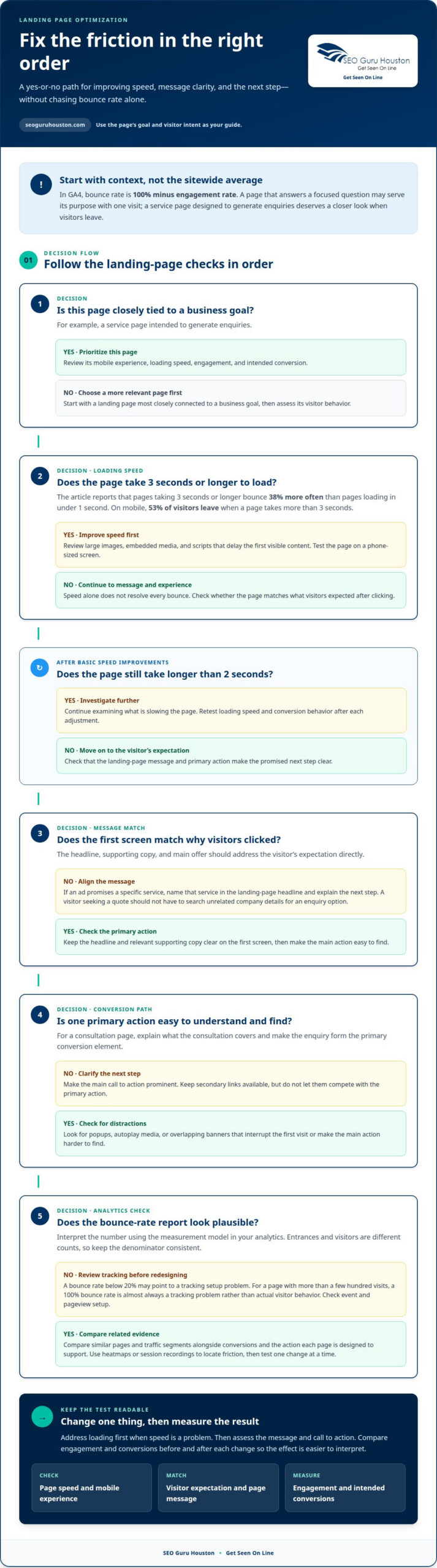
A slow landing page can lose visitors before they see the offer. Pages that take three seconds or longer to load bounce 38% more often than pages loading in under one second. On mobile, 53% of visitors leave when a page takes more than three seconds. Treat loading speed as part of conversion optimization, not a technical detail separate from engagement.

Start with the landing page most closely tied to a business goal, such as a service page designed to generate enquiries. Review its mobile experience and load speed, then make one change and measure its effect on engagement and conversions. A page that takes five seconds to load may be losing visitors. If it still takes longer than two seconds after basic speed improvements, investigate further.

  • Reduce heavy page elements. Review large images, embedded media, and scripts that delay the first visible content. For example, replace an oversized banner image with a compressed version that still communicates the offer.
  • Prioritize mobile loading. Test the landing page on a phone-sized screen. Check whether the headline, main offer, and primary action appear clearly without waiting for lower-page elements.
  • Remove distractions. Look for popups, autoplay media, or overlapping banners that interrupt the first visit. Make sure the main call to action remains easy to find.
  • Retest after each adjustment. Compare the page’s loading speed and conversion behavior before and after a change. If speed improves but visitors still leave, review the message and page experience next.

Speed alone won’t resolve every bounce. The page must also address why visitors clicked. If an ad promises a specific service, name that service in the landing-page headline and explain the next step directly. Someone looking for a quote shouldn’t have to search through unrelated company details to find an enquiry option.

Check that the first screen has a clear headline, relevant supporting copy, and one prominent action. For example, a page promoting a consultation can explain what it covers and feature an enquiry form as its primary conversion element. Keep secondary links available, but don’t let them compete with the main action.

Make each improvement deliberately. If a slow mobile landing page also has a vague offer, address loading first, then assess the message and call to action. For businesses building or refining sites across popular CMS platforms, design agencies like New Wave Digital Designs focus on streamlining page structure and user pathways to reduce early drop-offs. This sequence helps reveal which elements affect visitor behavior and keeps optimization focused on the outcome: a faster page that gives visitors a relevant answer and a clear path to conversion.

2. What is bounce rate?

Bounce rate measures visits that don’t meet a site’s definition of engagement. In Google Analytics 4 (GA4), bounce rate is 100% minus engagement rate. That means a single-page visit isn’t automatically a bounce in GA4; the session’s engagement status matters. Some analytics tools use a simpler definition, counting a visit as a bounce when someone leaves within 10 seconds.

Use the measurement model shown in your analytics before interpreting the number. For example, 500 bounces from 1,000 entrances produce a 50% bounce rate. Bounce-rate examples can vary depending on how analytics tools define and count visitors. Entrances and visitors are different counts, so keep the denominator consistent when reviewing a report.

In Google Analytics, begin with your top 20 landing pages. Compare their bounce rates with conversions, traffic sources, and the action each page is designed to support. A high rate on a page expected to generate enquiries deserves attention; a useful article may satisfy a visitor with one answer. Look for patterns across similar pages, not just the largest sitewide number.

Behavioral analytics can explain what the rate alone cannot. A heatmap can show where visitors click, how far they scroll, and whether key buttons attract attention. If visitors click an image expecting it to open but it isn’t interactive, that points to a usability gap. Session recordings can add context, while A/B testing can compare a focused change, such as a clearer button label, with the current page.

Prioritize tests based on evidence. First, identify a page with a meaningful role in traffic or conversions. Next, use heatmaps and behavior data to locate friction, such as visitors stopping before the enquiry form. Then test one change at a time and track engagement alongside the page’s intended conversion. Changing several elements together makes the results harder to interpret.

A bounce rate below 20% may point to a tracking setup problem. An analytics script firing twice can log two pageviews for one visit and distort the report. For a page with more than a few hundred visits, a 100% bounce rate is almost always a tracking problem rather than actual visitor behavior. Review event and pageview setup before redesigning the page.

Redefining a bounce can lower the reported rate quickly, but it doesn’t repair a poor experience. Keep GA4 engagement events aligned with meaningful visitor actions, then use the metric alongside clicks, conversions, and page behavior. For pages that need stronger structure, landing page development can help connect analytics findings to a clearer user journey.

3. Bounce rate benchmarks by website type

A bounce-rate benchmark helps only when the comparison is relevant. An online store, a blog, and a help center serve different purposes, so their visitors behave differently. Treat the metric as a diagnostic signal, not a universal score. A rate worth investigating on a product page may be normal on an article that answers a focused question.

Use these ranges as reference points, then compare pages with similar goals:

  • E-commerce sites: Average bounce rates range from 20% to 45%. A store can use below 45% as a target, while examining product pages separately from category pages.
  • Blogs and content sites: Average rates range from 40% to 60%, and some reach 90%. A reader may get the answer from one post without needing another page.
  • Lead-generation service sites: Average rates range from 30% to 55%. Review whether service pages make the offer and enquiry path clear.
  • Help and FAQ sites: Average rates range from 65% to 80%. Visitors may find a solution in one session and leave satisfied.

Broad benchmark tables offer another lens: 40-55% is classified as average, while 55-70% is classified as high. These labels don’t override the purpose of a page. A 60% rate may warrant closer attention on a lead-generation landing page, yet fit a support page where visitors quickly find instructions.

For non-e-commerce websites, below 60% can be considered average to good. Some people treat below 30% as evidence that a site is performing well, but a low number alone doesn’t prove strong engagement or conversions. Check whether the sessions include meaningful actions, such as form submissions or clicks on important links.

Make comparisons useful by matching page types first. Compare blog posts with other blog posts, product pages with product pages, and service pages with similar service pages. Then examine the same metric over the same reporting period and using the same analytics definition. Mixing unlike pages can hide a problem or make normal behavior look like a failure.

Separate mobile behavior during analysis, too. A landing page may attract different traffic and perform differently on mobile than on desktop. Compare each device group with similar pages, then investigate whether the content, layout, and next action suit that screen. Don’t assume the device caused the difference without reviewing the visitor journey.

Use a benchmark to decide where to investigate, not what to change automatically. If a product page sits above the e-commerce range, examine its traffic source, product information, and next step. If an FAQ page falls within its higher range, check whether visitors complete their task. The right measure reflects the page’s role and the outcome it should support.
How to Fix a High Bounce Rate by Matching Visitor Intent

4. Matching content to visitor intent

Interpret bounce rates through visitor intent, not as a verdict on page quality. Someone arriving at a blog post to answer one question may leave satisfied after reading. A visitor landing on a service page may need clearer details or a useful next step. Compare the search query, referring message, and page content to see whether they align.

On mobile, cramped text, hard-to-tap controls, confusing navigation, and intrusive pop-ups can interrupt the task and make visitors more likely to leave. Keep menus and key actions easy to use on small screens, and make pop-ups relevant and unobtrusive. A pop-up that blocks the answer before someone can read it creates friction, not engagement.

Make the first screen confirm that visitors reached the right page. For example, if a post answers a question about choosing a service, state that topic clearly in the heading and opening. Then organize supporting details in a logical order. Short paragraphs of ideally 2-4 lines help readers scan, while readable font sizes of 14-16px or even 18px support comfortable reading on modern screens.

Make the whole page easy to scan. Use descriptive subheadings, concise paragraphs, and lists for steps with a clear sequence. Someone looking for setup instructions should be able to find the relevant step without working through a dense block of text. Keep each section focused on its promise, and remove repeated details that slow readers seeking a direct answer.

Multimedia can clarify a complex idea, but it should support the text rather than get in the way. For example, a short demonstration can show how a process works, while a descriptive caption explains its relevance. Give images useful context, and avoid placing a large media element above the answer when visitors need a quick explanation. The page should remain understandable even if visitors don’t interact with the media.

Match the call to action to what the visitor has just read. A guide explaining a process can offer a related next step; a page answering a simple question may need only a relevant internal link. Avoid asking blog readers to make a high-commitment decision before they have enough context. The closer the action fits the content, the more naturally it supports the visitor’s intent.

Use scroll behavior to identify where the page stops meeting expectations. If visitors leave before reaching a key explanation, move that information higher or make the section easier to spot. A scroll-triggered pop-up appearing after about 20 minutes of reading may suit a long session better than one that interrupts the opening. Review the page’s purpose, readability, navigation, and interaction points together before changing its design.

5. Bounce rate by traffic segment

A sitewide bounce rate can hide the source of a problem. Before changing a page, segment traffic by channel, campaign, device, and audience. A landing page may satisfy search visitors but lose visitors from a paid campaign because the ad promised something different. The useful question isn’t just which page has the highest rate. It’s who arrives, what they expect, and whether the page delivers.

Start by comparing source or medium in Google Analytics. Review organic search, paid search, social, email, and referral sessions separately, then examine campaign-level results. For example, an email promoting a specific service should lead to a page that clearly explains it. If the email gets clicks but the landing page doesn’t match the offer, the mismatch may be the issue, not the audience.

Search traffic also needs a closer look. Visitors using a branded query already know the business name; non-branded searchers may be discovering a solution for the first time. BrightEdge Research estimates that 52% of clicks on non-branded queries go to the top three sites listed on search engine results pages. For that audience, a page should quickly establish relevance and answer the query that brought them there.

Compare device segments alongside traffic sources. If mobile visitors from a social campaign leave more often than desktop visitors from the same campaign, review the mobile experience and the ad’s promise. Keep the comparison focused: change one relevant element, then assess the same audience and traffic source again. Mixing desktop and mobile behavior can hide where the journey breaks.

  • Channel: Compare search, paid, social, email, and referral visits.
  • Campaign: Match each campaign’s message with its destination page.
  • Device: Separate mobile and desktop behavior within the same source.
  • Audience: Compare new and returning visitors where the reporting supports it.

Use conversion actions to assess whether a segment is valuable. A blog visitor arriving from social media may read one post and leave, while a paid-search visitor may be expected to submit an enquiry. For teams managing multi-channel campaigns, digital agencies like Web Bridge focus on aligning social media marketing content directly with on-page expectations to retain visitor interest. A higher bounce rate in the first group doesn’t automatically call for the same fix as in the second. Tie each segment to its intended outcome before prioritizing work.

In competitive categories, visitors may have five competitor websites open in other tabs while considering a purchase. Make the page’s offer, proof, and next step easy to recognize, without assuming every departure signals failure. If a specific channel consistently sends an audience to an unsuitable page, optimize that journey rather than changing the entire site. Optimize landing pages for each audience by aligning the destination with the campaign and visitor expectations.

SEO Guru Houston

SEO Guru Houston helps businesses connect bounce-rate analysis with a clearer digital marketing strategy. When traffic arrives from search or paid campaigns but landing pages don’t meet visitor expectations, professional SEO services and PPC services can help address the gap between audience intent, campaign messaging, and page content. For companies focused on reaching business buyers, specialized B2B marketing and inbound marketing strategies can support a more relevant path from discovery to engagement.

When analytics reveal patterns across channels, audiences, or landing pages, SEO Guru Houston can help coordinate a response through search optimization, paid advertising, and comprehensive website services. The aim is to find where the visitor journey breaks and align marketing activity with the experience each page delivers. Contact SEO Guru Houston to discuss your bounce-rate and visitor-intent challenges.

Turn Bounce-Rate Insights Into Your Next Move

As you learn how to fix a high bounce rate, treat visitor behavior as a guide for ongoing decisions, not a score to chase. Choose a priority audience, clarify the action its landing page should support, and use future performance to refine the experience. This keeps optimization connected to business goals.

When the challenge spans both visibility and landing-page relevance, SEO Guru Houston offers Houston SEO Services, Houston PPC Services, and Houston B2B Marketing. These offerings can help connect how people find a business with the experience they encounter after clicking. The right focus depends on where the disconnect appears in your marketing journey.

Ready to identify a practical next step for your traffic and landing pages? Talk with SEO Guru Houston about your SEO needs. Build from what your audience is telling you, and keep improving with purpose.

Frequently Asked Questions

What is bounce rate?

Bounce rate is the percentage of visits classified as unengaged under your analytics setup. In GA4, it’s the share of sessions that aren’t engaged sessions. This distinction matters: a person may read one page, find the information they need, and leave without taking another action. Interpret the metric alongside the page’s purpose, conversions, and the behavior you want visitors to complete.

What usually causes high bounce rates?

High bounce rates often point to a gap between what visitors expect and what a page delivers. A search result or ad may promise one thing while the landing page emphasizes something else. A useful starting point for how to fix a high bounce rate is to identify that mismatch. Other causes include broken forms, unclear next steps, or mobile layouts that make key content difficult to use.

How do you measure and track progress?

First define the page’s intended outcome, such as a completed enquiry form or a click to a useful resource. Then compare bounce rate with that outcome and engagement for the same landing page, traffic source, and device category. Keep analytics definitions and reporting filters consistent. If you change the page, record what you changed so you can connect later results to that adjustment.

What is a good bounce rate by industry and website type?

There’s no single target that fits every site. E-commerce averages are 20% to 45%, blogs and content sites average 40% to 60%, lead-generation service sites average 30% to 55%, and help or FAQ sites average 65% to 80%. Compare like with like, such as product pages against product pages. A useful benchmark starts an investigation; it doesn’t decide whether a page succeeds.

What are the most common causes of a high bounce rate?

Common causes include a mismatch between the traffic source and page message, confusing navigation, slow loading, intrusive pop-ups, and content that doesn’t answer the visitor’s query. A technical fault can also stop forms or buttons from working. For example, if a contact form fails after submission, visitors may leave without converting. Check the page as a visitor would, including its links and key actions.

How can I diagnose high-bounce pages using analytics and Search Console?

In analytics, identify landing pages with concerning bounce behavior, then segment results by source, campaign, device, and conversion activity. In Google Search Console, review the queries and pages attracting search impressions and clicks. Compare the need suggested by each query with the page’s title and content. If visitors click expecting an answer the page doesn’t clearly provide, revise the content or align the search result message with the destination.

How do page speed and Core Web Vitals affect bounce rate?

Slow loading can delay the content visitors came to see, while poor responsiveness or shifting page elements can make it harder to read or act. Core Web Vitals describe loading performance, interactivity, and visual stability. Review them alongside bounce behavior for the affected pages and devices. If a page feels delayed or jumps during use, address those experience issues, then assess engagement and conversions.

How can I improve landing page content and match search intent?

Start with the query, ad, or social post that brought the visitor to the page. Make the headline reflect that need, answer the main question early, and organize supporting details under clear subheadings. To learn how to fix a high bounce rate, make sure the page meets the visitor’s original expectation. For a service query, explain the service and make the relevant enquiry action easy to find.
How to Optimize Amazon Product Listings for SEO in 2026

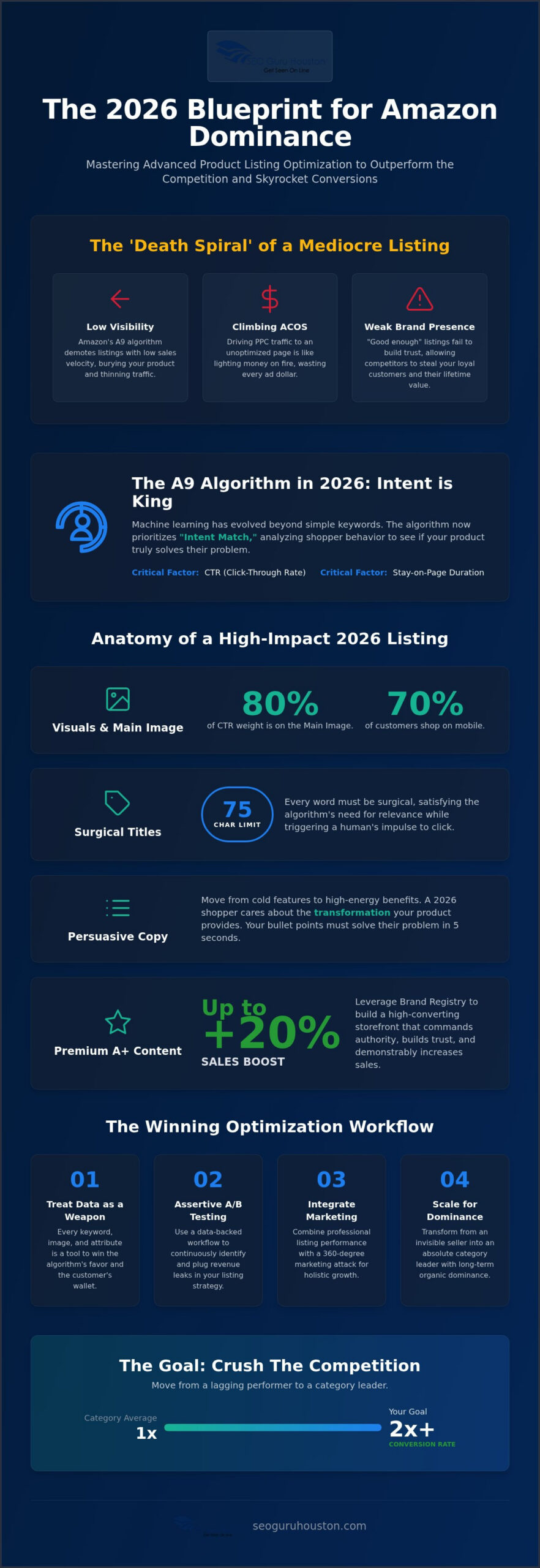
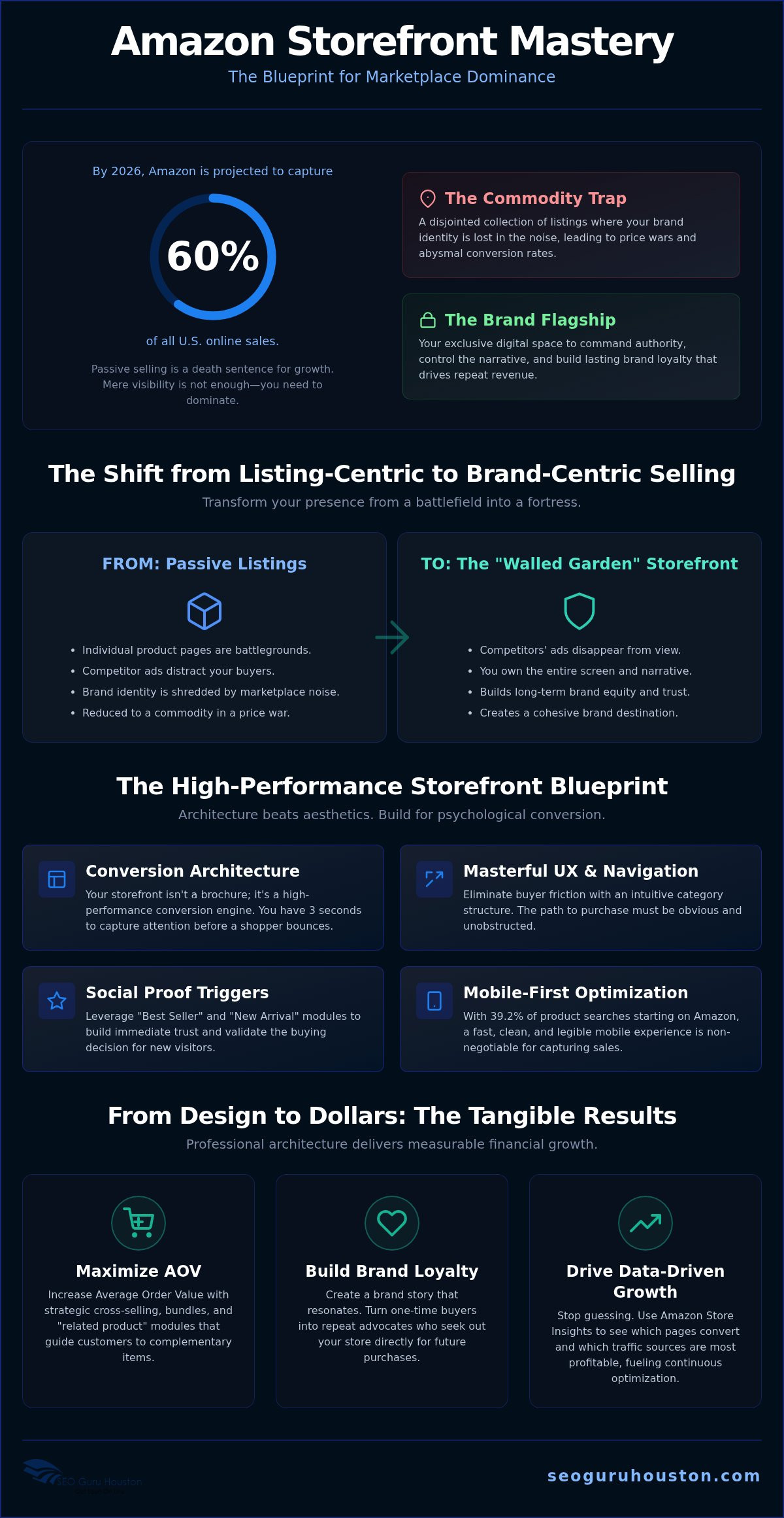
More keywords won’t automatically make an Amazon listing easier to find or more persuasive. Sellers often know their product needs better visibility, but the next steps can feel unclear: which search terms belong in the title, bullets, or backend fields, and how can the copy stay natural? Optimizing amazon product listings for seo works best when relevance and shopper clarity go together, not when keywords are repeated for their own sake.

This guide gives you a practical process to improve both. You’ll learn how to research and group relevant search terms, place them where they make sense, and shape a product detail page around the questions shoppers need answered. You’ll also learn to distinguish a discoverability problem from a conversion problem, then measure listing changes against meaningful outcomes. The goal is a clearer, more relevant listing and a disciplined way to assess whether your edits are helping.

Key Takeaways

  • Build a keyword map before editing so each relevant search term has a clear, useful place in the listing.
  • Make every listing element serve a purpose: help shoppers understand the product, assess its fit, and decide what to do next.
  • When optimizing amazon product listings for seo, prioritize relevance and readable copy over repeating the same phrases across fields.
  • Capture a baseline, update a focused group of related listing elements, and allow a suitable comparison period.
  • Separate discoverability signals from clicks, conversion, and sales to identify what needs attention next.

What Amazon Product Listing SEO Does, and What It Cannot Guarantee

Amazon listing SEO makes a product easier to discover through relevant searches and helps shoppers find useful information once they reach its detail page. That means aligning the listing’s language with the product and the way customers search, then clearly explaining what the product does, who it suits, and what buyers should know before choosing it. Keywords can help describe relevance, but they can’t replace a clear product page.

General SEO concepts offer a useful foundation. What is Search Engine Optimization? explains the broader goal of improving a page’s visibility in search. Amazon adds a marketplace context: shoppers are searching for products and comparing offers they can purchase, not simply looking for information on a topic. So optimizing amazon product listings for seo means considering both whether a listing matches a search and whether its content helps a shopper make a confident decision.

How Amazon search visibility differs from general web SEO

A website may use SEO to attract visitors researching a question, service, or product category. On Amazon, a shopper may search for a specific product type, compare several detail pages, and weigh each offer before buying. The listing must communicate product relevance, while its images, copy, price, availability, and other offer details can shape the shopper’s decision. Treat marketplace visibility and purchase performance as related but distinct questions. Appearing for a query doesn’t guarantee a click, and a click doesn’t guarantee a sale.

Why discoverability alone does not complete the job

Imagine a shopper searching for an adjustable laptop stand. A listing that includes the phrase but leaves compatibility, adjustment options, or key dimensions unclear may attract attention without resolving the buyer’s concerns. If the details are accurate and relevant, making them easy to find helps shoppers assess fit. Strong copy answers real questions; it doesn’t simply make room for more search terms.

Amazon listing SEO balances search relevance with product-page clarity, helping the right shoppers find a listing and understand why it fits their needs. Use that standard to review every field: does the wording accurately describe the product, and does it help a customer decide? If a phrase reads awkwardly or promises more than the product information supports, repetition won’t make it persuasive.

Keep expectations grounded. Optimization can support discoverability and improve the usefulness of a detail page, but it can’t guarantee a particular search position, traffic level, click-through rate, or sale. Results can also be affected by factors beyond listing copy, including the offer and shopper response. Treat changes as informed tests, not promises of a fixed outcome.

Amazon’s category requirements and available listing fields or research features can vary and change. Before editing, review current Seller Central guidance for the product’s category and the fields available to your account. This helps prevent an optimization plan from relying on outdated requirements or unavailable features.

How to Research and Map Amazon Keywords Before Editing a Listing

Start with research, not a rewrite. A focused keyword map helps you decide which phrases accurately describe the product, what shoppers likely mean by them, and where each term can fit naturally. This sequence makes optimizing amazon product listings for seo a deliberate process instead of a race to insert every phrase you find.

Build a relevant keyword set from shopper language

First, define the product plainly: its type, intended use, audience, and distinguishing attributes. Then gather the words shoppers use through Amazon search suggestions and relevant research features available in Seller Central. Treat these as clues, not automatic instructions. Keep terms that match the product and the shopper’s likely goal. Remove duplicates, unrelated searches, unsupported claims, and phrases that imply a feature the product doesn’t have.

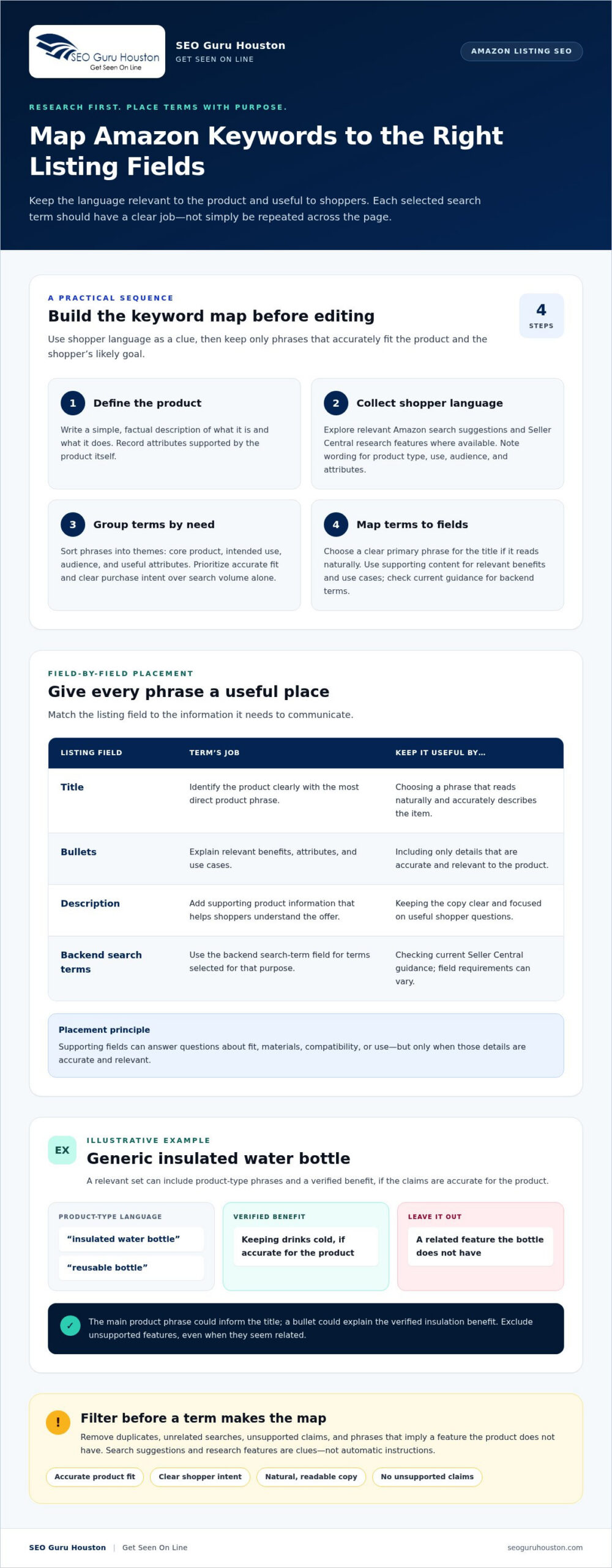
  • 1. Define the product. Write a simple, factual description of what it is and what it does. Record only attributes supported by the product itself.
  • 2. Collect shopper language. Explore relevant Amazon search suggestions and Seller Central research features where available. Note variations in product type, use, audience, and attribute wording.
  • 3. Group terms by need. Sort phrases into themes such as core product, intended use, audience, and useful attributes. Prioritize accurate product fit and clear purchase intent over search volume alone.
  • 4. Map terms to fields. Choose the clearest primary phrase for the title if it reads naturally. Use bullets and description content to explain relevant benefits and use cases. Check current Seller Central guidance before entering backend search terms, since requirements can vary.

Illustrative example: For a generic insulated water bottle, a relevant set might include “insulated water bottle,” “reusable bottle,” and phrases about keeping drinks cold, if those claims are accurate for the product. Group the first phrases as product-type language and the last as a benefit. The main product phrase could inform the title, while a bullet explains the verified insulation benefit. Exclude a term for a feature the bottle doesn’t have, even if it seems related.

Map search terms to listing fields

Give every selected phrase a job. Put the most direct product identification where shoppers can quickly understand what’s being offered. Use supporting fields to answer questions about fit, materials, compatibility, or use, but only when those details are accurate and relevant. Backend fields can accommodate suitable terms that don’t fit naturally in visible copy; they aren’t a place to stash unrelated phrases. Review current category-specific Seller Central rules before publishing.

A simple worksheet can keep the process consistent: record each phrase, its shopper intent, its relevance to the product, and its planned field. If several terms express the same need, choose the clearest wording rather than forcing every variation into the listing. For sellers seeking strategic support beyond their own research, Amazon marketing support can help connect keyword choices with broader listing goals.

Which Listing Elements Matter Most for Amazon SEO and Shopper Decisions?

Each listing element has a different job. Some help identify the product, some answer buyer questions, and others help shoppers judge what they’ll receive. Prioritize the fields that address the clearest gap rather than editing everything at once. Also distinguish listing content from offer conditions: price and availability can affect a shopper’s choice, but they aren’t copy edits.

Title, bullets, and description: make relevance easy to understand

Use the title to identify the product and include its core search language naturally. Bullets should make verified features and customer benefits easy to scan, while the description can add context or clarify use. Avoid repeating the same phrase across every field. For each edit, ask whether it improves product understanding or simply adds another keyword.

Listing element Shopper purpose Optimization priority
Title Identify the product quickly and establish its main relevance. High. Make the product type clear and use accurate, natural wording.
Bullets Scan key features, benefits, and product-fit details. High. Lead with useful, specific information that the product supports.
Description Understand additional context, use, or details. Medium. Add information that helps a decision; don’t restate every phrase.
Images See the product and assess visible features or scale. High for shopper clarity. Keep visuals accurate and consistent with the offer.
A+ Content Explore supplementary brand and product information. Consider it where available and useful; verify current access and rules.
Backend search terms Support relevant terms that don’t fit naturally in visible copy. Use selectively. Follow current Seller Central instructions and avoid redundancy.
Price and availability Assess the offer and whether the product can be purchased. Review separately from listing copy; these are offer conditions, not text fields.

Images, A+ Content, and backend terms: support the full listing

Accurate images let shoppers inspect what the written copy describes and compare relevant details. A+ Content can provide additional brand or product context, but eligibility, access, and content rules can vary. Backend terms aren’t a workaround for weak visible copy. Include only relevant terms that comply with current Amazon guidance.

Limits, field names, category requirements, and feature access can change. Verify current rules in Seller Central before publishing, especially for titles and backend terms. Don’t assume a field is available or that a character limit applies uniformly across categories.

Use the element that matches the problem. If shoppers may not recognize the product, review the title. If they can identify it but key benefits or fit remain unclear, strengthen the bullets, description, or supporting content. If the listing communicates the product well but the offer itself is less competitive, review price and availability separately. Repeating keywords everywhere won’t solve these gaps. Optimizing amazon product listings for seo means making each field relevant, readable, and useful for the decision it supports.

How to Optimize Amazon Product Listings for SEO in 2026

How to Optimize an Amazon Listing Step by Step Without Guesswork

A reliable optimization process starts with evidence, not a full-page rewrite. Record what the listing says now, identify the most likely obstacle, make a focused change, and review the result against your starting point. This sequence makes optimizing amazon product listings for seo easier to manage, especially when several people share responsibility for product content.

Create a baseline and prioritize the first improvements

Before editing, save the current title, bullets, description, images, and any other fields you plan to change. Note available indicators for search visibility, listing visits, clicks, and sales, along with the dates covered. Use reporting available in your Seller Central account, and check current documentation for metric names and definitions. Then diagnose the clearest gap: weak relevance, missing or confusing product information, or limited shopper response.

  • 1. Capture the starting point. Save the live listing and record relevant performance indicators for a defined date range. Note offer conditions, such as price or availability, that could affect comparisons.
  • 2. Choose a priority. If the product is hard to identify, refine relevant language in the title. If shoppers may not understand fit or benefits, improve the content that answers those questions. Focus on accurate, meaningful changes rather than cosmetic wording.
  • 3. Revisit your keyword map. Match selected phrases to the field where they fit naturally. Remove terms that don’t describe the product or help explain its value.
  • 4. Edit a focused group of related elements. Update only what’s needed to address the diagnosed issue. When practical, avoid changing unrelated fields at the same time so later comparisons are easier to interpret.
  • 5. Log the change. Record the edit, the date it went live, the reason for it, and the outcome you expect to observe.

Implement edits and evaluate them responsibly

Keep product facts accurate and follow current marketplace requirements as you publish. After an edit, allow a suitable observation period for the indicators you’re tracking to become useful. Compare like with like where possible, and account for seasonality, promotions, price changes, availability shifts, or other listing updates during the same period. If several variables changed together, don’t credit one wording change with the full result.

Use a simple change log to preserve context: “Updated bullets to clarify compatibility; monitor relevant visits and orders; offer price unchanged.” This makes the next decision more disciplined. If the chosen indicator improves but sales don’t, investigate the offer and shopper experience rather than adding more keywords. If no meaningful movement appears, revisit the diagnosis before making another targeted change.

For a related perspective on improving product pages, explore this Amazon listing optimization guide. For support applying a structured approach across your Amazon marketing, discuss your Amazon listing strategy.

How to Measure Amazon Listing SEO and Choose Your Next Move

A listing change is only useful if you can learn from it. Measure the path from search exposure to purchase, and don’t treat every weak result as a keyword problem. Discoverability indicators, shopper response, sales, and offer conditions describe different parts of the journey. Separating them gives you a clearer next step than watching sales alone.

Read performance signals without overclaiming

Use reporting tools and metrics currently available to your seller account. Names, access, and definitions can change, so check current Seller Central documentation before comparing figures or building a report. Compare equivalent date ranges where possible, and note promotions, inventory interruptions, price changes, and other offer shifts that could influence results. If a reporting feature isn’t available to your account, don’t assume a substitute measures the same thing.

Search exposure shows whether shoppers may be seeing your listing; conversion shows what happens after shoppers arrive. Use that distinction to locate the likely bottleneck, then interpret available measures in context:

  • Discoverability: If relevant search exposure is limited, review whether the listing clearly matches the product and the searches you’re targeting. Confirm that the terms are accurate and placed appropriately.
  • Clicks and visits: If shoppers see the offer but don’t select it, assess how clearly the title and main image communicate what’s being sold. Consider the competitive context rather than assuming a keyword change is needed.
  • Conversion: If shoppers visit but purchases remain weak, look for unanswered questions, unclear product details, or a mismatch between the listing and the offer. Review price, availability, and other offer conditions separately from the copy.
  • Sales: Read sales alongside traffic and conversion indicators. A change in sales alone doesn’t identify which part of the customer journey changed.

Choose the next move based on evidence. Retain an edit when relevant indicators improve without a clear trade-off. Refine it when the direction is promising but a specific page element still appears unclear or underperforming. Investigate when signals conflict, the comparison period included major offer changes, or the reporting doesn’t support a confident conclusion. Avoid declaring a single edit the cause when other variables changed at the same time.

When expert support can strengthen the optimization process

Coordinating keyword choices, listing content, and performance analysis can become challenging across multiple products or teams. SEO Guru Houston’s Amazon-specific marketing services can support sellers who want a more connected view of those decisions. To coordinate listing improvements with a wider marketplace strategy, explore Amazon marketing services.

Make Your Next Listing Improvement Count

Your next step doesn’t need to be a sweeping overhaul. Choose one product page with a clear opportunity, then turn what you learn into a repeatable standard for the rest of your catalog. That’s how optimizing amazon product listings for seo becomes an ongoing business practice, not a one-time rewrite. Each disciplined improvement can sharpen how your product is presented and give your team a stronger basis for its next decision.

If you want to connect listing work with a broader growth plan, SEO Guru Houston brings Amazon-specific marketing together with SEO, PPC, and web development expertise. This support can help align marketplace priorities with the rest of your digital strategy while keeping the shopper experience in focus. Explore Amazon marketing services and take a focused next step toward stronger product pages. Keep testing thoughtfully, learning from the evidence, and building momentum.

Frequently Asked Questions

How do I optimize an Amazon product listing for SEO?

Start by confirming every product fact, including size, material, compatibility, and intended use. Then match shopper search phrases to the fields where they read naturally: product identification in the title, decision-making details in bullets, and added context in the description. For example, don’t describe a charger as compatible with a device unless that claim is accurate. Save the original listing and available account data so later adjustments have a useful point of comparison.

What is the most important part of an Amazon listing for SEO?

No single field guarantees a ranking, so prioritize the weakest part of the specific listing. A shopper who can’t identify the item may need a clearer title; someone who understands the product but can’t assess fit may need better bullets, images, or description details. Backend terms can support discoverability under current Amazon requirements, but they can’t replace useful visible content. Diagnose the shopper’s likely question before choosing what to edit.

How many keywords should I use in an Amazon product listing?

There’s no universal keyword count that fits every product and category. Build a relevant set from the language shoppers use, then include a phrase only where it accurately describes the item or helps explain its use. A phrase that adds no new meaning can make copy repetitive. Check Seller Central for current field requirements, especially for backend terms, where formatting and eligibility may differ from customer-facing content.

Do backend keywords help Amazon product listings rank?

Backend search terms can provide relevant product information, but they don’t replace clear customer-facing content or guarantee a ranking change. Use them only for phrases that genuinely apply and follow the instructions currently shown in Seller Central. For example, an alternate term may be useful if shoppers use it for the same product type, while a phrase suggesting an unsupported feature should be left out. Review available account data after edits rather than assuming an effect.

Does Amazon A+ Content improve SEO?

A+ Content can give eligible brands more ways to explain a product and help shoppers understand its features, but don’t assume it directly improves organic rank. Treat it as a content option for answering questions that standard copy may not address well, such as how a product is used or what distinguishes it. Verify current access and publishing rules in Seller Central, then assess available shopper and sales indicators after the content is live.

How long does Amazon SEO take to work?

There’s no universal timeline or guaranteed ranking change after an optimization. A result may depend on whether Amazon processes the update, category conditions, shopper demand, inventory, and changes to the offer. Record when each edit goes live and allow a suitable period to observe relevant account data. Compare similar periods where possible, and avoid stacking frequent changes, since that can make it harder to identify which adjustment may have influenced performance.

Can I use the same keywords in my Amazon title and backend search terms?

Place keywords in a way that follows current Amazon guidance and keeps the title clear. Repeating an identical phrase in multiple fields may add little value, but don’t assume one rule covers every category or field. Keep visible copy natural and accurate, then check Seller Central’s current backend instructions before entering terms. Never use repetition to imply a feature, compatibility, or benefit the product doesn’t actually provide.

How can I tell whether my Amazon listing optimization is working?

Compare available search visibility measures with listing clicks, conversion, and sales to see where the customer journey may be changing. For instance, more visits without more orders may point to a different issue than limited exposure. Keep a record of the listing version, edit dates, and changes to price, inventory, or promotions. Use current Seller Central reporting where available, compare appropriate periods, and decide whether to retain, refine, or investigate the update.

What Makes a Good B2B Website? The Assertive Blueprint for Revenue Growth in 2026

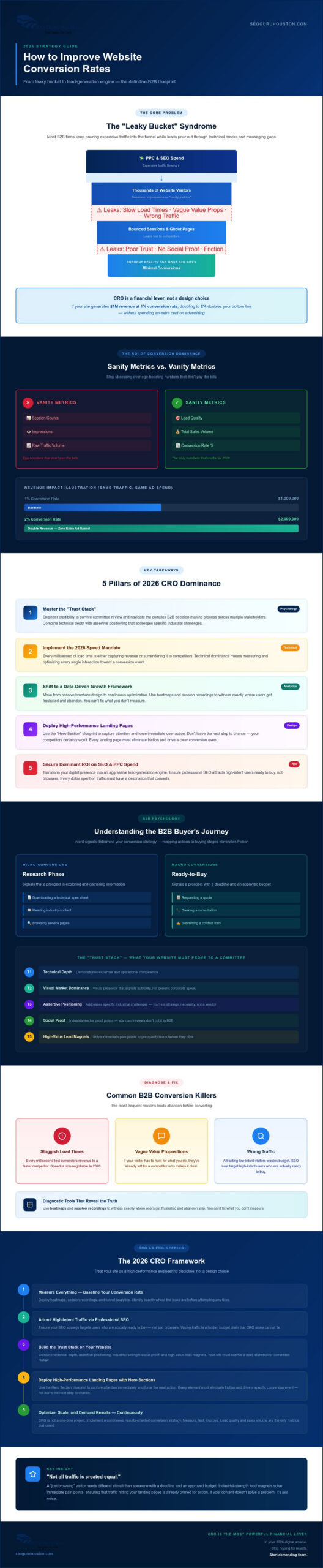
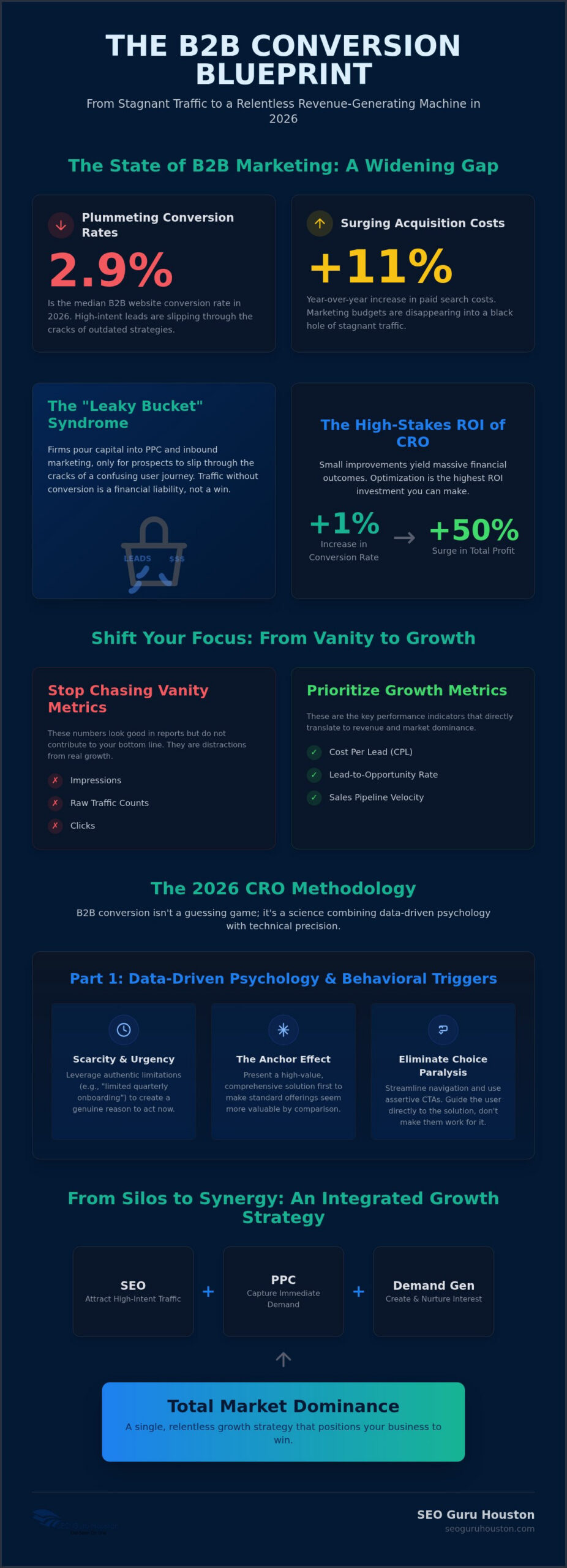
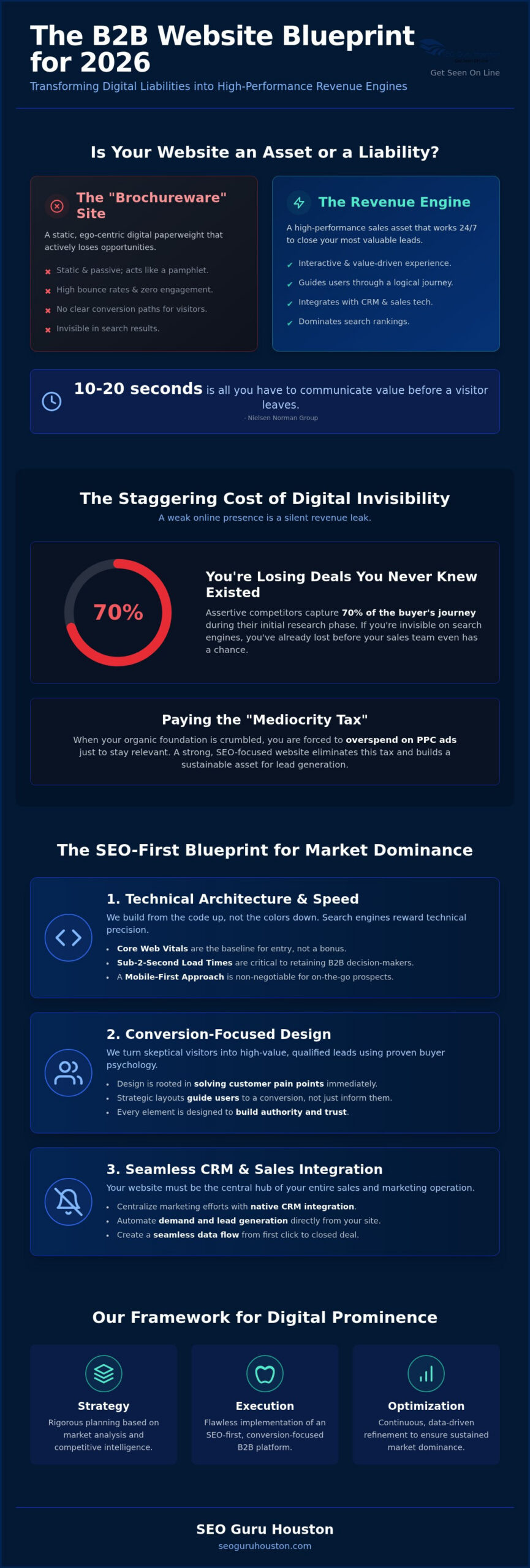
If your website is still acting like a digital brochure, it’s not an asset; it’s a liability that’s actively bleeding your market share. You’re likely watching traffic climb while your CRM stays silent, wondering exactly what makes a good b2b website in an era where 80% of the buying journey happens before a prospect even says hello. It’s frustrating to invest in visibility only to realize your site can’t close the gap between a click and a contract. You need a platform that doesn’t just look professional but actually forces the needle to move.

We’re moving past the age of “pretty” design and into the era of agentic commerce and high-velocity demand generation. This guide delivers the assertive blueprint you need to transform a static URL into a 24/7 sales powerhouse. You’ll discover the non-negotiable technical frameworks and psychological triggers that turn passive visitors into qualified leads. We’re stripping away the fluff to focus on the technical precision and strategic authority required to dominate the 2026 digital landscape. Get ready to stop chasing traffic and start engineering revenue.

Key Takeaways

  • Learn how to pivot from a static digital brochure to a high-velocity revenue engine that actively qualifies leads and shortens your sales cycle.
  • Identify the technical non-negotiables, including sub-2-second load speeds, that prevent your site from bleeding potential revenue to faster competitors.
  • Discover what makes a good b2b website by aligning your authority-building content with the modern, self-service buyer journey.
  • Master the conversion architecture and high-energy CTAs needed to transform anonymous traffic into a consistent stream of high-intent leads.
  • Build a future-proof digital presence that integrates with aggressive demand generation strategies to ensure long-term market dominance.

What Makes a Good B2B Website? Defining the Revenue Engine

A B2B website isn’t a digital business card; it’s a high-performance machine. In the competitive Business-to-business (B2B) landscape, your digital presence is either a strategic asset that qualifies leads or it’s a liability that’s bleeding your budget. Most companies settle for a “Digital Brochure” that sits passive and static. Real market leaders build a “Revenue Engine” that’s active, data-driven, and designed to shorten sales cycles by delivering value at every click. If you’re wondering what makes a good b2b website, the answer starts with its ability to force a conversion. It doesn’t just sit there. It works.

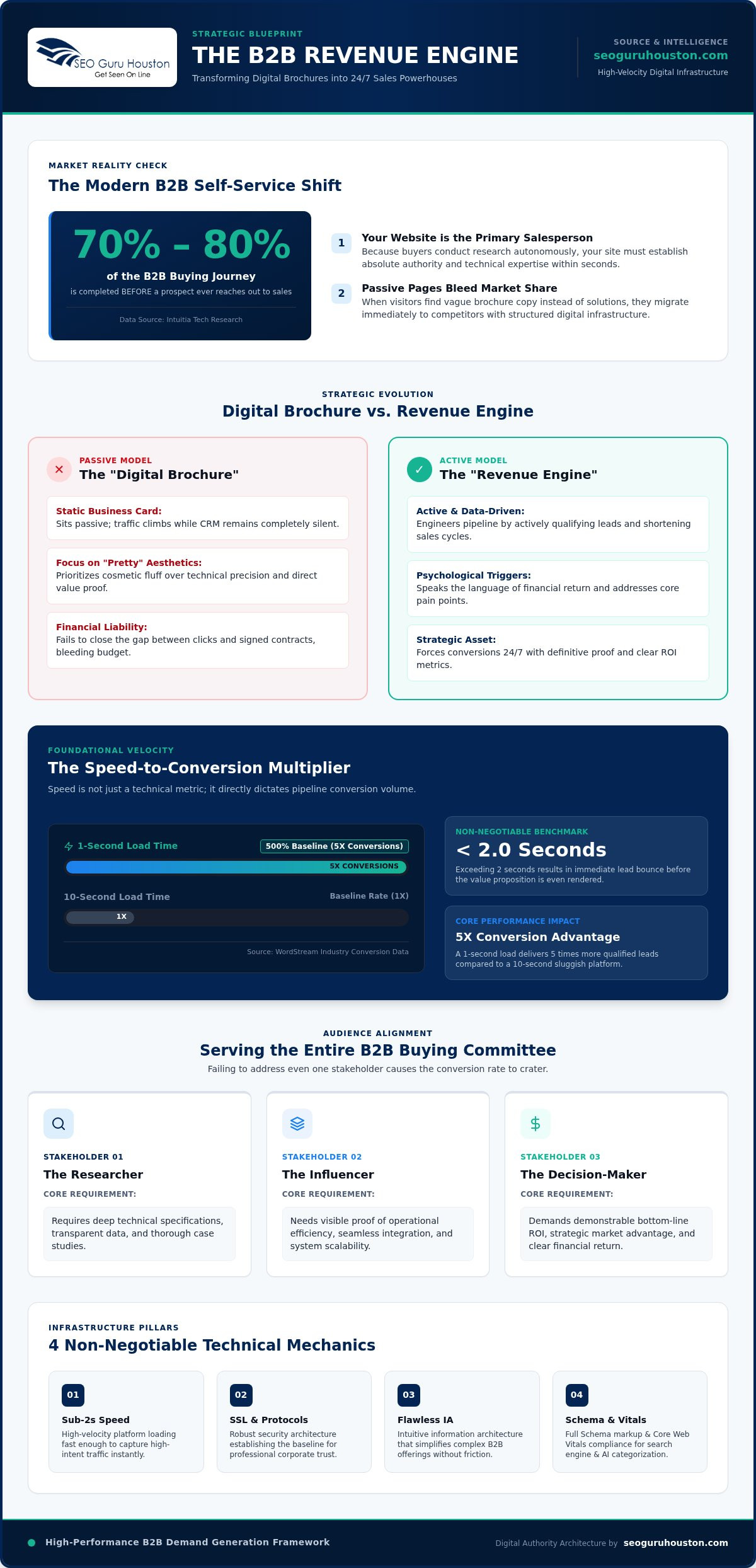
The reality of 2026 is that the buyer has changed. According to research from Intuitia Tech, 70% to 80% of the B2B buying journey is completed before a prospect ever reaches out to your sales team. This means your website is your primary salesperson. It must establish absolute authority within seconds. If a visitor can’t immediately see your technical expertise and strategic advantage, they’ll find it with a competitor who took their digital infrastructure seriously. Dominance isn’t an accident; it’s engineered through a site that speaks the language of results.

The Shift from Passive Presence to Active Demand Generation

Your website needs to do the heavy lifting that used to require a dozen sales calls. We’re moving beyond simple lead collection and into a b2b demand generation agency mindset. This means every page must use psychological triggers to move stakeholders through the funnel. You aren’t just asking them to “Contact Us.” You’re providing the proof they need to justify a high-stakes purchase. A good site qualifies the visitor by addressing pain points directly and presenting a definitive solution that makes your service a fundamental necessity for their survival.

Identifying the Core Stakeholders of Your Digital Presence

You aren’t designing for one person. What makes a good b2b website is its capacity to serve the entire buying committee. You need to provide technical transparency for the researcher, proof of efficiency for the influencer, and clear ROI for the final decision-maker. If you don’t speak the language of financial return, you’re just adding noise to the market. Trust is built through results, not fluff.

  • The Researcher: Needs deep technical specs and case studies.
  • The Influencer: Needs to see how your solution integrates and scales.
  • The Decision-Maker: Needs to see the bottom-line impact and strategic advantage.

Fail to address even one of these stakeholders, and your conversion rate will crater.

Foundational Mechanics: Speed, Security, and Seamless UX

Speed isn’t just a technical metric; it’s a conversion killer. If your site takes more than two seconds to load, you’ve already lost the lead before they even see your value proposition. Data from WordStream shows a B2B site that loads in 1 second can see 5 times more conversions than a site that takes 10 seconds. When you evaluate what makes a good b2b website, you have to look under the hood. High-velocity growth requires a high-velocity platform. Anything less is just an expensive way to frustrate your prospects.

Trust begins with a secure browsing environment. An SSL certificate and robust security protocols aren’t optional extras; they’re the baseline for professional credibility. Beyond security, your information architecture must be flawless. B2B offerings are often complex, but your navigation shouldn’t be. You need to organize your services so intuitively that a decision-maker can find exactly what they need without a map. If your high-performance digital infrastructure isn’t built on these pillars, your marketing efforts will never scale.

Technical Optimization for Search Dominance

Search engines don’t care about your aesthetic; they care about your code. Integrating professional seo services into your initial development is the only way to ensure market dominance. You need Schema markup to help AI and search engines categorize your B2B services accurately. By 2026 standards, hitting the benchmark for Core Web Vitals is mandatory for maintaining visibility. It’s about precision. Your site must be clean, crawlable, and technically superior to every competitor in your space.

User-Centric Design That Drives Action

Friction is the enemy of revenue. We implement the “3-click rule” to ensure any stakeholder can reach critical data or a conversion point within three actions. Your visual hierarchy should act as a silent guide, leading the eye away from fluff and toward high-value declarations. Mobile responsiveness is equally critical, as 80% of B2B buyers now use mobile devices during their purchasing journey. What makes a good b2b website in an enterprise context also includes ADA compliance; accessibility is a standard for national brands that refuse to leave money on the table.

  • Sub-2-Second Load Times: The non-negotiable standard for B2B retention.
  • Mobile-First Logic: Dominating the 80% of buyers researching on the go.
  • UX ROI: Every $1 invested in UX can return up to $100 according to UXtweak research.

Precision in design leads directly to precision in lead volume.

Establishing Absolute Authority Through Strategic B2B Content

Content is the digital manifestation of your expertise. In a market where buyers interact with an average of 13 pieces of content before engaging, your site must act as the ultimate guide. A fluff-filled blog won’t cut it. You need a b2b inbound marketing strategy that attacks specific industry pain points with surgical precision. If your content doesn’t solve a problem, it’s just digital noise. You’re not just providing information; you’re providing a roadmap to market dominance.

When evaluating what makes a good b2b website, look at the depth of its technical resources. White papers, webinars, and deep-dive technical articles aren’t just downloads. They’re proof of technical mastery. These assets serve as the authoritative voice that leads a prospect through the complex consideration stage, turning skepticism into trust through sheer competence. You must position your brand as the only logical choice in a sea of mediocre alternatives.

The Power of Website Video Marketing

Video is the highest-engagement medium available for complex solutions. It humanizes your brand and simplifies intricate industrial processes that text often fails to capture. Strategic Website Video Marketing focuses on placement and purpose. Use high-impact hero videos to establish immediate authority, then follow up with product-specific deep dives for the technical researchers. Video doesn’t just increase time-on-site; it builds immediate credibility by showing your solutions in action. It’s the most efficient way to bridge the gap between technical complexity and buyer understanding.

Case Studies: The Ultimate Proof of Transformation

Stop telling people what you do. Start showing them what you’ve achieved for others. Effective case studies move the needle because they provide social proof grounded in reality. We structure these using a Challenge, Solution, Result framework to ensure the narrative is clear and compelling. Use bold typography and symbols to emphasize financial gains and ROI metrics. A decision-maker doesn’t care about your feature list. They care about the measurable efficiency you delivered for a similar firm. This focus on outcomes is exactly what makes a good b2b website in the eyes of a high-value stakeholder.

What Makes a Good B2B Website? The Assertive Blueprint for Revenue Growth in 2026

Conversion Architecture: Turning Traffic into Qualified Leads

Traffic is vanity; conversions are sanity. If your site generates hits but no hand-raisers, your architecture is broken. Understanding what makes a good b2b website requires looking at how you ask for the business. Passive “Contact Us” buttons are for companies comfortable with second place. You need high-energy declarations that demand action. Research from WordStream indicates that personalized calls-to-action convert 202% better than standard ones. If you aren’t personalizing the ask, you’re leaving double the revenue on the table. It’s time to stop whispering and start leading.

The core of this strategy is high converting landing page design. These aren’t just pages; they are focused environments where distractions go to die. Every element must push the visitor toward a single objective. This is where demand generation happens. You trade high-value intellectual property, such as proprietary data or industrial frameworks, for contact information. This isn’t just a lead magnet; it’s a value exchange that positions you as the expert before the first sales call even happens.

Form optimization requires a ruthless balance. Ask for too much data, and you kill the conversion. Ask for too little, and you waste your sales team’s time with unqualified noise. Use conditional logic to keep forms short while capturing the high-intent data necessary for a sophisticated demand generation strategy. It’s about surgical precision, not just volume. You want a pipeline full of buyers, not browsers.

Strategic CTA Placement and Messaging

Context is everything. A visitor in the awareness stage shouldn’t be hit with a “Buy Now” button. You must map your CTAs to the buyer’s journey. Use urgency and value-driven language like “Secure Your Market Position” instead of generic words like “Download.” A/B testing is the non-negotiable process here. If you aren’t constantly refining your conversion points based on real data, you’re guessing with your company’s future. Stop guessing and start scaling your lead volume with precision.

Trust Signals and Social Proof

Friction is the psychological barrier between a visitor and a form submission. You crush that barrier with trust signals. Client logos, industry certifications, and specific awards are fundamental. They act as silent endorsements. Place your strongest testimonials near high-friction points, like the final field of a lead form. Absolute transparency in your results is your biggest competitive advantage. When you show exactly how you move the needle, you remove the risk of engagement. This level of conversion-focused detail is exactly what makes a good b2b website a dominant force in its industry.

Market Dominance: Building a Future-Proof B2B Presence

Market dominance isn’t a destination; it’s a constant state of evolution. If you treat your digital presence as a “set it and forget it” project, you’re essentially handing your market share to the competition. A stagnant site is a liability that hides revenue leaks you don’t even know exist. What makes a good b2b website in the long term is its ability to adapt based on hard data, not gut feelings. You need to leverage heatmaps and advanced analytics to identify exactly where prospects are falling out of your funnel. When you see the friction, you crush it. Maintenance isn’t just about fixing bugs; it’s about optimizing for a 9,900% UX ROI that forces the market to react to you.

The ultimate goal is a platform that stands as the undisputed leader in your national industry. This requires a shift from simple maintenance to a strategy of continuous improvement. With B2B website maintenance costs ranging from $5,000 to $500,000 annually depending on pipeline complexity, you must ensure every dollar spent is an investment in scalability. For organizations looking to unite high-performance digital marketing with purpose-driven web design, partnering with specialists like The Ethical Agency ensures long-term impact and architectural durability. You aren’t just building for today; you’re building a fortress that can withstand shifting algorithms and changing buyer behaviors.

Integrating SEO and PPC for Maximum Visibility

Isolation is the enemy of efficiency. Your digital strategy must be a unified front. When you work with a top-tier seo marketing company, they don’t just look at rankings; they align design with search intent. This organic foundation must be supercharged by a sophisticated ppc management strategy. Paid traffic provides immediate data on which keywords actually convert, allowing you to refine your organic content and landing pages with surgical precision. This feedback loop creates a compounding effect, lowering your acquisition costs while expanding your total search footprint. You don’t just want to be found; you want to own the entire results page.

Scaling Your B2B Digital Strategy

Ultimately, what makes a good b2b website is its capacity to scale without breaking. As you move toward international or enterprise-level expansion, your architecture must be ready to handle increased load and complex integrations. 96% of marketers have already adopted agentic AI for autonomous campaign decisions; if your site isn’t technically prepared for this level of automation, you’re already obsolete. You need a high-performance coach who understands these technical nuances and can guide your transition from invisibility to prominence. Stop settling for a site that just exists. It’s time to build a revenue engine that dominates. Take decisive action now and force your competitors to play catch-up.

Dominate Your Market with a High-Velocity Revenue Engine

Your digital presence is the battlefield where market share is won or lost. We’ve established that what makes a good b2b website isn’t just aesthetic appeal; it’s the technical precision of sub-2-second load times and a conversion architecture that forces action. If your site isn’t actively qualifying leads and shortening your sales cycle, it’s a liability you can no longer afford. The 2026 buyer demands a seamless, authority-driven experience. Anything less is an open invitation for your competitors to take the lead.

Transformation requires moving from invisibility to prominence through result-oriented technical mastery. You need a national-scale digital strategy that integrates high-converting funnels with aggressive demand generation. Stop settling for a passive brochure and start engineering a platform that works as hard as your top sales performers. The path to market dominance is clear for those ready to take decisive action. Ready to transform your website into a revenue engine? Contact SEO Guru Houston today! We’re ready to help you scale with precision and win.

Frequently Asked Questions

What is the most important feature of a B2B website?

The most important feature is a conversion-centric architecture that aligns perfectly with the modern self-service buyer journey. While aesthetics matter, your site must prioritize technical performance and clear, outcome-focused messaging to qualify leads effectively. It needs to act as a 24/7 sales engine, providing the specific data and social proof required for stakeholders to make informed decisions. A site that doesn’t force a conversion is just an expensive digital brochure.

How often should a B2B website be redesigned for optimal performance?

A B2B website should undergo a major strategic redesign every two to three years to stay ahead of rapidly shifting digital trends. However, the most successful firms adopt a continuous improvement model, using monthly data from heatmaps and A/B testing to refine the user experience. Waiting years to update your infrastructure creates revenue leaks. You must treat your site as a living asset that evolves alongside agentic AI and changing buyer expectations.

Why is SEO-first development critical for B2B lead generation?

SEO-first development is critical because it ensures your technical infrastructure is crawlable and authoritative from day one. Integrating search optimization into the initial build prevents the need for costly retroactive fixes. When evaluating what makes a good b2b website, technical precision in Schema markup and Core Web Vitals is non-negotiable. This approach guarantees that your high-value content actually reaches the 80% of buyers who conduct independent research before contacting a sales team.

What is the difference between B2B and B2C website design?

The primary difference lies in the complexity of the buyer journey and the number of stakeholders involved. B2C sites focus on emotional, immediate impulse buys, while B2B design must serve a multi-person buying committee with technical depth and financial justification. Your site must speak the language of ROI and long-term strategic advantage. It requires a structured flow that guides researchers, influencers, and decision-makers through a logical sequence of trust-building and technical transparency.

How do I measure the ROI of my B2B website?

Measuring ROI requires looking beyond vanity metrics like page views and focusing on qualified lead volume and pipeline velocity. You must track how many anonymous visitors convert into high-intent hand-raisers and eventually into closed revenue. Use advanced analytics to calculate the cost per lead and compare it to the lifetime value of the customer. A profitable site demonstrates a clear reduction in customer acquisition costs while increasing the total volume of high-margin opportunities.

Does a B2B website really need video marketing?

Video marketing is a fundamental necessity for explaining complex industrial processes and humanizing high-stakes brands. It provides the highest engagement levels of any medium, often increasing time-on-site and building immediate credibility. Strategic video placement, such as hero videos that establish authority or product deep dives, helps bridge the gap between technical complexity and buyer understanding. If you aren’t using video, you’re missing the most efficient way to communicate value to modern, mobile-first stakeholders.

What are the biggest mistakes companies make with their B2B websites?

The biggest mistakes include treating the site as a static brochure, ignoring sub-2-second load times, and using vague, jargon-heavy messaging. Many firms fail to provide clear conversion paths, leaving visitors confused about the next step. Another critical error is ignoring mobile responsiveness, which alienates the 80% of buyers researching on the go. Settling for a passive presence is the ultimate failure when considering what makes a good b2b website in a competitive landscape.

How long does it take to see results from a high-performance B2B site?

Technical improvements like site speed and UX refinements often yield immediate boosts in conversion rates for existing traffic. However, significant organic growth typically takes three to six months as search engines recognize your increased authority and technical precision. For rapid scaling, you should integrate your high-performance site with a robust PPC strategy to drive high-intent traffic instantly. The combination of a dominant platform and aggressive demand generation accelerates your path to market prominence.

High-Impact Landing Page A/B Testing Ideas to Explode Conversions in 2026

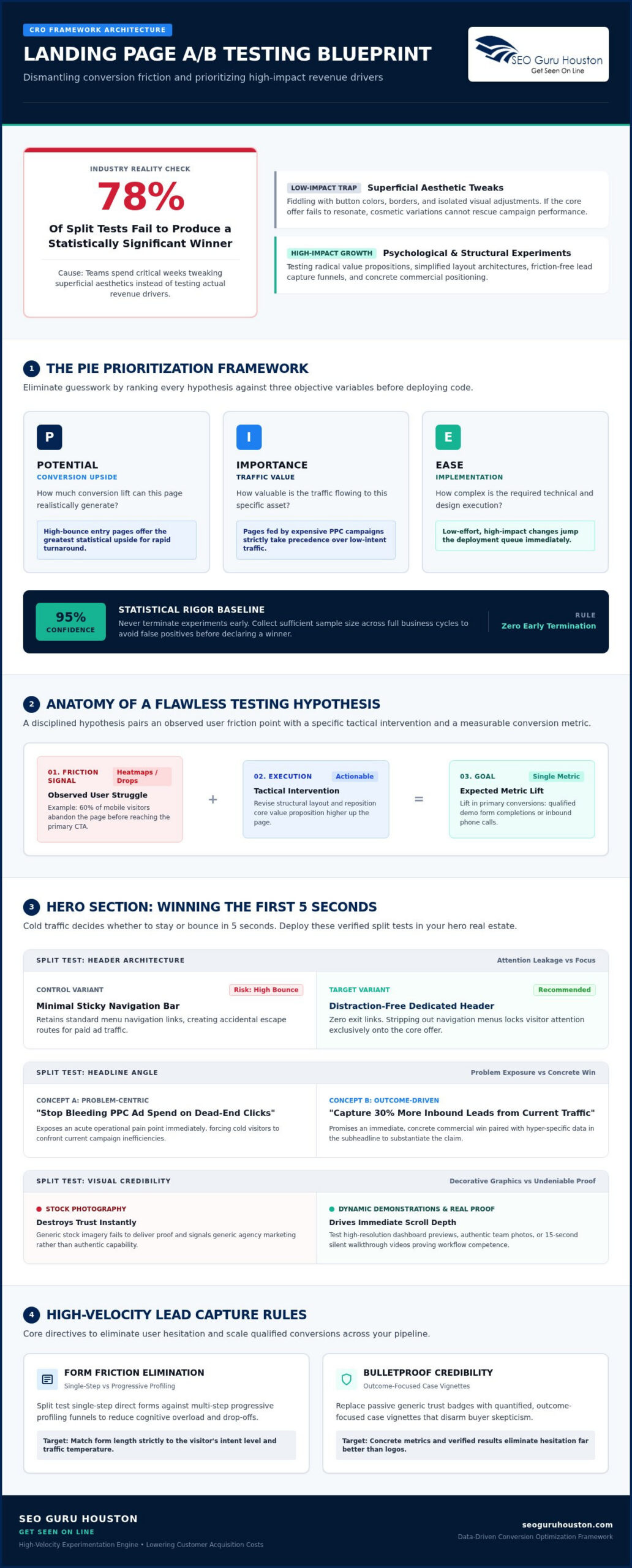
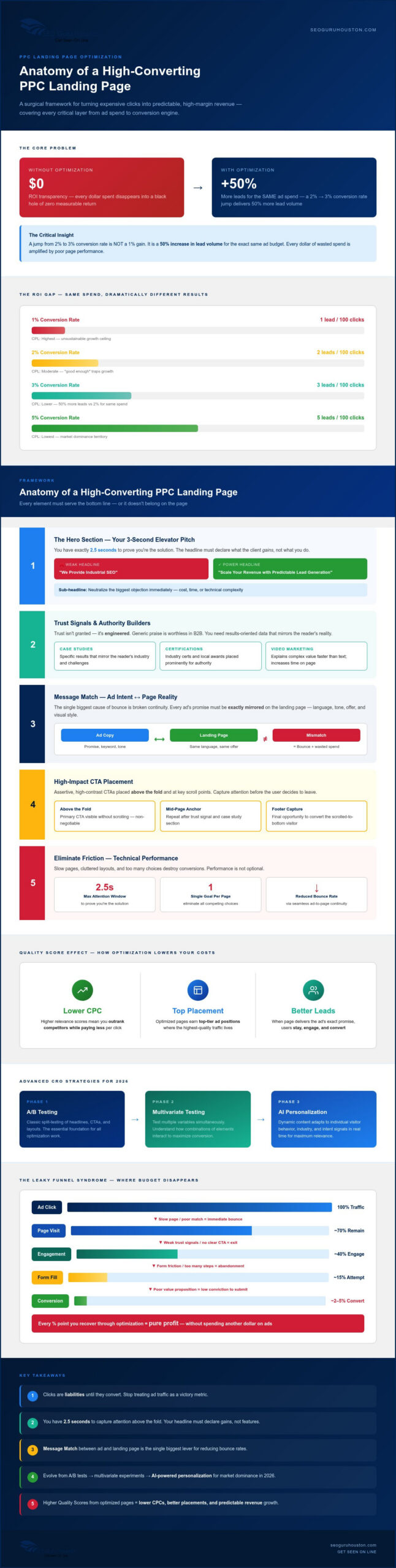
A staggering 78% of split tests fail to produce a statistically significant winner. Why? Most teams waste critical weeks tweaking superficial button colors instead of testing real revenue drivers. If you want to stop burning ad spend on visitors who bounce immediately, you need high-impact landing page a/b testing ideas that systematically dismantle conversion friction and sharpen your core offer.

You already know how frustrating it feels to watch customer acquisition costs climb across competitive PPC and paid social channels while minor design tweaks fail to move the needle. Running isolated, low-stakes experiments won’t deliver market dominance. You need a proven, repeatable framework that transforms underperforming pages into aggressive lead generators.

In this guide, you’ll discover battle-tested split-test concepts that directly cut acquisition costs, eliminate user hesitation, and maximize your paid traffic ROI. We’ll outline the exact experimentation roadmap top performers use to achieve double-digit conversion lifts and scale sustainable business growth.

Key Takeaways

  • Prioritize structural and psychological experiments over trivial aesthetic tweaks to drive real, measurable conversion lifts.
  • Deploy actionable landing page a/b testing ideas across your hero section to hook cold traffic within the first five seconds.
  • Eliminate form friction by split-testing single-step captures against multi-step progressive profiling funnels.
  • Replace generic trust badges with quantified, outcome-focused case vignettes that disarm buyer skepticism.
  • Transform one-off split tests into a high-velocity experimentation engine that continuously lowers customer acquisition costs.

The CRO Prioritization Matrix: Stop Guessing and Start Testing High-Impact Elements

Conversion rate optimization is not an interior decorating exercise. It’s an aggressive revenue engine designed to squeeze maximum pipeline value out of every single paid click. Treating optimization as cosmetic guesswork burns budget while competitors capture market share. True conversion acceleration requires systematic rigor, beginning with the core principles of A/B testing to validate behavioral shifts before deploying code.

To eliminate wasted cycles, every hypothesis must pass through a strict prioritization model: the PIE framework. By ranking ideas against three objective variables, you strip emotion out of the optimization roadmap:

  • Potential: How much conversion lift can this page realistically generate? High-bounce pages usually offer the highest upside.
  • Importance: How valuable is the incoming traffic? Pages fed by expensive PPC campaigns take precedence over low-intent organic traffic.
  • Ease: How complex is the technical implementation? Low-effort, high-impact changes always jump the queue.

Never pull the plug on an experiment early. Premature test termination creates false positives. Aim for a standard 95% statistical confidence baseline and collect sufficient sample size across full business cycles before declaring a winner.

Why Minor Cosmetic Tests Waste Valuable Campaign Momentum

Swapping a green CTA button for an orange one rarely produces sustainable revenue growth. These cosmetic adjustments fail because they ignore the primary psychological blockers preventing visitors from converting. Instead of fiddling with button borders, invest your traffic into testing radical value propositions, simplified layout architectures, and distinct commercial positioning. If your core offer fails to resonate, button color won’t save it.

The Anatomy of a Flawless A/B Testing Hypothesis

Strong experiments require disciplined hypotheses. A high-performing hypothesis always pairs an observed user struggle with a clear tactical intervention and an expected metric change. Review session recordings and scroll heatmaps to spot where friction spikes. If 60% of mobile users abandon your page before reaching the primary call to action, your structural layout demands immediate revision.

Tie every test variant directly to a single primary conversion metric, such as demo form submissions or qualified inbound phone calls. Connecting disciplined experimentation directly to high converting landing page design transforms scattered testing into a scalable revenue driver. Generating high-impact landing page a/b testing ideas is simple once you let real user friction dictate your roadmap.

Above-the-Fold A/B Testing Ideas: Winning the First Five Seconds

Your hero section dictates whether visitors engage or instantly bounce. If your above-the-fold real estate fails to communicate immediate, unambiguous value, your paid ad spend evaporates. The most high-leverage landing page a/b testing ideas focus ruthlessly on this entry screen. Start by testing your layout discipline: pit a distraction-free dedicated campaign header with zero exit links against a minimal sticky navigation bar. Stripping out extraneous menu items keeps user attention locked strictly on your core offer.

Headline Formula Battles: Problem-Centric vs. Outcome-Driven Messaging

Headlines make or break initial retention. Test a problem-centric headline that exposes an acute operational pain against an outcome-driven headline promising a concrete commercial win. For example, test an urgent problem statement (“Stop Bleeding PPC Ad Spend on Dead-End Clicks”) against a direct value proposition (“Capture 30% More Inbound Leads from Your Current Traffic”). Pair both variations with a subheadline featuring hyper-specific data to substantiate your claim immediately.

Visual Asset Split Tests: Static Graphics vs. Dynamic Demonstrations

Stock photography destroys credibility instantly. Replace decorative images with assets that deliver undeniable proof. Split test high-resolution dashboard previews against authentic photos of your actual team delivering results. Alternatively, test a 15-second silent walkthrough video demonstrating your product or process in action against a static graphic. Dynamic demonstrations often trigger deeper scroll depth by proving capability within the first five seconds of page load.

Call-to-Action Positioning: Single Hero Focus vs. Progressive Micro-Commitments

Demanding a full consultation immediately introduces friction for cold visitors. Test a single aggressive CTA (“Schedule Your Enterprise Demo”) against a low-threat micro-commitment (“Calculate Your Growth ROI”). Additionally, experiment with first-person, action-oriented button copy like “Claim My Strategy Roadmap” instead of sterile commands like “Submit Form.”

When you align your top-of-funnel messaging with precise visitor intent, conversions surge. Refining these entry points is vital, and deploying high-converting Websites Dev & Landing Pages gives your paid campaigns the commercial leverage they need to dominate.

Form and Friction Experiments: Engineering Maximum Lead Capture

Your lead form is the ultimate conversion chokepoint. You can hook prospects with a flawless headline and compelling visual proof, but an intimidating form will collapse your pipeline instantly. Finding winning landing page a/b testing ideas requires confronting form friction head-on. Every extra input field introduces cognitive drag, yet stripping out every barrier floods your sales team with junk inquiries. The goal is simple: capture high-intent leads efficiently without sacrificing lead quality.

Single-Step Simplicity vs. Multi-Step Micro-Commitment Funnels

Testing single-step forms against interactive multi-step funnels exposes how prospects prefer to share information. Presenting nine open fields upfront immediately triggers defense mechanisms. In contrast, multi-step forms use the psychological principle of commitment and consistency. By placing low-friction, non-threatening qualifying choices on step one (such as selecting an industry or primary business goal), users build momentum before reaching the final contact details screen.

  • Single-Step Layouts: Best suited for transactional, low-consideration offers like simple whitepapers or resource downloads.
  • Multi-Step Funnels: Superior for complex B2B services, custom quotes, and consultations where progressive profiling reduces perceived workload.

Field Reduction vs. Radical Qualification

Shorter forms do not always mean higher revenue. While research shows three-field forms convert 25% better than nine-field variations, and reducing fields from 11 to four can boost raw conversion volume by 120%, context matters. An email-only capture form might inflate top-of-funnel conversion rates while starving your sales reps of critical pipeline context.

Test radical qualification against basic capture. Run an experiment requiring business email, annual budget, and direct phone number against a streamlined three-field form. Track the downstream outcome: does the shorter form generate more closed deals, or does the qualified variation save your sales team hundreds of wasted hours on unqualified prospects? Measure deal velocity, not just form completions.

CTA Button Copy and Micro-Copy Security Reassurance

Default buttons labeled “Submit” or “Send Message” signal passive effort and zero value. Test assertive, benefit-driven button copy like “Get Instant Pricing” or “Launch My Growth Audit” to remind prospects of the payoff. Pair your button with clear risk-reversal micro-copy immediately underneath, such as “No credit card required” or “Guaranteed 24-hour response.” Eliminating last-second hesitation at the final click protects your paid media investments from costly eleventh-hour drop-offs.

High-Impact Landing Page A/B Testing Ideas to Explode Conversions in 2026

Social Proof and Objection Demolition: Building Bulletproof Credibility

Unsubstantiated marketing claims destroy conversions on contact. When cold traffic lands on your page, skepticism runs high. Visitors actively search for reasons not to trust you. Strategic landing page a/b testing ideas must tackle this credibility gap by proving real commercial impact. If your trust assets consist only of unverified quotes or random award badges, you are bleeding pipeline revenue every single day.

Quantified Case Results vs. General Client Endorsements

Vague praise like “Great team to work with!” carries zero commercial weight. Test generic praise against quantified case vignettes featuring hard business numbers. Showcase explicit client outcomes, such as a 42% lift in qualified pipeline or a 35% reduction in customer acquisition costs, paired with the client’s verified headshot, company title, and brand logo. Hard metrics eliminate ambiguity and force prospects to respect your capability.

  • Logo Walls: Test whether recognizable enterprise partner logos perform better above the fold or grouped below your primary value proposition.
  • Micro-Case Callouts: Test three-sentence result cards highlighting the exact problem, implementation, and verified financial return against standard quotes.

Contextual Proof Placement: Dispersed Signals vs. Dedicated Sections

Burying all customer endorsements into a single dedicated section at the bottom of the page is a critical mistake. Most visitors bounce before reaching the page footer. Instead, test dispersing micro-testimonials right beside high-friction action triggers. Placing a verified client quote directly beneath a demo booking form directly addresses buyer hesitation at the point of decision.

Aligning these proof mechanisms with your broader b2b demand generation agency strategy ensures every inbound lead encounters relentless validation from ad click to final submission.

Interactive Social Proof: Video Testimonials vs. Text Scrollers

Video testimonials provide unassailable authenticity, but they can slow page speed if poorly executed. Split test short, 45-second client interview clips against easily scannable quote cards. Monitor mobile engagement closely during this test; desktop users may pause to watch a case study, while mobile users on cellular connections often abandon slow-loading media assets.

Ready to turn underperforming traffic into predictable pipeline? Partner with our demand generation experts to build and scale bulletproof conversion engines that outpace your competition.

Building a Permanent Experimentation Engine to Maximize Paid Campaign ROI

Conversion rate optimization is not an annual checkup or a one-time audit. It’s an aggressive operational discipline. Treating split testing as an occasional, isolated project guarantees stagnant performance while customer acquisition costs continue to climb across paid channels. Scaling your bottom line demands a continuous experimentation engine that relentlessly uncovers, prioritizes, and executes winning landing page a/b testing ideas across your entire marketing funnel.

Aligning Traffic Temperature with Landing Page Architecture

Sending cold search traffic to the exact same page layout as warm retargeting visitors sabotages conversion rates. Cold prospects need immediate clarity, problem validation, and undeniable proof. Warm prospects already recognize your brand and respond far better to concise, offer-focused pages with friction-free forms. Synchronizing your post-click architecture with aggressive ppc management ensures complete message harmony between the target keyword and your page headline. Misaligned intent kills momentum before the user even reads your first paragraph.

Establishing an Agile Testing Cadence and Knowledge Repository

Execution velocity dictates how fast you capture market share. To maintain momentum, structure your experimentation roadmap around consistent operational rhythms:

  • Bi-Weekly Testing Sprints: Evaluate test performance every two weeks to analyze sample sizes, retire clear underperformers, and deploy new variations without delay.
  • Documented Failure Archives: Systematically log every losing variation. Understanding why an angle failed prevents teams from recycling dead messaging.
  • Cross-Funnel Rollouts: When an experiment yields a decisive lift, immediately push that winning headline formula or form architecture to secondary service pages.

Accelerating Conversion Performance with Dedicated Strategic Guidance

Executing high-level split tests while running day-to-day operations creates paralyzing internal bottlenecks. Standalone testing software won’t save you if your team lacks the bandwidth to interpret user data and engineer high-converting layouts. Real commercial scale happens when you fuse relentless paid traffic acquisition with elite conversion design. If you want to outpace competitors and maximize ROI across every marketing channel, Partner with SEO Guru Houston to deploy battle-tested landing page a/b testing ideas that turn paid traffic into scalable, predictable revenue.

Transform Your Landing Pages into Relentless Revenue Drivers

Market dominance isn’t built on guesswork or superficial tweaks. Winning the paid traffic battle requires eliminating conversion friction where it actually hurts: above-the-fold value alignment, form intimidation, and credibility barriers. When you systematically deploy high-impact landing page a/b testing ideas, you stop burning ad spend and start compounding measurable pipeline value.

Your competitors are actively bidding on your target keywords. Outpacing them demands a disciplined full-funnel integration connecting high-intent traffic directly to qualified pipeline. SEO Guru Houston operates as a data-driven digital marketing agency delivering aggressive commercial ROI through battle-tested landing page and CRO execution across competitive verticals. You don’t have to settle for inconclusive tests or sluggish growth rates. Stop bleeding ad spend and scale your revenue with SEO Guru Houston. Take decisive action today and turn your landing pages into unstoppable conversion engines.

Frequently Asked Questions

How long should an A/B test run before declaring a statistical winner?

Run your experiments for at least two full business cycles, which typically takes two to four weeks. Never terminate a test after three days just because an early variation shows a temporary conversion spike. Testing across full weekly cycles accounts for distinct weekend and weekday visitor behaviors. Always collect sufficient sample sizes and hit a standard 95% statistical confidence threshold before rolling out your winning variation permanently.

What is the minimum amount of traffic required to conduct landing page split testing?

You need enough traffic to generate at least several hundred conversions per variation for meaningful statistical validity. If your page receives fewer than 1,000 monthly visitors, standard split testing often takes months to reach reliable conclusions. In low-traffic scenarios, test radical structural shifts or gather direct qualitative feedback rather than testing micro-elements. Paid campaigns provide the fastest testing ground because consistent ad clicks fill sample pools rapidly.

Should I test multiple elements simultaneously with multivariate testing instead of A/B testing?

Use standard A/B testing unless you command hundreds of thousands of monthly visitors. Multivariate testing evaluates multiple page variables simultaneously, but it fractures traffic into exponential micro-segments. That dilution slows down your testing cycle and delays critical business decisions. For mid-market teams, deploying high-impact landing page a/b testing ideas one clear hypothesis at a time delivers actionable insights much faster while maintaining statistical clarity.

Can running landing page A/B tests hurt my search engine optimization rankings?

No, running split tests will not hurt your search rankings if you implement proper technical protocols. Search engines actively encourage testing when you handle page variations correctly. Always use canonical tags pointing back to the original control page if you split traffic across separate URLs. If you use script-based testing tools, ensure they load quickly and avoid deceptive cloaking practices that violate search engine guidelines.

How do I choose whether to test copy changes or visual design elements first?

Prioritize value proposition copy changes before redesigning visual assets. Clarity in your core offer drives conversion performance far more aggressively than updated color schemes or layout flourishes. If your headline fails to hook user interest or address an acute operational pain point, sleek visuals won’t rescue the page. Test your fundamental offer and objection-busting copy first, then test supporting graphics and layout arrangements.

What should I do if an A/B test produces completely inconclusive results?

Inconclusive results mean your test variation was too subtle to trigger a meaningful shift in visitor behavior. Over 75% of split tests fail to produce a decisive winner. When this happens, archive the test and pivot to bolder landing page a/b testing ideas. Don’t waste weeks testing minor variations of a dead concept. Review your session recordings and test an entirely different structural or messaging angle.

How does mobile landing page optimization differ when executing A/B tests?

Mobile split tests must focus ruthlessly on screen economy and friction elimination. Mobile visitors convert at roughly half the rate of desktop users despite generating the majority of web traffic. When running mobile tests, evaluate sticky bottom-anchored CTAs, collapsible accordion sections to reduce endless scrolling, and streamlined multi-step forms. Keep page assets ultra-light, as a single second of mobile load delay severely depresses conversions.

How to Improve Website Conversion Rates: The Assertive 2026 Strategy for Market Dominance

Your website isn’t a digital business card; it’s a high-stakes battlefield where you’re either capturing market share or surrendering it to the competition. You’ve likely poured significant capital into SEO and PPC, yet your analytics often reveal a graveyard of bounced sessions and ghosted landing pages. It’s frustrating to watch a marketing budget evaporate while your brand remains invisible to the high-value leads you deserve. If you’re tired of passive traffic and ready for measurable growth, we’re going to fix that immediately. This guide provides the definitive 2026 strategy on how to improve website conversion rates by treating your site as a high-performance engineering discipline rather than a design choice.

We’re handing you the psychological and technical blueprint required to transform a static brochure into an aggressive lead-generation engine. You’ll master the strategies needed to heighten lead quality, outshine your competitors, and secure a dominant ROI on every marketing dollar spent. We’ll break down the transition from digital invisibility to market prominence, focusing on the precision tactics that turn skeptics into loyal partners. It’s time to stop hoping for results and start demanding them through data-driven dominance.

Key Takeaways

  • Master the “Trust Stack” to engineer credibility and navigate the complex B2B decision-making process across multiple stakeholders.
  • Implement the 2026 Speed Mandate to ensure every millisecond of load time captures revenue instead of surrendering it to competitors.
  • Learn exactly how to improve website conversion rates by shifting from passive brochure design to a continuous, data-driven growth framework.
  • Deploy high-performance landing pages using the “Hero Section” blueprint to capture attention and force immediate user action.
  • Secure a dominant ROI on your SEO and PPC spend by transforming your digital presence into an aggressive lead-generation engine.

Stop Bleeding Leads: Why Website Conversion Rate is a Fundamental Business Necessity

If you’re driving thousands of visitors to a site that doesn’t convert, you aren’t marketing; you’re donating to Big Tech. Every dollar spent on PPC or SEO is a liability if your digital infrastructure is fundamentally broken. We define conversion rate optimization as the rigorous engineering discipline of maximizing the value of every single visitor who lands on your page. It isn’t about “tweaking” buttons or changing colors; it’s about business survival in an increasingly crowded marketplace.

Most B2B firms suffer from the “Leaky Bucket” syndrome. They keep pouring expensive traffic into the top of the funnel while leads pour out of technical cracks and messaging gaps at the bottom. Mastering how to improve website conversion rates is the only way to plug those holes and protect your investment. By 2026, the benchmark for a high-performing B2B website isn’t just a 2% or 3% rate. It’s about achieving technical dominance where every interaction is measured, optimized, and forced toward a conversion event.

The ROI of Conversion Dominance

Stop obsessing over vanity metrics like session counts or impressions. These are ego boosters that don’t pay the bills. Focus on sanity metrics. Lead quality and total sales volume are the only numbers that matter. Understanding how to improve website conversion rates is a strategic financial lever. If your site generates $1 million in revenue at a 1% conversion rate, doubling that rate to 2% doubles your bottom line without spending an extra cent on advertising. CRO is the most powerful financial lever in your 2026 digital arsenal.

Identifying Your Conversion Gaps

You can’t fix what you don’t measure. Use heatmaps and session recordings to witness exactly where users get frustrated and abandon ship. Often, the problem starts with the wrong traffic. This is where professional seo services become critical. They ensure you’re attracting high-intent users who are actually ready to buy. Common B2B conversion killers usually boil down to two things: sluggish load times and vague value propositions. If your visitor has to hunt for what you do, they’ve already left for a competitor who makes it clear. Be direct. Be fast. Be the obvious choice.

The Psychology of the B2B Buyer: Engineering Trust and Intent

B2B transactions aren’t impulse buys; they’re calculated risks involving multiple stakeholders and high-stakes budgets. If you want to know how to improve website conversion rates in this environment, you must stop selling and start engineering trust. Your website needs to survive a committee review. This means building a “Trust Stack” that combines technical depth with a visual presence that screams market dominance. Safe, generic corporate speak is a death sentence. Assertive positioning that addresses specific industrial challenges is what moves the needle. You’re not just a vendor; you’re a strategic necessity.

Understanding intent is the difference between a lead and a lurker. If you’re struggling with how to improve website conversion rates, you need to map user actions to their stage in the buying cycle. Micro-conversions, like downloading a technical spec sheet, signal research. Macro-conversions, like requesting a quote, signal a ready buyer. By implementing proven conversion rate optimization strategies, you can guide these users through a logical sequence that eliminates friction. Don’t leave the next step to chance; your competitors certainly won’t.

Capturing High-Value Intent

Not all traffic is created equal. A “just browsing” visitor needs different stimuli than someone with a deadline and an approved budget. Our approach as a b2b demand generation agency focuses on pre-qualifying leads before they even click. We create industrial-strength lead magnets that solve immediate pain points, ensuring that the traffic hitting your landing pages is already primed for action. If your content doesn’t solve a problem, it’s just noise.

The Power of Social Proof in Industrial Marketing

Standard reviews don’t cut it in the industrial sector. You need authority markers that prove you can handle the load. This involves a mix of technical case studies, industry certifications, and deep-dive whitepapers. Video testimonials are particularly potent; they humanize high-stakes transactions and provide the social proof required to bypass skepticism. Establishing this level of authority requires a comprehensive inbound marketing strategy for b2b that positions you as the undisputed expert in your field. This is how you transform a passive site into a high-performance engine.

Technical Dominance: Optimizing for Speed, Mobile, and AI Search Visibility

Technical performance is the silent killer of your digital ROI. If your site lags by even a fraction of a second, you aren’t just losing clicks; you’re actively funding your competitor’s growth. The 2026 Speed Mandate is absolute. Every millisecond of latency correlates directly to a drop in lead volume. Industrial decision-makers don’t have the patience for sluggish interfaces or broken elements. If you want to master how to improve website conversion rates, you must first secure a technical foundation that is beyond reproach. High-performance engineering is the only way to transform a slow, passive site into a high-speed lead generator.

The shift from mobile-first to mobile-only thinking is now a reality for the industrial sector. Procurement officers and engineers are increasingly vetting partners from the field or the factory floor. If your site doesn’t provide a seamless, high-velocity experience on a smartphone, you’re invisible. This requires a sophisticated high converting landing page design that prioritizes thumb-friendly navigation and instant information delivery. Your digital presence must be as rugged and reliable as the services you provide.

Eliminating Technical Friction

Friction is the enemy of action. We optimize Core Web Vitals not just to please Google’s algorithms, but to respect the user’s time. This means stripping away unnecessary scripts and heavy assets that bloat load times. Streamline your forms by following the “Less is More” rule for B2B lead generation; every additional field you require is another opportunity for a high-value lead to abandon the process. Ensure cross-browser and cross-device consistency to maintain a professional polish that reinforces your market authority. A glitchy form isn’t just a technical error; it’s a signal that your business lacks precision.

AI-Era Conversion Optimization

The 2026 search ecosystem is no longer dominated by links alone. AI agents like ChatGPT and Perplexity are now the primary gatekeepers of information. These models scan your site for specific conversion signals to determine if you’re a trustworthy recommendation. You must structure your data with advanced schema so these AI agents can accurately interpret and recommend your services. Increasing your “Share of Model” is just as important as your traditional search ranking. Technical dominance is the non-negotiable foundation of user trust in a machine-driven world. By aligning your technical signals with AI expectations, you ensure your brand remains at the forefront of the next generation of how to improve website conversion rates.

How to Improve Website Conversion Rates: The Assertive 2026 Strategy for Market Dominance

The Anatomy of a High-Performance Funnel: Landing Pages and Video Marketing

Stop treating your homepage like a catch-all for your marketing traffic. A homepage is designed for exploration and broad brand storytelling; a landing page is built for a single, aggressive purpose: conversion. If you’re wondering how to improve website conversion rates, the first step is separating these two functions. Sending paid traffic to a generic homepage is a guaranteed way to bleed your marketing budget. You need specialized funnels that align perfectly with specific search intent. This is where expert ppc management houston becomes a force multiplier, ensuring that every click lands on a page engineered for a specific business outcome.

The “Hero Section” is your digital handshake. You have less than three seconds to capture attention, communicate value, and prompt action. A high-performance hero section doesn’t hide the lead. It uses a bold, assertive headline that promises a specific transformation for the buyer. If your visitor has to scroll to find out what you do or how to contact you, you’ve already lost the battle. Every element on the page must serve the primary conversion goal. There is no room for distraction or fluff in a dominant B2B funnel.

Engineering the Perfect Landing Page

Human behavior is predictable. Most users follow an “F-Pattern” when scanning digital content, focusing their attention on the top and left sides of the screen. We place your primary Call to Action (CTA) and core value proposition directly in these high-visibility zones. Don’t settle for “safe” headlines that simply list features. Use language that denotes movement, precision, and proven success. Finally, stop guessing about what works. A/B testing allows us to move from “I think” to “I know” regarding user behavior. We test everything from button placement to headline phrasing to ensure your funnel is a finely tuned lead-generation machine.

Video: The Ultimate Conversion Catalyst

By 2026, professional website video marketing is no longer an optional luxury. It’s a fundamental requirement for high-stakes B2B transactions. Video humanizes your brand and builds the “Trust Stack” required to bypass skepticism. High-impact explainers, technical demos, and authority-building interviews allow you to communicate complex value propositions in seconds. However, technical precision is key. We integrate video using advanced optimization techniques to ensure engagement doesn’t come at the cost of site speed. If you’re ready to stop losing leads and start demanding results, it’s time to implement a high converting landing page design that forces action.

Scaling Your ROI: Implementing a Results-Oriented Conversion Strategy

Conversion optimization is not a project you finish; it’s a discipline you master. If you want to know how to improve website conversion rates at scale, you must move beyond the “set it and forget it” mentality. Dominating your market requires a continuous growth framework that treats every data point as a tactical advantage. You aren’t just looking for more clicks. You’re looking for market share. This is where the expertise of a data-driven seo marketing company becomes indispensable. They don’t just drive traffic; they engineer the environment where that traffic has no choice but to convert.

Scaling your ROI means interpreting analytics to make aggressive market moves. Most businesses drown in data but starve for insights. You need to identify the high-intent paths that lead to your most profitable contracts and double down on them immediately. Don’t waste time on segments that don’t produce. In the 2026 landscape, speed to insight is the ultimate competitive advantage. If you can’t see where the revenue is coming from, you’re flying blind while your competitors are using heat-seeking missiles.

Data-Driven Decision Making

Stop looking at bounce rates as an abstract number. Set up conversion tracking that actually reflects business growth, focusing on lead quality and sales velocity. Our “Guru” approach utilizes multi-channel attribution to understand the complex B2B journey across every touchpoint. We don’t just react to what happened yesterday; we use predictive analytics to anticipate buyer needs before they even type a query. This proactive stance ensures you’re always one step ahead. When you understand the “why” behind the click, you unlock the secret of how to improve website conversion rates across your entire digital footprint.

Partnering for Market Prominence

Trying to build a world-class CRO team in-house often leads to stagnation. The digital landscape moves too fast for internal generalists to keep up. A results-oriented agency is a fundamental necessity for scaling because they bring a track record of success across diverse industrial sectors. You need a partner who is obsessed with your revenue, not just your monthly reports. Moving from invisibility to prominence requires a comprehensive digital strategy that integrates SEO, PPC, and high-performance design into a single, cohesive engine.

The time for passive observation is over. Your competitors are already optimizing their funnels to steal your leads. Take decisive action today to dominate your market landscape. Transform your website from a liability into your most powerful sales asset. The roadmap to market dominance is clear; you just have to be bold enough to take the first step.

Command Your Market with a Conversion-First Strategy

The transition from a passive website to a high-velocity lead engine isn’t a design choice; it’s a strategic mandate for survival. You’ve seen the blueprint for technical dominance and the psychological triggers required to navigate complex B2B decision-making. By prioritizing speed, AI visibility, and high-impact video, you’re no longer just participating in the market. You’re defining it. Mastering how to improve website conversion rates is the single most effective way to multiply your marketing ROI and leave your competition behind.

Don’t let another high-value lead slip through a technical gap or a vague value proposition. Our specialized B2B and industrial expertise ensures your brand moves from invisibility to prominence with absolute precision. We deliver results-oriented PPC and SEO strategies coupled with high-performance landing page and video marketing solutions designed specifically for your bottom line. Stop losing revenue and start dominating your market with SEO Guru Houston today!

It’s time to stop settling for vanity metrics and start demanding measurable growth. Take the first step toward digital dominance and secure the results your business deserves.

Frequently Asked Questions

What is a good conversion rate for a B2B website in 2026?

A high-performing B2B website in 2026 should aim for a conversion rate between 5% and 10% for primary lead generation goals. While industry averages often hover around 2% to 3%, settling for average means losing market share. Your specific rate depends on lead quality and transaction value. Focus on maximizing visitor value through precision engineering rather than just chasing volume. Don’t let mediocre benchmarks dictate your growth.

How much does conversion rate optimization typically cost?

The cost of conversion rate optimization varies based on the complexity of your digital ecosystem and the scale of your traffic. It’s an investment in your infrastructure rather than a fixed expense. Professional strategies typically involve technical audits, A/B testing, and content refinement. Instead of looking at the price tag, evaluate the cost of your current leaky bucket where wasted marketing spend exceeds the price of expert optimization.

Can I improve my conversion rate without a full website redesign?

You don’t always need a full redesign to see massive gains in how to improve website conversion rates. Incremental, data-driven changes to your Trust Stack and hero sections often deliver immediate ROI. By optimizing your mobile interface, streamlining forms, and clarifying your value proposition, you can transform performance without the downtime of a complete overhaul. Small, technical adjustments frequently yield the highest percentage of growth for established brands.

How long does it take to see results from CRO efforts?

Technical fixes like site speed optimization can produce measurable results within days of implementation. More complex psychological adjustments and A/B testing cycles typically require 30 to 90 days to gather statistically significant data. This timeline ensures that your market moves are based on proven user behavior rather than temporary spikes. Continuous improvement is a long-term discipline that builds cumulative authority and revenue over time. Don’t expect magic; demand data.

What is the most important element on a high-converting landing page?

The headline in your Hero Section is the most critical element because it’s the first thing a visitor sees. It must move beyond listing features to promising a specific, assertive transformation for the buyer. If your headline fails to capture attention in three seconds, the rest of the page is irrelevant. Pair this with a singular, high-contrast Call to Action that forces the user to make a decisive move.

How does website speed specifically impact my conversion rate?

Speed is a non-negotiable foundation for user trust and conversion. Research shows that every millisecond of delay increases bounce rates and erodes your lead quality. Industrial decision-makers expect instant access to technical specs and demos. If your site lags, you’re signaling a lack of precision that high-value partners won’t tolerate. Faster sites don’t just rank better; they convert visitors who are ready to take immediate action. Speed is revenue.

Is video marketing really necessary for B2B conversion?

Professional website video marketing is a fundamental necessity for B2B dominance in 2026. Complex industrial solutions require more than just text to build credibility. You can deploy several high-impact formats:

  • Technical demos that prove performance
  • Explainer videos for complex value propositions
  • Authority-building interviews

Video humanizes your brand and serves as a powerful catalyst for trust, making it much easier to move stakeholders toward engagement.

What tools should I use to track my website conversion rates?

Effective tracking requires a combination of quantitative and qualitative data. You should implement a tech stack that includes:

  • Google Analytics 4 for high-level conversion paths
  • Heatmap software to visualize user friction
  • CRM integration to measure lead quality

This multi-channel approach provides the guru level of insight needed to understand exactly how to improve website conversion rates across every touchpoint of your funnel. Stop guessing and start measuring.

Amazon Product Listing Optimization: The 2026 Blueprint for Market Dominance

In 2026, a mediocre Amazon listing isn’t just a missed opportunity; it’s a slow-motion business suicide. You’ve likely watched your ACOS climb while your organic visibility sinks, leaving your brand buried under competitors who mastered the new 75-character title limit and assertive amazon product listing optimization months ago. It’s exhausting to fight for scraps while you’re still guessing what the current A9 algorithm actually wants from your product data. This is a brutal market that rewards precision and punishes hesitation.

This is where the guesswork ends. You’re about to master the strategies required to crush the competition and skyrocket your conversion rates to 2x the category average. We’ll break down the 2026 blueprint for market dominance, from leveraging the new searchable Item Highlights field to securing Premium A+ content that can boost sales by up to 20%. We’ll also explore how to navigate the 3.5% fuel and logistics surcharge while protecting your bottom line. This is your definitive guide to transforming from an invisible seller into an absolute category leader.

Key Takeaways

  • Reverse the “Death Spiral” of low visibility by treating your product data as a competitive weapon rather than a simple administrative task.
  • Master the strategic placement of high-intent keywords within the 2026 title constraints and Item Highlights to dominate your amazon product listing optimization.
  • Unlock the power of Premium A+ Content and Brand Registry to build a high-converting storefront that commands authority and boosts sales by up to 20%.
  • Implement a data-backed optimization workflow that uses assertive A/B testing to identify and plug revenue leaks in your current listing strategy.
  • Scale your market share by integrating professional listing performance with a 360-degree marketing attack designed for long-term organic dominance.

Beyond the Basics: Why Generic Amazon Listings are Revenue Killers

Stop treating your Amazon presence like a digital filing cabinet. In the hyper-competitive landscape of 2026, amazon product listing optimization isn’t an optional luxury or a simple data entry task; it’s a tactical siege on the marketplace. If you’re still approaching your listing with a “set it and forget it” mentality, you’re essentially handing your market share to the competition. High-performance brands recognize that every word, every image, and every backend attribute is a weapon designed to win the algorithm’s favor and the customer’s wallet.

The greatest threat to your brand growth is invisibility. When your conversion rates lag behind the category average, you enter the “Death Spiral.” This is a brutal feedback loop where Amazon’s algorithm notices your lack of sales velocity and systematically demotes your organic ranking. As your visibility drops, your traffic thins, and your ability to recover becomes exponentially more expensive. You can’t just spend your way out of a bad listing with PPC; you need a foundation that converts at a high level to prove your worth to the system. This is why professional Search engine optimization (SEO) principles are now the bedrock of Amazon success.

The Evolution of the Amazon A9 Algorithm in 2026

Machine learning has fundamentally changed the rules of engagement. By 2026, the algorithm has moved beyond primitive exact-match keywords to prioritize “intent match.” It analyzes complex patterns in shopper behavior to determine if your product truly solves the user’s problem. Metrics like click-through rate (CTR) and stay-on-page duration are now critical ranking factors. If your 2024 strategy relied on high-volume keywords without considering relevance, that approach is already obsolete. You must align your content with the specific psychological triggers that drive a 2026 shopper to click and buy. The machines are watching how humans interact with your brand, and they’re rewarding the listings that provide the most seamless experience.

The Real Cost of Mediocrity

Mediocrity is the most expensive mistake you can make in the Amazon ecosystem. When you drive traffic to a non-optimized landing page, you’re effectively lighting your ad spend on fire. Every bounce is a wasted dollar and a signal to the algorithm that your product isn’t a winner. Beyond the immediate financial loss, “good enough” listings suffer from a weak brand presence that fails to build trust. In a marketplace where shoppers have infinite choices, a lack of professional polish allows competitors to steal your loyal customers. You aren’t just losing a single sale; you’re losing the long-term lifetime value of a customer who no longer sees you as an authority in your niche. Masterful amazon product listing optimization is the only way to protect your margins and secure your territory.

The Anatomy of a High-Impact Listing: Keywords, Copy, and Conversion

A high-impact listing isn’t a technical manual; it’s a high-energy sales pitch. If your visuals don’t stop the scroll, your keywords simply won’t matter. Your main image carries 80% of the weight in the click-through rate (CTR) battle. In 2026, mobile-first optimization is mandatory because over 70% of your customers are shopping on handheld devices. If your listing looks cluttered or your text is unreadable on a smartphone, you’ve already lost the sale. You must design for the thumb, not the desktop.

Persuasive copywriting is about moving from cold features to high-energy benefit statements. Stop listing technical specs and start selling a transformation. A 2026 shopper doesn’t care about the material of your product as much as they care about the time it saves them or the status it confers. If you fail to hit the reader’s emotional core immediately, they’ll bounce to a competitor who does. This level of precision is the cornerstone of effective amazon product listing optimization.

Mastering the Title and Bullet Siege

Effective titles in 2026 must be surgical. With the strict 75-character limit implemented in July, every word must fight for its place. You need to satisfy the algorithm’s need for relevance while triggering a human’s impulse to click. Indexation is the definitive gateway to organic traffic, ensuring the algorithm recognizes your product as a relevant match for specific search queries. Once they click, your bullets must deliver a “Benefit-First” structure. Solving the customer’s problem in five seconds is the only way to maintain momentum. If the shopper doesn’t see a solution to their pain point within the first two bullets, they’re gone.

Backend Search Terms and Hidden Metadata

The invisible side of your amazon product listing optimization strategy is where you capture the traffic your competitors ignore. You have a 250-character limit in the backend search terms field. Use it wisely. Don’t repeat words already in your title or “Item Highlights.” Instead, leverage Spanish keywords and common misspellings to tap into massive, unserved audiences. This isn’t about keyword stuffing; it’s about expanding your reach. Fill out every “Subject Matter” and “Intended Use” field to tell the algorithm exactly where your product belongs. This hidden metadata is the secret to niche relevance and long-tail dominance. Mastering these technical nuances is the difference between a hobby and a high-performance business. If you’re ready to stop guessing, our Amazon services provide the tactical precision required to dominate.

Leveraging Brand Registry and A+ Content for Absolute Authority

Amazon Brand Registry is the non-negotiable foundation for any brand seeking more than just survival. In the 2026 marketplace, selling without a registered trademark (®) is a liability. This program doesn’t just provide a badge; it unlocks the full arsenal of amazon product listing optimization tools required to defend your territory. If you aren’t enrolled, you’re effectively fighting with one hand tied behind your back while competitors use advanced analytics and protection tools to systematically dismantle your market share.

A+ Content transforms a static page into a high-converting storefront. While basic A+ Content can increase sales by up to 8%, securing Premium A+ Content can skyrocket your conversions by up to 20%. To qualify for this elite status in 2026, you must have a published Brand Story across all listings and at least five approved A+ submissions within the last 12 months. This is about more than aesthetics. It’s about using every pixel to justify your price point and crush buyer hesitation before it starts.

The Strategic Advantage of A+ Content

Comparison tables are your most effective tool for keeping customers within your brand ecosystem. Instead of letting shoppers click away to a competitor’s product page to compare features, you provide that data right on your listing. This keeps the transaction focused on your catalog. High-energy lifestyle imagery allows you to justify premium pricing by showing your product in action, solving real-world problems. Additionally, detailed A+ modules set accurate expectations, which directly reduces return rates. When customers know exactly what they’re buying, your brand health remains pristine.

Brand Protection and Global Dominance

Winning the “Buy Box” battle is impossible without the assertive enforcement tools provided by Brand Registry. You can’t allow unauthorized resellers to bleed your margins or tarnish your reputation with inferior service. Use your Amazon Storefront as a dedicated destination for external traffic from social media or email campaigns, creating a controlled, high-conversion environment. This isn’t just about protection; it’s about global dominance. By integrating video marketing directly into your listing, you’ll explode engagement rates and leave static competitors in the dust. You have the tools to protect your intellectual property and scale your visibility. Use them.

Amazon Product Listing Optimization: The 2026 Blueprint for Market Dominance

The Guru’s Optimization Workflow: Testing, Iterating, and Scaling

Optimization is not a one-time event; it’s a relentless cycle of refinement. To achieve market dominance in 2026, you must adopt a high-performance workflow that moves beyond intuition and relies on cold, hard data. Phase 1 begins with a Baseline Audit. You must identify exactly where your listing is bleeding revenue. Is it a low click-through rate on your main image, or are customers bouncing because your “Item Highlights” fail to answer their core questions? Once you’ve identified the leak points, you move into the offensive phase of amazon product listing optimization.

Rigorous A/B Testing for Market Dominance

You must test one variable at a time to achieve statistically significant results. If you change your title and your price simultaneously, you’ll never know which move actually drove the result. Start with your main image. This is the fastest way to lower your customer acquisition cost (CAC). A 2026 shopper decides to click in milliseconds; your image must be the most professional and informative in the search results. Next, conduct price elasticity testing. Don’t just race to the bottom. Find the “sweet spot” where you maximize both volume and margin. This assertive approach ensures you aren’t leaving money on the table.

The Review Loop: Social Proof as a Conversion Engine

Social proof is the ultimate conversion multiplier. For new product launches in 2026, leveraging Amazon Vine is a fundamental necessity to jumpstart your review velocity and secure early organic ranking stability. However, the real “guru” move is analyzing your competitors’ negative reviews. These complaints are a goldmine for identifying “Gap Keywords” and pain points that other brands have ignored. By addressing these gaps in your own listing, you position your brand as the superior alternative. This feedback loop turns customer dissatisfaction into your strategic advantage. If your current strategy feels stagnant, it’s time to partner with an expert who understands these technical nuances. Our Amazon services provide the data-backed roadmap you need to scale.

Scaling is the final phase of the blueprint. Once you’ve perfected your domestic listing, you must expand into international marketplaces. This isn’t a simple translation task. It requires localized amazon product listing optimization that respects regional search habits and cultural nuances. Dominance isn’t just about winning one category; it’s about owning the global marketplace through precision and persistent iteration.

Partnering for Growth: Why Professional Amazon Optimization is Non-Negotiable

Success on Amazon in 2026 isn’t about checking boxes; it’s about tactical dominance. There’s a massive gulf between basic “listing services” that simply upload data and a high-performance growth partner that engineers revenue. A freelancer might get your product live, but a veteran strategist builds a scalable asset that survives algorithm shifts and aggressive competitor poaching. For B2B manufacturers, this specialized approach is even more critical. You aren’t just selling a unit; you’re managing complex specifications and high-volume procurement expectations that require a sophisticated 360-degree attack.

To win, you must integrate your organic amazon product listing optimization with a robust strategy for Amazon Marketing Services. Invisibility is a choice. If you aren’t leveraging professional expertise to bridge the gap between your technical data and your sales performance, you’re leaving your brand’s future to chance. The marketplace moves too fast for “good enough.” You need a partner who views your account through the lens of measurable ROI and long-term financial return.

Synergy Between Organic SEO and Amazon PPC

Your ad spend is only as effective as the page it lands on. When you invest in elite amazon product listing optimization, you’re directly lowering your PPC Advertising Cost of Sales (ACOS). A high-converting listing signals to the algorithm that your traffic is valuable, which often leads to lower bid costs and better ad placements. Additionally, your PPC data is a goldmine for organic discovery. We use your highest-converting ad keywords to refine your title and backend metadata, creating a virtuous cycle of visibility and profit. See our guide on Amazon PPC Management for more on how we synchronize these two forces for maximum impact.

The ROI of Assertive Management

Maintenance is just another word for slow failure. Market leaders don’t just maintain their positions; they aggressively expand them. The long-term value of owning your category on the world’s largest retailer is worth millions in brand equity and sustainable cash flow. Transitioning from a “standard seller” to a category authority requires decisive action and a commitment to technical excellence. Stop guessing why your competitors are winning and start executing a plan that puts you on top. The marketplace waits for no one. It’s time to stop bleeding revenue. Contact SEO Guru Houston for a professional Amazon audit and claim your spot at the top of the search results today.

Claim Your Territory in the 2026 Amazon Marketplace

The era of passive selling is dead. You’ve seen how the 2026 A9 updates and strict title limits have redefined the landscape. Success now requires a surgical approach to amazon product listing optimization that blends technical indexation with high-energy conversion psychology. If you aren’t aggressively iterating your A+ content and leveraging every byte of backend metadata, you’re essentially handing your market share to a more prepared competitor.

Don’t let your brand become a casualty of the “Death Spiral.” You need more than a listing; you need a high-performance engine that drives sustainable organic growth and crushes the competition. We bring specialized B2B and industrial expertise to every account, ensuring your results-oriented growth strategy is built for the long haul. It’s time to transform your visibility into absolute market dominance and secure the financial return your brand deserves.

Dominate the Marketplace: Get Your Amazon Optimization Blueprint from SEO Guru Houston

Your future as a category leader starts with a single decisive move. Take action today and lead your market into 2027 and beyond.

Frequently Asked Questions

What is Amazon product listing optimization?

It’s the strategic process of enhancing every element of a product page to maximize search visibility and conversion rates. This includes title refinement, bullet point persuasion, and backend metadata management. In 2026, it’s a fundamental necessity for business survival. You aren’t just filling out forms; you’re building a competitive weapon to crush rivals and claim absolute market share. This requires a surgical approach to data and psychology.

How long does it take to see results from Amazon SEO?

You should expect to see initial indexing changes within 24 to 48 hours, but meaningful organic ranking shifts typically take three to six weeks. This timeline depends on your sales velocity and the competitiveness of your category. Persistent iteration is key. If you don’t see a significant lift in conversion within the first month, your data likely needs more assertive testing to find the right intent match.

Is Amazon Brand Registry required for listing optimization?

While you can technically edit a listing without it, Brand Registry is a non-negotiable requirement for high-performance brands. It unlocks advanced tools like A+ Content, Brand Stories, and the ability to upload video marketing assets. Without these features, your amazon product listing optimization remains incomplete. You’ll struggle to defend your territory from unauthorized resellers and lose the ability to build long-term customer loyalty through visual storytelling.

Can I optimize my Amazon listing without professional help?

You can certainly attempt it, but the cost of a “good enough” listing is often wasted ad spend and lost revenue. Professional optimization requires deep technical expertise in machine learning and conversion psychology. Most sellers lack the time or tools to conduct the rigorous A/B testing needed for market dominance. Partnering with a seasoned veteran ensures your listing is a precision-engineered sales tool rather than a generic data entry task.

How does the Amazon A9 algorithm work in 2026?

In 2026, the A9 algorithm prioritizes “intent match” and shopper behavior signals over simple keyword frequency. It analyzes metrics like click-through rate, stay-on-page duration, and conversion history to determine relevance. The system is designed to reward products that provide a seamless customer experience. If your content doesn’t align with what the shopper actually wants to find, the algorithm will systematically demote your organic rank to protect the user experience.

What is the difference between Amazon SEO and Amazon PPC?

Amazon SEO focuses on long-term organic visibility through content and metadata refinement, while Amazon PPC involves paying for immediate traffic through sponsored placements. They’re two halves of the same coin. Strategic amazon product listing optimization lowers your PPC ACOS by improving the conversion rate of paid visitors. Conversely, PPC data provides the high-converting keyword insights you need to refine your organic strategy for a total 360-degree marketplace attack.

How often should I update my Amazon product listings?

You should review your listing data at least once per quarter, but high-volume categories require monthly audits. The marketplace is volatile. Competitors change their strategies, and Amazon frequently updates its policies, such as the 75-character title limit introduced in 2026. If you treat your listing as a static document, you’re inviting irrelevance. Regular testing of main images and pricing strategies is the only way to maintain category leadership.

Does A+ content help with my organic ranking on Amazon?

A+ Content doesn’t directly impact the indexing of keywords, but it indirectly skyrockets your organic ranking by increasing your conversion rate. When more shoppers buy your product after viewing your enhanced brand content, the algorithm notices the increased sales velocity. This positive feedback loop signals that your product is a winner. This leads the system to reward you with higher visibility and more prominent placement in the search results.

B2B Website Conversion Strategies: The Assertive Blueprint for Market Dominance

The median B2B website conversion rate has plummeted to just 2.9% in 2026, while paid search costs have surged by 11% year-over-year. If you feel like your marketing budget is disappearing into a black hole of stagnant traffic and confusing user journeys, you aren’t alone. Most b2b website conversion strategies are outdated relics that ignore the reality of a modern 11-person buying committee. You don’t need more vanity metrics. You need a website that works as hard as your top-performing sales representative.

We agree that watching high-intent leads slip through the cracks is unacceptable for any leader hungry for growth. This blueprint is your masterclass in high-performance conversion. You’ll learn to eliminate friction, track every sales-driving element, and slash your customer acquisition costs. We are moving beyond basic UX into a total framework for market dominance. From AI-assisted search optimization to high-converting landing pages, this is your path to turning a stagnant site into a relentless revenue-generating machine. It is time to stop surviving and start dominating.

Key Takeaways

  • Stop treating traffic as a vanity metric and start viewing it as a financial liability if it fails to convert into measurable revenue.
  • Master the psychology of the modern B2B buyer by implementing b2b website conversion strategies that leverage neuromarketing triggers and technical precision.
  • Execute a high-performance audit using quantitative heatmaps and qualitative session recordings to identify exactly where your funnel is leaking revenue.
  • Integrate SEO, PPC, and demand generation into a single, relentless growth strategy that positions your business for total market dominance.

Stop Bleeding Revenue: Why Traffic Without Conversion is a Business Failure

Traffic is not a win. It is a cost. If your website attracts thousands of visitors but fails to generate a single qualified lead, you aren’t growing; you’re bleeding. Every visitor who bounces is a lost opportunity and a wasted investment in your visibility. Conversion rate optimization (CRO) is the systematic process of turning these anonymous visitors into revenue-generating leads. It’s the difference between a vanity project and a high-performance sales engine.

Many firms suffer from “Leaky Bucket” syndrome. They pour massive amounts of capital into PPC services or inbound marketing, only for those prospects to slip through the cracks of a confusing user journey. Traffic is a liability if it fails to convert into measurable financial gain. CRO is the bridge between digital visibility and financial dominance.

The High Cost of Stagnant Conversion Rates

Small numbers dictate big outcomes. In the high-stakes world of industrial commerce, a mere 1% increase in your conversion rate can lead to a 50% surge in total profit. This isn’t magic; it’s math. When you optimize your funnel, your fixed costs remain the same while your revenue scales. Conversely, a friction-filled user experience does more than just lose a lead. It damages your brand reputation. In 2026, buyers have zero patience for digital incompetence. A low conversion rate is an open invitation for your competitors to step in and seize your market share. Don’t hand them the keys to your kingdom.

Vanity Metrics vs. Growth Metrics

Stop obsessing over clicks. Impressions and raw traffic counts are vanity metrics that look good on a slide deck but do nothing for your bank account. Growth metrics, such as qualified leads and closed-won sales, are the only numbers that matter. High-performance b2b website conversion strategies prioritize the depth of engagement over the breadth of traffic. Market leaders in 2026 understand that 100 high-intent visitors are infinitely more valuable than 10,000 accidental browsers. Evaluate your current ROI. If your visitor count is climbing but your revenue is flat, your strategy is broken. Effective b2b website conversion strategies fix the disconnect between interest and action.

To dominate your market, you must focus on these key growth indicators:

  • Cost Per Lead (CPL): How much you spend to acquire a potential buyer.
  • Lead-to-Opportunity Rate: The percentage of leads that are actually sales-ready.
  • Sales Pipeline Velocity: How quickly a lead moves from first touch to signed contract.

The 2026 CRO Methodology: Data-Driven Psychology Meets Technical Precision

B2B conversion isn’t a guessing game; it’s a science. In 2026, the most effective b2b website conversion strategies leverage neuromarketing to tap into the subconscious triggers of your buying committee. While your prospects think they’re making a purely rational decision, their brains are processing authority signals and psychological shortcuts at lightning speed. This is why a comprehensive B2B conversion rate optimization playbook is essential. You aren’t just changing a layout. You’re engineering a persuasive environment that demands action.

CRO isn’t a one-time fix. It’s an aggressive, continuous testing cycle that pits your current results against a relentless pursuit of better. In a hyper-competitive market, your authority signals, such as case studies, technical whitepapers, and verifiable results, must be front and center to overcome buyer skepticism. If you aren’t constantly refining these touchpoints, you’re leaving money on the table.

Behavioral Triggers and Cognitive Biases

Your website must guide the buyer’s brain toward a decision without friction. Leveraging scarcity and urgency is a powerful move, provided it remains authentic. Mentioning limited quarterly onboarding capacity creates a genuine reason to act now without appearing desperate. You should also utilize the Anchor Effect. By presenting a high-value, comprehensive solution first, your standard offerings gain perceived value through comparison. Finally, you must eliminate choice paralysis. If your navigation is a maze of fifteen options, you’re forcing your user to work. Streamline your paths and use assertive CTAs that tell the visitor exactly how to win. Don’t ask them to learn more. Tell them to Secure Your Market Position.

Technical Optimization for Maximum Trust

Psychology is useless if your site is slow. In 2026, a 100ms delay can decimate your conversion rate. Speed isn’t just a technical metric; it is a trust signal. If your website feels sluggish, a prospect assumes your service is too. This technical precision requires professional SEO services as the foundation. Without a technically sound site, your acquisition efforts are doomed to fail. Your architecture must be mobile-first and prioritize a thumb-driven user journey. If a busy executive can’t navigate your value proposition with one hand while on the move, they’ll find a competitor who makes it easier. Implementing these b2b website conversion strategies ensures your digital presence is a high-performance engine, not a static brochure. You can integrate these high-performance tactics into your B2B marketing strategy to ensure your funnel stays full of qualified opportunities.

Optimization vs. Acquisition: Why CRO is Your Highest ROI Investment

Most businesses waste their budgets chasing more traffic while their conversion rates remain stagnant. This is a strategic blunder. Acquisition is a recurring cost; optimization is a permanent asset. If you double your traffic, you likely double your marketing spend. If you double your conversion rate through aggressive b2b website conversion strategies, you double your revenue while keeping your acquisition costs flat. CRO is the force multiplier that makes every marketing dollar work ten times harder. It is the only way to combat the 11% year-over-year increase in CPCs we are seeing in 2026.

The Math of Market Dominance

Let’s look at the numbers. Imagine two competitors. Competitor A focuses on 2% traffic growth every month but ignores their 1% conversion rate. Competitor B implements high-performance b2b website conversion strategies to hit a 4% conversion rate. Competitor B wins every time. Why? Because they’ve lowered their Customer Acquisition Cost (CAC) and increased their Lifetime Value (LTV) by capturing more high-intent prospects from the same pool of traffic. This efficiency allows for more aggressive bidding in ppc management, essentially pricing the competition out of the market. High-converting sites don’t just survive; they dominate.

This approach ensures your sales team isn’t wasting time on low-quality inquiries. By optimizing the funnel, you achieve several critical business outcomes:

  • Enhanced Lead Quality: Filter out tire-kickers and focus your sales team on ‘ready-to-buy’ prospects.
  • Reduced CAC: Pay less for every closed deal by maximizing the value of existing traffic.
  • Increased LTV: Better user journeys lead to higher initial trust and long-term retention.

Future-Proofing Your Sales Funnel

In 2026, the digital landscape is more competitive than ever. Search algorithms now prioritize engagement depth and low bounce rates as primary ranking signals. If users land on your page and leave immediately because of a confusing journey, your visibility will tank. An optimized user journey builds brand authority and trust before your sales team even picks up the phone. By using CRO data, such as heatmap interactions and form completion rates, you can stay ahead of rapidly shifting digital trends. You aren’t just fixing a website; you’re building a resilient sales machine that adapts to buyer behavior in real-time. This is about more than just numbers. It is about establishing a dominant market position that competitors cannot touch.

B2B Website Conversion Strategies: The Assertive Blueprint for Market Dominance

Executing a High-Performance Audit: Identifying Friction in Your Funnel

Stop assuming you know why your prospects are leaving. A high-performance audit is the only way to replace intuition with cold, hard data. Effective b2b website conversion strategies start with quantitative analysis. By deploying heatmaps, you can see exactly where users are dropping off or ignoring your most valuable content. But the ‘where’ is only half the battle. You need qualitative feedback through session recordings and surveys to identify the ‘why.’ When you watch a frustrated user struggle with a broken link or an ambiguous button, you’ve found a leak in your revenue bucket.

Once friction points are located, you must move into hypothesis development. Don’t just make changes; create assertive tests that challenge the status quo. This leads to rigorous testing, where A/B and multivariate experiments validate your growth theories. If a change doesn’t measurably increase your lead volume, discard it. If it does, bake it into your permanent architecture. This is a relentless cycle of improvement that market leaders use to stay ahead.

The Landing Page Litmus Test

Your landing page has three seconds to promise a transformation. If a visitor can’t understand your value proposition in that window, they are gone. Your call-to-action (CTA) must be assertive, high-contrast, and impossible for the user to miss. It should tell the visitor exactly what to do next without any ambiguity. If your CTA is a passive ‘Learn More’ button, you are losing leads. For a deep dive into the technical architecture that drives these results, review our guide on high converting landing page design.

Eliminating Form and Navigation Friction

Friction kills sales. Every extra field you add to a contact form can cost you approximately 10% in conversions. Follow the ‘Less is More’ rule: only ask for what you absolutely need to qualify the lead. For complex B2B services where data is required, use multi-step forms. These increase the perceived ease of completion by breaking the process into digestible chunks. Combine this with real-time validation to reduce user frustration and abandonment. If your form is a barrier instead of a bridge, your b2b website conversion strategies are failing. You need a frictionless path to profit.

Ready to stop guessing and start growing? Optimize your landing pages for maximum conversion and take control of your market share today.

Partnering for Dominance: Assertive Conversion Growth and Demand Generation

Market dominance is never an accident. It is the result of a relentless, integrated offensive that treats digital marketing as a high-stakes competition. Most agencies provide generic advice or surface-level reports. We act as your high-performance coach, guiding you through the technical nuances and strategic pivots required for total prominence. This isn’t about doing “some” SEO or running a few ads. It is about the seamless integration of SEO, PPC, and CRO into a single, unstoppable growth machine. When these elements work in unison, your b2b website conversion strategies move from being a theoretical goal to a daily reality of lead generation.

We have zero interest in abstract fluff or vanity metrics that look good on a spreadsheet but fail to move the needle. Our focus remains fixed on measurable progress and financial return. If a tactic doesn’t lower your acquisition costs or increase your pipeline velocity, it doesn’t belong in your strategy. It is time to move beyond digital invisibility. You have the opportunity to transform your website from a quiet brochure into the most aggressive sales asset in your industry. Absolute market prominence is within reach, provided you are ready to stop observing and start executing.

The Inbound Marketing Advantage

Demand generation is a waste of capital if your core website cannot convert the interest you create. To win in 2026, you must align your inbound marketing strategy for b2b with specific, aggressive conversion goals. Content authority is your primary tool for moving skeptical prospects from initial awareness to a final purchase decision. High-value whitepapers, technical case studies, and video insights serve as the psychological fuel for your funnel. Without a high-converting core, your demand generation efforts are just expensive noise. Your content must do more than inform; it must persuade and command action at every touchpoint.

Taking Decisive Action for Growth

There is a massive difference between an “affordable agency” and a high-ROI growth partner. An affordable agency saves you money in the short term while costing you millions in lost opportunities. A high-ROI partner focuses on the bottom line, ensuring that every dollar spent returns multiples in revenue. Waiting to implement these b2b website conversion strategies is the most expensive mistake your business can make. Every day you delay is another day your competitors are capturing the leads that should have been yours. The cost of inaction is far higher than the investment in excellence.

Stop guessing about why your traffic isn’t turning into profit. Start scaling your business with a professional conversion audit that identifies every leak in your funnel. It is time to take control of your digital standing and claim your position as a market leader. Your path to dominance begins with a single, decisive move toward optimization.

Secure Your Legacy: Command Your Market with High-Performance Conversion

The era of passive digital brochures is over. In 2026, your website is either a high-performance revenue engine or a financial liability. We have dismantled the myth that traffic alone dictates success. By mastering data-driven psychology and eliminating technical friction, you transform stagnant visitors into high-value opportunities. Implementing aggressive b2b website conversion strategies is no longer an optional upgrade; it is the fundamental requirement for business survival in a hyper-competitive landscape.

You now have the blueprint to stop bleeding revenue and start scaling with precision. Whether it is through specialized B2B demand generation or a high-energy, results-oriented strategy, the path to prominence requires decisive action. We have a proven track record in competitive markets and are ready to help you bridge the gap between invisibility and total market dominance. Don’t let your competitors capture the leads you’ve already paid for.

Stop losing revenue and start dominating your market today! It is time to turn your digital presence into a relentless growth machine.

Frequently Asked Questions

What is a good conversion rate for B2B industries in 2026?

A good conversion rate for B2B websites in 2026 typically falls between 2% and 5% for blended traffic. While the median rate sits at 2.9%, top-quartile performers often achieve results 2.5 to 3 times higher than the industry average. These high-performing b2b website conversion strategies often leverage AI-assisted search, which converts at approximately 4.2%. Aiming for these benchmarks ensures your digital presence is a competitive asset rather than a stagnant cost.

How long does it take to see measurable results from CRO?

You can often see measurable shifts in user behavior within 30 to 60 days of implementing a rigorous testing cycle. While technical fixes like page speed optimization provide immediate trust signals, psychological triggers and A/B testing require sufficient traffic volume to reach statistical significance. Dominance isn’t achieved overnight. It requires a relentless commitment to iterative testing. We focus on short-term wins that fund long-term market prominence through continuous funnel refinement.

Can I perform CRO myself or do I need a professional agency?

While basic changes are possible internally, achieving market dominance requires a professional agency with deep technical and psychological expertise. DIY efforts often lack the sophisticated heatmapping, session recording, and multivariate testing tools necessary for a high-performance audit. A growth partner acts as a coach, integrating SEO, PPC, and CRO into a single strategy. Waiting to optimize is the most expensive mistake you can make; professional intervention ensures you stop bleeding revenue immediately.

What is the difference between A/B testing and multivariate testing?

A/B testing compares two distinct versions of a single page element, while multivariate testing analyzes multiple variables simultaneously to see which combination performs best. A/B testing is ideal for identifying major friction points quickly. Multivariate testing is a more complex approach that dictates the precise synergy between headlines, images, and CTAs. Both are essential components of assertive b2b website conversion strategies designed to maximize your total financial return.

How does conversion rate optimization affect my SEO rankings?

Conversion rate optimization directly boosts your SEO rankings by improving critical engagement metrics like dwell time and bounce rates. In 2026, search algorithms prioritize websites that provide a frictionless user journey and high-value interactions. When your site converts effectively, it signals to search engines that your content is authoritative and relevant. This creates a powerful feedback loop where higher rankings drive more traffic, which then converts at a superior rate.

What are the most common friction points on a B2B website?

The most common friction points include page load times exceeding three seconds, excessive form fields, and ambiguous calls-to-action. Every additional field in a contact form can decrease your conversion rate by 10%. Confusing navigation paths also cause choice paralysis, leading prospects to abandon their research. Eliminating these barriers is a fundamental necessity for business survival. A streamlined, thumb-driven mobile architecture is now a requirement for engaging busy executive buying committees.

Is CRO expensive to implement for a mid-sized business?

Implementation costs for CRO should be viewed as a high-ROI investment rather than a traditional expense. Because optimization lowers your Customer Acquisition Cost (CAC) and increases Lifetime Value (LTV), it effectively pays for itself by making your existing marketing spend work harder. Mid-sized businesses often see the highest relative gains because they have enough traffic to test accurately but enough agility to pivot quickly. It is the most cost-effective path to market dominance.

What tools are essential for a high-performance CRO audit in 2026?

A high-performance audit in 2026 requires a suite of tools focused on both quantitative and qualitative data. Essential technology includes heatmap generators to track user movement, session recording software to identify friction, and AI-driven personalization platforms. These tools allow you to move beyond abstract theories and make decisions based on documented user behavior. Combining these insights with technical speed audits ensures your website remains a relentless revenue-generating machine in a hyper-competitive landscape.

Amazon Storefront Design Houston: Assertive Strategies for Marketplace Dominance

If your Amazon presence is just a collection of listings, you aren’t a real brand; you’re just a commodity waiting to be undercut. It’s frustrating to watch high traffic numbers result in abysmal conversion rates while your identity gets swallowed by the noise. With Amazon projected to capture 60% of all U.S. online sales by 2026, managing a complex catalog shouldn’t feel like a losing battle. You already know that basic templates won’t cut it in this environment. This is where professional amazon storefront design houston strategies become your most lethal weapon for marketplace dominance.

We’ll show you how to transform a stagnant storefront into a high-octane revenue engine that commands authority. You’re about to learn the exact architectural strategies needed to increase average order value, drive cross-selling, and build the kind of brand loyalty that generates repeat $$$ automatically. Stop settling for mere visibility when you can secure total market control. This isn’t about looking pretty; it’s about building a psychological conversion funnel that wins every single time.

Key Takeaways

  • Learn why a professional storefront is your brand’s exclusive flagship and why passive selling is a death sentence for growth in 2026.
  • Master the blueprint for high-performance amazon storefront design houston that prioritizes conversion architecture over simple aesthetics.
  • Discover how to synchronize your product listings and brand store to create a seamless “hook and closer” sales funnel.
  • Leverage Amazon Store Insights to move beyond “set it and forget it” and unlock continuous, data-driven revenue growth.
  • Understand why assertive marketing services are the non-negotiable engine required to dominate the 2026 marketplace landscape.

Why Amazon Storefront Design Houston is a Fundamental Necessity for Growth

Think of your Amazon Storefront as your brand’s digital flagship. It’s the only space in the massive online marketplace where you own the entire screen. Passive selling is dead. If you’re just listing products and hoping for the best, you’re already losing. By 2026, Amazon is projected to account for 60% of all U.S. online sales. You can’t afford to be invisible in that volume of traffic. You need to dominate.

Most sellers fall into the “Invisibility Trap.” They have superior products but inferior presentation. Their brand identity gets shredded by the noise of a thousand competitors. An assertive amazon storefront design houston strategy fixes this immediately. It moves your business from a disjointed collection of SKUs to a cohesive brand pillar. This is a core part of a modern inbound marketing strategy. It works for B2B industrial equipment and B2C consumer goods alike. Stop being a commodity. Start being a destination.

The Shift from Listing-Centric to Brand-Centric Selling

Individual product pages are battlegrounds. Competitor ads are everywhere, distracting your buyers at the moment of purchase. A professional storefront creates a “walled garden.” Once a customer enters your store, your competitors’ Sponsored Product ads disappear from their view. You own the narrative. This is how you build long-term brand equity. You must leverage Amazon Brand Registry to unlock these high-performance design tools. It’s about taking control. It’s about protecting your traffic and ensuring your message is the only one they hear. It’s a fundamental necessity for survival.

Measurable Benefits of Professional Architecture

Don’t confuse design with decoration. We’re talking about architecture. A well-structured storefront uses strategic cross-selling modules to drive up your Average Order Value (AOV). If a customer buys a primary product, the architecture should lead them naturally to the accessories. This isn’t just about a single sale. It’s about driving brand loyalty and turning one-time buyers into repeat advocates. Use your storefront data to refine your overall demand generation tactics. You can see which pages convert and which sources drive the most profitable traffic. This is precision marketing at its finest.

  • Maximize AOV: Use bundles and related product modules to increase every transaction.
  • Build Loyalty: Create a brand story that resonates and keeps customers coming back.
  • Data-Driven Decisions: Stop guessing. Use Store Insights to fuel your growth.

The Blueprint for a High-Performance Amazon Storefront Architecture

Stop treating your storefront like a digital brochure. It’s a high-performance conversion engine. If your layout doesn’t mirror the principles of a high-converting landing page, you’re leaving money on the table. A comprehensive e-commerce plan requires more than just uploading high-resolution photos. It demands a blueprint designed for psychological dominance. In the world of amazon storefront design houston, architecture beats aesthetics every time. Beauty doesn’t pay the bills; conversions do.

You have exactly three seconds to capture a shopper’s attention before they bounce back to the search results. In a hyper-competitive marketplace where 39.2% of product searches begin directly on Amazon, you can’t afford a slow start. This is especially true for mobile-first shoppers. They demand instant clarity and lightning speed. If your storefront takes too long to load or looks cluttered on a smartphone, you’ve already lost the sale to a competitor who prioritized mobile UX.

Navigation and User Experience (UX) Mastery

Buyer friction is the silent killer of ROI. You need an intuitive category structure that eliminates confusion and guides the customer exactly where they need to go. Use “Best Seller” and “New Arrival” modules to trigger immediate action. These aren’t just widgets; they’re social proof markers that validate the buying decision instantly. Combine these with search-friendly headers to ensure your brand is discoverable. This aligns your storefront with broader professional SEO services, ensuring your brand remains visible and authoritative.

  • Intuitive Flow: Organize your catalog so the path to purchase is obvious and unobstructed.
  • Social Proof: Highlight top-rated products to build immediate trust with new visitors.
  • Mobile Optimization: Ensure every tile and text block is legible on smaller screens.

Visual Storytelling and Assertive Branding

Ditch the generic white-background shots for your storefront’s hero sections. Use high-energy lifestyle imagery that positions your products as the definitive solution to the customer’s problem. Your copy must move from dry technical specs to benefit-driven, assertive language that commands attention. Visual Authority is the bridge between curiosity and a completed purchase. For Houston-based sellers who want their physical merchandise to match this high-end digital aesthetic, you can check out Embroidery By Shotzy for premium custom branding. When you combine this visual power with strategic video marketing, you increase dwell time and build the emotional engagement necessary for long-term loyalty. Video is the closest thing to a physical product demo in a digital space; use it to close the deal.

Stop treating your product listings and your brand store as separate silos. They are the two halves of a singular, high-velocity sales engine. While your listings act as the “hook” to capture initial search intent, your amazon storefront design houston is the “closer” that solidifies brand authority. Relying solely on listings makes you an easy target. Competitors will use “conquesting” ads to hijack your traffic right on your own product page. You need a comprehensive architecture to keep them out. You need to own the entire customer experience.

When you start selling products online, you quickly realize that search results are a battlefield. A+ Content serves as the critical bridge here. It transforms a dry spec sheet into a compelling brand narrative. Verified data shows that utilizing premium A+ content can lead to a 40% conversion lift. This isn’t just a minor tweak; it’s a massive strategic advantage. It turns a casual browser into a brand follower who trusts your expertise.

The Funnel Effect: From Search to Storefront

The customer journey is rarely linear. A shopper might find you through a specific search query, but they won’t trust you until they see your full brand ecosystem. Use the “Visit the Store” link strategically to pull shoppers away from competitor-saturated search results. This is where our Amazon marketing tactics and Houston PPC services become lethal. We drive traffic directly to high-converting store sub-pages, bypassing the noise and putting the focus entirely on your value proposition. You aren’t just winning a click; you’re winning a customer.

Protecting Your Brand Real Estate

Your storefront is your only true “walled garden” on the platform. On a standard listing, Amazon forces “Related Products” modules onto your page. These are essentially invitations for your customers to leave and buy from someone else. A professional storefront eliminates these distractions entirely. It provides a cohesive experience that mirrors your professional website development. You aren’t just selling a single SKU. You’re providing a comprehensive brand environment that maximizes the ROI of every single click. This is how you scale.

  • Eliminate Distractions: Remove competitor ads from the buyer’s view.
  • Boost Conversion: Use A+ Content to drive a 40% lift in sales.
  • Control the Narrative: Mirror your off-platform brand identity for maximum trust.

Amazon Storefront Design Houston: Assertive Strategies for Marketplace Dominance

Maximizing ROI Through Data-Driven Storefront Optimization

Setting up a storefront is only the beginning. If you think your work ends once the page goes live, you’ve already lost the race to your competitors. Marketplace dominance is a moving target. You must commit to continuous optimization to maintain your edge. Professional amazon storefront design houston isn’t a static asset; it’s a living, breathing conversion machine that requires constant tuning. Stop settling for “good enough” when your data is screaming for improvement.

Amazon Store Insights provides the raw data you need to stop guessing and start winning. This tool identifies which sub-pages are your heavy hitters and which traffic sources are delivering the highest quality leads. Don’t just look at the numbers. Interrogate them. If one page has high traffic but low conversion, your architecture is failing the customer at the final hurdle. A/B testing your hero images, headlines, and call-to-action buttons allows you to squeeze every possible percentage point out of your traffic. Even a 1% increase in conversion can represent thousands of dollars in annual revenue. This level of scrutiny is what separates basic listings from elite amazon storefront design houston projects.

Analyzing Traffic and Conversion Metrics

The “Orders per Visitor” metric is the ultimate truth of your design. It tells you exactly how effective your brand story is at compelling action. If your visitors aren’t buying, your layout is likely creating friction. Identify the drop-off points in your navigation flow. Are shoppers getting lost in your multi-product catalog? For B2B brands, use external traffic data to measure the success of your broader inbound marketing strategy. When you drive high-intent industrial buyers from social or search directly to your store, the data should reflect a seamless transition from curiosity to purchase.

Iterative Design for Market Dominance

Buyer behavior shifts fast. Your storefront must reflect changing market trends and seasonal demand to remain relevant. Stale designs suggest a stale brand. Implement “Social Proof” modules, such as customer testimonials or “As Seen In” badges, to build instant trust with skeptical buyers. This iterative approach ensures you aren’t just reacting to the market; you’re leading it. Conversion Rate Optimization is the relentless pursuit of turning traffic into revenue. If you’re ready to stop leaving money on the table, it’s time to partner with an agency that understands the technical nuances of Amazon Services and demand generation.

  • Orders per Visitor: The primary KPI for storefront effectiveness.
  • Traffic Source Analysis: Identify which channels drive the highest ROI.
  • A/B Testing: Never stop testing headlines and imagery for maximum lift.
  • Seasonal Agility: Update your design to match buyer intent throughout the year.

Accelerate Your Growth with Assertive Amazon Marketing Services

Success on Amazon isn’t accidental. It’s the result of aggressive, calculated maneuvers that leave your competitors in the rearview mirror. By 2026, the marketplace will be even more crowded, making professional Amazon marketing services the non-negotiable engine of your business growth. If you aren’t moving forward with a dedicated strategy, you’re retreating. Achieving marketplace dominance requires more than just a basic setup; it demands a high-performance amazon storefront design houston strategy that integrates technical mastery with a savvy business mindset. We don’t just build pages; we architect revenue engines.

The “Guru” advantage lies in our ability to combine deep technical nuances with a relentless focus on your bottom line. We understand that visibility is worthless if it doesn’t lead to prominence and profit. Whether you’re managing a complex B2B industrial catalog or a high-volume B2C brand, our approach ensures your Amazon presence isn’t an island. We integrate your marketplace success into a total digital dominance plan, leveraging everything from Houston Inbound Marketing to precision demand generation. Stop settling for being a choice. It’s time to become the only logical solution for your customers.

Choosing a Result-Oriented Growth Partner

Don’t fall for the trap of the “affordable SEO company.” In the world of high-stakes e-commerce, cheap usually means expensive in the long run due to lost opportunities and stagnant sales. You need a high-ROI growth partner that treats your brand with assertive urgency. Evaluate your potential partners based on their track record of delivering measurable financial returns, not just vanity metrics like impressions or clicks. If your agency isn’t acting as a high-performance coach, pushing you toward market leadership, they’re holding you back. You deserve a partner who is as committed to your financial victory as you are.

Next Steps to Marketplace Dominance

Your journey to the top begins with a comprehensive brand audit. We don’t guess; we analyze. We identify the gaps in your current architecture and the untapped potential in your product line before we ever touch a design tool. This audit ensures that your amazon storefront design houston project is built on a foundation of data-driven reality. From there, we synchronize your store with your broader Social Media Marketing and external traffic strategies to create a unified brand ecosystem. The marketplace waits for no one. Stop bleeding revenue and start dominating the Amazon marketplace today.

  • Strategic Integration: Align your Amazon store with your total digital marketing efforts.
  • Assertive Urgency: Work with a partner that values speed and measurable ROI.
  • Technical Mastery: Leverage the latest 2026 platform tools to stay ahead of trends.
  • Financial Focus: Every design choice is filtered through the lens of profitability.

Secure Your Brand’s Marketplace Dominance

Dominating Amazon in 2026 requires moving past disjointed listings and embracing a full-scale brand architecture. You’ve learned that a professional storefront acts as your digital flagship; it protects your customers from competitor noise and drives up Average Order Value through strategic architecture. Data isn’t just for tracking. It’s the fuel for continuous optimization that keeps your brand ahead of shifting buyer behaviors. Implementing a high-performance amazon storefront design houston strategy is no longer an optional luxury; it’s a fundamental requirement for business survival and revenue expansion.

Stop settling for invisibility while your competitors capture your market share. Our specialized Houston PPC and Amazon expertise deliver proven, result-oriented strategies that turn traffic into loyalty. We bring an assertive, high-energy approach to every project to ensure your growth is both measurable and relentless. You have the products; now you need the platform to sell them properly. Maximize Your Amazon Revenue Now and transform your storefront into a high-octane growth engine. The marketplace waits for no one. Secure your lead today.

Frequently Asked Questions

How much does Amazon storefront design typically cost?

Professional design costs vary based on your catalog’s complexity and specific architectural needs. In 2026, industry data shows a range from $550 for basic setups to over $5,000 for high-performance, multi-page architectures. You shouldn’t view this as an expense; it’s a capital investment in your brand’s digital infrastructure. Cutting corners on your storefront design is essentially handing your market share to competitors who are willing to invest in professional excellence.

Do I need Amazon Brand Registry to have a storefront?

Yes, Amazon Brand Registry is a non-negotiable requirement for creating a storefront. This program verifies your intellectual property and unlocks the advanced design modules necessary for a professional presence. Beyond storefront access, it provides critical brand protection tools and detailed analytics. If you haven’t secured your Brand Registry yet, you’re effectively locked out of the most powerful conversion tools on the platform. Decisive action here is the first step toward marketplace dominance.

Can an Amazon Storefront improve my organic search rankings?

While a storefront doesn’t directly change the A9 algorithm’s ranking factors, it significantly boosts the performance signals that do. High-quality amazon storefront design houston increases dwell time and conversion rates, which are critical metrics for organic visibility. When Amazon sees that your traffic stays on your pages and actually buys, they reward you with better search placement. It’s a virtuous cycle where better design leads to better data and higher rankings.

How long does it take to design and launch a professional storefront?

Launching a high-performance storefront typically takes between two to four weeks depending on your catalog’s complexity. This timeline includes the strategic audit, asset creation, and the technical build-out. Speed is important, but precision is paramount. We focus on getting it right the first time so you don’t waste traffic on a sub-optimal experience. Don’t rush the architecture; a well-built funnel pays dividends for years, while a rushed job just bleeds potential revenue.

What are the most important sections to include in an Amazon Store?

Your store must prioritize high-converting modules over generic filler. You need a compelling hero section, a “Best Sellers” grid for social proof, and lifestyle video modules to build emotional engagement. Including a “New Arrivals” section keeps your brand fresh for repeat buyers. Every section should serve a specific purpose in the buyer’s journey, moving them from initial curiosity to a completed purchase. If a section doesn’t contribute to your goals, delete it.

Can I drive external traffic from social media to my Amazon Storefront?

Driving external traffic from social media to your storefront is one of the most effective ways to scale. By using “Store Source Tags,” you can track exactly which social campaigns are generating sales. This bypasses the search results page entirely, landing your customers in your “walled garden” where competitors can’t distract them. It’s a lethal strategy when combined with professional Amazon marketing services, allowing you to own the customer journey from discovery to checkout.

How often should I update my Amazon Storefront design?

You should update your storefront design at least once per quarter to align with seasonal demand and new product launches. Stale content tells shoppers your brand is inactive. In 2026, the pace of e-commerce is accelerating, and brands that stay static get left behind. Regular refreshes allow you to A/B test new imagery and copy based on the latest Store Insights data. Treat your storefront like a physical flagship; it needs regular maintenance to stay relevant.

What is the difference between a storefront and A+ content?

Storefronts and A+ Content serve different roles in your sales funnel. A storefront is a multi-page destination that represents your entire brand identity across all products. In contrast, A+ Content lives on individual product detail pages to close the sale for a specific SKU. You need both to dominate. While A+ Content handles the technical “buy now” decision, your amazon storefront design houston builds the long-term brand loyalty that leads to repeat purchases.

B2B Website Design Houston: The Assertive Blueprint for 2026 Market Dominance

Your current website is likely a liability, not an asset, costing you more in lost opportunities than you spent to build it. For those seeking solutions in b2b website design houston and beyond, a “pretty” site is just a digital paperweight if it doesn’t close deals. You’ve probably noticed that high traffic doesn’t always equal high revenue. It’s frustrating to see your brand invisible in search while competitors with inferior products capture all the elite leads. If you’re tired of an outdated design that lacks authority, you’re not alone. Most B2B leaders feel the same pressure to modernize before the April 2027 ADA compliance deadlines hit or the competition pulls too far ahead.

This article provides the assertive blueprint you need to turn your site into a high-performance revenue engine. We’ll show you how to transform your digital presence by integrating sales tech stacks and automated lead generation. You’ll learn how to build a platform that functions as your most effective 24/7 salesperson; for those focused on scaling their digital infrastructure, aiassetman.com offers specialized guidance on developing high-value digital assets. At SEO Guru Houston, we’re moving past abstract theories to focus on measurable market dominance and seamless CRM integration. Let’s explore the strategic shifts required to dominate the 2026 landscape and ensure your digital presence finally reflects your real-world expertise.

Key Takeaways

  • Shift from a static brochure to a high-performance sales engine to dominate the winner-take-all B2B landscape of 2026.
  • Prioritize an SEO-first philosophy where technical architecture and site speed drive your b2b website design houston strategy.
  • Deploy conversion architecture rooted in buyer psychology to transform skeptical visitors into high-value, qualified leads.
  • Centralize your marketing efforts by integrating your website with CRM and demand generation tools for a seamless sales funnel.
  • Move from digital invisibility to prominence by following a rigorous framework of strategy, execution, and continuous optimization.

Why Professional B2B Website Design is a Fundamental Necessity in 2026

The 2026 digital marketplace is a brutal, winner-take-all environment where the gap between market leaders and the “invisible middle” has become a canyon. If your digital presence feels like a relic from 2020, you aren’t just falling behind; you’re actively handing your market share to assertive competitors. In this high-stakes arena, “good enough” design is a silent revenue leak that drains your marketing budget and kills your sales momentum. You can’t afford a website that just sits there. You need a platform that dominates. Strategic b2b website design houston isn’t a cosmetic upgrade. It’s a fundamental necessity for business survival and aggressive growth.

Visibility is the only precursor to profit that matters. If your prospects can’t find you, your technical expertise and superior service don’t exist. We see too many Houston firms treating their websites as an afterthought while wondering why their lead pipelines are dry. The reality is simple: your website is either a high-performance engine or it’s an expensive digital paperweight. There is no middle ground in a market that demands instant authority and technical precision.

Brochureware vs. High-Performance Revenue Engines

Most B2B websites are stuck in the “brochureware” era. They’re static, ego-centric, and focused on “About Us” sections that nobody reads. A failing site is easy to spot. It has high bounce rates, zero engagement, and a complete lack of clear conversion paths. Modern buyers don’t want a digital pamphlet; they want an interactive, value-driven experience that solves their specific pain points in seconds. Research from the Nielsen Norman Group shows that users typically leave a webpage within 10 to 20 seconds unless you communicate a clear value proposition immediately. High-performance revenue engines use demand generation principles to guide users through a logical journey. They prioritize user activation over passive reading. Your site must be the hub of your entire sales operation, not just a place to host your logo. Specialists like שי דוד משרד פרסום emphasize that this transition requires a deep focus on UI/UX and results-driven campaign management to be truly effective.

The Cost of Digital Invisibility

The financial impact of a weak digital presence is staggering. When you lack organic visibility, you’re forced to overspend on PPC just to stay relevant. You’re essentially paying a “mediocrity tax” because your organic foundation is crumbled. Assertive competitors are already using advanced b2b website design houston strategies to capture the 70 percent of the buyer’s journey that happens before a lead ever speaks to a salesperson. If you’re invisible during that research phase, you’ve lost the deal before you even knew it existed. A beautiful site that ranks on page four of Google is a vanity project, not a business tool. B2B web design is a strategic sales asset that functions as a tireless, high-performance closer for your most valuable leads.

The SEO-First Blueprint for B2B Website Design Houston

A website that looks stunning but ranks on page five is a failure. We build from the code up, not the colors down. Real b2b website design houston begins with a technical foundation that search engines can’t ignore. If your site’s architecture is a mess, your marketing spend is being lit on fire. Search engines in 2026 don’t care about your aesthetic preferences; they care about crawlability, semantic relevance, and technical precision. We treat SEO as the skeleton of your site, ensuring every header, tag, and line of code serves a singular purpose: market dominance.

Technical Architecture and Site Speed

Clean code is the difference between a site that scales and one that stagnates. In 2026, Core Web Vitals are the baseline for entry, not a bonus feature. If your pages take more than two seconds to load, you’ve already lost the busy B2B executive who has zero patience for lag. We utilize a mobile-first approach because your prospects are vetting your firm on the move. This technical rigor is powered by professional seo services that dictate how a site should be structured for maximum visibility. By stripping away bloated plugins and unoptimized scripts, we ensure your site is a lean, fast-moving asset that Google rewards with top-tier rankings. Speed isn’t just a metric; it’s a competitive advantage that keeps users from bouncing to a competitor’s faster platform.

Information Architecture for Complex Sales

B2B sales aren’t impulse buys. They are complex, multi-stage journeys involving multiple stakeholders. Your site navigation must reflect this reality. We map out an information architecture that guides a prospect from initial awareness to final decision without friction. This involves a strategic hierarchy of pillar pages and supporting content that establishes your brand as a topical authority. When search engines see a logical flow of information, they recognize your brand as a leader in your niche. We don’t just dump content on a page. We build a knowledge hub that answers the hard questions your prospects are asking. If you want to win, you need to evaluate your technical foundation and ensure it’s built for the long game. This structured approach ensures that both humans and bots can navigate your complex offerings with ease, turning your website into a reliable source of truth for your industry.

Conversion Architecture: Turning Visitors into High-Value Leads

Conversion Rate Optimization (CRO) is not a decorative layer you add at the end of a project. It’s a non-negotiable design element that dictates the success or failure of your entire digital strategy. In the competitive landscape of b2b website design houston, a site that doesn’t convert is just an expensive liability. We don’t guess what works; we engineer paths that lead directly to revenue. The B2B buyer is a different breed. They aren’t looking for a quick fix; they’re looking for a partnership that mitigates risk and delivers measurable ROI. Your design must speak to this logical, trust-starved mindset from the very first click.

This strategy requires more than just a contact page. It demands high converting landing page design tailored to specific buyer personas. If you aren’t optimizing for the decision-maker’s psychology, you’re leaving money on the table for your competitors to scoop up. We focus on high-energy trust signals and social proof to move prospects through the funnel with urgency and confidence.

Reducing Friction in the Sales Funnel

Friction is the silent killer of B2B leads. If your contact form has twelve fields, you’re effectively telling your prospects to go elsewhere. We eliminate unnecessary hurdles to boost completion rates and keep the momentum high. Strategic placement of CTAs is never a matter of “gut feeling.” We use heat-map data to understand exactly where users are looking and clicking, ensuring your most important offers are impossible to miss. Additionally, integrating website video marketing allows you to establish immediate authority. A sixty-second high-impact video can communicate more trust and expertise than three pages of dense text. It’s about making the path to engagement as smooth and persuasive as possible.

Trust Signals and Absolute Authority

Trust is the primary currency of high-ticket B2B transactions. You can’t just claim to be an expert; you have to prove it at every turn. We integrate case studies and technical whitepapers as powerful lead magnets that provide value while demonstrating your track record. Your brand imagery should radiate a professional, high-energy vibe that matches your real-world performance. Don’t settle for generic stock photos that scream “average.” Leverage your technical certifications, industry awards, and deep-rooted Houston expertise to build a fortress of credibility.

  • Case Studies: Show the tangible results you’ve delivered for other industry leaders.
  • Whitepapers: Provide deep-dive insights that solve complex problems for your prospects.
  • Certifications: Display your professional credentials prominently to mitigate buyer risk.

When you combine these elements with assertive b2b website design houston, you create a digital presence that doesn’t just ask for business-it commands it.

B2B Website Design Houston: The Assertive Blueprint for 2026 Market Dominance

Strategic Demand Generation and CRM Integration

Your website is the cockpit of your entire sales operation. It’s where your b2b demand generation agency strategy lives or dies. If your site isn’t talking to your CRM, you’re flying blind and wasting capital. In the competitive landscape of b2b website design houston, a pretty interface is secondary to a functional ecosystem that captures, scores, and routes leads without human intervention. We don’t build digital brochures; we build integrated sales machines that work while your team sleeps.

Seamless integration with platforms like HubSpot or Salesforce isn’t a luxury. It’s a fundamental requirement for tracking real ROI. You need to know exactly which whitepaper or case study triggered a high-value contract. Gated content plays a pivotal role here. It’s the filter that separates window shoppers from serious buyers. By exchanging high-value insights for contact data, you build a high-quality database that your sales team can actually close. If you can’t measure the dollar-for-dollar return on your inbound marketing, your website is failing you.

Building a 24/7 Lead Capture Ecosystem

We map your content to every stage of the buyer’s journey to ensure no lead is left behind. Top-of-Funnel (TOFU) assets build awareness, while Middle-of-Funnel (MOFU) and Bottom-of-Funnel (BOFU) content drive final decision-making. Your inbound marketing strategy for b2b must be woven into every page. We automate lead scoring based on site interactions. If a prospect visits your service page three times in one afternoon, your CRM should alert your sales team immediately. This isn’t just marketing; it’s an automated growth machine that prioritizes high-intent prospects for your sales force.

Data-Driven Scaling and Analytics

Stop looking at page views. They are vanity metrics that don’t pay the bills. Focus on conversion paths and the velocity of your sales pipeline. We set up advanced tracking to identify exactly where prospects drop off in the funnel. If a specific page is “leaky” and losing visitors, we identify the friction point and eliminate it. Data doesn’t lie, and it doesn’t care about design trends. We prioritize measurable progress over abstract concepts like “brand awareness.” If you want to stop guessing and start growing, it’s time to integrate your sales and marketing tech for maximum market impact.

Partnering for Dominance: The SEO Guru B2B Framework

Your digital presence is either a catalyst for growth or a weight around your neck. In a market where the top search results capture the vast majority of clicks, a high-performance website is a fundamental business necessity. SEO Guru Houston positions itself as the assertive growth partner for firms that aren’t satisfied with mediocrity. We don’t just offer b2b website design houston; we provide a technical sales framework designed to crush your competition. Our role is that of a high-performance coach, pushing your brand from the shadows of page four into the spotlight of market prominence.

The SEO Guru Houston Methodology: Assertive Growth

Our framework is built on four pillars: Strategy, Execution, Optimization, and Scaling. During the Strategy phase, we identify the specific technical gaps in your current approach and map out a blueprint for dominance. Execution is where our technical experts build your SEO-first architecture, ensuring site speed and crawlability are flawless from the first line of code. We then move into Optimization, using heat maps and CRM data to prune away friction and boost lead quality. Finally, Scaling allows us to replicate successful conversion patterns across your entire service line. This ROI-driven methodology ensures your website functions as a relentless, 24/7 salesperson focused entirely on your bottom line.

Taking Decisive Action for 2026

The window for securing 2026 market share is closing fast. Every day you delay a redesign is a day your competitors entrench themselves further in the search results. Decisive action is the hallmark of a market leader. You must evaluate your current digital standing against the harsh realities of the modern B2B buyer’s journey. Is your site fully compliant with upcoming accessibility standards? Does it load in under two seconds? Is it capturing elite leads or just generating bounces? If your current platform fails any of these tests, it’s time for a radical transformation.

Investing in an SEO-first digital presence isn’t just a marketing expense; it’s a strategic move to future-proof your revenue and establish absolute authority in your niche. We help you move past abstract theories and focus on measurable progress. Don’t wait for your lead pipeline to dry up before you act. It’s time to engage with a veteran strategist who has the track record and technical precision to lead your firm to dominance. Your competitors won’t wait, and neither should you.

Seize Your Digital Dominance for 2026

The 2026 market belongs to the assertive. You’ve seen how an SEO-first architecture and conversion-focused design create an unbreakable foundation for growth. Your website must be more than a placeholder; it’s the hub of your entire demand generation strategy. By integrating technical precision with buyer psychology, you move from digital invisibility to absolute authority. Don’t let your competitors capture the elite leads that should be yours. Effective b2b website design houston is a fundamental necessity for business survival and aggressive scaling.

As specialized B2B demand generation experts, we bring a high-energy, results-oriented strategy to every partnership. We have a proven track record in competitive search markets, helping ambitious firms turn stagnant sites into high-performance revenue engines. The blueprint for market dominance is in your hands. It’s time to execute with precision and purpose. Your future market share depends on the decisions you make today. Let’s get to work.

Stop Bleeding Revenue and Dominate Your Market Today!

Frequently Asked Questions

What is the difference between B2B and B2C website design?

B2B design prioritizes risk mitigation and long-term partnerships over impulse transactions. Unlike B2C sites that target individual emotions, B2B platforms must satisfy a committee of decision-makers through logical proof points. You need deep technical content, whitepapers, and case studies to build authority. The goal is to facilitate a complex sales cycle where trust and technical precision are the primary drivers of success.

How long does a professional B2B website redesign typically take?

A high-performance redesign typically takes between 12 to 24 weeks to execute properly. This timeline isn’t just for design; it includes technical audits, information architecture mapping, and CRM integration. Cutting corners on this process usually results in a “leaky” funnel that costs more in lost revenue. We focus on a methodical build that ensures your site is ready for market dominance from day one.

Why is an SEO-first approach critical for B2B companies in 2026?

Search engines in 2026 prioritize technical health and topical depth above all else. If your site isn’t built SEO-first, you’re essentially invisible to your most valuable prospects. An assertive b2b website design houston strategy ensures your code is clean and your content hierarchy is perfect. This technical foundation is essential to outrank competitors who make the mistake of focusing on aesthetics over search visibility.

What are the core features of a high-converting B2B website?

You need lightning-fast load times and a clear value proposition that appears above the fold. Trust signals like case studies, industry awards, and technical certifications are mandatory for building authority. Your site must also feature a seamless lead capture ecosystem that routes data directly to your sales team. Every element should work together to move a prospect from initial awareness to a qualified sales conversation.

How much should a B2B business invest in a professional website design?

View your website as a 24/7 high-performance salesperson rather than a static business expense. Your investment should align with your specific revenue goals and the complexity of your sales funnel. While basic sites exist for small operations, a true revenue engine requires a strategic budget that reflects its role as your primary growth driver. Focus on the long-term ROI rather than the initial setup cost.

Can a website redesign improve my sales team’s overall efficiency?

A strategic redesign automates the early stages of the buyer’s journey through intelligent lead scoring. By the time a lead reaches your sales team, they are already educated on your value and qualified as a fit. This significantly reduces the sales cycle and allows your closers to focus on high-intent prospects. It transforms your website into a tool that actively supports your sales force’s efficiency.

How do I measure the ROI of my B2B website design project?

Track lead conversion rates and the total value of the sales pipeline generated directly through the site. Compare your Customer Acquisition Cost (CAC) before and after the redesign to see the efficiency gains. If your site is built correctly, you’ll see a measurable decrease in cost per lead and a sharp increase in lead quality. This data allows you to scale your marketing with confidence.

What role does video marketing play in modern B2B website design?

Video is the fastest way to build authority and establish a human connection in 2026. High-impact videos can explain complex industrial processes or software solutions in seconds. Integrating b2b website design houston with professional video marketing keeps users on the page longer and boosts engagement. It’s a powerful tool for demonstrating technical expertise and moving prospects through the funnel with high-energy persuasion.

PPC Landing Page Optimization Houston: Dominating the 2026 Conversion Landscape

In 2026, a “pretty” landing page is the fastest way to bankrupt your marketing department. You already know the sting of watching a massive Google Ads budget vanish into a black hole of zero ROI transparency. It’s exhausting to pay for clicks that result in nothing but low-quality leads that waste your sales team’s time. You deserve a predictable, scalable lead generation engine that turns every dollar spent into a measurable financial advantage.

Stop wasting your ad spend on pages that look fine but fail to perform. This article reveals the assertive strategies required to turn expensive clicks into high-margin revenue through elite PPC landing page optimization. We’re moving beyond basic design to focus on the technical precision and psychological triggers that drive market dominance. You’ll learn exactly how to transform your digital presence from a liability into an aggressive asset. We will break down the precise framework for building high-performance pages that capture attention, filter out the noise, and maximize your $$$ return on every LinkedIn or Google campaign.

Key Takeaways

  • Stop treating clicks as victories and start viewing them as liabilities until they convert into high-margin revenue.
  • Capture attention in under 2.5 seconds by mastering the “Above the Fold” mandate and utilizing assertive, high-impact CTA placement.
  • Drastically reduce bounce rates through perfect “Message Match,” ensuring your PPC landing page optimization Houston strategy creates seamless continuity between ad intent and page content.
  • Future-proof your lead generation by evolving from simple A/B tests to advanced multivariate experimentation and AI-powered personalization.
  • Scale your ROI by integrating technical PPC management with custom landing page development to build a predictable, high-performance revenue engine.

The Post-Click Reality: Why PPC Traffic Without Optimization is a Sunk Cost

Google Ads is a transaction. You buy a visit. That’s the extent of the promise. If that visitor lands on a generic, slow, or confusing page, you’ve essentially handed your money to a tech giant as a donation. In the high-stakes industrial and B2B markets, this “Leaky Funnel” syndrome is the silent killer of growth. You’re paying premium prices for clicks, yet your landing page is acting like a sieve, letting high-intent prospects slip through the cracks because the experience doesn’t match the expectation.

By 2026, the cost of digital attention has reached a tipping point. Market volatility and increased competition mean you can no longer afford the luxury of “managing ads” as a standalone task. You must pivot to engineering conversions. This psychological shift is what separates the market leaders from those who merely survive. Professional PPC landing page optimization Houston isn’t just about changing button colors; it’s about building a high-performance machine that justifies every cent of your ad spend.

The Financial Impact of a 1% Conversion Difference

Mediocrity is the most expensive mistake you can make. Consider the ROI gap: a jump from a 2% conversion rate to a 3% conversion rate isn’t just a 1% gain. It’s a 50% increase in lead volume for the exact same ad spend. When your page fails to convert, your Cost Per Lead (CPL) doesn’t just rise; it explodes. “Good enough” design is the enemy here. It creates a ceiling on your growth that no amount of ad budget can break through. If you want market dominance, you need a page that works as hard as your sales team does.

Stop Bleeding Budget on Irrelevant Traffic

There’s a direct, technical connection between your landing page and your bank account. Ad platforms like Google and LinkedIn use a Quality Score or Relevance Score to determine what you pay. When you prioritize PPC landing page optimization Houston, you’re sending a signal of elite relevance. This results in several critical business advantages:

  • Lower Bid Costs: Higher relevance scores mean you can outrank competitors while paying less per click.
  • Better Ad Placement: Optimized pages earn the top-tier spots where the highest-quality traffic lives.
  • Reduced Bounce Rates: When the page delivers exactly what the ad promised, users stay and engage.

Stop treating your ad spend as an unavoidable expense. With the right optimization framework, that spend transforms into a high-performance investment that yields predictable, scalable revenue.

Anatomy of a High-Converting PPC Landing Page

Designing for conversion requires more than aesthetic appeal. It demands a surgical approach to user psychology. In the context of PPC landing page optimization Houston, your layout must act as a guided path toward a single, high-value action. Most local businesses fail because they clutter the experience with too many choices. Market leaders do the opposite. They eliminate friction and command attention from the first pixel to the final footer. Every element on the page must serve the bottom line, or it shouldn’t be there at all.

The Hero Section: Your 3-Second Elevator Pitch

You have exactly 2.5 seconds to prove you’re the solution. Your headline shouldn’t describe what you do; it must declare what the client gains. Instead of “We Provide Industrial SEO,” try “Scale Your Revenue with Predictable Lead Generation.” This outcome-focused approach stops the scroll and forces engagement. Below that, your sub-headline should neutralize the biggest objection immediately, whether it’s cost, time, or technical complexity. Integrating professional website video marketing is non-negotiable here. A high-impact video explains complex value propositions faster than any text block, keeping users on the page longer and driving higher engagement rates.

Trust Signals and Authority Builders

Trust isn’t granted; it’s engineered. In B2B and industrial sectors, generic praise is worthless. You need results-oriented data that mirrors the reader’s reality. Place your “guru-level” credentials, industry certifications, and local awards prominently to establish technical authority. If your current page lacks these high-performance elements, it’s time to audit your Houston B2B marketing strategy to identify where you’re losing money.

  • Specific Case Studies: Highlight ROI percentages and measurable growth rather than vague “satisfaction” claims.
  • Authority Logos: Display certifications and memberships that prove you’re a seasoned veteran in your niche.
  • Precision Data: Use numbers that denote measurable progress, such as “Reduced CPL by 38% for Industrial Clients.”

Generic testimonials like “Great service!” actually hurt your credibility. Replace them with specific statements that prove your track record. This level of precision builds the confidence required for a prospect to take decisive action. Remember, your landing page is your best salesperson. It doesn’t need to be “fine.” It needs to be dominant.

The Science of Message Match: Aligning Ad Intent with Page Reality

Message match is the psychological glue that holds your conversion funnel together. It is the seamless continuity between the promise made in your ad and the reality delivered on your page. When a prospect clicks an ad for “Precision CNC Machining,” they expect to see that exact phrase and solution immediately. If they land on a generic homepage, you’ve broken a promise. This “broken promise” effect is the single biggest contributor to high bounce rates. In the competitive arena of PPC landing page optimization Houston, you cannot afford to be vague. You must provide a 1-to-1 mapping between the searcher’s intent and your digital response.

Technical precision in ad grouping is worthless if it leads to a fragmented user experience. Every ad group requires a dedicated landing page. This isn’t just a best practice; it’s a fundamental necessity for survival. By aligning your copy, imagery, and offer with the specific keyword that triggered the click, you eliminate the cognitive load on the user. You aren’t just showing them a page; you’re confirming they’ve found the exact solution they were hunting for.

Solving the Searcher’s Entry Question

Every visitor arrives with a specific “Job to be Done.” Your page must answer their primary entry question in under three seconds. To achieve this, you must aggressively remove digital friction. This starts by stripping away standard navigation menus. A landing page is not a website; it is a focused conversion environment. If you give a user five links to click, you’ve given them four ways to leave without converting. Your Call-to-Action (CTA) must also match their intent level. A prospect searching for “emergency repair” wants a “Call Now” button, while someone researching “long-term maintenance contracts” requires a “Download Quote Guide” option.

Industrial and B2B Specific Optimization

The B2B buyer’s journey is a marathon, not a sprint. Unlike B2C impulse buys, industrial procurement involves multiple stakeholders and complex technical requirements. Your landing page must speak to the engineer, the procurement officer, and the CEO simultaneously. This is where an elite b2b demand generation agency provides a strategic advantage. We don’t just optimize for clicks; we optimize for the technical scrutiny of the industrial sector.

  • Address Procurement Needs: Include technical data sheets, lead time estimates, and compliance certifications.
  • Tailor Content for Manufacturing: Focus on scalability, reliability, and long-term ROI rather than short-term discounts.
  • Intent-Based Flow: Design the page to guide users through a logical sequence of technical validation followed by an assertive CTA.

When you master message match, you stop guessing and start engineering. This level of PPC landing page optimization Houston ensures that your ad spend isn’t a gamble, but a calculated move toward market prominence.

PPC Landing Page Optimization Houston: Dominating the 2026 Conversion Landscape

Advanced Conversion Rate Optimization (CRO) Strategies for 2026

Basic A/B testing is no longer enough to secure a competitive edge. In 2026, market leaders have shifted toward multivariate experimentation, testing dozens of variables simultaneously to find the winning combination of copy, layout, and technical triggers. This is the new standard for PPC landing page optimization Houston. You aren’t just looking for a “better” page; you’re engineering a dominant one. By utilizing heatmapping and session recordings, you can see through the user’s eyes, identifying exactly where they hesitate and why they abandon your funnel. Stop guessing and start observing.

Personalization is the next frontier. Leveraging AI allows for real-time landing page adjustments based on the visitor’s industry, location, or previous search behavior. If a prospect arrives from a high-intent industrial keyword, the page should dynamically surface the most relevant technical specifications and case studies. This level of precision eliminates generic “fluff” and speaks directly to the decision-maker’s immediate needs.

Technical Performance as a Conversion Factor

Speed is a currency. The 2026 speed mandate is simple: every millisecond of delay costs you thousands in lost opportunities. Technical performance is now a primary conversion factor, not just a backend metric. You must optimize for Core Web Vitals to ensure instant page delivery. Mobile-first design is mandatory, especially for the modern industrial decision-maker who is often reviewing vendors on the move. Reducing “Time to Interactive” ensures that impatient searchers can engage with your CTA the moment they land, rather than waiting for heavy scripts to load. If your page is slow, your strategy is broken.

Data-Driven Iteration Cycles

Dominance requires a continuous growth loop. You must set up assertive tracking for both macro-conversions, like form submissions, and micro-conversions, such as video views or scroll depth. Analyzing form abandonment is particularly critical. If users are dropping off at the third field, your friction is too high. Implementing conversion rate optimization as a permanent part of your marketing rhythm ensures that your lead generation engine never stagnates. Data doesn’t lie; it provides the blueprint for your next revenue jump.

Don’t let your competitors outpace you with superior technology. If you are ready to transform your digital presence into a high-margin revenue engine, it is time to partner with the experts at SEO Guru Houston to refine your strategy and dominate your niche.

Scaling Your ROI with Professional PPC and Landing Page Management

Attempting DIY optimization in the 2026 landscape is a recipe for rapid budget depletion. You aren’t just competing against other local businesses; you’re competing against sophisticated algorithms and high-performance competitors who treat every click as a strategic investment. Real growth requires a seamless synergy between assertive ppc management houston and technical landing page design. If these two pillars don’t communicate, your strategy is fragmented and your revenue is leaking.

Transitioning from “getting clicks” to “dominating market share” requires a partner who focuses on your bottom line. Vanity metrics like impressions and click-through rates are irrelevant if they don’t translate into high-margin revenue. You need a veteran who understands that PPC landing page optimization Houston is a fundamental necessity for business survival. We move beyond the surface level to engineer a lead generation engine that is both predictable and scalable. This is about moving from invisibility to prominence through calculated, technical precision.

The SEO Guru Houston Advantage

Our approach is built on technical expertise and a deep understanding of B2B and industrial commerce. We don’t just “run ads.” We integrate a comprehensive inbound marketing strategy for b2b to ensure long-term dominance. This holistic method turns technical nuances into measurable strategic advantages. We act as your high-performance coach, guiding you through the complexities of digital lead generation. By combining custom web development with aggressive demand generation, we ensure every dollar spent on Google or LinkedIn works twice as hard for your business.

Your Blueprint for Market Dominance

Achieving market dominance starts with a cold, hard look at your current performance. You must request a comprehensive audit of your PPC funnel to identify the gaps where you’re losing money. Our roadmap moves you from mere visibility to total revenue transformation. It’s time to stop settling for “fine” and start demanding results that reflect your ambition. Taking decisive action now is the only way to outpace your competition and secure your financial future. PPC landing page optimization Houston isn’t an optional luxury. It’s the engine of your growth. Are you ready to take command of your niche?

Command Your Market and Secure Your Revenue Future

In the 2026 digital landscape, the distance between a click and a customer is measured by technical precision and psychological alignment. You’ve seen how “fine” landing pages act as a liability, draining your budget while your competitors scale. Dominance requires more than just showing up; it demands an assertive approach to PPC landing page optimization Houston that engineers conversions at every touchpoint. By mastering message match, prioritizing elite technical performance, and leveraging advanced CRO cycles, you transform your ad spend from an expense into a high-performance asset.

You don’t have to navigate this transition alone. As expert B2B and industrial lead generation specialists, we provide the results-oriented PPC and web dev integration required to outpace your competition. It’s time to stop settling for vanity metrics and start focusing on the measurable progress that defines market leaders. Take the first step toward digital prominence. Your growth is waiting.

Stop Bleeding Budget and Start Scaling Your Revenue Today!

Frequently Asked Questions

What is the ideal conversion rate for a B2B PPC landing page in 2026?

Aim for a conversion rate between 5% and 10% for high-intent B2B campaigns. While the average often hovers around 2% to 3%, elite performers in the industrial sector reach double digits by aligning technical authority with a frictionless user experience. Don’t settle for industry averages. Your goal is market dominance, which requires a page that filters for high-margin revenue rather than just collecting generic email addresses.

How many CTA buttons should a high-converting landing page have?

You should feature one primary Call-to-Action (CTA) repeated strategically throughout the page. Multiple different offers create choice paralysis and kill your conversion momentum. Stick to a single objective, such as “Request a Technical Audit” or “Download the Spec Sheet.” Place this assertive button “Above the Fold,” in the middle of the content, and again at the footer to ensure the prospect can take action the moment they’re ready.

Does landing page speed really affect my PPC ad costs?

Page speed is a critical technical factor that directly dictates your Quality Score and actual cost-per-click. If your page takes longer than 2.5 seconds to load, Google and LinkedIn will penalize your ad rank and charge you more for every visit. Precision PPC landing page optimization Houston ensures your technical infrastructure is lean. This lowers your overhead and allows you to outbid competitors while maintaining a higher ROI on every dollar spent.

Should I use my website’s homepage as a PPC landing page?

Never use your homepage as a destination for paid traffic. Homepages are designed for exploration; landing pages are engineered for conversion. A homepage contains too many navigation links and generic messages that dilute the searcher’s specific intent. To maximize your financial return, you must drive traffic to a dedicated, distraction-free environment that mirrors the exact promise made in your ad copy. Anything less is a wasted click.

What is the difference between landing page optimization and standard SEO?

Landing page optimization focuses on converting paid traffic through intent-based design, while standard SEO focuses on earning organic visibility through content authority. While they share some technical overlap, LPO is an aggressive strategy to turn expensive clicks into leads. SEO is a long-term play for brand prominence. For total market dominance, you need an integrated approach that utilizes both to capture every segment of your target audience.

How often should I A/B test my PPC landing pages?

A/B testing should be a continuous growth loop rather than a one-time event. You must test high-impact elements like headlines and CTAs at least once every month to stay ahead of shifting market trends. Once you find a winner, move to multivariate experimentation to refine technical nuances. If you aren’t testing, you’re guessing. Guessing is the fastest way to deplete your marketing budget without seeing a measurable strategic advantage.

Is video marketing necessary for industrial B2B landing pages?

High-impact video marketing is a fundamental necessity for industrial B2B pages in 2026. Technical decision-makers often prefer a 60-second video over a 2,000-word whitepaper to understand complex value propositions. Video builds immediate trust and keeps prospects on your page longer, which signals high relevance to ad platforms. It’s an assertive way to showcase your expertise and move prospects from curiosity to commitment without the friction of heavy text blocks.

What are the most common mistakes in PPC landing page design?

The most fatal mistakes include slow load times, weak headlines that focus on features rather than outcomes, and “broken” message match. If your ad promises a solution but your page delivers a generic sales pitch, the user will bounce instantly. Many businesses also fail by asking for too much information in their lead forms. Keep your forms lean and your value proposition assertive to ensure you aren’t losing high-quality leads to digital friction.