
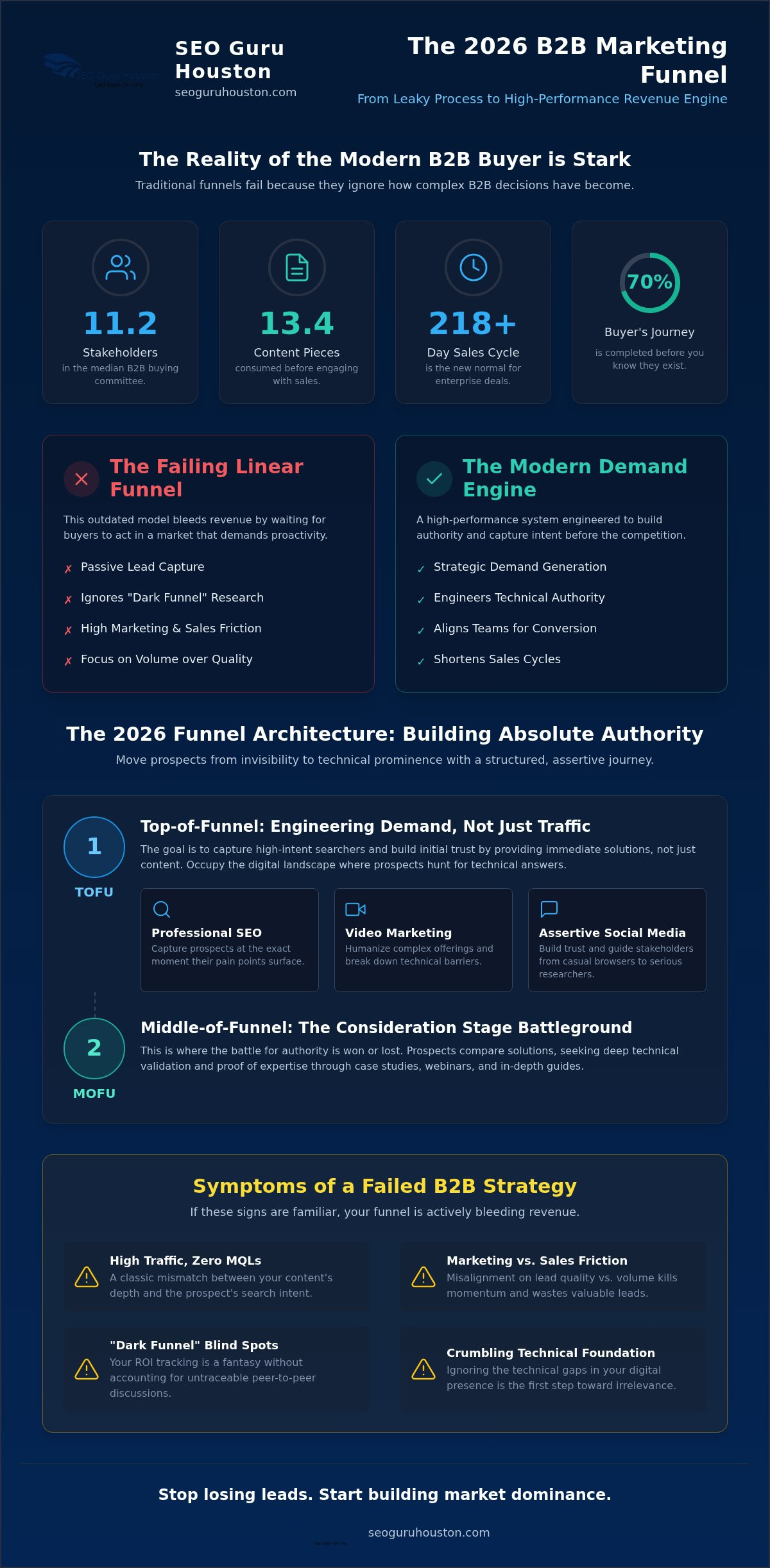
Why are you still betting your revenue on a linear sales process when the median B2B buying committee has ballooned to 11.2 stakeholders? In 2026, buyers consume an average of 13.4 pieces of content before they even think about talking to your team. You need to master how to create a b2b marketing funnel that doesn’t just capture emails but actually engineers technical authority before a discovery call is even booked.
We know the pain of watching your cost-per-lead skyrocket while your sales cycle stretches past the 218-day mark for enterprise deals. It’s exhausting to manage the friction between marketing and sales when outcomes don’t match the investment. This article is your assertive blueprint to stop losing leads to a leaky system and start building a high-performance engine that scales revenue. We’ll break down the exact engineering required to shorten your sales cycles, align your teams, and establish absolute market dominance through strategic demand generation and AI-assisted workflows. Prepare to move from invisibility to prominence by building a predictable lead generation machine that crushes the competition.
Key Takeaways
- Stop losing prospects to a leaky process by shifting your focus from passive lead capture to a comprehensive demand-generation strategy that builds technical authority.
- Master how to create a b2b marketing funnel that engages the modern buying committee and engineers trust through technical prominence before the first discovery call.
- Discover why tactical lead generation is no longer enough and why creating brand desire through strategic demand generation is the fundamental necessity for growth.
- Learn to engineer a high-conversion engine by mapping your content assets to the specific psychological triggers and technical pain points of your ideal customer profile.
- Shorten your sales cycles and establish absolute market dominance by integrating high-intent paid strategies with a robust inbound marketing framework.
Why Your Current B2B Marketing Funnel is Bleeding Revenue
Your current strategy is likely a relic. If you’re still relying on a traditional, passive marketing funnel concept, you’re handing your market share to competitors who are more aggressive. In 2026, the reality is stark. B2B buyers consume an average of 13.4 pieces of content before they ever engage with a sales team. This self-directed journey means prospects are often 70% of the way through their decision process before you even know they exist. If your engine isn’t built to capture this invisible intent, you’re bleeding revenue at every stage of the journey.
Passive inbound models fail because they wait for the buyer to initiate contact. In hyper-competitive sectors, that’s business suicide. Learning how to create a b2b marketing funnel that actually converts requires a shift from simply catching leads to actively generating demand. This is why partnering with a professional b2b demand generation agency is a fundamental necessity for growth. You need an assertive system that commands attention and establishes technical authority before the buyer even realizes they have a problem.
The Death of the Linear Buyer Journey
The path to purchase is no longer a straight line. It’s a complex web of “Dark Social” interactions and “Dark Funnel” research. Buyers are discussing your brand in private Slack groups and peer networks where your tracking pixels can’t reach. Without sophisticated multi-touch attribution, your ROI tracking is a fantasy. You’ll see fragmented search intent where prospects look for technical solutions long before they search for a vendor. If you don’t map your content to these specific, high-intent technical queries, your conversion rates will crater. You must understand how to create a b2b marketing funnel that accounts for these invisible touchpoints.
Symptoms of a Failed B2B Strategy
Are you seeing high traffic but zero MQLs? That’s a classic symptom of a mismatch between search intent and content depth. It’s a sign that your technical foundation is crumbling. Sales and marketing alignment isn’t just a corporate buzzword; it’s the difference between a closed deal and a wasted lead. Friction between these teams kills the momentum required to close high-ticket accounts. If your marketing team is focused on lead volume while sales demands lead quality, your funnel is broken. Diagnosing these leaks and fixing the technical gaps is the first step toward absolute market prominence. Stop ignoring the technical foundation of your digital presence and start engineering for results.
The 2026 B2B Funnel Architecture: Awareness to Absolute Authority
The linear path is dead. To dominate your sector, you must view your architecture not as a leaky bucket, but as a high-velocity engine. While many still cling to static models, the evolution of the traditional funnel suggests a more cyclical, momentum-based approach is necessary for 2026. This isn’t about passive observation; it’s about engineering an assertive journey that moves prospects from complete invisibility to technical prominence. When you’re figuring out how to create a b2b marketing funnel that actually scales, you must prioritize demand generation over simple lead capture.
TOFU: Engineering Demand, Not Just Traffic
Top-of-funnel (TOFU) activities in 2026 require more than just “brand awareness.” You need to occupy the search landscape where your prospects are hunting for technical answers. Leveraging professional seo services allows you to capture high-intent searchers at the exact moment their pain points surface. Don’t just give them a blog post; give them a solution. Use video marketing to humanize complex B2B offerings and break down technical barriers quickly. Assertive social media isn’t for “likes”; it’s for building the initial trust required to move a stakeholder from a casual browser to a serious researcher. If your current architecture feels stagnant, it’s time to consult with an expert in demand generation to realign your strategy.
MOFU: The Consideration Stage Battleground
Middle-of-funnel (MOFU) is where the battle for authority is won or lost. In 2026, buyers are savvy and skeptical. Your inbound marketing strategy for b2b must pivot from generic promotion to deep-dive education. This is the stage for expert comparison guides and white papers that don’t just list features, but solve architectural problems. Use interactive tools and webinars to capture intent data that your sales team can actually use. You aren’t just nurturing a lead; you’re educating a future partner. When you master how to create a b2b marketing funnel, you ensure that every MOFU touchpoint reinforces your position as the only logical choice in the market.
Bottom-of-funnel (BOFU) requires an assertive close. This is not the time for subtlety. You need to present undeniable social proof and concrete ROI projections that speak directly to the 11.2 stakeholders involved in the buying committee. In 2026, the assertive close is built on technical certainty. If your funnel hasn’t already established you as an absolute authority by this stage, you’ve already lost. Use case studies that mirror your ICP’s exact environment to remove any lingering doubt and push the deal across the finish line.
Demand Generation vs. Lead Generation: Which Growth Engine Wins?
Stop treating your prospects like prey. Lead generation is a tactical hunt for contact information, often resulting in a database full of low-intent names that your sales team despises. Demand generation is the strategic creation of brand desire. It’s about engineering an environment where the market already wants what you sell before you ever ask for a meeting. If you want to know how to create a b2b marketing funnel that actually scales, you must realize that a name in a database isn’t a customer. It’s just a data point.
In 2026, capturing a lead without pre-built trust is a waste of resources. If you’re learning how to create a b2b marketing funnel, you must realize that a hybrid approach is the only way to achieve rapid scaling. You need the precision of lead capture combined with the authority of demand generation. The Guru perspective is clear: a lead is just a number; a relationship built on technical prominence is an asset. Capturing a lead is useless if they don’t already respect your expertise. This is why professionals like Frank Novak argue that many businesses fail because they ignore the human element of authority in their automation.
Gated content is losing its effectiveness. Buyers are tired of trading their privacy for surface-level white papers. When you force a gate too early, you end up with high-volume, low-quality outcomes that tank your sales team’s productivity. The cost of chasing these low-intent leads is hidden in the hours your reps spend on discovery calls that go nowhere. You’re paying for a high cost-per-lead while your revenue remains stagnant. Measuring real ROI means looking past the vanity metrics of lead volume and focusing on pipeline velocity. If your sales cycle is stretching toward that 218-day enterprise average, your lead gen strategy is likely the culprit.
Building a Demand-First Machine
Prioritize ungated value. By giving away your best insights, you build market-wide authority that competitors can’t touch. This demand-first approach is what actually shortens the average sales cycle. When the buyer finally enters your funnel, they are already sold on your expertise. Integrating high-performance PPC services with a robust SEO strategy ensures you are visible exactly when the market’s technical pain points peak. You aren’t just filling a funnel; you’re building a predictable lead generation machine that converts at a higher rate because the trust is already established. This is a fundamental necessity for those hungry for market dominance. Don’t just collect emails; command the market’s attention.
Step-by-Step: Engineering Your High-Conversion B2B Funnel
Building a high-performance engine isn’t about hope; it’s about precision. When you master how to create a b2b marketing funnel, you stop guessing and start calculating ROI with cold, hard certainty. This process requires a move from generic awareness to technical prominence. Follow these five steps to engineer a funnel that crushes your competition:
- Step 1: Define your ICP and psychological triggers. Move beyond basic demographics. Identify the specific business survival and growth triggers that keep your ideal customer awake at night.
- Step 2: Map content assets to technical pain points. Ensure your content addresses the specific architectural or operational hurdles your prospects face at each stage.
- Step 3: Deploy high-performance architecture. Use high converting landing page design for every offer to ensure your traffic doesn’t just visit, but converts.
- Step 4: Fuel the engine. Integrate assertive PPC management to inject high-intent traffic into your funnel immediately while your organic authority builds.
- Step 5: Automate with precision. Utilize autonomous AI marketing agents to streamline lead generation and content creation, ensuring your nurture sequences use technical data to deliver the right message at the exact moment of need.
Psychological Trigger Mapping for B2B
In 2026, you aren’t just selling to a person; you’re selling to a committee of 11.2 stakeholders. You must distinguish between the ‘Decision Maker’ who cares about the bottom line and the ‘Influencer’ who cares about technical feasibility. Your copy must speak the language of business survival and aggressive growth. Use an assertive tone that creates urgency. If your messaging feels like an optional luxury, you’ve already lost. Position your solution as a fundamental necessity for their continued market existence. Ready to build a system that commands respect? Partner with an expert B2B marketing team to dominate your sector today.
The Technical Stack: CRM and Automation
Your technical stack is the backbone of your revenue engine. Your CRM must be the single source of truth for all ROI tracking. If your data is siloed, your strategy is blind. Implement lead scoring to prioritize ‘hot’ prospects who exhibit high-intent behaviors, such as visiting your pricing page or downloading a technical comparison guide. Use behavioral triggers to automate hyper-personalized follow-ups. When a prospect engages with a specific technical asset, your system should automatically deliver the logical next step in their journey. This level of automation ensures no high-value lead drops through the cracks of a leaky funnel. Precision in your stack leads to prominence in your market.
Scaling to Dominance: Integrating Inbound and Paid Strategies
Organic SEO is your foundation, but relying on it alone for rapid 2026 growth is a strategic error. You need immediate visibility to fuel your engine. Mastering how to create a b2b marketing funnel requires a dual-threat approach where paid and organic strategies feed each other. While SEO builds your long-term technical authority, assertive ppc management provides the instant momentum needed to dominate high-intent keywords. This isn’t an optional luxury. It’s a fundamental necessity for businesses hungry for market prominence.
Aggressive Paid Search for B2B
Stop playing defense. Use paid search to target competitor brand terms and surgically steal market share from established players. In 2026, surgical targeting on platforms like LinkedIn allows you to put your solution directly in front of C-suite executives who have the power to sign high-ticket contracts. Don’t fall into the trap of optimizing for vanity metrics like clicks or impressions. Your ad spend must be ruthlessly focused on revenue generation. If a campaign isn’t contributing to your pipeline velocity, cut it. An assertive strategy demands that every dollar works toward your bottom line. You’re not just buying traffic; you’re buying market share.
The Final Conversion: Turning Leads into Partners
The bottom of your funnel is where technical certainty meets emotional commitment. At this stage, your prospects need more than just a sales pitch. They need proof. Implementing website video marketing at the BOFU stage humanizes your solution and breaks down complex technical barriers in seconds. Combine this with high-impact case studies that provide undeniable ROI evidence. Your goal is to remove every shred of doubt. When you understand how to create a b2b marketing funnel, you know that the final step isn’t a request for information. It’s a move toward a strategic partnership.
The multiplier effect is real. When your paid ads capture intent and your organic content builds trust, you create a lead generation machine that’s nearly impossible to disrupt. This level of market dominance isn’t achieved by accident. It requires the specialized knowledge of a veteran team. Partnering with a result-oriented SEO marketing company is the final piece of the puzzle. It allows you to focus on scaling your operations while experts engineer your digital prominence. Don’t settle for invisibility when absolute authority is within reach. Take decisive action and command your market today.
Command Your Market: The Era of Assertive B2B Growth
The days of passive inbound marketing are over. In 2026, market dominance belongs to those who engineer trust through technical authority and strategic demand generation. You’ve seen that a modern engine requires more than just catching leads; it demands the creation of brand desire before the first discovery call. By integrating high-intent paid strategies with deep-dive technical content, you can bypass the noise and speak directly to the stakeholders who control the budget.
Mastering how to create a b2b marketing funnel is a fundamental necessity for your business survival and aggressive growth. You don’t have to navigate this complex landscape alone. Our expertise in expert B2B demand generation and data-driven ROI focus ensures you move from invisibility to prominence. We help you establish a dominant market presence that your competitors cannot ignore. Stop wasting resources on low-quality outcomes and start building a predictable revenue engine.
Stop Guessing and Start Scaling: Get Your Custom B2B Funnel Blueprint Today!
The path to market leadership is clear. Take decisive action now and watch your revenue engine crush the competition. You’ve got the blueprint; it’s time to build your legacy.
Frequently Asked Questions
How do you create a B2B marketing funnel from scratch?
You begin by ruthlessly defining your Ideal Customer Profile (ICP) and mapping their specific technical pain points. This isn’t a suggestion; it’s the foundation of your revenue engine. Once your ICP is locked, you must engineer high-converting landing pages and deploy assertive PPC management to fuel the funnel with high-intent traffic. Success requires moving from invisibility to technical prominence through a structured, data-driven approach that prioritizes demand generation over passive lead capture.
What are the 4 stages of a B2B marketing funnel in 2026?
The modern funnel consists of Awareness, Consideration, Intent, and Decision. In 2026, these stages are redefined by technical authority. Awareness is now about achieving technical prominence in your sector. Consideration involves expert solution comparisons that prove your superiority. Intent is the validation stage where stakeholders scrutinize your technical stack and past performance. Finally, the Decision stage requires an assertive close built on undeniable ROI evidence and social proof that speaks to the entire buying committee.
How long does it take for a B2B marketing funnel to show ROI?
You should expect to see immediate momentum if you integrate assertive PPC management to capture existing demand. However, building a predictable lead generation machine through organic SEO typically takes six to nine months of consistent execution. This timeline is a fundamental reality of the B2B landscape, where the average sales cycle is 121 days for mid-market deals. Decisive action today ensures you aren’t left behind by competitors who started their engineering months ago.
What is the difference between a B2B and B2C marketing funnel?
The primary difference lies in stakeholder complexity and the length of the sales cycle. B2C funnels often target emotional, individual decisions with short paths to purchase. Conversely, B2B funnels must address an average of 11.2 stakeholders and focus on business survival and long-term ROI. When you learn how to create a b2b marketing funnel, you’re engineering a psychological journey that builds technical trust over months across a diverse buying committee rather than chasing a quick impulse buy.
What are the most important metrics to track in a B2B funnel?
Stop obsessing over vanity metrics like clicks and focus on pipeline velocity and MQL to SQL conversion rates. You need to know exactly how fast prospects are moving through your engine and at what cost. Tracking Customer Acquisition Cost (CAC) against the lifetime value of a partner is essential for maintaining a result-oriented strategy. If your CRM isn’t providing a single source of truth for these metrics, your growth is built on guesswork rather than data.
Can a small business create an effective B2B marketing funnel?
Absolute market authority isn’t reserved for enterprise giants. Small businesses can dominate their niche by being more surgical and assertive than their larger, slower competitors. By focusing on demand generation and high-converting web development, you can punch above your weight class. You don’t need a massive budget; you need a precise strategy that prioritizes technical prominence and addresses the specific pain points of a well-defined Ideal Customer Profile to achieve growth.
Is content marketing still effective for B2B funnels in 2026?
Content marketing is the lifeblood of the 2026 funnel, but only if it provides deep technical value. Passive, surface-level blog posts are useless in a market where buyers consume 13.4 pieces of content before engaging sales. You must produce expert white papers, comparison guides, and website video marketing that establishes you as a guru in your field. If your content doesn’t solve a complex problem or prove ROI, it’s just noise that prospects will ignore.
How do I align my sales and marketing teams within the funnel?
Alignment requires a shared focus on revenue rather than individual department targets. You must establish a unified definition of a Sales Qualified Lead (SQL) and implement technical lead scoring within your CRM. When both teams are incentivized by closed deals and pipeline velocity, friction disappears. Learning how to create a b2b marketing funnel that works means ensuring marketing delivers the technical authority sales needs to close the deal with confidence and scale your revenue.

