Tag Archives: Search Engine Optimization

SEO for Law Firms: A Practical 2026 Growth Guide

What if stronger search rankings still leave your law firm short on qualified inquiries? SEO for law firms creates business value when visibility, legal trust, and the path to contacting your firm work together. Rankings matter, but they’re only one part of the result.

Potential clients often compare firms before they reach out. FindLaw research cited by MyCase reports that 75% visit between two and five law firm websites before making contact. If your pages don’t clearly address their needs or make the next step easy to find, more traffic may not mean more relevant consultations.

This guide lays out a practical sequence for building and improving your SEO strategy, from useful legal content and site structure to local visibility and intake tracking. You’ll also find a framework for assessing an agency or in-house approach and measuring progress beyond rankings and visits. The goal is a clearer connection between organic search and the inquiries that support your firm’s growth.

Key Takeaways

  • Build SEO for law firms around practice-area priorities and business goals, not an unfocused list of keywords.
  • Use a step-by-step workflow to audit your site, understand search intent, prioritize pages, make improvements, and review progress.
  • Compare in-house SEO, agency support, and paid search by considering control, expertise, coordination, capacity, and reporting.
  • Track the path from search visibility to relevant visits, contact actions, and qualified inquiries instead of relying on rankings alone.
  • Coordinate SEO with PPC and website improvements to create a growth plan aligned with your firm’s goals.

SEO for Law Firms: What It Does and Why It Matters

Referrals can be a strong source of new matters, but they don’t give every potential client a way to discover your firm while researching a legal problem. A well-planned organic search strategy can help close that gap and show how people find and engage with your website.

SEO for law firms means improving relevant visibility in unpaid search results and making the website useful once a searcher arrives. It involves more than keywords: page structure, content, technical accessibility, and clear next steps all shape the experience. For a broader overview of the discipline, see Search Engine Optimization (SEO).

Visibility means appearing in relevant search results, traffic means the visits those appearances bring, and a qualified inquiry is a contact from someone whose legal needs align with the firm’s work. These are connected stages, not interchangeable measures. A firm can gain visibility without meaningful visits or attract visits that never become appropriate inquiries.

Organic SEO and paid placements can support different acquisition needs. SEO builds a foundation for relevant unpaid discovery over time, while paid search can provide placement for selected searches through advertising. Both require relevant landing pages and a clear contact path. Neither channel, by itself, guarantees that a visitor is a suitable prospective client.

Which searches can bring potential clients to a law firm?

Search terms offer clues about what a person needs, but they don’t prove readiness to hire. Match the page to the likely intent:

  • Practice-area searches: Someone looking for a family law attorney may benefit from a focused service page explaining the practice and how to make contact.
  • Problem-based searches: A person asking what to do after a workplace injury may be looking for initial information. An educational article can address the question and guide readers to relevant services.
  • Firm-name searches: Someone searching for a specific firm may want its website, practice details, or contact information. Make those details easy to find.

Organizing pages around these distinct needs helps avoid sending every searcher to a generic homepage. It also gives your firm a practical way to decide which content to create or improve first.

Why rankings alone do not show whether SEO is working

A ranking is one signal, not a verdict. Impressions show how often a page appeared; position estimates where it appeared; organic visits show who clicked through. Calls and form submissions show contact actions, but those contacts still need to be assessed for relevance.

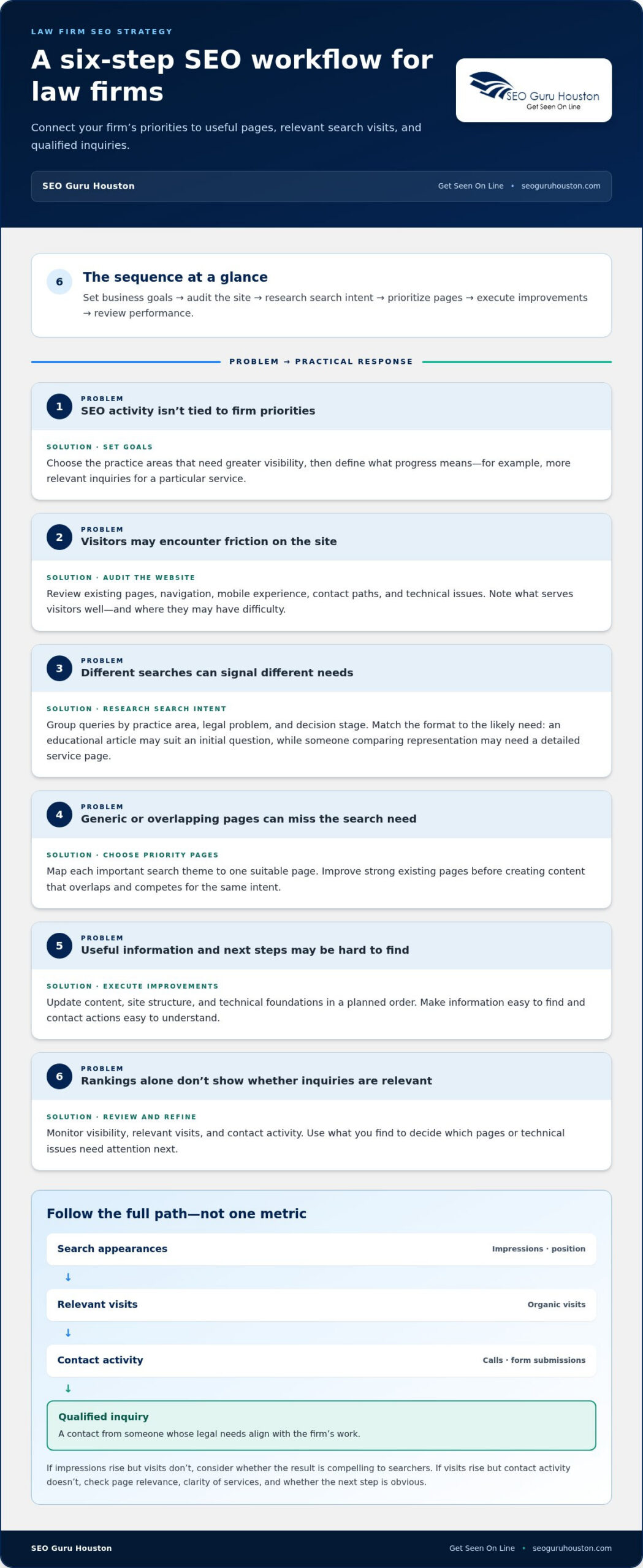
Look at the journey as a whole. If impressions rise but visits don’t, the result may not be compelling to searchers. If visits rise but calls and submissions don’t, check whether the page answers the query, explains the firm’s services clearly, and makes the next step obvious.

Traffic quality depends on search relevance, useful page content, and a clear path to contact. Results also depend on competition, the website’s existing condition, and sustained execution, so progress can vary. Evaluate the full path from search appearance to qualified inquiry rather than treating one position as proof of success.

How to Build a Law Firm SEO Strategy Step by Step

A focused SEO programme starts with your firm’s growth priorities, not a spreadsheet full of search terms. Decide which practice areas need greater visibility and what a useful inquiry looks like, then align your website and content with those priorities. This keeps SEO for law firms tied to the work your firm wants to attract.

Strategy sequence: set business goals, audit the site, research search intent, prioritize pages, execute improvements, and review performance.

  1. Set goals. Identify priority practice areas and define what progress means, such as more relevant inquiries for a particular service.
  2. Audit the website. Review existing pages, navigation, mobile experience, contact paths, and technical issues. Note what already serves visitors well and where they encounter friction.
  3. Research search intent. Group queries by practice area, legal problem, and decision stage. A person seeking a definition may need an educational article; someone comparing representation may need a detailed service page.
  4. Choose priority pages. Map each important search theme to one suitable page. Improve strong existing pages before creating overlapping content that competes for the same intent.
  5. Execute improvements. Update content, site structure, and technical foundations in a planned order. Make useful information easy to find and contact actions easy to understand.
  6. Review and refine. Monitor search visibility, relevant visits, and contact activity. Use the findings to decide which pages or technical issues need attention next.

Research keywords around practice areas and client questions

Build topic groups rather than treating every phrase as a separate target. For example, a practice-area group can include service terms, questions about a legal problem, and searches that suggest someone is comparing options. Review the current results for each theme to see whether searchers are shown service pages, explainers, or another format. Use relevant phrases naturally, and prioritize accurate answers over repeated keywords.

Improve pages, technical foundations, and legal content

Give each priority page a specific title, clear headings, useful internal links, and a next step that fits its purpose. Check that menus and forms work on mobile, important pages can be crawled, and pages load efficiently. Google’s SEO Starter Guide offers practical guidance on making content accessible to search engines and people.

Legal content also needs care. Attorney review can help ensure explanations reflect the firm’s knowledge and remain accurate, while clear author information helps readers understand who stands behind the material. Avoid implying a particular case result. For broader strategic context, see this guide to professional SEO services.

Effective execution connects content, technical health, and conversion paths instead of treating them as separate projects. A tailored SEO strategy can align site improvements with your firm’s growth priorities.

In-House SEO, Agency Support, or Paid Search: How to Compare

The right setup depends on the work your firm can consistently own, the expertise available, and how quickly you need campaign visibility. In-house SEO, agency support, and paid search aren’t interchangeable. Each has different strengths, and they can work together when responsibilities and reporting are clear.

Use this comparison to identify where your current resources fit. The best approach to SEO for law firms connects execution to practice-area priorities and qualified inquiries instead of focusing on activity for its own sake.

Control
In-house teams have direct access to firm decisions and can adjust priorities internally. Agency support involves an external working relationship, with scope and decisions coordinated with the firm. Paid search offers campaign-level control over targeting and spend.

Available expertise
Internal skills depend on the staff assigned to the work. An agency can bring SEO, paid search, website development, and landing-page capabilities into a coordinated plan. Paid search requires campaign management as well as a relevant destination page.

Coordination
In-house teams can connect marketing closely with attorneys and intake staff. Agency support can coordinate search strategy with site structure and page improvements. Paid campaigns need messaging and landing pages that match the search and the firm’s services.

Capacity
Internal execution works when staff have dedicated time for research, publishing, technical tasks, and reviews. Agency support can add execution capacity. Paid search requires ongoing campaign attention, separate from organic content and technical work.

Reporting
Whichever route you choose, reports should connect activity to business goals. Track visibility and visits alongside contact actions and inquiry relevance, not just completed tasks or campaign clicks.

When does an in-house law firm SEO approach make sense?

In-house execution can suit a firm with people who have relevant skills and protected time to use them. Internal staff understand practice-area priorities, firm language, and the questions attorneys hear from clients. That access can support accurate, useful content. The constraint is capacity: if research, writing, technical fixes, and performance reviews compete with other duties, progress can stall. Assign an owner to each task before choosing this model.

What should a firm assess when considering agency support?

Assess whether the proposed strategy starts with business goals and explains how search activity will be evaluated for lead quality. Look for coordination across organic SEO, paid search, and the website experience, with responsibilities and reporting made clear. A search click is only the start; a focused next step can help visitors find relevant information and contact options. For that journey, consider high-converting landing-page design.

Organic search builds visibility through sustained work and may compound as relevant pages gain traction. Paid search can put a firm in front of selected searches once campaigns are live, providing a different route to campaign visibility. It doesn’t replace SEO, and SEO doesn’t provide the same paid placement. Choose based on priorities, capacity, and measurement, then coordinate channels where they serve complementary needs.
SEO for Law Firms: A Practical 2026 Growth Guide

How to Measure Law Firm SEO Beyond Rankings

Strong reporting follows the full path from a search result to a relevant inquiry. For SEO for law firms, that means separating early signs of visibility from business outcomes and asking what each metric says about the next step. A ranking can improve while inquiries stay flat, so evaluate performance as a connected journey, not a single score.

Interpret rankings alongside conversion and lead-quality data because visibility alone does not show whether relevant searchers visit, contact the firm, or become qualified inquiries.

Which SEO metrics should a law firm review?

Use search-performance reports to understand how often pages appear and earn clicks, and analytics to assess what visitors do after arrival. Review trends over consistent periods, such as month to month or quarter to quarter, and annotate significant site changes, new content, or campaign activity. This context makes it easier to distinguish a real shift from normal variation.

  • Organic impressions and positions: Leading indicators that show whether priority pages are appearing for relevant searches.
  • Organic clicks and visits: Signals that searchers chose a result and reached the website.
  • Landing-page engagement: Review whether visitors explore useful content or take a next step, rather than judging a page by visits alone.
  • Contact actions: Track completed forms and calls where the measurement setup allows.

Where data allows, segment results by practice-area page and search intent. An educational article may attract people researching a question, while a service page may draw searchers comparing legal representation. Their engagement and contact patterns may differ, so combining them into one site-wide average can hide useful detail.

Analytics and search-performance tools each show only part of the journey. Search data can connect queries with impressions and clicks, while website analytics can record on-site activity. Neither necessarily reveals whether a person became a suitable prospective client. Attribution can also be incomplete when people switch devices, return later, or contact the firm through another route.

How should firms connect online inquiries to intake?

Track form submissions and calls when consent, privacy requirements, and technical setup permit. Configure events carefully so reports distinguish genuine completed actions from button clicks or incomplete forms. Then create a consistent intake process: record the stated source when available, the relevant practice area, and whether the inquiry fits the firm’s work. Keep collection and access to sensitive information aligned with the firm’s privacy practices.

Inquiry volume is not the same as qualified matter volume. A rise in contacts may include requests outside the firm’s practice areas, while fewer but more relevant inquiries may better reflect the goal. Review intake notes alongside page and channel performance, using consistent definitions so teams compare like with like.

Use a regular reporting cadence to identify what to investigate next, such as a page with growing visibility but few clicks or visits that rarely lead to relevant contact. This turns measurement into a decision tool, not a scoreboard. Explore a strategy that connects SEO reporting to lead-generation goals.

Turn Law Firm SEO Into a Coordinated Growth Plan

A stronger search programme isn’t a list of disconnected tasks. Define your firm’s growth goals, prioritize the practice-area pages that support them, decide who owns the work, make improvements, and measure what happens after people find the site. This gives SEO for law firms a clear direction and keeps effort focused on meaningful business outcomes.

SEO can work alongside paid search and website improvements, but neither channel is a guaranteed substitute for the other. Organic work develops relevant visibility over time. PPC can support campaign visibility for selected searches, while a useful website experience helps visitors understand the firm’s services and find an appropriate next step. The value comes from coordination, not simply adding more channels.

What a coordinated law firm digital strategy can include

Start with search research and your firm’s priority practice areas. Use those insights to shape content topics and page structure: a service page can explain a specific area of legal work, while an educational article can address a related question. Connect the pages through clear navigation and relevant internal links, then make sure each page offers a sensible next step for its audience.

A coordinated programme can bring together SEO, PPC, website development, landing-page design, and demand-generation capabilities. These are complementary parts of a digital growth strategy. For example, PPC can help a firm test campaign opportunities while organic pages are being developed, and the resulting search and inquiry data can inform future content and page improvements. Paid activity still needs a relevant landing page and clear measurement; it doesn’t guarantee qualified inquiries.

Reporting should tie channel activity to your firm’s stated goals. Review organic visibility and relevant visits alongside campaign engagement, contact actions, and inquiry relevance. This helps identify where the journey needs attention, whether that’s search targeting, page content, site structure, or the path to contact. Set expectations around learning and ongoing refinement, not promised rankings, lead volumes, or timelines.

Choose a practical next step for your firm

Before deciding what to change, write down the practice areas your firm wants to prioritize, the audiences it needs to reach, and the gaps in its current measurement. Then decide what the team can own internally and where coordinated support could connect search strategy, PPC, and website improvements. A focused discussion about these goals can turn a broad marketing ambition into a workable plan.

Make the next move specific: identify one priority page or measurement gap, assign ownership, and define how you’ll review progress. From there, your firm can build a coordinated strategy that adapts as evidence comes in. Build a stronger law firm search strategy.

Make Your Next Search Move Count

The next opportunity for your firm may not be another marketing task. It may be a sharper decision about which audience to reach, what you want them to do, and how you’ll recognize a useful inquiry. Set that direction first, then build a plan your team can sustain. That’s how SEO for law firms becomes a focused growth investment rather than activity without a clear purpose.

Our SEO, PPC, website development, and landing-page design services are supported by demand-generation and inbound-marketing capabilities. These services can be coordinated around your firm’s priorities, connecting search visibility with a relevant website experience and measurable goals. No channel can promise a particular outcome, but a tailored strategy gives you a clearer basis for choosing what to improve and how to assess progress.

Bring your priority practice areas and current measurement questions into the conversation. Build a stronger law firm search strategy with a plan shaped around your goals. Your next step can be focused, practical, and built for progress.

Frequently Asked Questions

What is SEO for law firms?

SEO for law firms improves a firm’s visibility in relevant unpaid search results and makes the pages people reach useful and easy to navigate. Unlike paid advertising, organic search visibility isn’t purchased as an ad placement. The goal goes beyond appearing near the top: clear service information, helpful answers, and a straightforward way to take action all matter. No SEO approach can promise a specific position or number of clients.

How long does SEO take to work for a law firm?

There’s no universal timeline for SEO results. Competition, the website’s condition, content quality, technical needs, and the consistency of implementation all affect progress. Early signs, such as impressions for relevant searches, can appear before meaningful business outcomes are clear. Set a baseline before work begins, then review results regularly against agreed goals. This helps distinguish initial visibility changes from longer-term patterns in relevant visits and inquiries.

How much does SEO for a law firm cost?

SEO fees depend on the work involved, including competition, website improvements, content needs, and whether the firm handles tasks internally or uses agency support. Compare proposals by scope, specific deliverables, reporting, and how the strategy connects to your practice-area priorities. A low fee may not cover the work you need, while a larger fee alone doesn’t establish value. No investment guarantees rankings or qualified inquiries.

Can a law firm do SEO in-house?

Yes, a law firm can manage SEO in-house if it has appropriate expertise and enough dedicated time for research, content, technical upkeep, and measurement. Internal staff may have close access to attorneys and a strong understanding of the firm’s services, but competing responsibilities can limit execution. One practical option is for firm staff to guide legal substance while outside support handles selected SEO, web, or paid-search tasks.

Is local SEO important for law firms?

Local SEO can matter when a firm serves clients in defined geographic areas and people search for legal services tied to those places. Keep business information accurate and make service pages clear about the work and audiences the firm serves. The right priorities depend on the firm’s actual service footprint. A national or highly specialized practice may focus more on specific legal topics than on place-based searches.

Should law firms use SEO and PPC together?

SEO and PPC can work together because they serve different roles. Organic SEO supports relevant unpaid visibility, while paid campaigns can place ads in front of selected searches while those campaigns are active. For example, a firm could direct a paid campaign to a page tailored to that service and compare its engagement with organic visits. Coordinate targeting and landing-page messaging, then assess the mix against goals and available resources. Neither channel guarantees leads.

What content should a law firm publish for SEO?

Publish accurate, useful content that reflects the firm’s practice areas and answers questions potential clients commonly ask. A service page can explain what the firm handles, while an article can clarify a related legal topic for someone still researching. Match the format to the searcher’s need, use clear headings, and arrange appropriate attorney review. Link each page to a relevant next step, such as a related service page or contact option.
Affordable SEO Company: How to Invest in Growth Without Overspending

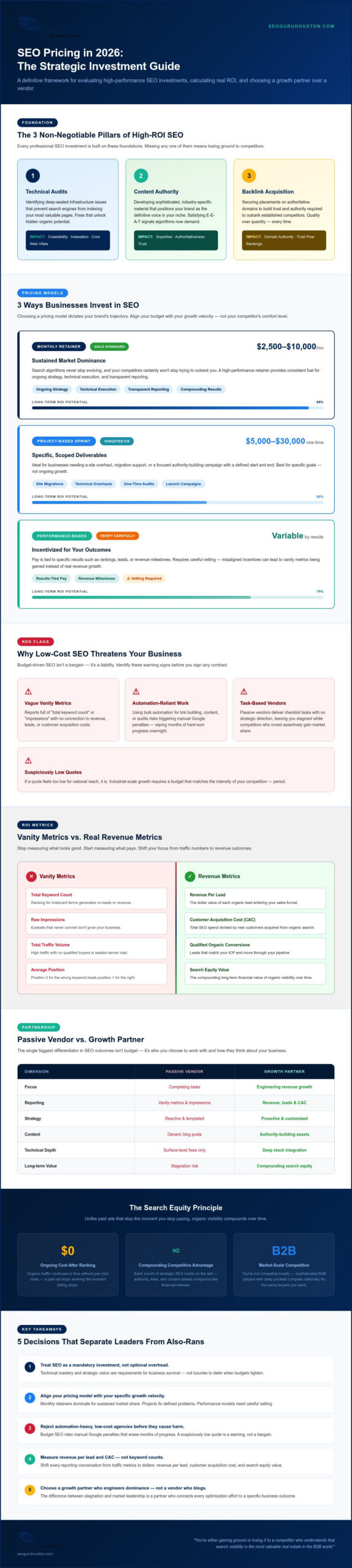
The cheapest SEO proposal can become the most expensive choice if it delivers activity without progress. An affordable SEO company should make your investment work harder by prioritizing opportunities tied to your business goals, not by offering the longest task list for the lowest price.

It’s reasonable to want clear deliverables, a manageable budget, and evidence that the work is moving your business forward. But comparing headline prices alone won’t show whether an engagement includes the right mix of technical improvements, content strategy, and performance measurement. SEO also takes time, so expectations should account for meaningful milestones as well as longer-term growth.

This guide explains what a focused SEO engagement can include and how to compare proposals by scope, strategic fit, and measurable outcomes. You’ll learn how to connect SEO priorities with business objectives, evaluate progress beyond rankings, and choose an approach that can adapt as your needs change. The goal is to invest with confidence, protect your budget, and build a stronger foundation for sustainable growth.

Key Takeaways

  • An affordable SEO company focuses on the work that fits your goals and resources, not simply the lowest quote.
  • Assess your business objectives, website condition, competition, and capacity to determine which SEO priorities matter most.
  • Compare proposals by scope clarity, prioritization, measurement, communication, and flexibility to understand where value comes from.
  • Set your SEO direction by defining an outcome, establishing a baseline, choosing priorities, and tracking qualified demand and conversions.
  • SEO can work alongside PPC, B2B and inbound marketing, and website improvements. The right mix depends on your growth priorities.

What Does an Affordable SEO Company Actually Mean?

Budget pressure is real. Every marketing dollar needs a job, and an SEO proposal full of unfamiliar tasks can make it hard to tell what you’re buying. But the lowest quote isn’t automatically the most affordable choice. If research, technical fixes, or performance tracking are missing, a low upfront cost may leave the problems limiting organic growth untouched.

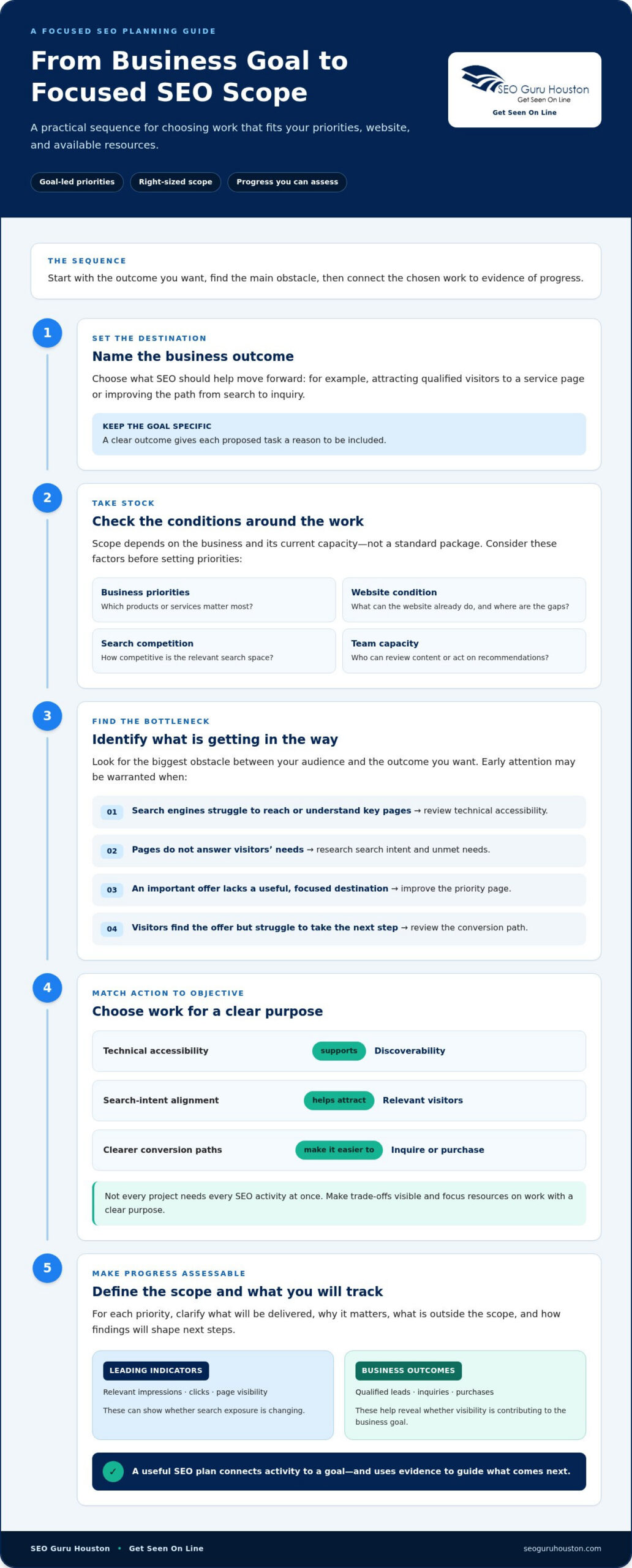
Affordability in SEO means a transparent, right-sized scope that connects available resources to measurable business priorities. Start with a clear outcome, such as attracting qualified visitors to a service page or improving the path from search to inquiry. Then identify the work most relevant to that outcome, specify what will be delivered, and define how progress will be assessed.

Search engine optimization (SEO) brings together activities that help improve a website’s visibility in search. A useful engagement turns that broad discipline into a focused plan. It isn’t a thin set of actions without a rationale, or an unexplained list of tasks that sounds comprehensive but isn’t tied to your business.

How Is Affordable SEO Different From Cheap SEO?

Affordable SEO prioritizes. Cheap SEO may simply remove the work needed to make informed decisions. A focused plan can concentrate on the most relevant pages and issues first while still grounding recommendations in research and tracking. Cutting those foundations makes it harder to evaluate the work because there’s no clear rationale or way to connect activity to progress.

Deliverable clarity matters more than a headline figure. You should understand what the work includes, why it matters, what falls outside the scope, and how findings will shape next steps. Imagine a company whose priority is generating more qualified inquiries for one service. A focused engagement might research search intent, improve that service page, and monitor relevant inquiry actions. A vague task list might promise assorted updates without explaining how they support the goal. The difference isn’t the number of tasks, but the reasoning behind them.

Who Can Benefit From a Focused SEO Engagement?

A focused engagement can suit a business that wants stronger organic visibility but needs to sequence marketing investments carefully. That might be a growing company with a defined service to promote, a business with limited capacity to create or update content, or a team strengthening its search foundation before expanding its efforts. The right starting point depends on the business, not a standard package.

Before setting scope, clarify the outcome and the resources available to support the work. Consider which products or services matter most, what the website can already do, and who can review content or act on recommendations. If your team can support only a narrow initiative, concentrating on a priority page may be more practical than spreading effort across the entire site. If capacity changes, priorities can change with it.

An affordable SEO company should make those trade-offs visible, not disguise them behind a low price or a long list of deliverables. A good-fit engagement gives your business a clear first move and a reasoned way to build from there.

What Shapes the Scope and Value of Affordable SEO Services?

SEO scope should reflect the business you’re trying to grow, not a standard checklist. A company seeking qualified inquiries for a specific service needs a different plan from an online retailer expanding product visibility. The website’s current condition, the competitiveness of its search space, and the time your team can contribute all affect what belongs in the plan and what should wait.

Think of the work in two layers. Foundational SEO addresses whether search engines can access and understand important pages, whether those pages match relevant search intent, and whether visitors can take a useful next step. Ongoing improvement may involve developing content for unmet needs, strengthening the site’s authority, and using performance data to refine priorities. A well-scoped engagement makes the transition between these layers clear. For a broader perspective on strategy, explore this guide to professional SEO services.

An affordable SEO company should explain why each priority fits your goals and what evidence will help assess its value. Not every project needs every SEO activity at once. The plan should make trade-offs visible so your resources go toward work with a clear purpose.

Which SEO Activities Deserve Early Attention?

Start with the website’s actual needs, not a generic checklist. Technical accessibility deserves attention if search engines struggle to reach or understand key pages. Search-intent research matters if visitors have needs your pages don’t answer. Improve priority pages when important services or products lack a useful, focused destination. Review conversion paths when people can find the offer but can’t easily take the next step.

Connect each activity to an objective: accessibility supports discoverability, intent alignment helps attract relevant visitors, and clearer conversion paths make it easier for those visitors to inquire or purchase. To decide what comes first, identify the biggest obstacle between your audience and the business outcome you want.

How Should SEO Performance Be Measured?

Use both leading indicators and business outcomes. Relevant impressions, clicks, and page visibility can show whether search exposure is changing. Qualified leads, inquiries, or purchases help reveal whether that visibility supports the business. Google Search Console can help you review search queries and page performance, while analytics data can show how visitors behave after landing on the site. Together, these sources provide context, not a promise of particular rankings or revenue.

SEO reporting should connect completed work to search visibility and meaningful business outcomes, so each review informs the next decision. A useful report explains what changed, what the data suggests, and what action follows instead of presenting metrics without interpretation.

  • Goal: Name the business outcome the SEO work is meant to support.
  • Baseline: Record relevant page, search, and conversion performance before changes.
  • Review: Compare progress over time and adjust priorities as evidence or business needs change.

Connecting scope to measurement turns SEO from a collection of tasks into a growth strategy. If your priorities call for a broader view of search and digital growth, explore SEO strategy and marketing resources to see how related efforts can fit together.

Affordable SEO Company vs. Low-Cost Provider: How to Compare Value

A proposal’s total cost tells you what you’d pay, not what the work is designed to accomplish. Compare the reasoning behind the scope: which business priority it serves, how the work will be measured, and what happens as needs change. A focused engagement may fit a defined objective; a broader partnership may suit a business addressing several connected growth needs. Neither is automatically better because it costs less or covers more.

Use this comparison to look beyond labels. These are common patterns, not fixed rules. A bare-minimum scope can suit a narrow need when its limits are clear.

What to compare Focused engagement Bare-minimum offer Broader growth partnership
Scope clarity Defines a specific objective, work areas, and boundaries. May list limited tasks without explaining their purpose. Connects SEO with related marketing or website work.
Prioritization Concentrates effort on the most relevant opportunity. May provide a fixed set of routine activities. Can address several priorities, if they’re genuinely needed.
Measurement Tracks indicators tied to the selected objective. May report activity without explaining its significance. Can connect performance across channels and conversion paths.
Communication Explains progress, decisions, and next steps. May offer limited context around completed tasks. Coordinates updates across connected areas of work.
Flexibility Can refocus as the priority evolves. May have little room to adjust its preset scope. Can shift emphasis among services as business needs change.

What Should a Transparent SEO Proposal Explain?

A transparent proposal links four parts: the business objective, the work chosen to support it, the reporting used to review progress, and expectations for discussing what comes next. The connections matter. If a deliverable has no stated purpose, or a report tracks measures unrelated to the objective, it’s difficult to judge whether the work is useful. An affordable SEO company should make those connections understandable without promising a specific ranking or revenue result.

Look for explanations, not just labels. “Improve key pages” is hard to evaluate without knowing which pages, why they matter, and how progress will be reviewed. A clear scope makes assumptions and boundaries visible, helping you compare substance rather than headline price.

When Does a Broader Growth Partnership Make Sense?

SEO can bring relevant visitors to a website, but it can’t resolve every barrier to growth by itself. If a landing page makes it hard to take action, website improvements may support the path from visit to inquiry. If the business needs to reach demand sooner while organic visibility develops, PPC may complement SEO. A broader partnership makes sense when those needs are connected and your team can act on them.

More services aren’t automatically more valuable. The right combination depends on the goal, capacity, and gaps identified. For broader context on how SEO fits into digital marketing, read this SEO marketing company guide. If your priorities span search and website performance, SEO and digital growth strategy can provide a useful starting point.

Affordable SEO Company: How to Invest in Growth Without Overspending

How to Set an SEO Budget and Priorities That Fit Your Business

An SEO budget works best when it’s built around a business result, not a wish list of tasks. Start with what growth should look like, identify the current barriers, then assign resources to the work most likely to move the right measure. This grounds priorities in evidence and makes it easier to explain why some work comes first while other opportunities wait.

Use this sequence to turn a broad ambition into a workable plan:

  1. Define the business outcome. Choose a meaningful objective, such as attracting qualified inquiries for a particular service or increasing relevant organic visits to important product pages.
  2. Assess the baseline. Review current search visibility, website activity, conversion paths, and inquiry data. Use your own site’s performance as the reference point rather than assuming an industry benchmark applies.
  3. Prioritize the constraint. Identify what most limits progress. It might be a technical issue, an important page that doesn’t meet search intent, or a website experience that makes it hard to take action. Fund the work that addresses that obstacle first.
  4. Set measures. Pair an early indicator, such as relevant organic visits, with a business outcome, such as qualified inquiries. Define what counts and where the data comes from before work begins.
  5. Review and adjust. Compare results with the baseline, discuss what the evidence suggests, and revisit the plan when capacity, business goals, or customer needs change.

This sequence gives an affordable SEO company a practical framework for prioritizing effort without treating every possible task as equally urgent.

How Can You Set Useful SEO Objectives?

Make broad goals observable. “Grow online” is difficult to act on. “Increase relevant organic visits to the service page and track how many become qualified inquiries” gives the team a direction and a way to learn. Record the starting point and keep definitions consistent across review periods. If the meaning of a qualified inquiry changes, note that change so performance comparisons remain useful.

Don’t judge the plan on traffic volume alone. More visits may not matter if those visitors aren’t looking for what the business offers or don’t take a meaningful next step. Match each measure to the customer journey and the outcome the business values.

How Should You Balance SEO With Other Growth Channels?

SEO can build organic visibility over time, while paid search may support demand that needs attention sooner. Website and landing page improvements can help visitors understand an offer and act on it. The right mix depends on your objective, available resources, and how customers move from discovery to decision. Not every business needs every channel at once.

If search attracts the right audience but the page makes conversion difficult, focused landing page design may address a more urgent constraint than expanding traffic efforts. Reassess the mix as evidence and priorities evolve.

Build your next steps around a clear goal, an honest baseline, and measures that connect marketing activity to business progress. Explore SEO growth services to consider how a data-driven search strategy can support your priorities.

How an Integrated SEO Partner Turns Affordability Into Growth

SEO creates more value when it supports a clear business objective instead of operating as a disconnected list of tasks. Search visibility matters, but so does what visitors find when they arrive and whether the site helps them take a meaningful next step. Connecting those pieces helps direct effort toward the full path from discovery to inquiry.

An integrated approach can draw on SEO, PPC, B2B marketing, inbound marketing, and website development and landing page design. That doesn’t mean every business needs every capability. A company focused on organic discovery may prioritize SEO; one seeking paid-search visibility may add PPC. If relevant visitors reach a page that doesn’t explain the offer or guide action, web improvements may be the more immediate priority. The right combination follows the goal.

For an affordable SEO company, integration is about coordination, not piling services onto a plan. Search strategy can inform which pages deserve attention, landing page work can support the visitor’s next step, and lead-generation priorities can shape which outcomes to track. Each activity should have a role in the business objective.

When Can SEO, PPC, and Web Development Work Together?

Organic search and paid search can serve different needs. SEO supports a longer-term effort to build visibility for relevant searches, while PPC can support paid-search objectives. Their roles may complement each other, but they aren’t interchangeable and shouldn’t be assumed to deliver the same outcomes.

Website development and landing page design connect those traffic sources to the customer journey. For example, a business seeking qualified inquiries might align search content and paid-search messaging with a page that clearly presents the relevant service and next step. A company focused on a different audience or offer may need a different page or channel mix. The best sequence depends on the goal, site condition, and available resources. There’s no universal timeline or guaranteed result. Evaluate progress against the measures selected for the project.

What Should a Practical First Conversation Establish?

Start with the business need. What outcome matters most? Which audience are you trying to reach, what challenges currently interrupt their path to action, and what marketing resources can your team contribute? Answers help distinguish a search visibility challenge from a conversion issue or a need to coordinate demand generation across channels.

A useful discussion connects those answers to possible priorities and services. If the main obstacle is organic discoverability, SEO may lead. If the page experience is holding back inquiries, web work may deserve attention. If paid visibility is part of the objective, PPC may have a role. This keeps the plan focused instead of treating service breadth as a reason to use everything.

Bring your goals and current challenges into focus, then turn them into a practical growth direction. Discuss your SEO growth goals and take the next step with purpose.

Turn Your Next SEO Decision Into Forward Momentum

Your SEO plan doesn’t need to solve every growth challenge at once. It needs to give your team a clear next move, a way to assess whether that move is useful, and room to adapt as the business evolves. Treat each review as a decision point: keep investing in work that supports your objectives, refine what isn’t connecting, and shift focus when your priorities or capacity change.

That’s how an affordable SEO company engagement can become a practical growth tool rather than a fixed list of deliverables. Start with the business question that matters most, then build a focused plan around the answer. Progress comes from deliberate decisions and learning from the evidence, not from trying to do everything at once.

Ready to turn your priorities into a clear direction? Map out your next SEO priorities and take the next step with confidence. Your growth strategy can start focused and become stronger as your business moves forward.

Frequently Asked Questions

Can an affordable SEO company guarantee first-page rankings?

No. An affordable SEO company can research opportunities, improve relevant pages, and monitor search performance, but it can’t control search engine results or promise a specific position. Rankings shift with competition, search changes, and other factors beyond any agency’s control. Look for clear explanations of planned work and progress measures instead. For example, track whether priority pages gain relevant impressions and attract visitors who match your intended audience.

How long does it take to see results from SEO?

There’s no reliable universal timeline because progress depends on the site’s starting condition, competition, scope, and how quickly recommendations are implemented. Some changes, such as correcting a page access issue, may be observable before broader business outcomes become clear. Treat early movement as a signal to investigate, not proof of success. Compare performance with a baseline over consistent periods, and assess whether visibility is developing into relevant visits and meaningful actions.

What should an SEO report include?

A useful report should show work completed, pages or search themes affected, relevant performance changes, and recommended next actions. It should define the reporting period and clarify how key metrics are calculated. For example, a report might distinguish visitors to a priority service page from all organic visits, then show whether those visitors completed a tracked inquiry action. Context matters: numbers without interpretation don’t explain what to do next.

Can an SEO strategy change as my business goals change?

Yes. SEO priorities should respond when your business shifts focus, changes its offerings, or discovers that a different audience or page deserves attention. A company moving toward a new service line, for example, may need to reassess which pages and search topics receive effort. Keep previous goals and reporting definitions documented, then note why the plan changed. That preserves useful comparisons while making room for new priorities.

Does affordable SEO include content creation?

It can, but content creation should be explicitly defined in the engagement rather than assumed. Clarify whether the work involves content research, outlines, drafting, updating existing pages, or reviewing material your team provides. The right choice depends on the goal and your internal capacity. If a page already answers customer questions well, improving its clarity may be more useful than adding another article. Focus content investment on a real audience need.

Is SEO or PPC better when a business needs leads quickly?

PPC can support paid-search visibility for a near-term campaign, while SEO builds organic visibility through ongoing work and may take longer to influence business outcomes. Neither channel guarantees leads. Before directing more traffic to a site, check that the offer is clear, the landing page matches the ad or search intent, and inquiry tracking works. The best choice depends on urgency, budget capacity, customer journey, and whether the business can respond to demand.

Signs of a Bad SEO Company: 9 Red Flags to Watch for in 2026

What if the SEO reports landing in your inbox show plenty of activity but reveal nothing about leads, conversions, or revenue? That gap doesn’t automatically prove your SEO company is failing, but it does mean you need clearer evidence. The signs of a bad seo company often hide behind confident ranking promises, vague updates, and work you can’t verify.

You’re right to expect more than charts and claims. SEO takes time, rankings can shift, and no company can responsibly guarantee a top position. But a capable partner should be able to explain the strategy, show what work was completed, and connect search performance to meaningful business goals. This guide covers nine warning signs, from secretive tactics and missing account access to reports that overlook qualified traffic and conversions. You’ll learn how to assess the evidence, distinguish a genuine concern from a normal fluctuation, and choose a practical next step that protects search visibility and supports growth.

Key Takeaways

  • Recognize the signs of a bad seo company by looking for risky practices and claims that aren’t backed by clear, verifiable work.
  • Separate normal ranking fluctuations from recurring unexplained changes by considering your site’s conditions, competition, and the work being done.
  • Use a simple review process to check account access, goals, reports, completed work, and business outcomes.
  • Document specific concerns and use them to guide a focused discussion about deliverables and measurable next steps.
  • Look for a partnership that connects SEO activity to audience needs, qualified traffic, leads, and conversions.

What are the signs of a bad SEO company? Start with these warning signals

Unclear work, disappointing results, and confident claims can leave you wondering whether your SEO investment is moving the business forward. One concern alone doesn’t prove misconduct. Look for a pattern: repeated opacity, risky tactics, or activity that can’t be connected to your goals. Search engine optimization (SEO) improves a site’s visibility in search results, but the work should still be explainable and open to review.

Start with these warning signals:

  • Guaranteed rankings: A promise of a specific position or certain result treats search outcomes as controllable when they aren’t.
  • Unexplained tactics: The company refers to “secret methods” but won’t describe the work or its purpose, even at a high level.
  • Vague reporting: Updates show activity or ranking charts without explaining what changed, why it matters, or how performance relates to qualified traffic and leads.
  • Withheld account access: You can’t access your own Google Search Console, Google Analytics 4, or website administrator accounts.

A bad SEO company repeatedly hides its methods, uses risky practices, or can’t connect its work to your business goals. A temporary ranking change alone is not proof of poor service.

Which SEO promises should make you pause?

Be cautious of claims like “number one by next month” or “we guarantee page-one rankings.” An SEO company can set targets and explain the work intended to pursue them, but it can’t dictate search-engine decisions, competitors’ activity, or how a search result changes. Ambition is useful when it comes with a strategy, milestones, and honest uncertainty. A guaranteed position or exact timeline is different: it presents an uncertain outcome as certain.

“Secret methods” deserve scrutiny if the company won’t explain what it’s doing, which pages or issues the work addresses, or how progress will be assessed. A strategy may involve technical details, but the business purpose and deliverables shouldn’t be a mystery.

What does poor SEO communication look like?

A report that lists impressions, clicks, or rankings without interpretation leaves you guessing. Useful reporting explains what the metrics indicate and how search activity relates to your goals, such as qualified visits, inquiries, or conversions. Communication is also a concern when updates repeatedly go missing, no one clarifies who owns a task, or questions about completed work go unanswered.

Keep direct access to your analytics and search accounts. You need to review performance and retain continuity if the working relationship changes. If access is withheld, ask for a clear explanation and a way to regain control. Treat the issue as a reason to investigate the broader pattern, not as a verdict on its own.

Bad SEO company or normal delay? Separate red flags from search volatility

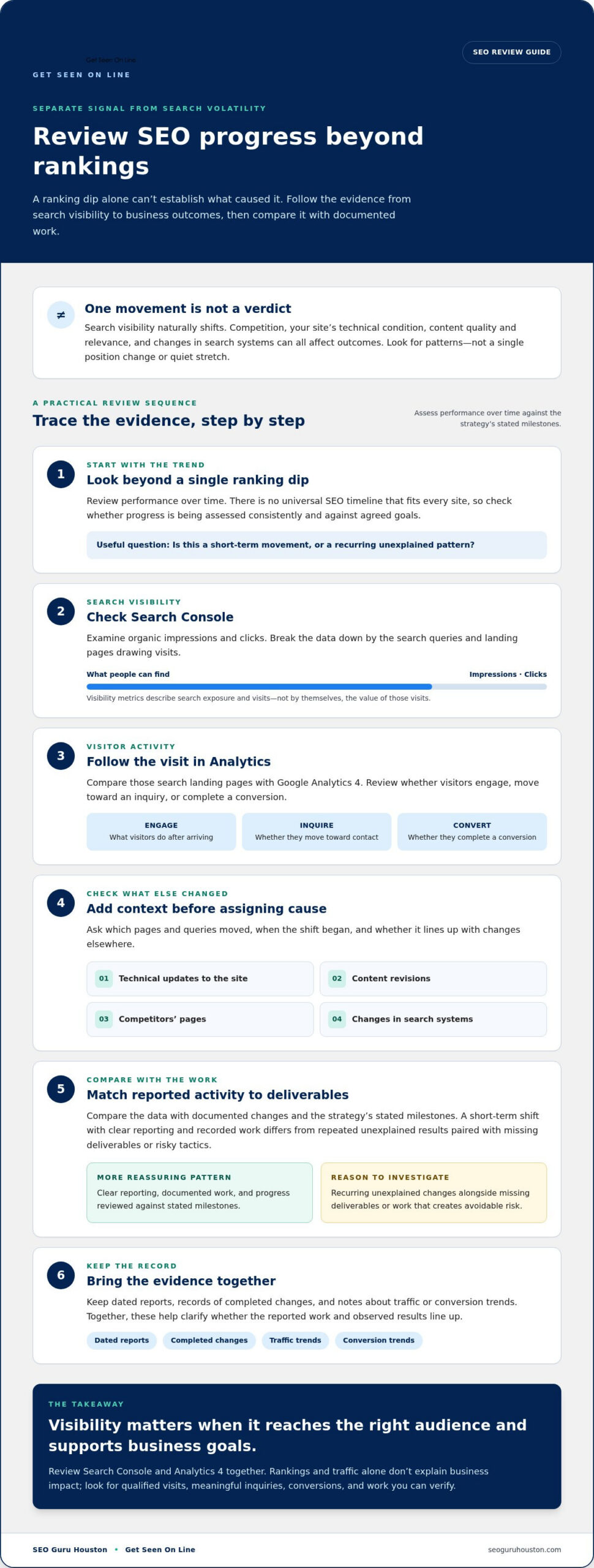
A ranking dip can feel like proof that something has gone wrong. But search visibility naturally shifts, and SEO outcomes depend on factors beyond an agency’s control, including competition, your site’s technical condition, and the quality and relevance of its content. One change in position, or a quiet stretch in traffic, can’t establish who or what caused it.

Look for a pattern instead. A short-term movement accompanied by clear reporting and documented work is different from recurring unexplained changes, risky tactics, or promised deliverables that never appear. Compare performance over time with the strategy’s stated milestones. There’s no universal timeline that fits every site, so focus on whether progress is being assessed consistently and the work is moving toward agreed goals.

Is a ranking drop proof your SEO company is failing?

No. Before drawing a conclusion, consider what else changed: a technical update, a content revision, shifts in competitors’ pages, or changes in search systems. Ask which pages and queries moved, when the shift began, and whether the change lines up with documented site or SEO work. The signs of a bad seo company are more persuasive when a pattern of unexplained results appears alongside missing deliverables or work that creates avoidable risk.

Keep evidence together: dated reports, records of completed changes, and notes about traffic or conversion trends. If you suspect deceptive or unfair business conduct rather than ordinary underperformance, the Federal Trade Commission (FTC) offers information about reporting such concerns in the United States.

Which SEO metrics reveal progress beyond rankings?

Use Google Search Console to examine organic impressions and clicks, including the queries and landing pages drawing search visits. Then compare those pages with Google Analytics 4 data to understand what visitors do after arriving: whether they engage, move toward an inquiry, or complete a conversion. Review these sources together, since neither rankings nor traffic alone explains the business impact.

Visibility metrics show whether people can find you; business-context metrics show whether that visibility is attracting the right audience and supporting growth. A rise in clicks to an irrelevant page may not help your goals, while a smaller stream of qualified visits can be valuable if it leads to meaningful inquiries. Assess trends alongside completed deliverables, and ask for a clear explanation when the data and reported work don’t line up.

If you’re reassessing your approach, explore how SEO strategy can support business goals by connecting search visibility with qualified traffic and conversions.

How to review an SEO company’s work, reports, and account access

Use a repeatable review, not a gut check. Start by confirming you can access the relevant accounts, then compare the SEO plan with its reports, completed tasks, and business outcomes. This makes it easier to identify gaps without assuming that a disappointing metric proves poor service.

  • Confirm access: Sign in to your business’s Google Search Console and Google Analytics 4 properties.
  • Define the goals: Identify the outcomes the strategy is meant to support, such as qualified organic visits, inquiries, or conversions.
  • Inspect the reports: Check the reporting period, metrics, findings, completed actions, and proposed next steps.
  • Match work to strategy: Compare reported tasks with visible content updates, site changes, and documented technical findings.
  • Assess outcomes: Consider trends in search visibility alongside landing-page performance and business results.

Google’s SEO Starter Guide provides context for claims about search fundamentals and practices. Use Google Search Central documentation to assess whether explanations align with published guidance, rather than accepting technical-sounding claims without evidence. Access to data makes a review possible, but it doesn’t prove the work is effective or appropriate. The signs of a bad seo company become clearer when access problems are part of a wider pattern of unclear work or unsubstantiated reporting.

What should an SEO report show?

A useful report identifies the period covered, the goals being tracked, work completed, findings, and next steps. It should explain changes in organic impressions and clicks in context, such as which landing pages gained or lost search visits and whether those visits led to measurable conversion actions. If lead quality can be assessed, include that context too. Rankings are one indicator, not the whole performance story.

Look for a clear connection between an action and its purpose. For example, a report that lists a page update should identify the page, summarize what changed, and explain what the team will monitor. If the report presents a metric without interpretation, ask how it relates to the strategy’s goals.

What account access and ownership should you review?

Confirm that your business can access its own Google Search Console and Google Analytics 4 properties. Also identify who controls the website, domain registration, tracking configuration, and other marketing accounts used in the work. Access arrangements can differ, but you should know who holds administrative control and how access can be maintained if the relationship changes.

Record missing access or unclear ownership before changing settings or removing users. Document which account is involved, who currently controls it, and what access you need. That creates a clear starting point for resolving the issue without disrupting tracking or site operations.

Signs of a Bad SEO Company: 9 Red Flags to Watch for in 2026

What to do when your SEO company shows these warning signs

Don’t make a major decision based on a vague concern. Build a clear record first, then use it to seek answers and decide whether the engagement can be corrected. Note the specific claim or issue, the date, the related report or message, any missing deliverable, and the account or access involved. Keep copies of reports and relevant site or campaign settings you can access.

Next, request a focused review meeting. Bring the agreed goals, documented work, and the evidence that raised concern. Ask for a plain-language explanation of what was completed, what remains, and how the next steps will address the issue. A credible corrective plan should name the root problem, assign actions, connect those actions to business goals, and set a review point. Vague reassurance isn’t a plan.

Prioritize account security and ownership. Confirm you can access your business accounts and understand who controls the website, domain, tracking, and marketing tools. Before removing access, changing technical settings, or ending the relationship, preserve records and make sure you won’t lose control of essential accounts or disrupt tracking. The signs of a bad seo company matter most when the company won’t address documented issues or repeatedly avoids accountability.

How should you raise concerns about SEO performance?

Keep the discussion specific and evidence-based. Instead of saying, “SEO isn’t working,” point to an agreed goal, a report period, a missing deliverable, or a change that needs explanation. Ask which completed actions support the strategy, what the current data suggests, and which priorities come next. After the meeting, write down commitments, owners, and review dates so you can assess progress against the same expectations.

When should you consider changing your SEO approach?

Consider a change if opacity continues, access concerns remain unresolved, or the work relies on tactics that conflict with Google Search guidance. Before a transition, preserve account access and document current site, tracking, and campaign settings. Avoid abrupt technical changes until you understand what they do and how they could affect search visibility. A careful handoff protects continuity while giving you a clearer basis for deciding what should change.

Ready to connect search visibility with qualified traffic and business goals? Explore SEO strategy and services to move toward a more focused growth plan.

What a trustworthy SEO partnership should deliver, and how to move forward

A strong SEO partnership doesn’t sell certainty. It gives you realistic expectations, a strategy you can understand, reporting that explains progress and setbacks, and communication that makes responsibilities clear. Most of all, its work connects to your audience and business goals, not just a list of completed tasks.

How can you recognize accountable SEO work?

Look for a plan that explains how technical improvements, content, and authority-building activities support your stated objectives. The right priorities depend on your site and audience, but each recommendation should have a clear purpose. Reporting should explain what the team decided, what changed, what the evidence suggests, and what comes next. If a result falls short, expect a reasoned explanation and an adjustment, not just another chart.

An accountable SEO partnership sets realistic expectations, explains its strategy, reports on evidence and outcomes, and takes responsibility for clear next steps. Use that standard alongside the warning signs you’ve reviewed. It helps distinguish a working relationship that needs better alignment from one that repeatedly avoids transparency.

How can SEO support broader business growth?

Search visibility can contribute to demand generation when it connects the right audience with useful pages designed to guide visitors toward a meaningful action. SEO can help people discover relevant content; a focused landing page can make the next step clear. Depending on your goals, PPC may complement organic search by supporting paid visibility. These channels should work toward shared business objectives, not operate as disconnected activity.

For more context on building search visibility, see Professional SEO Services: Dominating the 2026 Search Ecosystem. The broader relationship between search strategy and marketing goals is also explored in SEO MARKETING COMPANY: Dominate Search and Explode Your Revenue in 2026!

Choose a practical next step: define the outcomes that matter, review the evidence against them, and agree on a strategy with clear responsibilities and measurable priorities. If your current approach can’t meet that standard, use what you’ve documented to guide a more accountable growth plan.

Make your next SEO decision with confidence

The clearest signs of a bad seo company aren’t a single ranking dip or a slow month. Look for recurring patterns: promises presented as certainties, work you can’t verify, reports disconnected from business results, or restricted access to your own accounts. Review the evidence over time, and distinguish ordinary search movement from practices that deserve a closer look.

A stronger partnership gives you realistic expectations, an explainable strategy, transparent reporting, and clear next steps. Judge progress by more than rankings: consider whether SEO is attracting qualified visitors and supporting leads and conversions. When your goals call for it, SEO and PPC can work alongside website development and landing pages to support visibility and lead generation.

Start by defining the outcomes that matter, reviewing the work against those goals, and choosing a strategy you can understand and evaluate. Explore SEO strategies built around measurable business growth. Take control of your search strategy with evidence, clarity, and a focus on the customers you want to reach.

Frequently Asked Questions

What are the biggest signs of a bad SEO company?

Common signs of a bad seo company include guaranteed rankings, tactics the company refuses to explain, reports that don’t connect work to business goals, and restricted access to your accounts. Look for a recurring pattern rather than treating one missed update or ranking dip as proof. Ask for evidence of completed work, a clear explanation of the strategy, and reporting that relates search activity to qualified traffic, leads, or conversions.

Can an SEO company guarantee first-page Google rankings?

No company can control Google’s search results, so a guaranteed first-page position should make you cautious. A responsible SEO partner can set targets, explain the strategy, and track progress, but rankings depend on factors such as competition, your site, and search systems. Ask what actions support the target, how progress will be measured, and what the company will do if results differ from expectations.

How long should SEO take to show results?

There isn’t one reliable timeline for every SEO campaign. Progress depends on factors such as your site’s condition, competition, content, and the scope of the work. Rather than relying on a promised deadline, review the strategy’s stated milestones and evidence of completed tasks. Ask how progress will be evaluated over time, including search visibility, organic traffic, and meaningful outcomes like inquiries or conversions.

Is a sudden drop in rankings proof my SEO company did something wrong?

No. A single ranking drop doesn’t establish cause or responsibility. Technical changes, content updates, competitors, and search-system changes can all affect visibility. Review which pages and queries changed, when the shift began, and whether it aligns with documented work. Check Google Search Console for notifications about manual actions. A ranking change after a broad search update isn’t automatically a penalty; assess patterns, deliverables, and business outcomes before deciding what happened.

What should an SEO company include in its monthly report?

A useful report should identify the period covered, agreed goals, completed work, findings, and next steps. It should explain organic impressions and clicks in context, such as which landing pages changed and whether visitors took measurable actions. Rankings can provide useful context, but they shouldn’t stand alone. Look for clear reporting on qualified traffic, inquiries, or conversions where tracking allows, and ask for plain-language explanations of unexplained changes.

Should my business own its Google Search Console and Analytics accounts?

Yes. Your business should retain access to its Google Search Console and Google Analytics 4 properties so you can review search performance and website activity. Confirm that you can sign in and understand who has administrative access. Also clarify ownership and access for your website, domain, and tracking setup. An agency may help manage these accounts, but your ability to review the data shouldn’t depend on its reports alone.

What should I do if my SEO company refuses to explain its work?

Document the request, the response, relevant reports, and any missing deliverables. Ask for a plain-language summary of completed actions, their purpose, and the next priorities tied to your goals. Record commitments and review dates. If explanations remain vague or account access is restricted, preserve your records and confirm control of essential accounts before changing settings or ending access. Judge the response by whether it resolves the specific concern with verifiable evidence.

Technical SEO Audit Checklist: The Assertive Blueprint for Market Dominance in 2026

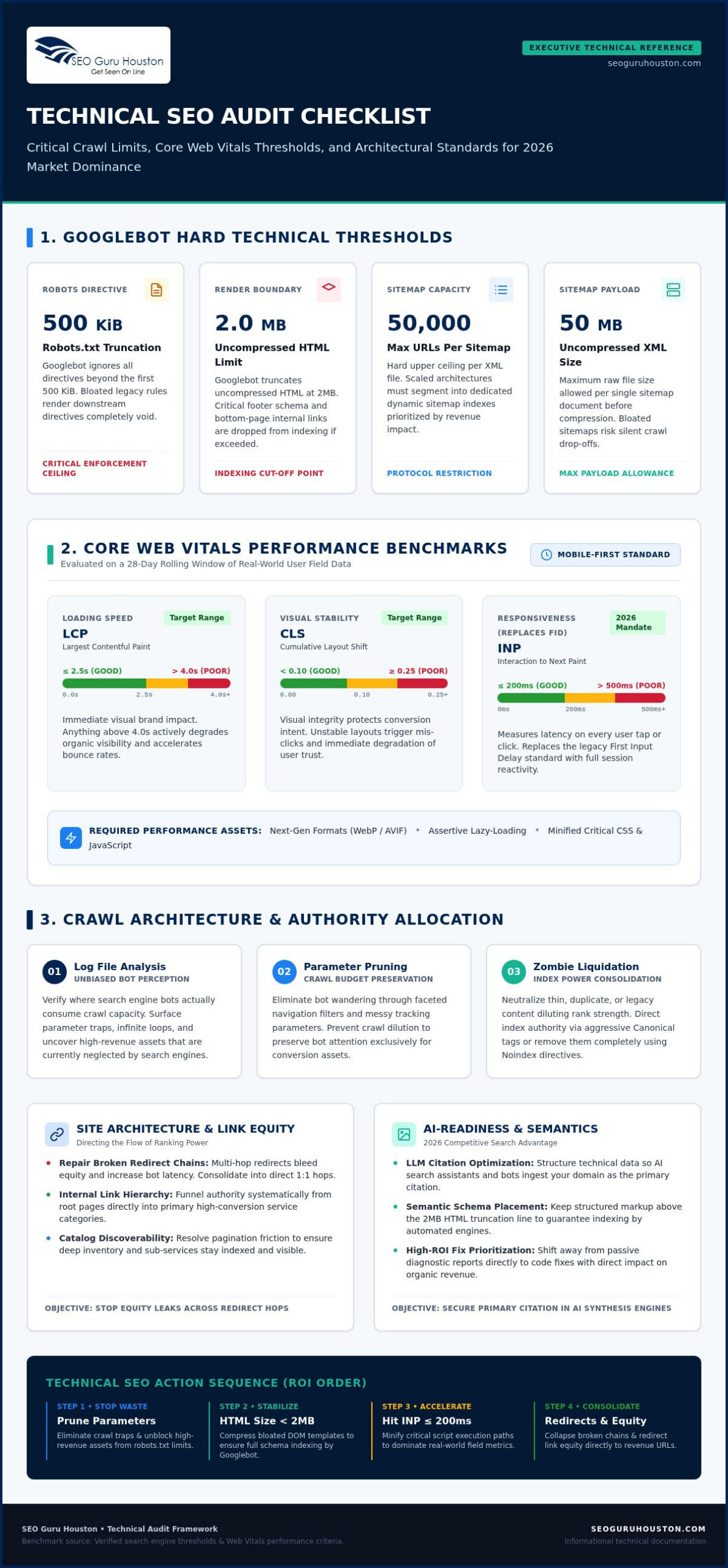
Is your website a high-performance revenue engine, or is it a silent liability bleeding profit every time a search engine attempts to crawl it? You’ve likely invested heavily in content and design, yet you remain invisible while competitors dominate the rankings. It’s a common reality; even the best content is useless if technical bottlenecks prevent search engines from indexing it properly. This technical seo audit checklist is the definitive solution for leaders tired of confusing jargon that doesn’t translate to actual business outcomes.

This is the end of the guesswork. You are about to gain an assertive blueprint for market dominance in 2026. We’re moving past basic fixes to tackle high-impact variables like Googlebot’s 2MB truncation threshold and the permanent shift to Interaction to Next Paint (INP) for responsiveness. You’ll receive a prioritized list of technical fixes designed to optimize your site for both human users and AI search engines. We are going to transform your digital presence from a passive brochure into a measurable, high-ROI growth machine that captures every available dollar of organic demand.

Key Takeaways

  • Master your crawl budget by using robots.txt to assertively direct search engines away from low-value pages and toward your high-conversion assets.
  • Treat site speed as a non-negotiable competitive advantage to ensure you aren’t gifting market share to faster competitors.
  • Eliminate revenue leaks by following this technical seo audit checklist to repair broken redirect chains and establish a logical, high-authority internal link hierarchy.
  • Secure your 2026 competitive edge by optimizing for LLM-readiness, ensuring your brand is the primary citation for AI search assistants and chatbots.
  • Shift from passive analysis to aggressive growth by prioritizing technical fixes that deliver the fastest measurable ROI and financial return.

The Foundation of Dominance: Crawlability and Indexing

Crawlability is the bedrock of your digital empire. If search engines can’t find your pages, your content is essentially non-existent. Every second a bot spends on a low-value page costs you money in lost opportunity. You must treat your crawl budget as a high-stakes investment. A successful strategy requires mastering search engine optimization fundamentals to ensure bots prioritize your high-conversion assets over digital clutter. This is the first pillar of any professional technical seo audit checklist intended for market leaders.

Your robots.txt file is a power play. It’s not a suggestion; it’s a directive. However, Googlebot ignores anything beyond the first 500 KiB of this file. If your file is bloated with legacy rules, you’re flying blind. Similarly, your XML sitemaps must move beyond basic lists. In 2026, dynamic sitemaps that prioritize high-revenue URLs are the standard for market dominance. Stick to the verified limits: 50,000 URLs and an uncompressed file size of 50MB per sitemap. Anything more is a waste of resources that search engines will simply ignore.

Crawl Budget Optimization for High-Traffic Sites

Stop letting search bots wander aimlessly through faceted navigation or messy tracking parameters. These traps dilute your authority and exhaust your crawl budget. You need to identify and prune these low-value parameters immediately. Leverage Log File Analysis to see exactly how search engines perceive your site. This data doesn’t lie. It reveals where bots are getting stuck and which high-revenue landing pages they’re ignoring. Your audit must prioritize frequent recrawling of pages that actually drive business growth.

Advanced Indexing Control and Canonicalization

Zombie pages are silent killers. These are thin, outdated, or duplicate pages that dilute your site’s ranking power and confuse search algorithms. Use Canonical tags as a weapon to consolidate link equity into your primary URLs. If a page doesn’t serve a clear business purpose, use Noindex directives to focus ranking power on your most important assets. Be aggressive with your uncompressed HTML size. Googlebot truncates content after the 2MB mark. If your code is bloated, your internal links and schema at the bottom of the page won’t be indexed. Solving pagination challenges ensures your full catalog of products and services remains discoverable and ready to rank.

The Speed of Money: Performance and Core Web Vitals

Speed isn’t just a technical metric; it’s a financial imperative. Every millisecond your site lingers during a load is an assertive gift to your competitors. If a user has to wait, they leave. It’s that simple. In the high-stakes environment of 2026, performance is the silent engine driving your conversion rates and organic visibility. A comprehensive technical seo audit checklist must prioritize speed as a non-negotiable foundation for market dominance.

Google’s judgment is based on the Google Core Web Vitals metrics and thresholds, which rely on a 28-day rolling window of real-world user data. You don’t get a pass because your local dev environment is fast. You need to dominate these field metrics to stay relevant. Mobile-first isn’t a trend anymore; it’s the only standard that matters. If your mobile performance isn’t flawless, you’re effectively invisible to a majority of your audience. High-converting Websites Dev & Landing Pages require a robust server-side environment to handle traffic surges without sacrificing speed.

Crushing Core Web Vitals Thresholds

Dominating user experience starts with meeting strict thresholds. Your Largest Contentful Paint (LCP) must be 2.5 seconds or less to ensure an instant brand impact. Anything over 4.0 seconds is considered poor and will tank your rankings. Cumulative Layout Shift (CLS) is about professional trust. Keep your score under 0.10 to prevent frustrating visual jumps that kill conversion rates. Finally, you must master Interaction to Next Paint (INP). With a target of 200 milliseconds or less, INP ensures your site feels high-energy and responsive to every click or tap. Audits still citing First Input Delay (FID) are obsolete; INP is the only responsiveness standard that counts today.

Advanced Performance Tactics for 2026

  • Next-Gen Assets: Use WebP or AVIF image formats combined with assertive lazy-loading to reduce initial payload without sacrificing visual quality.
  • Code Streamlining: Minify your critical CSS and JavaScript. Every unnecessary byte in the rendering path is a bottleneck that delays your time-to-interactive.
  • Edge Delivery: Utilize a high-performance Content Delivery Network (CDN) to ensure your site loads at lightning speeds nationally, regardless of the user’s distance from your primary server.

Your hosting environment is the silent engine of your success. Cheap, unoptimized hosting is a liability that no amount of front-end tweaking can fix. Professional execution ensures your infrastructure is built for growth, not just survival. If you’re ready to stop losing revenue to slow load times, it’s time to audit your stack against these 2026 standards.

Your site architecture is either a conduit for authority or a graveyard for link equity. If your structure is flat and disorganized, search engines can’t determine your true niche expertise. You need a logical hierarchy that directs power toward your high-value assets. This isn’t just about organization; it’s about establishing market dominance. A professional technical seo audit checklist must scrutinize how every internal link serves the bottom line and fuels growth.

Topical Authority through Strategic Siloing

Siloing is the assertive method of grouping related content to signal deep expertise. By creating thematic clusters, you help search engines understand your topical relevance. Use descriptive anchor text to reinforce this. Every link from a high-authority blog post should strategically point toward your high converting landing page design to maximize conversion potential. This ensures your most powerful backlinks fuel your most important service pages. Don’t let your link power dissipate across irrelevant pages.

Redirect Management and Site Hygiene

404 errors and broken redirect chains are revenue leaks. They frustrate users and signal neglect to search algorithms. Audit your 301 redirects to ensure they point to live, relevant content. Redirect loops are even worse. They exhaust your crawl budget and kill the user experience. Fix them immediately. Clean, keyword-rich URL paths are essential for both humans and bots. If a URL is messy, it’s a barrier to success. Regularly scan for broken outbound links to maintain professional site integrity.

Backlinks are expensive and difficult to acquire. Wasting that equity on low-value pages is a strategic failure. Your architecture should act as a funnel, concentrating authority where it generates the most ROI. If you aren’t auditing your link distribution monthly, you’re leaving money on the table. Dominance requires precision in how you direct the flow of digital power across your domain.

Technical SEO Audit Checklist: The Assertive Blueprint for Market Dominance in 2026

AI-Readiness and Content Semantics: The 2026 Competitive Edge

Keywords are no longer enough. To dominate in 2026, your website must function as a structured data source for both traditional algorithms and generative AI. This is where most brands fail. They focus on visible text while ignoring the semantic layer that search engines crave. An assertive technical seo audit checklist bridges this gap by turning your site into a recognized entity in the Knowledge Graph. If you aren’t optimizing for machine readability, you’re voluntarily handing your market share to competitors who are.

Advanced Schema Deployment

Schema markup is your direct line to the search engine’s brain. While many sites use basic JSON-LD, few deploy it with the precision required for market dominance. Focus on Organization, Product, and Service schema to establish your brand’s authority. You must stay current with recent deprecations; Google has pruned several rich result types, including How-To and most FAQ snippets. Don’t waste resources on dead schema. Instead, prioritize PriceSpecification and Author nodes to provide the granular data that fuels modern search results. Validating this structured data is essential. Even a single syntax error can render your entire schema block invisible to search bots.

Optimizing for AI Search and Discovery

AI search engines like SearchGPT and Perplexity don’t just crawl; they synthesize. If your content isn’t structured for easy extraction, these engines will ignore you. You must differentiate between training bots like GPTBot and citation bots like OAI-SearchBot. Blocking all AI agents is a strategic blunder. A recent cohort audit revealed that 41% of B2B websites inadvertently block AI search crawlers, resulting in a loss of up to 34% of potential citations in generative engines. Deploying an /llms.txt file at your domain root provides clean Markdown context that minimizes token waste and ensures your brand is the primary source for AI-generated summaries. This is a critical component of any 2026 technical seo audit checklist.

Success in this landscape requires a sophisticated blend of technical precision and strategic content mapping. You can’t afford to leave your AI visibility to chance. If you’re ready to secure your 2026 competitive edge, professional Digital Marketing and Lead Generation Services can ensure your brand remains at the forefront of this digital evolution. Stop guessing and start scaling with a strategy built for the future of search.

From Audit to Action: Implementing for Massive ROI

Data without decisive action is just expensive noise. Completing a technical seo audit checklist is only the first step; the real profit lies in the execution. Most businesses fail here because they treat technical fixes as a long-term “to-do” list rather than an urgent offensive strategy. If you aren’t prioritizing fixes based on their immediate impact on revenue, you’re wasting time. Market dominance requires a ruthless focus on the variables that move the needle today.

The 3-Tier Prioritization Framework

Success in 2026 demands a structured approach to implementation. You can’t fix everything at once, and you shouldn’t try. Use this framework to allocate your resources effectively:

  • Tier 1: Critical Blockers. These are the “fires” that stop search engines in their tracks. This includes resolving server errors, fixing indexation blocks, and securing your site against vulnerabilities. If bots can’t see you, nothing else matters.
  • Tier 2: Growth Drivers. Once the path is clear, focus on performance. This means crushing the Core Web Vitals thresholds we discussed earlier and refining your site architecture. These improvements directly correlate with higher conversion rates and better user retention.
  • Tier 3: Competitive Polish. This is where you pull ahead of the pack. Advanced schema deployment, entity optimization, and AI-readiness ensure you aren’t just ranking, but dominating the semantic search landscape.

Scaling Your Success with Expert Guidance

Technical SEO is high-stakes surgery, not a hobby for an internal IT generalist. One misconfigured line in a robots.txt file or a botched canonical tag can wipe out years of organic growth in hours. Professional execution is a fundamental necessity for business survival. A “guru” approach is required to navigate complex migrations and the nuances of the 28-day CrUX rolling window. You need a partner who measures success through leads and real revenue growth, not just abstract traffic numbers.

To achieve total search coverage, your technical foundation must be integrated with broader Professional SEO Services. This ensures your content and authority strategies are built on a rock-solid platform. For those ready for immediate market capture, pairing these fixes with PPC Management Services creates a dual-threat presence that leaves no revenue on the table. Stop guessing and start scaling. The blueprint is in your hands; now it’s time to lead.

Secure Your Market Dominance Before the Competition Wakes Up

Winning in the 2026 search ecosystem requires more than just good content; it demands a flawless technical foundation. You’ve seen how crawl budget optimization and AI-readiness separate market leaders from invisible entities. By following this technical seo audit checklist, you’re not just fixing errors. You’re building a high-performance revenue engine that captures every available lead.

We specialize in technical SEO and demand generation with a proven track record of scaling B2B and industrial brands. Our results-oriented approach is focused entirely on your measurable ROI. Don’t let invisible technical gaps bleed your marketing budget dry. It’s time to transform your site from a liability into your most powerful sales asset.

Stop Losing Revenue and Claim Your Market Dominance—Get Your Professional Audit Today!

The digital landscape moves fast, but with the right blueprint, you’ll move faster. Take decisive action now and watch your organic growth accelerate.

Frequently Asked Questions

What is a technical SEO audit and why does my business need one?

A technical SEO audit is a comprehensive evaluation of your website’s backend infrastructure. It identifies barriers that prevent search engines from crawling, indexing, and ranking your content. Your business needs this because even the best content is useless if it’s invisible. By identifying and fixing these deep-seated issues, you ensure your site functions as a high-performance revenue engine that captures every available lead in your market.

How often should I perform a comprehensive technical SEO audit?

You should perform a comprehensive audit at least once every quarter. Digital trends and search engine algorithms evolve at a breakneck pace. Regular checkups using a professional technical seo audit checklist allow you to catch silent errors before they sabotage your rankings. If you’re making frequent site updates or migrating content, monthly audits are a fundamental necessity for maintaining your competitive edge and market dominance.

Can technical SEO issues actually lead to a loss in revenue?

Yes, technical failures are direct revenue leaks. If your site takes too long to load or contains broken redirect chains, potential customers will bounce to a competitor. Search engines will also penalize your visibility, meaning your high-conversion landing pages never reach your target audience. You aren’t just losing rankings; you’re leaving actual dollars on the table by ignoring the backend health of your digital presence.

What are Core Web Vitals and why are they a non-negotiable in 2026?

Core Web Vitals are specific metrics Google uses to measure user experience, focusing on loading speed, interactivity, and visual stability. In 2026, these are non-negotiable because search engines prioritize sites that provide a seamless human experience. Failing to meet these thresholds, like the 200ms limit for Interaction to Next Paint (INP), tells Google your site is a liability, resulting in lower organic visibility and decreased trust from your visitors.

How long does it take to see results after fixing technical SEO issues?

You typically see measurable ROI within four to twelve weeks after implementation. While some performance improvements like faster load times provide an immediate boost to conversion rates, search engines require time to recrawl and re-evaluate your site. Consistency is key. Following a detailed technical seo audit checklist ensures that once these improvements take hold, your site is positioned for long-term growth rather than a temporary spike in traffic.

What is the difference between a technical audit and a content audit?

A technical audit examines the “pipes” of your website, such as crawlability, indexation, and server response codes. A content audit evaluates the quality, relevance, and engagement of the actual information on your pages. Think of it this way: the technical audit ensures the stage is built correctly, while the content audit ensures the performance is worth watching. You need both to establish yourself as a recognized authority.

Is a technical SEO audit necessary if I am already running PPC campaigns?

Absolutely. Technical SEO is the foundation for all other marketing, including PPC and demand generation. A technically sound website improves your landing page experience, which can lead to higher Quality Scores and lower costs per click. If your site is slow or broken, you’re essentially paying to send traffic to a dead end. Professional execution ensures your paid and organic strategies work together for maximum financial return.

Why should I hire a professional agency for a technical SEO audit?

Hiring a specialized agency provides the precision and “guru” level expertise required to navigate complex digital landscapes. Professional teams use advanced tools like Log File Analysis to see exactly how bots perceive your site. They identify subtle errors that an internal generalist might miss. This isn’t an optional luxury; it’s a strategic investment in professional execution that ensures no revenue is left on the table during your growth journey.

SEO Pricing Houston: The Assertive Guide to High-ROI Search Investments in 2026

Accepting a “budget” SEO quote isn’t just a missed opportunity; it’s a deliberate choice to let your competitors seize the market while your capital evaporates. You’ve likely been burned by agencies promising the world for a few hundred dollars, only to be left with stagnant traffic and zero revenue to show for it. It’s frustrating to look at a marketing budget and see a line item that doesn’t clearly correlate to your bottom line. You deserve better than vague promises and vanity metrics that don’t pay the bills.

This assertive guide eliminates the guesswork by providing a definitive framework for evaluating strategic SEO investments, addressing common search queries such as ‘seo pricing houston’, through the lens of high-performance demand generation. You’ll stop viewing search optimization as an optional overhead cost and start treating it as a precision-engineered investment in market dominance. We’re going to break down the 2026 national B2B pricing benchmarks and reveal the exact framework for calculating your search ROI. By the end of this article, you’ll have the confidence to choose a growth partner, like SEO Guru Houston, that prioritizes financial returns over empty reports.

Key Takeaways

  • Recognize why technical mastery and strategic vision are mandatory investments for business survival rather than optional luxuries.
  • Evaluate the effectiveness of monthly retainers versus performance models by using seo pricing houston as a benchmark for national standards.
  • Identify the warning signs of budget-driven SEO services that rely on automation and risk long-term manual penalties.
  • Calculate your true search ROI by shifting focus from vanity traffic metrics to concrete revenue per lead and customer acquisition costs.
  • Learn to distinguish between passive task-based vendors and assertive growth partners who prioritize your total market dominance.

Decoding the Cost Factors of Professional SEO Services

Professional SEO isn’t a line item you trim when times get tough. It’s the digital oxygen your business needs to breathe in a suffocatingly competitive market. In 2026, viewing search optimization as an optional luxury is a fast track to invisibility. When you evaluate seo pricing houston, you aren’t just paying for a checklist of tasks; you’re investing in an expertise premium that separates market leaders from also-rans. Technical mastery and strategic vision command higher fees because they deliver the only metric that actually matters: measurable revenue growth.

The cost of a high-ROI campaign is built on three non-negotiable pillars:

  • Comprehensive Technical Audits: Identifying the deep-seated infrastructure issues that prevent search engines from indexing your most valuable pages.
  • Content Authority: Developing sophisticated, industry-specific material that positions your brand as the definitive voice in your niche.
  • High-Quality Backlink Acquisition: Securing placements on authoritative domains to build the trust and “juice” required to outrank established competitors.

Modern search is a high-stakes competition for market dominance. If your strategy isn’t aggressive, it’s obsolete. You’re either gaining ground or losing it to a competitor who understands that search visibility is the most valuable real estate in the B2B world.

The Guru Methodology: Beyond Simple Keyword Rankings

Basic SEO often focuses on vanity metrics like “total keyword count,” but assertive professional SEO services demand a more rigorous approach. True demand generation requires a deep integration between your technical stack and your sales funnel. It’s not just about getting found; it’s about being found by the right people at the exact moment they’re ready to buy. Data-driven strategies justify professional price points by connecting every optimization effort to a specific business outcome. Don’t settle for a vendor who just blogs; choose a partner who engineers growth.

Technical Complexity vs. Content Depth in 2026

The rise of AI-integrated search and complex technical schema has fundamentally changed the labor requirements of a successful campaign. Standards for seo pricing houston reflect the need for developers and strategists who can navigate these shifting technical requirements without breaking your site’s performance. Simultaneously, B2B content has evolved beyond surface-level listicles. It now requires specialized industry knowledge to satisfy search engine algorithms that prioritize expertise, authoritativeness, and trustworthiness. Search Equity is the long-term financial value of organic visibility that compounds over time, providing a sustainable competitive advantage that no paid ad can match.

SEO Pricing Houston: Comparing Retainers, Projects, and Performance Models

Choosing a pricing model is a strategic decision that dictates your brand’s trajectory for the next fiscal year. Stop viewing marketing as a gamble and start seeing it as a tactical deployment of capital. There are three primary ways businesses invest in search: monthly retainers, project-based sprints, and performance-based models. When evaluating seo pricing houston, use it as a benchmark for national-scale B2B marketing standards. If a quote feels too low for a national reach, it probably is. Industrial growth doesn’t happen in a vacuum; it requires a budget that matches the intensity of your competition.

While the keyword might imply a regional focus, the standards for industrial and B2B growth are strictly national. You aren’t just competing with the shop down the street; you’re battling for market share against sophisticated players with deep pockets. To win, you must align your budget with your specific growth velocity and choose a structure that incentivizes long-term dominance over short-term survival.

Monthly Retainers for Market Dominance

The monthly retainer remains the gold standard for sustained market dominance. Why? Because search algorithms never stop evolving, and your competitors certainly won’t stop trying to outrank you. A high-performance retainer provides the consistent fuel needed for ongoing strategy, technical execution, and transparent reporting. National benchmarks for B2B and industrial sectors in 2026 show that serious players commit to multi-month cycles to capture exponential revenue growth. It’s about compounding interest; the work done in month three supports the massive gains seen in month twelve. This model ensures your site stays ahead of technical shifts while building the authority required to own your niche.

Project-Based Scaling for Rapid Growth

Project-based scaling is your catalyst for rapid growth when specific gaps exist in your sales funnel. If your site is technically sound but fails to convert, a high converting landing page design can provide an immediate boost to your lead volume. These one-time technical overhauls or content sprints serve as the foundation for a broader inbound marketing strategy for b2b. While projects offer quick wins and solve immediate bottlenecks, they often lack the long-term defensive posture of an ongoing partnership.

Performance-based models might sound attractive because they promise to share the risk. However, in the B2B world, this often leads to “lead inflation” where vendors chase low-quality traffic just to hit a quota. A true growth partner focuses on revenue, not just clicks. You need a model that incentivizes high-intent prospects and long-term market share over short-term vanity metrics that look good on paper but don’t impact your bank account.

Why Low-Cost SEO is a Fundamental Threat to Your Business Survival

If you’re still entertaining quotes for $500 a month, you aren’t shopping for a marketing partner; you’re shopping for a digital disaster. When evaluating seo pricing houston, understand that “cheap” is a relative term that often masks massive opportunity costs. An “affordable seo company” might save you a few thousand dollars in the short term, but it will cost you millions in lost revenue and eroded brand trust. Aggressive competitors don’t cut corners. They invest in dominance. If you want to win in a crowded B2B market, you have to play at the level of the leaders, not the laggards.

Assertive marketing is the only defense against a landscape filled with rivals hungry for your market share. Choosing a budget-tier vendor is effectively a decision to remain invisible. In 2026, search engines are sophisticated enough to identify and punish shortcuts instantly. You need a strategy that builds authority, not one that risks your entire domain for the sake of a low monthly bill.

The Hidden Cost of ‘Budget’ Agencies

Low-cost vendors survive on volume, not results. They often hide behind “black box” tactics, offering zero transparency into how your budget is actually being spent. This lack of accountability usually covers for a reliance on automated link-building or thin, AI-generated content that provides no value to your prospects. These poor strategies don’t just fail to move the needle; they can permanently damage your domain authority. Every dollar you think you’re saving on a budget agency is actually a dollar of market share handed directly to your competitors. In the high-stakes world of industrial commerce, “saved money” in SEO is almost always “lost market share.”

Recovering from Penalties and Poor Strategy

Cleaning up a “black hat” mess is significantly more expensive than building a foundation correctly the first time. Technical debt accumulates rapidly when an agency prioritizes speed over standards. Industry professionals report that it often takes three times longer to fix bad SEO than to implement a professional strategy from the start. Contrast this risky behavior with the reliability of a seasoned b2b demand generation agency. A professional partner focuses on building Search Equity that compounds over time, providing a sustainable competitive advantage rather than chasing temporary hacks that lead to manual penalties. Don’t let a “budget” choice turn into a long-term financial liability.

SEO Pricing Houston: The Assertive Guide to High-ROI Search Investments in 2026

Measuring Success: How to Calculate the Real ROI of Your Search Strategy

Stop obsessing over ranking reports. They are vanity metrics that often mask a failing strategy. If your agency is bragging about “Page 1” but your sales team is starving for leads, you have a conversion problem, not a visibility problem. True success is the transition from total invisibility to undeniable market prominence. When you evaluate seo pricing houston, your primary focus must be on revenue per lead and customer acquisition cost (CAC). This is the only way to treat marketing as a precision-engineered investment rather than a hopeful expense.

Validating your SEO ROI becomes much simpler when you leverage ppc management houston data. Paid search acts as a laboratory, revealing exactly which keywords drive high-intent prospects to your door. We use these insights to double down on organic strategies that target high-value revenue streams. It’s about moving beyond the “hope and pray” method of marketing and using cold, hard data to dictate your search strategy. Rankings don’t pay bills. Revenue does.

Beyond Rankings: Tracking Revenue and Lead Quality

Raw traffic volume is a distraction. In industrial B2B sectors, you might only need five high-value contracts a year to see a massive return. Tracking lead quality is mandatory. We insist on deep CRM integration to follow a prospect from their first search query to the final signature. This allows you to see the exact financial impact of your search visibility. If you can’t prove that a keyword resulted in a sale, that keyword isn’t worth your budget. High-performance seo pricing houston models always prioritize lead depth over click volume.

The Long-Term Value of Organic Authority

SEO offers the “Compounding Interest” of the digital world. While the cost-per-click of paid advertising continues to climb, the cost-per-lead from organic search typically drops as your domain gains authority. This authority creates a moat that competitors cannot simply buy their way over. In 2026, you should calculate the “Replacement Value” of your organic traffic. Ask yourself: what would it cost to buy this same volume of high-intent visitors through ads? The answer usually reveals that your organic presence is your most valuable business asset.

Benchmark your current ROI and start investing in search equity that actually grows your bottom line.

Strategic Demand Generation: Why Result-Oriented Partnerships Outperform Vendors

Stop hiring vendors who treat your business like a ticket in a support queue. In the high-stakes world of industrial B2B, a task-based approach is a recipe for stagnation. You need a results-oriented growth partner who views seo pricing houston as a tactical investment in market share rather than a monthly overhead cost. A vendor delivers a checklist of completed tasks; a partner delivers a predictable pipeline of high-value leads. This distinction is the difference between barely surviving and absolute market dominance.

Integrated services are no longer an optional luxury for those wanting to win. Your search strategy must be supported by high-performance web development, video marketing, and a professional social media presence. If your search visibility isn’t backed by a technical infrastructure that converts, you’re effectively paying to send leads to your competitors. Bridging the gap in your current strategy requires decisive action and a partner who understands the entire demand generation ecosystem. You don’t need a cheerleader; you need a coach who demands results and provides the technical roadmap to reach them.

To dominate your market through integrated funnels, you can discover Populis Digital and their expertise in web design and conversion-focused strategies for SMEs.

Integrated PPC and SEO for Maximum Visibility

A unified digital strategy reduces your overall marketing spend by eliminating data silos and redundant efforts. When your paid and organic teams share insights, you gain total visibility into the search landscape. This synergy allows you to dominate the top of the search results while simultaneously building long-term organic equity. This comprehensive approach extends to specialized platforms, as explored in our amazon marketing services houston guide. High-performance agencies manage the entire funnel, ensuring that every touchpoint from the first search query to the final sale is optimized for maximum financial impact.

Scaling Your B2B Funnel with Assertive Inbound

Moving from “getting found” to “capturing demand” requires professional web design that speaks the language of your specific industry. Website video marketing is a critical component of this transition; it increases conversion rates by building immediate authority and trust with technical buyers. This higher conversion rate justifies premium seo pricing houston because the traffic you generate actually results in closed contracts. It’s time to stop guessing about your marketing budget and start investing in a strategy that scales. We act as the high-performance coach for your market transformation, leading the charge from digital invisibility to industry prominence.

Seize Your Market Dominance in 2026

You now have the definitive framework to stop guessing and start investing with precision. We’ve decoded why technical mastery and strategic vision are non-negotiable for business survival in a high-stakes digital economy. You understand that real ROI isn’t found in vanity rankings; it’s found in the compounding interest of organic authority and high-quality B2B lead generation. Navigating seo pricing houston requires a permanent shift from a cost-cutting mindset to an assertive, results-driven strategy that prioritizes your bottom line over empty reports.

Don’t let your competitors own the digital real estate that rightfully belongs to your brand. Our high-energy methodology combines deep expertise in technical SEO, PPC, and Demand Generation with a track record of proven results in industrial sectors. It’s time to bridge the gap between your current standing and the market prominence you deserve. Stop losing revenue and start scaling; get your assertive growth strategy now! Your transformation from invisible to prominent starts with a single decisive step. Let’s build your moat today.

Frequently Asked Questions

How much does professional SEO cost in 2026?

Professional SEO costs reflect the depth of technical expertise and market competitiveness required for B2B dominance. While rates vary based on industry complexity, you should expect to pay for a strategy that integrates technical audits, high-authority content, and aggressive demand generation. Avoid budget vendors who prioritize volume over value. Investing in a seasoned veteran ensures your capital builds long-term authority rather than evaporating on ineffective shortcuts.

Is it worth paying for a monthly SEO retainer?

A monthly retainer is the only way to build the compounding Search Equity needed to outpace aggressive competitors. Search algorithms and competitor tactics evolve daily, so a sustained commitment ensures your site remains technically sound and authoritative. This model provides the consistent fuel required for long-term market dominance rather than temporary spikes. It turns a one-time expense into a recurring engine for high-quality industrial lead generation.

Why is there such a huge difference in SEO pricing between agencies?

The price gap usually reflects the difference between task-based vendors and results-oriented growth partners. Low-cost agencies often rely on automated tools and generic templates that risk manual penalties and brand erosion. Premium partners charge for strategic vision, industrial expertise, and the technical integration of SEO with web development and video marketing. You’re paying for a coach who understands the nuances of your specific commercial landscape.

Can I get results with a small business SEO package?

Small business packages often fail to meet the intensity required for competitive B2B or industrial sectors. If your goal is national market share, a starter package won’t provide the aggressive technical optimization or authority building needed to win. You need a strategy scaled to your specific growth ambitions, not a one-size-fits-all checklist. Choosing a budget tier is effectively a decision to remain invisible to high-value prospects.

How long does it take to see a return on investment from SEO?

Most high-performance campaigns begin showing measurable progress in lead quality and organic authority within three to six months. However, the true ROI of seo pricing houston is found in the long-term compounding of your search equity. By month twelve, the decreasing cost-per-lead often creates a sustainable competitive moat that paid advertising cannot match. SEO is a marathon that rewards those who maintain an assertive defensive posture.

What is the difference between SEO and demand generation pricing?

SEO pricing typically focuses on organic visibility, while demand generation pricing covers the entire funnel from awareness to conversion. Demand generation is more comprehensive, often integrating Houston PPC services, video marketing, and high-converting landing pages. You pay for the infrastructure that captures and converts search traffic into measurable revenue. It’s about engineering a system that feeds your sales team high-intent prospects every single day.

Should I choose an affordable SEO company or a high-ROI growth partner?

You should always choose a high-ROI growth partner if you are serious about business survival and market dominance. An “affordable” company often results in lost market share and technical debt that takes years to fix. A growth partner acts as a high-performance coach, focusing on metrics like revenue per lead and customer acquisition cost. They ensure every dollar invested contributes directly to your prominence and financial growth.

What should be included in a standard B2B SEO contract?

A professional B2B contract must include technical audits, strategic content roadmaps, and transparent reporting on revenue-focused KPIs. It should also outline the scope for seo pricing houston regarding on-page optimization, backlink acquisition, and ongoing technical maintenance. Ensure the agreement prioritizes your business outcomes over simple task completion. This accountability ensures your partner is as committed to your bottom line as you are.

Local SEO Houston: The Assertive Blueprint for Market Dominance in 2026

Local SEO Houston: The Assertive Blueprint for Market Dominance in 2026

If your business isn’t firmly planted in the top three results of the Google Map Pack, you’re handing 42% of your potential market share directly to your competitors. Dominating local seo houston isn’t a vanity project; it’s the difference between a thriving enterprise and a stagnant one. You’ve likely felt the sting of rising ad costs while your organic presence remains buried on page two. It’s frustrating to see less-qualified businesses capture the high-quality lead flow that should be yours.

We’re here to change that trajectory immediately. This guide provides the assertive blueprint you need to turn digital proximity into predictable revenue. You’ll learn how to conquer the 2026 algorithm environment, where core updates now hit every three months. We’ll break down the technical shifts in hyperlocal targeting and AI-powered search agents that will transform your Google Business Profile into a dominant, scalable growth engine.

Key Takeaways

  • Capture high-intent traffic by treating local search as a strategic offensive rather than a passive directory listing.
  • Master the 2026 Map Pack using sentiment analysis and review velocity as your primary ranking signals over traditional backlinks.
  • Secure a faster ROI by focusing on local seo houston tactics that target neighborhood-specific intent instead of broad national keywords.
  • Eliminate leaky conversion funnels by implementing localized schema markup and high-performance service-area pages.
  • Transform your digital presence from an optional luxury into a high-performance growth engine built for total market dominance.

What is Local SEO Houston? Defining Your Market Territory

Stop thinking of SEO as a passive directory listing. In a city as competitive as Houston, local SEO is a strategic offensive. It’s a calculated strike to capture high-intent traffic before your competitor even wakes up. Proximity has evolved into the number one conversion factor for modern consumers. If you aren’t the closest, most authoritative option on their screen, you simply don’t exist. You need to dominate the map to survive. Winning the battle for local seo houston requires more than just a pulse; it requires an assertive blueprint for dominance.

Many agencies will sell you vanity rankings on keywords that don’t drive a dime in profit. We focus on revenue-generating visibility. This requires a precise orchestration of three core pillars. First, a 100% optimized Google Business Profile. Second, aggressive on-page signals like localized H1s and schema. Third, a rock-solid citation network that confirms your legitimacy across the web. To understand the technical foundation, one should look at What is Local SEO and how it differs from traditional organic search. Effective local seo houston isn’t a set-it-and-forget-it task; it’s a relentless pursuit of the top spot.

The Psychology of the “Near Me” Searcher

Local searchers aren’t just browsing. They’re hunting. When someone searches for a service “near me,” they’ve already bypassed the traditional awareness funnel. They don’t want to read a blog post about why they need a service; they have a problem that needs an immediate solution. This urgency makes them significantly more likely to convert than someone performing a broad national search. They want a phone number, an address, and a reason to trust you right now. In this high-stakes environment, being ranked at number four is the same as being invisible. You’re either in the spotlight or you’re in the dark. There is no middle ground in a winner-take-all market.

Proximity vs. Authority: The Local Ranking Balance

Google’s algorithm is a high-speed balancing act between physical distance and brand power. While you can’t change your office’s GPS coordinates, you can amplify your authority so Google expands your ranking radius. This is how you win. The Local Pack captures approximately 85% of all local search traffic. If you aren’t dominating that space, you’re fighting for the scraps on page two. True digital dominance means owning every high-value search within your service radius. It requires a scalable digital growth engine that forces competitors to play catch-up while you secure predictable revenue. You must build a brand that Google trusts enough to show to users ten miles away, not just two blocks away.

Dominating the Local Map Pack: The 2026 Power Moves

Your Google Business Profile (GBP) is no longer just a digital business card; it’s your most aggressive sales tool. If your profile isn’t 100% optimized, you’re leaving the door wide open for competitors to steal your market share. In 2026, a basic profile is a liability. Dominating local seo houston requires a profile that is meticulously detailed, from specific service categories to high-resolution, geotagged media. Google uses these signals to verify that you aren’t just a business in the city, but an active authority in specific neighborhoods like River Oaks or Sugar Land.

Winning at local seo houston means understanding that review velocity and sentiment analysis are the new ‘backlinks’ for local search. Google’s AI doesn’t just count your stars anymore. It parses the language of your reviews to measure service quality and technical expertise. High-performance businesses prioritize a consistent stream of fresh, keyword-rich testimonials. This isn’t a luxury. It’s a fundamental necessity for business survival in a crowded digital marketplace.

Review Management as a Competitive Weapon

Stop settling for generic ‘great job’ comments. You need authoritative testimonials that mention specific services and Houston-based locations. Responding to every review, both positive and negative, signals a high level of brand activity to Google’s algorithm. This social proof is critical in the modern customer journey, which often involves up to 150 digital touches before a conversion occurs. If you want to see how these pieces fit into a broader local SEO strategy, you must view reviews as a dynamic asset, not a static score.

Citations and NAP Consistency: The Trust Factor

Trust is the invisible force behind every high-ranking profile. Name, Address, and Phone Number (NAP) consistency is absolutely non-negotiable. Even a slight variation in your business name creates friction in Google’s ‘trust graph.’ Authoritative local directories act as digital witnesses that verify your identity. Beware of ‘ghost listings’ or outdated data from past office moves; they act as anchors that drag down your visibility. Clean data is the prerequisite for scaling. If you’re ready to audit your current standing, our team at Houston SEO services can identify the gaps in your digital foundation.

Use local posts and geotagged video to prove your regional relevance in real-time. Uploading video content of your team on-site in Houston provides the undeniable proof Google’s AI craves. Local posts shouldn’t just be announcements. They should be high-impact ‘touches’ that drive immediate engagement. Treat your GBP as a living, breathing sales engine that never stops closing deals.

Local vs. National SEO: Which Battlefield Are You On?

Winning at digital marketing requires you to choose your battles wisely. Many businesses waste thousands chasing national rankings for broad terms, only to find themselves drowned out by massive conglomerates with bottomless budgets. National SEO is a war of attrition; local seo houston is a tactical strike. While national campaigns focus on general awareness and informational intent, local strategies target the users who are ready to swipe their cards right now. You don’t need to rank for ‘marketing’ in New York if your revenue comes from Houston. You need to own your backyard first.

The technical divide between these two battlefields is stark:

  • Keyword Intent: National is often informational; local is purely transactional.
  • Competition: National is global; local is limited to your specific service radius.
  • ROI Velocity: Local typically converts significantly faster due to the proximity factor.
  • Ranking Signals: National relies heavily on broad backlinks; local relies on GBP and review sentiment.

The ROI on local search is almost always faster because you’re competing against a finite number of players in a specific geography. Even if you’re a multi-location brand or a national entity, you cannot afford to ignore the local battlefield. Large corporations often make the mistake of thinking local SEO is ‘small time,’ yet they lose millions to agile local competitors who understand neighborhood-level intent. A hybrid approach, where you leverage national authority to boost specific local landing pages, is the ultimate power move for market dominance.

Intent Mapping: Why “Local” is a Buying Signal

National keywords are often plagued by informational intent. People searching for ‘how to do SEO’ are looking for a DIY guide, not a partner. They’re tire kickers. In contrast, local search terms are inherently transactional. When someone searches for a service in their immediate area, they’ve already decided to buy; they’re just deciding who to buy from. This filters out the noise and delivers high-quality lead flow directly to your doorstep. For brands that require a more expansive reach across multiple markets, our Professional SEO Services provide the technical infrastructure to scale beyond city limits without losing that surgical precision.

The Cost of Invisibility in Your Own Market

Allowing a competitor to sit in the top spot of the local pack is a direct tax on your business. Every day you aren’t visible is a day you’re funding your rival’s growth. Defending your territory isn’t optional; it’s a fundamental necessity for survival. By dominating local seo houston, you create a scalable digital growth engine that funds your future expansion. You must implement proven local marketing strategies from the SBA to ensure your brand remains the undisputed authority. Once you’ve secured your home base, national expansion becomes a logical next step rather than a risky gamble. Don’t let your competitors build a fortress while you’re still debating the battlefield.

Local SEO Houston: The Assertive Blueprint for Market Dominance in 2026

The Local SEO Implementation Checklist for Rapid Scaling

Theory alone won’t pay the bills. You need a rigorous, technical execution plan to turn digital proximity into predictable revenue. Most businesses fail because they ignore the leaky funnels in their local visibility. If your website isn’t optimized for the 150 digital touches a modern consumer requires before buying, you’re essentially handing leads to your competitors on a silver platter. Dominating local seo houston starts with a brutal audit of your current standing. Are you visible where it matters, or are you just taking up space?

Your on-page strategy must go beyond basic keyword stuffing. Localized H1 tags and dedicated service-area pages are the bare minimum for 2026. Technical SEO is equally critical. Google’s mobile-first indexing means your site must be lightning-fast for on-the-go searchers in Houston. If a potential client in Montrose can’t load your site in under two seconds, they’re gone. You need a site that captures attention and forces immediate action. This isn’t just about rankings; it’s about building a scalable digital growth engine.

Schema Markup: Speaking Google’s Language

If you want Google to trust your data, you must speak its language. LocalBusiness Schema is the secret sauce for market dominance in 2026. This structured data removes all ambiguity regarding your service area, operating hours, and specific offerings. It tells the algorithm exactly who you are and where you operate. JSON-LD is the gold standard for local data and ensures your business information is parsed correctly by AI-powered search agents. Implementing this technical layer allows you to bypass competitors who are still relying on outdated, plain-text signals. It’s about precision, authority, and technical superiority.

High-Converting Landing Pages for Local Traffic

Your homepage is often too broad to convert a high-intent local searcher. You need dedicated service-area landing pages that speak directly to the needs of specific Houston neighborhoods. To build instant trust, integrate video marketing for business websites into these pages. Video provides the undeniable proof of expertise that text cannot match. The Guru approach to conversion is simple: make it frictionless. Place your CTAs where they’re impossible to miss and ensure they cater to the urgent searcher who needs a solution right now. If you’re ready to stop guessing and start growing, our Houston SEO services can build the high-performance engine your business deserves.

The SEO Guru Advantage: Why Assertive Local Marketing Wins

Stop treating SEO as a line-item expense or an optional luxury. If your strategy isn’t a high-performance growth engine, it’s a liability. Most agencies are passive; they provide reports filled with green arrows and vanity metrics that don’t actually impact your bank account. We operate differently. We are high-performance coaches who focus exclusively on the bottom line. Dominating local seo houston requires an assertive partner who moves beyond technical checklists to execute a comprehensive market land-grab.

Our methodology integrates Houston SEO Services with Houston PPC Services and aggressive demand generation to create total market saturation. We don’t just wait for customers to find you; we engineer the digital environment so they have no other choice. This holistic approach ensures that every dollar spent on local seo houston contributes to a scalable digital growth engine. We don’t just report on the weather; we change the climate of your industry. If you want to win, you have to stop playing defense and start taking territory.

Beyond Rankings: Driving Real Business Outcomes

A number one ranking is worthless if it doesn’t produce a high-quality lead. We bridge the gap between visibility and revenue by integrating B2B demand generation with surgical local targeting. This strategy ensures that your brand isn’t just seen, but sought after by ready-to-buy decision-makers. It’s time to move from digital invisibility to absolute prominence. You need a partner who understands that local search is just one piece of a much larger, high-impact revenue machine. We don’t settle for “participation trophies” in the search results; we settle for market dominance.

Decisive Action: Your Next Steps to Dominance

The window for easy local dominance is closing fast as more businesses wake up to the reality of the 2026 algorithm shifts. Your competitors are already trying to cement their authority in the Map Pack. Are you going to let them? You need to evaluate your current agency with total honesty. Ask yourself these critical questions:

  • Do they prioritize your bottom-line revenue over vanity rankings?
  • Are they integrating multi-channel strategies like PPC and demand gen to support your local presence?
  • Do they provide proactive execution or just reactive, monthly reporting?

If they aren’t pushing you to dominate, they’re holding you back. Success in the Houston market favors the bold and the decisive. You’ve seen the blueprint and you know the stakes. The only thing left is to take action before your service radius is claimed by someone else. Stop losing revenue and start dominating your market today.

Claim Your Digital Territory Today

The blueprint for market dominance is clear. You can no longer afford to be a passive participant in the digital landscape. By mastering local seo houston, you move from invisibility to absolute prominence; you capture high-intent leads before your competitors even know they’ve lost. You’ve seen how technical precision in schema markup and high-conversion landing page design creates a scalable digital growth engine. You’ve understood why proximity is now the ultimate conversion factor for modern consumers.

Since 2017, we’ve delivered proven B2B results by integrating advanced video marketing with surgical local search strategies. We don’t just report on metrics; we execute a calculated land-grab for the most valuable real estate in your market. Your revenue depends on your visibility in the top three results. Don’t wait for another algorithm update to bury your business further. It’s time to stop playing defense and start taking territory.

Ready to Dominate Your Local Market? Get Your Assertive Growth Strategy Now!

The market is waiting for a leader. It’s time you took your place at the top and turned proximity into predictable revenue today.

Frequently Asked Questions

How long does it take to see results from local SEO?

Significant visibility shifts typically manifest within three to six months of consistent execution. While minor technical optimizations can trigger quick wins in the first 90 days, true market dominance requires a sustained effort to build authority. This timeline allows Google to verify your business data and measure user engagement signals. If you want a predictable revenue stream, you must commit to a long-term strategic offensive.

What is the most important factor for ranking in the Google Map Pack?

Proximity remains the primary signal, but your Google Business Profile optimization is the factor you can actually control. Google balances how close you are to the searcher with how relevant and prominent your brand appears online. By maximizing your profile’s detail and generating high-velocity reviews, you force the algorithm to prioritize your business over competitors who might be physically closer but digitally weaker.

Can I do local SEO myself or do I need a professional agency?

Managing your own local seo houston strategy is possible but rarely scalable for ambitious businesses hungry for growth. Google now updates its core algorithm approximately every three months, requiring constant technical adjustments that most business owners simply don’t have time to master. Hiring a professional agency transforms SEO from a time-consuming chore into a high-performance growth engine. It’s the difference between merely participating in the market and actually winning it.

What is the difference between local SEO and organic SEO?

Local SEO targets the ‘Map Pack’ and searches with specific geographical intent, while organic SEO focuses on the standard blue link results. Local strategies are built around your physical location and service area to capture ready-to-buy leads in your backyard. Organic SEO is broader and often informational, aiming for national or global reach. You need a coordinated strike across both battlefields to own the entire search engine results page.

How much does professional local SEO cost in 2026?

Investment levels vary based on your industry’s competitiveness and the number of locations you need to dominate. Rather than looking for the cheapest price, you should evaluate the potential return on investment and the quality of the lead flow generated. High-impact strategies require a budget that supports aggressive content creation, technical optimization, and proactive review management. Treat this as a fundamental business necessity for survival rather than an optional expense.

Do I need a physical office address to rank for local SEO?

You need a verifiable physical presence within your target market to claim and maintain a Google Business Profile. While service-area businesses can hide their exact street address, having a legitimate local footprint is critical for building a ‘trust graph’ with Google. Virtual offices and P.O. boxes are frequently flagged and suspended by the algorithm. If you want to rank in Houston, you must prove you are an active part of the local commerce landscape.

How do online reviews affect my local search rankings?

Reviews are the lifeblood of local authority and act as the new digital backlinks in 2026. Google’s AI parses review sentiment and keyword usage to determine if you are a reliable expert in your specific field. High review velocity and consistent engagement show the algorithm that your business is active and trusted by the community. A stagnant review profile is a clear signal of a dying brand that Google will eventually stop recommending.

What is NAP consistency and why does it matter for my business?

NAP stands for Name, Address, and Phone Number, and its consistency across the web is non-negotiable for ranking. Discrepancies in this data create friction in Google’s ability to verify your business identity, which directly suppresses your visibility. Even small variations in your business name can damage your local authority and confuse potential customers. Maintaining a clean, unified data profile ensures that search engines and ready-to-buy leads can find you without hesitation.

SEO MARKETING COMPANY: Dominate Search and Explode Your Revenue in 2026!

SEO MARKETING COMPANY: Dominate Search and Explode Your Revenue in 2026!

53% of all website traffic still comes from organic search, but if you aren’t visible in the top spots, you’re losing money every single second!! The digital landscape has shifted. With Google’s AI Overviews now appearing in over 25% of searches, the old tactics are dead. You need an aggressive seo marketing company that understands how to turn your website into a high-velocity lead generation engine.

It’s exhausting to deal with high bounce rates and low-quality traffic that never converts. You know your business deserves the top spot, but the constant algorithm updates feel like a moving target. We get it. This article shows you exactly how to secure dominant search visibility and a predictable lead flow that survives any AI update. We’re diving into the exact roadmap to achieve an 8x ROI and build a future-proof strategy for 2026. If you want to explode your revenue and leave competitors in the dust, then this is the blueprint you’ve been waiting for. It is time to stop guessing and start winning.

Key Takeaways

  • Learn why shifting from “ranking for words” to total market share dominance is the only way to win in 2026!!
  • Discover the 4 pillars of a high-velocity strategy that turn your website into a high-octane lead generation engine.
  • Master the balance between SEO, PPC, and inbound marketing to maximize your ROI and build long-term equity.
  • Use our “Guru Checklist” to vet a results-driven seo marketing company and avoid the trap of low-value, “cheap” services.
  • Future-proof your digital presence against aggressive AI search changes and ensure your visibility remains dominant.

What is an SEO Marketing Company? Beyond the Keywords!

Stop chasing vanity metrics. Start building a cash machine. If your current agency only talks about “meta tags” and “backlinks,” you aren’t working with a growth partner. You’re working with a technician. A true seo marketing company functions as a high-octane engine for your bottom line. We don’t just optimize for algorithms; we optimize for humans who have credit cards in their hands!!

The game has changed. Ranking for a random word is a vanity project. Dominating market share is a business strategy. Traditional Search engine optimization (SEO) was about visibility, but in 2026, it’s about authority. This shift requires three non-negotiable pillars:

  • Technical Excellence: The high-velocity infrastructure that ensures search engines can crawl, index, and understand your site without friction.
  • Content Authority: High-impact messaging that proves you’re the undisputed leader in your industry.
  • Conversion Logic: The psychological architecture that turns organic traffic into high-quality leads.

Why is a “marketing-first” focus superior to a “technical-only” approach? Because traffic without a conversion strategy is a wasted investment. If you don’t connect your search visibility to a structured sales funnel, you’re leaving money on the table for your competitors to grab. A results-driven seo marketing company bridges the gap between being “found” and being “hired.”

The Revenue Engine Philosophy

Your website shouldn’t be a digital brochure; it must be a revenue engine. SEO feeds every stage of the sales funnel. It builds awareness for cold prospects, provides technical proof for those in the consideration phase, and creates the trust needed to close the deal. This builds long-term brand equity. When you own the top search results, you own the market’s trust. It’s that simple.

SEO in the Age of AI and GEO

Welcome to the era of Generative Engine Optimization (GEO). With AI Overviews now appearing in over 25% of searches as of June 2026, traditional tactics are dead. You need a strategy that optimizes for AI-driven answers, not just standard blue links. An expert company ensures your brand is the one the AI cites as the primary source. If you aren’t prepared for this shift, your organic visibility will vanish. Don’t let your brand become invisible!!

The 4 Pillars of a High-Velocity SEO Strategy

High-speed execution. Zero fluff. If you want to dominate the market, your strategy must be built on four unbreakable pillars. Most agencies treat these as separate tasks, but a results-driven seo marketing company knows they function as a single, high-octane engine. If one part fails, the whole machine stalls. You aren’t just looking for clicks; you’re looking for market dominance!!

  • Technical SEO: This is your engine. It ensures search engines can crawl, index, and understand your site without hitting a wall.
  • On-Page Optimization: This is your salesperson. It wins the click by aligning your content with exactly what the user is searching for.
  • Authority Building: This is your reputation. Research shows the top-ranking result on Google has, on average, 3.8 times more backlinks than those in lower positions. Trust is earned through high-quality profiles.
  • User Experience (UX): This is your closer. It keeps visitors on your site and guides them toward a conversion before they have a chance to bounce to a competitor.

Strong search engine optimization (SEO) is built on a foundation that prioritizes the user’s journey from the first click to the final sale. If you’re ready to see how these pillars apply to your specific niche, it’s time to partner with an expert seo marketing company that prioritizes your bottom line.

Technical SEO Audit: Fix the Errors NOW!

Speed is a ranking factor. Period. Core Web Vitals aren’t just technical jargon; they’re the pulse of your website’s health. With mobile devices accounting for over 62% of global web traffic, mobile-first indexing dictates your search success. If your site doesn’t load instantly on a smartphone, you’re invisible. You need to identify and crush crawl errors, broken links, and slow-loading assets immediately to stay competitive, often utilizing professional care plans from purplecow.digital to maintain peak performance.

Content Architecture that CRUSHES Goals

Stop writing for robots. Write for the humans who sign the checks. We use a “Guru” approach to keyword mapping that focuses on topic clusters rather than isolated terms. This builds topical authority that AI search engines love. In the B2B world, your content must address specific pain points and offer concrete solutions. Features are fine, but benefits and ROI are what actually move the needle. Topic clusters prove your expertise and keep users engaged across multiple pages, increasing the likelihood of a high-quality lead. It’s about depth, not just breadth.

SEO vs. PPC vs. Inbound: Which Strategy Wins?

Stop wasting your budget on fragmented tactics. If you want to dominate your market, you need to understand the difference between renting traffic and owning it. Many business owners get caught in a trap, thinking they have to choose between SEO, PPC, or Inbound marketing. A high-octane seo marketing company knows that the real magic happens when you integrate these channels into a single, high-velocity growth engine. You don’t just want clicks; you want a 14.6% close rate, which is what search leads deliver compared to a measly 1.7% for outbound leads!!

SEO is your long-term equity play. It builds a foundation that competitors can’t simply buy their way past. PPC is your high-speed lead generator, perfect for immediate results or testing new markets. Inbound marketing is the holistic strategy that nurtures those leads until they’re ready to sign a contract. If you are still confused about what is SEO and how it fits into your broader goals, you’re already behind the curve. The most successful brands use an integrated “Search & Social” approach to capture attention across the entire digital landscape.

When to Prioritize SEO over Paid Ads

Analyze your cost-per-lead over a 12-month period and the winner is clear. While PPC gives you an instant presence, SEO is reported to deliver an 8x ROI, which is double that of PPC advertising. SEO builds a “moat” around your business. Once you own the top spots for high-intent keywords, you stop paying for every single click. If you want to see how this compares to our integrated PPC services, you’ll find that organic growth provides the sustainable momentum that paid ads just can’t match on their own. It’s about building an asset, not just running a campaign.

The Power of the Monthly Retainer

SEO is a marathon, not a sprint. You can’t “do SEO” once and expect to stay on top of a market where Google holds nearly 90% of the share and updates its algorithm constantly. When you partner with a results-driven seo marketing company, the first 90 days are about stabilization and aggressive optimization. We identify the leaks in your funnel and crush the technical errors holding you back. Continuous optimization is the only way to survive in a market where AI Overviews are changing the game every week. If you aren’t constantly improving, you’re falling behind. We don’t settle for “good enough”; we push for total dominance.

SEO MARKETING COMPANY: Dominate Search and Explode Your Revenue in 2026!

How to Choose an SEO Company: The Guru Checklist!

Vetting an agency isn’t about looking at a trophy case. It’s about auditing their process. If a potential seo marketing company can’t explain their methodology in plain English, they don’t have one. Demand transparency from day one. You need to know exactly where your budget is going and how each action connects to your revenue goals. If they hide behind jargon, they’re hiding a lack of results!!

B2B and industrial markets require a specialized playbook. You aren’t selling $20 t-shirts; you’re selling complex solutions with long lead cycles. A generalist agency will fail you because they don’t understand the nuance of reaching a C-suite decision-maker. Verify their results by looking for case studies that show tangible revenue growth. Traffic is a vanity metric. If the leads aren’t high-quality, the traffic is worthless. You need a partner that values your bottom line as much as you do.

Assess their tech stack before signing anything. With 56% of companies already using AI in their digital marketing efforts, your agency must be at the forefront of this shift. Ask about their use of advanced analytics and AI-driven optimization tools. Finally, demand high communication velocity. You shouldn’t have to chase your partner for a status update. Regular, aggressive reporting is the standard for a high-achieving seo marketing company. If they aren’t proactive, they aren’t a partner; they’re a vendor.

Red Flags to Avoid at ALL Costs

Guaranteed #1 rankings are a total myth in 2026. No one controls Google’s algorithm, and anyone promising a specific spot is lying to get your signature. Watch out for proprietary “secret sauce” claims. This is usually a cover for outdated or “black hat” tactics that will eventually get your site penalized. Also, avoid dirt-cheap pricing. Professional SEO requires talent and time. If the price seems too good to be true, they’re likely using low-quality link schemes that put your domain at risk.

The Importance of Industry-Specific Knowledge

Industrial marketing is about the long game. You need a partner that understands how to nurture a lead through a six-month sales cycle. Targeting decision-makers requires content that speaks to operational efficiency and ROI, not just surface-level features. Search Intent is the precise alignment between a user’s specific business problem and your targeted solution. If you’re ready to work with a team that actually understands your industry, it’s time to hire a results-driven Houston B2B Marketing expert to lead the charge.

SEO Guru: Your High-Octane Partner for Growth!

Stop settling for mediocre growth. If your business isn’t dominating the first page, you’re essentially invisible to 90% of your potential customers. We don’t just “do SEO”; we build high-performance revenue engines that crush the competition. As a premier seo marketing company, our team engineers high-performance architectures that transform invisible websites into market leaders. We’ve spent years perfecting award-winning strategies that have dominated the Texas market and beyond. We aren’t here to give you a digital brochure. We’re here to give you an unfair advantage!!

Our assertive approach to B2B and industrial lead generation is built for high-growth brands that demand quantitative success. We understand the complexity of the industrial sector. We know that a single high-quality lead can be worth six or seven figures. That’s why our professional SEO services and monthly SEO management is the single best investment you can make for your brand’s future. It’s about building long-term equity that pays dividends long after the initial campaign is over. If you want to win, you need a partner who values speed and efficiency as much as you do.

The SEO Guru Houston Blueprint for Success

Success isn’t an accident; it’s a system. Our systematic approach begins with aggressive technical audits that identify every friction point holding your site back. We don’t stop at organic search. By leveraging our Houston PPC Services and Social Media Marketing, we create a multi-channel surge that accelerates your organic growth. This integrated approach ensures you capture attention at every stage of the funnel. You’ll never be left in the dark. We provide transparent, results-driven reporting every single month so you can track your ROI in real-time. We prove our efficacy through your bottom line. This is the exact seo marketing company partnership that scales businesses at velocity.

Ready to Dominate Your Market?

Page 2 is a graveyard for businesses that didn’t act fast enough. Don’t let your competitors steal the clicks that belong to you. If you’re ready to stop guessing and start winning, it’s time for a custom strategy session tailored to your specific revenue goals. We’ll analyze your current footprint and show you exactly where the leaks are in your lead generation engine. This is your moment to take control of your search visibility. Let’s build something legendary together. It’s time to explode your revenue and secure your place at the top.

GET YOUR FREE STRATEGY SESSION NOW!

Secure Your Market Dominance and Explode Your Revenue!!

You’ve seen the roadmap. Dominating search in 2026 isn’t a suggestion; it’s a requirement for survival. By mastering the 4 pillars of high-velocity growth and staying ahead of the shift toward Generative Engine Optimization (GEO), you turn your website into a powerful lead generation engine. You don’t need another passive vendor. You need a proactive seo marketing company that understands the high stakes of B2B and industrial lead generation.

We bring award-winning B2B marketing strategies and a proven track record of quantitative success to every partnership. We’ve mastered the complexity of industrial sales cycles and the technical demands of modern search engines. If you’re ready to stop settling for average and start claiming the market share you deserve, the choice is clear. It’s time to turn your digital presence into a high-octane revenue machine. Your future growth starts with a single decision. Let’s build your dominance together.

CRUSH THE COMPETITION: Get Your Free SEO Strategy Session Today!!

Frequently Asked Questions

What does an SEO marketing company do?

A results-driven seo marketing company functions as a high-octane engine for your business growth. They don’t just “rank keywords.” They build a comprehensive architecture that includes technical excellence, content authority, and conversion logic. Their goal is to turn your website into a lead generation machine that dominates market share. If you aren’t seeing a clear connection between your search visibility and your revenue, your current partner is failing you!!

How much should I pay for SEO marketing services?

Your investment level depends entirely on your competitive landscape and aggressive growth goals. High-velocity SEO requires a commitment to quality over “cheap” tactics that can actually harm your domain. Professional services focus on building long-term equity rather than just checking boxes. If you want to outpace competitors who are spending heavily on their digital presence, you must be prepared to invest in a strategy that delivers a sustainable ROI.

How long does it take for an SEO marketing company to show results?

You should expect to see meaningful movement in your search visibility within 3 to 6 months. The first 90 days are critical for stabilizing your site and crushing technical errors that hold you back. SEO is a marathon, not a sprint. It takes time for search engines to recognize your authority and for your content to climb the rankings. Once that momentum builds, it creates a predictable lead flow that survives market shifts.

Is SEO still relevant in the age of AI search?

SEO is more relevant now than ever because AI search requires a new level of authority. With AI Overviews appearing in over 25% of searches as of June 2026, you must optimize for Generative Engine Optimization (GEO). If your brand isn’t the primary source the AI cites, you’ll lose massive amounts of traffic. Traditional tactics are failing. You need a strategy that proves your expertise to both humans and AI models alike.

What is the difference between an SEO agency and a digital marketing agency?

An SEO agency focuses specifically on organic search dominance, while a digital marketing agency offers a broader range of services like social media and branding. While a generalist agency might provide “full service,” a specialized partner brings deeper technical expertise to the table. They understand the high-stakes world of technical audits and authority building. If your goal is total search dominance, a specialist is your best bet for high-octane results.

Can I do SEO myself or should I hire a company?

You can handle basic on-page tasks, but scaling a revenue engine requires professional-grade expertise. Staying ahead of constant algorithm updates and AI shifts is a full-time job. Hiring a company ensures speed and efficiency. It allows you to focus on running your business while experts handle the technical heavy lifting. If you want to move at velocity, you need a partner who has a proven track record in your specific industry.

How do I measure the ROI of my SEO marketing company?

Measure your ROI by tracking the growth in high-quality leads and actual revenue generated from organic search. Don’t get distracted by vanity metrics like “total impressions.” Search leads have a close rate of 14.6%, which is nearly ten times higher than outbound leads. A high-achieving seo marketing company will provide transparent reports that connect your search rankings directly to your bottom line. If the leads aren’t converting, the strategy isn’t working!!

What happens if I stop working with my SEO company?

Your rankings will eventually erode as competitors continue to optimize and search algorithms evolve. SEO isn’t a one-time setup; it’s a continuous process of improvement. If you stop, you lose the ability to adapt to new trends like visual and voice search. Competitors will quickly move into the spots you vacate. Maintaining your visibility is the only way to ensure your lead generation engine stays at full power. To take your growth further, partnering with a specialized b2b demand generation agency ensures your pipeline stays full and your brand remains the authority AI models and buyers turn to first.