
Tag Archives: Thought Leadership

Thought Leadership Content Strategy: The Assertive Guide to Market Dominance in 2026

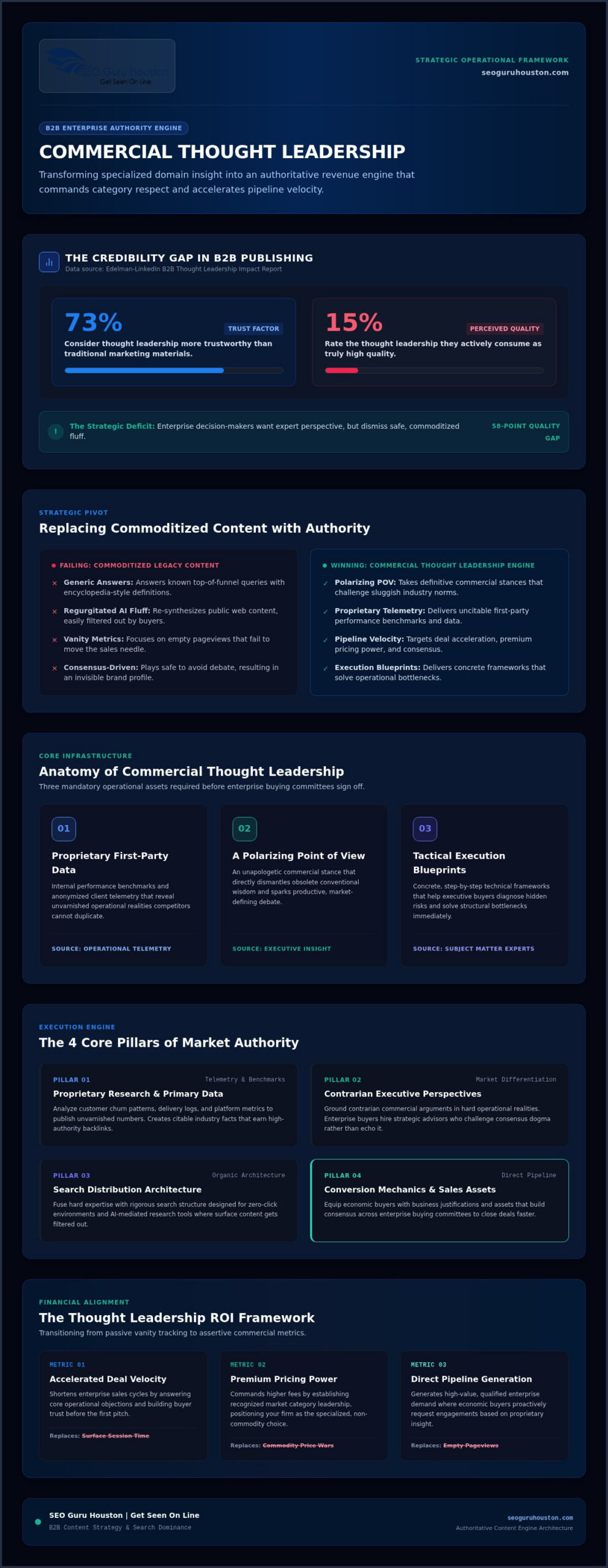
According to the Edelman-LinkedIn B2B Thought Leadership Impact Report, 73% of decision-makers consider thought leadership more trustworthy than traditional marketing materials, yet only 15% rate what they consume as high quality. Closing that massive credibility gap requires an assertive thought leadership content strategy that treats domain expertise as an immediate revenue driver rather than a vanity publishing exercise.

You already know the frustration of pumping out safe, commoditized articles that generate empty pageviews without moving the sales needle. It’s exhausting to fight for ten minutes on a calendar with busy executives, only to watch bolder competitors capture category mindshare with decisive, market-defining points of view.

It’s time to take control of the conversation. You’re about to master how to transform specialized executive insight into an authoritative content engine that commands industry respect and accelerates pipeline revenue. Ahead, we break down the four operational pillars of market authority, battle-tested methods for extracting internal expert knowledge, and the exact distribution frameworks required to dominate executive networks in 2026.

Key Takeaways

  • Learn how an assertive thought leadership content strategy replaces commoditized blog posts with market-defining perspectives that command executive authority.
  • Master the four foundational pillars separating category leaders from reactive followers: proprietary research, executive perspectives, search distribution, and conversion mechanics.
  • Replace vanity traffic metrics with an aggressive ROI framework focused on deal velocity, premium pricing power, and direct pipeline generation.
  • Execute a repeatable 5-step blueprint to audit competitor whitespace and systematically extract deep technical insight from your busiest subject matter experts.
  • Convert strategic brand narratives into high-impact sales assets that build consensus across enterprise buying committees and close deals faster.

What Is a Thought Leadership Content Strategy in 2026?

A modern thought leadership content strategy is not a vanity publishing initiative, nor is it a corporate public relations campaign. It is an intentional commercial framework engineered to establish decisive market authority and accelerate enterprise pipeline. Too many mid-market B2B companies mistakenly believe establishing authority requires licensing third-party editorial journalism or funding multi-million-dollar research programs. In reality, real authority stems from taking definitive stances on pressing commercial challenges, framing unrecognized risks, and offering operational frameworks that competitors simply cannot duplicate.

Legacy content models focus on answering known top-of-funnel queries with generic advice. That model is dead. Today, modern buyers ruthlessly disqualify vendors who push safe, commoditized definitions. To capture executive mindshare, brands must study how recognized industry thought leaders dismantle conventional wisdom, shifting their perspective from passive educational publishing to aggressive, point-of-difference market education.

The Anatomy of Commercial Thought Leadership

Building an authoritative revenue engine requires three non-negotiable operational assets:

  • Proprietary First-Party Data: Internal performance benchmarks and anonymized client telemetry that reveal unvarnished operational realities.
  • A Polarizing Point of View: An unapologetic commercial stance that directly challenges sluggish industry norms and sparks productive debate.
  • Tactical Execution Blueprints: Concrete, step-by-step frameworks that help executive buyers solve structural operational bottlenecks immediately.

When enterprise buying committees evaluate six-figure contracts, they do not read surface-level fluff. They look for proven partners who demonstrate rigorous commercial clarity. Authoritative positioning directly bridges the gap between high-level brand awareness and qualified demand generation, giving economic buyers the exact business justification they need to sign off on your deal.

Why Commoditized Content Fails Modern B2B Buyers

Automated generative tools have flooded search engines with synthetic, regurgitated answers. Consequently, enterprise executives have developed an aggressive filter against surface-level listicles and basic educational explainers. If your content sounds like a digital encyclopedia, decision-makers assume your execution capabilities are equally average.

Standing out in zero-click search environments and AI-mediated research tools demands original perspectives that algorithms cannot synthesize from existing public web pages. An assertive thought leadership content strategy plants a flag in the market. It positions your firm as the obvious, specialized category leader before an executive prospect ever formally requests a proposal.

The 4 Core Pillars of an Authoritative B2B Content Engine

Most publishing programs fail because they treat content creation and search distribution as disconnected disciplines. Competitors focus solely on primary surveys or rely entirely on sporadic social media activity. That leaves a massive competitive opening. A dominant thought leadership content strategy fuses hard data, executive vision, organic search architecture, and direct conversion mechanics into a self-sustaining revenue engine that systematically captures category leadership nationally.

Pillar 1: Proprietary Industry Data and Primary Research

Surveys are useful, but your internal telemetry is an untapped goldmine. Analyze your platform metrics, customer benchmarks, and annual service delivery logs to uncover hidden market dynamics. When you publish unvarnished numbers on customer churn patterns, implementation bottlenecks, or cost inefficiencies, you produce citable industry facts. Trade publications and competing analysts have no choice but to reference your findings, earning high-authority backlinks and cementing your brand as the primary market source.

Pillar 2: The Contrarian Point of View

Safe advice breeds invisible brands. Enterprise buyers do not hire partners who merely agree with the consensus; they look for strategic advisors who challenge obsolete industry dogma. Ground your contrarian arguments in real-world operational results. If popular wisdom says to cut top-of-funnel investments during economic uncertainty, show the operational cost of going dark. As highlighted by Harvard Business Review, cut-and-paste opinions are obsolete, making genuine operational expertise the only sustainable baseline for executive credibility. Bold positioning naturally filters out price-sensitive commodity buyers while attracting sophisticated buyers who value decisive guidance.

Pillars 3 & 4: Intent Distribution and Conversion Architecture

Brilliant insights are worthless if they sit in unindexed PDF files or disappear down social feeds within forty-eight hours. Market leaders structure their ideas into permanent organic assets that capture sustained executive search intent across every stage of the evaluation cycle.

  • Semantic Intent Architecture: Map deep-dive executive viewpoints to high-intent commercial keywords. Connect high-level market predictions to bottom-of-funnel capability pages through tight contextual internal linking.
  • Executive Conversion Mechanics: Remove friction by replacing generic newsletter subscription boxes with direct access to diagnostic tools, technical briefs, and executive briefings.

Pairing strategic insight with high converting landing page design transforms passive readers into scheduled enterprise sales calls. If your distribution architecture lacks the technical precision to route high-intent executive traffic into measurable sales pipeline, exploring specialized enterprise demand generation support can bridge that critical conversion gap.

Thought Leadership vs. Traditional Content Marketing: The ROI Framework

Traditional content marketing relies on a volume game. Teams publish dozens of basic keyword-targeted articles each month, hoping to capture broad search traffic and convert visitors through gated eBooks. That playbook is broken. Chasing sheer search volume attracts student researchers, entry-level practitioners, and competitors, but it rarely moves the needle for high-value enterprise sales. A commercially focused thought leadership content strategy abandons the volume trap to prioritize deep audience qualification and rapid deal velocity.

Enterprise sales cycles drag on because complex buying committees harbor unspoken objections regarding risk, implementation feasibility, and operational disruption. Assertive thought leadership tackles these friction points head-on before a prospect ever speaks to your sales team. By publicly dismantling the hidden costs of legacy solutions and laying out clear roadmaps for change, you educate buyers early. You enter the sales cycle as a trusted strategic advisor rather than a desperate vendor pitching generic features.

Metrics That Matter: Pipeline Velocity vs. Vanity Pageviews

Stop reporting impressions, social shares, and raw pageviews to executive leadership. Boardrooms care about revenue. Dominant content programs measure performance using hard commercial indicators:

  • Sales Cycle Compression: Tracking how quickly prospects advance through pipeline stages after consuming your strategic frameworks.
  • RFP Win Rates and Pricing Power: High-authority positioning commands respect. Gartner notes that 67% of B2B buyers prefer an entirely rep-free buying experience; when content handles the heavy lifting, close rates and contract sizes naturally increase.
  • Direct Pipeline Attribution: Monitoring first-touch and multi-touch qualified inbound revenue tied directly to executive whitepapers and technical teardowns.

Building Defensible Moats with Inbound Demand

Generic blog content offers zero competitive protection. Automated search scrapers can summarize basic listicles in seconds, robbing your website of clicks and visibility. Original proprietary frameworks, contrarian executive stances, and rigorous field insights create an impenetrable intellectual moat. Competitors cannot replicate genuine frontline discoveries.

Integrating these high-caliber perspectives into a structured inbound marketing strategy for b2b compounds your organic reach over time. Every authoritative asset acts as a permanent commercial beacon. It captures high-intent decision-makers, defends against competitive poaching, and builds an enduring foundation for measurable business growth.
Thought Leadership Content Strategy: The Assertive Guide to Market Dominance in 2026

How to Build and Execute Your Thought Leadership Strategy

Executing a dominant thought leadership content strategy doesn’t require bloated consulting retainers or disruptive corporate retreats. It requires an agile, disciplined operational engine that extracts frontline practitioner knowledge and systematically transforms it into market-defining pipeline assets.

Steps 1 & 2: Market Interrogation and Narrative Positioning

Start by interrogating market search queries to uncover critical knowledge gaps your competitors are too timid to address. Look at where industry advice remains vague, outdated, or overly cautious. Next, run monthly customer advisory interviews to isolate the expensive, operational bottlenecks enterprise buyers battle behind closed doors.

Use these insights to build distinct editorial pillars that reinforce your core methodology. Anchor every narrative theme within a dedicated b2b demand generation agency framework to ensure high-level brand positioning feeds qualified commercial intent.

Step 3: The Frictionless Subject Matter Expert Extraction System

According to the Content Marketing Institute, at 37% of B2B organizations, fewer than 5% of internal subject matter experts actively contribute to marketing assets. Busy leaders don’t have time to write 3,000-word essays. Force them to draft copy from scratch, and your production calendar will collapse.

Fix this breakdown with a frictionless extraction protocol:

  • Schedule 30-Minute Monthly Interviews: Interview technical founders, engineers, and product specialists using targeted commercial prompts.
  • Record and Transcribe Conversations: Capture authentic industry jargon, battle-tested operational stories, and unfiltered technical opinions.
  • Synthesize Raw Transcripts: Ghostwrite authoritative, insight-dense strategic arguments that protect executive calendars while preserving their authentic voice.

Steps 4 & 5: Multi-Format Production and Distribution Flywheel

Draft your long-form flagship guides with dual-intent architecture: dense enough to sway executive buying committees and technically structured for organic search dominance. Once published, deconstruct that core intellectual property across multiple channels. Convert key arguments into high-impact LinkedIn frameworks, short executive video summaries, and focused newsletter breakdowns.

Partnering with a proven seo marketing company ensures your authoritative assets achieve maximum crawlability, high search rankings, and generative engine visibility. Stop letting valuable internal expertise sit dormant on internal servers. Claim your market authority and engineer a content distribution engine that drives aggressive pipeline growth today.

Transforming Industry Insight into Scalable Revenue

Sporadic publishing schedules will never build category dominance. If your company treats content creation as an ad-hoc marketing chore, you leave enterprise revenue on the table. Transforming specialized insight into commercial pipeline requires shifting from reactive blogging to an always-on revenue engine. A winning thought leadership content strategy bridges the gap between deep intellectual capital and tangible commercial evaluation, ensuring every published perspective steers executive prospects directly toward your capabilities.

Institutionalizing Authority Across Owned Web Properties

Relying solely on external platforms leaves your business vulnerable to algorithmic whim. Build your digital headquarters into an unassailable center of gravity. Organize your domain around comprehensive resource hubs that solve complex enterprise dilemmas from multiple strategic angles.

Connect these deep-dive thought pieces to high-converting commercial pages using purposeful internal linking. When high-level strategic teardowns route qualified traffic directly into bottom-of-funnel solutions, you turn academic interest into commercial momentum. Enforce non-negotiable editorial standards across every asset: zero fluff, verifiable frontline data, and actionable strategic execution. Compromise on quality, and you compromise executive trust.

Accelerating Market Dominance with Strategic Execution

Scaling this operational infrastructure requires decisive action across your entire digital footprint:

  • Prune Commoditized Content: Ruthlessly audit your existing library. Strip out low-value listicles, generic definitions, and outdated posts that dilute your authoritative stance.
  • Syndicate with Commercial Precision: Pair organic search architecture with targeted paid distribution to place your strategic viewpoints squarely in front of active enterprise buying committees.
  • Align Narrative with Commercial ROI: Treat every guide, benchmark report, and executive breakdown as an active sales enablement asset designed to validate high-ticket purchase decisions.

Category leaders don’t wait for market demand to materialize; they actively shape it. Executing an aggressive thought leadership content strategy secures valuable organic search positions while positioning your firm as the indisputable benchmark in your space. When you align specialized technical knowledge with an assertive distribution engine, you don’t just participate in industry conversations. You dictate them.

Turn Executive Insight into Measurable Market Authority

Market dominance isn’t won by playing safe or churning out generic blog posts that enterprise buyers ignore. Category leaders win by taking decisive commercial stances, deploying proprietary operational data, and transforming specialized practitioner insight into an unassailable demand engine. A rigorous thought leadership content strategy doesn’t just educate your target market; it commands executive respect, dismantles buying friction upfront, and systematically shortens complex sales cycles.

The window to capture uncontested category mindshare is wide open, but only for organizations willing to lead with conviction. At SEO Guru Houston, we engineer data-backed SEO and content architectures built to dominate competitive enterprise search landscapes. Our proven national B2B demand generation frameworks bridge the gap between technical search visibility and measurable pipeline growth, ensuring your intellectual capital translates directly into bottom-line returns. Scale your inbound revenue with SEO Guru Houston and start commanding the market dominance your expertise deserves.

Frequently Asked Questions

What is the primary difference between thought leadership and content marketing?

The primary difference lies in commercial intent and intellectual originality. Traditional content marketing answers existing tactical search queries to harvest informational traffic. An assertive thought leadership content strategy re-architects how buyers view their problems, introducing proprietary viewpoints that position your methodology as the only logical choice. Content marketing educates entry-level practitioners on basic tactics; thought leadership influences senior executives who control enterprise budgets and make decisive vendor selections.

How do we measure the actual ROI of a thought leadership content strategy?

Measure thought leadership ROI through sales velocity, RFP selection rates, and closed-won revenue rather than superficial pageviews. Track inbound attribution by asking prospects where they first discovered your perspective. Monitor pipeline cycle duration to evaluate whether strategic pieces resolve operational objections before initial calls. When high-value buyers reference your research in procurement evaluations and accept premium pricing, your thought leadership content strategy is directly driving bottom-line profitability.

How often should an enterprise publish thought leadership content to see measurable results?

Quality and strategic depth vastly outweigh raw publishing frequency in enterprise B2B markets. One comprehensive, research-backed flagship asset per month, supported by weekly executive commentary across professional channels, generates stronger commercial traction than daily low-effort posts. Buyers don’t need endless noise. They require defensible frameworks that solve structural problems. Consistency matters, but publishing half-baked opinions just to fill an arbitrary editorial calendar destroys executive credibility. Focus on substance over volume.

Can small or mid-market B2B companies successfully compete against industry giants in thought leadership?

Yes, agile mid-market firms consistently outmaneuver industry giants by adopting sharper, unfiltered market stances. Large enterprises are often paralyzed by corporate bureaucracy and risk-averse legal departments, resulting in bland, consensus-driven messaging. Nimble mid-market firms can move decisively, publishing contrarian operational truths and frontline telemetry that corporate giants won’t dare touch. By dominating specific niche problems with uncompromising technical depth, smaller companies establish definitive authority and win high-ticket contracts over sluggish incumbents.

How do we extract insights from busy C-suite executives who lack time to write?

Use a monthly journalistic interview protocol instead of asking executives to write drafts from scratch. Schedule a focused 30-minute monthly recorded discussion where a skilled interviewer prompts the executive on recent client wins, emerging market threats, and common buyer mistakes. Transcribe the session to capture authentic terminology and cadence. Your content marketing team then structures that raw technical insight into polished long-form assets and social dispatches, requiring only a ten-minute final review from the executive.

What role does search engine optimization play in an executive thought leadership strategy?

Search engine optimization transforms transient thought leadership perspectives into permanent, compounding commercial assets. Without deliberate search architecture, executive insights disappear down social feeds within days. Proper technical SEO aligns your original arguments with high-intent commercial queries, ensuring decision-makers find your frameworks whenever they actively research solutions. Optimizing your core ideas for search engines and generative answer platforms ensures continuous inbound visibility without relying on perpetual ad spend or relentless social posting.

How do we identify contrarian viewpoints that resonate without alienating prospective clients?

Target broken industry conventions and ineffective legacy workflows rather than criticizing specific people or prospects. Focus on standard industry practices that silently drain capital, waste executive time, or produce mediocre outcomes. Validate your critique with proprietary performance data or operational case studies showing why traditional methods fail. When you articulate the hidden costs of legacy thinking with analytical clarity, you don’t alienate enterprise buyers; you prove you possess the foresight to fix expensive organizational blind spots.
B2B Social Media Marketing: The 2026 Blueprint for Market Dominance

Your LinkedIn strategy isn’t failing because of the algorithm; it’s failing because it’s built for vanity, not velocity. It’s a hard truth to swallow when you’re watching your team pour hours into posts that earn “likes” but leave the sales pipeline bone-dry. You’re likely tired of the disconnect between social activity and actual revenue. It’s a massive drain on your resources. We understand that high-performance b2b social media marketing houston requires more than just showing up. It demands an assertive, technical approach that captures market intent and forces your competition into the shadows.

This article provides the 2026 blueprint to stop wasting budget on empty metrics and start building a repeatable engine for social demand generation. You’ll learn how to transform your presence from a quiet observer to an absolute authority in your niche. We’ll break down the shift toward community-led strategies, the rise of executive thought leadership, and the precise methods for driving a measurable increase in marketing-qualified leads. It’s time to move past the fluff and execute a strategy that treats social media as the lifeblood of your growth.

Key Takeaways

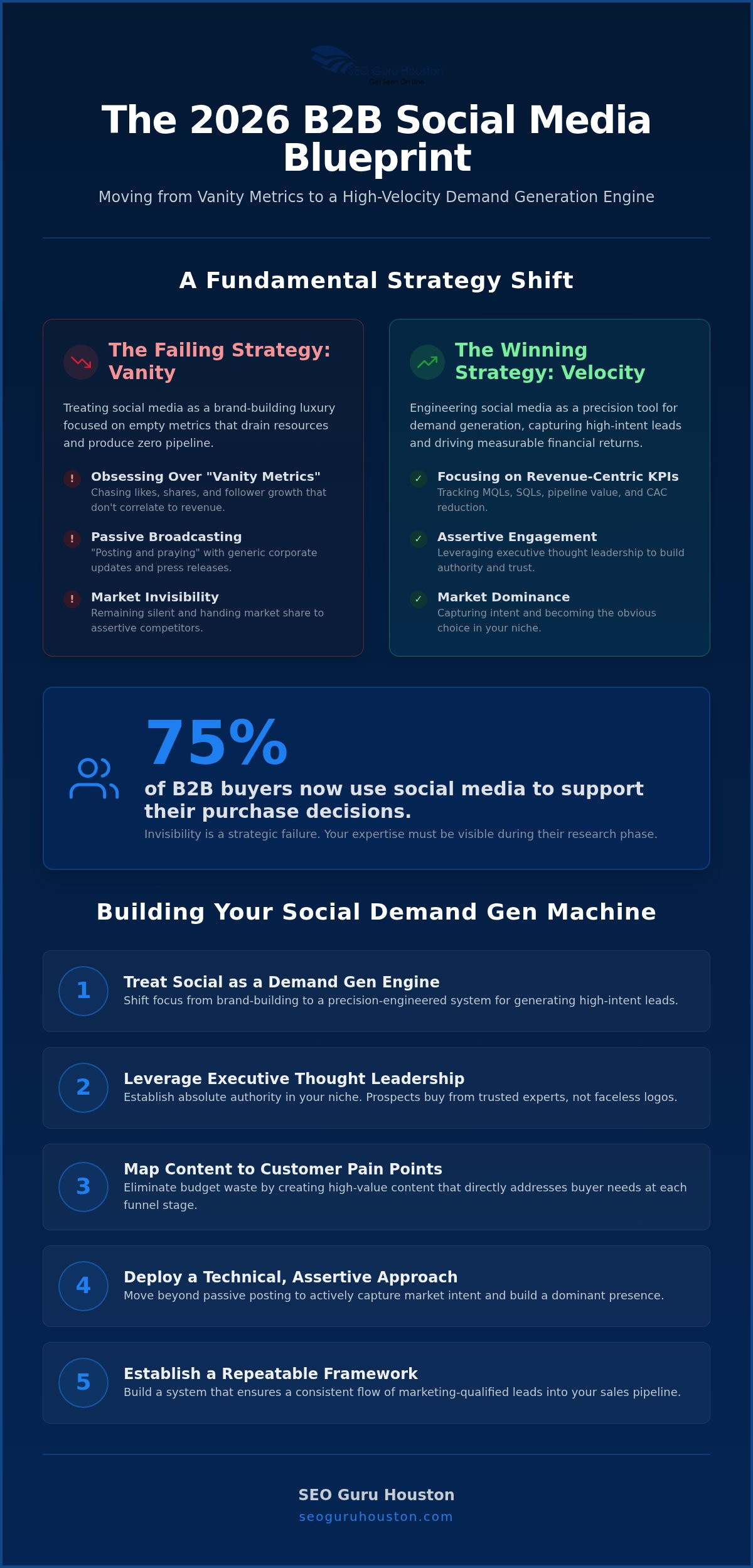
  • Stop treating social media as a brand-building luxury and start utilizing it as a precision-engineered engine for demand generation.
  • Move beyond generic corporate updates by leveraging executive thought leadership to establish absolute authority in your technical niche.
  • Eliminate budget waste by mapping high-value content to the specific pain points and funnel stages of your Ideal Customer Profile.
  • Scale your market presence by deploying a technical, assertive approach to b2b social media marketing houston that focuses on capturing high-intent leads.
  • Establish a repeatable framework for social demand generation to ensure a consistent flow of marketing-qualified leads into your sales pipeline.

What is B2B Social Media Marketing in 2026?

B2B social media is no longer a peripheral brand exercise. It’s a high-performance demand generation engine designed to capture market intent before your competitors even know a lead exists. If you’re still treating your feeds as a digital scrapbook for company picnics, you’re burning capital. Effective b2b social media marketing houston requires a shift from passive broadcasting to assertive engagement. It’s about building a technical infrastructure that drives measurable financial return.

Stop obsessing over “likes” and “shares.” In 2026, vanity metrics are a distraction from the bottom line. Dominant players focus on revenue-centric KPIs that reflect actual growth. By deploying advanced social selling techniques, your team can move beyond the “post and pray” methodology that depletes budgets without delivering MQLs. Focus on these metrics instead:

  • Marketing-qualified leads (MQLs) sourced directly from social touchpoints.
  • Sales-qualified leads (SQLs) influenced by executive thought leadership.
  • Total pipeline value attributed to social demand generation.
  • Customer acquisition cost (CAC) reduction through organic authority.

The Role of Social in the B2B Buying Journey

Research indicates that 75% of B2B buyers now use social media to support their purchase decisions. The modern buying committee is larger and more fragmented than ever; you aren’t just selling to one manager. You’re selling to IT, finance, and operations simultaneously. Social media provides the “top-of-funnel” fuel for a comprehensive inbound marketing strategy for b2b, ensuring your brand is the obvious choice when those stakeholders finally meet. It builds the necessary trust to navigate complex, multi-million dollar procurement cycles.

Why Invisibility is a Business Risk

Market invisibility is the single greatest threat to your B2B growth. If your prospects can’t find your expertise during their research phase, you don’t exist in their world. Passive presence is a slow death; assertive market dominance is the only way to survive. Your competitors are already winning by capturing intent on platforms you might be ignoring. They are building trust while you stay silent. Choosing to remain invisible is a strategic failure that hands your market share to the boldest innovator in the room. Don’t let your technical expertise go unnoticed because your social engine is idling. To learn how a dedicated team can sharpen your digital strategy, discover SocialWings Online Marketing Ügynökség and their professional solutions for business growth.

The LinkedIn Authority Engine: Beyond Personal Branding

LinkedIn is your strategic command center for market dominance. If you’re still just reposting company press releases, you’re effectively invisible to the people who matter. Real dominance comes from a technical authority engine that shortens sales cycles by establishing trust long before the first discovery call. While there are various B2B social media platforms to consider, LinkedIn remains the non-negotiable headquarters for capturing professional intent. Transitioning from generic “corporate posting” to “executive thought leadership” isn’t a vanity project; it’s a fundamental necessity for business survival.

The 2026 algorithm has evolved to penalize generic, AI-generated fluff. It rewards depth, technical nuance, and verified expertise. This shift means your b2b social media marketing houston strategy must be built on proprietary data and original research. Authority is a strategic asset that you must leverage to bypass gatekeepers. Speak directly to decision-makers who are hungry for solutions, not slogans. If you aren’t positioned as the definitive expert, you’re just another vendor competing on price.

Executive Thought Leadership as a Sales Tool

Your C-suite must become industry gurus. In high-stakes industrial sales, prospects don’t buy from logos; they buy from experts they trust. Human-to-human connection is the ultimate competitive advantage in a crowded market. To achieve this, move away from polished PR statements and focus on high-impact content that addresses specific technical hurdles. When your executives share “war stories” or break down complex market shifts, they stop being salespeople and start being partners. This level of authority forces your competition to play catch-up while you close deals faster.

Content Formats That Convert in 2026

Short-form video has officially invaded the B2B space. It’s no longer just for consumer brands. Your website video marketing assets must extend to your social feeds to maintain a consistent narrative across all touchpoints. Use 60-second technical breakdowns to hook busy engineers or data-driven polls to spark debate among procurement officers. These formats feed the “Dark Social” ecosystem, influencing the private Slack channels and internal emails where real buying decisions happen. If you’re ready to stop guessing and start dominating, partnering with an assertive growth partner can turn your social presence into a revenue-generating machine.

B2B vs. B2C Social Media: Why Your Strategy is Likely Failing

Most B2B firms fail because they treat their social presence like a digital billboard for consumer goods. B2C marketing is built on impulse and emotional triggers; B2B dominance is built on technical logic and risk mitigation. If you’re chasing viral trends, you’re likely missing the mark. High-performance b2b social media marketing houston requires a deep understanding of the professional mindset. Your audience isn’t looking for a distraction. They’re looking for a solution to a technical bottleneck or a strategic way to increase their bottom line.

You aren’t selling to a single scrolling consumer. You’re selling to a buying committee. This group usually includes technical experts, finance directors, and operations managers. Each stakeholder has different pain points and varying levels of skepticism. A single viral video won’t convince a procurement officer to sign a six-figure contract. You need sustained, educational touchpoints that build credibility over a cycle that often lasts months. As noted by experts on social media for B2B sales, the platform serves as a vital bridge for relationship building in these complex, high-stakes environments.

The Problem with Chasing Trends

Chasing the latest viral audio or meme is a recipe for budget depletion. In the industrial B2B world, “reach” is a vanity metric that often hides a lack of substance. If 100,000 people see your post but none of them have budget authority, your ROI is zero. Focus on relevance. Assertive brands prioritize being the most relevant voice in a room of ten decision-makers rather than being background noise for millions. Don’t dilute your technical authority in an attempt to be relatable. Your prospects don’t want a “fun” brand; they want a reliable partner who understands their industry nuances.

Measuring What Matters: Pipeline over Popularity

Your social engine must feed your broader growth strategy. Data from your social interactions should directly inform your ppc management and SEO efforts. If a technical whitepaper teaser generates high engagement on LinkedIn, that’s a clear signal to double down on those specific keywords in your search campaigns. In 2026, we define social-assisted revenue as any closed deal where a social touchpoint occurred within the multi-month attribution window. Track these three KPIs to ensure absolute financial gain:

  • Marketing-Qualified Leads (MQLs) sourced from gated social content.
  • Sales-Qualified Leads (SQLs) originating from direct executive engagement.
  • Social-assisted conversions within the CRM pipeline.

B2B Social Media Marketing: The 2026 Blueprint for Market Dominance

Building a Social Demand Gen Machine: 5 Non-Negotiable Steps

A high-performance social engine doesn’t happen by accident. It is a precision-engineered system designed to move prospects from total indifference to a signed contract. If your current approach feels like guesswork, you’re likely missing one of these five technical pillars. Dominating the b2b social media marketing houston landscape requires more than just “engagement”; it requires a relentless focus on demand generation and measurable financial return.

Step 1: Define your “Ideal Customer Profile” (ICP) and their specific pain points. You cannot sell to everyone. Identify the specific industries, company sizes, and job titles that drive your revenue. Step 2: Map content to the B2B funnel. Create awareness with technical insights, build consideration with deep-dive case studies, and force a decision with ROI-focused demos. Step 3: Integrate social with your b2b demand generation agency efforts. Social media should never exist in a silo; it must be the lifeblood of your broader inbound strategy. Step 4: Implement a high-performance “Social Selling” program. Equip your sales team to engage with prospects directly on LinkedIn, moving conversations from public threads to private deal-closing sessions. Step 5: Use paid social to aggressively scale what works. Once an organic post resonates, pour fuel on the fire with targeted LinkedIn Ads to reach your entire market.

Targeting the Buying Committee with Precision

Budget waste is the enemy of growth. By using granular filters like job seniority, specific company lists, and member groups, you can ensure your message only reaches the actual decision-makers. This is the core of Account-Based Marketing (ABM) on social. You aren’t shouting into a void. You are delivering a surgical strike to the desks of the people who matter. Retargeting strategies then keep your brand top-of-mind during those long, multi-month sales cycles, ensuring you remain the obvious choice when the procurement window finally opens.

Scaling with Paid Social Ads

Organic reach is a laboratory for testing ideas, but paid social is the megaphone for market dominance. In competitive industrial sectors, you cannot wait for the algorithm to find your audience. The Guru approach to LinkedIn Ad creative is direct, professional, and urgent. We cut through the noise by addressing technical bottlenecks immediately. To maximize your ROI, these ads must lead to high converting landing page design that captures intent and converts it into a tangible pipeline. If you are ready to stop playing small, partner with an assertive growth strategist to build your engine today.

The Assertive Social Strategy: Partnering with SEO Guru Houston

SEO Guru Houston is not just another service provider; we are the high-performance growth partner your business needs to achieve absolute market dominance. While others offer generic packages, we build a customized, assertive social engine that captures intent and converts it into revenue. Our strategy is built on an “SEO-First” philosophy. We use search data to inform social content, ensuring your expertise is discoverable exactly when your prospects are searching for technical solutions. For firms in the industrial B2B and manufacturing sectors, this level of precision is the difference between a stagnant pipeline and a thriving enterprise.

Effective b2b social media marketing houston requires a partner who understands that social is the lifeblood of growth. We treat your social channels as the top-of-funnel fuel for your entire demand generation strategy. By aligning your social presence with technical SEO and industrial-grade content, we ensure your brand is perceived as the only logical choice for high-stakes buying committees. We don’t just manage accounts; we build a repeatable system for social demand generation that focuses on your bottom line.

Our Guru Process: From Invisibility to Prominence

Speed and precision define our execution. We don’t believe in long, theoretical onboarding periods that delay your results. Our process moves rapidly through three critical phases:

  • Technical Audit: Identifying the gaps in your current presence and the missed opportunities in your specific technical niche.
  • Strategic Blueprint: Mapping high-value content to your ICP and integrating website video marketing to humanize your technical expertise.
  • Assertive Execution: Deploying a relentless schedule of thought leadership and paid social ads to force your brand into the spotlight.

This method moves your organization from being a quiet, invisible player to becoming a prominent industry leader. We integrate technical nuance with aggressive market capture to ensure you don’t just participate in the conversation; you lead it. By the time we reach the execution phase, your social presence is no longer an optional luxury but a fundamental necessity for your growth.

Demand More From Your Marketing Agency

If your current agency focuses on “likes” rather than leads, they are failing your business. “Affordable” services often result in massive losses of potential revenue because they lack the technical expertise to navigate industrial niches. You deserve a partner who understands the practical realities of your commerce and the high stakes of your sales cycle. Stop wasting your budget on passive strategies that yield no measurable progress. It is time to take decisive action and build a system that drives real B2B revenue. Stop guessing and start scaling with SEO Guru Houston.

Execute Your Blueprint for 2026 Market Dominance

The era of passive posting is over. You’ve seen that high-performance b2b social media marketing houston requires a technical, revenue-centric approach that treats LinkedIn as a strategic command center rather than a digital billboard. By transforming your C-suite into industry gurus and mapping content to the technical buying committee, you build a formidable barrier against competitors who are still chasing viral vanity metrics. This isn’t just about social media; it’s about building a precision-engineered growth engine that captures market intent with surgical accuracy.

With over 25 years of B2B marketing expertise, SEO Guru Houston specializes in the industrial and manufacturing growth that generalist agencies find too complex. Our high-performance guru strategy ensures you don’t just participate in the market; you lead it. It’s time to stop guessing and start scaling with a partner who understands the financial realities of your commerce. Your transformation from invisibility to prominence starts with a single, decisive action. Let’s build your engine and secure your position at the top of your niche.

Ready to Dominate Your Market? Schedule Your B2B Growth Session Now!

Frequently Asked Questions

How does B2B social media marketing differ from B2C?

B2B marketing focuses on technical problem solving and consensus based decisions rather than emotional impulse. While B2C prioritizes viral entertainment, high-performance b2b social media marketing houston targets a professional mindset. You aren’t selling to a single person; you’re selling to an entire buying committee. This requires sustained, educational touchpoints that address specific technical bottlenecks. Your strategy must reflect the complexity of multi-month sales cycles and the need for absolute risk mitigation.

Which social media platform is best for B2B lead generation?

LinkedIn remains the undisputed leader for B2B lead generation because it allows you to target professional intent with surgical precision. While other platforms offer reach, LinkedIn provides the context necessary for high-stakes industrial sales. It is the only platform where users are actively looking for solutions to business challenges. By leveraging its technical infrastructure, your team can bypass gatekeepers and deliver your message directly to the desks of decision-makers who have the authority to sign contracts.

Is LinkedIn advertising worth the high cost for B2B companies?

The higher cost of LinkedIn advertising is a strategic investment in lead quality rather than a simple expense. You pay a premium to eliminate budget waste by filtering for specific job titles, company sizes, and industries. If you’re selling high-value industrial solutions, a single qualified lead is worth more than a thousand generic clicks. Assertive brands use these ads to aggressively scale their organic authority and dominate their niche with precision.

How do you measure the ROI of B2B social media marketing?

You measure ROI by tracking revenue-centric KPIs that correlate directly with your sales pipeline. Move beyond vanity metrics like likes and focus on marketing-qualified leads (MQLs) and social-assisted conversions. By integrating social data with your CRM, you can identify exactly which touchpoints influenced a deal. This technical approach ensures every dollar spent on your social engine is moving you closer to measurable financial gain and market prominence.

Can social media really help with industrial or manufacturing sales?

Social media is a fundamental necessity for industrial and manufacturing firms that want to move from invisibility to prominence. It provides a platform to showcase technical expertise and humanize complex engineering solutions. High-performance b2b social media marketing houston helps you reach the various stakeholders in a manufacturing buying committee simultaneously. This assertive presence ensures your firm is the only logical choice when a prospect begins their technical research phase.

How often should a B2B company post on social media for maximum impact?

Maximum impact comes from consistency and technical depth rather than sheer volume. Posting three to four times per week is usually sufficient if every post provides genuine value or original research. You don’t want to dilute your brand with low-quality fluff that your audience will ignore. Focus on high-impact content that addresses specific industry pain points. This approach keeps your brand top-of-mind without exhausting your team’s creative resources or your audience’s attention.

What is the role of thought leadership in B2B social strategy?

Thought leadership is the ultimate trust-builder in high-stakes B2B environments. It transforms your executives into industry gurus that prospects actually want to consult. When your leadership shares proprietary data or technical “war stories,” they bridge the gap between a cold vendor and a trusted partner. This strategy shortens sales cycles by establishing your organization’s absolute authority before the first discovery call even happens. It is a non-negotiable asset for growth.

How do social media signals affect my company’s SEO rankings?

Social media signals influence your SEO rankings indirectly by driving brand search volume and high-quality referral traffic. When your content resonates on social platforms, it leads to more people searching for your company by name. Google interprets this as a strong signal of authority and expertise. Furthermore, social sharing increases the likelihood of earning backlinks from industry publications. This synergy ensures your social engine and your search strategy work together to achieve market dominance. For organizations aiming to strengthen these signals on platforms like YouTube or Instagram, Greedier Social Media offers engagement services that help amplify your brand’s social presence.