
What if your agency’s value depends less on how fast it wins new clients and more on how well it keeps and serves the ones it has? Marketing agencies commonly sell for 3x to 8x adjusted EBITDA, and maximizing the value of your marketing agency means building durable earnings a buyer can rely on. Client retention matters because it can support more predictable revenue and stronger margins.
Revenue alone doesn’t tell the whole story. Buyers also consider whether the team uses its capacity effectively, whether management can operate without constant owner involvement, and whether client relationships are strategic or easily replaced. Strong retainers can help, but only when the work is well-scoped and profitable.
This article explains how retention, utilization, management depth, strategic value, and retainer quality can shape agency valuation. You’ll see how these factors affect profitability and buyer confidence, along with operational improvements that can make an agency more resilient and valuable.
Key Takeaways
- Use retention and margin benchmarks to spot where client relationships can strengthen profitability.
- Improve utilization by streamlining repeatable workflows and matching team capacity to client work.
- Reduce owner dependence by clarifying responsibilities and building leadership that can manage accounts independently.
- Assess agency partnerships by strategic contribution and measurable outcomes, not cost alone.
- Evaluate retainers for durability, clear scope, and delivery demands, not just recurring revenue.
1. How can client retention impact agency profitability?
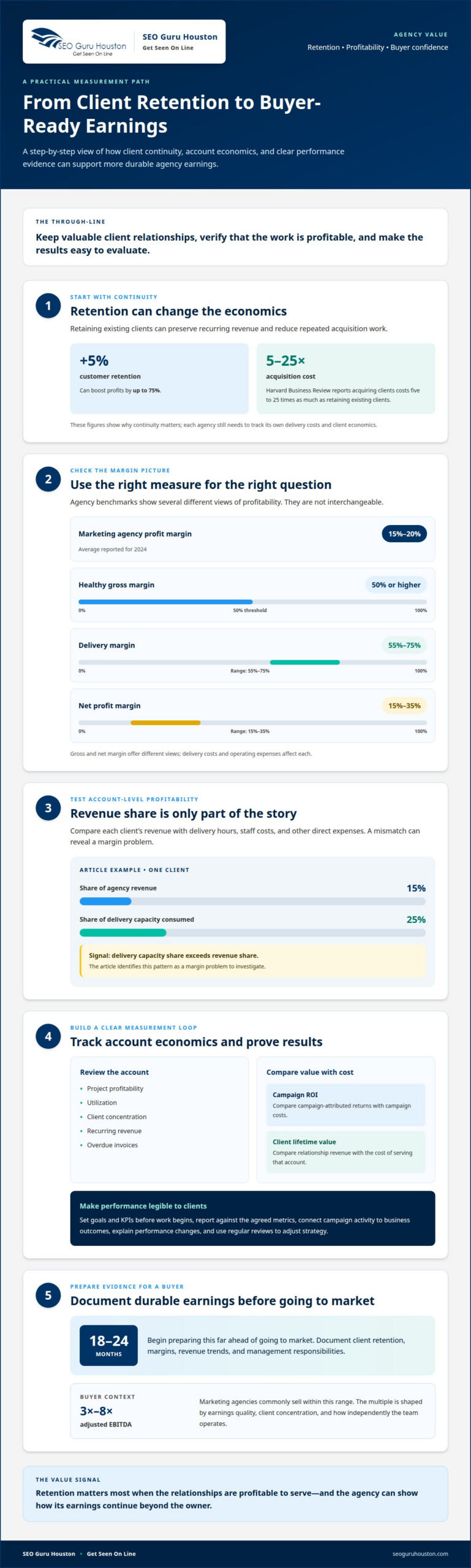
Retention supports profitability by preserving recurring revenue and reducing repeated acquisition work. A 5% increase in customer retention can boost profits by up to 75%, while Harvard Business Review reports acquiring clients costs five to 25 times as much as retaining existing clients. These figures show why client continuity matters, but each agency must track its own delivery costs and client economics.
Agency margin benchmarks clarify where that value appears. Marketing agency profit margins averaged 15% to 20% in 2024, while a healthy gross margin is generally 50% or higher. Delivery margins typically range from 55% to 75%, and net profit margins can range from 15% to 35%. Gross and net margin offer different views of an agency’s profitability, with delivery costs and operating expenses affecting each.
Retention only improves results when accounts are profitable to serve. Compare each client’s revenue with its delivery hours, staff costs, and other direct expenses. For example, a client producing 15% of revenue while consuming 25% of delivery capacity signals a margin problem. Track project profitability alongside utilization, client concentration, recurring revenue, and overdue invoices to see where workload or payment timing strains cash flow.
How do you measure a marketing agency’s ROI and client lifetime value? Compare campaign-attributed returns with campaign costs, then assess lifetime value by comparing the client’s revenue over the relationship with the cost of serving that account. Review both measures by client and service line so strong topline results don’t conceal weak delivery profitability.
How can an agency prove campaign results and communicate value to clients? Set goals and KPIs before work begins, then report performance against those agreed metrics. The U.S. Environmental Protection Agency identifies evaluation as a critical element of any communication program. Connect campaign activity to business outcomes, explain performance changes, and use regular reviews to adjust strategy.
Profit levels also influence valuation multiples. Owner-operated agencies under $500K in profit typically sell for 2.5x to 3.5x SDE; agencies with $500K to $1M in profit typically sell for 3x to 4.5x SDE or adjusted EBITDA. Agencies with $1M to $3M in adjusted EBITDA typically sell for 4x to 6x EBITDA, while those with $3M to $5M typically sell for 5x to 7x.
How do you prepare a marketing agency for sale and increase its valuation? Begin preparing 18 to 24 months before going to market, documenting client retention, margins, revenue trends, and management responsibilities. Buyers commonly assess agencies at 3x to 8x adjusted EBITDA, with the multiple shaped by earnings quality, client concentration, and how independently the team operates.
2. How can I increase my agency’s utilization rate?
Start by measuring how client-facing team members spend their available working time. The recommended utilization rate for client-facing agency team members is 70% to 80%; account managers and senior strategists should target 60% to 70%. These roles also need time for planning, client communication, and quality control, so pushing every person toward delivery work can damage service quality.
How can an agency streamline operations and improve team utilization? Map recurring tasks, identify bottlenecks, then automate repetitive work such as routine reporting or task handoffs. Use the time recovered for client delivery, review, or training. A 10% reduction in delivery hours through process improvements can be modeled against team capacity and delivery costs to see whether the change improves efficiency without cutting essential work.
Make the workflow visible. Use project plans to record owners, deadlines, scope, and current status, then review workload during regular team check-ins. Agile methods can help teams break large campaigns into smaller tasks, identify blockers early, and adjust priorities as results come in. Pair that process with training so team members can take on work confidently instead of routing every specialist task through one overextended employee.
Capacity planning should look ahead, not just at this week’s timesheets. Forecast demand 90 to 120 days into the future, then compare expected client work with each team member’s available delivery hours. For example, if one client requires 25% of the agency team’s delivery capacity, managers can assess whether that account leaves enough room for other commitments and planned growth. Adjust assignments before overload creates delays or expensive last-minute staffing changes.
What services and niches are most profitable for marketing agencies? There’s no universal winner: profitability depends on delivery costs, pricing, client fit, and how repeatable the work is. Specializing in a niche can help an agency focus its expertise and workflows, but the niche still needs demand and work the team can deliver efficiently.
How do you grow a marketing agency without sacrificing service quality? Set capacity limits, document repeatable processes, and take on work only when the right skills and time are available. Track utilization alongside delivery costs, missed deadlines, and revision patterns; any one metric can hide strain. A consistent inbound marketing strategy can support a steadier flow of suitable opportunities, while a disciplined delivery plan keeps growth aligned with team capacity.
Owner dependence and management depth
A marketing agency becomes harder to transfer when clients, delivery decisions, and revenue depend on its founder. Buyers assess whether account leadership can maintain relationships and guide work without the owner handling every escalation. If the founder remains central, the sale may include a transition commitment of 12 to 24 months, extending the owner’s role after closing.
Build management depth by assigning a clear owner to each function, client relationship, and decision. Define who leads accounts, approves budgets, manages staffing, and resolves delivery issues. Document each partner’s responsibilities and communication expectations, then give department leads authority to act within agreed limits. This structure supports consistent service and shows that daily operations don’t rely on one person.
What are common risks that reduce a marketing agency’s value? Founder dependence, client concentration, unclear scopes, and inconsistent financial records can make future earnings look less reliable. If the largest client exceeds 20% of revenue, buyers may apply a discount or contingent structure equivalent to 0.5 to 1.5 turns of EBITDA.
Scope control protects delivery margins and client relationships. Document each campaign’s deliverables, responsibilities, assumptions, and approval steps in a clear scope of work. When a client requests additional work, assess the impact on deadlines, staffing, and fees before accepting. Use a written change order to record approved changes instead of absorbing extra work informally and weakening project profitability.
Project management tools can make responsibilities visible across the agency. Keep tasks, owners, due dates, approvals, and scope changes in one shared workflow. For example, an account lead can flag a requested landing-page revision, while the delivery lead estimates the workload and updates the schedule after approval. Regular status reviews reveal delays early and reduce the founder’s role as the agency’s default project tracker.
Management depth also changes how buyers assess earnings. Marketing agency buyers often begin underwriting on adjusted EBITDA when the agency approaches $750K to $1M in profit and has account leadership independent of the founder. Clear reporting, documented processes, and reliable account ownership help explain whether those earnings can continue after a transition.
Sale readiness also affects deal structure. Well-prepared marketing agencies frequently receive 50% to 70% of headline consideration in cash at closing, while earn-outs often account for 20% to 40%, paid over one to three years. Build the evidence early: maintain current client contracts, financial records, scopes, and role documentation. A buyer can assess risk more clearly when performance and responsibilities are documented instead of held in the owner’s memory.
4. Prioritizing strategic value over cost savings
Cutting a marketing budget can reduce immediate expenses, but it may also weaken customer acquisition and retention. Prioritize investments that connect specific audience needs to measurable business outcomes. Define the goal, choose a relevant metric, and assess results against it. For example, evaluate a campaign designed to generate qualified leads by lead quality and progression, not clicks alone.
Start with audience analysis. Document target customers’ demographics, behaviors, preferences, and barriers to purchase. Then choose channels that fit how those customers discover and evaluate solutions, such as social media, content marketing, and SEO. An evidence-based strategy helps focus resources; a channel that attracts attention but prompts no useful action may not deserve continued investment.
Content strategy turns those insights into a coordinated plan. Set a clear purpose for each asset, identify whom it serves, and map how it supports the buyer’s decision. For example, an educational article can address an early-stage concern, while a focused landing page can explain a relevant offer. Website development and landing pages can support that journey by giving campaigns a clear destination and conversion path.
Branding also contributes strategic value when it makes an agency or client easier to recognize and trust. A survey found that 77% of marketers say branding is critical to their growth plans. Keep messaging consistent across channels, but tailor each campaign to its audience and objective. Track qualified inquiries, conversion patterns, and repeat business to assess whether brand investment supports growth and retention.
Strategic partnerships can expand an agency’s capabilities without requiring every skill to sit in-house. Before starting joint work, define each partner’s role, expertise, responsibilities, and shared measures of success. For example, a specialist partner may strengthen a campaign where the agency lacks a particular capability, such as collaborating with video and social content specialists like kyndacreative.com. Clear ownership and communication help protect delivery quality while creating new ways to serve clients.
Funding can accelerate expansion, but it should support a defined growth plan rather than cover unclear operating gaps. Model how the investment will generate capacity, improve delivery, or reach a new audience, then compare expected benefits with repayment or ownership implications. Keep overhead in view: marketing agency overhead costs should generally be 20% to 30% of gross income. That benchmark can help frame an agency’s operating review, not replace project-level analysis.
Choose strategic investments by comparing their expected contribution with the resources they require. A lower-cost option isn’t automatically more profitable if it weakens lead quality, client results, or delivery consistency. Clear goals, audience research, and ongoing performance reviews give agency leaders stronger evidence for deciding where to expand and where to redirect effort.
5. Recurring revenue and retainer quality
A retainer can make revenue more predictable, but recurring invoices alone don’t make an agency valuable. Buyers also assess how durable each client relationship is, whether services have clear boundaries, and how much effort each account requires. A retainer that renews reliably and produces healthy margins offers stronger evidence of repeatable earnings than one that depends on constant renegotiation.
Start by defining the work. Specify deliverables, responsibilities, reporting, approval processes, and how requested changes will be handled. Then compare the agreed scope with actual delivery hours and costs. If a client repeatedly requests additional work, revise the scope or retainer terms rather than letting unplanned tasks quietly consume capacity. Clear terms help both sides understand what the ongoing engagement covers.
Optimize each retainer around outcomes and a sustainable delivery model. Review account performance, client priorities, team workload, and contribution to revenue together. Regular pricing audits can reveal when the scope has expanded or delivery costs have changed. Model a 15% retainer rate increase against net margin to understand the possible effect, then consider how the change fits the account’s work and value.
Revenue quality can influence valuation. Agencies with 60% or more of revenue on durable retainers can trade at the top of their benchmark range. Consistent revenue growth of 15% or more also supports a position at the top of the valuation multiple range. These benchmarks make the durability and profitability of recurring work important, not simply the percentage billed each month.
Retainer-led PR and communications firms trade at approximately 5x to 7x adjusted EBITDA. A retainer-led agency may trade one to two EBITDA turns higher than a project-led agency. These comparisons don’t mean every retainer deserves a premium. Client concentration, retention patterns, margins, and the agency’s ability to deliver consistently all affect how dependable that revenue appears.
Use a straightforward account review to strengthen retainer quality. Compare contracted revenue with actual delivery effort, check whether reports connect work to agreed goals, and flag accounts where scope and fees no longer align. For example, a recurring content engagement may need revised deliverables if approval delays or extra revisions regularly increase the team’s workload. Document the updated expectations and review results with the client.
For a stronger ongoing marketing program, discuss a strategy that supports recurring results. A clear service scope, performance measures, and regular reviews give retainer relationships structure while helping agency leaders assess revenue quality and delivery demands.
SEO Guru Houston
SEO Guru Houston helps businesses nationwide build digital marketing strategies around visibility, lead generation, and measurable growth. If you’re strengthening your agency’s value by improving client results, comprehensive SEO services, PPC services, B2B marketing, and inbound marketing solutions can support distinct goals across the customer journey. The right approach depends on your audience, growth priorities, and how you measure campaign performance.
Turn to SEO Guru Houston when your business needs a clearer marketing plan, stronger demand generation, or support connecting digital activity to business outcomes. The agency offers nationwide SEO, PPC, inbound marketing, and website development to help businesses focus on priorities and direct effort toward suitable channels. To discuss your marketing goals, contact SEO Guru Houston.
Make Agency Value an Operating Priority
Maximizing the value of your marketing agency is an ongoing leadership decision, not a task reserved for a future sale. Set a clear direction, assign accountability, and make business decisions based on evidence rather than habit. When a process, client relationship, or investment needs attention, define the next action and who owns it. That discipline helps turn plans into repeatable progress.
Choose the next improvement based on where your agency needs the most resilience. A focused operating review can help leadership move from identifying issues to making informed decisions while keeping long-term business goals in view. You don’t need to change everything at once. Start with a deliberate step, measure what changes, and keep building.
Contact SEO Guru Houston today to discuss your marketing goals and next steps. Keep moving forward with a strategy built around the value you want your agency to create.
Frequently Asked Questions
What Is Marketing Agency Valuation?
Marketing agency valuation estimates what a buyer may pay for the business based on its earnings and risk profile. For example, two agencies with similar earnings may attract different offers if one relies on a single client or founder for key decisions. Buyers assess financial records, contracts, revenue durability, and operational continuity to understand how much of the agency’s performance can continue after ownership changes.
How do I transition from hourly billing to value-based pricing?
Move gradually by selecting a service with clear outcomes and scope, then price the engagement around its business value rather than hours alone. Review past projects to understand the effort, client objectives, and results delivered. Propose a defined scope, explain which success measures apply, and document exclusions. A pilot with one suitable client can show whether the pricing and delivery process work before broader adoption.
How can client retention impact agency profitability?
Retained clients can create opportunities to deepen expertise and reduce the disruption of repeatedly replacing lost accounts. Track renewal patterns by client type, service, and starting period to identify where relationships tend to weaken. For instance, if clients disengage when reporting is unclear, improve the review process and show how decisions connect to agreed goals. Retention analysis helps identify a practical cause, not just a cancellation count.
What are the most important metrics to track for agency profitability?
Track metrics that explain how revenue becomes cash and where work creates avoidable effort. Alongside profit measures, review invoice aging, scope changes, revision frequency, client concentration, and revenue by service line. For example, repeated revisions can point to unclear approvals or an inefficient brief. A monthly dashboard comparing these measures helps leaders spot changes early and decide whether to adjust processes, account expectations, or service mix.
What operational changes have the biggest impact on profitability?
Prioritize changes that remove recurring friction from delivery. Standardize client intake, centralize approvals, and create reusable templates for common deliverables. For example, a consistent campaign brief can prevent missing information that triggers rework across strategy, creative, and reporting. Review the workflow after each project cycle, identify recurring delays, and assign someone to improve that step. Small process fixes can protect team focus and the client experience.
What pricing model generates the highest agency profits?
No single pricing model produces the highest profit for every agency. Choose based on how predictable the work is, how clearly outcomes can be scoped, and how much delivery effort varies. A fixed project fee can suit a bounded engagement, while ongoing work may fit recurring billing. A hybrid model can combine defined deliverables with continuing services. In every case, estimate delivery effort and establish change terms before committing.
What technology investments provide the best ROI for agency profitability?
The strongest technology investment solves a measurable operational problem. A customer relationship management system can organize lead and client information, while time-tracking or project tools can clarify how work moves through delivery. Before adopting software, define the task it should improve and record the current process. After implementation, compare adoption, administrative effort, and reporting quality. Avoid paying for overlapping tools that teams don’t use consistently.
What does maximizing the value of a marketing agency mean?
Maximizing the value of a marketing agency means building a business whose performance is understandable, repeatable, and less dependent on any single relationship or person. That takes reliable records, clear ownership, and services delivered through documented processes. For example, a new account lead should be able to understand client commitments from shared records rather than relying on informal handoffs. The aim is a stronger business, not simply a higher asking price.

