
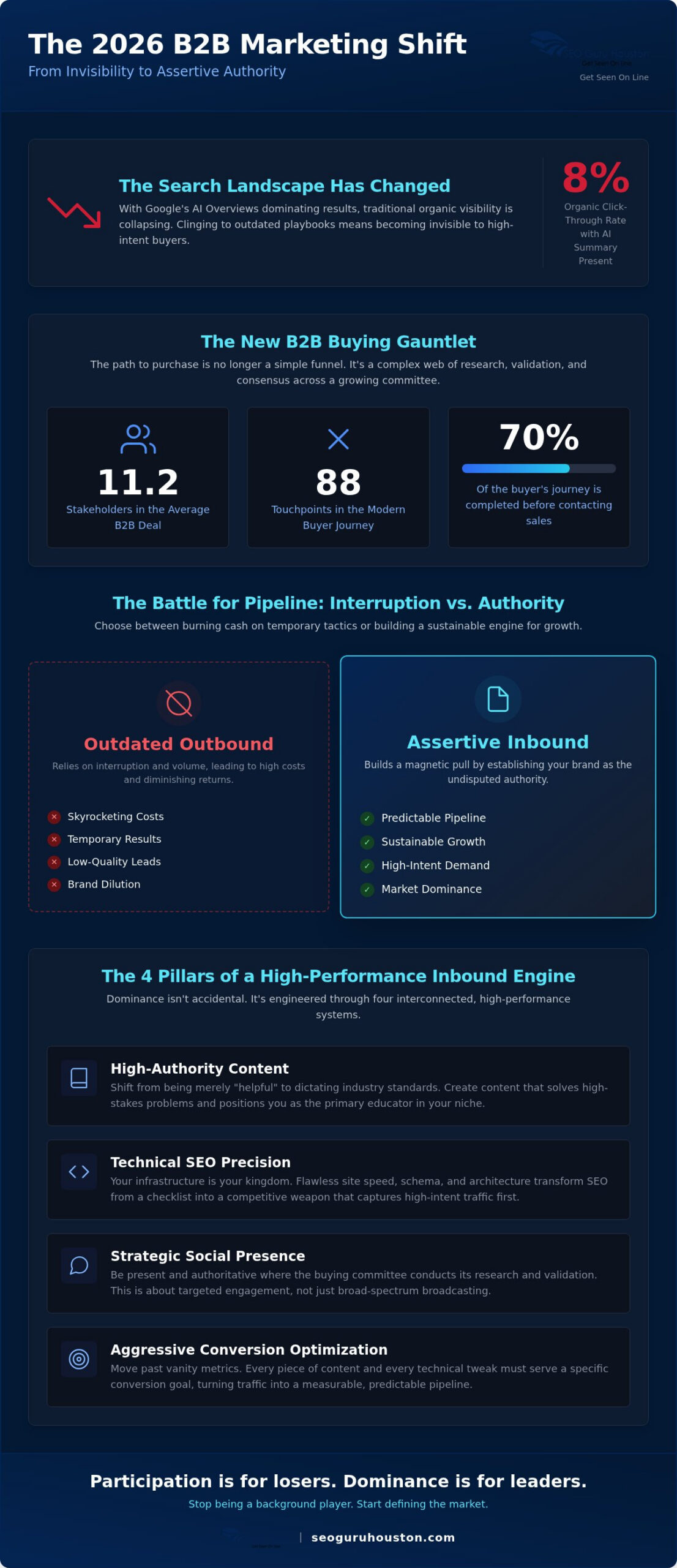
In 2026, if your brand isn’t the immediate, non-negotiable answer to a buyer’s problem, you don’t just lose the click; you lose the entire market. With Google’s AI Overviews now dominating search results, organic click-through rates have plummeted to just 8% when an AI summary is present. You’re likely feeling the squeeze of an invisible brand presence and an inbound marketing strategy for b2b that feels stuck in the past. It’s a brutal reality for those clinging to outdated playbooks while outbound costs skyrocket and sales teams complain about lead quality.
You deserve a predictable pipeline that doesn’t rely on burning cash on cold outreach. This guide reveals the assertive framework designed to capture high-intent demand and establish you as the undisputed authority in your niche. We’ll break down the high-performance tactics you need to navigate the 11.2 stakeholders now involved in the average B2B deal. We’re moving past vanity metrics to focus on hard conversions, technical SEO dominance, and a content engine that turns searchers into loyal partners.
Key Takeaways
- Shift your mindset from being just “helpful” to establishing assertive authority that captures high-intent demand before your competitors even enter the conversation.
- Learn how to build a technical infrastructure and an inbound marketing strategy for b2b that effectively handles the 88 touchpoints of the modern buying committee.
- Replace the high costs and temporary results of outbound with a sustainable demand generation engine that drives predictable and measurable pipeline growth.
- Execute a high-precision blueprint that maps strategic content to every stage of the buyer’s journey, focusing on high-stakes pain points to eliminate low-quality leads.
- Discover why scaling for market dominance requires a strategic shift toward quality and expert-led execution rather than simply increasing your content volume.
What is an Inbound Marketing Strategy for B2B in 2026?
An effective inbound marketing strategy for b2b isn’t a passive collection of blog posts; it’s a high-performance engine designed to dominate your market. In 2026, the definition has shifted from merely being “helpful” to establishing assertive authority. You aren’t just answering questions. You’re dictating the industry standard and capturing demand before your competitors even realize a prospect is looking. This framework integrates technical precision with psychological triggers to attract, engage, and convert buyers who are tired of being sold to and hungry for real expertise.
While outbound methods rely on interruption and volume, inbound focuses on magnetic pull. It’s the difference between a cold caller begging for five minutes and a prospect seeking out your specific solution because you’ve already proven your value. To understand this shift, look at a comprehensive Digital Marketing Overview; you’ll see that the most successful brands have moved away from “spray and pray” tactics. They focus on four core pillars: high-authority content, technical SEO, social presence, and aggressive conversion optimization. If you lack any of these, your pipeline will remain unpredictable.
The Death of the Cold Call and the Rise of the Self-Educated Buyer
Buyers have changed. Research suggests that 70% of the B2B buyer journey is completed before a prospect ever reaches out to a sales team. They’re doing the heavy lifting in the shadows, comparing your whitepapers to your rival’s webinars. If you aren’t visible during this research phase, you’re effectively non-existent. An assertive inbound marketing strategy for b2b fills this trust gap by positioning your brand as the primary educator. It acts as a 24/7 digital sales force that never takes a day off, never misses a follow-up, and never fails to deliver the right message at the right time.
Defining the Assertive Inbound Framework
Participation is for losers; dominance is for leaders. The assertive inbound framework adopts a “Guru” persona, delivering specialized knowledge with total confidence. You don’t just participate in the conversation; you lead it. This requires a level of technical sophistication that most internal teams can’t maintain. To stay ahead of the five confirmed algorithm updates Google has already executed in the first half of 2026, leveraging professional SEO services is a fundamental necessity. It’s about moving from digital invisibility to absolute prominence. You must decide if you want to be a background player or the authority that defines the market.
The Mechanics of Authority: Building a High-Performance B2B Inbound Engine
Authority in the B2B space isn’t a badge you wear; it’s a machine you build. If you want to dominate your sector, you must move past the idea that content is your only asset and realize that technical infrastructure is the kingdom. A successful inbound marketing strategy for b2b requires a robust foundation where every byte of data serves a specific conversion goal. This means your site speed, schema markup, and mobile-first architecture must be flawless. Without these, your brilliant insights remain buried in the depths of page two. Partnering with a specialized seo marketing company ensures that your technical SEO isn’t just a checklist, but a competitive weapon designed to capture high-intent traffic before your rivals even wake up.
Decision-makers don’t have time for fluff. They have high-stakes problems that need immediate, data-backed solutions. When you align your content with these specific pain points, you shift from being a replaceable vendor to a strategic partner. This alignment is the cornerstone of a modern inbound marketing strategy for b2b that actually converts. As search behaviors evolve with AI and semantic search, the future of inbound marketing belongs to those who prioritize deep technical relevance and user intent over simple keyword density. It’s about engineering visibility so that when a CEO searches for a solution, your brand is the only logical choice.
B2B Content Marketing: Establishing Absolute Authority
Generic blog posts are dead. To win in 2026, you need deep-dive white papers and proprietary research that your industry actually cites. Humanize your technical solutions through strategic website video marketing; it builds trust faster than a thousand words of copy ever could. Authority Content is defined as data-driven insights that solve a $1M+ business problem. If your content doesn’t save a client time or make them money, it’s just noise that clutters the digital landscape.
High-Energy B2B Social Media and Demand Generation
LinkedIn is your battlefield, not just a bulletin board. You must use it for assertive brand building that commands attention and respect. A results-oriented b2b social media agency doesn’t just post content; they drive demand by positioning your leaders as industry gurus with specialized knowledge. Integrate social proof like case studies and video testimonials early in the funnel to eliminate buyer skepticism before it even takes root. If you are ready to stop being invisible, it might be time to look at how Houston B2B marketing experts can accelerate your growth and visibility.
Inbound vs. Outbound: The Assertive Case for Strategic Demand Generation
Outbound marketing is a sugar high. It provides immediate spikes in activity that vanish the moment you stop pouring money into the furnace. Inbound is different. It’s a permanent asset that builds equity over time. While your competitors are stuck on the treadmill of cold calls and interruptive ads, a mature inbound marketing strategy for b2b creates a self-sustaining ecosystem. You don’t just rent attention; you own it. This shift in ownership drastically reduces your cost-per-acquisition (CPA) because you’re no longer paying for every single impression. You’re harvesting the demand you’ve already cultivated through consistent authority.
Many executives dismiss inbound because they think it’s too slow. That’s a fundamental misunderstanding of how market dominance works. Inbound isn’t slow; it’s compounding. Every high-authority white paper or technical video you produce adds another layer of credibility that works for you forever. If you want results that scale without a linear increase in budget, you need an engine that gets more efficient with every lead it generates. A mature inbound engine doesn’t just lower costs; it increases lead quality. When prospects find you through their own research, they arrive with a higher intent to buy and a shorter sales cycle. This is the assertive case for strategic demand generation. You aren’t begging for a seat at the table. You’re the one hosting the dinner.
Why Demand Generation Trumps Simple Lead Generation
Lead generation is about collecting emails. Demand generation is about creating a hunger for your specific solution before a prospect even identifies as a “lead.” When you work with a b2b demand generation agency, the goal isn’t just a full CRM. It’s market mindshare. You want to be the “Guru” they think of when a crisis hits. By the time they fill out a form, the sale is already 90% won because you’ve already established non-negotiable authority. You capture the market’s mindshare to win their wallet.
Calculating the B2B Inbound Marketing ROI
Measuring success requires looking beyond vanity metrics like page views. You must track the transition from Marketing Qualified Leads (MQLs) to Sales Qualified Leads (SQLs) to actual revenue. Don’t ignore “dark social,” those unmeasurable touchpoints like Slack mentions or private recommendations. These are often the true drivers of high-value deals. In competitive industrial sectors, inbound is no longer an optional luxury. It’s a fundamental necessity for business survival and revenue scaling. If your current strategy doesn’t provide a predictable pipeline, you’re not just falling behind; you’re becoming obsolete.
The Blueprint: 5 Steps to Executing a Winning B2B Inbound Marketing Strategy
Execution separates the market leaders from the also-rans. Most companies treat their inbound marketing strategy for b2b like a hobby. They publish occasionally and hope for the best. That’s a recipe for invisibility. To dominate in 2026, you need a disciplined, five-step blueprint that turns your digital presence into a high-performance lead generation machine. This isn’t about being “active” online. It’s about being effective. If you aren’t following a structured path, you’re just wasting your marketing budget on vanity metrics that don’t pay the bills.
Step 1 & 2: Strategy and Content Architecture
Your first move is identifying your Ideal Customer Profile (ICP) and their high-stakes pain points. Don’t guess. Use real data to understand the $1M+ problems keeping your buyers awake at night. Once you’ve identified these, you must build a “content fortress” around your primary keywords. This means creating a dense web of interconnected articles, videos, and white papers that make it impossible for a prospect to research your industry without finding your brand. Use your specialized “Guru” insights to provide value that competitors can’t replicate. Every piece of content must have a clear, assertive call to action. Passive content leads to passive results.
- TOFU (Top of Funnel): Educate your audience on the industry-wide shifts they can’t ignore to build awareness.
- MOFU (Middle of Funnel): Demonstrate your specific technical expertise through case studies and proprietary research.
- BOFU (Bottom of Funnel): Provide the final proof needed to close the deal, such as implementation guides or ROI calculators.
Step 3 & 4: Conversion and Distribution
Traffic is useless if it doesn’t convert. You must deploy high converting landing page design to capture high-intent traffic the moment it arrives. Conversion-First Design is a landing page that removes all friction to the sale by focusing on a single, powerful objective. While SEO provides long-term authority, integrating ppc management allows you to dominate the search results immediately and support your inbound efforts. Use aggressive retargeting to keep your brand in front of self-educating buyers as they move through their journey. If they leave your site without converting, they should see your authority content across every social channel they visit.
Finally, Step 5 is about optimization and scaling. Use hard conversion data to double down on what works and cut what doesn’t. If you’re ready to stop guessing and start growing, it’s time to implement a professional Houston Inbound Marketing framework that delivers measurable results. Stop playing small and start building the authority your business deserves.
Scaling for Dominance: Turning Inbound Traffic into Measurable Revenue Growth
Scaling your business isn’t a matter of simply cranking out more blog posts. Volume is a trap if it lacks direction. To truly dominate, your inbound marketing strategy for b2b must evolve into a precision instrument that prioritizes high-value revenue over raw traffic numbers. Many companies fail here because they try to scale mediocrity. If your foundation is weak, adding more content only accelerates your invisibility. True growth comes from refining your message, tightening your conversion funnels, and ensuring every digital touchpoint reinforces your status as the industry leader.
This level of strategic execution often requires outside expertise. Partnering with a specialized B2B marketing agency ensures you aren’t just following trends; you’re setting them. You need a partner that understands the technical nuances of your specific industrial or commercial sector. It’s about moving beyond “getting leads” to capturing the entire market’s attention. The cost of remaining invisible in a crowded search ecosystem is far higher than the investment in a professional, results-oriented strategy. Don’t let your brand become a footnote in your competitor’s success story.
Measuring What Matters: KPIs for Market Leaders
Stop obsessing over page views. Market leaders focus on revenue attribution. You need to know exactly which white paper or technical video triggered that high-value deal. Your “Guru” metric should be Share of Voice (SOV) in your specific niche. If your brand isn’t the one appearing in every relevant conversation, you aren’t dominating. Use hard data to pivot your strategy in real-time. If a specific channel isn’t delivering an assertive ROI, cut it and double down on the assets that drive actual growth. Precision beats volume every single time.
Your Next Move: From Invisible to Prominent
The window for claiming the “Authority” position in your industry is closing fast. Every day you delay your inbound marketing strategy for b2b is a day your competitors use to build their digital fortress. The risk of being a background player is too high for any ambitious business to ignore. You must take decisive action now. Move from digital invisibility to absolute prominence by engaging with a partner committed to your bottom line. Success isn’t an accident. It’s the result of an assertive strategy executed with total confidence. The market is waiting for a leader. It’s time to step up and claim that spot.
Dominate Your Industry and Claim Your Authority
The era of passive marketing is over. To win in 2026, you must replace generic, “helpful” content with an assertive inbound marketing strategy for b2b that establishes non-negotiable authority. You’ve seen the blueprint for success. It requires a technical foundation that search engines respect and a demand generation engine that captures the market’s mindshare before your rivals even wake up. Invisibility is a choice you can no longer afford to make if you intend to survive and thrive in a competitive landscape.
Stop settling for vanity metrics and start building a predictable revenue pipeline. We are your high-performance digital growth partners, delivering specialized B2B demand generation tactics and result-oriented SEO strategies that turn organic traffic into measurable financial gain. The window to claim your spot as the undisputed industry guru is closing fast. Stop losing revenue and start dominating your market; contact SEO Guru Houston today! Your transformation from digital invisibility to absolute prominence starts with a single decisive action. Take control of your digital standing and lead your industry with confidence.
Frequently Asked Questions
What is the best inbound marketing strategy for B2B?
The most effective inbound marketing strategy for b2b is an assertive authority framework that combines high-performance technical SEO with specialized, data-driven content. You must move beyond being merely helpful and focus on solving high-stakes business problems that your competitors ignore. This strategy requires a “Guru” approach where you dictate industry standards and capture demand by positioning your brand as the only logical solution for sophisticated buyers.
How long does it take to see results from B2B inbound marketing?
Measurable revenue growth typically manifests within six to nine months of consistent execution. While your digital authority begins compounding immediately, the complex B2B buyer journey now averages 272 days and involves up to 88 touchpoints. You aren’t just looking for a quick spike in traffic; you’re building a permanent asset that delivers a predictable pipeline and lower acquisition costs over the long term.
How do you measure B2B inbound marketing ROI?
Focus on revenue attribution and the conversion velocity from Marketing Qualified Leads (MQLs) to Sales Qualified Leads (SQLs). Stop obsessing over vanity metrics like page views or social likes. A results-oriented leader measures success by the cost-per-acquisition (CPA) and the total lifetime value (LTV) of customers generated through organic channels. If your analytics don’t show a direct line to the bottom line, your measurement strategy is failing.
What is the difference between inbound marketing and lead generation?
Lead generation is a tactical, often transactional process of capturing contact information, while inbound marketing is the holistic engine that drives long-term demand. Inbound creates a magnetic pull that makes prospects want to do business with you before they even fill out a form. It’s about building a dominant brand presence that ensures you own the market’s mindshare, making lead generation a natural and recurring byproduct of your authority. To understand how a specialized approach can fuel national growth, explore these houston lead generation services designed to transform your pipeline into a high-performance demand generation engine.
Can small B2B companies compete with larger firms using inbound marketing?
Small companies can absolutely dominate larger rivals by claiming a specific niche with superior, specialized expertise. Agility allows you to produce assertive, “Guru-level” content that resonates deeply with a specific Ideal Customer Profile (ICP) while larger firms remain stuck in generic, corporate messaging. By focusing your resources on technical SEO and high-intent keywords, you can outrank massive competitors who have become complacent in their digital strategy.
What are the most effective content types for B2B inbound?
Proprietary research, deep-dive white papers, and technical video marketing are the undisputed champions of B2B conversion. These formats demonstrate the specialized knowledge required to solve a $1M+ business problem. Buyers are tired of surface-level blog posts; they want evidence-based insights that provide a strategic advantage. Using video allows you to humanize complex technical solutions and build trust across a buying committee that now averages 11.2 stakeholders.
Does inbound marketing work for industrial or manufacturing companies?
An assertive inbound marketing strategy for b2b is a fundamental necessity for industrial and manufacturing sectors where the sales cycle is long and technical requirements are high. Your buyers are conducting extensive research in the shadows before they ever speak to a sales representative. If you aren’t providing the technical specs, ROI calculators, and case studies they need during that research phase, you are effectively invisible to your most valuable prospects. Pairing your inbound efforts with dedicated houston lead generation services can accelerate your pipeline by ensuring high-intent buyers are captured and converted at every stage of their extended research journey.

