Author Archives: admin

Questions to Ask Before Hiring a Marketing Agency: A 2026 Guide

What if the best marketing agency isn’t the one with the slickest pitch, but the one that can explain how it makes decisions? The questions to ask before hiring a marketing agency should reveal more than a polished presentation. They should show whether its strategy connects your business goals to the right channels, measurable outcomes, and accountable execution.

Expect clear answers about what success means, how progress will be reported, what happens first, and who is responsible for each step. Without that clarity, marketing activity can pile up while its business impact remains hard to see.

This 2026 guide gives you focused questions to assess an agency’s strategy, measurement, delivery process, and fit with your team. You’ll learn how to evaluate whether SEO, PPC, websites, and demand generation support the same growth priorities, and how to set expectations for reporting and responsibilities before work begins. Go into the conversation ready to look beyond promises and assess the plan behind them.

Key Takeaways

  • Start with the business outcome you need, your target audience, and the barrier standing in the way, rather than leading with a channel request.
  • Use questions to ask before hiring a marketing agency to understand how research and audience insight shape channel choices and priorities.
  • Find out how campaign indicators connect to qualified leads, sales, or pipeline, and what reporting can and can’t show.
  • Clarify who leads and performs the work, how communication flows, and how issues are handled before signing.
  • Compare agencies across strategy, measurement, execution, communication, and business fit to make a decision based on clear reasoning.

Questions to Ask Before Hiring a Marketing Agency: Start With Your Goals

Start with the business result you need, the audience you want to reach, and what’s holding progress back. Don’t lead with “We need SEO” or “We want more social posts.” Those are possible tactics, not the underlying problem. A capable agency should first understand what your business needs to change, then explain which marketing priorities could help. If you’re still defining an agency’s role, this overview of what is a marketing agency provides helpful background.

Which business goal should the agency solve first?

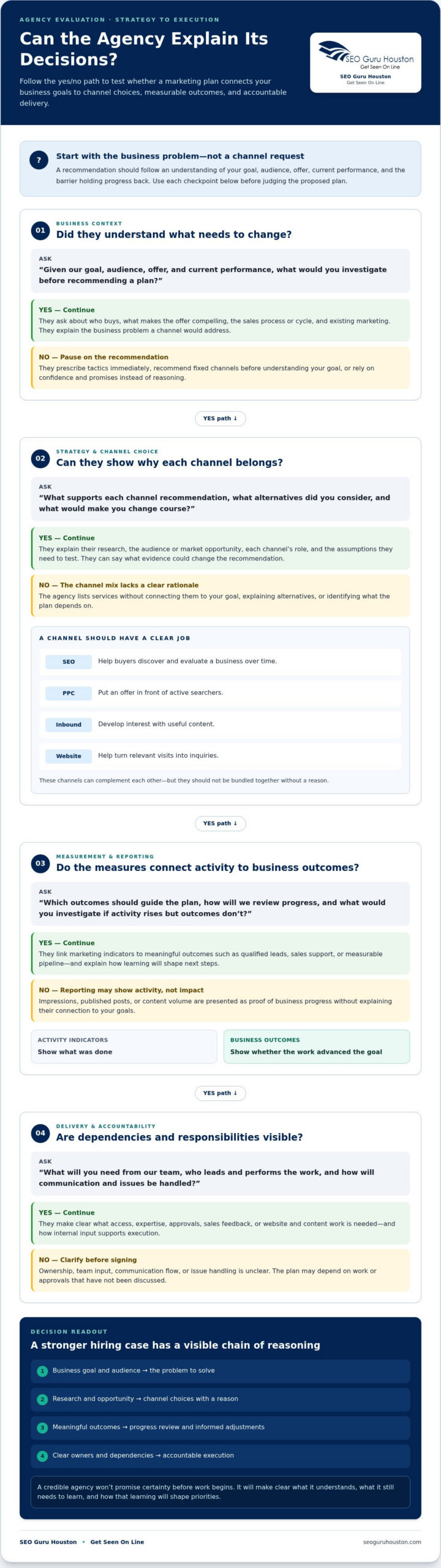
Ask: “Given our goal, audience, offer, and current performance, what would you investigate before recommending a plan?” The answer should show how the agency connects your business context to marketing decisions. For example, a company looking for more qualified sales conversations may need to clarify its ideal buyers, offer, and sales cycle before deciding whether SEO, PPC, inbound marketing, or another channel belongs in the plan.

Listen for questions about who buys, what makes the offer compelling, how long a sale takes, and what current performance reveals. A channel recommendation can make sense, but it should follow a clear explanation of the problem it addresses. Be cautious if the agency prescribes tactics immediately or relies on confidence and promises instead of reasoning.

Quick answer check:

  • Strong signal: The agency asks about your audience, offer, sales process, and existing marketing.
  • Strong signal: It explains the business problem a proposed channel would address.
  • Warning sign: It recommends a fixed set of channels before understanding your goal.

How will the agency define a successful partnership?

Ask: “Which outcomes should guide the plan, and how will we review progress?” The answer should connect marketing work to a business result, such as generating qualified leads, supporting sales, or building a measurable pipeline. Clarify how the agency will evaluate progress and use what it learns to set next steps.

Separate outcomes from activity. Impressions, published posts, and content volume can show what was done, but they don’t prove that the work advanced your business goal. Ask how those indicators relate to meaningful results and what the agency would investigate if activity increases but outcomes don’t.

“A useful agency brief names the business outcome, the audience it matters to, and the barrier marketing must help overcome.”

A credible answer won’t promise certainty before the work begins. It will make the logic visible: what the agency understands, what it still needs to learn, and how that knowledge will shape priorities. Among the questions to ask before hiring a marketing agency, this one helps reveal whether the pitch is built around your business or simply around a list of services.

Ask How the Marketing Agency Builds Strategy and Chooses Channels

A strategic recommendation should have a clear chain of reasoning: what the agency learned about your audience and market, which opportunity it sees, and why the proposed channels fit your goal and resources. Ask what research informs the plan, how the agency understands buyer needs and competitors, and what evidence could change its recommendation. The questions to ask before hiring a marketing agency should test the thinking behind the channel mix, not just the list of services.

How does the agency decide which channels deserve investment?

Ask: “What supports each channel recommendation, what alternatives did you consider, and what would make you change course?” Listen for a clear explanation of each channel’s role in the customer journey. SEO may help buyers discover and evaluate a business over time; PPC can put an offer in front of active searchers; inbound marketing can develop interest with useful content; and website or landing page work can help turn relevant visits into inquiries. Similarly, for creator and UGC initiatives, specialized partners like Indie Collaborates show how vetted influencer campaigns should connect directly to measurable performance. These channels can complement each other, but they shouldn’t be bundled together without a reason.

For a closer look at search strategy, explore this guide to professional SEO services.

What to assess Useful agency reasoning What to learn
Strategy Connects the audience, business goal, and market opportunity Why this plan fits your situation
Channel rationale Explains each channel’s job and alternatives considered Where attention and effort will go
Dependencies Identifies needed website changes, content, access, or approvals What must be ready for execution
Expected learning Names the assumptions to test and how findings inform adjustments How the strategy can evolve

What will the agency need from your team?

Ask what access, subject-matter expertise, approvals, and sales feedback the work depends on. A sound plan makes responsibilities visible. Your team may provide product knowledge or review content, while the agency uses that input to shape campaigns, pages, and lead-generation activity. Clarify how the plan will use existing assets and internal marketing capacity, so it builds on what’s already working rather than duplicating effort.

If business-to-business growth is a priority, this B2B demand generation guide offers a related perspective. A tailored digital plan works best when agency recommendations, internal expertise, and sales feedback support the same goals. Learn more about SEO Guru Houston’s digital marketing approach and how connected digital services can support planning.

Questions About Marketing Results, Reporting, and Proof

A marketing report should help you make decisions, not just display activity. Ask which indicators connect campaign work to qualified leads, sales, or pipeline, and how the agency will assess whether performance is moving in the right direction. The answer should distinguish early signals, such as relevant traffic or completed inquiries, from business outcomes that may take longer to emerge.

Channel metrics show what marketing activity produced; business outcomes show whether that activity mattered to the company.

What should a useful marketing report explain?

Ask what the report includes, how often you’ll review it, which data sources it uses, and who will interpret the findings. Depending on your setup, sources might include Google Analytics 4, Google Ads, and CRM data. A dashboard alone isn’t enough. Look for clearly defined metrics, trends over time, context for changes, and recommended actions.

Clarify attribution limits, too. A customer may interact with several channels before becoming a lead or buyer, and available tracking may not show every influence. Ask how the agency will account for that uncertainty rather than presenting one channel’s numbers as the complete story. If results differ from expectations, the agency should explain what it will investigate, such as lead quality, landing-page performance, campaign targeting, or tracking issues.

  • Clear definitions: You know what counts as a lead and how it’s qualified.
  • Useful context: The report explains what changed and why it may matter.
  • Next steps: Findings lead to specific questions, tests, or adjustments.

How can you assess case studies and performance claims?

Ask what the client’s starting point and objectives were, what timeframe the results covered, and which work the agency handled. A useful case study explains relevant context, including changes to the offer, website, sales process, or other marketing activity. Ask how results were measured and what the agency can reasonably attribute to its contribution.

Past performance can show how an agency thinks and works, but it can’t guarantee the same outcome for your business. Your audience, competition, resources, sales cycle, and starting conditions may differ. Treat a case study as evidence to examine, not a forecast. Among the questions to ask before hiring a marketing agency, this one helps distinguish transparent proof from a headline claim. Look for careful explanations, not promises based on someone else’s results.
Questions to Ask Before Hiring a Marketing Agency: A 2026 Guide

Ask About Execution, Communication, and Accountability Before You Sign

A sound strategy needs a working process behind it. Before signing, make sure you know who owns the work, how tasks move from plan to delivery, how updates and decisions are handled, and what happens when problems arise. These questions to ask before hiring a marketing agency help turn a promising pitch into clear expectations your team can use day to day.

  • Ownership: Who leads the account, who performs the work, and who makes decisions on each side?
  • Workflow: How do tasks, approvals, dependencies, and deadlines move from kickoff to completion?
  • Communication: How often will you meet, which channels will you use, and where will decisions be recorded?
  • Issue resolution: How will the team raise delays, performance concerns, or proposed scope changes?

Who owns the work and how will progress stay visible?

Ask who your day-to-day contact will be and which specialists will contribute. Then agree on a meeting rhythm, communication channels, approval windows, and the people authorized to make decisions. After each review, action items should have clear owners and next steps. Documented dependencies, such as your team supplying subject-matter input or approving a landing page, make it easier to catch delays before they stall execution.

What happens when priorities or performance change?

Ask how the team will use new evidence to adjust campaign priorities and explain changes to the plan. Clarify how a scope change is raised, how its impact on timing or workload is evaluated, and how it’s approved before work shifts. If results raise concerns, expect direct communication about what the team sees, what it’s investigating, and what happens next. Avoid arrangements where reporting changes without explanation or issues become a blame exercise.

Put the working model in writing before the engagement begins: contacts, responsibilities, review points, approval steps, and how changes are handled. That gives both teams a shared reference when priorities shift and makes accountability practical, not just a word in a pitch.

See how SEO Guru Houston’s digital marketing services bring strategy and execution together across SEO, PPC, websites, and demand generation.

Turn Your Marketing Agency Questions Into a Clear Hiring Decision

A confident presentation can make every agency sound capable. Base your decision on the quality of its reasoning and whether its approach fits your business. Use the same questions to ask before hiring a marketing agency in each conversation, then record specific evidence instead of relying on who made the strongest impression.

How do you compare answers without choosing the best presentation?

Score each agency across the same five areas: strategy, measurement, execution, communication, and business fit. You might rate each area from 1 to 3, where a low score means the answer lacked clarity and a high score means it was specific, relevant, and supported by clear reasoning. Add a brief note beside each score so your decision reflects what the agency actually explained.

  • Strategy: Did the recommendation connect to your goals and audience?
  • Measurement: Were outcomes and reporting explained in practical terms?
  • Execution: Were roles, workflow, and dependencies clear?
  • Communication: Did the agency explain how decisions and concerns will be handled?
  • Business fit: Did its proposed approach account for your resources and priorities?

Compare answers against the business outcomes you established, not against how polished the pitch felt. If an agency leaves an assumption unanswered, record it as a point to resolve in the proposed scope. That can prompt a useful discussion rather than automatically ruling out a potential partner. Look for clear logic, realistic expectations, and a defined route from planning to action.

What should happen after choosing a marketing agency?

Before work begins, make sure the agreed scope captures the goal, responsibilities, reporting approach, and review points. Use the kickoff to align on access, decision-makers, immediate priorities, and what your team needs to provide. Then agree on how progress will be reviewed and how new information can shape strategic adjustments. A shared plan gives both teams a practical starting point.

Ready to turn your priorities into a focused plan? Build a strategy for measurable digital growth with SEO Guru Houston. A strong partnership starts with a clear goal, a tailored digital strategy, and an accountable path forward.

Choose a Growth Partner With a Clear Plan

The questions to ask before hiring a marketing agency should help you see beyond the pitch. Look for a strategy grounded in your business goals, a measurement plan that connects marketing activity to meaningful outcomes, and a working process with clear ownership and communication.

Before you commit, make sure the proposed scope explains what the agency will do, what your team will contribute, and how you’ll review progress together. The right partnership isn’t built on confident promises. It’s built on sound reasoning, realistic expectations, and a plan that can adapt as you learn.

SEO Guru Houston connects specialized SEO and PPC services with website development, landing pages, and demand generation to support business growth. Discuss a digital strategy built around your growth goals and take the next step with clarity.

Frequently Asked Questions

What questions should I ask before hiring a marketing agency?

The questions to ask before hiring a marketing agency should reveal how it will understand your goals, choose channels, measure progress, and manage the work. Ask who will perform the work, what your team needs to provide, and how recommendations may change as new evidence emerges. Use the same core questions with each agency to compare clear reasoning and defined responsibilities instead of broad promises or presentation style.

How do I know if a marketing agency is right for my business?

A suitable agency should understand your audience, sales process, growth goals, and internal capacity before recommending an approach. In specialized sectors, this alignment is crucial; for example, luxury houses often turn to niche brand strategy consultancies like Omedia Paris because prestige audiences require distinct storytelling and positioning. Ask it to explain why its strategy fits your situation and how it will evaluate progress. Relevant experience can help you assess its capabilities, but it doesn’t guarantee the same results for your business. Consider the quality of its reasoning, communication, reporting plan, and ability to adapt as your needs and findings evolve.

What should a marketing agency include in its proposal?

A useful proposal connects your business goals to a defined strategy, recommended services, responsibilities, measurement, and a process for reviewing progress. It should state important assumptions and dependencies, such as access, approvals, or input from your team. Check that the proposal explains how findings will be reported and what decisions they’ll inform. These details give both sides a practical basis for agreeing on scope, priorities, and how the work will proceed.

How can I tell whether a marketing agency’s results are genuine?

Ask what the client’s starting point and objective were, how results were measured, what timeframe was involved, and which work the agency performed. Look for context about other factors that may have influenced the outcome, such as changes to the website or sales process. A case study can demonstrate experience, but it isn’t a forecast for your company. Credible explanations describe limitations and how the findings shaped later decisions.

Should I hire one agency for SEO and PPC?

It depends on your goals, audience, internal capacity, and how the channels need to work together. Ask how SEO and PPC each support the strategy, how performance will be assessed, and who coordinates the work. One agency may provide a more integrated plan, while a focused engagement may fit a narrower priority. Choose based on strategic fit, clear ownership, and the agency’s ability to connect channel activity to your business objectives.

How often should a marketing agency report results?

Set a reporting cadence that fits the campaign, the decisions you need to make, and the time required for meaningful data to emerge. Ask what regular updates will cover and how the team will flag urgent issues. A useful report explains results, context, and recommended next steps rather than presenting unexplained numbers. Agree on the format and schedule during planning, then revisit them if campaign activity or business priorities change.

What are red flags when hiring a marketing agency?

Be cautious if an agency guarantees outcomes outside its control, recommends tactics without explaining why, or reports activity without connecting it to business objectives. Unclear responsibilities and unanswered questions about assumptions can also create friction. These signs warrant specific follow-up, not necessarily an immediate decision. Ask how success will be measured, who owns each task, and how changes will be handled. Proceed when the answers give you enough clarity to define scope and expectations.

Lead Capture Page Examples: 5 Types That Turn Visitors Into Prospects

What if the form that brings in the most leads is also the reason sales spends time on poor-fit prospects? When visitors reach your page but don’t submit, it’s tempting to shorten the form or copy another business’s layout. But effective lead capture page examples show that the right amount of friction depends on the offer, audience, and visitor’s readiness to act.

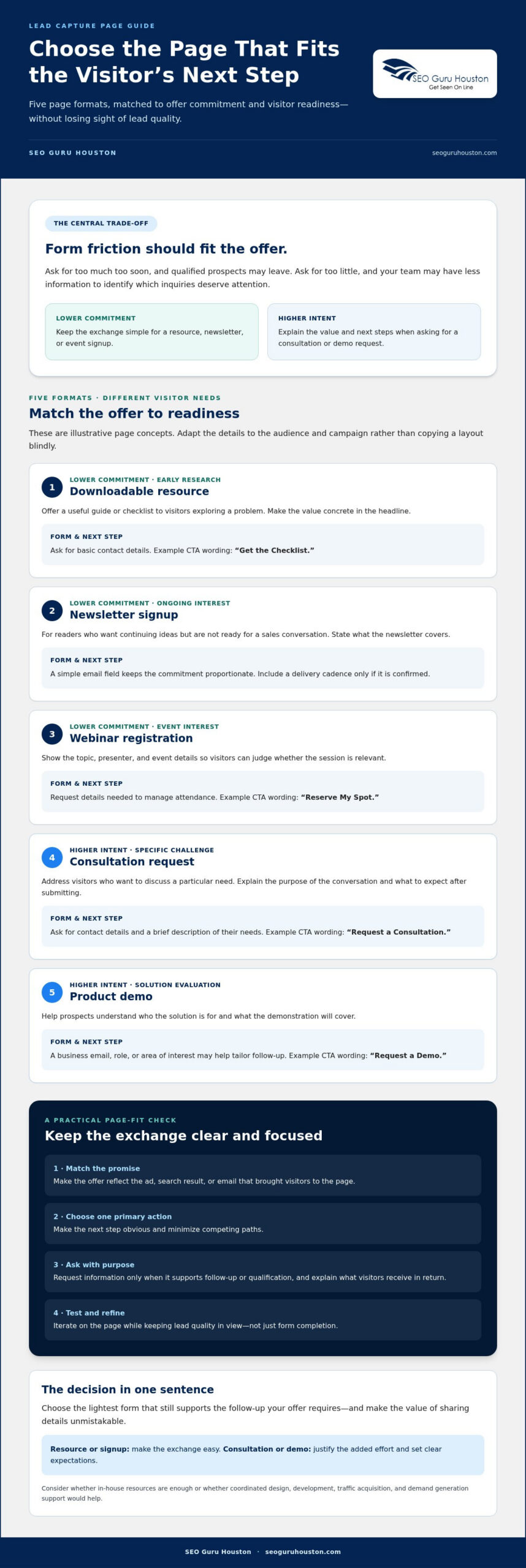
There’s more to a successful page than polished design. The offer should match the ad, search result, or email that brought visitors there. Ask for too much information too soon, and qualified prospects may leave. Ask for too little, and your team may struggle to identify which inquiries deserve attention.

This guide compares five page formats and explains where each fits, what it asks of visitors, and what to consider in its copy, form, and trust elements. Use it to match a page to your conversion goal, balance form completion with lead quality, and create a focused experience that turns the right visitors into actionable prospects.

Key Takeaways

  • See how five lead capture page examples align different offers with visitor readiness and a clear next step.
  • Compare form fields, calls to action, and qualification goals before choosing a page format.
  • Match the page promise to the message that brought visitors there, then focus the page on one primary conversion action.
  • Use testing and iteration to refine the page without losing sight of lead quality.
  • Learn when in-house resources may be enough and when coordinated design, development, traffic acquisition, and demand generation can help.

What Makes a Lead Capture Page Example Worth Copying?

A page can look polished and still miss its goal if the offer, form, and visitor’s reason for arriving don’t line up. A lead capture page is a focused page that offers something of value in exchange for a visitor’s contact or business information. It connects a relevant offer to a focused form and a clear conversion action, giving visitors a reason to share their details.

The best lead capture page examples aren’t templates to copy blindly. They show how the structure should change with the page’s goal, the audience’s readiness, and the value being offered. Someone exploring a topic may be open to downloading a practical guide, while a prospect comparing vendors may be ready to request a consultation or product demo. Match the next step to the visitor’s likely needs instead of sending everyone to the same form.

Lead capture page vs. landing page: what is the difference?

A lead capture page is a type of landing page built specifically to collect prospect details. The broader term also covers pages designed for other actions, such as selling a product or encouraging event registration. The Landing page overview also identifies “lead capture page” as another name for this focused format.

For example, a company promoting a webinar might send visitors to a dedicated registration page with the event details and signup form. A general website page might describe the webinar too, but its navigation and other links can draw attention toward unrelated content.

What should a strong lead capture page accomplish?

The headline and offer should reflect why visitors arrived. If an ad promises a product demonstration, explain what the demo helps them evaluate rather than switching to an unrelated offer. Make the next step obvious with one primary call to action and as few competing paths as practical.

Then balance form friction with lead fit. A low-commitment resource may need only basic contact details, while a consultation request may justify asking about a business need or role. Request information only when it supports a clear follow-up or qualification purpose, and explain what visitors receive in return. The exchange should feel relevant and straightforward.

5 Lead Capture Page Examples for Different Offers and Buyer Stages

The right page format depends on what visitors are ready to do and what you’re asking them to share. These five concepts are illustrative, not client examples, case studies, or claims of proven results. Use them to shape a page around your offer, then adapt the details to your audience and campaign.

The more commitment an offer asks of a visitor, the more clearly the page should justify that effort and explain what happens next. Unbounce’s collection of lead capture page examples can offer additional design ideas, but the best model still depends on your offer and traffic source.

Examples for lower-commitment offers and early-stage visitors

  • Downloadable resource: For visitors researching a problem, offer a useful guide or checklist in exchange for basic contact details. A headline such as “Plan Your First Product Launch With This Step-by-Step Checklist” makes the value concrete. Keep the form concise and use a direct CTA such as “Get the Checklist.”
  • Newsletter signup: Invite readers who want ongoing ideas but aren’t ready for a sales conversation. State the subject matter, and include a delivery cadence only if it’s confirmed. A simple email field and “Sign Up” CTA keep the commitment proportionate.
  • Webinar registration: Feature the topic, presenter, and event details so visitors can judge the session’s relevance before sharing information. Ask for the details needed to manage attendance, and make the next step clear with a “Reserve My Spot” CTA.

These lower-commitment offers can attract people at different stages of interest. A short form reduces effort, but a signup alone doesn’t establish whether someone is a strong fit for a future sales conversation.

Examples for higher-intent prospects and considered purchases

  • Consultation request: Address visitors who want to discuss a specific challenge. Explain the purpose of the conversation and what to expect after submitting. Ask for contact details and a brief description of their needs, then use a CTA such as “Request a Consultation”—a structure used by platforms like adudesk.com to assess project scope before matching homeowners with vetted professionals.
  • Product demo: Help prospects evaluating a solution understand who it’s for and what the demonstration will cover. A form might ask for a business email, role, or area of interest if those details help tailor the follow-up. “Request a Demo” makes the next step clear.

Consultation and demo pages ask for a stronger signal of intent than a newsletter signup, so additional questions may be reasonable. Tie each field to a real qualification or follow-up need. Greater commitment doesn’t guarantee a better-fit lead. If page execution is a challenge, landing page design and development is one area of support to consider.

How to Compare Lead Capture Page Examples Before Choosing a Format

Don’t choose a page format just because it looks polished. Compare each option against the offer, the visitor’s likely readiness, and the information your team needs next. This makes the trade-off clear: the effort required from visitors should be proportionate to the value they expect to receive.

Create a comparison table with one row per format and columns for:

  • Offer: What does the visitor get?
  • Visitor readiness: Are they exploring a problem or evaluating a solution?
  • Form fields: What information is essential?
  • CTA: What action will the visitor take?
  • Qualification purpose: How will the details support follow-up or help assess fit?

Then check message match. A page reached from a search result, ad, email, or referral should continue the same conversation. If an ad promises a product demo, the headline should confirm that offer and the page should explain what the demonstration covers. This alignment helps visitors see that they’re in the right place. It also supports lead generation by connecting initial interest to a relevant next step.

For guidance on coordinating page structure and conversion elements, see this guide to high-converting landing page design.

How many form fields should a lead capture page use?

Start with the fields required to deliver the offer or take the promised next step. A resource download may only need contact information, while a consultation form could ask for a brief description of the visitor’s needs. Add qualification questions only when the answers will meaningfully improve follow-up or help assess fit.

Shorter forms can reduce submission friction, while extra fields can provide useful context. Test changes against completed submissions and downstream lead quality, not form completion alone. Removing a field may increase responses while leaving your team with less information to prioritize inquiries.

Which trust and conversion elements belong on the page?

Use testimonials, credentials, or client logos only when they’re verified and you have permission to display them. Set clear expectations near the form: what information you’re requesting, what happens after submission, and where visitors can find privacy information. Avoid unsupported promises about data handling or compliance.

Make the primary CTA prominent and specific. “Get the Guide” or “Request a Consultation” tells visitors what action they’re taking; generic wording like “Submit” does not. Keep supporting details focused on reducing uncertainty rather than adding competing actions.

Lead Capture Page Examples: 5 Types That Turn Visitors Into Prospects

How to Build and Test a Lead Capture Page That Converts

A strong page starts before the first design choice. Define who it’s for, what the offer delivers, and where visitors will come from. Then make every element support one measurable conversion action. The patterns in these lead capture page examples can help you choose a format, but testing with your own audience shows whether the page is doing its job.

Conversion rate measures how often visitors submit; business value depends on whether those submissions become relevant, qualified opportunities. Track both where measurement allows, so you don’t judge the page by volume alone.

A practical lead capture page build sequence

  1. Set the target: Identify the intended audience, offer, traffic source, and event that counts as a conversion, such as a completed registration or request.
  2. Build the message: Write a headline that matches the original ad, search result, email, or referral. Add accurate, relevant supporting proof, a form suited to the offer, and clear privacy information. Draft a confirmation message that tells people what happens next.
  3. Check the experience: Test the page on mobile and desktop. Make sure form labels are clear, the page is usable with a keyboard, text is easy to read, and the form works from start to confirmation. Check loading performance before launch.

Keep the page focused on one primary conversion action. If visitors arrive from a campaign promising a consultation, don’t make them guess whether the page is about a download or a demo. The page and campaign should make the same promise.

For more ideas on improving page performance, explore this conversion rate optimization guidance.

What should you test and measure after launch?

Start with a baseline. Track page visits, form starts, completed submissions, and qualified outcomes where available. These measures help show where visitors drop off and whether submitted leads progress beyond the form.

Test one meaningful variable at a time, such as the headline, CTA wording, or form length. Compare results across relevant traffic sources, since visitors arriving from search may behave differently from those responding to an email. Don’t treat a small or inconsistent sample as a clear winner; gather enough evidence to make a useful decision.

Connect submissions to sales acceptance or another defined quality signal when your measurement setup permits. If the page generates more submissions but fewer appropriate prospects, revisit the offer, targeting, or form questions. Use page data and lead outcomes together to guide the next iteration.

Need support aligning landing page development with your acquisition strategy? Explore landing page and demand generation support.

When to Get Expert Help With Lead Capture Page Design

Your team may be able to build a straightforward page in-house when the offer is clear, the form works reliably, and someone can monitor results. Specialist support may help when page issues involve design, development, analytics, and the campaigns sending visitors. The goal isn’t simply to make the page look better. It’s to identify what’s preventing the page and its traffic strategy from working together.

Signs your page needs more than a visual redesign

A fresh layout won’t fix a mismatch between visitor intent and the offer. Before changing colors or rearranging sections, check whether the ad or search result sets an expectation the headline doesn’t meet, whether the offer is hard to understand, or whether form steps create confusion. These are possibilities to investigate, not diagnoses. Review page behavior and visitor feedback before deciding what to change.

Also check whether your measurement connects visits and submissions to useful outcomes, such as sales acceptance or a qualified inquiry. If tracking stops at the form, you may know how many people submitted without knowing whether those leads were relevant. Separate confirmed problems, such as a broken form, from assumptions that need evidence. That distinction helps your team focus its time and budget.

How landing page design fits into a wider growth strategy

A capture page doesn’t operate on its own. SEO, PPC, inbound marketing, or demand generation may bring visitors with different questions and levels of intent. Someone arriving from an educational search may need a resource, while a person responding to a campaign about a specific solution may be ready for a more direct offer. Reflect that context in the page copy and offer.

Coordination takes more than visual design. Development needs to support a usable page and functioning form; acquisition strategy needs to attract the intended audience; and the offer needs to give visitors a clear reason to act. For B2B teams, a considered B2B demand generation strategy can help frame how page activity fits into broader prospect development. Professional support can connect these pieces, but it does not promise a particular conversion rate or sales result.

If your team is reviewing lead capture page examples but needs help turning the right format into a functioning part of its acquisition strategy, discuss landing page design and lead generation with a team that offers website development and landing pages alongside SEO, PPC, inbound marketing, and demand generation.

Turn the Right Page Format Into Your Next Step

The strongest lead capture page examples do more than look appealing. They align the offer with visitor intent, ask for information in proportion to the value promised, and make the next action unmistakable. Choose a format that fits your audience’s readiness, then test the message, form, and CTA against both submissions and lead quality.

Keep the full journey in view. The promise in an ad, search result, or email should carry through to the page, and the page’s results should connect to meaningful business outcomes. That’s how a landing page becomes part of a coordinated growth strategy rather than an isolated design project.

SEO Guru Houston offers landing page design and website development, alongside SEO, PPC, inbound marketing, and demand generation capabilities. If you’re ready to connect page design with the way you attract prospects, explore landing page design and lead generation support. Start with a clear offer and a focused next step, then improve the page using what you learn.

Frequently Asked Questions

What is a lead capture page?

A lead capture page is a focused web page that collects contact or qualifying information in exchange for an offer, such as a guide, consultation, webinar, or product demonstration. It should explain the value visitors receive, what happens after they submit, and which action to take. Measure success by completed forms and whether the resulting leads are relevant to your business.

What should a lead capture page include?

A lead capture page should include a clear headline, a relevant offer, concise supporting copy, a visible form, and a button that describes the action. Add only evidence you can verify and have permission to use, such as testimonials or client logos. Explain what happens after submission and provide appropriate privacy information. Keep unnecessary navigation and competing calls to action from distracting visitors from the page’s main goal.

How many fields should a lead capture form have?

Use the fewest fields needed to deliver the offer or support the next step. A simple download may need only basic contact details, while a consultation request may benefit from a few questions about the visitor’s needs. Each extra field can add effort, so compare completion rates with lead usefulness. Test changes with enough relevant traffic before deciding which form works best for your business.

Do lead capture pages need a thank-you page?

A confirmation experience helps visitors know their submission was received and what to expect next. It might provide the promised resource, explain how follow-up will happen, or offer a relevant next step without distracting from the original conversion. Use a dedicated thank-you page or an on-page confirmation, depending on how you deliver the offer. Check that your analytics records the intended conversion accurately.

What is a good conversion rate for a lead capture page?

There’s no single conversion rate that defines success for every page. Results depend on the offer, audience, traffic source, buying stage, form requirements, and how you count conversions. Establish a baseline using consistent analytics, then assess completed submissions alongside lead quality. Compare similar traffic sources and campaign conditions. Treat external benchmarks cautiously, since their audience and measurement methods may differ from yours.

Should a lead capture page have navigation?

A focused page often limits navigation so visitors can concentrate on its offer and primary action. Still, removing every route to important information can create uncertainty or make the page harder to use. Consider the audience, offer, and page purpose when deciding what to include. Visitors should be able to access necessary privacy details and understand who is making the offer. Test meaningful alternatives rather than assuming less navigation is always better.

How do you test a lead capture page?

Start with a hypothesis tied to a measurable issue, such as an unclear headline or a form that asks for unnecessary information. Where practical, change one major element at a time and define success before the test begins. Review completed submissions alongside qualified outcomes, compare relevant traffic, and collect enough data to make a sound decision. Don’t call a winner based on a small or inconsistent sample.

Building a B2B Content Calendar: A Practical 2026 Guide

What if your B2B content calendar did more than tell the team what to publish next? Building a b2b content calendar around dates alone can keep posts moving, but it won’t solve reactive publishing, disconnected topics, or unclear ownership. A useful calendar connects buyer questions to business priorities and helps you assess whether content is supporting the work it was created to do.

Consistency matters, but publishing regularly without direction can produce assets that sales can’t use and buyers don’t need. A practical calendar gives marketing, sales, and subject-matter experts a shared plan, with clear owners, deadlines, approvals, distribution steps, and performance measures.

This guide shows you how to build that system for 2026. You’ll connect business goals and buyer needs to focused themes, formats, and production tasks, then set up a manageable workflow and measurement loop. The result is a calendar that can coordinate demand generation, organic search, paid promotion, and landing pages around a shared objective. You’ll also learn how to use performance insights to make more informed content decisions over time.

Key Takeaways

  • Build your calendar around one or two business priorities, then connect each asset to a specific audience need.
  • When building a b2b content calendar, prioritize ideas by strategic fit, buyer importance, search opportunity, sales usefulness, and team effort.
  • Keep the workflow manageable by assigning one accountable owner to each production stage and defining reviewers clearly.
  • Choose measures that match each asset’s purpose, separating publishing reliability from audience engagement and business outcomes.
  • Use performance insights to refine future topics and distribution, without assuming content alone caused revenue.

What a B2B content calendar should do beyond scheduling posts

A basic publishing list answers one question: “What goes live, and when?” A strategic calendar also clarifies who needs each asset, what decision it supports, who owns the work, and how the team will distribute and assess it. A B2B content calendar organizes content decisions as well as publishing dates.

That distinction separates filling slots from building a useful system. An editorial calendar offers a foundation for scheduling content, but building a b2b content calendar around business goals means connecting each planned asset to objectives, buyer questions, sales needs, and channel activity. Marketing, sales, and subject-matter experts should be able to see what’s planned and understand why it matters.

How a content calendar supports a complex B2B buying journey

Buyers need different information as they recognize a problem, compare options, and prepare to make a decision. Awareness content might explain a challenge. Evaluation content could compare approaches or trade-offs. Decision-stage material might help a stakeholder assess implementation considerations. Map each asset to the question it answers, rather than assigning a generic funnel label and stopping there.

Different stakeholders may also have different concerns. A technical evaluator may need to understand how a solution works, while a finance leader may focus on cost justification and risk. Plan for these distinct needs without assuming every person in a buying group needs the same asset. Helpful content can support demand generation and sales conversations, but no single piece should be treated as a guaranteed lead source.

What belongs in the calendar, and what does not

Include the information the team needs to make decisions and move work forward:

  • Audience, topic, and intent: who the asset serves, what it covers, and the buyer question or business objective behind it.
  • Format and channel: whether it’s an article, case study, or another asset, and where it will be published or distributed.
  • Owner, status, and deadline: who’s accountable, where the work stands, and when the next milestone is due.
  • Success measure: the indicator that fits the asset’s purpose, such as engagement, sales use, or qualified conversion activity.

Make the workload visible. Label early ideas as tentative and separate them from confirmed commitments, so a brainstorm doesn’t look like a production promise. Keep detailed instructions, source material, and review notes in linked briefs. The calendar should be easy to scan; the brief should guide execution. Together, they create a clear path from buyer need to published and distributed content.

How to build a B2B content calendar from business goals

Start with a business priority, not a list of topics. If the priority is improving visibility for a key solution, the calendar may need search-focused educational content. If sales needs help addressing recurring objections, plan assets that explain those concerns to the relevant stakeholders. Building a b2b content calendar this way gives every planned item a clear purpose and prevents the team from scheduling disconnected ideas just to fill slots.

Set objectives and map buyer questions

Translate one or two business priorities into content objectives, such as increasing awareness, supporting evaluation, or equipping sales conversations. Gather input from sales, subject-matter experts, customer-facing teams, and existing analytics. Look for recurring questions, objections, search patterns, and gaps in customer research. These signals can help you validate themes before turning them into production commitments.

Use this workflow to turn those insights into a plan:

  • Set the objective: Identify the business priority and the content outcome that can support it.
  • Identify the audience: Specify the role, account type, or stakeholder group the content is for.
  • Map needs: Capture the audience’s questions and concerns at relevant journey stages.
  • Select topics: Choose themes that address those needs and fit the priority.
  • Assign the work: Select a feasible format and channel, then name an owner and reviewer.
  • Review the plan: Confirm capacity, distribution, and a suitable measure before making a commitment.

Every planned asset should name its audience and purpose, so the team knows whose question it answers and which business priority it supports. This makes it easier to decide whether an idea belongs in the calendar now, later, or not at all. For a sales-oriented perspective on planning content that drives sales, consider how buyer questions and sales needs can guide topic choices.

Turn priority themes into briefs and calendar entries

Choose the format and channel based on the audience’s needs, the asset’s purpose, and what the team can deliver. A complex topic may call for an in-depth article. A sales team may need a concise resource to share during evaluation. When useful, connect channels to the same objective, such as supporting organic search with paid promotion or a relevant landing page.

Each calendar entry should identify the owner, subject-matter reviewer, deadline, distribution plan, and success measure. Link it to a brief that captures the angle, evidence to source, call to action, and search intent. This keeps the calendar scannable while giving the people creating the asset enough direction to do the work. Teams coordinating content with broader demand generation can also explore B2B marketing support.

How to prioritize B2B content ideas without overloading the team

A calendar fails when it commits the team to more work than it can produce. Publishing dates don’t create capacity. Before adding an idea, weigh its value against the effort needed to research, draft, review, approve, and distribute it. Building a b2b content calendar means making trade-offs, not treating every promising topic as an immediate assignment.

Choose a prioritization model that fits available capacity

For quick, explainable decisions, use an impact-and-effort matrix. Prioritize ideas with strong audience and business value that the team can realistically deliver. Defer high-effort topics when their benefits are unclear. A weighted score can help compare a larger backlog, but only if the team agrees on the criteria, evidence, and decision owner. A precise-looking score shouldn’t disguise guesswork.

Use a shared set of questions to assess each idea. The ratings below are illustrative, not universal benchmarks. Adjust them to your business priorities and available evidence.

Criterion Topic A: recurring buyer objection Topic B: emerging market trend
Audience importance High, raised in sales conversations Medium, audience relevance needs validation
Strategic fit High, supports a current priority Medium, adjacent to the priority
Search opportunity Medium, confirm with search data Unknown, research needed
Sales usefulness High, addresses a known question Low to medium, usefulness unclear
Effort Medium, requires subject review High, requires new research

Topic A may be the stronger near-term choice, but verify the assumptions rather than treating the example as a rule. Protect capacity for revisions, subject-matter review, approvals, and distribution. A plan that accounts only for drafting is likely to slip as soon as feedback is needed.

Compare channels and formats against the job to be done

Balance evergreen content that answers lasting questions with timely topics tied to launches or changing buyer concerns. Repurpose useful material when it suits the audience and channel, and check that the plan covers awareness, evaluation, and decision needs without forcing an asset into every stage. Search-focused articles can support discoverability; a landing page can serve a specific conversion journey. Email, social media, or video can work when they fit audience access and team capability.

Prioritize the asset first, then select the channel mix that supports its purpose. For a wider view of coordinating content and channels, see this guide to B2B inbound marketing strategy.

Building a B2B Content Calendar: A Practical 2026 Guide

Manage a B2B Content Calendar from Brief to Publication

A calendar becomes useful when it shows how work moves, not just when an asset is due. Building a b2b content calendar means mapping each item from idea to brief, draft, subject-matter review, editing, approval, publication, and distribution. Assign one accountable owner to every stage. Contributors can help, but when ownership is shared without being clear, no one may know who should move the work forward.

Set responsibilities, approvals, and realistic deadlines

Clarify who owns strategy, drafting, subject expertise, editing, final approval, publishing, and promotion. One person may cover several roles on a small team; what matters is making ownership visible. Choose reviewers based on the asset’s subject and risk. A technical claim may need an expert’s review, while a sensitive or regulated claim may require additional approval before publication.

Work backward from the publish date. Allow time for drafting, fact-checking, subject review, editing, approvals, and accessibility checks. Set a review window that fits the team’s workload, then define what happens if feedback is late. The owner might follow up, escalate to the designated approver, or reset the date. A clear process prevents silent delays from becoming missed deadlines.

Set a planning cadence the team can sustain. Some teams may plan themes well ahead and confirm individual assets closer to production; others may need a shorter horizon. Review upcoming work often enough to catch capacity changes, but avoid adding meetings that create more overhead than clarity.

Use a calendar format the team will actually maintain

A spreadsheet, project-management tool, or marketing platform can all work. Choose based on how people collaborate, manage approvals, and access briefs. The tool matters less than having a single source of truth. Standardize fields, status labels, owner names, and file naming so the team can quickly see what’s planned, blocked, or ready to publish.

Keep the calendar scannable and link each entry to the brief and working draft. If an asset needs a focused conversion destination, connect its distribution plan to high-converting landing page design guidance. For editorial work that supports broader pipeline programs, use the same planning principles to coordinate content with demand generation.

Need help aligning content operations with demand generation? Explore B2B marketing support as you refine your process.

How to measure and improve your B2B content calendar

A calendar that tracks only what shipped tells you whether the team published, not whether the content served its purpose. Measure execution separately from audience response and business outcomes. That distinction makes a missed deadline visible without mistaking a high publishing volume for marketing impact.

Choose metrics that match the content objective

Before an asset goes live, decide what evidence you’ll use to assess it and where that evidence will come from. Choose measures that fit the job the content is meant to do:

  • Attract an audience: Review organic visibility, relevant search queries, clicks, and engagement in the analytics tools available to your team.
  • Support consideration: Look at meaningful actions, such as visits to a related page, resource requests, or engagement with the asset, alongside sales feedback about its usefulness.
  • Assist a buying decision: Where tracking allows, review qualified actions and assisted conversions, then check whether sales conversations reflect the questions the content was designed to answer.
  • Keep production on track: Monitor whether assets move through stages on time and where approvals or reviews tend to stall.

Set limits on reporting before drawing conclusions. A CRM, web analytics, search performance data, and sales feedback each show different parts of the journey. Document what each source can and can’t tell you, and use consistent tracking where appropriate. If a prospect interacted with several touchpoints, don’t claim one article caused the sale. Treat attribution as evidence of contribution, not proof of sole causation.

Turn performance reviews into the next planning cycle

Review progress and results at a cadence that fits your publishing volume and sales cycle. A small team with a handful of active assets may need a different rhythm than a team publishing across several channels. Focus on decisions, not dashboards for their own sake. Which audience questions keep coming up? Which journey stages lack useful content? Which assets need an update because information, search performance, or buyer needs have changed?

For each review, choose a next action: refresh content that remains valuable but needs updating, repurpose a strong idea for another relevant format, consolidate overlapping assets, or retire material that no longer serves a clear need. Record the decision and owner in the calendar, then carry those insights into the next planning cycle. That feedback loop makes building a b2b content calendar an ongoing improvement process, rather than a one-time scheduling exercise.

If in-house capacity limits execution, consider whether specialist support in SEO, paid promotion, or landing pages could help connect content with broader demand generation goals.

Turn Your Content Calendar Into a Growth Engine

A strong calendar does more than keep publication dates visible. It connects business priorities to buyer questions, gives every asset a clear owner and purpose, and helps the team focus on work it can deliver well. Building a b2b content calendar also means making room to assess what happens next, from audience engagement to qualified actions and sales feedback.

Keep improving the system. Use performance insights to refresh useful assets, fill gaps in the buyer journey, and make smarter choices about future topics and channels. The goal isn’t to publish more for the sake of output. It’s to make content a coordinated part of demand generation.

SEO, PPC, inbound marketing, and demand generation services, along with website development and landing page design, can help connect content with broader marketing activity. Explore B2B marketing support and take the next step toward a coordinated demand generation strategy.

Frequently Asked Questions

What should a B2B content calendar include?

A B2B content calendar should include the details needed to plan, assign, publish, and evaluate each asset. Track its audience, topic, purpose, format, channel, owner, status, deadline, distribution plan, and success measure. Link to a brief for detailed instructions instead of squeezing them into the calendar. When building a b2b content calendar, keep fields consistent and easy to scan so the team can quickly see priorities and workload.

How far ahead should a B2B content calendar be planned?

Plan far enough ahead to align content with business priorities, while keeping near-term production flexible. One approach is to set broad themes annually, coordinate campaigns quarterly, develop briefs closer to production, and manage immediate tasks weekly. Treat these as planning horizons, not fixed rules. The right timeline depends on publishing pace, review requirements, team capacity, and how often business priorities or buyer needs change.

Who should be involved in building a B2B content calendar?

Involve people who understand business priorities, buyer questions, subject accuracy, and execution. Marketing can coordinate the calendar; sales and customer-facing teams can share recurring objections and information needs; subject-matter experts can validate technical details. Assign one accountable owner to each asset or workflow stage, and select reviewers based on the content’s subject and risk. Not every contributor needs to attend every planning discussion.

How do you prioritize B2B content ideas?

Compare each idea by audience importance, fit with current business priorities, search opportunity, usefulness to sales, and production effort. Use an impact-and-effort matrix for quick decisions, or a weighted score if the team agrees on criteria and evidence. Prioritize ideas with a clear audience need and purpose that your team can deliver. Keep lower-confidence or resource-intensive ideas in a backlog until they’re validated or capacity opens up.

What is the difference between a content strategy and a content calendar?

A content strategy defines why content is needed, who it serves, what business objectives it supports, and how success will be assessed. A content calendar turns those decisions into planned work by recording topics, formats, channels, owners, deadlines, and status. The strategy sets direction; the calendar helps the team act on it. Without strategic direction, a calendar can become a list of publishing dates disconnected from buyer or business needs.

How can a small B2B team maintain a content calendar?

Keep the calendar lean and plan only work the team can realistically produce. Use a shared spreadsheet or project tool, limit fields to those that support decisions, and give each asset one clear owner. Focus on a small set of business priorities, reuse strong material when it suits another channel, and leave room for reviews and updates. A brief recurring check-in can surface blockers and help adjust deadlines before work stalls.

Which metrics should a B2B content calendar track?

Track operational measures, audience response, and business indicators separately. Operational measures include on-time publication and workflow delays. Audience measures may include organic visibility, relevant engagement, and visits. For assets intended to support consideration, review qualified actions, sales feedback, and assisted conversions where tracking allows. Match metrics to each asset’s purpose, identify reporting sources in advance, and avoid claiming that a single piece of content caused revenue.

B2B Social Media Strategy: A Practical 2026 Guide

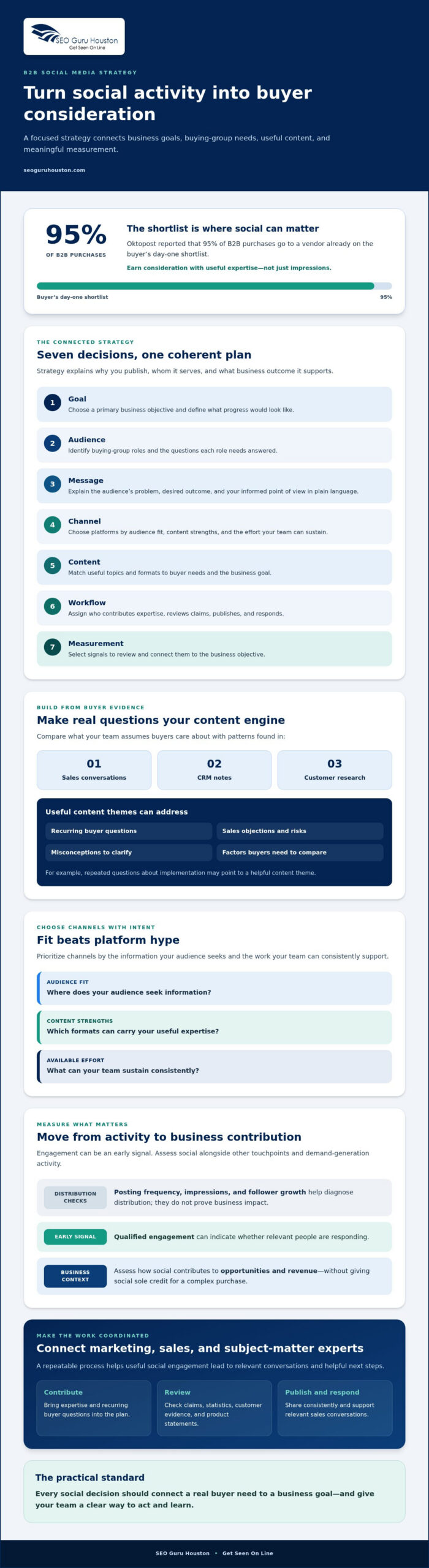
What if your social media presence helped buyers shortlist your company before they ever spoke with sales? Oktopost reported in June 2026 that 95% of B2B purchases go to a vendor already on the buyer’s day-one shortlist. A social media strategy for b2b companies should help earn that consideration, not just collect impressions. Yet it’s easy to spread a small team across too many platforms, publish without a clear audience, and struggle to connect engagement with opportunities or revenue.

You’re right to expect more from social than a steady stream of posts. The challenge is building a focused approach that supports how buying groups research, compare, and validate potential vendors, while giving your team a practical way to create and distribute useful content consistently.

This guide shows you how to prioritize platforms around your audience and business goals, shape an editorial focus, and establish a repeatable content workflow. You’ll also learn how to track meaningful pipeline signals alongside engagement, so you can assess social activity in the context of demand generation and broader digital marketing.

Key Takeaways

  • Build a social media strategy for b2b companies around business goals, buying-group needs, and clear measures of success.
  • Turn customer questions and sales objections into useful content themes your team can plan and publish consistently.
  • Choose channels based on audience fit, content strengths, and available effort, not platform hype.
  • Track qualified engagement as an early signal, then assess how social contributes to opportunities and revenue.
  • Coordinate marketing, sales, and subject-matter experts so social engagement leads to relevant conversations and helpful next steps.

What a B2B Social Media Strategy Must Accomplish

A social media strategy is more than a decision to post regularly. A B2B social media strategy is a set of connected decisions about business goals, buying groups, channels, content, resources, and measurement that guides how social supports growth. A publishing calendar tells your team what goes out and when. Strategy explains why it matters, whom it serves, and what outcome it should support.

That distinction keeps activity from becoming the goal. Posting frequency, impressions, and follower growth can help diagnose distribution, but they don’t prove social is moving the business forward. Define the outcomes first, such as helping the right buyers discover your company, building trust through useful expertise, supporting consideration, giving sales relevant material for conversations, or staying helpful to existing customers.

Start with business goals and buying-group needs

Choose one primary business objective before selecting platforms or formats. Then map the people involved in a purchase, including decision-makers, influencers, and others who shape evaluation. What do they need to understand? Which objections or risks slow a decision? A social media strategy for b2b companies becomes more focused when it answers real buying questions instead of assuming every audience wants the same message.

Separate assumptions from evidence. Compare what your team thinks buyers care about with patterns in sales conversations, CRM notes, and customer research. If prospects repeatedly ask how implementation works, for example, that may point to a useful content theme. Keep the objective specific enough to guide choices, but broad enough to address the buying group’s different information needs.

Set a realistic role for social media

Social can help buyers discover your expertise, encounter consistent messages, learn about a problem, and find relevant resources. It can also support sales conversations and customer retention when teams share useful, timely information. As a foundation, this overview of social media marketing explains the broader practice; a B2B strategy connects it to a defined audience and business purpose.

Keep expectations grounded. Organic social can influence a complex purchase without being the only source a buyer encounters, so it rarely deserves sole credit for a conversion. Measure its contribution alongside other touchpoints and demand-generation activity. A broader B2B demand generation framework can help show how social fits with channels and follow-up that support demand capture. The aim is not to claim every win for social. It’s to make social’s role clear, useful, and measurable.

Build a B2B Social Media Strategy Around Audience, Message, and Content

Once the business objective is clear, turn it into a plan your team can execute. A strong social media strategy for b2b companies connects what buyers need to know with what your business needs to accomplish. Use this sequence to keep the decisions connected:

  • 1. Goal: Choose the primary business objective and define what progress would look like.
  • 2. Audience: Identify the buying-group roles you need to reach and the questions each role asks.
  • 3. Message: State the audience’s problem, the outcome they want, and your informed point of view in plain language.
  • 4. Channel: Select platforms based on where your audience seeks information and which formats your team can sustain.
  • 5. Content: Match useful topics and formats to buyer needs and the goal.
  • 6. Workflow: Assign who contributes expertise, reviews claims, publishes, and responds.
  • 7. Measurement: Decide which signals you’ll review and how they relate to the business objective.

Translate buyer research into a clear message

Make the message specific enough to guide content, but not so broad it could belong to any company. Ask subject-matter experts and sales teams to surface recurring questions, misconceptions, and objections. Then check those ideas against sales conversations, CRM notes, and customer research. A useful post might explain a complex decision factor, address a common concern, or clarify what buyers should compare.

A B2B social content plan should reflect the questions buyers actually ask, so every post helps them make a better-informed decision. Keep claims precise. Verify statistics, customer evidence, and product statements before publishing, and don’t present an illustrative example as a customer result.

Create content pillars and a workable publishing system

Group ideas into a small set of recurring themes tied to audience needs and business priorities. For example, a team might organize content around expert insights, educational resources, customer proof approved for use, and carefully selected material from credible sources. Each type has a different job: original insight builds perspective, education answers questions, verified proof provides evidence, and curation adds useful context.

Choose formats to fit the message, not a trend. Expert commentary can unpack a timely issue; short video can make a process easier to understand; documents can organize a practical checklist; discussion prompts can invite relevant questions. Set a realistic production rhythm, name contributors and reviewers, and repurpose strong ideas thoughtfully rather than posting filler to meet a quota. For a complementary approach to connecting useful content with buyer needs, explore B2B inbound marketing.

Choose B2B Social Media Channels by Buyer Fit, Not Hype

The strongest channel isn’t automatically the one with the loudest buzz or the biggest reported audience. It’s the one your buying group uses for relevant information, where your team can contribute credibly and consistently. LinkedIn can support professional discovery and conversation, but that doesn’t make it the default choice for every B2B buyer. Validate assumptions against customer research, sales feedback, and the channels prospects mention during evaluation.

Assess platform fit before committing resources

Compare each channel against four practical questions: Are decision-makers and influencers there? Does the platform suit the content you can produce well? How much effort will consistent participation require? What business role could it support? The table is a starting point, not a universal ranking. Confirm fit with evidence from your own audience.

Channel Potential audience fit Content fit Relative effort Possible goal
LinkedIn Buyers who use professional networks for industry information and discussion Expert commentary, company perspectives, useful documents, conversation prompts Moderate, with regular input from knowledgeable contributors Discovery, credibility, and professional conversation
YouTube Buyers who seek in-depth explanations or demonstrations Educational explainers, interviews, walkthroughs High if planning, production, and review exceed team capacity Education and consideration
Reddit or specialist communities People who seek peer discussion or answers in topic-focused spaces Detailed responses, practical insights, careful participation Moderate to high, depending on the research and engagement required Listening, discovery, and trust through relevant participation

Effort depends on your team, not just the platform. A subject expert who enjoys explaining technical topics may make video a workable choice; a lean team without production capacity may get more from focused written contributions. Start with a manageable channel set. Expand only when buyer evidence supports it and you can maintain quality without weakening existing efforts. For teams that need external expertise to establish and maintain a consistent digital footprint, consulting marketing specialists like cornerstone-ms.co.uk can help bridge the resource gap.

Match channel roles to the wider buyer journey

Think of social as a route into useful information, not the whole journey. A post can introduce a problem or explain an idea; a relevant resource on your site can provide depth and a clear next step. Coordinate social distribution with search, paid campaigns, and conversion-focused landing pages so each touchpoint supports the same message. For campaign traffic, use the high-converting landing page guide to consider how the destination can support the action you want visitors to take.

Keep testing disciplined: define what evidence would justify continuing, adjusting, or adding a channel. That turns platform selection from guesswork into a practical decision within your social media strategy for b2b companies.

B2B Social Media Strategy: A Practical 2026 Guide

Launch, Measure, and Improve Your B2B Social Media Strategy

A social program becomes measurable when the team agrees on what it’s trying to change and how it will review progress. Use a simple launch sequence to establish that discipline before activity scales:

  • 1. Set a baseline. Record current performance for the channels and business indicators tied to your objective. Note how the data is defined and where it comes from.
  • 2. Assign ownership. Name who plans content, approves claims, publishes, monitors responses, and shares relevant activity with sales.
  • 3. Build the calendar. Schedule themes and formats your team can sustain, leaving room to respond to timely questions and conversations.
  • 4. Configure tracking. Use consistent UTM parameters on campaign links where appropriate, and confirm that the destination page and analytics setup can capture relevant visits. Record useful context in CRM records when the process supports it.
  • 5. Set a review cadence. Choose a regular interval for checking early signals and a longer window for assessing outcomes that take time to develop.
  • 6. Iterate with evidence. Keep what supports the objective, refine what shows promise, and stop activity that consumes effort without a clear role.

Choose KPIs that reflect the strategy’s objective

Match a small set of indicators to the goal, then define the measurement period and what counts. Qualified comments, relevant conversations, resource visits, or responses from target roles can serve as leading indicators. Reach and engagement help diagnose whether content is being seen and prompting a response, but they don’t automatically demonstrate pipeline contribution.

Opportunities, progression through CRM stages, and revenue are lagging outcomes. Review these alongside campaign data and sales feedback where available. UTM parameters can identify some visits or conversions associated with tagged links, but they can’t capture every influence: buyers may see a post, discuss it internally, and return through another channel. Social reporting can show contribution and patterns, but it isn’t proof that social alone generated the revenue.

Run focused experiments and adjust the plan

Test one meaningful variable at a time, such as the audience, format, message, or call to action. Write down the hypothesis, observation window, result, and decision before repeating the test. If you change several elements at once, it’s harder to tell what affected the outcome.

Use Google Analytics 4 and CRM reporting only when they’re configured, relevant to the question, and verified by your team. Keep measurement practical. If your team needs support connecting social media marketing with broader demand generation, explore coordinated marketing support.

Turn Your B2B Social Media Strategy Into Coordinated Demand Generation

Social earns more value when it connects to what happens next. A useful post can introduce a challenge, an educational resource can help a buyer explore it, and a sales conversation can address the questions that follow. Treat each interaction as part of a connected path, not a demand-generation result on its own.

Connect social content to a useful next step

Match the call to action to the reader’s readiness. Someone encountering your company for the first time may benefit from an educational guide; a buyer comparing options may need a detailed resource or a relevant conversation with your team. Avoid asking every reader for the same commitment. The next step should feel like a logical continuation of the content.

Make sure the destination page delivers on the post’s promise. It should clearly identify who the resource is for, what the visitor will find, and what they can do next. Coordinate social campaigns with inbound marketing so posts, useful resources, and follow-up support a consistent experience instead of treating every post as a standalone lead generator.

Make the handoff clear

Set expectations for what happens when someone engages. Marketing can identify relevant interactions and share context; sales can decide whether a direct response is appropriate; subject-matter experts can clarify technical questions or contribute accurate answers. Define who owns each handoff and what information to pass along, such as the content viewed, the question asked, or the buyer’s stated need. A timely, relevant response builds on the interaction without assuming every like or comment signals purchase intent.

Before assigning ownership, check your internal capacity across strategy, creative, publishing, analytics, and subject expertise. Keep the work in-house where responsibilities and time are clear. If coordinating channels or interpreting measurement exceeds that capacity, outside support may help align social media marketing with B2B marketing, demand generation, PPC, and website or landing-page services. The agency offers these services as potential parts of a coordinated digital approach.

Use this action checklist

  • Connect each content theme to a buyer need and a business priority.
  • Choose a next step that fits the reader’s readiness, then make the destination page clear and relevant.
  • Agree on how marketing, sales, and subject-matter experts will route and respond to meaningful engagement.
  • Review ownership and capacity before expanding channels or publishing commitments.
  • Assess social alongside other demand-generation activity, without assigning it sole credit for a complex conversion.

Ready to connect social activity with a broader B2B marketing plan? Build a stronger B2B digital marketing strategy with support aligned to your business goals.

Turn Your Social Strategy Into Measurable Momentum

A focused social media strategy for b2b companies starts with business goals and buyer needs, then turns them into channel choices and useful content your team can sustain. Prioritize platforms based on evidence, not hype. Measure qualified engagement as an early signal, then review how social activity connects with opportunities and revenue without claiming sole credit for complex buying decisions.

The next step is coordination. Connect social posts to relevant resources, align marketing and sales on useful follow-up, and make sure each channel supports the wider demand-generation journey. If your team needs help bringing those pieces together, the agency offers social media marketing, B2B marketing, demand generation, SEO, PPC, website development, and landing-page capabilities that can support a coordinated digital approach.

Build a stronger B2B digital marketing strategy around your audience and business goals. Start with a clear objective, keep learning from buyer signals, and give your team a practical plan to move forward with confidence.

Frequently Asked Questions

What is a social media strategy for a B2B company?

A B2B social media strategy connects business objectives with buyer audiences, channel choices, messaging, content, team responsibilities, and measurement. It defines what social should help accomplish and how the company will assess progress. Unlike a posting calendar, it explains why the company publishes, whom it serves, and how social supports the wider buying journey. For example, a strategy might use expert content to answer buyer concerns and guide interested readers to a relevant resource.

Which social media platform is best for B2B companies?

There’s no single best platform for every B2B company. LinkedIn may suit professional conversations and business-focused content, while YouTube may fit audiences that prefer video explanations. Other channels can make sense if buyers use them to research relevant topics. Choose based on evidence about your audience, the content your team can produce credibly, your business goals, and available capacity. Test assumptions with a focused effort before committing substantial resources to a channel.

How often should a B2B company post on social media?

Post at a pace your team can sustain while keeping content useful and relevant. The right frequency depends on audience expectations, available resources, and how much time it takes to create and review quality content. Set a realistic cadence rather than publishing simply to fill a calendar. Then assess whether the schedule helps you reach the intended audience and learn from performance. Adjust if consistency begins to compromise quality or strain team capacity.

How do B2B companies measure social media strategy results?

Start with the strategy’s objective, then choose a small set of indicators that show progress. Reach and engagement can reveal whether content attracts attention, while qualified visits, conversions, CRM activity, and sales feedback add business context. Use consistent tracking, including UTM parameters on campaign links where appropriate. Attribution has limits: social may influence a long buying journey without being the only measurable source. Review patterns across channels instead of assigning every outcome to one post.

Can social media generate leads for B2B companies?

Yes, social can contribute to B2B lead generation by helping relevant buyers discover useful expertise and take a meaningful next step. Its contribution depends on audience fit, messaging, content, the destination experience, and follow-up. Not every interaction indicates purchase intent, and not every lead is ready for sales. Define qualification criteria, connect campaign posts to relevant landing pages, and make sure appropriate CRM processes help your team track and respond to interest.

What content should B2B companies post on social media?

Share content that answers genuine buyer questions and demonstrates useful expertise. Options include expert commentary, educational resources, product or service explanations, short videos, event insights, and customer evidence when its facts are verified and use is approved. Organize topics into a few recurring themes tied to audience needs. Match each post’s format and next step to its purpose, and avoid unsupported claims. A practical explanation of a common sales objection can be more useful than a generic promotional update.

How long does it take for a B2B social media strategy to work?

There’s no universal timeline for a B2B social media strategy to work. Timing depends on your starting audience, sales cycle, content quality, publishing consistency, and ability to distribute content and follow up. Qualified engagement may show up before measurable pipeline influence. Establish a baseline, set review periods that reflect your buying cycle, and look for trends across activity rather than judging the plan by one post. Use what you learn to refine the strategy over time.

B2B Keyword Research Guide: Find Search Terms That Drive Revenue

What if the keyword with the fewest searches could bring in your best-fit customer? In B2B, search volume alone can’t tell you whether a query reflects casual curiosity or a buyer actively comparing solutions. A useful b2b keyword research guide starts with buyer intent and business value, not a spreadsheet sorted from most searches to least.

Keyword research that connects to your products and sales process is worth the effort. But multiple decision-makers, long buying cycles, and varied customer language can make it hard to know which topics deserve your team’s time. A repeatable process helps connect search terms to buyer needs and qualified pipeline.

This guide explains how to gather ideas from search data and customer conversations, assess intent and business relevance, and organize keywords by funnel stage. You’ll also learn how to prioritize topics, turn your keyword map into useful content and conversion-focused pages, and measure whether your strategy is attracting the right audience. The goal isn’t more traffic for its own sake. It’s search visibility that supports demand generation and gives buyers a clearer path to evaluate your solution.

Key Takeaways

  • Use your products, customer problems, differentiators, and sales-team language to build a keyword list grounded in real buyer needs.
  • This b2b keyword research guide shows how to assess terms by relevance, intent, audience fit, ranking feasibility, and business value, not search volume alone.
  • Group related queries by shared intent and choose the page that best answers the buyer’s need instead of creating a separate page for every variation.
  • Turn prioritized topics into content and conversion-focused pages that support search visibility and demand generation.
  • Review rankings, relevant visits, conversions, and sales feedback together. Distinguish early visibility signals from business outcomes.

What B2B keyword research reveals about your buyers and market

B2B keyword research is the process of discovering and evaluating the searches business buyers use, then connecting those searches to customer needs and company goals. Put simply, B2B keyword research identifies relevant searches, interprets the intent behind them, and prioritizes the ones that support business objectives. That’s the difference between collecting terms and building a strategy.

A keyword tool can estimate how often people search a phrase, but that estimate doesn’t tell you who’s searching, what problem they’re trying to solve, or whether your business can help. A broad, high-volume query may attract students or people looking for general information. A lower-volume phrase describing a specific operational challenge could signal a better-fit prospect. Use volume as context, not as a verdict. Foundational concepts such as Keyword research explain how terms and search intent relate, but B2B research must also account for your products and sales process.

How B2B keyword research differs from consumer keyword research

One business purchase can involve several stakeholders, each searching from a different perspective. A technical evaluator might look for integration details, a department leader may investigate workflow impact, and a finance decision-maker may compare total costs. Their searches may look unrelated in a keyword export, yet all can belong to the same buying journey. B2B consideration can also begin well before vendor comparisons, with queries focused on symptoms, risks, and possible approaches.

Hypothetical example: A company considering project management software might have an operations lead searching for ways to reduce missed deadlines, an IT specialist checking security and integrations, and a finance leader comparing software costs. These are illustrative searches, not client performance data. Research that captures only “project management software” misses the distinct questions shaping the purchase.

Which business outcomes should keyword research support?

Start with outcomes the business can act on, such as qualified organic visits, relevant inquiries, and sales conversations with organizations that fit your offering. Raw impressions can show that a page appeared in search results, but they don’t establish whether the right audience engaged or took a meaningful next step.

SEO and demand generation can use the same research for different purposes. SEO can use intent and topic relevance to guide search-focused pages and content. Demand generation can use buyer questions to shape educational materials and conversion-focused landing pages across the journey. Together, they help teams decide what to publish and what to measure. A practical b2b keyword research guide asks not only “How many searches?” but also “Who needs this, why now, and what business goal does the answer support?”

How to conduct B2B keyword research step by step

A reliable workflow starts with what your business knows, then uses search data to test and expand that knowledge. This keeps the research connected to your offer instead of letting a tool dictate your content plan. Use these steps to create a keyword set your team can explain, validate, and act on.

Build seed topics from business and customer knowledge

  1. Set the business scope. List the products or services you want to support, the customer problems they address, and the differentiators that matter. This gives the research a clear boundary.
  2. Gather buyer language. Review product pages, sales call notes, customer questions, and common objections. Ask salespeople and subject-matter experts how buyers describe their challenges, desired outcomes, and concerns. Customer conversations can reveal ideas that tools may not surface. Neil Patel’s overview of B2B keyword research also emphasizes looking beyond volume to buyer intent and real-world language.
  3. Group the seed topics. Organize phrases around solutions, use cases, industries, and decision-maker concerns. For example, a cybersecurity provider might separate topics about cloud access controls from questions about compliance reporting or implementation. Keep the initial list focused on areas your business can credibly address.

Expand and validate keyword ideas

  1. Find query variations. Use Google autocomplete and related searches to discover how people phrase questions. Google Search Console can show queries that already lead people to your site, while keyword platforms can suggest additional terms and estimate search demand. Treat each source as research input, not an instruction.
  2. Check the live results. Search important phrases and examine what appears. Are results mostly explainers, comparison pages, product pages, or something else? The format and focus of ranking pages offer clues about the intent Google currently associates with a query. Compare that intent with the buyer need you identified.
  3. Validate and document. Remove terms that don’t fit your offer or audience, flag uncertain assumptions, and note which topics need more input from customers or the sales team. Record each keyword’s source, research date, and intended audience or stage. This makes the work easier to reproduce and refresh.

This b2b keyword research guide process turns scattered ideas into a defensible working list. From there, connect your research to the wider marketing plan. For a broader view of how keyword insights can support demand generation, explore B2B demand generation strategies.

How to prioritize B2B keywords beyond search volume

Search volume is an estimate, not a forecast of qualified traffic or revenue. Use it to understand potential demand, but don’t let it outweigh whether a query matches your offering and the people you serve. A specific, lower-volume search can deserve priority if it reflects a clear business need your company can credibly address.

Compare candidate terms against the same criteria. The example below is hypothetical, not performance data. Ratings are directional, so document your team’s reasoning rather than treating them as universal scores.

Criteria “Project management software” “Project management software for engineering teams”
Relevance Broad category match Strong if the offer serves engineering teams
Intent Could be research or evaluation More specific solution exploration
Audience fit Unclear without more context Defined audience, if it matches the target market
Ranking feasibility Review the strength and focus of current results Check whether relevant pages can compete for this niche
Business value Depends on whether broad interest aligns with the offer Potentially strong when it maps to a real use case

How to assess search intent and buying stage

Classify each query by what the searcher wants to do: learn about a topic, understand a problem, explore possible solutions, or compare vendors. Informational, problem-aware, solution-aware, and vendor-comparison labels are useful clues, not fixed funnel assignments. Search the phrase and inspect the results. Guides may indicate a need for explanation, while comparison pages or product pages can signal evaluation. Then write down the buyer question the page should answer. That question matters more than assigning a funnel stage by assumption.

How to weigh relevance, competition, and business value

Ask whether your company has the expertise and offering to satisfy the query. Next, review ranking pages for relevance, depth, and apparent authority. A keyword platform’s difficulty score can help with triage, but it can’t determine whether your page is competitive or your business is a credible fit.

Compare broad and long-tail terms using the same criteria, then explain any ratings or weighting in plain language. Sales, marketing, and subject-matter experts should challenge assumptions, especially around audience fit and commercial value. There’s no universal scoring formula. Prioritize the term your team can justify based on buyer need, business relevance, and a realistic path to serving the searcher. That’s the practical edge of a b2b keyword research guide: a prioritization method based on evidence, not volume alone.

B2B Keyword Research Guide: Find Search Terms That Drive Revenue

How to organize B2B keywords into topics and content priorities

A strong keyword list becomes useful when it tells your team what page to create, what that page should answer, and how it supports a broader topic. Group queries by shared intent and the page that can best meet the need. A topic cluster connects related content around a central subject. It doesn’t mean publishing a separate page for every wording variation.

How to map keywords to pages and content formats

Assign each planned page one primary query theme, then add closely related questions it can answer without drifting from its purpose. Match the format to what searchers need: an explainer for foundational questions, a comparison for evaluating options, a service page for a specific offering, or a case study when you have a relevant, substantiated example. Page goals matter too. A conversion-focused landing page should make the next step clear and align with visitor intent, as outlined in this guide to conversion-focused landing page design.

Before commissioning new content, review existing pages and their target themes. If two pages answer the same question for the same audience, they may compete for visibility or divide attention. Consider whether to refine one page, combine overlapping material, or clarify each page’s distinct purpose. Don’t split a topic into multiple URLs just because a keyword tool lists several close variations.

How to create a practical B2B keyword roadmap

Prioritize topics by business relevance, audience need, content readiness, and strategic dependencies. A page that depends on a clear service description or expert input may need that foundation first. Track each topic in a shared roadmap so decisions stay visible and actionable:

  • Topic and target audience: Who needs this information?
  • Intent and page type: What question should the page answer, and in what format?
  • Owner and next action: Who will move it forward, and what needs to happen next?

Review the roadmap with marketing, sales, and subject-matter experts. Their feedback can reveal missing questions, duplicated plans, or topics that aren’t a good fit. This turns a b2b keyword research guide into a working content plan, not a static spreadsheet. For a coordinated approach to attracting and educating prospects, explore how B2B inbound marketing can support content planning.

How to measure, refresh, and activate your B2B keyword research

A keyword map earns its place when it guides decisions and improves with use. Build a review loop that connects search visibility to what happens after a visit, while keeping the limits of your data in view. Rankings and clicks can show whether your content is being found. They can’t, by themselves, prove that a keyword generated revenue.

Which signals help evaluate keyword performance?

Use Google Search Console to review impressions, clicks, the queries bringing people to your site, and the landing pages appearing for those searches. Treat these as leading indicators of visibility and organic engagement, not business outcomes. Then use analytics and CRM data, where available, to examine relevant visits, meaningful page actions, inquiries, and lead quality. Agree on what counts as a qualified inquiry and how teams will report it before drawing conclusions.

Attribution depends on tracking quality, sales-cycle length, and shared reporting definitions. A prospect may discover a topic through search, return through another channel, and engage with sales later. Report what your data supports, such as organic visits to a page or inquiries associated with a tracked journey. Don’t assign revenue to a keyword without evidence connecting the search activity to the outcome.

When should you refresh your B2B keyword map?

Revisit priorities when offerings or positioning change, sales teams hear new customer language, competitors shift their content, or search results begin favoring different page types. Before adding more content, compare planned topics with existing page performance. A page may already attract relevant queries and need improvement, while another topic may lack a suitable destination.

  • Review: Compare visibility, relevant visits, conversion signals, and sales feedback against the page’s purpose.
  • Decide: Keep the target, update the page, consolidate overlapping coverage, or investigate a newly emerging need.
  • Record: Note the change, evidence, decision, owner, and next action so the research informs the next content and demand generation cycle.

Make this loop part of your working process, not a one-time spreadsheet exercise. A practical b2b keyword research guide helps teams learn from both search behavior and sales conversations, then adjust priorities accordingly. For support connecting search visibility with broader marketing goals, explore SEO and digital growth services.

Turn Your Keyword Research Into a Clear Growth Plan

A useful b2b keyword research guide does more than generate a list of search terms. It helps you connect buyer questions to your products, prioritize keywords by intent and business relevance, and organize related searches into content with a clear purpose.

Keep the process active. Use search visibility, relevant visits, conversion signals, and sales feedback to refine your priorities, while avoiding revenue claims that aren’t supported by reliable evidence. The result is a stronger foundation for content and demand generation decisions, not a promise of automatic growth.

SEO and PPC, B2B marketing, inbound marketing, and demand generation can work alongside keyword insights to support visibility and buyer engagement. Website and landing page development can help shape conversion-focused journeys around what prospects are searching for. To discuss how SEO, PPC, B2B marketing, and web development can support your marketing priorities, explore SEO and digital growth services. Keep listening to buyers, testing your assumptions, and turning each insight into a smarter next step.

Frequently Asked Questions

What is B2B keyword research?

B2B keyword research identifies and evaluates the search terms business buyers use, then connects those queries to buyer intent and business goals. It considers the different questions people may ask while researching, evaluating, and selecting a business solution. A practical b2b keyword research guide uses search data alongside customer and sales-team insights, so keyword priorities reflect real buyer needs rather than search volume alone.

How do you do keyword research for a B2B company?

Start with your offerings, customer problems, differentiators, and the language buyers use in sales conversations. Turn those insights into seed topics, then expand them with Google autocomplete, related searches, Search Console, and keyword platforms. Review live search results to understand intent and suitable page formats. Document each topic’s audience, intent, source, and next step, then validate your priorities with sales and subject-matter experts.

How many keywords should a B2B page target?

There’s no fixed number. Give each page one primary query theme and include closely related terms or questions when they share the same intent and can be answered naturally on that page. For example, one service page may address several ways buyers describe the same need. If a query represents a distinct audience or purpose, it may deserve a separate page. Prioritize usefulness and clarity over hitting a keyword count.

Should B2B keyword research focus on high-volume keywords?

No. Search volume is an estimate of demand, not proof that a query will attract qualified prospects. A broad term may bring visitors whose needs don’t match your offering, while a specific, lower-volume phrase may closely reflect a buyer’s problem or solution requirements. Consider relevance, intent, audience fit, ranking feasibility, and business value alongside volume. Let customer evidence and product fit shape priorities, not a volume sorting order.

How do you find B2B long-tail keywords?

Look for detailed phrases in sales call notes, customer questions, support conversations, and common objections. Expand those ideas with Google autocomplete, related searches, Search Console queries, and keyword platforms. Long-tail searches often describe a specific use case, industry, problem, or decision-maker concern. Check the results page to confirm what searchers appear to want, then prioritize terms your business can credibly address, even if tools report limited volume.

How often should you update B2B keyword research?

Refresh your research when a meaningful change could affect buyer needs or search intent. Triggers include a shift in your offerings or positioning, new language from sales conversations, competitor changes, or noticeably different search results. Also compare planned topics with existing page performance before commissioning more content. Record what changed, why you updated a priority, and what action follows. This keeps the keyword map useful without treating updates as busywork.

How can you tell whether a B2B keyword can attract qualified leads?

Check whether the query matches your offering, target audience, and the expertise you can demonstrate. Review its intent and current search results, then ask sales whether the underlying need appears in real buyer conversations. After publishing, examine relevant visits, inquiries, and lead quality using analytics and CRM data where available. Tracking limitations and long sales cycles matter, so don’t credit revenue to a keyword unless your evidence supports that connection.

Retargeting Campaign Best Practices: A 2026 Checklist for Better Results

Retargeting fails when every past visitor sees the same ad. If your campaigns generate impressions but few qualified conversions, the problem may not be your budget. It may be that your follow-up ignores what people viewed, how close they are to taking action, and whether they’ve already converted. Strong retargeting campaign best practices start with relevance, not repetition.

It’s easy to see why retargeting feels like a sure thing: these people already know your business. But broad audience lists, intrusive ad frequency, and unclear attribution can waste spend and wear down trust. Effective retargeting is a lifecycle-specific follow-up system, not a loop of generic ads to everyone who visited your site.

This practical checklist will help you build intent-based audience segments, set sensible exclusions and exposure limits, match messages to each stage, and measure outcomes beyond impressions and clicks. You’ll also see where privacy-conscious data practices and focused landing pages fit. The goal is to bring the right prospects back with a useful next step, then use performance evidence to improve the campaign.

Key Takeaways

  • Set a campaign objective first so each retargeting effort supports a clear stage of the customer lifecycle.
  • Use observable actions and recency to shape audience segments, then match each group with a relevant next message.
  • Choose channels and creative based on campaign purpose, and verify current platform capabilities before launch.
  • Apply these retargeting campaign best practices to review events, consent behavior, exclusions, destination pages, and conversion tracking.
  • Assess performance against meaningful business outcomes, and use a structured self-audit to identify where additional expertise could help.

Retargeting Campaign Best Practices Start With a Clear Goal

Retargeting works best when it has a specific job. It’s paid advertising aimed at eligible people who previously interacted with your brand or content, with the goal of guiding them toward a relevant next step. For a neutral introduction to the concept, see Behavioral retargeting. Methods and audience options vary by platform, so verify current tracking, consent, and targeting requirements before building a campaign.

What is a retargeting campaign, and when should you use one?

Prospecting introduces your business to people who haven’t interacted with it. Retargeting follows up with people who have, such as someone who viewed a product, started but didn’t submit a form, read relevant content, or purchased before. Each action signals a different level of familiarity, not a guaranteed intention to convert.

Use the previous interaction to decide the campaign’s role. Ads might help a content reader explore a service, encourage a form starter to complete an inquiry, or introduce a past customer to a relevant next offer. Retargeting can support consideration, conversion, repeat purchase, or lead nurturing. An interaction alone doesn’t make someone eligible: tracking availability, audience size, platform settings, and applicable platform rules all affect who can be reached and how often.

Set one measurable campaign objective before choosing ads

Start with the next meaningful action, not the ad format. If the goal is lead generation, define a qualified inquiry in terms your team can apply consistently. If the goal is repeat purchase, specify the purchase event you’ll measure. Impressions and clicks can help diagnose delivery and engagement, but they don’t prove the campaign is creating valuable business outcomes.

Before launch, document four things:

  • Baseline: Record the current level of the outcome you want to improve.
  • Conversion event: Specify the action that counts, such as a submitted inquiry or completed purchase.
  • Reporting window: Set the period you’ll use to assess results, and apply it consistently.
  • Owner: Name who will monitor delivery, review lead or customer quality, and decide what to adjust.

These retargeting campaign best practices give your team a clear way to judge performance instead of mistaking reach for impact. Keep the definition concise: “We’ll show relevant ads to eligible people who previously interacted with our brand, and measure whether they complete [defined action] within [reporting window].”

Build Retargeting Audiences Around Intent and Customer Lifecycle

A site visit is a signal, not a complete picture of intent. Someone who visited a pricing page may be closer to an inquiry than someone who read a general article. Someone who already purchased may need a retention message, not another ad urging them to buy for the first time. Strong retargeting campaign best practices turn these differences into clear audience and messaging rules.

Which retargeting audience segments should you create first?

Begin with actions that connect to a meaningful next step. Group eligible visitors by behavior, then choose a follow-up that fits what they did:

  • High consideration: People who viewed pricing, service details, or product pages may need a focused benefit or a clear path to ask questions.
  • Incomplete action: Form starters who didn’t submit may need a reminder that addresses a likely barrier, if the platform can build this audience appropriately.
  • Early research: Readers of educational content may respond better to a helpful guide or related resource than an immediate sales message.
  • Past customers: Separate purchasers from acquisition audiences. Consider retention or repeat-purchase messaging only when there’s a relevant next offer.

Set audience duration around your actual buying cycle and observed conversion patterns. Review how long it typically takes people to act, then adjust the inclusion window as evidence accumulates. A fixed duration for every audience can keep people in a campaign after the message is no longer useful. For lead-stage follow-up, align advertising with the broader progression from first engagement to sales readiness. This B2B demand generation guide offers a useful framework for thinking about that journey.

Use exclusions and privacy-conscious audience rules

Exclusions help keep your campaign relevant. If the objective is acquiring new customers, suppress people who have already completed the target purchase or inquiry. If those customers warrant follow-up, create a separate audience and define a distinct retention goal. Review exclusions as offers and objectives change, rather than letting old rules run unchecked.

Before activating any audience, confirm that your tracking and consent behavior, data use, and platform settings meet applicable requirements. Platform policies and audience capabilities can change, so verify them before launch. Collect only the data needed to define and evaluate the audience, and document its source, inclusion criteria, exclusions, and review owner. This record makes it easier to spot stale segments and maintain consistent controls.

Give each segment a next action and matching creative. Don’t show an educational-content reader the same message as a pricing-page visitor. If audience rules, paid campaign management, or the destination page need a closer review, explore paid campaign planning support.

Choose Retargeting Channels, Creative, and Frequency by Context

The right channel depends on who you can reach, what action you want, and which format can make the next step clear. Search, display, social, and video each have different audience requirements and creative strengths. Platform capabilities change, so verify current audience options, placements, measurement access, and frequency controls before launch. Don’t spread budget across every channel by default.

How do you choose a retargeting channel?

Compare audience availability, intent, creative fit, and measurement before committing. A channel belongs in the plan only if it can reach an eligible audience and support the campaign objective. Use one testable hypothesis at a time, such as whether a concise social message helps pricing-page visitors request more information.

Channel Strength Limitation Suitable context
Search Can meet people as they search for relevant information. Audience targeting and delivery options vary by platform. Re-engaging eligible visitors who return to search with related intent.
Display Visual reminders can extend reach across supported placements. Broad exposure can feel repetitive without careful audience and frequency management. Reinforcing consideration with a clear, recognizable message.
Social Supports feed-friendly creative and messaging suited to the platform. Available audiences, formats, and controls can change. Following up with eligible visitors using a relevant next step.
Video Can explain a product, service, or process through motion and sound. Requires suitable creative and an audience the platform can reach. Addressing questions that need more explanation than a short ad can provide.

Create relevant ads without causing ad fatigue

Build the message around the visitor’s previous action and likely next question. A pricing-page visitor may need a clear way to compare options; someone who watched an explainer may benefit from a deeper resource. Keep the ad and destination page aligned so the promise doesn’t disappear after the click. This high-converting landing page design guide covers how to maintain that consistency.

Rotate distinct creative concepts, not just minor wording changes. Where frequency controls are available, set them deliberately, then review exposure alongside engagement, conversions, and negative feedback. If people see the ad repeatedly but stop responding, refresh the message, narrow the audience, or pause delivery. These retargeting campaign best practices keep exposure tied to usefulness rather than repetition. If channel selection, PPC campaign management, or landing-page alignment needs a structured review, explore paid campaign support.

Retargeting Campaign Best Practices: A 2026 Checklist for Better Results

Use This Retargeting Campaign Checklist to Launch and Optimize

A disciplined pre-launch review can catch broken events, mismatched messages, and wasted spend before they distort your results. Use this sequence to check the full path, from audience setup to the action you expect people to take. Platform interfaces and tracking requirements change, so verify current settings before activation.

What should you check before launching a retargeting campaign?

Work through each step in order. An audience appearing in an ad platform doesn’t prove that every setting is correct.

  • Confirm the objective. Name the business action the campaign should support and how you’ll recognize a qualified outcome.
  • Review audience rules. Check inclusion criteria, exclusions, eligibility, and whether the audience is large enough for the platform to serve ads.
  • Verify tracking and consent behavior. Test relevant tags and events, and confirm tracking behaves as intended when a visitor’s consent choices change.
  • Test the conversion path. Complete the journey yourself, from ad link to landing page to submission or purchase. Check for firing events, broken links, and discrepancies between platform and analytics reporting.
  • Inspect the experience. Make sure ad claims match the destination page, the next action is clear, and the page works on mobile.
  • Record the launch details. Document the baseline, conversion event, reporting window, budget owner, and person responsible for optimization.

Quick reference: Approve the campaign only after its objective, audience eligibility, exclusions, consent behavior, tags and events, destination page, mobile experience, and conversion tracking have been checked and documented.

How should you measure and improve campaign performance?

Review business outcomes alongside delivery signals. Track qualified inquiries or purchases along with reach, frequency, engagement, and conversion events. Compare results with the baseline you recorded, and note how attribution is configured. Ad platforms and analytics tools may report different totals because they use different tracking and attribution methods. A reported conversion can show an attributed relationship, but attribution alone doesn’t prove the ad caused the action.

Set a recurring review schedule that fits campaign volume. At each review, look for delivery problems, audience saturation, changes in lead or customer quality, and gaps between platform reporting and internal records. If performance shifts, change one major variable at a time, such as the creative or audience rule, and log the change, date, and outcome. That makes each test more informative than changing several settings at once.

These retargeting campaign best practices turn launch QA into an ongoing improvement process. If you need support coordinating PPC campaign management with tracking and landing-page development, review paid campaign management options.

Make Retargeting a Measurable Part of Your Growth Strategy

Retargeting earns its place when it supports a broader growth plan, not when it runs as a disconnected stream of ads. Connect paid campaigns to demand generation and a landing page designed around the action you want visitors to take. That alignment helps teams assess whether follow-up advertising is contributing to qualified inquiries, sales progression, or customer retention.

When should you manage retargeting in-house or seek support?

An internal team may be well placed to manage campaigns when it has the capacity to maintain them, understands relevant platform settings, can produce and refresh creative, and trusts its measurement process. If one or more of those pieces is missing, outside expertise may help close the gap. The decision is about capability and workload, not company size.

Before engaging a partner, clarify who will manage audience strategy, tracking coordination, creative testing, reporting, and communication. Ask what work is included, what access your team will have, how often results will be reviewed, and how recommendations will be documented. Look for a clear process and scope, not just promised outcomes. A broader PPC management guide can also help frame retargeting within paid campaign planning.

Turn the checklist into a campaign improvement plan

Don’t try to fix everything at once. Choose the largest verified gap, whether it’s audience quality, message relevance, or measurement confidence. Then write down the action, its owner, the evidence you’ll use to assess it, and a review date. For example, if the landing page doesn’t deliver the next step promised in an ad, assign someone to address that mismatch before changing several campaign settings.

Retargeting campaign best practices matter most when they become a repeatable operating habit. Connect each improvement to a business outcome, review what the evidence can and can’t tell you, and carry useful findings into the next campaign cycle. If your priorities are clear and you’d like support with PPC management, demand generation, or landing-page development, explore PPC and digital growth support.

Turn Retargeting Insights Into Your Next Growth Move

Retargeting delivers more value when it’s part of a connected growth strategy, not a standalone stream of reminders. The retargeting campaign best practices in this checklist point to a practical standard: make each follow-up relevant, respect audience choices, and judge performance by meaningful business outcomes.

Your next move doesn’t need to be a full campaign overhaul. Use your audit to identify the most important gap, assign an owner, and set a date to review progress. Then build on what the evidence shows. A well-defined audience, clear message, and useful destination page can work together to move prospects toward action.

If you want help connecting paid advertising with demand generation and landing-page development, PPC management and related campaign support are available. Explore PPC and digital growth support and consider what fits your priorities.

Keep testing thoughtfully, protect the prospect experience, and make each campaign decision count. Better results start with a clear next step.

Frequently Asked Questions

What are the best practices for a retargeting campaign?

Start with one business objective, then build eligible audience segments around relevant interactions and lifecycle stages. Match each segment with a useful message and destination page, and exclude people for whom the ad is no longer relevant. Check tracking and consent behavior before launch. The strongest retargeting campaign best practices also include reviewing qualified outcomes, exposure, and engagement regularly, then making measured adjustments instead of relying on impressions alone.

How long should a retargeting campaign run?

Run a campaign long enough to gather useful performance evidence, but don’t assume one duration fits every business. Base audience membership windows on your buying cycle and observed conversion patterns. A considered business purchase may take longer than a straightforward online order. Set a review date, check whether people are still converting within the chosen window, and adjust or pause if the audience becomes stale or the campaign no longer supports its objective.

How often should someone see a retargeting ad?

There isn’t one frequency that works for every audience, platform, and campaign. Set exposure limits where the platform offers them, then monitor frequency alongside engagement, conversions, and negative feedback. If people keep seeing an ad but stop responding, the message may be repetitive or no longer relevant. Consider refreshing the creative, narrowing the audience, or pausing delivery. Check platform controls regularly, since available settings can change.

Can retargeting work without third-party cookies?

Yes. Retargeting can use eligible first-party signals, such as customer information or activity collected directly through a business’s own properties, when platform settings and applicable requirements permit. Google’s Privacy Sandbox includes the Protected Audience API, designed to support remarketing and custom audience use cases without tracking individuals across sites. Reach and measurement may differ by platform, browser, and audience, so verify current capabilities and consent behavior before activation.

What is the difference between retargeting and remarketing?

The terms are often used interchangeably for follow-up marketing to people who have already interacted with a brand. Some marketers use “retargeting” more specifically for paid ads shown to previous visitors, while “remarketing” can also refer to follow-up through channels such as email. Naming conventions vary between platforms and teams. For campaign planning, define the audience, channel, and intended next action rather than relying on the label alone.

How do you measure whether a retargeting campaign is working?

Measure the business action the campaign was designed to support, such as a qualified inquiry or completed purchase. Review that outcome alongside reach, frequency, engagement, and conversion tracking, and compare results with a suitable baseline. Keep the attribution window and reporting method consistent. Attribution can show that a platform credited an ad with a conversion, but it doesn’t by itself prove the ad caused the outcome. Check lead or customer quality as well.

Should retargeting ads exclude people who already converted?

Usually, yes, when the campaign’s goal is to acquire a new inquiry or purchase. Exclude people who have completed that action so they don’t keep seeing an ad that no longer fits their needs. If past customers are eligible for a useful follow-up, such as a relevant repeat-purchase message, create a separate audience and objective. Review exclusions as campaign goals change, and confirm the platform can apply the audience rules as intended.

What Makes a Good B2B Website? The Assertive Blueprint for Revenue Growth in 2026

If your website is still acting like a digital brochure, it’s not an asset; it’s a liability that’s actively bleeding your market share. You’re likely watching traffic climb while your CRM stays silent, wondering exactly what makes a good b2b website in an era where 80% of the buying journey happens before a prospect even says hello. It’s frustrating to invest in visibility only to realize your site can’t close the gap between a click and a contract. You need a platform that doesn’t just look professional but actually forces the needle to move.

We’re moving past the age of “pretty” design and into the era of agentic commerce and high-velocity demand generation. This guide delivers the assertive blueprint you need to transform a static URL into a 24/7 sales powerhouse. You’ll discover the non-negotiable technical frameworks and psychological triggers that turn passive visitors into qualified leads. We’re stripping away the fluff to focus on the technical precision and strategic authority required to dominate the 2026 digital landscape. Get ready to stop chasing traffic and start engineering revenue.

Key Takeaways

  • Learn how to pivot from a static digital brochure to a high-velocity revenue engine that actively qualifies leads and shortens your sales cycle.
  • Identify the technical non-negotiables, including sub-2-second load speeds, that prevent your site from bleeding potential revenue to faster competitors.
  • Discover what makes a good b2b website by aligning your authority-building content with the modern, self-service buyer journey.
  • Master the conversion architecture and high-energy CTAs needed to transform anonymous traffic into a consistent stream of high-intent leads.
  • Build a future-proof digital presence that integrates with aggressive demand generation strategies to ensure long-term market dominance.

What Makes a Good B2B Website? Defining the Revenue Engine

A B2B website isn’t a digital business card; it’s a high-performance machine. In the competitive Business-to-business (B2B) landscape, your digital presence is either a strategic asset that qualifies leads or it’s a liability that’s bleeding your budget. Most companies settle for a “Digital Brochure” that sits passive and static. Real market leaders build a “Revenue Engine” that’s active, data-driven, and designed to shorten sales cycles by delivering value at every click. If you’re wondering what makes a good b2b website, the answer starts with its ability to force a conversion. It doesn’t just sit there. It works.

The reality of 2026 is that the buyer has changed. According to research from Intuitia Tech, 70% to 80% of the B2B buying journey is completed before a prospect ever reaches out to your sales team. This means your website is your primary salesperson. It must establish absolute authority within seconds. If a visitor can’t immediately see your technical expertise and strategic advantage, they’ll find it with a competitor who took their digital infrastructure seriously. Dominance isn’t an accident; it’s engineered through a site that speaks the language of results.

The Shift from Passive Presence to Active Demand Generation

Your website needs to do the heavy lifting that used to require a dozen sales calls. We’re moving beyond simple lead collection and into a b2b demand generation agency mindset. This means every page must use psychological triggers to move stakeholders through the funnel. You aren’t just asking them to “Contact Us.” You’re providing the proof they need to justify a high-stakes purchase. A good site qualifies the visitor by addressing pain points directly and presenting a definitive solution that makes your service a fundamental necessity for their survival.

Identifying the Core Stakeholders of Your Digital Presence

You aren’t designing for one person. What makes a good b2b website is its capacity to serve the entire buying committee. You need to provide technical transparency for the researcher, proof of efficiency for the influencer, and clear ROI for the final decision-maker. If you don’t speak the language of financial return, you’re just adding noise to the market. Trust is built through results, not fluff.

  • The Researcher: Needs deep technical specs and case studies.
  • The Influencer: Needs to see how your solution integrates and scales.
  • The Decision-Maker: Needs to see the bottom-line impact and strategic advantage.

Fail to address even one of these stakeholders, and your conversion rate will crater.

Foundational Mechanics: Speed, Security, and Seamless UX

Speed isn’t just a technical metric; it’s a conversion killer. If your site takes more than two seconds to load, you’ve already lost the lead before they even see your value proposition. Data from WordStream shows a B2B site that loads in 1 second can see 5 times more conversions than a site that takes 10 seconds. When you evaluate what makes a good b2b website, you have to look under the hood. High-velocity growth requires a high-velocity platform. Anything less is just an expensive way to frustrate your prospects.

Trust begins with a secure browsing environment. An SSL certificate and robust security protocols aren’t optional extras; they’re the baseline for professional credibility. Beyond security, your information architecture must be flawless. B2B offerings are often complex, but your navigation shouldn’t be. You need to organize your services so intuitively that a decision-maker can find exactly what they need without a map. If your high-performance digital infrastructure isn’t built on these pillars, your marketing efforts will never scale.

Technical Optimization for Search Dominance

Search engines don’t care about your aesthetic; they care about your code. Integrating professional seo services into your initial development is the only way to ensure market dominance. You need Schema markup to help AI and search engines categorize your B2B services accurately. By 2026 standards, hitting the benchmark for Core Web Vitals is mandatory for maintaining visibility. It’s about precision. Your site must be clean, crawlable, and technically superior to every competitor in your space.

User-Centric Design That Drives Action

Friction is the enemy of revenue. We implement the “3-click rule” to ensure any stakeholder can reach critical data or a conversion point within three actions. Your visual hierarchy should act as a silent guide, leading the eye away from fluff and toward high-value declarations. Mobile responsiveness is equally critical, as 80% of B2B buyers now use mobile devices during their purchasing journey. What makes a good b2b website in an enterprise context also includes ADA compliance; accessibility is a standard for national brands that refuse to leave money on the table.

  • Sub-2-Second Load Times: The non-negotiable standard for B2B retention.
  • Mobile-First Logic: Dominating the 80% of buyers researching on the go.
  • UX ROI: Every $1 invested in UX can return up to $100 according to UXtweak research.

Precision in design leads directly to precision in lead volume.

Establishing Absolute Authority Through Strategic B2B Content

Content is the digital manifestation of your expertise. In a market where buyers interact with an average of 13 pieces of content before engaging, your site must act as the ultimate guide. A fluff-filled blog won’t cut it. You need a b2b inbound marketing strategy that attacks specific industry pain points with surgical precision. If your content doesn’t solve a problem, it’s just digital noise. You’re not just providing information; you’re providing a roadmap to market dominance.

When evaluating what makes a good b2b website, look at the depth of its technical resources. White papers, webinars, and deep-dive technical articles aren’t just downloads. They’re proof of technical mastery. These assets serve as the authoritative voice that leads a prospect through the complex consideration stage, turning skepticism into trust through sheer competence. You must position your brand as the only logical choice in a sea of mediocre alternatives.

The Power of Website Video Marketing

Video is the highest-engagement medium available for complex solutions. It humanizes your brand and simplifies intricate industrial processes that text often fails to capture. Strategic Website Video Marketing focuses on placement and purpose. Use high-impact hero videos to establish immediate authority, then follow up with product-specific deep dives for the technical researchers. Video doesn’t just increase time-on-site; it builds immediate credibility by showing your solutions in action. It’s the most efficient way to bridge the gap between technical complexity and buyer understanding.

Case Studies: The Ultimate Proof of Transformation

Stop telling people what you do. Start showing them what you’ve achieved for others. Effective case studies move the needle because they provide social proof grounded in reality. We structure these using a Challenge, Solution, Result framework to ensure the narrative is clear and compelling. Use bold typography and symbols to emphasize financial gains and ROI metrics. A decision-maker doesn’t care about your feature list. They care about the measurable efficiency you delivered for a similar firm. This focus on outcomes is exactly what makes a good b2b website in the eyes of a high-value stakeholder.

What Makes a Good B2B Website? The Assertive Blueprint for Revenue Growth in 2026

Conversion Architecture: Turning Traffic into Qualified Leads

Traffic is vanity; conversions are sanity. If your site generates hits but no hand-raisers, your architecture is broken. Understanding what makes a good b2b website requires looking at how you ask for the business. Passive “Contact Us” buttons are for companies comfortable with second place. You need high-energy declarations that demand action. Research from WordStream indicates that personalized calls-to-action convert 202% better than standard ones. If you aren’t personalizing the ask, you’re leaving double the revenue on the table. It’s time to stop whispering and start leading.

The core of this strategy is high converting landing page design. These aren’t just pages; they are focused environments where distractions go to die. Every element must push the visitor toward a single objective. This is where demand generation happens. You trade high-value intellectual property, such as proprietary data or industrial frameworks, for contact information. This isn’t just a lead magnet; it’s a value exchange that positions you as the expert before the first sales call even happens.

Form optimization requires a ruthless balance. Ask for too much data, and you kill the conversion. Ask for too little, and you waste your sales team’s time with unqualified noise. Use conditional logic to keep forms short while capturing the high-intent data necessary for a sophisticated demand generation strategy. It’s about surgical precision, not just volume. You want a pipeline full of buyers, not browsers.

Strategic CTA Placement and Messaging

Context is everything. A visitor in the awareness stage shouldn’t be hit with a “Buy Now” button. You must map your CTAs to the buyer’s journey. Use urgency and value-driven language like “Secure Your Market Position” instead of generic words like “Download.” A/B testing is the non-negotiable process here. If you aren’t constantly refining your conversion points based on real data, you’re guessing with your company’s future. Stop guessing and start scaling your lead volume with precision.

Trust Signals and Social Proof

Friction is the psychological barrier between a visitor and a form submission. You crush that barrier with trust signals. Client logos, industry certifications, and specific awards are fundamental. They act as silent endorsements. Place your strongest testimonials near high-friction points, like the final field of a lead form. Absolute transparency in your results is your biggest competitive advantage. When you show exactly how you move the needle, you remove the risk of engagement. This level of conversion-focused detail is exactly what makes a good b2b website a dominant force in its industry.

Market Dominance: Building a Future-Proof B2B Presence

Market dominance isn’t a destination; it’s a constant state of evolution. If you treat your digital presence as a “set it and forget it” project, you’re essentially handing your market share to the competition. A stagnant site is a liability that hides revenue leaks you don’t even know exist. What makes a good b2b website in the long term is its ability to adapt based on hard data, not gut feelings. You need to leverage heatmaps and advanced analytics to identify exactly where prospects are falling out of your funnel. When you see the friction, you crush it. Maintenance isn’t just about fixing bugs; it’s about optimizing for a 9,900% UX ROI that forces the market to react to you.

The ultimate goal is a platform that stands as the undisputed leader in your national industry. This requires a shift from simple maintenance to a strategy of continuous improvement. With B2B website maintenance costs ranging from $5,000 to $500,000 annually depending on pipeline complexity, you must ensure every dollar spent is an investment in scalability. For organizations looking to unite high-performance digital marketing with purpose-driven web design, partnering with specialists like The Ethical Agency ensures long-term impact and architectural durability. You aren’t just building for today; you’re building a fortress that can withstand shifting algorithms and changing buyer behaviors.

Integrating SEO and PPC for Maximum Visibility

Isolation is the enemy of efficiency. Your digital strategy must be a unified front. When you work with a top-tier seo marketing company, they don’t just look at rankings; they align design with search intent. This organic foundation must be supercharged by a sophisticated ppc management strategy. Paid traffic provides immediate data on which keywords actually convert, allowing you to refine your organic content and landing pages with surgical precision. This feedback loop creates a compounding effect, lowering your acquisition costs while expanding your total search footprint. You don’t just want to be found; you want to own the entire results page.

Scaling Your B2B Digital Strategy

Ultimately, what makes a good b2b website is its capacity to scale without breaking. As you move toward international or enterprise-level expansion, your architecture must be ready to handle increased load and complex integrations. 96% of marketers have already adopted agentic AI for autonomous campaign decisions; if your site isn’t technically prepared for this level of automation, you’re already obsolete. You need a high-performance coach who understands these technical nuances and can guide your transition from invisibility to prominence. Stop settling for a site that just exists. It’s time to build a revenue engine that dominates. Take decisive action now and force your competitors to play catch-up.

Dominate Your Market with a High-Velocity Revenue Engine

Your digital presence is the battlefield where market share is won or lost. We’ve established that what makes a good b2b website isn’t just aesthetic appeal; it’s the technical precision of sub-2-second load times and a conversion architecture that forces action. If your site isn’t actively qualifying leads and shortening your sales cycle, it’s a liability you can no longer afford. The 2026 buyer demands a seamless, authority-driven experience. Anything less is an open invitation for your competitors to take the lead.

Transformation requires moving from invisibility to prominence through result-oriented technical mastery. You need a national-scale digital strategy that integrates high-converting funnels with aggressive demand generation. Stop settling for a passive brochure and start engineering a platform that works as hard as your top sales performers. The path to market dominance is clear for those ready to take decisive action. Ready to transform your website into a revenue engine? Contact SEO Guru Houston today! We’re ready to help you scale with precision and win.

Frequently Asked Questions

What is the most important feature of a B2B website?

The most important feature is a conversion-centric architecture that aligns perfectly with the modern self-service buyer journey. While aesthetics matter, your site must prioritize technical performance and clear, outcome-focused messaging to qualify leads effectively. It needs to act as a 24/7 sales engine, providing the specific data and social proof required for stakeholders to make informed decisions. A site that doesn’t force a conversion is just an expensive digital brochure.

How often should a B2B website be redesigned for optimal performance?

A B2B website should undergo a major strategic redesign every two to three years to stay ahead of rapidly shifting digital trends. However, the most successful firms adopt a continuous improvement model, using monthly data from heatmaps and A/B testing to refine the user experience. Waiting years to update your infrastructure creates revenue leaks. You must treat your site as a living asset that evolves alongside agentic AI and changing buyer expectations.

Why is SEO-first development critical for B2B lead generation?

SEO-first development is critical because it ensures your technical infrastructure is crawlable and authoritative from day one. Integrating search optimization into the initial build prevents the need for costly retroactive fixes. When evaluating what makes a good b2b website, technical precision in Schema markup and Core Web Vitals is non-negotiable. This approach guarantees that your high-value content actually reaches the 80% of buyers who conduct independent research before contacting a sales team.

What is the difference between B2B and B2C website design?

The primary difference lies in the complexity of the buyer journey and the number of stakeholders involved. B2C sites focus on emotional, immediate impulse buys, while B2B design must serve a multi-person buying committee with technical depth and financial justification. Your site must speak the language of ROI and long-term strategic advantage. It requires a structured flow that guides researchers, influencers, and decision-makers through a logical sequence of trust-building and technical transparency.

How do I measure the ROI of my B2B website?

Measuring ROI requires looking beyond vanity metrics like page views and focusing on qualified lead volume and pipeline velocity. You must track how many anonymous visitors convert into high-intent hand-raisers and eventually into closed revenue. Use advanced analytics to calculate the cost per lead and compare it to the lifetime value of the customer. A profitable site demonstrates a clear reduction in customer acquisition costs while increasing the total volume of high-margin opportunities.

Does a B2B website really need video marketing?

Video marketing is a fundamental necessity for explaining complex industrial processes and humanizing high-stakes brands. It provides the highest engagement levels of any medium, often increasing time-on-site and building immediate credibility. Strategic video placement, such as hero videos that establish authority or product deep dives, helps bridge the gap between technical complexity and buyer understanding. If you aren’t using video, you’re missing the most efficient way to communicate value to modern, mobile-first stakeholders.

What are the biggest mistakes companies make with their B2B websites?

The biggest mistakes include treating the site as a static brochure, ignoring sub-2-second load times, and using vague, jargon-heavy messaging. Many firms fail to provide clear conversion paths, leaving visitors confused about the next step. Another critical error is ignoring mobile responsiveness, which alienates the 80% of buyers researching on the go. Settling for a passive presence is the ultimate failure when considering what makes a good b2b website in a competitive landscape.

How long does it take to see results from a high-performance B2B site?

Technical improvements like site speed and UX refinements often yield immediate boosts in conversion rates for existing traffic. However, significant organic growth typically takes three to six months as search engines recognize your increased authority and technical precision. For rapid scaling, you should integrate your high-performance site with a robust PPC strategy to drive high-intent traffic instantly. The combination of a dominant platform and aggressive demand generation accelerates your path to market prominence.

High-Impact Landing Page A/B Testing Ideas to Explode Conversions in 2026

A staggering 78% of split tests fail to produce a statistically significant winner. Why? Most teams waste critical weeks tweaking superficial button colors instead of testing real revenue drivers. If you want to stop burning ad spend on visitors who bounce immediately, you need high-impact landing page a/b testing ideas that systematically dismantle conversion friction and sharpen your core offer.

You already know how frustrating it feels to watch customer acquisition costs climb across competitive PPC and paid social channels while minor design tweaks fail to move the needle. Running isolated, low-stakes experiments won’t deliver market dominance. You need a proven, repeatable framework that transforms underperforming pages into aggressive lead generators.

In this guide, you’ll discover battle-tested split-test concepts that directly cut acquisition costs, eliminate user hesitation, and maximize your paid traffic ROI. We’ll outline the exact experimentation roadmap top performers use to achieve double-digit conversion lifts and scale sustainable business growth.

Key Takeaways

  • Prioritize structural and psychological experiments over trivial aesthetic tweaks to drive real, measurable conversion lifts.
  • Deploy actionable landing page a/b testing ideas across your hero section to hook cold traffic within the first five seconds.
  • Eliminate form friction by split-testing single-step captures against multi-step progressive profiling funnels.
  • Replace generic trust badges with quantified, outcome-focused case vignettes that disarm buyer skepticism.
  • Transform one-off split tests into a high-velocity experimentation engine that continuously lowers customer acquisition costs.

The CRO Prioritization Matrix: Stop Guessing and Start Testing High-Impact Elements

Conversion rate optimization is not an interior decorating exercise. It’s an aggressive revenue engine designed to squeeze maximum pipeline value out of every single paid click. Treating optimization as cosmetic guesswork burns budget while competitors capture market share. True conversion acceleration requires systematic rigor, beginning with the core principles of A/B testing to validate behavioral shifts before deploying code.

To eliminate wasted cycles, every hypothesis must pass through a strict prioritization model: the PIE framework. By ranking ideas against three objective variables, you strip emotion out of the optimization roadmap:

  • Potential: How much conversion lift can this page realistically generate? High-bounce pages usually offer the highest upside.
  • Importance: How valuable is the incoming traffic? Pages fed by expensive PPC campaigns take precedence over low-intent organic traffic.
  • Ease: How complex is the technical implementation? Low-effort, high-impact changes always jump the queue.

Never pull the plug on an experiment early. Premature test termination creates false positives. Aim for a standard 95% statistical confidence baseline and collect sufficient sample size across full business cycles before declaring a winner.

Why Minor Cosmetic Tests Waste Valuable Campaign Momentum

Swapping a green CTA button for an orange one rarely produces sustainable revenue growth. These cosmetic adjustments fail because they ignore the primary psychological blockers preventing visitors from converting. Instead of fiddling with button borders, invest your traffic into testing radical value propositions, simplified layout architectures, and distinct commercial positioning. If your core offer fails to resonate, button color won’t save it.

The Anatomy of a Flawless A/B Testing Hypothesis

Strong experiments require disciplined hypotheses. A high-performing hypothesis always pairs an observed user struggle with a clear tactical intervention and an expected metric change. Review session recordings and scroll heatmaps to spot where friction spikes. If 60% of mobile users abandon your page before reaching the primary call to action, your structural layout demands immediate revision.

Tie every test variant directly to a single primary conversion metric, such as demo form submissions or qualified inbound phone calls. Connecting disciplined experimentation directly to high converting landing page design transforms scattered testing into a scalable revenue driver. Generating high-impact landing page a/b testing ideas is simple once you let real user friction dictate your roadmap.

Above-the-Fold A/B Testing Ideas: Winning the First Five Seconds

Your hero section dictates whether visitors engage or instantly bounce. If your above-the-fold real estate fails to communicate immediate, unambiguous value, your paid ad spend evaporates. The most high-leverage landing page a/b testing ideas focus ruthlessly on this entry screen. Start by testing your layout discipline: pit a distraction-free dedicated campaign header with zero exit links against a minimal sticky navigation bar. Stripping out extraneous menu items keeps user attention locked strictly on your core offer.

Headline Formula Battles: Problem-Centric vs. Outcome-Driven Messaging

Headlines make or break initial retention. Test a problem-centric headline that exposes an acute operational pain against an outcome-driven headline promising a concrete commercial win. For example, test an urgent problem statement (“Stop Bleeding PPC Ad Spend on Dead-End Clicks”) against a direct value proposition (“Capture 30% More Inbound Leads from Your Current Traffic”). Pair both variations with a subheadline featuring hyper-specific data to substantiate your claim immediately.

Visual Asset Split Tests: Static Graphics vs. Dynamic Demonstrations

Stock photography destroys credibility instantly. Replace decorative images with assets that deliver undeniable proof. Split test high-resolution dashboard previews against authentic photos of your actual team delivering results. Alternatively, test a 15-second silent walkthrough video demonstrating your product or process in action against a static graphic. Dynamic demonstrations often trigger deeper scroll depth by proving capability within the first five seconds of page load.

Call-to-Action Positioning: Single Hero Focus vs. Progressive Micro-Commitments

Demanding a full consultation immediately introduces friction for cold visitors. Test a single aggressive CTA (“Schedule Your Enterprise Demo”) against a low-threat micro-commitment (“Calculate Your Growth ROI”). Additionally, experiment with first-person, action-oriented button copy like “Claim My Strategy Roadmap” instead of sterile commands like “Submit Form.”

When you align your top-of-funnel messaging with precise visitor intent, conversions surge. Refining these entry points is vital, and deploying high-converting Websites Dev & Landing Pages gives your paid campaigns the commercial leverage they need to dominate.

Form and Friction Experiments: Engineering Maximum Lead Capture

Your lead form is the ultimate conversion chokepoint. You can hook prospects with a flawless headline and compelling visual proof, but an intimidating form will collapse your pipeline instantly. Finding winning landing page a/b testing ideas requires confronting form friction head-on. Every extra input field introduces cognitive drag, yet stripping out every barrier floods your sales team with junk inquiries. The goal is simple: capture high-intent leads efficiently without sacrificing lead quality.

Single-Step Simplicity vs. Multi-Step Micro-Commitment Funnels

Testing single-step forms against interactive multi-step funnels exposes how prospects prefer to share information. Presenting nine open fields upfront immediately triggers defense mechanisms. In contrast, multi-step forms use the psychological principle of commitment and consistency. By placing low-friction, non-threatening qualifying choices on step one (such as selecting an industry or primary business goal), users build momentum before reaching the final contact details screen.

  • Single-Step Layouts: Best suited for transactional, low-consideration offers like simple whitepapers or resource downloads.
  • Multi-Step Funnels: Superior for complex B2B services, custom quotes, and consultations where progressive profiling reduces perceived workload.

Field Reduction vs. Radical Qualification

Shorter forms do not always mean higher revenue. While research shows three-field forms convert 25% better than nine-field variations, and reducing fields from 11 to four can boost raw conversion volume by 120%, context matters. An email-only capture form might inflate top-of-funnel conversion rates while starving your sales reps of critical pipeline context.

Test radical qualification against basic capture. Run an experiment requiring business email, annual budget, and direct phone number against a streamlined three-field form. Track the downstream outcome: does the shorter form generate more closed deals, or does the qualified variation save your sales team hundreds of wasted hours on unqualified prospects? Measure deal velocity, not just form completions.

CTA Button Copy and Micro-Copy Security Reassurance

Default buttons labeled “Submit” or “Send Message” signal passive effort and zero value. Test assertive, benefit-driven button copy like “Get Instant Pricing” or “Launch My Growth Audit” to remind prospects of the payoff. Pair your button with clear risk-reversal micro-copy immediately underneath, such as “No credit card required” or “Guaranteed 24-hour response.” Eliminating last-second hesitation at the final click protects your paid media investments from costly eleventh-hour drop-offs.

High-Impact Landing Page A/B Testing Ideas to Explode Conversions in 2026

Social Proof and Objection Demolition: Building Bulletproof Credibility

Unsubstantiated marketing claims destroy conversions on contact. When cold traffic lands on your page, skepticism runs high. Visitors actively search for reasons not to trust you. Strategic landing page a/b testing ideas must tackle this credibility gap by proving real commercial impact. If your trust assets consist only of unverified quotes or random award badges, you are bleeding pipeline revenue every single day.

Quantified Case Results vs. General Client Endorsements

Vague praise like “Great team to work with!” carries zero commercial weight. Test generic praise against quantified case vignettes featuring hard business numbers. Showcase explicit client outcomes, such as a 42% lift in qualified pipeline or a 35% reduction in customer acquisition costs, paired with the client’s verified headshot, company title, and brand logo. Hard metrics eliminate ambiguity and force prospects to respect your capability.

  • Logo Walls: Test whether recognizable enterprise partner logos perform better above the fold or grouped below your primary value proposition.
  • Micro-Case Callouts: Test three-sentence result cards highlighting the exact problem, implementation, and verified financial return against standard quotes.

Contextual Proof Placement: Dispersed Signals vs. Dedicated Sections

Burying all customer endorsements into a single dedicated section at the bottom of the page is a critical mistake. Most visitors bounce before reaching the page footer. Instead, test dispersing micro-testimonials right beside high-friction action triggers. Placing a verified client quote directly beneath a demo booking form directly addresses buyer hesitation at the point of decision.

Aligning these proof mechanisms with your broader b2b demand generation agency strategy ensures every inbound lead encounters relentless validation from ad click to final submission.

Interactive Social Proof: Video Testimonials vs. Text Scrollers

Video testimonials provide unassailable authenticity, but they can slow page speed if poorly executed. Split test short, 45-second client interview clips against easily scannable quote cards. Monitor mobile engagement closely during this test; desktop users may pause to watch a case study, while mobile users on cellular connections often abandon slow-loading media assets.

Ready to turn underperforming traffic into predictable pipeline? Partner with our demand generation experts to build and scale bulletproof conversion engines that outpace your competition.

Building a Permanent Experimentation Engine to Maximize Paid Campaign ROI

Conversion rate optimization is not an annual checkup or a one-time audit. It’s an aggressive operational discipline. Treating split testing as an occasional, isolated project guarantees stagnant performance while customer acquisition costs continue to climb across paid channels. Scaling your bottom line demands a continuous experimentation engine that relentlessly uncovers, prioritizes, and executes winning landing page a/b testing ideas across your entire marketing funnel.

Aligning Traffic Temperature with Landing Page Architecture

Sending cold search traffic to the exact same page layout as warm retargeting visitors sabotages conversion rates. Cold prospects need immediate clarity, problem validation, and undeniable proof. Warm prospects already recognize your brand and respond far better to concise, offer-focused pages with friction-free forms. Synchronizing your post-click architecture with aggressive ppc management ensures complete message harmony between the target keyword and your page headline. Misaligned intent kills momentum before the user even reads your first paragraph.

Establishing an Agile Testing Cadence and Knowledge Repository

Execution velocity dictates how fast you capture market share. To maintain momentum, structure your experimentation roadmap around consistent operational rhythms:

  • Bi-Weekly Testing Sprints: Evaluate test performance every two weeks to analyze sample sizes, retire clear underperformers, and deploy new variations without delay.
  • Documented Failure Archives: Systematically log every losing variation. Understanding why an angle failed prevents teams from recycling dead messaging.
  • Cross-Funnel Rollouts: When an experiment yields a decisive lift, immediately push that winning headline formula or form architecture to secondary service pages.

Accelerating Conversion Performance with Dedicated Strategic Guidance

Executing high-level split tests while running day-to-day operations creates paralyzing internal bottlenecks. Standalone testing software won’t save you if your team lacks the bandwidth to interpret user data and engineer high-converting layouts. Real commercial scale happens when you fuse relentless paid traffic acquisition with elite conversion design. If you want to outpace competitors and maximize ROI across every marketing channel, Partner with SEO Guru Houston to deploy battle-tested landing page a/b testing ideas that turn paid traffic into scalable, predictable revenue.

Transform Your Landing Pages into Relentless Revenue Drivers

Market dominance isn’t built on guesswork or superficial tweaks. Winning the paid traffic battle requires eliminating conversion friction where it actually hurts: above-the-fold value alignment, form intimidation, and credibility barriers. When you systematically deploy high-impact landing page a/b testing ideas, you stop burning ad spend and start compounding measurable pipeline value.

Your competitors are actively bidding on your target keywords. Outpacing them demands a disciplined full-funnel integration connecting high-intent traffic directly to qualified pipeline. SEO Guru Houston operates as a data-driven digital marketing agency delivering aggressive commercial ROI through battle-tested landing page and CRO execution across competitive verticals. You don’t have to settle for inconclusive tests or sluggish growth rates. Stop bleeding ad spend and scale your revenue with SEO Guru Houston. Take decisive action today and turn your landing pages into unstoppable conversion engines.

Frequently Asked Questions

How long should an A/B test run before declaring a statistical winner?

Run your experiments for at least two full business cycles, which typically takes two to four weeks. Never terminate a test after three days just because an early variation shows a temporary conversion spike. Testing across full weekly cycles accounts for distinct weekend and weekday visitor behaviors. Always collect sufficient sample sizes and hit a standard 95% statistical confidence threshold before rolling out your winning variation permanently.

What is the minimum amount of traffic required to conduct landing page split testing?

You need enough traffic to generate at least several hundred conversions per variation for meaningful statistical validity. If your page receives fewer than 1,000 monthly visitors, standard split testing often takes months to reach reliable conclusions. In low-traffic scenarios, test radical structural shifts or gather direct qualitative feedback rather than testing micro-elements. Paid campaigns provide the fastest testing ground because consistent ad clicks fill sample pools rapidly.

Should I test multiple elements simultaneously with multivariate testing instead of A/B testing?

Use standard A/B testing unless you command hundreds of thousands of monthly visitors. Multivariate testing evaluates multiple page variables simultaneously, but it fractures traffic into exponential micro-segments. That dilution slows down your testing cycle and delays critical business decisions. For mid-market teams, deploying high-impact landing page a/b testing ideas one clear hypothesis at a time delivers actionable insights much faster while maintaining statistical clarity.

Can running landing page A/B tests hurt my search engine optimization rankings?

No, running split tests will not hurt your search rankings if you implement proper technical protocols. Search engines actively encourage testing when you handle page variations correctly. Always use canonical tags pointing back to the original control page if you split traffic across separate URLs. If you use script-based testing tools, ensure they load quickly and avoid deceptive cloaking practices that violate search engine guidelines.

How do I choose whether to test copy changes or visual design elements first?

Prioritize value proposition copy changes before redesigning visual assets. Clarity in your core offer drives conversion performance far more aggressively than updated color schemes or layout flourishes. If your headline fails to hook user interest or address an acute operational pain point, sleek visuals won’t rescue the page. Test your fundamental offer and objection-busting copy first, then test supporting graphics and layout arrangements.

What should I do if an A/B test produces completely inconclusive results?

Inconclusive results mean your test variation was too subtle to trigger a meaningful shift in visitor behavior. Over 75% of split tests fail to produce a decisive winner. When this happens, archive the test and pivot to bolder landing page a/b testing ideas. Don’t waste weeks testing minor variations of a dead concept. Review your session recordings and test an entirely different structural or messaging angle.

How does mobile landing page optimization differ when executing A/B tests?

Mobile split tests must focus ruthlessly on screen economy and friction elimination. Mobile visitors convert at roughly half the rate of desktop users despite generating the majority of web traffic. When running mobile tests, evaluate sticky bottom-anchored CTAs, collapsible accordion sections to reduce endless scrolling, and streamlined multi-step forms. Keep page assets ultra-light, as a single second of mobile load delay severely depresses conversions.

Website Redesign SEO Checklist 2026: Protect Rankings and Accelerate Revenue Growth

A website redesign without strict technical SEO architecture isn’t a refresh; it’s unforced revenue suicide. If you’re asking how to modernize your digital platform without watching hard-earned keyword rankings, backlink equity, and organic pipeline vanish overnight, your concern is entirely justified. Creative design teams frequently build visually stunning layouts while inadvertently breaking indexing protocols and content hierarchies. That’s why executing a proven website redesign seo checklist 2026 from day one is non-negotiable if you want to protect your digital market share.

You shouldn’t have to gamble your organic revenue to launch a faster, high-converting website. When you align development with technical search rigor, you don’t just prevent post-launch traffic collapses; you turn your redesign into a scalable demand generation asset. In this guide, we break down the exact pre-launch verification workflows, 301 redirect mapping frameworks, and modern Core Web Vitals thresholds you need to dominate competitors and launch with absolute confidence.

Key Takeaways

  • Baseline your legacy organic traffic, keyword rankings, and backlink equity before staging begins to eliminate performance blind spots.
  • Follow an airtight website redesign seo checklist 2026 to build precise 1:1 redirect maps that transfer authority without leaking equity.
  • Engineer your new templates around mobile-first technical infrastructure, meeting strict Interaction to Next Paint and rendering speed benchmarks.
  • Structure content hierarchies around semantic entity clarity to ensure full topical comprehension across modern AI search engines.
  • Execute rigorous staging authentication and immediate post-launch crawl audits to neutralize indexing errors before they threaten pipeline revenue.

Pre-Redesign Discovery: Auditing Existing Assets and Benchmarking Baseline Metrics

A redesign launched without forensic benchmarking guarantees unrecoverable organic traffic collapse. Visually stunning interfaces mean nothing if your search visibility tanks the moment new templates hit production. Modernizing your platform requires balancing foundational web design principles with an aggressive technical audit before touching a single wireframe. Following a rigorous website redesign seo checklist 2026 begins with uncovering what currently drives revenue, what builds authority, and what can be safely cut.

Comprehensive Site Crawl and URL Inventory

Never rely on a basic CMS export to map your digital footprint. Run a deep crawl using multiple crawler tools, cross-referencing server log files to uncover hidden access paths.

  • Extract every indexed asset: Catalog all live pages, active status codes, canonical tags, and core technical metadata across the domain.
  • Isolate orphan pages: Flag high-performing legacy pages that generate organic traffic despite missing from primary navigation menus.
  • Map technical debt: Uncover existing redirect loops, 404 response errors, and broken internal links before they contaminate your staging environment.

Benchmarking Organic Performance and High-Yield Keywords

Raw traffic numbers don’t show the whole picture; revenue attribution does. Document your baseline metrics page by page, tracking primary search terms, click-through rates, organic impressions, and commercial form completions. Tie each URL to the specific commercial intent driving inbound pipeline. Crucially, map page-level external backlinks. If a legacy URL holds high-authority referring domains, altering or deleting it without a calculated preservation plan destroys accumulated link equity instantly.

Content Pruning and Architecture Audit

Migrating every outdated article and duplicate landing page simply bloats your crawl budget and dilutes domain authority. A redesign gives you the strategic mandate to prune dead weight ruthlessly. Group content into four clear action buckets: preserve, consolidate, redirect, or prune. That is why elite professional seo services audit technical foundations to protect revenue before creative development begins. Building your new site architecture on a lean, high-performing foundation sets the stage for genuine organic growth.

Your site architecture dictates search crawler efficiency and user journey velocity. When structural hierarchies break, organic visibility collapses rapidly. Retaining legacy URL paths whenever possible is the safest way to avoid unnecessary equity redistribution. If changing URLs is unavoidable, a disciplined execution of your website redesign seo checklist 2026 prevents link decay and keeps search bots focused on high-priority assets.

Structuring Logical Topical Clusters and Navigational Hierarchies

Organize content into tightly grouped topic clusters rather than sprawling, disconnected directories. Every commercial service and supporting guide must sit within a clear topical parent-child relationship. Ensure your primary conversion assets remain reachable within three clicks from the homepage. When search engines crawl shallow click depths, crawl budget utilization improves and internal PageRank flows directly to core commercial pillars.

Constructing an Airtight 301 Redirect Mapping Matrix

Never rely on wildcard domain redirects or lazy mass routings to the homepage; Google treats irrelevant bulk redirects as soft 404 errors, stripping away accumulated ranking authority. Build a granular 1:1 redirect map that pairs every retired URL with its exact conceptual successor.

  • Audit status responses: Verify every legacy URL returns an immediate HTTP 301 status, avoiding temporary 302 or 307 headers.
  • Eliminate redirect chains: Flatten legacy multi-hop redirect chains into single direct jumps to prevent crawler drop-off.
  • Purge internal loops: Test server response codes systematically to guarantee zero circular redirect paths exist before staging review.

Updating Navigation Menus and Internal Linking Frameworks

Design modern header, footer, and sidebar menus with intent-driven anchor text rather than generic labels. Hardcode all internal navigation to link directly to final destination URLs, completely bypassing your 301 redirect engine. Pairing streamlined navigation with a high converting landing page design turns raw organic sessions into predictable pipeline. If managing complex technical architecture while overhauling front-end code feels overwhelming, partnering with proven search marketing specialists ensures zero equity leaks during the transition.

Technical SEO Infrastructure: Engineering Speed, Mobile-First, and Crawlability

Stunning front-end aesthetics collapse under the weight of bloated scripts and sluggish server infrastructure. If search engine bots hit render delays or execution timeouts, your visibility plummets regardless of visual appeal. Executing an uncompromising website redesign seo checklist 2026 demands that technical performance takes precedence before any styling frameworks are finalized.

Core Web Vitals and Page Experience Benchmarks

Passing page experience evaluations requires engineering your templates against rigid performance thresholds. Measure real-world field metrics relentlessly to keep Largest Contentful Paint (LCP) at or under 2.5 seconds, Cumulative Layout Shift (CLS) below 0.1, and Interaction to Next Paint (INP) strictly beneath 200 milliseconds across complete user sessions.

  • Accelerate server response: Deploy edge caching and multi-region Content Delivery Networks to achieve sub-second Time to First Byte (TTFB).
  • Modernize media delivery: Convert legacy graphic assets into compressed WebP or AVIF formats while enforcing explicit height and width dimensions to eliminate layout shifts.
  • Strip execution bloat: Minify CSS and defer non-critical JavaScript to eradicate render-blocking execution bottlenecks.
  • Streamline DOM structure: Reduce DOM depth to maximize mobile device processing efficiency and speed up interactive responsiveness.

Mobile-First Responsive Frameworks and Accessibility

Search crawlers evaluate your website strictly through a mobile smartphone lens. Desktop-only optimizations don’t move the needle. Your mobile viewports must maintain absolute content, internal link, and structured data parity with desktop layouts. Verify tap targets provide generous interactive spacing, typography remains legible without pinch-to-zoom gestures, and layout elements comply with accessibility standards to prevent user frustration.

Rendering, JavaScript Execution, and Indexation Control

Relying heavily on client-side JavaScript rendering introduces massive crawl delays and indexation blind spots. Search engines consume precious crawl budget when forced to render complex client-side scripts. Utilize server-side rendering (SSR) or static site generation for core commercial templates to feed bots pre-rendered HTML instantly. Enforce self-referential canonical tags across every unique template, configure parameter handling cleanly, and generate streamlined XML sitemaps containing only indexable 200-OK status URLs.

Website Redesign SEO Checklist 2026: Protect Rankings and Accelerate Revenue Growth

Modern search engines evaluate semantic topic context and entity relationships, not isolated keywords. Treating on-page optimization as an afterthought during a redesign ruins keyword footprint breadth. Web designers often strip out critical copy blocks or collapse descriptive headers into empty stylistic banners, confusing search models. Incorporating entity architecture into your website redesign seo checklist 2026 ensures search crawlers clearly connect your services to your broader corporate identity.

Metadata and Heading Hierarchy Preservation

Design overhauls must preserve semantic heading structures across every template. Keep exactly one clear H1 per URL, followed by logically ordered H2 and H3 subheadings that reflect topical progression. Craft concise, information-dense opening paragraphs that define your solutions within the first 60 words. This positioning satisfies immediate buyer search intent while claiming prime real estate in generative search snapshots. Rewrite stagnant title tags and meta descriptions to emphasize compelling value hooks, lifting click-through rates across updated SERPs.

Schema.org Markup and Semantic Entity Mapping

Structured data provides explicit semantic clues directly to search engine knowledge graphs. While Google retired FAQ rich results from search displays on May 7, 2026, structured JSON-LD remains foundational for establishing entity trust and machine comprehension. Research from Vynce Digital in July 2026 showed that 72% of first-page Google results utilize structured data, with roughly 41% of all web pages adopting JSON-LD.

  • Establish organizational identity: Deploy nested Organization schema referencing your official brand assets, key leadership, and verified corporate registry profiles.
  • Connect verified entities: Utilize sameAs arrays linking to Wikidata profiles and authoritative industry directories to resolve entity ambiguity.
  • Define offerings granularly: Implement Service and Product schema with specific operational attributes rather than generic marketing text.
  • Validate syntax pre-launch: Run every dynamic template through schema validation checkers to confirm zero broken properties or syntax errors.

Content Optimization for Buyer Intent and Demand Generation

Traffic without pipeline acceleration is a wasted investment. Every refreshed page must align directly with commercial intent, answering high-friction buying questions without unnecessary fluff. See how a leading b2b demand generation agency structures messaging to convert qualified organic visitors into measurable opportunities. Ready to dominate competitive search categories without risking your pipeline? Partner with our growth strategists to engineer an airtight technical foundation that drives sustainable market leadership.

The Staging, Launch, and Post-Launch QA Protocol: Safeguarding Organic Growth

The cutover window between staging and production represents the most volatile phase of your entire project. Even a minor deployment oversight can trigger catastrophic search visibility drops within hours. Implementing an airtight staging and cutover sequence within your website redesign seo checklist 2026 protects hard-won equity and ensures seamless operational execution when DNS records shift.

Staging Environment Security and Pre-Flight Validation

Search crawlers will index public test subdomains if you leave them open. Protect staging environments behind HTTP basic authentication or server-level IP whitelisting rather than relying solely on robots.txt disallow rules.

  • Enforce authentication gates: Restrict staging access to authorized teams to block search bots from indexing draft templates and generating duplicate content flags.
  • Execute synthetic pre-launch crawls: Crawl the authenticated staging environment to verify that internal navigation, canonical URLs, and schema markup match production specifications.
  • Validate redirect behavior: Test your redirect mapping table in a staging container to ensure immediate 301 responses with zero intermediate hops.

Launch-Day Cutover Checklist and DNS Migration

Launch day requires decisive, disciplined execution. As DNS updates propagate globally, execute a rapid verification sequence. Remove staging noindex meta tags immediately, ensure your production robots.txt file permits crawler access to all indexable paths, and confirm SSL certificates force sitewide HTTPS without mixed content warnings. Submit refreshed XML sitemaps to major webmaster consoles immediately to prompt rapid recrawling of critical commercial URLs.

Post-Launch Auditing, Log Analysis, and Volatility Management

Deployment marks the beginning of intensive monitoring, not the finish line. Inspect search console indexation coverage reports every 24 hours to catch crawl anomalies, soft 404s, and unexpected dropped URLs. Parse real-time server access logs daily to verify Googlebot is discovering and parsing updated templates cleanly. If you notice isolated ranking fluctuations, address them instantly by fine-tuning internal links. Once baseline visibility stabilizes, align your platform with an aggressive inbound marketing strategy for b2b to accelerate demand generation and turn technical stability into lasting revenue dominance.

Turn Your Digital Overhaul Into an Unstoppable Revenue Engine

A website overhaul isn’t merely a creative aesthetic refresh; it’s a high-stakes operational pivot that directly impacts your bottom line. When you execute an airtight website redesign seo checklist 2026, you insulate years of hard-won domain authority, maintain precise 1:1 redirect integrity, and deliver lightning-fast Core Web Vitals across every device. Modernizing your platform must expand your market share and accelerate conversion velocity, never jeopardize it.

Don’t leave your organic pipeline to chance or accept ranking drops as an inevitable cost of growth. Combining rigorous technical SEO architecture, high-converting landing page frameworks, and aggressive inbound demand generation funnels ensures your new digital asset drives measurable ROI from day one. Partner with seasoned digital strategists to safeguard your rankings and scale revenue today. Take decisive control of your digital visibility, outpace hesitant competitors, and build an enduring competitive advantage that turns searchers into sustainable revenue.

Frequently Asked Questions

How long does organic traffic typically fluctuate after a website redesign?

Expect organic volatility to persist for two to six weeks while search crawlers discover, re-index, and evaluate updated templates. The exact timeline depends on site size, crawl frequency, and domain authority. Following a methodical website redesign seo checklist 2026 minimizes this stabilization period. If traffic remains depressed beyond eight weeks, unaddressed technical debt, broken redirect chains, or stripped semantic content are usually the culprits.

Can a website redesign improve organic search rankings immediately?

Immediate ranking gains are rare because search engines require time to process systemic architectural shifts. However, substantial performance lifts frequently emerge within 30 to 60 days post-launch. When you resolve severe legacy crawling hurdles, accelerate server response times, and deploy clearer topic structures, crawlers reward the upgraded user experience. The key is treating technical SEO as a baseline growth engine rather than a decorative cosmetic patch.

What happens if we launch without setting up 301 redirects?

Launching without 301 redirects instantly triggers widespread 404 response errors, destroying your accumulated page authority and inbound backlink equity. Search engines treat missing pages as vanished content, de-indexing URLs and wiping out historical keyword rankings in days. Beyond ranking devastation, incoming referral and organic visitors land on dead pages, causing immediate bounce spikes, fractured conversion paths, and severe top-line revenue destruction across your entire digital sales pipeline.

How do we prevent search engines from indexing our staging website?

Implement HTTP basic password authentication or restrict access exclusively to approved corporate IP addresses. Never rely solely on a staging robots.txt file or meta noindex directives, as minor configuration slips can still expose test URLs to public crawling. Server-level authentication creates an impenetrable barrier, preventing search bots from discovering staging subdomains, creating duplicate content conflicts, or prematurely indexing unfinished development templates.

Is it safe to change URL structures and permalinks during a redesign?

It’s safe only when paired with meticulous 1:1 permanent redirect mapping, but keeping existing URLs is always the lower-risk choice. Whenever permalinks change, search algorithms must rediscover the new paths and reassign link equity. If structural alterations are necessary for site scalability, document every old path and verify that every redirect points directly to its closest relevant successor without passing through intermediate redirect hops.

Why do websites often lose significant traffic after a visual revamp?

Traffic drops occur when creative design decisions accidentally strip away vital technical SEO elements. Web design teams often replace keyword-rich, crawlable body text with visual widgets, delete high-ranking subpages, or alter heading hierarchies. Executing a structured website redesign seo checklist 2026 keeps development teams accountable to search equity. Without that technical governance, search bots find an unrecognizable page context, resulting in swift ranking demotions across core revenue terms.

How does modern Core Web Vitals optimization impact post-redesign performance?

Fast, responsive technical infrastructure directly impacts how search engines evaluate user experience signals sitewide. Meeting benchmarks for Largest Contentful Paint and Interaction to Next Paint ensures that mobile visitors browse without input delays or layout shifts. Sites delivering rapid response times reduce bounce rates and maximize crawl efficiency. Search crawlers prioritize stable, performant digital platforms, turning superior technical speed into a decisive competitive advantage post-launch.

© Copyright 2001 - 2026 seoguruhouston All Rights Reserved.

Call ButtonCall Button