
61% of the B2B buyer journey is completed anonymously before a buyer contacts sales, according to the 6sense B2B Buyer Experience Report. Broad campaigns can miss early decision-makers, while generic personalization may give high-value accounts little reason to engage. Effective account based marketing (abm) strategies connect the right accounts with relevant experiences and timely sales follow-through.
If your team is tired of chasing leads that don’t match business priorities, a more focused approach can help. This playbook shows how to define account-fit criteria, align marketing and sales around shared goals, personalize engagement without losing scale, and measure progress using account engagement and pipeline indicators.
You’ll learn how to tier target accounts, coordinate touchpoints across channels, and track movement from account interest to revenue. Forrester’s 2026 State of Business Buying reports an average of 13 internal stakeholders and 9 external participants in an enterprise B2B decision, making coordinated, multi-threaded engagement essential. SEO, PPC, content, and landing pages can all support that engagement when they work together. ABM is strongest when selection, relevance, and follow-through move in sync.
Key Takeaways
- Build your target-account list around business fit, customer potential, strategic relevance, and meaningful engagement signals.
- Use account based marketing (abm) strategies to align marketing and sales on shared goals, ownership, and next steps.
- Choose one-to-one, one-to-few, or one-to-many planning based on account needs, personalization, and available resources.
- Coordinate relevant content, SEO, PPC, social media, landing pages, and sales follow-through around each account’s needs.
- Set shared measurement definitions and a baseline so you can distinguish early account engagement from sales progress and pipeline outcomes.
What Are Account-Based Marketing (ABM) Strategies, and When Do They Fit?
Account-based marketing (ABM) is coordinated marketing and sales engagement focused on a selected group of high-value business accounts. Instead of treating every prospect as an equal opportunity, teams identify organizations that fit their priorities, learn what matters to them, and coordinate relevant communication with sales follow-through. The account-based marketing definition and principles capture this account-first approach: each target account is treated as a distinct market, not simply another name in a lead list.
A practical definition: “An ABM strategy is a shared plan for choosing valuable accounts, engaging the people involved in their decisions, and measuring progress toward business outcomes.” That distinction matters. ABM isn’t one personalized campaign, a software purchase, or a new label for sales outreach. It’s a way to organize ongoing decisions about whom to pursue, what to communicate, and how marketing and sales work together.
ABM doesn’t require switching off broader demand generation. Broad campaigns can build awareness and attract potential buyers beyond a named-account list; ABM adds focused attention where a closer, more tailored approach makes business sense. The two can reinforce each other: broad content helps establish relevance, while account-focused engagement responds to the priorities and questions of selected organizations.
How is ABM different from traditional B2B marketing?
Traditional B2B marketing often aims to attract a broad audience and convert interested individuals into leads. ABM starts by prioritizing accounts, then coordinates engagement around the organization and its buying group. The difference is in planning and alignment, not in the need for useful content. A strong guide, landing page, or social message still earns attention; ABM makes it more relevant to the account’s context and helps sales follow up with purpose.
Which teams and business goals are a good fit?
ABM often fits B2B teams pursuing valuable, considered purchases where several stakeholders contribute to a decision. It can support goals such as deeper engagement within priority accounts and a stronger, more qualified pipeline. Fit depends on more than deal value: teams need the capacity to research account needs, create relevant engagement, and collaborate with sales. Without those basics, personalization can become a rushed template rather than a meaningful experience.
Use these readiness questions to assess the opportunity:
- Can your team explain which account characteristics signal a strong business fit?
- Can marketing and sales agree on account ownership, useful next steps, and what progress looks like?
- Is there enough time and insight to tailor engagement to account needs rather than relying on generic messages?
For example, a company selling a complex solution to organizations with distinct operational needs may benefit from focused account engagement and coordinated sales conversations. A business built around quick, low-touch transactions may get more value from broader demand generation. Choose the approach your team can execute consistently and evaluate against shared business goals.
How to Build an ABM Strategy: Select Accounts, Align Teams, and Set Goals
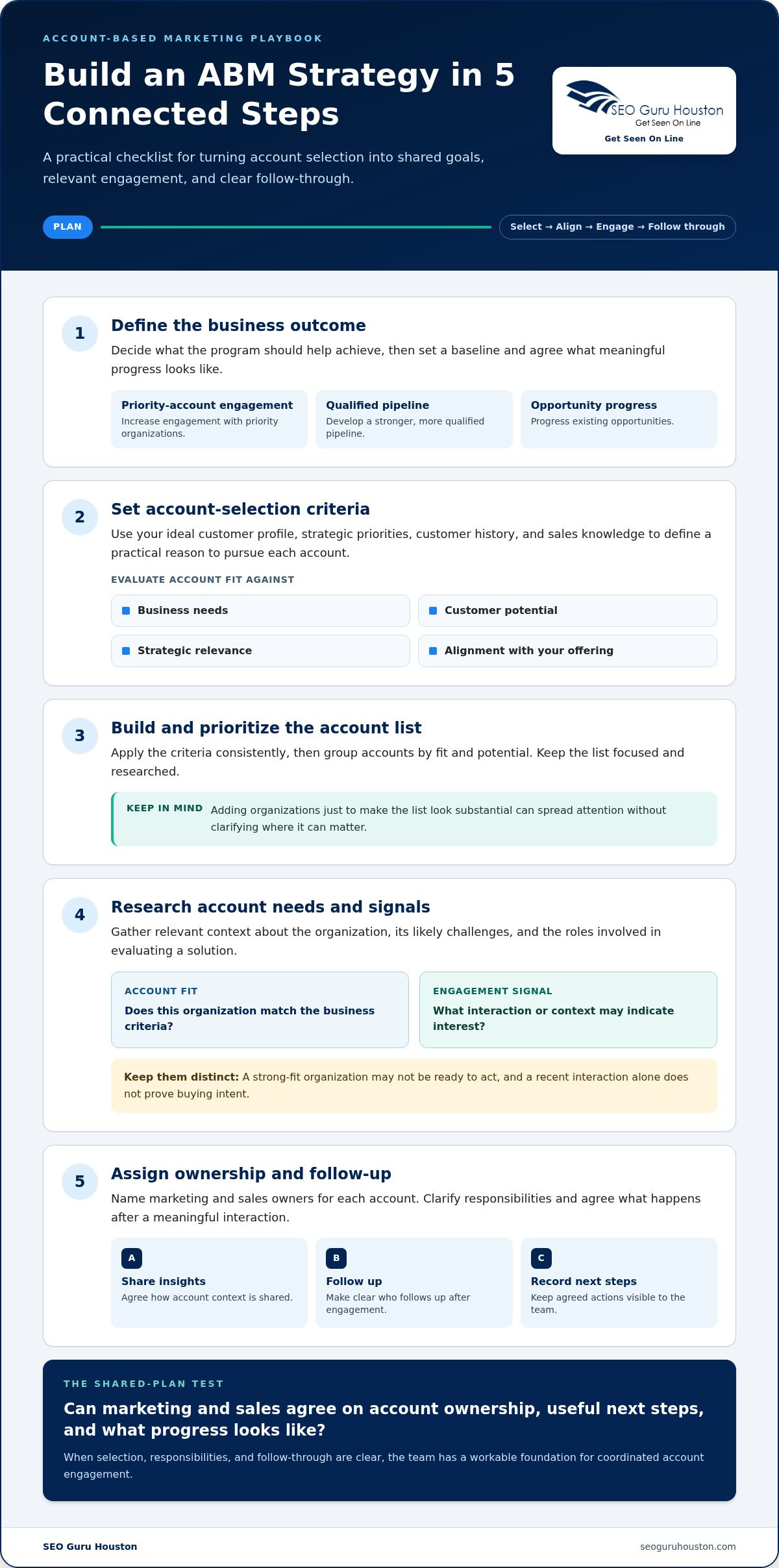
A strong ABM plan starts before the first ad or sales message. Marketing and sales need a shared reason to pursue each account, a clear definition of success, and agreed responsibilities for moving engagement forward. Use this sequence to turn account selection into a focused, workable program.
- Define the business outcome. Choose what the program should help achieve, such as increasing engagement with priority organizations, developing qualified pipeline, or progressing existing opportunities. Set a baseline and agree how the teams will recognize meaningful progress.
- Set account-selection criteria. Define the traits that indicate a strong fit, including business needs, customer potential, strategic relevance, and alignment with your offering. Use customer history and sales knowledge to make the criteria practical, not aspirational.
- Build and prioritize the account list. Apply the criteria consistently, then group accounts by fit and potential. Avoid adding organizations simply to make the list look substantial. A focused, researched list gives teams a defensible reason to invest effort; an arbitrary large list spreads attention without clarifying where it can matter.
- Research account needs and signals. Gather relevant context about the organization, its likely challenges, and the roles involved in evaluating a solution. Keep account fit separate from engagement signals: a strong-fit organization may not be ready to act, and a recent interaction alone doesn’t prove buying intent.
- Assign ownership and follow-up. Name the marketing and sales owners for each account, define their responsibilities, and agree on what happens after a meaningful interaction. Clarify who shares insights, who follows up, and how the team records next steps.
How should you identify and prioritize target accounts?
Start with your ideal customer profile, strategic priorities, and what sales has learned from customer conversations. Evaluate each account across four dimensions: business fit, potential to become or grow as a customer, strategic relevance, and available engagement signals. Document the reasons for inclusion so both teams can explain the choice and revisit it when circumstances change.
A simple account record can capture the fit rationale, known business needs, relevant buying-group roles, recent interactions, and an open question for further research. Don’t treat missing information as proof of poor fit; mark it as a research gap. This makes prioritization more transparent and helps distinguish a promising account from one that merely looks familiar.
How can marketing and sales align around an account?
Before outreach or paid campaigns begin, agree on account ownership, shared objectives, and what counts as qualified engagement. For example, teams might define a useful signal as a relevant stakeholder engaging with material tied to an identified business need, rather than counting any isolated click as readiness. Establish a regular review rhythm to share new account insight, address follow-up gaps, and adjust priorities together.
These selection and alignment practices are central to account based marketing (abm) strategies: they connect team capacity to clear business priorities. Teams developing that coordinated approach can also explore B2B marketing and demand generation as part of broader execution planning.
ABM Strategy: One-to-One, One-to-Few, or One-to-Many?
There’s no single account-based marketing model that fits every team. The right level of personalization depends on the value and complexity of the accounts, how many share meaningful needs, and the time your team can devote to research and coordination. Treat one-to-one, one-to-few, and one-to-many as planning models, not guaranteed performance tiers or rigid definitions.
Use this comparison to match the approach to your capacity, not just your ambition:
One-to-one
Audience: A small number of strategically important accounts.
Personalization: Deep, informed by account-specific research.
Resources and coordination: Highest effort; marketing and sales closely coordinate engagement for each account.
One-to-few
Audience: A cluster of accounts with meaningful shared needs or business characteristics.
Personalization: Tailored to the cluster, with account-level adjustments where useful.
Resources and coordination: Moderate effort; teams coordinate around common messaging while accounting for relevant differences.
One-to-many
Audience: A broader set of accounts that fit defined criteria.
Personalization: Focused on shared segments, with less account-specific customization.
Resources and coordination: Designed to extend targeted engagement across more accounts, using consistent processes and team handoffs.
When does one-to-one ABM make sense?
Choose one-to-one when an account is strategically important enough to justify substantial research and tailored engagement. For example, a team pursuing an organization with distinct operational needs could shape content around those needs and coordinate sales conversations with the people involved in the decision. The trade-off is clear: deeper personalization requires more account insight, content effort, and ongoing coordination. Keep the account list small enough to serve well.
When should teams use one-to-few or one-to-many ABM?
One-to-few works when several accounts share a real problem, buying context, or business characteristic but still need relevant adaptations. One-to-many suits broader targeted engagement when accounts meet common criteria and the team can’t create bespoke experiences for each. In both cases, grouping should reflect actual similarities, not convenience alone. Test the segment’s relevance and engagement before expanding its scope.
To choose, ask whether the accounts genuinely share a need, how much research your team can complete, and whether sales can follow through consistently. If a cluster has sharply different priorities, split it or move key accounts into a more tailored approach. If one-to-one research is outpacing the team’s ability to act on it, narrow the list or simplify the engagement plan. Strong account based marketing (abm) strategies right-size personalization so the team can deliver it reliably, then adjust as it learns.
How to Execute ABM with Relevant Content, Channels, and Sales Follow-Through
Execution starts with account context, not a channel checklist. For each target account, map the business needs you can substantiate, the buying-group roles you understand, and the questions each role may need answered. Then choose content and touchpoints that help people make progress. A useful principle: relevance comes from matching a message to an account need and its buying context.
How do you personalize ABM content without sounding generic?
Build messaging around documented challenges, stated priorities, and solutions that genuinely fit. For grouped accounts, focus on a shared need; for a one-to-one program, use deeper account research to make the content more specific. Avoid superficial personalization or claims that imply private knowledge. If a buyer hasn’t shared a concern, present it as a possibility to explore, not a fact about their organization.
Match the asset to the question at hand. A practical explainer can clarify an unfamiliar approach, while a focused landing page can show how a relevant service addresses a business need. For example, if an account is assessing how to improve its visibility for a specific category of search, useful content can explain the considerations, while a landing page presents a clear next step. Keep claims accurate and the message helpful, not merely personalized by name.
How should channels and sales follow-up work together?
Give every channel a job. SEO can help relevant content appear for active searches; PPC can support visibility for relevant keywords; social media can build familiarity; and landing pages can give interested visitors a focused destination. These touchpoints should reinforce a coherent account conversation, not repeat the same copy everywhere. Coordinate sales follow-up with the context available, and use genuine engagement to guide a useful next conversation.
A straightforward execution sequence keeps activity connected:
- Map needs to messages. Identify the account challenge, relevant buying roles, and the content that can help each role evaluate it.
- Assign channel roles. Decide which touchpoints support discovery, consideration, or a next step, and make sure the experience feels consistent.
- Prepare sales follow-through. Share account context and agree what engagement merits a response, so outreach adds value rather than restarting the conversation.
- Review and refine. Look for gaps between the message, channel, and account response, then adjust the next touchpoint accordingly.
Building account based marketing (abm) strategies doesn’t require specialized enterprise technology to begin. A clear account brief, useful content, coordinated channel choices, and agreed sales follow-through provide a practical foundation. SEO, PPC, social media, and landing-page work can support that coordinated approach as part of broader B2B marketing.
Build a more connected engagement plan with B2B marketing and demand generation support tailored to your business priorities.
How to Measure ABM Strategy Performance and Improve the Next Campaign
ABM measurement should show more than whether a campaign attracted attention. Track early account engagement separately from sales progression and pipeline outcomes, then review how one stage connects to the next. This helps marketing and sales spot useful signals without treating a click or impression as proof of revenue impact.
Before launch, agree on a baseline, a review period, and shared definitions. Decide what qualifies as an engaged account, which interactions count as meaningful, and what sales must accept before an account is considered qualified. Confirm how the team will record opportunity progress and pipeline contribution as well. Consistent definitions make comparisons more useful and reduce disagreement over what the results mean.
Which ABM metrics show engagement and account progress?
Use account-level reporting to assess both the depth and quality of engagement. Look for relevant interactions across the account and, where information is available, participation from different buying-group roles. Then evaluate whether sales accepts the account, whether opportunities progress, and how pipeline contribution changes when it can be reliably measured.
- Early indicators: Relevant content interactions, repeat engagement, and reach across known buying-group roles.
- Sales progression: Sales-accepted accounts, substantive follow-up, and movement into or through an opportunity.
- Business outcomes: Qualified pipeline contribution and closed-won results, reviewed over a period that fits the sales process.
Interpret each signal in context. A click may reflect curiosity, not purchase readiness. A quiet account may still be researching independently. Compare activity with the account’s known needs and sales conversations, and avoid assigning campaign credit to revenue based on a single interaction.
How can a team improve its ABM program over time?
Review results with sales at the account level. Identify where engagement stalled, whether follow-up matched the signal, and whether the account criteria or message needs adjustment. If a high-fit account engaged but received no relevant next step, examine the handoff. If an account repeatedly interacts without progressing, reassess its needs, timing, or fit before increasing activity.
Use the review to make a specific change for the next cycle: refine a selection criterion, clarify a message, shift channel emphasis, or improve follow-up expectations. SEO ranking and status reporting can help teams assess search visibility; Google Analytics implementation can support website measurement; PPC conversion tracking can help connect paid clicks with recorded conversions. Landing-page performance can also inform whether the destination supports the intended next step. Treat these as inputs for learning, not guarantees of account or revenue results.
Strong account based marketing (abm) strategies turn measurement into a practical feedback loop: define what progress means, observe account and sales signals, then adjust the next campaign. Explore SEO Guru Houston’s digital marketing services for support with coordinated visibility and lead generation.
Turn Your ABM Plan Into the Next Move
Your next step doesn’t need to be a sweeping campaign. Choose a focused group of accounts, agree on one business outcome, and put a practical engagement plan into motion. Then use what you learn from account interactions and sales conversations to sharpen the next round. That steady cycle of action and refinement gives account based marketing (abm) strategies lasting direction.
Execution takes coordination as well as ambition. SEO Guru Houston brings 12+ years of experience and 950+ completed projects, including 100+ B2B and B2C projects across diverse industries. Its professional team is committed to account management, goal setting, and conversion tracking, helping connect digital marketing activity with business priorities without promising a particular outcome.
Ready to build a more coordinated approach to visibility and lead generation? Explore SEO Guru Houston’s digital marketing services and take the next step with a clear focus.
Frequently Asked Questions
What is account-based marketing (ABM), and how does it work?
ABM organizes marketing and sales activity around selected business accounts rather than treating every prospect as an equally likely opportunity. For example, a team might identify an organization that fits its customer profile, share a relevant educational resource, and have sales respond when a stakeholder shows meaningful interest. The key is a connected process: account choice informs the message, and the response helps guide the next interaction.
What are the most effective account-based marketing strategies?
Effective account based marketing (abm) strategies connect account insight to specific actions. Start by documenting the business issue you can address, then adapt useful content for the people involved in evaluating a solution. Give each channel a distinct role, and agree with sales on what follow-up a meaningful interaction should trigger. For instance, repeated engagement with a relevant topic could prompt a helpful conversation, not an automatic generic pitch.
Is account-based marketing suitable for small B2B teams?
Yes, small B2B teams can use ABM by limiting the program to accounts they can research and serve attentively. A team without dedicated campaign staff might begin with a small cluster sharing a clear business need, then reuse a core resource while adjusting the sales conversation to each organization. A simple shared account document can capture known needs, interactions, owners, and next steps without requiring specialized enterprise technology.
How do you choose accounts for an ABM campaign?
Choose accounts by applying criteria that reflect the customers your business can serve well, not just organizations that have interacted with your content. Consider relevant business needs, strategic fit, potential to become a strong customer, and whether your team can reach and support the right stakeholders. Record why each account qualifies and what information is still missing. This makes it easier to revisit choices when new sales insight changes the picture.
What is the difference between one-to-one and one-to-many ABM?
One-to-one ABM builds an engagement plan around an individual account, so research and messaging can reflect its particular context. One-to-many uses common themes and repeatable content for a broader group of suitable accounts, with less individual tailoring. A practical distinction is how the team prepares: a bespoke account brief for the first model, versus shared segment guidance and consistent review of account responses for the second.
How do you measure account-based marketing success?
Measure success by checking whether target accounts move from relevant engagement toward sales conversations and qualified opportunities, not by relying on impressions alone. Compare results with a baseline and use the same definitions across marketing and sales. A useful review asks whether the right people engaged, whether sales followed up, and whether opportunities progressed. Because purchases can involve several interactions, interpret contribution across the account journey rather than crediting one touchpoint.
Can SEO and PPC be part of an account-based marketing strategy?
Yes. SEO can help target audiences find relevant business content through search, while PPC can support visibility for selected keywords. A landing page can provide a clear destination aligned with the message, and conversion tracking can help evaluate recorded actions from paid campaigns. These channels work best when their content and next steps match the account’s needs, and sales can respond with context rather than a disconnected pitch.

