
Facebook can be an effective B2B advertising channel, but only when the campaign is built around how business buyers discover, evaluate, and choose solutions. The answer to whether Facebook advertising is effective for B2B depends on fit: the right audience, a relevant offer, and messaging matched to the buyer’s stage matter more than simply running ads. Treat it as a strategic channel, not a shortcut to instant sales.
It’s fair to question whether a platform often associated with consumer brands can support a longer, more considered business purchase. The opportunity is there when your audience uses Facebook, your campaign gives them a useful reason to engage, and your landing page carries the conversation forward. This guide explains when Facebook can fit a B2B brand, how its strategy differs from B2C, and how precise targeting and funnel-stage messages can strengthen campaign effectiveness. You’ll also learn what to measure beyond clicks, so you can judge whether your ads are attracting the right prospects and helping move them toward a meaningful next step.
Key Takeaways
- Assess whether Facebook can reach the people involved in your B2B buying process before committing campaign budget.
- Adapt B2B creative to build trust and support a considered decision, rather than relying on consumer-style, immediate-purchase messaging.
- Use custom and lookalike audiences to shape who sees your ads, then refine targeting based on the prospects who engage.
- Match each message and landing-page experience to the buyer’s next step, including smaller actions that signal growing interest.
- Measure campaign performance against business outcomes, so clicks alone don’t disguise whether your ads are contributing to conversions.
1. Should Your B2B Brand Advertise on Facebook?
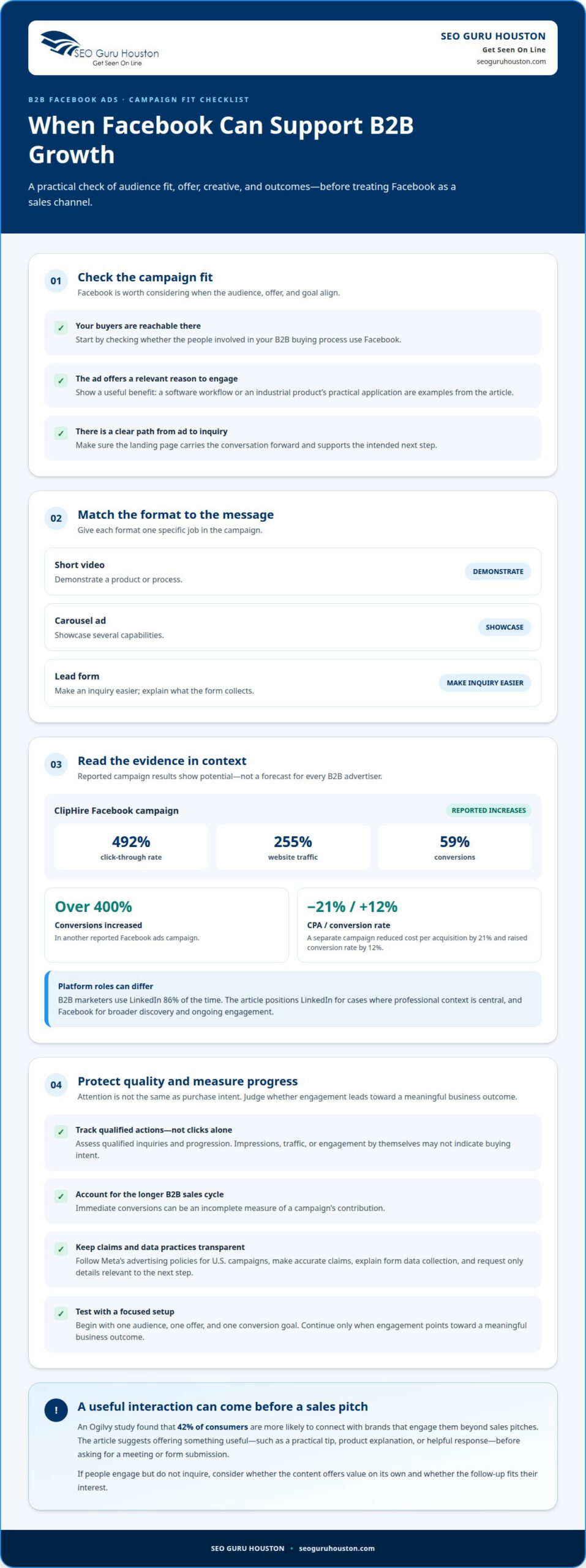
Facebook can support B2B growth when its audience, offer, and campaign goal align. The results from ClipHire show why the channel deserves a measured test: its Facebook campaign increased click-through rate by 492%, website traffic by 255%, and conversions by 59%. So, is Facebook advertising effective for B2B? It can be, when you judge performance by qualified actions, not attention alone.
No single industry automatically performs best. The strongest fit comes when buyers are reachable on Facebook and an ad can show a relevant benefit. For example, a software company can demonstrate a product workflow, while an industrial supplier can spotlight a practical application. Both need a clear path from ad to inquiry.
Campaign outcomes can vary sharply by offer and execution. In another reported campaign, Facebook ads increased a client’s conversions by over 400%. A separate campaign reduced cost per acquisition by 21% and raised conversion rate by 12%. These examples show potential, not a forecast for every B2B advertiser.
Facebook and LinkedIn can serve different roles. B2B marketers use LinkedIn 86% of the time, while Facebook can broaden discovery and support ongoing engagement. Use LinkedIn when professional context is central; consider Facebook for reaching prospects with useful content and following up with people who showed interest.
Choose the ad format to suit the message. Short video can demonstrate a product or process; carousel ads can showcase several capabilities; lead forms can make inquiries easier. Give each format a specific purpose, such as presenting a software demo, a customer-use scenario, or a downloadable guide.
For U.S. campaigns, follow Meta’s advertising policies and use data transparently. Make claims accurate, explain what a form collects, and request only details relevant to the next step. Avoid copy that implies you know someone’s sensitive or private circumstances.
There are limits. Facebook engagement doesn’t automatically mean purchase intent, and a broad audience can produce low-quality clicks. Long B2B sales cycles also make immediate conversions an incomplete measure. Track qualified inquiries and progression, not just impressions or traffic.
Start with one audience, one offer, and one conversion goal. For example, promote a case study to relevant decision-makers and assess whether they take the intended next step. Continue the test only if engagement points toward a meaningful business outcome.
That makes the quality of the interaction worth considering alongside the offer. An Ogilvy study found that 42% of consumers are more likely to connect with brands that engage them beyond sales pitches. For B2B advertisers, that can mean giving prospects something useful before asking for a meeting or submitting a form. A practical tip, a product explanation, or a helpful response can make the brand’s presence feel relevant rather than purely promotional.
Use this principle to shape both the ad and the response that follows. Offer information that addresses a genuine business question, then make the next step clear without making it feel like a demand. If people engage but do not inquire, assess whether the content offers value on its own and whether the follow-up matches their interest. The goal is a useful exchange that builds trust and gives the campaign a measurable purpose.
2. Differences between B2B and B2C ad strategies
A B2C ad often sells a product directly to an individual buyer. A B2B ad usually supports a decision involving several people, business needs, and follow-up. For example, a project-management platform may need to persuade a department lead and earn approval from finance. That changes the offer, message, and campaign goal.
Start with the buying decision, not the product category. A consumer furniture ad might lead with a new sofa and a purchase prompt. A commercial furniture company could instead show how configurable workstations suit a growing office. The B2B message connects the offer to a business task, such as planning a workspace or comparing specifications.
The audience also changes the creative. A consumer campaign can focus on personal preference, convenience, or an immediate need. A B2B campaign should make its business relevance clear. For instance, an accounting software ad can highlight invoice workflows for finance teams, while avoiding claims that every company shares the same process.
Proof matters in different ways, too. A consumer may respond to a product demonstration or a straightforward feature comparison. A business buyer may need evidence to explain a decision internally. A case study, implementation overview, or product demonstration can give prospects material to discuss with colleagues. Keep every claim specific and supportable.
The conversion action should fit the amount of commitment. A direct purchase prompt may suit a low-cost consumer product. A B2B prospect evaluating enterprise software may prefer a demo request or a detailed guide first. Make the next step explicit: explain what the person receives after submitting a form, and keep the requested details relevant.
Campaign timing follows the same distinction. A consumer promotion may focus on a seasonal purchase window. A business campaign can support research over a longer decision process, with separate messages for learning, evaluating, and taking action. For example, introduce a checklist before offering a product demonstration.
Use different success measures for each objective. A B2C campaign may prioritize completed purchases. For a B2B campaign, assess whether inquiries fit the intended customer profile and progress toward a sales conversation. A high click rate with irrelevant inquiries signals a mismatch between the ad promise and the offer.
Build the campaign in sequence: define the business problem, write a buyer-focused message, choose an appropriate next step, and align the landing page. A cybersecurity provider, for instance, could offer a risk-assessment guide instead of asking for an immediate sale. This gives prospects a useful first action while keeping the campaign connected to a business need.
3. Effectiveness of Facebook ads for B2B brands
Facebook campaign effectiveness depends on the business result you measure. A campaign may attract attention without generating suitable inquiries, while a smaller audience may produce prospects worth pursuing. A software firm, for example, should distinguish guide downloads from demo requests and sales-qualified leads. Each action signals a different level of commercial intent.
There isn’t one typical conversion rate that applies across B2B Facebook campaigns. A guide download, demo request, and qualified inquiry are different conversions, so compare rates only when the action and audience match. A campaign offering a product demonstration shouldn’t be benchmarked against one offering an introductory checklist.
Set a measurable objective before launching. If a cybersecurity company wants demo requests, its primary measure should be completed requests from relevant businesses, not video views. If the goal is to introduce a new service, meaningful engagement with an explanatory page may be an earlier signal. The objective determines which campaign events matter.
Connect ad activity to the landing-page action. A mismatch can weaken performance: an ad promising a practical procurement guide should lead to that guide, not a generic homepage. Track the steps from ad click to form completion and review where prospective buyers leave. This gives you a clearer diagnosis than clicks alone.
Lead quality matters as much as volume. A student’s form submission for an assignment is different from an inquiry by a company evaluating vendors. Define useful qualification criteria, such as business type, role, or stated need, then assess which ads generate matching inquiries. Don’t treat every completed form as an equal sales opportunity.
Facebook campaign results can change when the audience, creative, offer, or landing page changes. Test one meaningful variable at a time. For example, a manufacturing supplier could compare a production-process video with a downloadable equipment checklist while keeping the audience and next step consistent. This makes the comparison more informative.
Review performance across the full path to revenue. A strong click-through rate may conceal weak lead quality, while an early-stage campaign may support later decisions without generating immediate inquiries. Compare engagement with qualified leads and sales progression, using consistent definitions. This keeps reporting focused on business outcomes.
Use the findings to make a deliberate adjustment: refine the audience, sharpen the offer, or improve the landing page. If prospects click but don’t submit the form, review the page’s relevance and friction. If submissions rarely qualify, refine the message to attract businesses with a matching need. Then measure the revised campaign against its original goal.
There is no single typical conversion rate for B2B Facebook ads; results vary with the audience and the action being measured. Compare rates only for campaigns with the same conversion goal and audience.
4. Facebook targeting with custom and lookalike audiences
An effective B2B Facebook campaign starts with a defined business goal, a focused audience, and a relevant offer. Custom audiences can reconnect with people who already engaged, while lookalike audiences help find new users resembling a selected source audience. For example, a software firm might reach past site visitors, then seek similar prospects.
A custom audience uses a business’s existing audience signals, such as customer records, website activity, or engagement with a Facebook or Instagram account. Each source serves a different purpose: a customer list can support retention, while product-page visitors may be suitable for follow-up advertising.
Choose the source according to the campaign’s next step. A company promoting a product demo could focus on visitors to its demo information page. A firm introducing a new service might target people who engaged with its social content. Avoid combining unrelated interactions, such as webinar viewers and existing customers, into one audience without a clear reason.
Lookalike audiences extend a useful source audience to reach new people with similar characteristics. A B2B advertiser could use its qualified customer records as the source, rather than every form submission. The source quality matters: if it contains poor-fit leads, the resulting audience may reflect that weakness.
Keep audience groups distinct enough to interpret the results. For example, separate recent product-page visitors from people who watched a general brand video. Tailor the message to each group: the first may need a detailed comparison, while the second may benefit from an introductory explanation.
Use customer data responsibly and keep audience inputs relevant to the campaign. Consider how records were collected and whether their use aligns with your privacy commitments. Ad copy should address business needs without implying knowledge of sensitive personal details.
Evaluate an audience by the quality of the resulting actions, not its size alone. Compare qualified inquiries from customer-based targeting with those from a lookalike audience. If the lookalike audience brings broad interest but few relevant prospects, refine the source, offer, or message before expanding the campaign.
5. Funnel-stage messaging and micro-conversions
A B2B buyer rarely moves from first impression to sales conversation in one click. A facilities manager discovering a maintenance platform needs different information from a manager comparing vendors. Map each Facebook ad to the buyer’s current question, then offer one clear next action. This keeps the message useful instead of demanding a decision too soon.
At the awareness stage, introduce the problem and explain its business impact. A logistics company, for example, could promote a guide to reducing delivery delays. Use plain language in the ad, then direct readers to a page that delivers the promised guidance. A hard sales pitch can feel premature to someone still defining the problem.
Consideration-stage messages help prospects evaluate possible approaches. A manufacturing software provider might share a process comparison, product walkthrough, or case study. Each asset should answer a specific question, such as how a workflow changes or which teams use the tool. The next step could be viewing a demonstration rather than immediately booking a sales call.
Decision-stage creative can make the commercial next step more direct. A prospect who has reviewed a product page may be ready to request a consultation or tailored demonstration. Match the ad’s promise to the form and follow-up. If the ad offers a product walkthrough, the landing page should make it easy to understand and request.
Micro-conversions are smaller actions that show progress before a final inquiry. Examples include watching a product video, opening a comparison page, or downloading a checklist. Track them separately from qualified leads. A video view signals attention, but not the same intent as a completed demo request.
Build a sequence that reflects those actions. Someone who reads an introductory guide could later see a detailed comparison. A visitor to a pricing or product page could receive a demonstration offer. Exclude people who already completed the intended action, where campaign setup allows, so follow-up messages remain relevant rather than repetitive.
Keep the landing page aligned with each funnel stage. An ad for a guide should open the guide’s page, while a demonstration ad should explain what the demonstration covers. Remove unrelated navigation or competing offers when they distract from the chosen action. Then review the path from ad engagement to form completion and qualified inquiry.
Set a distinct success measure for each message: guide downloads for awareness, comparison engagement for consideration, and qualified requests for decision-stage campaigns. Review these actions together to see where prospects advance or stall. Turn your funnel map into a focused campaign sequence, with each ad earning the next step through relevant information.
Track every interaction—whether it involves a document download, comparison view, or demonstration request. Tailor each message to its funnel stage, and optimize its landing page to convert ad-generated traffic. Review whether the page makes that stage’s next action clear and easy.
SEO Guru Houston
SEO Guru Houston helps B2B brands assess whether Facebook advertising supports their audience, goals, and sales process. If you’re unsure how paid social fits alongside search and lead generation, comprehensive B2B Marketing, PPC Services, and Inbound Marketing solutions can connect campaign planning with the broader path from discovery to inquiry. Professional SEO Services can also support visibility when prospects research solutions beyond social platforms.
Turn to SEO Guru Houston when your ads attract attention but don’t clearly support qualified inquiries, or when you need a more connected strategy across channels. Share your audience, campaign goals, and current challenges to start a focused conversation. Contact SEO Guru Houston to discuss the right next step for your B2B marketing.
Turn Your Facebook Strategy Into a Measurable Next Step
Turn your campaign idea into a clear test. Decide which business outcome matters, define the audience that can influence it, and choose an action that signals genuine interest. Then align the ad, landing page, and follow-up around that same goal.
Whether Facebook advertising is effective for B2B depends on how well the campaign advances a real business objective. Treat each launch as a learning opportunity: use the results to sharpen the message, improve the audience fit, and guide prospects toward a useful next conversation. A disciplined approach gives your team a stronger basis for deciding what to refine or scale.
If you’re ready to shape a focused plan around your B2B goals, contact SEO Guru Houston today. Take the next step with clarity, and build a campaign strategy that keeps your business moving forward.
Frequently Asked Questions
Should Your B2B Brand Advertise on Facebook?
Yes, if your prospective buyers use Facebook and you can connect their attention to a relevant business need. For example, a company selling specialized inventory software could test an educational resource for operations teams, then assess whether resulting inquiries represent suitable organizations. If your audience is difficult to reach there or the offer needs a highly specific professional context, prioritize channels that better match those conditions.
How effective is Facebook advertising for B2B lead generation?
Facebook can generate B2B leads, but the useful measure is whether those leads fit your sales criteria and advance into real conversations. For example, a training provider could separate inquiries from companies seeking team instruction from individual requests for personal courses. Align the form questions with that distinction, then review lead feedback with sales. This helps identify whether the campaign attracts prospective buyers, rather than simply collecting contact details.
Which B2B industries perform best with Facebook advertising?
No single B2B industry automatically performs best. Facebook is a stronger fit when buyers are reachable there and the ad can show a relevant benefit, such as a software workflow or an industrial application.

