Category Archives: Uncategorized

Amazon A+ Content Practices for More Helpful Product Pages

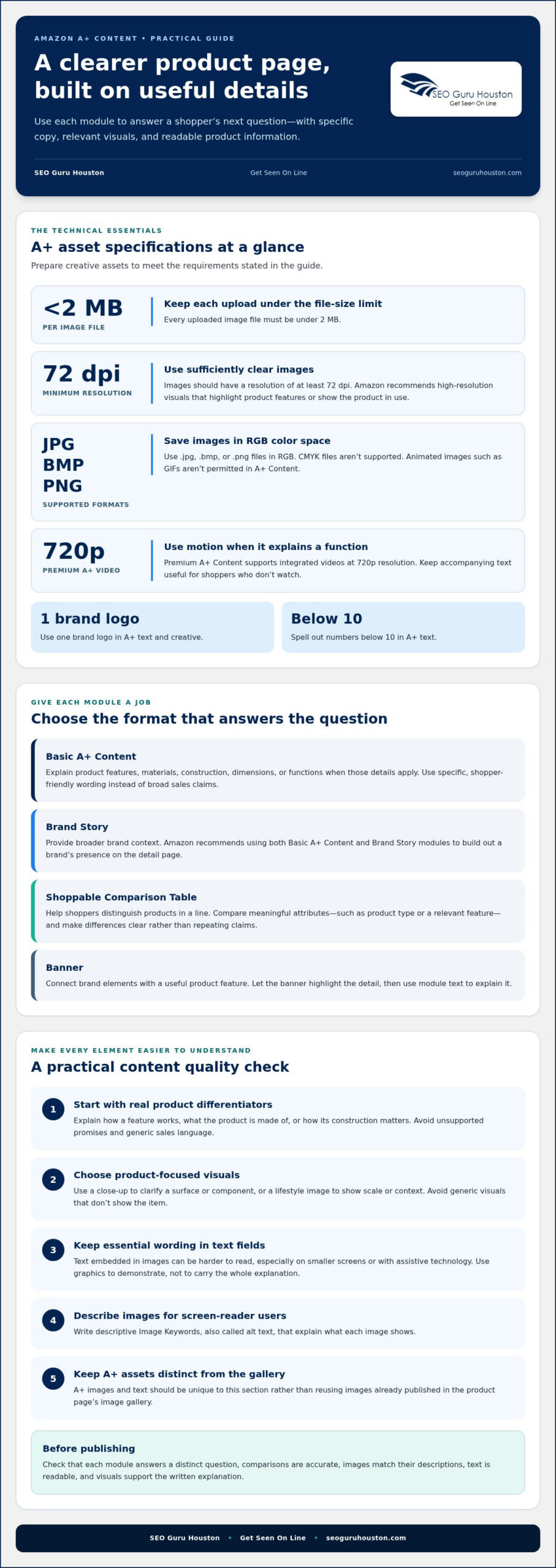
Helpful A+ pages make product details easier to understand, not harder to find. The most effective Amazon A+ content best practices are to explain features in specific, customer-friendly language, use clear product-focused images, and place key information in text fields rather than burying it in graphics. Each uploaded image file must be under 2 MB.

It’s easy to focus on polished visuals and overlook the questions shoppers need answered: how a product is made, what a feature does, or how options compare. A+ Content works best when each image and module clarifies a specific detail instead of repeating the listing or adding generic sales copy.

This guide explains how to choose useful modules, organize product information, prepare images and alt text, and make comparisons easy to scan. You’ll find practical ways to create product pages that communicate clearly and help shoppers make informed decisions.

Key Takeaways

  • Explain product features and construction in specific, shopper-friendly language instead of relying on broad sales claims.
  • Choose product-focused images that clarify details, and keep each uploaded image file under 2 MB.
  • Use module text fields for key information, and write descriptive image text to support shoppers using screen readers.
  • Consider a comparison table to help customers understand differences across your product line.
  • Review how Amazon marketing and SEO can work together to strengthen product-page visibility and usefulness.

Amazon a+ content best practices

Amazon A+ Content lets registered brand owners add storytelling, enhanced product images, and customized text placements to product detail pages. Treat each module as an answer to a shopper’s next question, not another advertisement. Effective Amazon A+ content best practices start with identifying product questions, then matching each answer to the clearest text or visual format.

Start with the product’s real differentiators. Explain its materials, construction, dimensions, or functions when those details apply. For example, replace “built for convenience” with a clear explanation of how a feature works. Friendly, informative wording helps shoppers understand the product without broad sales claims or unsupported promises.

Choose modules with distinct purposes. Amazon recommends using both Basic A+ Content and Brand Story modules to build out a brand’s presence on the detail page. Basic A+ can explain product features; Brand Story can provide broader brand context. A banner can pair brand elements with a product feature, while module text gives shoppers details they can read and scan.

Use the shoppable Comparison Table when customers need to distinguish products in a line. Compare meaningful attributes, such as product type or a relevant feature, rather than filling columns with repeated claims. Make each comparison clear enough to support a decision. If products serve different purposes, spell out those differences instead of suggesting one option suits everyone.

Prepare creative assets to meet Amazon’s stated technical requirements before uploading:

  • Keep every image file under 2 MB, with a resolution of at least 72 dpi.
  • Use .jpg, .bmp, or .png files in RGB color space; CMYK files aren’t supported.
  • Leave out animated images such as GIFs, which aren’t permitted in A+ Content.
  • Use one brand logo, and spell out numbers below 10 in A+ text.
  • Write descriptive Image Keywords, also called alt text, that explain each image for screen-reader users.

Make every image count. Amazon recommends high-resolution visuals that highlight product features or show the product in use. A close-up can clarify a surface or component; a lifestyle image can demonstrate scale or context. Avoid generic visuals that don’t show the item. Keep A+ images and text unique to this section rather than reusing gallery images.

Put essential wording in module text fields. Text embedded in an image may be harder to read, especially on smaller screens or for customers using assistive technology. Use graphics to demonstrate, not to carry the entire explanation. For example, pair a labeled product detail with a text module explaining what it does and why it may matter to a shopper.

Premium A+ Content supports integrated videos at 720p resolution. Use video when motion can clarify a product function or demonstrate how a feature works. Keep the accompanying text useful for shoppers who don’t watch. Video should add an explanation, not replace product details that customers need to compare options or understand the item.

Before publishing, review the page from a shopper’s perspective. Check that each module answers a distinct question, comparisons are accurate, and images match their descriptions. Confirm the text is readable and the visuals support the written explanation. These steps turn A+ modules into a coherent product guide rather than a collection of disconnected brand assets.

Give every module a clear role in answering likely shopper questions. Amazon recommends using banner images to highlight product features and brand elements in A+ Content, so choose a banner that connects the brand presentation to a useful product detail. Explain product features and construction specifically, using helpful, friendly language instead of general sales-focused text. Keep the wording focused on the product and how its features work, so shoppers can assess the information without relying on broad promotional language. For product lines with alternatives, Amazon recommends the shoppable Comparison Table module to highlight features and help customers make purchase decisions. Use the table to make distinctions easy to understand, not to repeat claims.

Creative choices and file preparation also affect how clearly the page communicates. Amazon recommends high-resolution images that highlight product features or show the product in use, and advises avoiding generic images that do not showcase the product. Choose visuals that directly support the accompanying explanation, then check the supported file formats: Amazon A+ Content supports .jpg, .bmp, and .png image files in RGB color space; CMYK color space is not supported. Keep the A+ presentation distinct from the gallery: Amazon A+ images and text must be unique to A+ and should not reuse images already published in the product page’s image gallery. Distinct copy and relevant visuals give each module a clear purpose on the detail page.

Amazon A+ Content Practices for More Helpful Product Pages

SEO Guru Houston: Houston SEO Services

SEO Guru Houston offers Amazon Services to help businesses align product-page content with a broader marketing strategy. Turn to this support when aligning listing content with product positioning, brand messaging, and customer discovery across channels. Clear A+ modules can explain product value, while a coordinated strategy helps keep messaging consistent wherever shoppers encounter the brand.

Comprehensive digital marketing services can support search visibility beyond Amazon, while targeted PPC services and inbound marketing strategies address other parts of the digital customer journey. The right mix depends on your goals, audience, and existing marketing activity. Start by identifying where your product information is unclear or disconnected, then define what your Amazon presence needs to accomplish.

Contact SEO Guru Houston to discuss your Amazon marketing needs and implement proven amazon a+ content best practices for your brand.

Turn Clear Product Pages Into a Stronger Strategy

Treat each product page as part of a larger customer journey. Use shopper questions and product feedback to guide future updates, then keep the language and positioning consistent wherever customers discover your brand. Amazon A+ content best practices are most useful when the page supports a clear business goal, not just a visual refresh.

SEO Guru Houston offers Houston SEO Services, Houston PPC Services, and Houston B2B Marketing. These services can support businesses working to connect product marketing with broader search, advertising, or business-to-business goals. The right focus starts with understanding which audience you need to reach and what you want your digital marketing to accomplish.

Ready to discuss how Amazon marketing fits into your broader strategy? Contact SEO Guru Houston to explore a practical next step for your business. Build with purpose, keep improving, and give every product page a clear job to do.

Ways to Increase Amazon FBA Sales With Better Listings

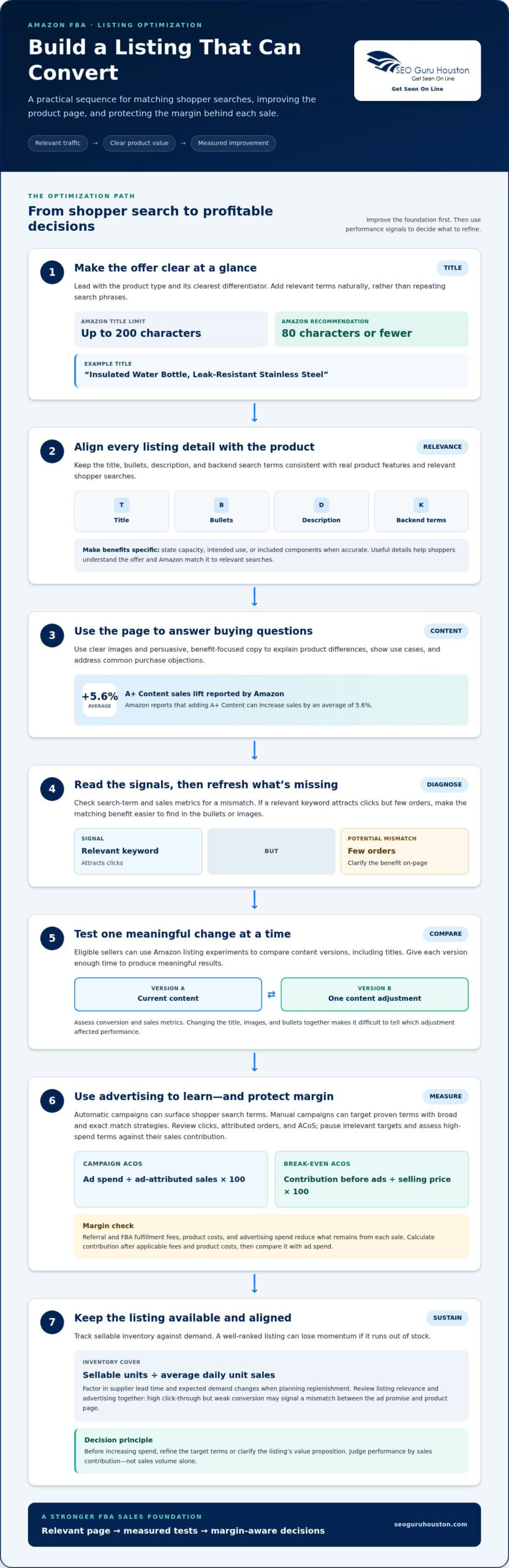
More traffic won’t fix a listing that fails to convert, and more orders won’t help if advertising eats the margin. To understand how to increase sales on Amazon FBA, strengthen the product page, target relevant searches, price competitively, and build buyer confidence through genuine reviews. Keep break-even ACoS in view: calculate it by dividing contribution before ads by the selling price, then multiplying by 100.

When sales stall, it’s easy to focus on ad spend, but growth often starts with the listing. Clear images, persuasive copy, relevant keywords, and a shopper-appropriate price give every campaign a stronger foundation.

This guide explains how to improve listings, attract traffic, choose keywords, assess pricing, and encourage reviews while protecting profitability. It also shows how to measure performance and make informed adjustments instead of relying on guesswork.

Key Takeaways

  • Make product pages easier to find and more persuasive with clear titles, useful images, and benefit-focused copy.
  • Use your Amazon Storefront and relevant external channels to bring qualified shoppers to your listings.
  • Review competitor pricing and promotions while protecting your contribution margin and break-even ACoS.
  • Research search terms from relevant products, then use them naturally in listings and advertising campaigns.
  • Build buyer confidence with strong product quality and compliant review requests, then use feedback to improve your listing.

1. Product listing optimization

Your listing must match the shopper’s search and answer their buying questions fast. Start with the product title: Amazon allows up to 200 characters and recommends 80 characters or fewer. Lead with the product type and its clearest differentiator, then add relevant keywords naturally. A title such as “Insulated Water Bottle, Leak-Resistant Stainless Steel” is more useful than a string of repeated search terms.

To improve product ranking and organic visibility, align the title, bullets, description, and backend search terms with the product’s actual features and relevant shopper searches. Describe benefits specifically, including capacity, intended use, or included components when accurate. Relevant details help shoppers understand the offer and Amazon match the listing to appropriate searches.

Refresh listing content when search-term or sales metrics show a mismatch. For example, if a relevant keyword attracts clicks but few orders, make the corresponding benefit easier to find in the bullets or images. Amazon reports that adding A+ Content can increase sales by an average of 5.6%. Use that space to clarify product differences, explain use cases, and address common purchase objections.

Test changes rather than guessing. Eligible sellers can use Amazon listing experiments to compare content versions, including titles. Give each title version enough time to produce meaningful results before comparing them. Change one meaningful element at a time, then assess conversion and sales metrics. If you change the title, images, and bullets together, you won’t know which adjustment affected performance.

Use advertising to test relevance as well as generate traffic. Automatic campaigns can surface search terms shoppers use; manual campaigns can then target proven terms using broad and exact match strategies. Control spend by reviewing clicks, attributed orders, and ACoS, which equals ad spend divided by ad-attributed sales, multiplied by 100. Pause irrelevant targets and assess high-spend terms against their sales contribution.

Amazon referral and FBA fulfillment fees, product costs, and advertising spend all reduce the amount left from each sale. Calculate your contribution after applicable fees and product costs, then compare it with ad spend. This sets a practical margin limit for campaign decisions, rather than measuring success by sales volume alone.

Avoid lost FBA sales by tracking sellable inventory against demand. Divide sellable units by average daily unit sales to calculate inventory cover, then factor in supplier lead time and expected demand changes when planning replenishment. Even a well-ranked listing can lose momentum if it runs out of stock.

Review listing relevance and advertising together. A high click-through rate but weak conversion may signal a mismatch between the ad promise and the product page. Before increasing spend, refine the target terms or clarify the listing’s value proposition.

2. Amazon Storefront and external traffic

An Amazon Storefront gives your brand a curated destination within Amazon, beyond an individual product detail page. Use it to group related products, introduce product ranges, and guide shoppers to relevant options. For example, a kitchen brand could organize cookware by cooking task, helping visitors find a suitable product. Keep each page focused: too many choices can obscure the next step.

Build the Storefront around how customers shop, not your internal catalog structure. Create clear categories, use concise product explanations, and feature items available to buy. Then review Amazon traffic and sales metrics by product or page. If visitors reach a category but don’t continue to a product, simplify the layout or make the grouping more intuitive. This gives the Storefront a measurable role in your sales strategy.

External traffic can introduce your products to shoppers who haven’t found them through Amazon search. Social media gives brands a place to demonstrate a product in context, answer common questions, and direct interested viewers to the relevant Amazon page. The research reports that 27% of customers use social media for product discovery and 67% of consumers buy products through social platforms. Treat those figures as a reason to test relevant content, not as a promise of results for any individual brand.

Choose a specific audience and message before publishing. A home organization brand, for example, might show a storage product solving a particular household problem and link to its Amazon listing. Keep the post and destination consistent: if social content promotes a specific size or feature, make it easy to find on the Amazon page. Track referral traffic and attributed orders to identify useful visits, rather than judging performance by views alone.

Amazon’s Brand Referral Bonus averages 10% of the sales price for sales generated by directing traffic to Amazon listings. Include that program in your external-traffic planning, and assess the resulting sales alongside the campaign’s costs. Amazon DSP campaigns can also run outside the Amazon ecosystem, using audience segmentation and shopper retargeting to reach defined groups. These options can help brands expand beyond organic marketplace discovery, but campaign targeting still needs a clear audience and relevant product message.

Coordinate every traffic push with inventory. A successful social post or external campaign can send more shoppers to a listing, so align promotion timing with sellable stock and replenishment plans. After each campaign, compare the channel, promoted product, visits, and orders. Keep the content that brings qualified shoppers; revise weak messages or destinations. If social content is part of your growth plan, social media marketing can help connect campaign messaging with the customer journey.

3. Competitive pricing and promotions

A competitive price can improve conversion, but copying a competitor without checking your own economics can be costly. Compare similar products by features, pack size, and customer value, then decide where your offer fits. Amazon’s launch guidance recommends comparing competitor prices to assess positioning. Revisit the comparison when a competing listing changes its offer or your product costs shift.

Price also matters for the Featured Offer, formerly called the Buy Box. Somewhere between 80% and 90% of Amazon purchases are made through the Featured Offer. A compelling price can help your offer compete for that placement, but selection isn’t controlled by price alone. Amazon announced changes to its separate Featured Offer eligibility step beginning in July 2026; removing that step doesn’t guarantee selection.

Choose a promotion to match its purpose. A coupon can make an offer more noticeable, while a limited-time deal creates a defined buying window. Amazon Lightning Deals run for 4 to 12 hours. Amazon promotes 7-Day Deals on its Deals page for 7 days, and these deals are limited to Brand Registered businesses. Plan campaign timing around inventory and demand, so an effective promotion doesn’t outpace available stock.

For repeat purchases, Amazon suggests offering customers a 10% discount on their next purchase as one way to encourage another order. Use a discount where a follow-up purchase makes sense, such as a replenishable product. Compare resulting orders with full-price sales and watch whether shoppers return after the offer ends. Promotions should strengthen customer value, not train every buyer to wait for a lower price.

Measure each test against a clear comparison. Record the regular price, promotional dates, units sold, conversion, and contribution after costs. Compare results with a similar period without the offer, accounting for differences in inventory or traffic. If ranking or visibility rises during a discount, check whether sales remain steady afterward. This helps distinguish a short-lived promotional spike from lasting demand.

Coordinate pricing and campaigns. If a Featured Offer change, coupon, and Lightning Deal run together, it can be difficult to tell what drove results. Test one major pricing change at a time, then use the outcome to refine future promotions. Protect margin first, and scale campaigns that bring qualified orders and repeat business.

Ways to Increase Amazon FBA Sales With Better Listings

4. Amazon keyword research and long-tail keywords

Start with shoppers’ language, not assumptions about how they describe your product. Write down its core use, audience, material, and key differentiator, then combine those attributes into focused search phrases. For a stainless-steel lunch container, research terms related to meal prep, leak resistance, and office lunches. Each phrase should accurately describe the item and reflect a likely buying need.

Amazon Brand Analytics can help sellers examine shopper searches and product comparisons to identify sales opportunities. Compare search behavior with your orders and listing performance. Look for relevant queries that attract attention but don’t lead to purchases, then check whether your product or page addresses the need. Use the finding to refine positioning, add useful detail, or prioritize a better-matched keyword.

Build a competitor set from 5-10 best-selling ASINs in your category, then examine how their products are described. Note the shared terms that accurately apply to your offer, and separate them from claims or features your product doesn’t have. For example, if shoppers value compact storage, use a phrase such as “space-saving lunch container” only when it describes your product honestly.

Long-tail keywords are specific phrases that reveal a shopper’s intended use or preference. “Lunch container” describes a broad category; “stainless-steel lunch container for meal prep” narrows the search. Add relevant phrases to listing content where they read naturally. Don’t force every variation into the title. Clear copy helps shoppers understand the offer and keeps keyword use relevant to the product.

Use advertising search-term results to test whether researched phrases attract qualified shoppers. Automatic campaigns can uncover relevant queries, while broad and exact manual targeting can gather data on selected terms. Review search terms, clicks, and orders together. Move relevant converting phrases into focused targeting, and exclude irrelevant queries that spend without matching the product. This makes keyword research an ongoing part of your seller strategy, not a one-time launch task.

Revisit keywords when customer demand or your product range changes. A new size, bundle, or use case may call for different search language, while discounts can shift attention toward value-focused terms. If an influencer demonstrates a product for a particular activity, check whether shoppers search for that use case before adding it to your listing copy. Let Amazon Brand Analytics, advertising results, and product accuracy guide each update.

5. Amazon product reviews and Vine

Reviews help shoppers judge whether a product matches its claims before buying. An Amazon survey found that 54.4% of customers read at least four product reviews before making a purchase decision. That makes review quality and relevance important to conversion, especially when shoppers compare similar products. Treat feedback as evidence about the buying experience, not simply a star-rating target.

Use Amazon’s Request a Review button for each order to invite customer feedback through Amazon’s process. Keep the request neutral; don’t ask buyers for positive reviews or offer coupons, discounts, or other incentives in exchange for favorable sentiment. The FTC Consumer Reviews and Testimonials Rule took effect on October 21, 2024, and addresses fake or false reviews and incentives conditioned on a specific review sentiment.

Amazon Vine is another route for eligible products to receive feedback from Vine reviewers. One new seller enrolled 10 product units during launch, but that example isn’t a required enrollment amount or a sales forecast. Vine reviews may take time: an Amazon representative stated that they typically arrive 22 or more days after reviewers request a product. Plan your launch with that timing in mind, rather than expecting immediate reviews.

Use early feedback to improve what shoppers see and receive. If reviews repeatedly mention unclear sizing, revise the relevant listing details. If customers misunderstand an included component, clarify the description and product images. Address product quality issues at their source: a promotional campaign may bring more purchases, but it won’t fix a gap between the product and its claims.

Reliable shipping and quality products can support positive feedback. As an FBA seller, keep inventory available and ensure the product arrives as described. Monitor review themes alongside returns, conversion, and profit. Complaints about damage call for operational attention; repeated setup questions may signal missing instructions or unclear listing content.

Don’t treat review volume as the only measure of progress. Look for specific comments about fit, durability, packaging, or intended use, then decide which changes are actionable. For example, if buyers praise portability but ask about cleaning, make care information easier to find. Keep updates factual, and don’t edit claims simply to pursue a higher rating.

Build a review process into each launch: request reviews through Amazon’s tool, monitor incoming feedback, and resolve recurring product or information problems. Use Vine as one possible launch tactic, not a substitute for customer experience. To connect review insights with listing and advertising improvements, strengthen your Amazon sales strategy.

SEO Guru Houston: Houston SEO Services

SEO Guru Houston helps sellers connect Amazon listing improvements with broader visibility and traffic goals. Its Amazon Services and PPC services fit businesses looking to coordinate marketplace marketing with paid campaigns. Comprehensive SEO services and inbound marketing can support broader discovery and customer acquisition beyond an individual product page.

Turn to SEO Guru Houston when listing updates, keyword targeting, advertising, and customer acquisition need a coordinated strategy. The right approach depends on your products, audience, and marketing priorities, so start by identifying the growth challenge you want to address.

Contact SEO Guru Houston to discuss your Amazon marketing goals, or visit seoguruhouston.com.

Turn your next sales decision into a growth plan

A practical plan for how to increase sales on Amazon FBA starts by identifying the constraint that currently limits growth. Choose the business priority that matters most, assign responsibility for acting on it, and review performance before making another major change. This makes your next move deliberate and helps you learn from the outcome.

Think beyond individual listing adjustments, too. If your growth priorities include broader visibility, paid acquisition, or business-to-business demand, SEO Guru Houston offers Houston SEO Services, Houston PPC Services, and Houston B2B Marketing. These capabilities can support a wider marketing strategy alongside your Amazon efforts.

Bring your goals and current challenges into a focused conversation, then decide which next step best fits your business. Contact SEO Guru Houston today to discuss your marketing priorities. Keep moving with purpose, measure what matters, and build on each informed decision.

Frequently Asked Questions

What Is Break-Even ACoS?

Break-even ACoS is the advertising cost percentage that uses all contribution available before advertising. Calculate it by dividing contribution before ads by the selling price, then multiplying by 100. For example, if you know the amount left after product costs and selling fees, compare that contribution with the sale price. A target below break-even ACoS leaves room for other expenses and profit.

What Is TACoS?

TACoS, or total advertising cost of sales, compares ad spend with total sales, including both ad-attributed and organic sales. Calculate it by dividing total ad spend by total sales, then multiplying by 100. Use TACoS alongside ACoS: if advertising spend stays steady while total sales grow, the relationship can show whether sales beyond directly attributed ad orders are contributing.

What Is Unit Session Percentage?

Unit Session Percentage measures units ordered relative to listing sessions. Divide units ordered by sessions, then multiply by 100. It helps distinguish a traffic problem from a conversion problem: if sessions increase but the percentage falls, visitors may not find the product or offer compelling. Review search-term relevance, product options, and shopper questions before increasing traffic further.

How do I optimize Amazon FBA product listings for more sales?

A practical approach to how to increase sales on Amazon FBA is to make the listing answer buyers’ questions before they order. For a desk lamp, clarify whether the bulb is included, show its controls, and accurately explain its intended use. Check that each variation leads to the correct detail page. Review customer questions and returns for recurring misunderstandings, then update the content causing confusion.

How can sellers use coupons, deals, and promotions to increase Amazon sales?

Match each offer to a clear goal, such as introducing a new product or encouraging a trial purchase. Before activating a coupon, identify the eligible product and estimate how discounted orders affect contribution. After the offer ends, compare purchase patterns with the preceding period. If demand drops immediately, the deal may have attracted price-sensitive buyers rather than built lasting interest.

How do pricing strategies and competitor research improve Amazon sales?

Competitor research helps sellers understand how shoppers may assess an offer, but comparisons should account for meaningful differences. If you’re considering how to increase sales on Amazon FBA, compare pack size, product specifications, and included components before reacting to a lower price. Track how your own price changes relate to orders and conversion. A competitor’s temporary discount alone isn’t a reason to reduce your price.

How can Amazon sellers improve product images, titles, bullet points, and A+ Content?

Give each listing element a distinct job. Use the title to identify the item clearly, bullets to explain practical benefits, and images to show details shoppers can’t assess from text alone. A+ Content can organize comparisons or explain product use. For a kitchen tool, a comparison chart can show which model suits different cooking tasks without repeating the title.

What are the risks of using external traffic and social media to drive Amazon sales?

External traffic can attract visitors whose expectations don’t match the product page, weakening conversion and wasting campaign effort. A popular post can also drive demand beyond available inventory. Keep the social message consistent with the Amazon listing, direct each post to the relevant product, and monitor orders and stock. Don’t judge a campaign by engagement alone; assess whether it attracts likely buyers.

Build a B2B Demand Generation Content Strategy for Pipeline Growth

Pipeline growth starts before a prospect is ready to talk to sales. The main goal of B2B demand generation is to build awareness and trust across the buyer journey, then turn that interest into qualified opportunities. A strong B2B demand generation content strategy supports that goal with useful content at each stage, not just lead capture.

It’s easy to focus on the leads coming in now. But buyers also need clear, relevant information while they’re still identifying a problem, comparing approaches, and building internal agreement. Content that meets them at those moments can make your business easier to understand and consider.

This guide explains how to build a strategy around buyer needs, map content to awareness, consideration, and decision stages, and activate it across channels such as search, social media, email, and paid advertising. You’ll also learn how to align sales and marketing around qualified opportunities and measure content’s contribution to the pipeline. The aim is practical: create a connected system that earns attention, supports buying decisions, and gives demand generation a clear path to growth.

Key Takeaways

  • Build ideal customer profiles and buyer personas around real needs, roles, and buying triggers so your content speaks to the people involved in a purchase.
  • Align sales and marketing on qualified-lead definitions, shared measures, and a smooth handoff to keep promising opportunities moving.
  • Activate useful content across search, social, email, and paid channels, adapting each asset to the audience and platform.
  • Use demand generation to build awareness and trust before prospects are ready to buy, then connect that interest to relevant next steps.
  • Map content to awareness, consideration, and decision stages so buyers get the right information as their needs evolve.

1. Why Has Content Become the Foundation of Modern Demand Generation?

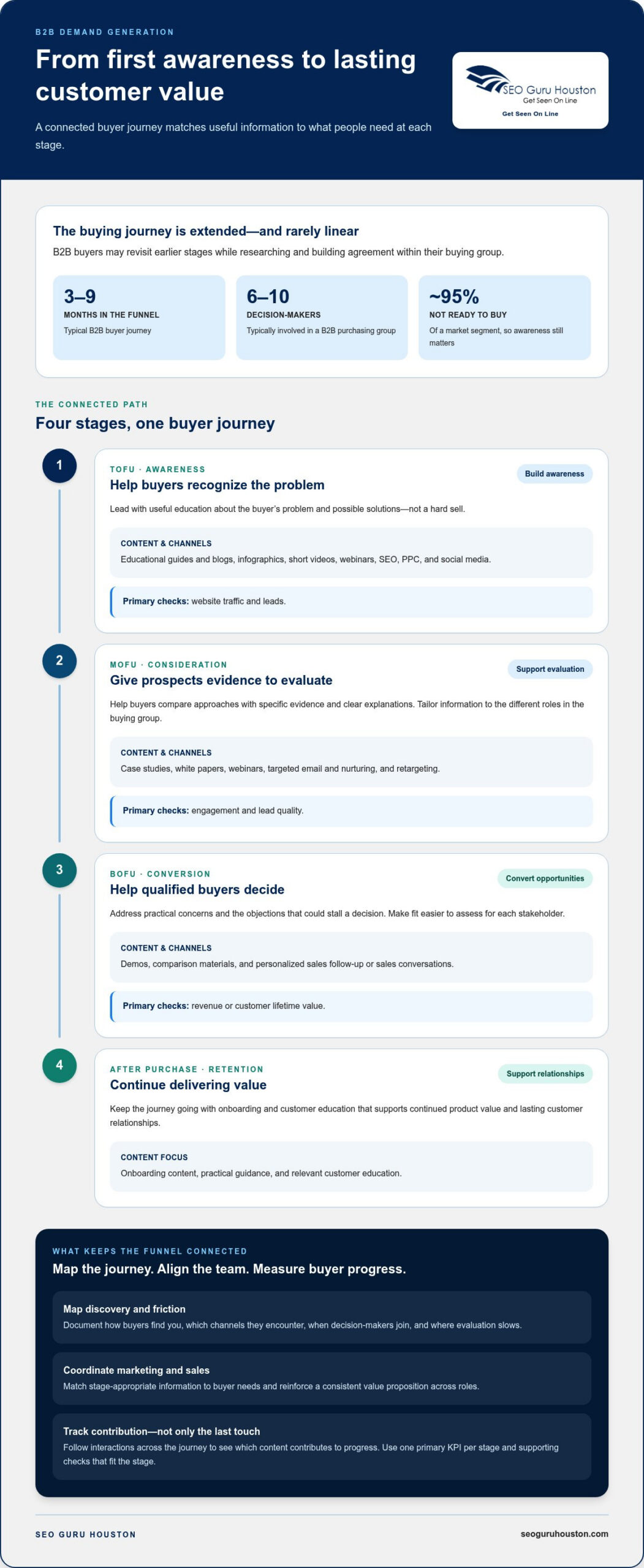
Content gives buyers useful information before a sales conversation begins. That matters because B2B purchasing often involves several stakeholders, each evaluating different risks and requirements. A 2025 benchmark puts buying groups at an average of 11 stakeholders. A clear content program helps a business build awareness across that group, rather than relying only on lead capture when someone is ready to talk.

Start by defining an ideal customer profile around company fit, then create buyer personas for the people inside those companies. Record their roles, priorities, pain points, triggers, and jobs-to-be-done. For example, a finance leader may need evidence of cost control, while an operations leader needs to understand implementation demands. B2B purchasing decisions involve around 6-10 decision-makers, and more than a dozen individuals may express distinct needs. These details make lead generation programs more relevant and help teams choose topics buyers actually need.

Next, map content to the buyer journey. At awareness, explain the problem and its business impact through educational articles. During consideration, compare approaches and answer technical questions with guides or webinars. At decision, use case studies and clear product information to help stakeholders assess fit. Voice of the Buyer 2026 reports that 58% of buyers prioritize alignment with their use case or technical requirements when shortlisting vendors. Each asset should answer a specific question and point to a useful next step.

Independent research also shapes buyer confidence. In 2025, 61% of B2B buyers preferred sales-rep-free experiences while conducting their own research. Content must therefore stand on its own: explain claims clearly, address objections, and give different stakeholders material they can share internally. Forrester reported in 2024 that 86% of B2B purchases stall and result in no decision. Useful content can help a buying group build understanding and agreement before that momentum disappears.

For example, a persona-led program could pair an awareness article about a costly workflow problem with a consideration guide comparing possible solutions. A decision-stage case study could then show how a similar organization evaluated its options. Use this practical planning rule for every asset: match it to a stage, a stakeholder need, and a clear next action.

2. How can a company develop a successful B2B content marketing strategy?

Build the plan around shared decisions, not separate departmental calendars. Sales hears objections in conversations; marketing sees audience engagement across channels. Bring both teams together to connect those signals and choose content themes that address real buyer questions. For organizations seeking senior leadership to drive this collaboration, engaging fractional CMO services London can provide the strategic oversight needed to unite both functions. A useful starting point is a monthly planning session where sales shares recurring objections and marketing matches each one to a relevant asset.

Agree on what qualifies as a lead before launching campaigns. Document the company fit, role, problem, and intent signals that make an opportunity relevant. Then define the handoff: what context accompanies a lead, who follows up, and how sales shares feedback. This prevents a campaign download from being mistaken for sales readiness without evidence of need or fit.

Align content with the audience and its decision stage. An early-stage operations leader may need a practical explanation of a process problem. A technical evaluator may need implementation details, while a finance stakeholder needs a business case. Create a version of the core message for each role, but keep the central claim consistent. The result should be one coherent idea tailored to each stakeholder’s responsibilities.

Map the buying group before assigning content. A CRM record can connect target accounts with their contacts, roles, interactions, and open questions. Use that view to spot gaps: if a champion engages with a guide but the technical evaluator still needs answers, create material to support that review. Account-based marketing can use CRM data to tailor messaging for high-value accounts and their decision-makers.

Measure performance through a connected set of indicators: content engagement, qualified opportunities, pipeline contribution, and revenue outcomes. Use campaign and CRM records to connect interactions with account progression, then review attribution rules jointly so teams interpret influence consistently. In the Tenth Edition State of Marketing, 83% of marketers reported a clear view into their impact on the sales pipeline. Treat that visibility as a reason to define shared reporting, not as proof that one asset caused a sale.

Run a regular review to improve the plan. Marketing can bring engagement patterns; sales can bring call feedback and stalled-deal reasons. Together, decide which topics need a new format, which messages need revision, and where a buyer lacks useful information. For teams seeking help coordinating content with pipeline priorities, B2B marketing support can be a relevant next step.

3. Content activation across ABX, outreach, and paid channels

Content creates demand only when target buyers can find and use it. Build an activation plan around account priorities, buyer intent, and channel behavior. In an account-based experience (ABX), coordinate content across the account’s interactions, not just one contact’s clicks. For a target account researching workflow issues, a useful sequence could pair a search-focused article with a LinkedIn insight and tailored sales outreach.

Give each channel a distinct role. Organic search helps buyers discover educational material while investigating a problem. LinkedIn can distribute industry reports and whitepapers to professional audiences. Email can provide relevant follow-up based on a person’s expressed interests. Paid advertising can extend reach to selected audiences or promote a high-value asset. Keep the message consistent, but adapt its format and opening to each channel.

Plan organic and paid distribution together. First, identify the asset’s audience, funnel stage, and intended action. Then select channels that match how that audience consumes information. For example, publish an educational article organically, use paid promotion to reach relevant account roles, and send an email with a deeper guide to engaged readers. LinkedIn is described as a leading channel for reaching B2B executives and senior stakeholders.

Social engagement needs a repeatable cadence. Small B2B teams can publish two to three organic posts per week on LinkedIn or another channel their ideal customers use. A single webinar can also become five LinkedIn posts, each highlighting a distinct takeaway or question. This repurposing gives the original content more entry points without copying the same promotional message into every post.

Use paid media to extend useful content, not to disguise a weak offer. Match the promotion to buyer intent: an educational asset suits problem-aware audiences, while a case study can support active evaluation. Set campaign measures before launch, such as target-account engagement, meaningful asset interactions, and qualified follow-up. The 81% of buyers are more likely to engage with brands that have a strong, cohesive professional social presence figure points to the importance of consistency across organic and paid activity.

Events create opportunities for direct interaction. Before a webinar or industry event, promote a clear topic through social posts, email, and paid placements where appropriate. During the event, capture audience questions and engagement signals. Afterward, share relevant resources and tailor follow-up to expressed intent rather than sending every attendee the same message.

Review performance across channels, not in isolated dashboards. Compare which assets attract target accounts, support meaningful engagement, and contribute to pipeline conversations. Then focus distribution on the channels and formats that prompt useful buyer actions. This discipline turns content activation into a coordinated system, with each touchpoint helping the next work harder.

Build a B2B Demand Generation Content Strategy for Pipeline Growth

4. What is the main goal of B2B demand generation?

The goal is to create sustained interest and move suitable accounts toward qualified opportunities. That work begins before a buyer is actively comparing vendors. Demand generation helps people recognize a problem, explore possible responses, and develop enough understanding to consider a next step. A b2b demand generation content strategy supports this by connecting useful information with the buyer’s changing needs, rather than treating every interaction as an immediate sales lead.

Demand generation also nurtures accounts before they’re ready to buy. A buyer who encounters a useful explanation today may return later with specific questions. Build a sequence that responds to those changing needs: start with accessible educational material, then offer deeper insights as interest develops. A second b2b demand generation content strategy consideration is keeping follow-up relevant to the account’s behavior, rather than sending every contact the same campaign.

Marketing automation can help keep follow-up relevant. Set up personalized email communications based on the resources a contact engages with and the topics they explore. Someone reading about an operational challenge could receive an implementation guide next. A contact evaluating possible approaches might benefit from a case study. The goal is to make the next useful resource easier to find, not to automate messages for their own sake.

Evaluate the program by the progress it supports. Track meaningful content engagement, account progression, qualified opportunities, and contributions to pipeline or revenue. If a report attracts interest but doesn’t lead to further exploration, review its audience, topic, and next step. This analysis helps teams distinguish content that builds awareness from work that captures active intent or supports ongoing nurturing. Demand generation succeeds when these functions work together throughout the buyer relationship.

5. Demand generation framework and funnel stages

A useful framework turns funnel stages into decisions about what to publish, promote, and measure. Start with five demand-generation phases: demand creation, demand capture, revival, acceleration, and expansion. For each phase, define the audience, buyer question, content asset, and next action. This makes the framework operational, not just a diagram. Teams can see where a buying group needs new insights and where existing content already supports progress.

At the awareness stage, buyers need help naming a problem and understanding its impact. Use educational articles, short videos, or checklists that explain a challenge in plain language. For example, an article about delayed reporting can describe symptoms and possible causes without pushing for an immediate sales conversation. Focus on the reader’s question, then offer a related resource to deepen understanding.

During consideration, buyers compare approaches and assess whether a solution fits their needs. Use detailed guides, webinars, comparison tools, or expert interviews to explain trade-offs and implementation questions. A useful asset should help a stakeholder bring informed insights to an internal discussion. At the decision stage, case studies, product demonstrations, and practical implementation information can help the buying group assess evidence and reduce uncertainty.

Choose formats by the work buyers need to do, not by a calendar template. A technical evaluator may prefer a detailed guide, while an executive may need a concise summary of business impact. Case studies are preferred by 78% of B2B decision-makers during evaluation. Webinars are trusted by 58% of B2B decision-makers. Use these formats where they answer genuine evaluation questions, then judge performance by relevant engagement and account progression.

Balance gated and ungated content according to an asset’s value. Keep foundational articles and practical explainers ungated to support discovery and sharing. Gate a substantial guide or webinar when registration creates a useful follow-up opportunity, and make the value clear before requesting details. Avoid placing every useful insight behind a form: buyers need enough accessible information to decide whether deeper engagement is worthwhile.

Finally, review the funnel as a connected system. If awareness content attracts readers but few explore related material, improve the next step or link to a stronger consideration asset. If decision-stage case studies draw attention but opportunities stall, ask sales which evaluation questions remain unanswered. Update the asset map based on those observations, then assign owners for revisions and distribution. This feedback loop keeps the framework aligned with real buying behavior.

SEO Guru Houston: B2B Marketing Support

SEO Guru Houston can help connect your content plan with the channels buyers use to research and evaluate solutions. Its SEO services can strengthen search visibility for useful resources, while PPC services can promote content to relevant audiences. B2B marketing can align content with pipeline priorities, and inbound marketing can support attracting and nurturing business prospects. The right mix depends on your audience, funnel priorities, and content gaps. To discuss your demand generation goals, contact SEO Guru Houston.

Turn Your Content Plan Into the Next Growth Move

Choose one pipeline priority and use it to guide every content decision. It might be reaching a new audience, improving the path from first interaction to sales conversation, or helping active opportunities resolve a specific concern. Set the priority, identify the buyer behavior that would signal progress, and give the team a clear review point.

A practical B2B demand generation content strategy should keep evolving as buyer questions, sales feedback, and channel performance change. Treat each campaign as a learning cycle: publish with intent, observe meaningful engagement, and use what you learn to sharpen the next asset. Consistency matters, but so does the willingness to adjust when the content isn’t helping buyers take a useful next step.

Ready to put your priorities into action? Start a conversation with SEO Guru Houston about the direction you want your demand generation to take. Build with purpose, learn from the response, and keep moving your pipeline forward.

Frequently Asked Questions

What is the main goal of B2B demand generation?

The goal is to create sustained interest that can develop into qualified business opportunities. Help potential buyers understand a problem before they actively evaluate vendors, then give them useful ways to explore solutions. For example, a company entering a new market could publish educational material that clarifies an overlooked operational challenge, helping future buyers recognize a need before a sales conversation begins.

How can a company develop a successful B2B content marketing strategy?

Start with evidence from customer conversations, sales calls, and recurring support questions. Choose a business priority, then create an editorial brief for each asset: intended reader, question answered, proof required, and next step. If prospects often ask about implementation risk, for example, produce a practical explainer covering dependencies and common decision points. Review responses with sales and revise topics as buyer questions change.

How can B2B marketers boost demand?

Make useful expertise easier to discover, share, and discuss. Turn customer questions into educational resources, then ask subject-matter experts to add practical insight rather than generic claims. A software company, for instance, could publish a clear guide to diagnosing a process bottleneck and invite prospects to discuss their challenges. Consistent distribution through relevant professional channels helps the material reach people before they enter an active buying cycle.

Why Has Content Become the Foundation of Modern Demand Generation?

Content lets buyers learn and compare ideas without starting with a sales meeting. A well-organized resource library can answer questions at different levels, from basic terminology to implementation concerns. A new visitor might find a plain-language explainer, while a returning reader can access a detailed evaluation guide. This continuity helps a brand remain useful across separate research sessions and internal discussions.

How Does Content Build Buyer Confidence Throughout the Buying Journey?

Confidence grows when content explains both the value and the practical realities of a decision. Use transparent examples, clear evidence, and specific answers to common objections. A case study is more useful when it describes the original challenge, the approach taken, and lessons learned, rather than offering only praise. Pair that evidence with implementation guidance so buyers can judge its relevance and share informed details with colleagues.

How Does Content Support Every Buying Committee Member?

Give each stakeholder material tied to their decision responsibilities. A technical evaluator may need architecture details, while a finance reviewer needs a clear explanation of business impact. The internal champion benefits from a concise resource they can forward to colleagues. Create a shared core message, then adapt the supporting details to each role. This helps the buying group discuss one solution using information relevant to everyone involved.

How can I improve content consumption in B2B marketing?

Make every asset easy to scan and use. Lead with the key takeaway, organize sections around buyer questions, and provide a clear next resource. A long research report, for example, can include an executive summary and descriptive section headings so readers can find relevant findings. Repurpose its core insights into shorter formats, but preserve context so each version remains accurate and useful.

How do you use intent data for B2B demand generation campaigns?

Use intent signals to guide relevance, not to assume a buyer is ready to purchase. Review patterns such as repeated visits to related resources, engagement with a product-focused page, or questions raised during a webinar. Combine those signals with account fit and known interactions before choosing follow-up content. For example, send a technical guide after repeated interest in implementation topics, then use subsequent engagement to shape the next step.

How to Rank Higher Than My Competitors With Local SEO

Longer content doesn’t automatically rank higher. To understand how to rank higher than my competitors, target relevant searches where your business can offer a stronger, more useful answer, then make it easy for local customers to find and use your site. Keyword difficulty matters as much as content length.

It’s natural to think that publishing more pages or writing longer articles will help you move ahead. But a page earns visibility by matching search intent and meeting people’s needs, not by adding words for their own sake. Choose realistic opportunities and build pages that serve them well.

You’ll learn how to use competition levels to prioritize keywords, create useful local landing pages, align content with search intent, improve site performance, and strengthen your business listings. Each step helps you focus your effort where it can make a practical difference in local search.

Key Takeaways

  • Build location-specific pages around the services and local questions your customers actually search for, rather than repeating the same copy across every page.
  • Match each page’s content and title tag to the searcher’s intent; longer copy alone won’t make a page more competitive.
  • Improve mobile usability and site performance so visitors can quickly find the information and contact options they need.
  • Keep your business details accurate and consistent across your website, Google Business Profile, and relevant directories.
  • Prioritize achievable keywords, especially searches where competitors rank well but your pages are close to becoming visible.

1. Hyperlocal content and location-specific landing pages

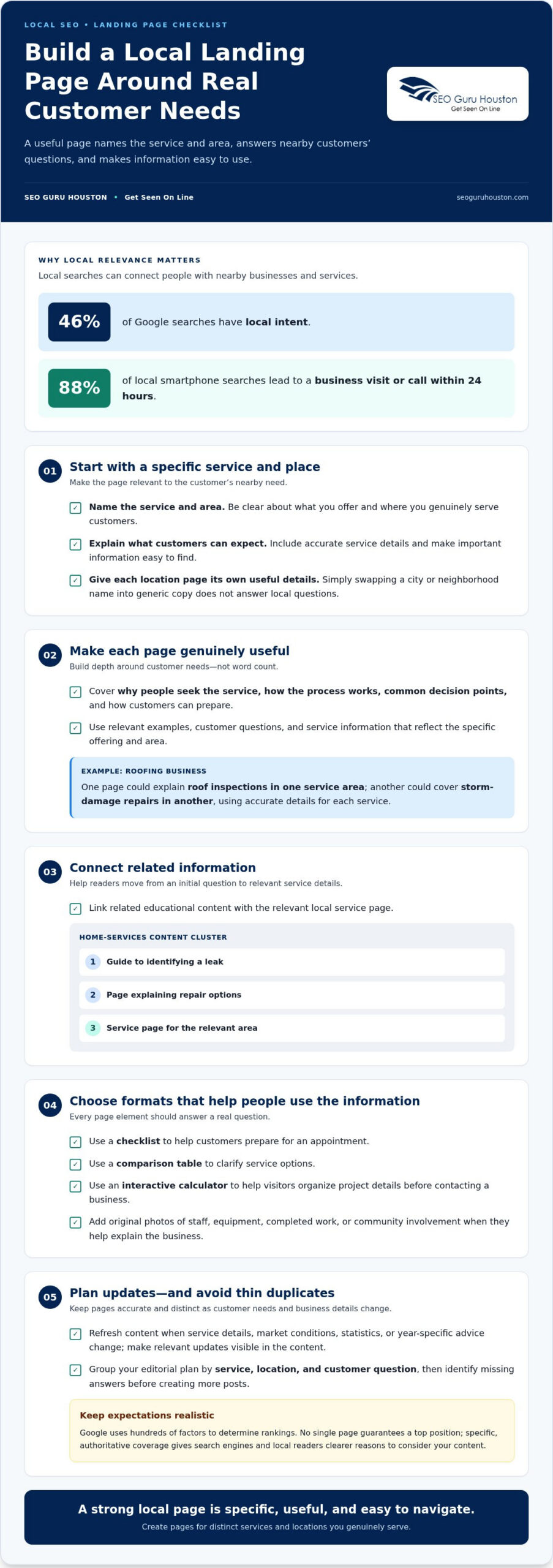
Local relevance starts with a page that answers a nearby customer’s specific need. 46% of Google searches have local intent, and 88% of local smartphone searches lead to a business visit or call within 24 hours. Give those searchers a clear path: name the service and area, explain what customers can expect, and make the next step easy to find. A page that simply swaps a city name into generic copy won’t provide that detail.

Create a dedicated landing page for each distinct service and location you genuinely serve. For example, a roofing company could explain roof inspections in one service area and storm-damage repairs in another, while a specialized travel service such as dumbablack.com can highlight distinct regional routes and private transfers using accurate details about each offering. Include locally relevant examples, customer questions, and service information. Keep each page useful on its own, rather than publishing near-identical pages that differ only by neighborhood name.

Build depth around customer needs, not word count. A strong local page can cover the reasons people seek the service, what the process involves, common decision points, and how to prepare. Then connect it to related educational content. For example, a home-services business might create a guide to identifying a leak, a page explaining repair options, and a service page for the relevant area. This cluster shows topical coverage and helps visitors move from research to action.

Choose a format that makes the information easier to use. A checklist can help customers prepare for an appointment; a comparison table can clarify service options; an interactive calculator can help them organize project details before contacting a business. Add original photos of staff, equipment, completed work, or community involvement where they help explain the business. Each element should answer a real question, not exist merely to make a page look busy.

Plan updates alongside publication. Refresh pages when service details, market conditions, statistics, or year-specific advice change, and make the update visible in the relevant content. A useful editorial plan might group pages by service, location, and customer question, then identify missing answers before creating more posts. Google uses hundreds of factors to determine rankings, so no single page guarantees a top position. But authoritative, specific coverage gives search engines and local readers clearer reasons to consider your content.

2. Search intent and title-tag click-through rates

A page can target the right keywords and still miss the reader’s intent. Search a target phrase and study the results: are the top results service pages, guides, videos, listings, or comparisons? Someone searching for “emergency plumber” is unlikely to need a detailed history of plumbing. Use a format that answers the query, and write a title tag that accurately describes the page.

Google considers many factors when ranking pages. Relevance, useful content, and signals from across the web all shape visibility; no single title or trick controls position. Title tags still matter because they tell searchers what a page covers. Write a distinct, specific title that naturally includes the topic and clearly describes the result. Don’t promise information the page doesn’t provide.

For keyword gap analysis, compare the searches your site targets with the searches competitors visibly address. Group keywords by intent, then note where your page is missing, mismatched, or less helpful. If competitors answer “how to choose a landscaper” with practical criteria and your page only lists services, add the missing decision guidance. Google Search Console shows queries already generating impressions for your site; review them alongside current search results to find useful content opportunities.

Competitor-analysis tools can help uncover ranking keywords, page topics, and changes in visibility. Start with Google Search Console for your own query and page data; consider paid platforms if you need broader competitor estimates or research workflows. Compare tools by the keyword data, competitor tracking, user seats, and exports they include, since features and pricing vary. Choose one based on the analysis you’ll actually use.

How long does ranking take? Initial local SEO improvements can appear within 30-60 days, while significant ranking improvements typically take 3-6 months, depending on competition and consistent optimization. Review performance regularly, refine titles when they don’t accurately reflect the page, and update content as search needs change.

3. How do site speed and mobile optimization affect my ranking?

A slow website adds friction before visitors can read, call, or request information. Aim for a load time under two seconds when competing in search. A one-second delay affects website rankings and conversions, so speed optimization supports both visibility and visitor experience. Competitor sites loading in under two seconds can feel far more responsive than pages taking four or five seconds.

Start technical SEO work by measuring real page performance, then fix the biggest bottlenecks. Compress oversized images, remove unused scripts, and reduce unnecessary page elements. Strong server infrastructure also plays a crucial role in lowering response times, leading many regional businesses to optimize through fast web hosting in Dubai. Test key pages, not just the homepage: a service page with a large gallery or embedded tools may load differently. Recheck after each change to see whether the visitor experience improved.

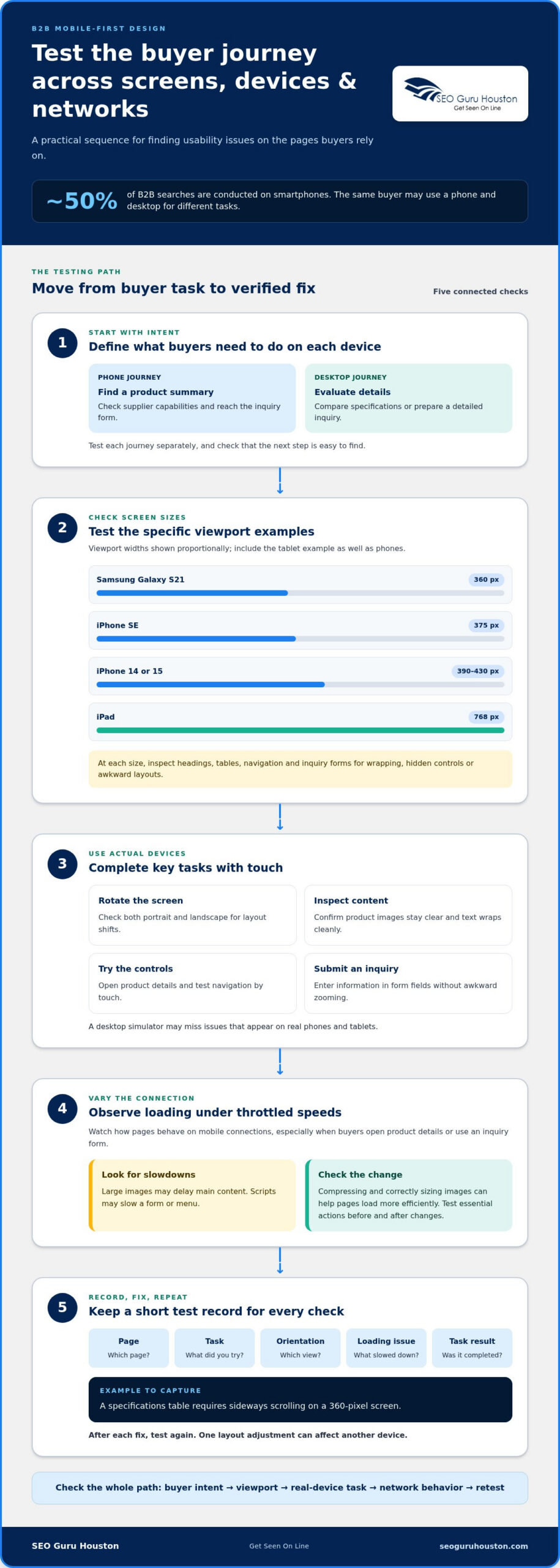
Mobile responsiveness matters because customers often browse on phones, where limited screen space makes usability problems obvious. Open your important pages on a mobile device and test the full journey. Can someone read the service details, tap the phone number, complete a form, and find the location without pinching or horizontal scrolling? Make buttons easy to tap, text readable, and navigation simple. A dealership, for example, should make inventory, service details, and contact options easy to find.

Check mobile page speed separately from desktop performance. A page that appears fast on a powerful computer may struggle on a phone with a slower connection. Prioritize the content visitors need first, defer nonessential scripts, and use appropriately sized images. Then test forms and menus on different screen sizes. A broken mobile form can cost a lead even when the page loads.

Structured data and HTTPS support a sound technical foundation. Use JSON-LD to describe eligible page content, such as an article’s headline, author, and organization. This helps search crawlers interpret a page, but structured data doesn’t guarantee a special search appearance. Keep markup accurate and aligned with visible content. HTTPS encrypts the connection between a website and its visitors; make sure pages load securely and internal links don’t send users to outdated HTTP versions.

Use a practical review cycle: test speed, inspect mobile usability, correct security warnings, and validate structured data after site changes. A redesign may improve navigation but introduce oversized images or scripts that slow key pages. Technical SEO isn’t a one-time launch task. Track performance on important landing pages and prioritize fixes that help visitors take their next step.

How to Rank Higher Than My Competitors With Local SEO

4. Consistent business citations and directory listings

For local visibility, Google considers relevance and proximity alongside trust signals. A complete Google Business Profile can connect your business with relevant nearby searches, but it can’t erase distance or guarantee a higher position. Treat your profile and directory listings as consistent records: customers should see matching business names, addresses, phone numbers, hours, and service details.

Start with a profile audit. Open Google Business Profile and compare every field with your website and current business records. Check the business name, address, phone number, hours, categories, services, and photos. If your hours change for a holiday, update the profile and website together. If your business moves or changes phone numbers, correct important directory listings too, rather than leaving outdated details across the web.

Keep your Google Business Profile active with accurate details and current photos. Add service information that matches your actual offerings, and replace outdated images when the location, team, or customer-facing environment changes. Answer common profile questions clearly. Reviews also contribute to local trust: online reviews account for approximately 15% of local ranking factors. Encourage genuine feedback after completed work, and respond professionally without scripting customers’ opinions.

What SEO tactics can cause Google penalties? Manipulative practices such as keyword stuffing, cloaking, paid links intended to distort rankings, or fake business listings can undermine trust and expose a site to search-quality enforcement. Keep directory entries truthful, and don’t create duplicate profiles to target nearby areas.

5. Choosing keywords by competition level

Don’t make the most competitive search term your first target. Less-contested keywords may offer more achievable opportunities. A focused keyword strategy compares search intent, competitor positions, and the pages you already have. The goal isn’t to chase every term. Identify searches where your content can offer stronger relevance and a better answer.

Begin with a keyword gap analysis. List the searches that bring visitors to your site, then compare them with queries competitors appear for. Look for terms that match your services but lack a useful page on your website. For example, a commercial cleaning business might find competitors ranking for “office floor cleaning” while its own pages only discuss general janitorial services. That missing topic could merit a dedicated, helpful page.

Next, prioritize opportunities by current ranking position. Focus on terms where a competitor ranks in positions 1–5 while your relevant page appears in positions 11–30. These searches can reveal a page that already has topical relevance but needs clearer coverage, stronger intent alignment, or better internal links. Compare the pages side by side: note which customer questions they answer, what format they use, and where your content leaves useful details out.

Don’t confuse search volume with business value. A broad keyword may attract traffic from people who aren’t ready to buy, while a specific local phrase may signal a clear need. Assess each term by asking whether it describes a service you provide, matches a real customer question, and can support a useful page. Then map each keyword to one primary page, so several pages don’t compete for the same query.

Use a simple scoring sheet to make choices consistent. Record the keyword, intent, competitor position, your page position, business relevance, and the content gap. Give priority to terms with strong relevance and a realistic path to improvement. Recheck competitor rankings monthly to spot movement, then adjust major strategy decisions quarterly using performance data and competitive changes.

Higher rankings for highly competitive keywords may take 6-12 months of sustained effort. Build toward those terms by covering related customer questions and strengthening the pages that support them. If you’re deciding how to rank higher than my competitors, start with the clearest opportunity, not the biggest keyword. A page that serves a specific search well can build the foundation for broader outranking efforts.

SEO Guru Houston: Houston SEO Services

SEO Guru Houston helps businesses put search strategy into action through SEO services, keyword research, competitive research, website traffic analysis, and local SEO campaigns. Turn to the team when your pages, keyword priorities, site performance, or business listings need a coordinated plan rather than disconnected fixes. The work can focus on relevant search opportunities, stronger visibility, and content aligned with customer intent.

For businesses that need complementary support, Houston PPC Services, Houston B2B Marketing, and Houston Inbound Marketing can address other parts of digital growth. The right approach depends on your goals, audience, and current marketing priorities.

Ready to discuss your search visibility? Contact SEO Guru Houston to start the conversation.

Turn Your Search Strategy Into Your Next Growth Move

If you need support connecting that work to broader growth goals, SEO Guru Houston offers Houston SEO Services, Houston PPC Services, and Houston B2B Marketing. The right focus depends on your audience, current online visibility, and the goals your business needs to pursue.

Bring your priorities into a conversation and decide what to tackle first. Contact SEO Guru Houston to discuss your search strategy and next steps. With a focused plan and steady execution, you can build stronger visibility and move your business forward.

Frequently Asked Questions

Does longer content always rank better than shorter content?

No. Content performs when it satisfies search intent, whether that takes a concise answer or a detailed guide. For a query about a business’s opening hours, a clear hours page is more useful than an extended article. For a complex purchasing decision, readers may need comparisons, explanations, and examples. Match the page’s depth to the task, then remove sections that don’t help readers decide or act.

How do site speed and mobile optimization affect my ranking?

Speed and mobile usability can influence whether visitors stay, read, and take action, while performance is one part of a wider ranking picture. Test a page on an actual phone, including its menu, forms, and tap-to-call links. A service page that loads but hides its contact button below a large banner still creates friction. Prioritize fixes that help visitors reach the information or action they need.

How important are backlinks when comparing my site to a competitor?

Backlinks can support a site’s authority, but they shouldn’t replace useful pages, sound technical foundations, or relevant local information. Compare links by their context and relevance, not just by a domain-authority score, which can be manipulated. Look for genuine mentions from organizations, publications, or partners connected to your industry. Avoid buying links designed to manipulate rankings; focus on earning references through useful resources and legitimate business relationships.

Which reasons influence competitor rankings the most?

Competitors can rank higher because their pages better match a search, cover a topic more thoroughly, or earn stronger trust signals. Local results also reflect relevance and the searcher’s proximity. Compare the actual page, not just the domain: a competitor may have a focused service page while your site has only a broad overview. Identify the gap, then address what matters most to the searcher’s task.

Why are your competitors outranking you and what keywords are they ranking for?

Competitors may have pages that answer more specific searches, cover topics more fully, or align more clearly with customer intent. To see which keywords they rank for, compare their visible pages in search results with your own and review your query data in Google Search Console. Note the exact page and query pairing. A competitor’s ranking term is an opportunity only if it fits your services and audience.

How to analyze competitors’ SEO keywords and backlinks?

Start by selecting a few direct competitors, then record the pages appearing for searches relevant to your business. Group their keywords by intent, such as learning, comparing, or contacting a provider. For backlinks, examine the referring page and why it links to the competitor. A relevant industry resource may reveal a useful outreach or content opportunity; a large link count alone doesn’t show whether a link helps your strategy.

How to find high-intent keywords competitors are missing?

Look for searches that signal a decision or immediate need, then compare them with competitors’ page coverage. Search phrases that include a service, problem, or location can reveal specific needs, such as “commercial roof leak repair” rather than “roofing.” Check whether your business offers that service and whether your site answers the query clearly. Build a page only when it can provide accurate, useful information for that search.

How to improve on-page SEO and content quality to outrank competitors?

Choose one clear purpose for the page, then align its title, main heading, introduction, and supporting sections with that purpose. Add details that help readers decide, such as service limitations, preparation steps, or a practical comparison. Link to related pages where useful. Before publishing, remove repeated claims and confirm that every important statement matches the service your business provides.

Content Strategy for Boring Industries That Finds Fresh Angles

A supposedly boring industry can produce compelling content when it starts with real customer questions, not forced gimmicks. A content strategy for boring industries should combine audience insight, an authentic brand voice, perspectives from industry insiders, and useful ideas rooted in everyday problems. A practical starting point is to list 50 questions customers might ask about your product or service, then turn the strongest answers into clear, valuable content.

Some industries may seem to have fewer obvious stories to tell. Yet technical details, recurring customer frustrations, buying decisions, and the people behind the work all offer useful angles. The key is to make each piece relevant to your audience and true to your business.

This article explains how to understand your audience, build a distinctive and credible voice, and bring customers or industry insiders into the conversation. You’ll also get a structured way to generate and organize ideas, giving writers clear direction while leaving room for fresh, useful stories.

Key Takeaways

  • Study how your audience gets information and what it cares about, then use those insights to shape relevant topics and formats.
  • Show personality through a consistent, credible voice. Humor and entertaining angles work best when they still fit your business and audience.
  • Invite customers and industry insiders to contribute practical perspectives that deepen trust and bring fresh experience to your content.
  • Document your audience, voice, priorities, and unresolved decisions so creative work stays aligned with a clear strategy.
  • Find new angles by reframing everyday industry questions, connecting related topics, and curating useful insights from trusted sources.

1. Understanding audience demographics and media habits

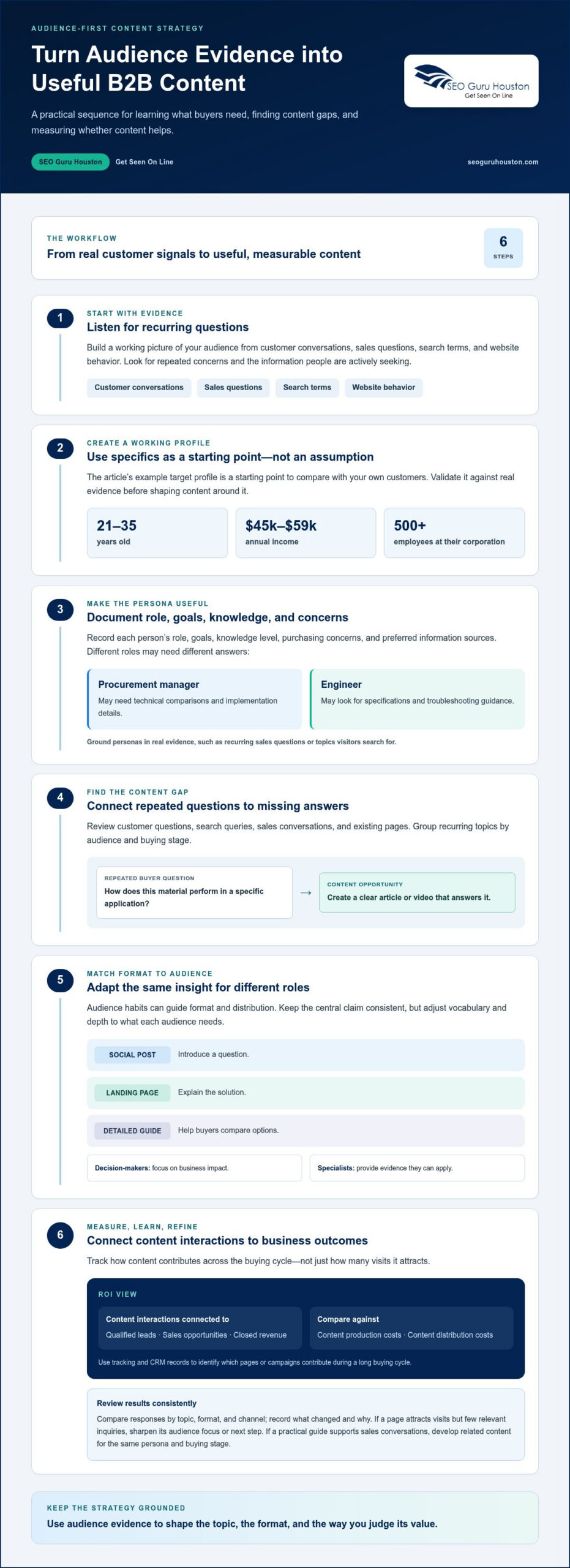
A content strategy for boring industries starts with a specific audience, not a broad assumption about who might buy. Build a working profile from customer conversations, sales questions, search terms, and website behavior. For example, the target profile described here includes people aged 21 to 35 years, earning $45,000 to $59,000, and employed by corporations with more than 500 employees. Treat that profile as a starting point, then compare it with your own customers.

Turn the profile into a practical persona by documenting the person’s role, goals, knowledge level, purchasing concerns, and preferred information sources. A procurement manager may need technical comparisons and implementation details, while an engineer may look for specifications and troubleshooting guidance. Base each persona on real evidence, such as recurring sales questions or topics visitors search for on your site.

How do you identify audience needs and content gaps in a niche industry? Review customer questions, search queries, sales conversations, and existing pages, then group recurring topics by audience and buying stage. If buyers repeatedly ask how a material performs in a specific application but your site offers no clear explanation, that gap could become a useful article or video.

Audience habits can shape both format and distribution. Check which pages attract attention, whether visitors arrive through search or social platforms, and which formats prompt useful responses. An operations leader may prefer a concise process guide, while a technical audience may value a detailed comparison. Test formats, keep the tactics audiences respond to, and revise those they ignore.

Make industry topics interesting by connecting them to audience interests without forcing an unrelated trend. A manufacturer might explain material durability through an environmental angle, or connect a local business story to local sports. A familiar reference, such as a popular book, can also clarify a technical idea. Any connection should strengthen the explanation, not distract from the product or customer problem.

Adapt the same core insight for different roles and formats. A social post can introduce a question, a landing page can explain the solution, and a detailed guide can help buyers compare options. Keep the central claim consistent, but adjust the vocabulary, depth, and next step. Decision-makers need to understand the business impact; specialists need evidence they can apply to their work.

How do you measure content marketing ROI in B2B industries? Connect content interactions to qualified leads, sales opportunities, and closed revenue, then compare the resulting value with content production and distribution costs. Use tracking and CRM records to see which pages or campaigns contribute during a long buying cycle, rather than judging a technical guide by visits alone.

Review results on a consistent schedule. Compare responses by topic, format, and channel, and record what changed and why. If an article attracts visits but few relevant inquiries, sharpen its audience focus or next step. If a practical guide supports sales conversations, develop related content for the same persona and buying stage.

2. Balancing personality and authenticity

Technical accuracy earns trust, but a brand’s personality gives readers a reason to remember it. In 2014, content marketing was dubbed “The Year of the Story.” That idea still applies to industrial topics: explain what a product changes for a real person, not just what it contains. A maintenance company, for example, can pair an equipment guide with a technician’s account of spotting a recurring issue.

Choose three voice attributes, such as practical, candid, and curious, and define each with an example. “Practical” might mean explaining a process in plain language; “candid” means acknowledging a genuine limitation instead of hiding it in vague copy. A brief voice guide gives writers a shared reference and keeps the brand’s personality consistent across blog posts, sales pages, and social updates.

Use humor with judgment. A light joke about a familiar workplace headache can make a post approachable, but humor about safety, customer losses, or a serious technical failure can undermine credibility. Before publishing, check that the humor supports the point, suits the audience, and sounds like the people who do the work. Cut it if it distracts from the useful information.

Show the people behind the expertise. A project manager can explain why a process changed, a technician can clarify a common misconception, and a founder can describe the principle behind a business decision. Use specific details. “We care about quality” is generic; describing how a team handles a difficult handoff demonstrates that value through an example.

Personality also comes through in structure. Replace a stiff introduction with a clear problem, use descriptive subheadings, and close with a useful next step. An article about equipment maintenance might open with signs of an overlooked issue, then offer a simple inspection checklist. This professional structure makes the writing easier to follow and more engaging.

Keep the brand recognizable across topics without making every piece sound identical. An occasional entertaining post can reinforce the voice while staying relevant to the business. A manufacturer, for instance, could share a brief behind-the-scenes account of how a team solved an unusual production challenge. Track comments, shares, and meaningful inquiries to learn which tones and formats prompt responses, then refine future content.

Consistency matters across channels, too. A social post can be punchier than a technical guide, but both should reflect the same values and level of candor. A focused social media marketing approach can help carry that voice into audience conversations, rather than treating each post as a disconnected announcement.

3. Publishing guest posts from customers or industry insiders

A customer or industry insider can explain a difficult problem in language readers recognize. Invite a plant manager to describe how an equipment issue disrupted production, or ask a distributor to explain a recurring buyer misconception. Firsthand details add context that internal experts may overlook. Choose contributors for relevant experience, not job titles alone.

Start with a focused invitation. Name the intended audience, the question the post should answer, and the practical takeaway for readers. For example, ask a maintenance lead to explain how teams identify early signs of wear. Provide a short outline with prompts, but let the contributor bring examples and terminology from their daily work.

Strong guest content can reveal problems customers may not describe in formal interviews. Ask contributors to walk through a recent challenge: what happened, what made it difficult, and what information helped. A supplier might explain why a specification was misunderstood during purchasing. Remove confidential details, then shape the story around a lesson other buyers can use.

Put education first in every draft. A controls engineer could clarify the difference between a sensor fault and a wiring issue, while noting when readers need qualified technical help. Keep explanations precise, define industry terms, and use a practical example for each major point. Readers should get a useful resource, not a disguised product pitch.

Give readers a practical next step. A logistics customer might share a checklist for preparing a shipment, while an industry analyst could explain what data to gather before comparing suppliers. Add a clear summary and relevant links to your own guides. People arriving from search should understand the advice without insider knowledge.

Before publication, edit for clarity, accuracy, and your established voice. Preserve the contributor’s perspective, but remove unexplained acronyms and unsupported claims. Confirm names, product references, and technical details with the author. Then promote the finished post through the contributor’s professional network, email updates, and relevant social channels. A useful post can earn attention from Google and readers when its subject matches a real search need.

Keep the relationship active after publication. Thank the contributor, share audience questions, and invite a follow-up as the topic develops. An older blog post can also become a short video, even if the original was published two years earlier. Repurposing the insight creates another format and a fresh reason to reconnect with the contributor and audience.

A follow-up can turn interest into action: the company in the article estimates that converting a customer by phone gives it about a 75% chance of closing the sale. Keep the next step relevant to the advice, rather than forcing a pitch.

Balance material that moves beyond the brand’s core topic with posts that reinforce it, so readers stay connected without feeling pestered. The gym partnership in the example offers customers a 10% coupon in exchange for promoting a vehicle hail-damage guide. Brands can also link to and share material from industry sources, curating useful content from others to reinforce their authority.

Content Strategy for Boring Industries That Finds Fresh Angles

4. Separating strategy clarity from creative content

Set the strategy before brainstorming headlines. Document what the organization does, who it serves, where revenue comes from, and which audience needs the content should address. Then define voice attributes, channel priorities, and useful outcomes in plain language. A pump manufacturer, for example, might focus on helping facility teams compare maintenance approaches. Clear direction gives creative work a target without dictating every sentence.

What content formats work best for traditionally boring industries? Try practical formats such as evergreen guides, local stories, short videos, and link-worthy resources. A comparison guide can explain technical choices, while a short video can demonstrate a process. Match each format to the audience’s question and the content’s purpose, then track responses, including comments and qualified inquiries.

Plan a monthly mix of one local piece, two evergreen pieces, and one link-worthy asset. A local piece could explain a regional operating challenge, while evergreen articles could answer recurring maintenance questions. The asset might be a checklist, calculator, or original visual guide that others may reference. This mix adds variety while keeping the publishing plan manageable and focused.

A link-worthy resource earns attention by making a useful idea easier to understand or share. For a building supplier, that might be a material selection chart or a clear guide to common project decisions. A contest can also invite participation when it fits the audience. One hail-related example offered a $500 prize to the local homeowner submitting the largest hailstone during the season. The prize was tied directly to the subject.

Videos make complex processes visible. Film a technician explaining a routine inspection, then add captions and a concise written summary for readers who prefer text. A B2B marketer can also repurpose material from a blog post written two years earlier into a short-form video. Keep the central advice accurate, refresh dated details, and adapt the opening to the video audience.

Give writers creative freedom within clear boundaries. Specify the intended reader, voice attributes, core message, and required evidence, then let writers choose the story and presentation. Explicit guidance helps writers and campaign teams interpret the strategy consistently. Flag unresolved decisions, such as a messaging framework still in development, rather than letting each new piece invent its own direction.

How much does a content marketing strategy cost for a small B2B business? The price depends on scope, research, production formats, and distribution needs, and is provided after a quote request. A focused plan may prioritize a few useful formats, while a broader program requires more research and ongoing production.

Review the plan against audience response and business relevance. If a guide prompts thoughtful comments or helps sales answer recurring questions, use that signal to shape the next topic. Content creation becomes more efficient when every piece has a defined purpose, while reader conversations keep the strategy connected to real needs.

5. Content idea generation for less exciting industries

Start with customer questions, not a brainstorm about what sounds exciting. Write down 50 questions buyers ask about a product, process, or decision. A filtration company might list questions about choosing a filter, spotting wear, or comparing materials. Group similar answers, then choose topics that solve real problems and support business goals.

Use a content idea matrix to explore each question through generalization, specification, similarity, and time. A question about equipment maintenance could become a general guide, a model-specific explanation, a comparison with another method, or a seasonal checklist. This framework turns one useful insight into distinct digital content instead of repeating the same article under a new title.

How can B2B companies make technical or complex topics engaging? Start with a familiar problem, explain the technical point in plain language, and show its practical effect. For example, explain how a vehicle’s fuel warning relates to driver decisions, then support the answer with clear details.

Which SEO keywords and topics should boring-industry businesses target? Focus on phrases that reflect customer questions, product applications, comparisons, and troubleshooting needs. Match each keyword with a useful answer, such as a solar company explaining how home-buying decisions affect energy planning.

Useful ideas can come from connections beyond the core product. A content piece about buying a house earned 99 links in the solar energy industry. In auto maintenance, an article about car iterations and how far drivers can travel after the gas light comes on earned 151 linking root domains. Both examples connect an industry subject to a decision people already understand.

What are examples of successful content marketing in boring industries? A blender campaign was associated with a 700% increase in total blender sales between 2006 and 2008. Industrial marketers can also find an audience through a niche newsletter with a mailing list of 10,000 people, as Ross Simmonds has noted.

In regulated industries, key risks include inaccurate claims, unclear qualifications, and advice readers could mistake for guidance about their personal situation. Build review into the workflow: verify technical statements, document evidence, and send sensitive drafts through appropriate internal review before publication.

How do you build a content strategy for an industrial or regulated business? Document what the organization does, where its revenue comes from, who its audience is, and which questions the content should answer. Record shared decisions and unresolved issues, then connect each topic to an audience need and business goal.

Use these steps to build a practical topic pipeline, then turn the strongest ideas into a focused B2B content and demand-generation plan.

SEO Guru Houston: Houston SEO Services

SEO Guru Houston can help turn useful industry knowledge into a clear digital strategy that reaches the right buyers nationwide. If your content answers customer questions but struggles to earn search visibility, professional SEO services can support a focused approach to relevant topics and search intent. For complex business audiences, specialized B2B marketing and inbound marketing methodologies can connect educational content with broader demand generation goals.

Identify where your strategy needs support: audience targeting, search visibility, or a clearer path from useful information to qualified inquiries across your target markets. SEO Guru Houston can align those priorities with your content program and overarching marketing objectives.

Contact SEO Guru Houston to discuss how a clearer content strategy can support your business goals.

Turn Your Next Idea Into a Clear Plan

A content strategy for boring industries becomes valuable when it guides regular decisions, not just when it sits in a document. Choose one audience need, assign responsibility for addressing it, and decide how you’ll judge whether the content is useful. This gives your next idea a purpose before production begins, while leaving room to adjust based on feedback from readers and sales teams.

SEO Guru Houston can support the next stage with Houston SEO Services, Houston PPC Services, and Houston B2B Marketing. These offerings can help connect content priorities with search visibility, paid campaigns, and business-to-business marketing goals. Bring a clear picture of the audience you want to reach and the questions your content should answer.

Ready to turn your ideas into a more focused marketing plan? Explore your next steps with SEO Guru Houston. Your industry already has useful knowledge to share. Put it to work with purpose, and keep building from there.

Frequently Asked Questions

What is content strategy for boring industries?

A content strategy is a documented plan for turning specialized knowledge into information that helps a defined audience make decisions. A commercial flooring supplier, for example, could plan articles about durability, installation considerations, and facility maintenance. Each topic needs a clear reader, purpose, and suitable format. The strategy helps teams choose what to create, maintain a consistent message, and connect useful information to business priorities.

How often should companies in niche industries publish content?

Choose a publishing cadence your team can sustain while keeping information accurate and useful. A monthly planning cycle can coordinate new articles, updates, and distribution without making every week a deadline. For example, a manufacturer could publish a guide when customers repeatedly ask about a specification, then update existing pages when product details change. Review audience response regularly and adjust the schedule to match capacity and demand.

Core Web Vitals Optimization for Faster, More Stable Pages

A page can load quickly and still frustrate visitors. The three Core Web Vitals measure loading performance with Largest Contentful Paint (LCP), responsiveness with Interaction to Next Paint (INP), and visual stability with Cumulative Layout Shift (CLS). A practical core web vitals optimization guide targets an LCP of 2.5 seconds or less, an INP below 200 milliseconds, and a CLS score below 0.1.

Those thresholds turn a vague “my site feels slow” concern into specific issues to investigate. Speed matters, but responsiveness and unexpected page movement can disrupt the experience even after content appears. Improving these signals can make important pages smoother and easier to use.

This guide explains what each metric measures, how layout shifts and delayed interactions affect visitors, and how image delivery influences loading performance. It also covers Core Web Vitals in Google Search, where they are one consideration among several, and the optimization work that can address underlying problems.

Key Takeaways

  • Understand how loading, responsiveness, and visual stability are measured, and what good performance looks like for each metric.
  • Spot common causes of layout shifts, including animations and transitions, and learn how to keep page elements stable as content loads.
  • See why Interaction to Next Paint replaced First Input Delay and what the change means for assessing real interactions.
  • Explore how image formats, sizing, and delivery affect loading speed, especially when an image is the page’s largest visible element.
  • Learn how real-user data and performance dashboards help connect Core Web Vitals improvements with page experience in Google Search.

Cumulative Layout Shift (CLS) – What is CLS?

Cumulative Layout Shift (CLS) measures unexpected movement of page elements during loading and use. Aim for a CLS score below 0.1; scores from 0.1 to 0.25 need improvement, while scores above 0.25 are poor.

Animation and Transition Layout Shifts

Animation-related layout shifts happen when motion changes an element’s position or size and pushes other content around. They matter because a moving page can make visitors lose their place or click the wrong control. Layout shifts caused by animated or transitioned CSS properties affect CLS when they occur more than 500 milliseconds after a user interaction.

Choose animations that don’t change the page’s layout, such as transforms and opacity changes, instead of properties that reposition nearby elements. Pages that animate CSS properties capable of affecting layout are 15% less likely to have good CLS than pages overall. Pages animating margin or border widths have poor CLS at almost twice the rate of pages overall.

Font Loading and Layout Stability

Font loading can shift a layout if the browser first displays fallback text, then replaces it with a custom font whose characters occupy different space. That change can alter line breaks and move headings, paragraphs, and buttons. For example, a heading that wraps onto an extra line after a font swap can push the content below it down.

Use the CSS property font-display: swap; to show fallback text while a custom font loads. Check how the chosen font affects line length and wrapping so you can reserve enough space for text. Preloading critical fonts can prioritize assets essential to the page layout and help reduce movement during loading.

Cumulative Layout Shift Optimization

CLS optimization means finding unexpected movement and reducing it without hiding or delaying useful content. Start with a performance report to identify affected pages and elements, then reproduce the movement during loading. For example, an image without reserved space may push a paragraph down when it appears.

Fix the cause at the element level. Specify image and video width and height attributes so the browser can reserve space before those assets load. Positioning ads lower on a page can reduce instability caused by ads above the fold. Preload critical images and fonts when they are essential to the initial layout.

  • Reserve space for images and videos with explicit dimensions.
  • Keep animated effects from changing surrounding layout.
  • Review font swaps, ads, and other late-loading elements in the report.

Check visual stability across the page, not only on first display. A change to one element can affect nearby content, so compare the layout before and after loading. Prioritize shifts that obstruct reading or controls, then validate the updated page in the report.

What are the three Core Web Vitals metrics?

Core Web Vitals measure real-world loading performance, responsiveness, and visual stability. Largest Contentful Paint (LCP) tracks loading, Interaction to Next Paint (INP) evaluates responsiveness, and Cumulative Layout Shift (CLS) captures unexpected movement. Good targets are LCP within 2.5 seconds, INP below 200 milliseconds, and CLS below 0.1. A core web vitals optimization guide can help connect each metric to the page experience it represents.

To measure Core Web Vitals, open the report in Google Search Console to review groups of pages. Use PageSpeed Insights for page-level results and Chrome DevTools’ Performance panel to inspect a browser session. Search Console and Chrome User Experience Report data reflect real-world Chrome user experiences, while DevTools helps investigate issues in a controlled test.

The three metrics reveal different bottlenecks. A simple page may display its main content slowly if the server responds late. A page can load quickly yet feel unresponsive when JavaScript blocks the browser’s main thread. Or the layout can shift after loading, disrupting reading or interaction.

Google evaluates field performance at the 75th percentile of user experiences. That means the report reflects the slower end of real visits, not only a developer’s fastest test. The Chrome User Experience Report uses anonymized data collected from Chrome users, helping distinguish a lab-only issue from a problem visitors encounter across devices and network conditions.

PageSpeed Insights helps connect results to possible causes. Compare field data with lab diagnostics: field data reflects user experience, while a lab test provides a repeatable view of a page load. Test important templates, such as a product page and a lead form, because each may have different bottlenecks.

Performance dashboards are most useful when they track trends alongside affected page groups. In Search Console, check whether issues cluster around a template or URL type, then compare later reports after making changes. One test cannot show whether a fix improved the experience for real users.

Page builders and plugins can add scripts, styles, and requests that compete for browser time. On WordPress, review active plugins and remove unused features or scripts where safe. If TTFB stays above 400 milliseconds, address hosting before relying on frontend changes to improve LCP; a good TTFB target is below 0.8 seconds.

Shared WordPress hosting typically has a TTFB of 500 to 1500 milliseconds, compared with 100 to 300 milliseconds for managed WordPress hosting. Caching can reduce repeated server work, while a content delivery network can deliver assets to users in different locations. When template changes are needed, website development and landing page work can address the page structure behind recurring performance problems.

Interaction to Next Paint (INP): What Is It?

Interaction to Next Paint (INP) measures how quickly a page responds throughout a visitor’s interactions. A good INP is below 200 milliseconds; a score from 200 to 500 milliseconds needs improvement, and above 500 milliseconds is poor. Unlike a metric focused on one input, INP reflects the delay from interaction through the browser’s next visual update.

Google replaced First Input Delay (FID) with INP in March 2024. FID measured only the delay before a browser began processing a visitor’s first input. It did not account for later interactions or the time needed to process an event and render its visual response. INP provides a broader view by considering interactions such as clicking a menu, typing into a search field, or adding an item to a cart.

Consider a visitor selecting a filter. The browser may receive the click promptly, but a long JavaScript task can delay the filtered results appearing. INP includes that wait for the next paint. A page’s INP is 500 milliseconds if its slowest interaction takes half a second to process. This helps identify sluggish controls that a fast initial page display can conceal.

Start diagnosis by reproducing the slow interaction, then inspect the page’s main-thread work in Chrome DevTools. Browser tasks lasting more than 50 milliseconds are considered long tasks and can block responses to user actions. Look for expensive event handlers, repeated layout calculations, and scripts that run during the interaction. Break lengthy JavaScript work into smaller tasks, remove unnecessary processing, and avoid updating large sections of the page when one element changes.

Third-party scripts can compete for processing time. Review analytics, chat widgets, and advertising scripts, then load them asynchronously or limit their use where possible. For example, avoid recalculating search results on every keystroke if the interface can wait until typing pauses. Keep the response clear, such as by showing a loading state while results render.

Use real-user monitoring and the Core Web Vitals report in Search Console to identify patterns across page groups. Lab testing can help reproduce an interaction, while field data shows how visitors experience it across devices and network conditions. Prioritize the slowest meaningful interactions, then compare measurements after each code change.

Preloading helps with resources needed early, but it does not directly fix every INP problem. Prioritizing a critical script can help it arrive sooner, but competing resources can still delay interaction processing. Distinguish loading delays from JavaScript execution issues, then address the bottleneck affecting the visitor’s next action.

Core Web Vitals Optimization for Faster, More Stable Pages

Image format and responsive image optimization

For mobile users, prioritize the image that becomes the largest contentful paint element, then reduce its file size and loading delay. Serve appropriately sized images, use modern formats such as WebP, and lazy-load images outside the viewport while ensuring the primary visual is discoverable early.

Images often determine whether a mobile page feels ready. The 2024 Web Almanac reports that 73% of mobile pages have an image as their LCP element. Compress large files and serve WebP where appropriate; WebP media content is 34% smaller than the usual format. Match each image’s dimensions to its display size instead of sending a large desktop asset to a narrow screen.

Responsive image markup lets the browser choose a suitable source for the screen and layout. Use srcset to offer image variants and sizes to describe their expected display width. For example, a phone showing a small product thumbnail shouldn’t download the oversized file used for a full-width desktop banner. This reduces unnecessary data transfer.

Make the LCP image easy for the browser to discover in the initial HTML. Among pages whose LCP element was an image, 35% had image source URLs that weren’t discoverable in the initial HTML response. A further 7% obscured the LCP image behind a data-src attribute. Avoid hiding the primary image behind JavaScript-driven loading when it needs to appear early.

Prioritize images larger than 10,000 square pixels when investigating LCP. Use image preloading selectively for a critical, immediately visible visual, so the browser can request it sooner. Don’t preload every image: unnecessary requests compete for network capacity and can delay the resource that matters most.

Reserve layout space by setting image dimensions, then lazy-load below-the-fold images. Sixty-six percent of pages have at least one image without an explicit size, which can leave the browser unable to allocate space before loading. WordPress has supported native WebP images since version 5.8, and native lazy loading since version 5.5.

Image optimization is only part of resource optimization. Render-blocking CSS can delay the first display, while large JavaScript bundles and third-party scripts compete for browser time. Minify CSS and JavaScript, defer noncritical resources, and load below-the-fold images as they approach the viewport.

  • Compress images and select responsive variants for mobile display.
  • Keep the LCP image visible in initial HTML and prioritize it selectively.
  • Reserve image space and lazy-load visuals outside the viewport.

A content delivery network can serve image assets quickly to users in different locations. After changing formats, markup, or delivery, compare mobile field performance and inspect the LCP element again. This helps show whether the image itself, its discovery, or another resource is still delaying the visual result in Google Search.

The practical targets help teams decide what to fix. Aim for Largest Contentful Paint within 2.5 seconds, Interaction to Next Paint below 200 milliseconds, and Cumulative Layout Shift below 0.1. Google assesses user experiences at the 75th percentile, so a page’s fastest visit does not represent every visitor. A page that performs well only on a developer’s laptop may still struggle on slower mobile networks.

Use that percentile perspective to prioritize pages and templates. If a Search Console report groups URLs with similar performance, investigate their shared layout or components first. For example, a slow product template may affect many product pages; fixing shared image handling or scripts can address a pattern rather than one URL. Reassess field data after changes because real-world results reflect users’ devices and connections.

Keep the metrics in context. A good LCP score means the largest visible content appeared promptly; it does not prove every form or menu responds well. Likewise, a good Interaction to Next Paint result does not show that a page answers the visitor’s query. Pair Core Web Vitals data with the page’s purpose and user tasks, such as reaching a contact form or comparing service details.

Make the next action specific: connect a page group’s Search Console status to its template, then prioritize changes affecting loading, responsiveness, or stability. For a stronger search experience, build a performance-focused website strategy around the pages visitors need most.

SEO Guru Houston: Houston SEO Services

SEO Guru Houston helps businesses connect organic search priorities with the pages customers use to evaluate their services. If Core Web Vitals reports reveal recurring issues across important landing pages, our professional optimization strategies can align technical performance priorities with search visibility and page goals.

That work can support a broader growth strategy. Comprehensive digital marketing and B2B campaigns help businesses pursue different acquisition goals, while a well-structured website gives visitors a clearer path to useful information and next steps.

For a focused discussion about your website’s search priorities and core web vitals optimization guide implementation, contact SEO Guru Houston.

Turn Better Page Experience Into Your Next Step

Performance work creates the most value when it supports a clear business goal. Choose a priority page, connect its technical needs to the action you want visitors to take, and keep that focus as your site evolves. A core web vitals optimization guide can frame the work, but progress depends on applying the right changes to the pages that matter to your audience.

When technical improvements need to align with broader visibility and growth objectives, SEO Guru Houston offers search engine optimization, pay-per-click advertising, and B2B marketing. These services can support different acquisition strategies while your website gives visitors a smoother path to useful information and next steps.

Bring your priorities into focus and decide what better page experience should help your business achieve. Contact SEO Guru Houston to discuss how its digital marketing services fit your goals. Keep moving forward with a site built to serve both your audience and your growth strategy.

Frequently Asked Questions

FCP vs LCP: What Is the Difference?

First Contentful Paint (FCP) records when the browser first renders visible content, such as text or an image. Largest Contentful Paint (LCP) measures when the largest visible content element appears. FCP may occur while the main image or headline is still loading. Use both measurements to narrow down delays: slow FCP points to an early rendering issue, while a later LCP may point to the primary content element.

FID vs INP: What Changed?

Interaction to Next Paint (INP) replaced First Input Delay (FID) in Google’s Core Web Vitals in March 2024. FID measured delay before the browser began processing a visitor’s first interaction. INP assesses the responsiveness of interactions across a visit, including the delay until the next visual update. For example, a quick first click doesn’t reveal whether a later filter selection takes too long to display results.

First Input Delay (FID): What Is FID?

First Input Delay measured the time between a visitor’s first interaction and the browser beginning to process it. It focused on input delay, not the full time required to update the page afterward. An ideal FID was below 100 milliseconds; 100 to 300 milliseconds needed improvement, and above 300 milliseconds was poor. FID is now a legacy metric, so use INP when evaluating current Core Web Vitals.

Largest Contentful Paint (LCP): What Is LCP?

Largest Contentful Paint measures how long the largest visible content element takes to appear after a page starts loading. That element might be a prominent heading, an image, or another large content area. LCP helps identify whether the content visitors came to see appears promptly. For example, a page may show its logo quickly but still have a slow LCP if its main banner loads later.

What Is a Good LCP Score?

A good LCP is within the first 2.5 seconds after loading begins. A score from 2.5 to 4.0 seconds needs improvement, while a score greater than 4.0 seconds is poor. If a report flags LCP, identify which element was measured before changing code. A large image, delayed server response, or render-blocking resource can each affect when that element appears.

What Does Insufficient Real User Data in PageSpeed Insights Mean?

It means PageSpeed Insights lacks enough eligible real-world Chrome user data to show field results for that page or origin. It is not a performance score and does not establish whether the page is fast or slow. Use available lab diagnostics to investigate a specific test, then review field data later as it becomes available. Test important page templates, not just the homepage.

What Are Core Web Vitals, and What Are the Current LCP, INP, and CLS Thresholds?

Core Web Vitals measure real-world loading performance, responsiveness, and visual stability. Good targets are LCP within 2.5 seconds, INP below 200 milliseconds, and CLS below 0.1. LCP above 4.0 seconds, INP above 500 milliseconds, and CLS above 0.25 are poor. The middle ranges need improvement: LCP from 2.5 to 4.0 seconds, INP from 200 to 500 milliseconds, and CLS from 0.1 to 0.25.

How Do Field Data and Lab Data Differ When Evaluating Core Web Vitals?

Field data reflects real visits from Chrome users, while lab data comes from a controlled test that helps reproduce and diagnose page behavior. Field results show how people experience a page across their actual devices and network conditions. A lab test can help isolate a slow script or image, but one test does not represent every visitor. Compare both views to connect real-world patterns with specific technical causes.

Mobile first design for B2B sites that puts usability first

A desktop layout shrunk to fit a phone isn’t mobile-first. Mobile-first design for B2B sites starts with the smallest screens, prioritizes essential content and actions, then adds features as the layout scales up for tablets and desktops. The goal is a clear, usable experience on every screen, not a desktop page squeezed into a narrow column.

That matters because buyers may use a phone to research a solution, compare options, or reach out between meetings. If key information is hard to find, buttons are awkward to tap, or pages take too long to load, the experience can get in the way of a business decision.

This guide explains what mobile-first design means and how it differs from responsive design. You’ll also learn how device and network testing, navigation, page performance, and Google’s mobile-first indexing affect a B2B website, so you can see which design choices support usability and search visibility.

Key Takeaways

  • Start with essential B2B content and actions on small screens, then expand the experience for larger devices.
  • Test real phones and tablets across screen sizes, orientations, and network conditions to uncover usability issues.
  • Make mobile navigation easy to scan and interactive controls comfortable to tap, while keeping key pathways visible on desktop.
  • Optimize images, scripts, and page layouts to support faster loading and a smoother mobile experience.
  • Review the mobile version of your site as part of both usability and search visibility, since Google uses it for indexing and ranking.

What is mobile first design?

Mobile-first design begins with a phone-sized experience, then expands it for tablets and desktop screens. For B2B teams, that means prioritizing essential information and user actions before adding wider layouts or extra features.

The approach matters because a buyer may first encounter a supplier on a phone, then continue research on a desktop. About 50% of B2B searches are conducted on smartphones. A mobile-first design for B2B sites makes the first interaction usable, while still leaving room for detailed product information and complex decision-making on larger screens.

Mobile-First and Responsive Approaches

Mobile-first defines the order of design decisions, responsive describes how layouts adapt to screen size, and adaptive uses selected fixed layouts. This distinction helps teams avoid treating a mobile view as a compressed desktop page. With mobile-first design, teams establish the essential content and journey first, then enhance the experience as more screen space becomes available.

Responsive layouts can adjust fluidly across device sizes, whether the design began on a phone or desktop. Adaptive design may instead use fixed layouts for widths such as 320, 480, 760, 960, 1,200, and 1,600 pixels. These approaches can overlap: a mobile-first site can also use responsive layouts. The key is to prioritize content and controls for each screen.

For example, a phone layout might place a product overview, specifications, and inquiry action in one clear column. A desktop layout can then show comparison tables or supporting details side by side. Simply stacking desktop elements may retain the content but hide the buyer’s next step.

Value for B2B Buyers and Decision-Makers

Mobile-first design helps B2B buyers find and use essential information on a small screen, which matters during early research and later vendor evaluation. A clear product summary, readable specifications, and accessible inquiry path make the experience easier to navigate without removing depth from the desktop version.

The cost of a B2B redesign depends on its scope, existing platform, content, integrations, and required layout changes; pricing is provided after a quote request. Common mistakes include shrinking desktop text, hiding key actions, and carrying every desktop element onto mobile without prioritizing. Measure results by comparing mobile traffic, form completion, qualified inquiries, and task success before and after launch, segmented by device and key landing page.

Mobile-first design prioritizes mobile users, while responsive design focuses on adapting layouts across device sizes. The goal is to prioritize the mobile experience rather than simply squeeze a desktop site onto a smaller screen. A mobile-first design process begins with smartphone and tablet basics, then adds features as more screen space becomes available.

Usability testing across devices and network conditions

A design that looks sound in a browser preview can behave differently on actual devices. Test the pages buyers use across screen sizes, orientations, and network conditions.

Device-Specific User Intent

Device-specific intent means the same buyer may use a phone and desktop for different tasks. A mobile user might check a supplier’s capabilities between meetings, while a desktop user compares specifications or prepares a detailed inquiry.

Test those journeys separately, then check that each device supports the next step. For example, confirm that phone users can find a product summary and submit an inquiry, while desktop visitors can scan detailed technical information. Analytics can reveal which devices bring valuable conversions, helping you test against actual buyer behavior.

Cross-Device and Screen-Size Testing

Cross-device testing checks whether content and interactions work across different screens and hardware. It matters because a layout that fits one phone may wrap awkwardly or hide controls on another.

Use specific viewport examples: test an iPhone SE at 375 pixels, an iPhone 14 or 15 at 390-430 pixels, and a Samsung Galaxy S21 at 360 pixels. Include an iPad at 768 pixels, then rotate devices to catch layout shifts. Check headings, tables, navigation, and inquiry forms at each size.

Real-device testing reveals issues a desktop simulator may miss. Open important B2B pages on actual phones and tablets, then complete key tasks using touch. Check whether product images remain clear, text wraps cleanly, and form fields accept input without awkward zooming. Test portrait and landscape orientations, since screen space changes when users rotate a device.

Network conditions matter too. Use throttled speeds to simulate slower connections, then observe how pages load on mobile devices. Large images may delay the main content, while scripts may slow a form or menu. Compressing and correctly sizing images can help pages load more efficiently. Test essential actions, such as opening product details or submitting an inquiry, before and after making changes.

Keep a short test record for each device and connection condition. Note the page, task, screen orientation, loading issue, and whether the user completed the task. For example, record if a specifications table requires sideways scrolling on a 360-pixel screen. Re-test after each fix, because one layout adjustment can affect another device.

If testing identifies layout or interaction problems, focused website development and landing pages can help address them as part of the site experience.

Mobile-first testing can use throttled network speeds to simulate real conditions. Test mobile designs across network speeds, device orientations, screen sizes, and hardware capabilities, using real phones and tablets.

Mobile B2B navigation should make core pages and next actions easy to find and tap. The best mobile-first UX practices combine clear pathways, finger-friendly controls, and simplified menus without hiding essential routes on larger screens.

Touchscreen-Friendly Interfaces

A touchscreen-friendly interface supports tapping and scrolling without requiring precise pointer control. This matters when buyers need to review specifications or complete an inquiry on a phone. Make buttons distinct from nearby text links, use readable labels, and keep interactive elements visually clear. On a product page, separate actions such as “View specifications” and “Request information” so each has an obvious tap area.

Mobile Navigation

Mobile navigation organizes the most important pages into a compact, usable pathway. A collapsible menu can reduce clutter, while sticky navigation can keep a key action available as visitors scroll.

Prioritize core routes such as products, services, and contact. Don’t make buyers navigate several menu layers to reach an inquiry form. On larger screens, keep critical navigation visible instead of automatically hiding it behind a hamburger menu. Responsive design should adapt navigation to the screen, not remove useful options.

Touch Target Sizes and Spacing

Touch targets are the active areas users tap, and adequate size and spacing help prevent missed selections. Apple recommends a minimum touch target of 44 by 44 pixels; Google recommends 48 by 48 pixels.

Apply these recommendations to buttons, menu items, and form controls. Leave enough space between adjacent actions, such as “Download spec sheet” and “Contact sales,” so a tap doesn’t trigger the wrong one. Mobile form fields should have a minimum height of 40 pixels for easier interaction.

Review each high-value page by following a buyer’s route from entry to action. On a phone, check whether the menu opens clearly, the current location is understandable, and the main action remains easy to reach. A long B2B form can be split into manageable steps with progress shown, helping users understand what remains.

Dropdowns need special attention. A select menu containing more than 100 options can be difficult to scan on a phone. Typeahead or autocomplete lets users find a relevant choice by entering text. For example, a buyer selecting an industry can type its name instead of scrolling through a lengthy list.

Test the same navigation on mobile and desktop, then adjust each layout for its context. Thoughtful website development and landing pages can align menus, forms, and calls to action around the buyer’s next step.

Mobile first design for B2B sites that puts usability first

Mobile site performance and search indexing

For mobile lead generation, keep forms focused, labels visible, and inputs easy to complete. Break complex requests into manageable steps, show progress, and make the main action clear. For example, a request form can collect contact details first, then ask for project specifics. This makes each step easier to understand on a smaller screen.

Performance affects how smoothly mobile users can reach that form. Compress and correctly size images, remove unnecessary assets, and defer scripts that aren’t needed immediately. Lazy-load non-critical content, and avoid large autoplay videos that compete with page content. These choices reduce the work needed to display the first screen, especially on slower connections.

Use Core Web Vitals to assess key parts of the mobile experience. A Largest Contentful Paint (LCP) time of 2.5 seconds or less is important for SEO ranking. The mobile Core Web Vitals checklist specifies an Interaction to Next Paint (INP) target of 200 milliseconds or less, and a Cumulative Layout Shift (CLS) target below 0.1.

Each metric points to a different issue. LCP measures how quickly the largest visible content appears, such as a product heading or hero image. INP reflects how quickly the page responds to actions, such as opening a hamburger menu. CLS tracks unexpected movement, such as a form shifting after an image loads. Stabilize image dimensions and limit script-heavy interactions to address these problems.

Google uses mobile-first indexing, so the mobile version of a site is central to how it indexes and ranks pages. Keep important text, links, metadata, and structured content available on mobile instead of hiding them in a separate version. A desktop page may display a full specification table while its mobile version collapses it. Ensure users and search engines can still access the same essential information.

Measure performance on key landing pages, not just the homepage. Compare loading and interaction behavior before and after changes, then review form completion alongside page performance. A faster page alone doesn’t prove that a lead-generation flow works. Check whether visitors can complete every field and submit successfully. Test changes on smaller screens, where cramped forms or delayed buttons can interrupt conversion.

Mobile optimization works best as an ongoing cycle: identify the slow or unstable element, make a targeted change, then retest the page. For example, if a large product image delays LCP, resize and compress that asset before changing unrelated scripts. This keeps improvements tied to measurable page behavior and the actions B2B visitors need to complete.

Mobile-first design and search rankings

Mobile-first design for B2B sites supports search visibility by making the phone experience fast, usable, and complete. Google uses mobile-first indexing, so the mobile version matters for how pages are indexed and ranked. The practical takeaway is clear: build mobile pages that preserve useful content and actions, not stripped-down copies of desktop pages.

Start with content parity. If a desktop product page includes specifications, pricing context, and internal links, make those details available on phones too. A mobile layout can present them in accordions or stacked sections, but visitors and search engines still need access. Hiding a product’s technical specifications from the mobile version, for example, can undermine buyer research and the page’s topical relevance.

Next, make each important page easy to find and understand. Use descriptive page titles, clear headings, and links that explain where they lead. A buyer searching for industrial filtration equipment should land on a page focused on that equipment, not a generic homepage. Connect related pages with contextual links, such as linking a product description to compatible applications.

Mobile usability influences what visitors can do after arriving from search. On phones, visual hierarchy should make the offer, supporting details, and next action easy to scan. Buttons need clear labels and enough space, while text must remain readable without zooming. If a buyer can’t find a request-information action beneath a long product description, search visibility may not translate into useful engagement.

Performance is part of that experience. A large hero image can delay the content visitors came to see, while heavy scripts can slow a menu or form. Compress images, load non-critical assets later, and test key pages on actual phones. Then check that the main heading, product details, and buttons appear and work as intended at different screen sizes.

Use search and behavior data together to find weak points. Compare mobile impressions, clicks, landing-page engagement, and completed inquiries for the same pages. If a page earns search visits but few visitors reach its form, review the content order, loading behavior, and mobile action path. Judge changes to buttons or page layouts by these outcomes, not appearance alone.

Mobile-first design for B2B sites isn’t a shortcut to rankings; it aligns indexable content with a usable buyer journey. Keep the mobile version complete, relevant, and easy to act on. For a site that needs stronger page structure and mobile usability, explore website development and landing pages.

SEO Guru Houston: Houston SEO Services

SEO Guru Houston can help connect mobile usability with the search and lead-generation goals behind your B2B website. Its professional SEO services address organic visibility, while comprehensive B2B marketing and inbound marketing support strategies for reaching business buyers and guiding them toward meaningful next steps.

Consider a focused review when mobile pages are difficult to find in search, attract visitors who don’t convert, or make important information hard to use. The review can align search priorities with the mobile experience, from landing-page content to inquiry paths. The right approach depends on your audience, website, and business objectives.

Contact SEO Guru Houston to discuss how mobile usability and search visibility fit your B2B marketing goals.

Turn a Better Mobile Experience Into Your Next Move

Make your next step focused: choose a B2B page that supports an important buyer decision, then align marketing and sales around what that page needs to accomplish. A mobile-first design strategy for B2B sites works best when usability, search visibility, and lead quality serve the same business goal. That shared direction helps teams prioritize improvements instead of treating design, SEO, and demand generation as separate projects.

SEO Guru Houston offers Houston SEO Services, Houston PPC Services, and Houston B2B Marketing to support businesses working toward stronger digital performance. If your team is ready to connect its website experience with its marketing priorities, contact SEO Guru Houston today.

Set a clear objective, make the buyer journey easier to act on, and keep improving with purpose. Your next opportunity can start with a more usable first visit.

Frequently Asked Questions

What is mobile-first design for B2B websites?

Mobile-first design for B2B websites starts by shaping essential buyer tasks for phones, then expands the experience for wider screens. For example, a procurement manager should be able to locate a product’s application details and share the page with colleagues without relying on a desktop. The method sets priorities around real buyer tasks, rather than simply shrinking a desktop page or removing information from the mobile version.

How should B2B websites prioritize content and navigation on mobile?

Put information that helps buyers make their next decision near the top, such as a clear product purpose, key specifications, and a relevant action. Keep secondary material available without letting it dominate the first screen. For example, a distributor’s product page can foreground compatibility and an inquiry option, with detailed documentation in clearly labeled sections. Use analytics to identify the pages and actions mobile visitors actually use.

What mobile-first website performance benchmarks should B2B sites meet?

Use these Core Web Vitals benchmarks: Largest Contentful Paint (LCP) at 2.5 seconds or less, Interaction to Next Paint (INP) at 200 milliseconds or less, and Cumulative Layout Shift (CLS) below 0.1. Assess these measures on key mobile landing pages, not just the homepage. A product page with a large visual or interactive quote form can behave differently, so investigate the page-level cause when a metric falls short.

How does mobile-first design affect B2B SEO and Google rankings?

Google uses mobile-first indexing, so it relies on a site’s mobile version for indexing and ranking. Keep valuable page content and crawlable links accessible there, including details that support a buyer’s search, such as product applications or technical documents. Mobile-friendly design can support search visibility through usability and performance, but it doesn’t replace relevant content or clear page organization. Review important landing pages on phones alongside search performance.

LinkedIn Ads for B2B Lead Generation: Targeting and ROI

A filled form is only the start; the right targeting and a low-friction form turn LinkedIn ads for B2B lead generation into a stronger path to qualified pipeline. Build audiences around professional attributes such as job title, company, industry, seniority, and skills. Then use LinkedIn Lead Gen Forms to pre-fill profile details, making it easier for prospects to share their information in a single click.

It makes sense to focus on audience fit and form completion, because a high lead count alone can hide poor-quality prospects. This guide explains how to define your ideal customer profile, target decision-makers, and optimize form fields without sacrificing useful qualification details. You’ll also learn how to assess lead quality beyond the initial submission and measure campaign performance through the pipeline, from clicks and conversions to sales outcomes. The goal is simple: make every campaign decision serve better-fit leads and clearer ROI.

Key Takeaways

  • Define your ideal customer profile before building an audience, then focus targeting on the professional attributes that signal buying relevance.
  • Make Lead Gen Forms easy to complete while keeping only the fields that help your team qualify and follow up with prospects.
  • Look beyond lead volume: evaluate whether submissions fit your audience and progress toward meaningful sales conversations.
  • Track campaign performance through the pipeline so you can identify where leads stall and which changes may improve results.
  • Use a mix of content and ad formats to keep your brand relevant as B2B buyers research their options.

1. ICP definition and LinkedIn audience targeting

Strong LinkedIn ads for B2B lead generation start with a precise ideal customer profile (ICP), not a broad industry label. Define the organizations most likely to benefit, then identify the people involved in their buying decisions. For example, a software company might prioritize mid-market manufacturers and target operations leaders, finance executives, and IT decision-makers. Specify firmographic fit, relevant roles, seniority, and the business problem your offer addresses.

Translate that ICP into LinkedIn’s professional targeting criteria. Advertisers can select job title, company, industry, seniority, and skills, then combine attributes to narrow relevance. Start with the strongest fit signals, such as “manufacturing” plus “operations director,” instead of stacking every possible filter. LinkedIn can match uploaded target-company lists against more than 8 million LinkedIn Pages, helping account-based campaigns reach decision-makers at named organizations.

Use Matched Audiences to prioritize high-value accounts and build retargeting groups from people who visited your website, engaged with an ad, or downloaded content. Website retargeting requires at least 300 matched users before the audience can be targeted. Keep prospecting and retargeting distinct: a first-touch audience may need an educational resource, while people who already engaged can receive a more specific case study or demo offer.

Audience size matters. A practical campaign starting point is 50,000-500,000 members, as recommended in the guidance summarized here. If your filters make the audience too narrow, remove weaker constraints before expanding beyond your ICP. For example, retain the target industry and seniority, but test related job titles. Exclude current customers, employees, competitors, or converted leads where those groups would waste impressions or receive the wrong message.

Map audiences to buying stages before choosing creative. Cold prospects need a useful introduction; engaged visitors may respond to proof, such as a customer story; sales-ready accounts may be ready for a direct consultation offer. This staged approach supports demand generation without assuming every prospect is equally close to buying.

How do LinkedIn ads compare with Google Ads and Meta ads for B2B leads? LinkedIn’s professional attributes and company targeting help focus on roles and accounts, while Google Ads can reach people expressing search intent. Meta ads commonly use broader demographic and interest signals, so the strongest channel depends on whether account fit, active search, or broader discovery matters most.

What LinkedIn advertising policies and targeting restrictions apply to lead generation? Use LinkedIn’s available professional attributes and eligible Matched Audiences, and ensure each audience meets platform requirements. In particular, website retargeting needs 300 matched users; campaign content and targeting must also follow LinkedIn’s advertising policies.

2. Lead quality, pipeline measurement, and campaign optimization

Lead volume can look strong while sales receives few useful opportunities. Set a quality baseline before launch: aim for at least 70% ideal-customer-profile fit among leads, then record each lead’s status from submission through opportunity. A simple scoring model can weigh company fit, role, engagement, and buying intent. Use those criteria to distinguish promising prospects from contacts who downloaded an asset but aren’t ready to speak with sales.

Build conversion tracking around the campaign objective, not clicks alone. LinkedIn Lead Gen Forms reporting includes cost per lead, form fill rate, and the audiences converting. Connect those metrics to CRM stages such as marketing-qualified lead, sales-accepted lead, sales-qualified lead, and opportunity. Offline conversion tracking can link ad exposure to later sales actions, while integrations with HubSpot, Marketo, or Salesforce can pass lead data into nurturing workflows.

Choose creative that fits both the offer and the buying stage. Sponsored Content can feature a case study, whitepaper, or industry report; carousel ads can present several benefits, while video can demonstrate a product or share a customer testimonial. Lead Gen Forms reduce manual entry, but results still depend on audience fit and a useful offer. Test creative variations and compare qualified pipeline, not just click-through rate.

Its ad auction uses advertiser bids, and Campaign Manager supports daily or lifetime budgets that you can change as results develop. Start with a budget aligned to the test’s audience and conversion goal; avoid frequent changes that make it harder to compare performance. LinkedIn Accelerate campaigns should receive 4-6 weeks of stable budget to learn, according to the playbook.

Use a staged launch. During the initial phase, confirm tracking, review lead fit, and correct delivery problems. During days 31-60, the playbook recommends an SAL rate of at least 60% and an SQL rate of at least 35%. By days 61-90, it recommends achieving at least 15% better CPA on SQLs and opportunities than when optimizing for leads alone. Treat these as operating benchmarks, not substitutes for your own pipeline data.

How do you improve conversion and lead quality? Refresh creative every 2-3 weeks, keep the offer relevant, and use lead scoring to prioritize follow-up. Route LinkedIn leads for first contact in under five minutes, then follow up within 24 hours of each Lead Gen Form submission.

How should you measure campaigns? Review cost per lead and form fill rate alongside lead quality, sales-stage progression, and return on ad spend. Track whether leads become sales-accepted leads, qualified opportunities, and revenue, then use those outcomes to refine targeting, creative, and bids.

Common risks include judging success by lead count, neglecting follow-up, and letting irrelevant impressions consume budget. Keep the wasted impression rate below 5%, and use retargeting, including website and video engagement, to support the pipeline. About 30% of assisted pipeline in a LinkedIn B2B campaign should come from retargeting, according to the playbook.

Need a clearer demand generation plan connecting paid campaigns to pipeline? Explore demand generation strategy as a way to align audience, offer, and follow-up.

LinkedIn Ads for B2B Lead Generation: Targeting and ROI

3. CTR, conversion rate, CPL, lead quality, and ROAS

Use click-through rate (CTR) to diagnose whether an ad earns attention, not to declare a campaign successful. Cold-prospecting LinkedIn content ads should aim for at least 0.5% CTR. Single-image ads paired with Lead Gen Forms typically see 0.4-0.8% CTR. Compare each campaign with its format and audience, since a relevant decision-maker click matters more than an unqualified click.

Conversion rate reveals what happens after the click. Calculate it by dividing completed actions by the relevant visits, then multiplying by 100. For a Lead Gen Form campaign, track both form opens and completed submissions to spot friction. A form-fill rate of 10-20% is a target for cold audiences, while warm audiences can aim for 20-40%. If clicks are healthy but completions lag, review the offer, form fields, and message match.

LinkedIn reports that Lead Gen Form campaigns increase conversions by 2-3x compared with standard Sponsored Content campaigns. That comparison can help guide a test, but assess your own audience and conversion path. Test one clear variable at a time, such as the offer or creative, and compare completed forms and qualified leads. Keep campaign objectives, attribution settings, and reporting periods consistent so the result reflects the change you tested.

Cost per lead (CPL) is campaign spend divided by submitted leads. LinkedIn’s guide reports that its cost per lead is 28% lower than Google AdWords. Use that comparison as context, not a substitute for your account’s actual results. A low CPL can still mask weak fit, so segment leads by company, role, and sales qualification. For example, compare the CPL of all form submissions with the CPL of sales-qualified leads.

Lead quality connects advertising metrics to revenue potential. Score fit and intent using signals such as target-company match, decision-making responsibility, and engagement with a high-value asset. Then assess how leads progress into sales conversations and opportunities. An audience that generates fewer submissions but more qualified opportunities may be more valuable than a larger, less relevant group.

Return on ad spend (ROAS) compares revenue attributed to ads with campaign spend. Calculate it by dividing attributed revenue by advertising cost, using the same attribution approach across campaigns. For a longer B2B sales cycle, monitor qualified pipeline and closed revenue alongside immediate form conversions. This prevents early engagement from being mistaken for final business impact.

Review metrics as a connected sequence: CTR indicates attention, conversion rate shows response, CPL measures acquisition efficiency, and lead quality tests fit. ROAS connects the path to revenue. When results weaken, identify the stage first. Low CTR may point to an audience or creative issue; low form completion suggests friction in the offer or form; high lead volume with a weak pipeline calls for stronger qualification and follow-up.

4. Lead Gen Forms and form-field optimization

LinkedIn Lead Gen Forms reduce friction by pre-filling professional details from a member’s profile. Depending on available profile information, fields can include name, contact details, company, seniority, job title, and location. Members can submit with one click instead of typing each answer, making the form useful for mobile users responding to Sponsored Content or a Message Ad.

Keep the form focused on the information sales needs to act. A practical starting point is four fields for most B2B forms. For example, request name, work email, company, and job title when those details support lead routing and qualification. Each extra question asks for more effort, so add a field only when its answer changes follow-up, qualification, or audience segmentation.

Match the form to the offer. Someone requesting an introductory guide may only need to provide basic work details, while a consultation request may justify a qualifying question about business needs. Keep the question direct and easy to answer. For example, offer a short set of choices about the prospect’s main challenge instead of asking for a lengthy description.

Set expectations before the click. Explain in the ad what the prospect will receive, who the offer is for, and what happens after submission. Then use the thank-you page to deliver the promised resource or direct the person to a relevant website destination. A downloadable eBook, case study, or product information page can clarify the next step.

LinkedIn Lead Gen Forms reporting shows cost per lead, form fill rate, and which audiences convert. Review these measures together: a high fill rate matters only when submissions fit your target accounts and provide actionable details. Leads can be downloaded from Campaign Manager or sent to a CRM or marketing automation platform. Connecting the data to HubSpot, Marketo, or Salesforce supports timely routing and nurturing.

Test changes deliberately. Compare one form version with another, changing a single element such as the offer description, field selection, or call to action. Track both completed submissions and downstream lead quality, then keep the version that contributes stronger prospects. LinkedIn’s guide reports that Bynder increased leads by 400% using Lead Gen Forms, but that case study is not a forecast for every campaign.

Use a 10% form completion rate as a target, then diagnose performance against your own audience and offer. If completion is weak, check whether the ad promise matches the form, whether each requested detail is essential, and whether the thank-you page gives a clear next step. Small edits to those elements can make the path from LinkedIn impression to useful lead more direct.

5. How do LinkedIn ads generate B2B leads?

LinkedIn ads put a business offer in front of professionals researching solutions and guide interested members toward a next step. A typical path moves from a relevant impression to content engagement, a form submission, and sales follow-up. Strong campaigns connect each step, keeping the ad promise, landing experience, and follow-up message consistent.

Sponsored Content appears in members’ feeds and can promote whitepapers, case studies, or industry reports. A carousel can present related ideas, such as a business challenge, its impact, and a practical solution. Video ads can feature a short product demonstration or customer testimonial. Match the format to the asset: a report suits a detailed learning offer, while a demo can show how a product works.

LinkedIn Message Ads can deliver personalized messages to members’ inboxes for account-based marketing. Dynamic Ads use profile data to create personalized experiences, while Spotlight Ads can direct people to a landing page. Follower Ads serve a different purpose: growing a Company Page audience. Choose the format for the action you want, rather than treating every ad type as interchangeable.

For a named-account campaign, pair a useful asset with company and role relevance. For example, a manufacturer could promote an operations case study to decision-makers at selected manufacturing accounts. Prospects who engage can later see a more focused offer. LinkedIn retargeting can reach people who visited a website, engaged with an ad, or downloaded content, helping the campaign continue the conversation.

Content helps buyers evaluate options before they’re ready to speak with sales. LinkedIn’s lead generation guide says a typical B2B buyer consumes 7 to 10 pieces of content before making a choice. Plan a sequence that offers distinct value, such as an industry report, a practical case study, and a product demonstration. Each asset should answer a different question and make the next step clear.

Buying decisions involve more than one person. LinkedIn research found that 3.1 to 4.6 groups can influence a B2B purchase decision. Build messages for the roles involved, such as finance, technical, and operational stakeholders, and give each group a reason to engage. A campaign that speaks to only one contact may miss other voices shaping the purchase.

Ultimately, LinkedIn ads for B2B lead generation work by combining professional targeting, relevant content, and a clear conversion path. Map each creative to an audience need, then connect form submissions and content engagement with suitable sales follow-up. Plan your LinkedIn lead generation approach around the pipeline you want to build.

SEO Guru Houston: Houston SEO Services

SEO Guru Houston can help when LinkedIn campaigns need to connect with a broader B2B acquisition strategy. Its B2B marketing and PPC services support businesses aligning paid campaigns with audience needs, landing pages, and pipeline goals. SEO services can complement that work by building organic visibility for prospects researching solutions beyond an ad click.

Turn to SEO Guru Houston when campaign activity generates leads but it is unclear how channels contribute to sales opportunities. SEO, PPC, and inbound marketing can bring targeting, content, and follow-up into sharper focus, while supporting buyer education across relevant touchpoints.

Contact SEO Guru Houston to discuss how these services can fit your B2B marketing goals.

Turn Campaign Insight Into Your Next Growth Move

The next step is to make every marketing channel support the same business goal. Treat each LinkedIn campaign as part of a wider path: the message creates interest, your website builds understanding, and a relevant next step helps prospects continue their research. That perspective keeps LinkedIn advertising for B2B lead generation connected to the conversations and opportunities your business wants to create.

SEO Guru Houston can support that broader strategy through B2B marketing, PPC, and SEO services. These offerings can help align paid visibility with B2B audience needs and organic discovery, giving your team a clearer foundation for reaching prospective customers across their research journey.

Ready to shape a more connected approach to B2B growth? Contact SEO Guru Houston to discuss your marketing goals and the next steps that fit your business. Build with focus, learn from each campaign, and keep moving toward stronger opportunities.

Frequently Asked Questions

How to target B2B audiences on LinkedIn by job title, company, and industry?

Build a LinkedIn audience by combining the role, organization, and sector that define a qualified prospect. For example, target procurement leaders at healthcare companies, then compare that segment with operations leaders at the same companies. Keep audience groups distinct so reporting shows which combination attracts stronger prospects. Exclude existing customers or converted leads when the offer is aimed at new business, and refine targeting with sales feedback.

What is the average cost per lead for LinkedIn B2B ads in the United States?

LinkedIn B2B cost per lead varies with the auction, audience competition, ad format, offer, and conversion rate, so one average won’t predict your campaign’s result. A narrow audience of senior decision-makers may cost more to reach than a broader group, while a stronger offer can improve form completions. Track spend against qualified leads and sales opportunities, not submissions alone, to understand whether the campaign’s acquisition cost supports your pipeline goals.

How to set up LinkedIn Lead Gen Forms step by step?

Create a LinkedIn Page and access Campaign Manager, then build a Sponsored Content or Message Ad campaign with a Lead Gen Form. Choose only the fields needed to qualify leads, keeping most forms to four fields or fewer, and add a thank-you page. Download leads from Campaign Manager or connect the form to a CRM or marketing automation platform.

© Copyright 2001 - 2026 seoguruhouston All Rights Reserved.

Call ButtonCall Button