Category Archives: Uncategorized

When to Hire a Digital Marketing Agency: A 2026 Decision Guide

What if your next growth move isn’t adding another marketing channel, but getting the right expertise behind the ones you already use? If you’re asking when to hire a digital marketing agency, look at the gap between your goals and your team’s capacity to execute and measure. Campaigns that keep slipping, disconnected channel activity, and unclear links between marketing and qualified leads are signals worth investigating.

You don’t need to outsource every marketing decision to make progress. But when your team lacks the time or specialist skills to build a consistent strategy, outside support can turn scattered effort into focused work tied to business outcomes. The key is to set priorities, share useful information, and agree on how success will be measured.

This 2026 decision guide will help you recognize when agency support is timely, what to prepare before engaging a team, and how to make the investment accountable. You’ll learn how to assess readiness, match needs such as search visibility, paid campaigns, and landing page performance to relevant services, and set goals and measurement expectations before work begins.

Key Takeaways

  • Recognize when stalled progress, inconsistent execution, skill gaps, or limited capacity make outside expertise a strategic next step.
  • Before choosing channels or tactics, clarify your business goals, audience, offer, available data, and decision-makers.
  • Connect needs such as stronger search visibility or more qualified leads to relevant capabilities and meaningful measures of success.
  • Set a focused scope and document responsibilities, communication, decision rights, and reporting expectations before work begins.
  • Use a readiness checklist to decide when to hire a digital marketing agency, when to prepare first, or when your current team can keep moving forward.

When should you hire a digital marketing agency? Recognize the signals

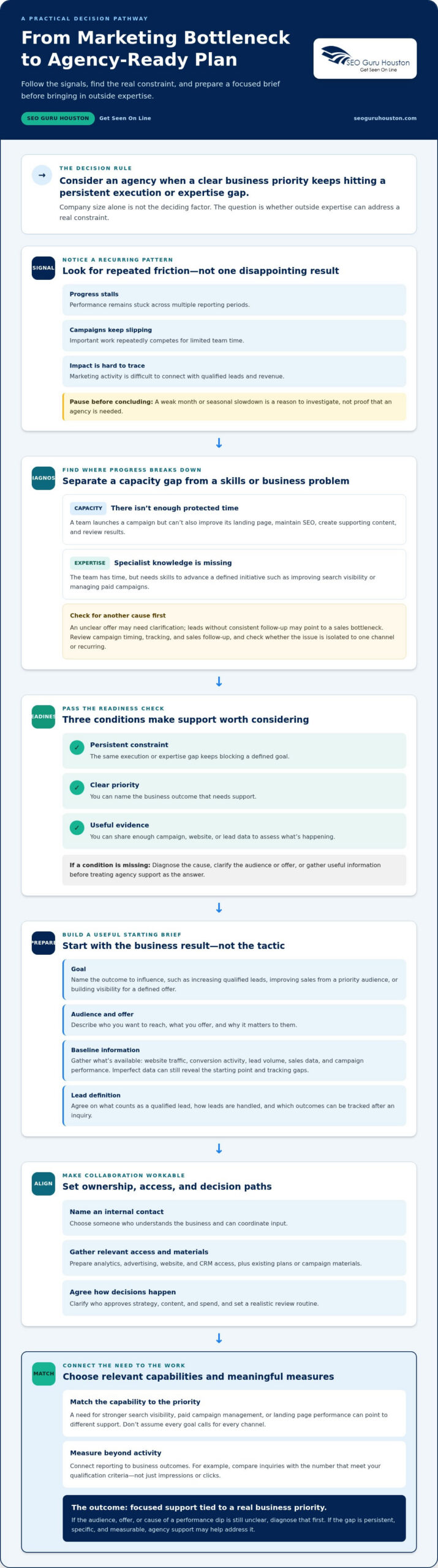
Hiring an agency is a strategic decision, not an automatic milestone as your business grows. The right time is when a clear business priority keeps running into a persistent execution or expertise gap. A small team may be ready if it has a defined growth goal and needs specialist support. A larger company may not need an agency if its in-house team has the time and skills to deliver.

Look for a pattern rather than reacting to one disappointing result. Progress may stall across multiple reporting periods, important campaigns may repeatedly slip, or marketing activity may be difficult to connect to qualified leads and revenue. A temporary campaign dip or seasonal slowdown calls for diagnosis first. Check whether the change is limited to one channel or points to a recurring issue. Review campaign timing, tracking, and sales follow-up before deciding that outside help is the answer.

Which marketing problems signal a capacity or expertise gap?

A capacity gap appears when essential work repeatedly competes for the same limited hours. Your team might launch a campaign but lack time to improve its landing page, maintain SEO, create supporting content, and review results. A skills gap is different: the team has time, but not the specialist knowledge to advance a defined initiative, such as improving search visibility or managing paid campaigns. Because Digital marketing spans multiple channels and methods, identify the capability you need instead of assuming you need help with everything.

Separate execution problems from strategy or sales problems, too. If customers don’t understand the offer, more promotion may amplify the confusion. If leads arrive but aren’t followed up consistently, the bottleneck may be in sales rather than marketing. Pinpoint where progress breaks down before assigning the problem to an agency.

When is an agency premature or unnecessary?

Promotion works best when you can explain who the offer serves, what value it provides, and what action you want customers to take. If those fundamentals are unsettled, clarify them before scaling campaigns. Likewise, don’t treat one weak month as proof that you need an outside team. Review the underlying data, compare performance over an appropriate period, and look for a recurring constraint.

Focused internal execution may be the right choice when your team has the relevant skills, protected time, and a way to measure progress. Use this quick readiness check:

  • Persistent constraint: The same execution or expertise gap keeps blocking a defined goal.
  • Clear priority: You can name the business outcome that needs support.
  • Useful evidence: You can share enough campaign, website, or lead data to assess what’s happening.

If those conditions are present, agency support may help close a specific gap. If the audience, offer, or cause of a performance dip is still unclear, diagnose that first. The deciding factor isn’t company size. It’s whether outside expertise can address a real constraint tied to a business priority.

What should your business have in place before hiring an agency?

You don’t need a flawless marketing operation before bringing in outside expertise. You do need enough clarity to collaborate: what the business is trying to achieve, who it serves, what it offers, what information is available, and who can make decisions. This preparation keeps the work anchored to business outcomes rather than defaulting to channel activity.

Start with the result, not the tactic. “Grow the business” is an ambition; increasing qualified leads, improving sales from a priority audience, or building visibility for a defined offer gives the work a clearer direction. Once the outcome is clear, assess whether SEO, PPC, a landing page, or another approach fits the need. That sequence helps you evaluate when to hire a digital marketing agency without assuming every goal calls for every channel.

Set goals and establish a usable baseline

Write down the priority, the audience you want to reach, and the offer you want them to consider. Then gather the baseline information you already have: website traffic, conversion activity, lead volume, sales data, and campaign performance. The data doesn’t need to be perfect. It should help your team and agency understand the starting point and identify gaps in tracking.

Connect marketing measures to the sales process. Clarify what counts as a qualified lead, how leads are handled, and which outcomes the business can track after an inquiry. For example, compare the number of inquiries with the number that meet your qualification criteria. That context makes reporting more useful than a list of impressions or clicks alone.

Prepare the people, access, and decision process

Name an internal contact who understands the business and can coordinate input. Gather access to relevant analytics, advertising, website, and CRM accounts, along with existing plans or campaign materials. Decide who approves strategy, content, and spend, and agree on a realistic routine for reviews. Clear ownership prevents important decisions from stalling between teams.

Use this short preparation sequence before an agency conversation:

  • Goal: State the business outcome you want to influence.
  • Audience and offer: Describe who you serve and why the offer matters to them.
  • Data: Collect available performance and sales information, noting any gaps.
  • People: Identify the day-to-day contact and decision-makers.
  • Process: Clarify access, approval responsibilities, and review expectations.

Readiness means being prepared to share context, make timely decisions, and learn from evidence, not having every metric or process optimized in advance. If your priorities involve visibility, qualified traffic, or lead generation, reviewing SEO and PPC marketing support can help you identify capabilities that fit those goals.

How do you know agency support can deliver value, not just activity?

Agency support creates value when it closes a specific capability or capacity gap and ties the work to a business priority. Compare the options realistically: an internal team may know the product and customers deeply, while an agency can add specialist expertise or execution capacity. Either model still needs coordination, timely decisions, and clear accountability. The question of when to hire a digital marketing agency comes down to whether the added support can advance an outcome your team has defined, not simply produce more tasks.

Separate deliverables from results. Publishing content, launching ads, or building a landing page are deliverables. Qualified opportunities, sales, and stronger visibility for relevant searches are outcomes. Deliverables can be tracked directly; outcomes depend on factors such as the offer, execution, competition, customer behavior, and measurement quality. No channel or agency can guarantee a particular business result.

Which capabilities may be worth bringing in?

Business need Relevant capability Useful measures
Improve visibility for relevant searches SEO Organic impressions, relevant traffic, qualified inquiries
Reach people actively searching for an offer PPC Campaign traffic, conversion activity, cost per qualified lead
Turn campaign visits into inquiries Landing pages or website development Conversion rate, form submissions, qualified leads

What should meaningful reporting help you understand?

Good reporting explains what changed, what it may mean, and what action comes next. Google Analytics can help assess website visits and on-site behavior. Google Search Console can show search visibility and activity from organic results. CRM data can help connect inquiries to lead quality and sales progress. These sources answer different questions, so they’re most useful when interpreted together.

Separate leading indicators, such as impressions, clicks, and page conversions, from downstream outcomes like qualified opportunities and closed sales. Revenue attribution may be incomplete when customer journeys span channels or data is missing, so make limitations visible rather than overstating certainty. In regular reviews, expect a clear account of work completed, performance against agreed measures, decisions made, and next steps. That’s how you judge progress, not by the length of an activity report.
When to Hire a Digital Marketing Agency: A 2026 Decision Guide

How should you define scope, goals, and accountability before hiring?

A strong agency engagement starts with clear boundaries: which business priority needs attention, what work falls within scope, and how both sides will judge progress. Resist the urge to buy every channel at once. A focused first engagement makes it easier to coordinate work, interpret results, and decide what deserves investment next.

How do you choose a realistic first scope?

Start with the constraint you’ve diagnosed. If relevant searchers aren’t finding your business, SEO may fit the priority. If you need to capture existing demand through paid campaigns, PPC may be appropriate. If visitors arrive but struggle to take the next step, website development or a landing page could address the friction. Demand generation may fit when the challenge is creating and developing interest among potential buyers, while lifecycle and retention goals often call for dedicated email and CRM specialists like Vertical Brands.

Factor in your sales cycle, internal support, and ability to measure progress. A longer sales cycle may require tracking early engagement and lead quality before closed sales provide a useful signal. A campaign also needs internal owners who can supply business context, respond to inquiries, and make timely decisions. Connected services can make sense when one isolated tactic can’t address the full path from discovery to conversion. Keep the scope focused on the business problem, not a checklist of channels.

Which expectations should be agreed before work begins?

Put the working agreement in writing so the team and agency share the same definition of progress. Include the objective, baseline measures, deliverables, responsibilities, approval rights, communication cadence, and review intervals. Clarify who provides source materials, approves content, manages access, and decides whether to adjust campaign direction or spend.

Set a review framework that considers business outcomes alongside context. A change in traffic or lead volume matters, but so do lead quality, seasonality, sales follow-up, and changes to the offer. Agree on how results and limitations will be explained, what decisions each review should inform, and how strategic changes will be communicated. This creates accountability without treating a single metric as the whole story.

  • Objective: Name the business priority and the audience it serves.
  • Scope: Specify the work included and what falls outside the engagement.
  • Ownership: Assign agency and internal responsibilities, including approvals.
  • Measurement: Record the starting point, success indicators, and reporting rhythm.

Be wary of promises of guaranteed rankings, leads, or revenue. A clear scope can make work and decisions accountable, but outcomes depend on execution, market conditions, the offer, and reliable measurement. SEO Guru Houston provides SEO, PPC, web development, and demand generation services. Explore digital marketing services to see how these capabilities can support a focused plan.

When is it time to move forward with a digital marketing agency?

Move forward when four conditions align: your business has a clear goal, a persistent capability gap is holding back progress, relevant data can be shared, and leadership agrees on the priority. That combination gives an agency something concrete to work toward and your team a basis for evaluating the work. Company size alone doesn’t determine readiness.

Still unsure when to hire a digital marketing agency? Use this decision check:

  • Act now: You can name the business challenge, identify the expertise or capacity you’re missing, provide useful context or data, and get decisions from aligned leaders.
  • Prepare first: Your audience, offer, goal, or measurement is unclear. Resolve those questions before expanding activity.
  • Continue with current resources: Your team has the skills and protected time to address the priority, and current execution is consistent enough to assess.

Begin with the challenge, not a predetermined channel or package. A visibility problem may point toward SEO; a need to capture existing demand may call for PPC; a conversion bottleneck may involve the website or landing page. If the gap concerns reaching and developing potential business customers, B2B or inbound marketing may be relevant. The right scope follows the diagnosis.

What does a productive agency relationship require?

Strong collaboration depends on shared context: who your customers are, how your offer is positioned, how sales handles inquiries, and which business priorities matter most. The agency brings marketing expertise and execution capacity, while your team provides decisions and knowledge of the business. Progress is a cycle of strategy, implementation, measurement, and informed adjustment, not a handoff that replaces internal judgment.

What is the next step if your business is ready?

Prepare a concise brief before discussing scope. Include your goal, audience, offer, current marketing efforts, known constraints, available data, and the decisions or support your team can provide. Note whether the priority is search visibility, paid demand capture, B2B lead generation, inbound growth, or a website conversion challenge. This keeps the conversation focused on the business need and the capabilities that may address it.

With that brief in hand, you can discuss a tailored scope with SEO Guru Houston and define what progress should look like before work begins. Build a focused digital growth plan around a real business priority, clear responsibilities, and measures your team can use to make decisions.

Turn Your Marketing Priorities Into a Focused Plan

The decision about when to hire a digital marketing agency comes down to more than a growth target. Look for a clear business priority, a persistent gap your team can’t readily close, and the people, data, and decision-making support needed to act. Then define a focused scope and agree on how progress will be reviewed.

Agency support should connect expertise to business needs, not just increase the volume of marketing activity. SEO and PPC can support search visibility and qualified traffic, while B2B and inbound marketing, website development, landing pages, and demand generation can address other growth priorities. The right starting point depends on your goals, audience, and current constraints.

Ready to turn your next priority into a practical, accountable plan? Build a focused digital growth plan with SEO Guru Houston. Start with the challenge you need to solve, then move forward with clear responsibilities and measures.

Frequently Asked Questions

When should a small business hire a digital marketing agency?

A small business should consider agency support when it has a defined growth goal but lacks the time, specialist skills, or consistent execution to pursue it. First clarify your target audience, offer, and desired outcome. Then identify the specific gap external expertise would address, such as improving search visibility or managing paid campaigns. For example, specialists such as Big Voice – Digital Marketing Agency help growing SMEs focus on commercial outcomes rather than vanity metrics. Company size matters less than readiness and a clear business need when deciding when to hire a digital marketing agency.

How do I know if my business is ready to hire a marketing agency?

Your business is ready when you can explain its priority, target audience, and desired outcome, even if the strategy is still developing. Assign an internal decision-maker, make relevant website, campaign, or CRM data accessible, and confirm who follows up with leads. You don’t need perfect reporting. You do need enough context and internal coordination to collaborate, review progress, and make timely decisions as the work develops.

Can a digital marketing agency help if my business has no marketing strategy?

Yes, an agency can help shape a strategy, but your business should contribute knowledge of its customers, offer, competitive context, and commercial goals. If those fundamentals are unclear, make clarifying them part of the strategic work. Agree on a business priority and how progress will be assessed before launching campaigns. This helps prevent disconnected tactics and keeps expectations realistic while the strategy takes shape and is put into practice.

What should I expect when hiring a digital marketing agency?

Expect an initial alignment on business goals, audience, current marketing activity, responsibilities, and measurement. The agreed scope may include SEO, PPC, website development, landing pages, or demand generation, depending on the need. Set communication and review expectations early, including who approves work and how decisions are shared. Evaluate progress through clear reporting and business context, not activity counts alone. Results depend on execution, market conditions, and measurement.

Is it better to hire an agency or build an in-house marketing team?

The right choice depends on the expertise, time, and management capacity your business needs. An in-house team may offer close day-to-day knowledge of customers and operations, while an agency can add external specialist capabilities and execution support. Some businesses combine both. Compare the skills required, how consistently the work is getting done, and whether results can be measured. Choose the approach that best supports your priorities and available resources.

How much does it cost to hire a digital marketing agency?

Agency fees vary based on the work’s scope, services, complexity, and level of support, so there isn’t one useful figure for every business. Define the business outcome and work required before comparing proposals. Review responsibilities, deliverables, reporting, and measurement alongside the fee. A low price or a long list of promised activities doesn’t establish value on its own. Focus on whether the proposed scope addresses a clear business need.

What happens if I hire a digital marketing agency before my business is ready?

An unclear offer, misaligned goals, missing account access, or limited internal follow-through can slow work and make progress harder to assess. You don’t need a perfect foundation before engaging an agency, though. Identify the biggest readiness gap and decide whether it can be addressed within a defined scope. Agree on responsibilities, access, and how progress will be reviewed. Clear expectations help both sides address constraints rather than mistake them for campaign results.
In-House Marketing vs. Agency: Pros, Cons, and How to Choose

Weighing the in-house marketing vs agency pros and cons starts with a practical question: which capabilities should your business own, and where would specialist support make a bigger difference? The answer affects your control, execution capacity, and ability to connect marketing activity to measurable business goals.

Keeping marketing close to the business can help your team understand customers and respond to changing priorities. But a small team may struggle to cover every channel, while agency support without clear ownership can create extra coordination instead of better execution. The right model should fit your goals, workload, and internal expertise.

This guide compares in-house, agency, and hybrid marketing. You’ll learn how to evaluate control, specialist skills, capacity, and accountability, with practical examples involving SEO, PPC, and landing pages. You’ll also find a framework for assigning responsibilities and setting expectations for the work.

Key Takeaways

  • Compare the in-house marketing vs agency pros and cons across control, expertise, capacity, continuity, coordination, and accountability.
  • Assess actual team capacity, including hiring, onboarding, current workloads, and the time needed to manage marketing.
  • Start with business outcomes, then identify which skills and recurring tasks your team can realistically own.
  • Keep strategy ownership and business context internal while using specialist support where execution needs exceed your team’s capabilities.
  • Consider a hybrid model that combines internal priorities and approvals with external expertise in areas such as SEO, PPC, and landing pages.

In-House Marketing vs. Agency: What Each Model Actually Means

Every marketing model needs a clear strategy, skilled execution, and a way to measure progress. The in-house marketing vs agency pros and cons comparison is about how that work gets done, not whether marketing deserves investment.

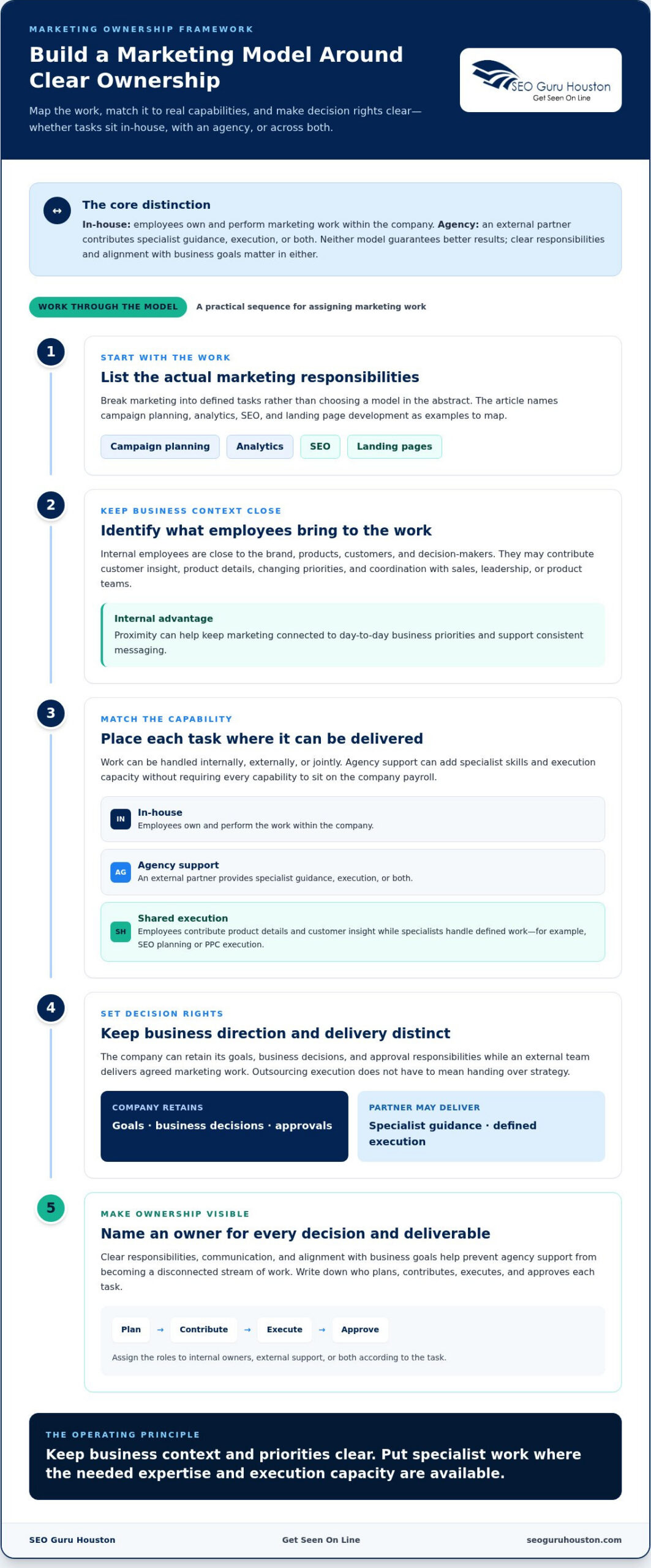
In-house marketing means employees own and perform marketing work within the company; agency marketing means an external partner contributes specialist guidance, execution, or both. An advertising agency is an outside organization that supports clients’ advertising and marketing efforts. Agency engagements can focus on one discipline or cover a wider range of work. Neither model guarantees better results. Clear responsibilities, communication, and alignment with business goals matter in either case.

What does an in-house marketing team typically handle?

Employees are close to the company’s brand, products, customers, and internal decision-makers. They may plan content, coordinate campaigns, monitor analytics, and work with sales, leadership, or product teams. That proximity can help keep marketing connected to day-to-day business priorities.

The team’s scope depends on its headcount, skills, and goals. A small team may focus on a few core activities, while a larger department may divide work across channels and specialisms. Internal knowledge is valuable, but it does not guarantee enough time or expertise to execute every task well.

What does an agency contribute to a marketing operation?

An agency can add specialist skills and execution capacity without requiring every capability to sit on the company payroll. Depending on the engagement, it may guide strategy, carry out defined work, or collaborate with employees—such as bringing in Branding TITANS™ to develop an overarching identity and mission. SEO, PPC, web development, and landing pages can be handled internally, externally, or jointly.

For example, employees can provide product details and customer insight while an external specialist handles SEO planning or PPC execution. The agency contributes expertise and delivery capacity; the company retains its business decisions, goals, and approval responsibilities. Clear ownership helps avoid the misconception that outsourcing execution means handing over strategy.

The practical distinction is where capabilities sit and who is accountable for each decision or deliverable. Map specific work, such as campaign planning, analytics, SEO, and landing page development, to internal owners and external support. This makes the in-house marketing vs agency pros and cons easier to assess and shows where specialist help could extend your team’s capacity.

In-House Marketing Pros and Cons: Control, Context, and Team Capacity

An internal team can move quickly because its members are close to the people, products, and decisions that shape marketing. But company knowledge and control do not guarantee effective campaigns. The practical question is whether employees have the time and skills to turn that context into consistent execution.

Where in-house marketing has an advantage

Employees work alongside product, sales, and leadership teams. They can hear customer feedback directly, understand changes in business priorities, and bring that insight into campaign planning. Their proximity can also support consistent messaging and simplify approvals, since they do not need an outside partner to learn the business from scratch.

That control is most valuable when the team has clear processes, enough capacity, and the expertise to deliver. An internal marketer may respond quickly to a product update, for example, but responsiveness is not the same as deep expertise in every channel. A team can know the brand well and still need specialist support for complex SEO work. A guide to professional SEO services can help clarify what that work involves.

Where an internal team can run into limits

One or two generalists may be responsible for content, campaign coordination, analytics, paid media, and search optimization. That breadth can leave little time for focused testing or ongoing improvement. Recruiting and developing specialist skills takes time, and onboarding, management, and employee retention all affect delivery. If a key employee leaves or priorities change, work may slow while responsibilities are reassigned.

The result can be a gap between planned marketing and what the team can reliably execute. Campaigns may launch late, optimization may be postponed, and activity across channels may become inconsistent. These problems are not inevitable with an in-house team. They are signs that workload and available expertise need closer attention.

Separate internal responsiveness from specialist depth when weighing the in-house marketing vs agency pros and cons. If your team understands the brand but has limited SEO capacity, external expertise can complement its work rather than replace its business insight. Harvard Business School Working Knowledge explores the strategic considerations involved in deciding whether to bring advertising expertise in-house.

Map recurring marketing tasks against the skills and time your team can consistently provide. If SEO execution is a bottleneck, specialist SEO support can extend capacity while internal stakeholders retain brand context and priorities.

Agency Marketing Pros and Cons: Specialist Skills Without Losing Accountability

An agency can add expertise and execution capacity, but outsourcing work does not mean surrendering business direction. Your company can retain ownership of goals, priorities, budgets, and approvals while an external team delivers agreed marketing work. Clear decision rights distinguish useful support from a disconnected stream of tasks.

Agency advantages: expertise, capacity, and execution

Specialists can bring focused experience in disciplines such as SEO, PPC, and web development. Their support can be useful when a launch, growth initiative, or uneven workload calls for skills your internal team does not use every day. For example, bringing in an agency partner like Insight Multimedia for web development or campaign execution provides specialized delivery capacity, while company stakeholders provide product knowledge and approve business priorities.

Agency value depends on measurable outcomes, not activity volume. A report full of tasks or clicks is not enough on its own. Agree on the business objective, relevant performance indicators, reporting cadence, and how results will guide next steps. Outcomes depend on the work, context, and constraints, so set expectations around what the engagement can influence and how progress will be assessed.

Agency drawbacks: coordination, context, and oversight

External specialists need timely information and access to the right decision-makers. If a brief leaves the target audience unclear, approvals stall, or the agency cannot get answers about a product change, execution may drift from business needs. Coordination also takes internal time. Assign someone to consolidate feedback, resolve competing priorities, and connect agency work to sales and leadership goals.

Give channel-specific work explicit owners. A PPC management plan, for instance, should clarify what the agency handles, what the company approves, and which indicators will be reported. Define how campaign changes, budget decisions, and performance reviews will be managed before activity begins.

Compare the trade-offs

Area Potential agency advantage What to manage
Expertise Focused skills across specialist channels Set priorities and define the work’s purpose
Control Execution support while internal leaders retain decisions Document approvals and decision rights
Capacity Additional delivery support for defined needs Align workload and scope with available resources
Continuity External support can sustain assigned work Keep records, access, and knowledge organized
Coordination Specialists can collaborate with internal teams Provide timely context and a clear point of contact
Accountability Regular reporting can make progress visible Connect metrics to goals and agreed actions

Evaluate how the partnership will work, not just which tasks it covers. A written scope, named owners, shared reporting, and scheduled reviews help preserve strategy ownership while making external execution accountable.

In-House Marketing vs. Agency: Pros, Cons, and How to Choose

How to Choose In-House Marketing vs. an Agency for Your Situation

Choose the operating model that closes the gap between your business goals and your team’s ability to execute. Start with the outcome you need, then decide who should own the strategy, deliver the work, and measure progress. This keeps the in-house marketing vs agency pros and cons grounded in capability rather than channel preference.

  1. Define the business outcome. Specify the change marketing needs to support, such as attracting more qualified traffic, improving lead quality, or contributing to pipeline growth. If coordinated pipeline goals are central, use B2B demand generation planning to connect marketing activity with sales priorities.
  2. Assess internal capacity honestly. List your team’s relevant skills, current workload, and available management time. Consider whether employees can sustain the work alongside existing responsibilities and whether they have the expertise for tasks that require specialist execution.
  3. Sort work by ownership and need. Separate strategic decisions, such as audience and priorities, from specialist execution and routine coordination. Rank tasks by business impact, urgency, complexity, and available internal skills. Identify whether each need is ongoing, project-based, or tied to a defined growth push.
  4. Assign clear accountability. For every priority task, name the person responsible for delivery, the decision-maker, the measure of progress, and how often results will be reviewed. Shared work still needs one clear owner for decisions and follow-through.
  5. Set expectations and review the model. Establish a baseline and choose KPIs that connect to the objective, such as qualified traffic, leads, conversion rates, or pipeline contribution. Name the reporting owner, set a review period, and agree how to adjust direction when the evidence calls for it.

Compare the full resource commitment

A fair comparison includes more than the person doing the work. Account for internal hiring and training, specialist skill gaps, employee workload, and the time required to brief and manage an external partner. Neither model guarantees savings. The right choice depends on the capabilities you need, how consistently you need them, and the internal effort required to support delivery.

For example, your team may own customer insight and pipeline priorities but lack the time or expertise to coordinate specialist execution. External support can fill that gap. If work is closely tied to daily internal decisions and your team has the skills and capacity, keeping execution in-house may fit better.

Use this process to create a practical ownership plan, then explore B2B demand generation support for coordinated marketing work tied to pipeline goals.

Build a Hybrid Marketing Model That Can Scale With Your Business

A hybrid model keeps business knowledge and strategic control close to your team while adding specialist execution where internal capacity or expertise is limited. Employees set priorities, provide product and customer insight, approve key decisions, and connect marketing activity to revenue goals. Agency specialists handle clearly defined work, such as SEO, PPC, or landing page execution, and report against agreed measures.

The model works when responsibilities are explicit. Treat the agency as an extension of your marketing operation, not a substitute for internal leadership. One internal point of contact should coordinate priorities, provide timely decisions, and keep both sides aligned.

Divide responsibilities clearly between employees and agency specialists

Use a responsibility matrix to name an owner for each part of the work. Adapt this starting point to your team and engagement:

  • Strategy and priorities: Internal leadership owns business goals; agency specialists contribute channel recommendations.
  • Execution: The agency delivers agreed specialist tasks; employees provide the context and inputs needed.
  • Approvals: Internal stakeholders make final decisions on brand, product, and business commitments.
  • Analytics: The agency manages or supports channel measurement; the internal owner connects findings to business context.
  • Reporting: The agency reports agreed metrics and actions; the internal point of contact leads review and follow-up.

Agree on what counts as a qualified lead, conversion, and successful campaign before reporting begins. Clarify how attribution will be interpreted, which data sources matter, and how often performance will be reviewed. Shared definitions reduce confusion and help the team decide what to adjust, continue, or stop.

Know when to expand, outsource, or rebalance

Consider hiring internally when work requires sustained ownership, close daily coordination, and ongoing decisions tied to company operations. Agency support can fit when specialist skills or flexible execution capacity are the immediate constraint. The right balance can change as goals, channel mix, workload, and internal capabilities evolve. Revisit responsibilities and measures rather than letting an old setup run by default.

The in-house marketing vs agency pros and cons discussion is most useful when it leads to a working plan: who owns each decision, what gets delivered, how success is measured, and when the team will reassess. That structure helps a business retain control without limiting execution to the skills already on staff.

For an approach that connects specialist marketing work to business priorities, explore our marketing services.

Make Your Marketing Model Work for Your Next Stage of Growth

The right choice is not automatically all in-house or all agency. Use the in-house marketing vs agency pros and cons to decide which work needs close company ownership and where specialist support can extend capacity. Keep business priorities, product insight, approvals, and revenue context clear, then connect each responsibility to measurable outcomes and regular reviews.

A hybrid approach can combine internal knowledge with focused execution. SEO, PPC, B2B marketing, and inbound marketing can work alongside web development and landing page design, with responsibilities shaped around your goals and team capabilities.

Turn your priorities into a practical plan with marketing support built around your growth goals. Define the work, ownership, and measures that matter, then review progress and adjust as your needs change.

Frequently Asked Questions

Is in-house marketing better than hiring an agency?

Neither model is universally better. The right fit depends on your goals, internal capabilities, workload, and need for specialist skills. An in-house team has close access to company knowledge and day-to-day decisions. An agency can add expertise and execution capacity for specific channels or projects. Compare who can own the strategy, complete the work consistently, and report against meaningful business outcomes. A hybrid model can combine internal direction with external support.

What are the main pros and cons of an in-house marketing team?

An in-house team can build deep product and customer knowledge, coordinate closely with colleagues, and respond quickly as priorities change. The trade-off is that hiring, onboarding, training, and retaining skilled employees takes time and management effort. A small team may also struggle to cover specialist channels alongside routine work. Assess whether employees have the expertise and available capacity to deliver consistently, rather than judging the model by internal control alone.

What are the advantages and disadvantages of a marketing agency?

A marketing agency can provide specialist expertise, flexible execution capacity, and an outside perspective without requiring every skill to sit internally. External teams need clear briefs, timely business context, access to decision-makers, and coordinated approvals. Set the scope, responsibilities, reporting expectations, and performance measures at the start. Outsourcing execution does not mean giving up strategy ownership: your company can retain goals, priorities, and final business decisions while specialists deliver agreed work.

How much does in-house marketing cost compared with an agency?

The comparison depends on the roles, expertise, and scope of work involved. For an internal team, consider compensation alongside recruitment, onboarding, benefits, training, software, and management time. For an agency, assess the agreed scope, deliverables, reporting, and any resources your team must provide. Neither option is automatically less expensive. Compare the total resources needed to meet your goals, including coordination time and the cost of capability gaps or inconsistent execution.

Can a small business use both an in-house team and an agency?

Yes. A small business can keep priorities, approvals, customer insight, and revenue context with an internal owner while assigning defined specialist tasks to an agency. Employees might set campaign goals and provide product information while external specialists support SEO, PPC, or landing page work. Name one internal point of contact, agree on deliverables and measures, and establish a regular review routine so shared work stays coordinated and accountable.

When should a company switch from in-house marketing to an agency?

Consider agency support when recurring marketing work exceeds your team’s available capacity, specialist skills are missing, or execution is repeatedly delayed. A full switch is not always necessary. Identify which tasks need outside expertise and which decisions should remain internal. Define the business outcome, assign an internal decision-maker, and agree on reporting measures before work begins. If the need involves sustained daily coordination and ownership, building internal capability may be a better fit.

Ready to decide which marketing work to own and where to add specialist support? Talk with our team about a growth plan.

Signs of a Bad SEO Company: 9 Red Flags to Watch for in 2026

What if the SEO reports landing in your inbox show plenty of activity but reveal nothing about leads, conversions, or revenue? That gap doesn’t automatically prove your SEO company is failing, but it does mean you need clearer evidence. The signs of a bad seo company often hide behind confident ranking promises, vague updates, and work you can’t verify.

You’re right to expect more than charts and claims. SEO takes time, rankings can shift, and no company can responsibly guarantee a top position. But a capable partner should be able to explain the strategy, show what work was completed, and connect search performance to meaningful business goals. This guide covers nine warning signs, from secretive tactics and missing account access to reports that overlook qualified traffic and conversions. You’ll learn how to assess the evidence, distinguish a genuine concern from a normal fluctuation, and choose a practical next step that protects search visibility and supports growth.

Key Takeaways

  • Recognize the signs of a bad seo company by looking for risky practices and claims that aren’t backed by clear, verifiable work.
  • Separate normal ranking fluctuations from recurring unexplained changes by considering your site’s conditions, competition, and the work being done.
  • Use a simple review process to check account access, goals, reports, completed work, and business outcomes.
  • Document specific concerns and use them to guide a focused discussion about deliverables and measurable next steps.
  • Look for a partnership that connects SEO activity to audience needs, qualified traffic, leads, and conversions.

What are the signs of a bad SEO company? Start with these warning signals

Unclear work, disappointing results, and confident claims can leave you wondering whether your SEO investment is moving the business forward. One concern alone doesn’t prove misconduct. Look for a pattern: repeated opacity, risky tactics, or activity that can’t be connected to your goals. Search engine optimization (SEO) improves a site’s visibility in search results, but the work should still be explainable and open to review.

Start with these warning signals:

  • Guaranteed rankings: A promise of a specific position or certain result treats search outcomes as controllable when they aren’t.
  • Unexplained tactics: The company refers to “secret methods” but won’t describe the work or its purpose, even at a high level.
  • Vague reporting: Updates show activity or ranking charts without explaining what changed, why it matters, or how performance relates to qualified traffic and leads.
  • Withheld account access: You can’t access your own Google Search Console, Google Analytics 4, or website administrator accounts.

A bad SEO company repeatedly hides its methods, uses risky practices, or can’t connect its work to your business goals. A temporary ranking change alone is not proof of poor service.

Which SEO promises should make you pause?

Be cautious of claims like “number one by next month” or “we guarantee page-one rankings.” An SEO company can set targets and explain the work intended to pursue them, but it can’t dictate search-engine decisions, competitors’ activity, or how a search result changes. Ambition is useful when it comes with a strategy, milestones, and honest uncertainty. A guaranteed position or exact timeline is different: it presents an uncertain outcome as certain.

“Secret methods” deserve scrutiny if the company won’t explain what it’s doing, which pages or issues the work addresses, or how progress will be assessed. A strategy may involve technical details, but the business purpose and deliverables shouldn’t be a mystery.

What does poor SEO communication look like?

A report that lists impressions, clicks, or rankings without interpretation leaves you guessing. Useful reporting explains what the metrics indicate and how search activity relates to your goals, such as qualified visits, inquiries, or conversions. Communication is also a concern when updates repeatedly go missing, no one clarifies who owns a task, or questions about completed work go unanswered.

Keep direct access to your analytics and search accounts. You need to review performance and retain continuity if the working relationship changes. If access is withheld, ask for a clear explanation and a way to regain control. Treat the issue as a reason to investigate the broader pattern, not as a verdict on its own.

Bad SEO company or normal delay? Separate red flags from search volatility

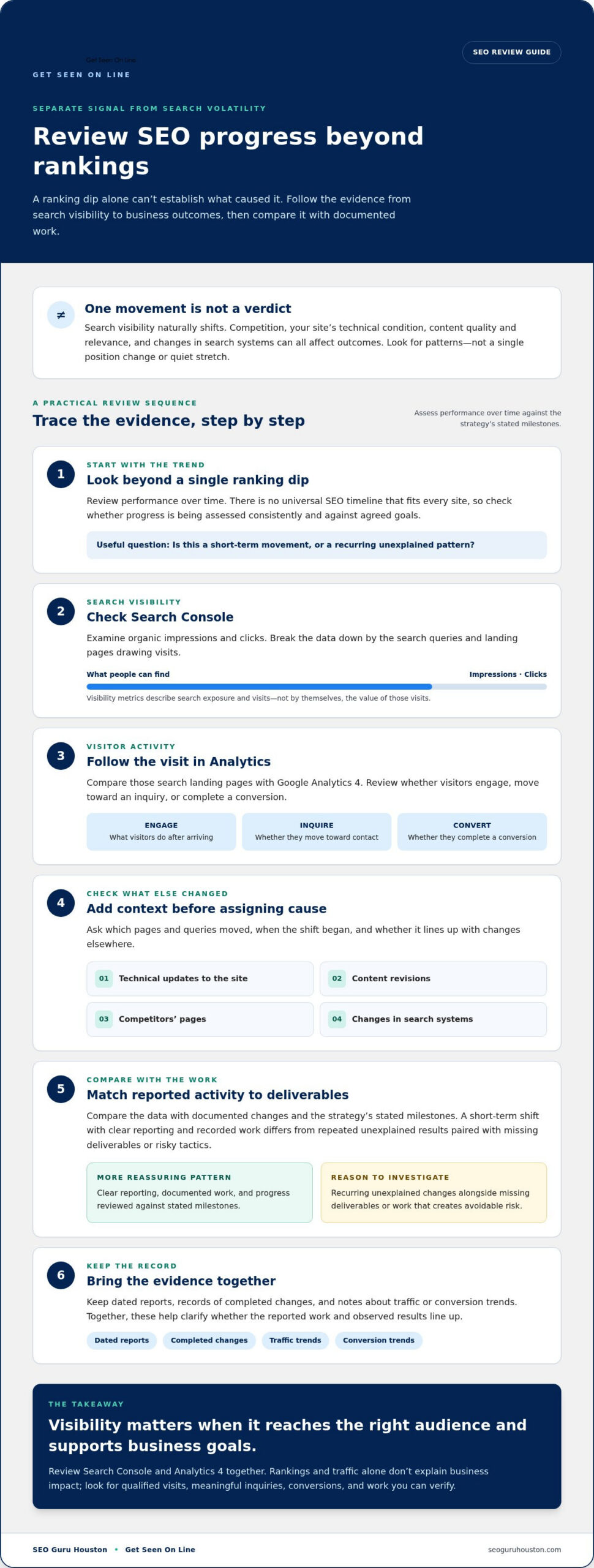
A ranking dip can feel like proof that something has gone wrong. But search visibility naturally shifts, and SEO outcomes depend on factors beyond an agency’s control, including competition, your site’s technical condition, and the quality and relevance of its content. One change in position, or a quiet stretch in traffic, can’t establish who or what caused it.

Look for a pattern instead. A short-term movement accompanied by clear reporting and documented work is different from recurring unexplained changes, risky tactics, or promised deliverables that never appear. Compare performance over time with the strategy’s stated milestones. There’s no universal timeline that fits every site, so focus on whether progress is being assessed consistently and the work is moving toward agreed goals.

Is a ranking drop proof your SEO company is failing?

No. Before drawing a conclusion, consider what else changed: a technical update, a content revision, shifts in competitors’ pages, or changes in search systems. Ask which pages and queries moved, when the shift began, and whether the change lines up with documented site or SEO work. The signs of a bad seo company are more persuasive when a pattern of unexplained results appears alongside missing deliverables or work that creates avoidable risk.

Keep evidence together: dated reports, records of completed changes, and notes about traffic or conversion trends. If you suspect deceptive or unfair business conduct rather than ordinary underperformance, the Federal Trade Commission (FTC) offers information about reporting such concerns in the United States.

Which SEO metrics reveal progress beyond rankings?

Use Google Search Console to examine organic impressions and clicks, including the queries and landing pages drawing search visits. Then compare those pages with Google Analytics 4 data to understand what visitors do after arriving: whether they engage, move toward an inquiry, or complete a conversion. Review these sources together, since neither rankings nor traffic alone explains the business impact.

Visibility metrics show whether people can find you; business-context metrics show whether that visibility is attracting the right audience and supporting growth. A rise in clicks to an irrelevant page may not help your goals, while a smaller stream of qualified visits can be valuable if it leads to meaningful inquiries. Assess trends alongside completed deliverables, and ask for a clear explanation when the data and reported work don’t line up.

If you’re reassessing your approach, explore how SEO strategy can support business goals by connecting search visibility with qualified traffic and conversions.

How to review an SEO company’s work, reports, and account access

Use a repeatable review, not a gut check. Start by confirming you can access the relevant accounts, then compare the SEO plan with its reports, completed tasks, and business outcomes. This makes it easier to identify gaps without assuming that a disappointing metric proves poor service.

  • Confirm access: Sign in to your business’s Google Search Console and Google Analytics 4 properties.
  • Define the goals: Identify the outcomes the strategy is meant to support, such as qualified organic visits, inquiries, or conversions.
  • Inspect the reports: Check the reporting period, metrics, findings, completed actions, and proposed next steps.
  • Match work to strategy: Compare reported tasks with visible content updates, site changes, and documented technical findings.
  • Assess outcomes: Consider trends in search visibility alongside landing-page performance and business results.

Google’s SEO Starter Guide provides context for claims about search fundamentals and practices. Use Google Search Central documentation to assess whether explanations align with published guidance, rather than accepting technical-sounding claims without evidence. Access to data makes a review possible, but it doesn’t prove the work is effective or appropriate. The signs of a bad seo company become clearer when access problems are part of a wider pattern of unclear work or unsubstantiated reporting.

What should an SEO report show?

A useful report identifies the period covered, the goals being tracked, work completed, findings, and next steps. It should explain changes in organic impressions and clicks in context, such as which landing pages gained or lost search visits and whether those visits led to measurable conversion actions. If lead quality can be assessed, include that context too. Rankings are one indicator, not the whole performance story.

Look for a clear connection between an action and its purpose. For example, a report that lists a page update should identify the page, summarize what changed, and explain what the team will monitor. If the report presents a metric without interpretation, ask how it relates to the strategy’s goals.

What account access and ownership should you review?

Confirm that your business can access its own Google Search Console and Google Analytics 4 properties. Also identify who controls the website, domain registration, tracking configuration, and other marketing accounts used in the work. Access arrangements can differ, but you should know who holds administrative control and how access can be maintained if the relationship changes.

Record missing access or unclear ownership before changing settings or removing users. Document which account is involved, who currently controls it, and what access you need. That creates a clear starting point for resolving the issue without disrupting tracking or site operations.

Signs of a Bad SEO Company: 9 Red Flags to Watch for in 2026

What to do when your SEO company shows these warning signs

Don’t make a major decision based on a vague concern. Build a clear record first, then use it to seek answers and decide whether the engagement can be corrected. Note the specific claim or issue, the date, the related report or message, any missing deliverable, and the account or access involved. Keep copies of reports and relevant site or campaign settings you can access.

Next, request a focused review meeting. Bring the agreed goals, documented work, and the evidence that raised concern. Ask for a plain-language explanation of what was completed, what remains, and how the next steps will address the issue. A credible corrective plan should name the root problem, assign actions, connect those actions to business goals, and set a review point. Vague reassurance isn’t a plan.

Prioritize account security and ownership. Confirm you can access your business accounts and understand who controls the website, domain, tracking, and marketing tools. Before removing access, changing technical settings, or ending the relationship, preserve records and make sure you won’t lose control of essential accounts or disrupt tracking. The signs of a bad seo company matter most when the company won’t address documented issues or repeatedly avoids accountability.

How should you raise concerns about SEO performance?

Keep the discussion specific and evidence-based. Instead of saying, “SEO isn’t working,” point to an agreed goal, a report period, a missing deliverable, or a change that needs explanation. Ask which completed actions support the strategy, what the current data suggests, and which priorities come next. After the meeting, write down commitments, owners, and review dates so you can assess progress against the same expectations.

When should you consider changing your SEO approach?

Consider a change if opacity continues, access concerns remain unresolved, or the work relies on tactics that conflict with Google Search guidance. Before a transition, preserve account access and document current site, tracking, and campaign settings. Avoid abrupt technical changes until you understand what they do and how they could affect search visibility. A careful handoff protects continuity while giving you a clearer basis for deciding what should change.

Ready to connect search visibility with qualified traffic and business goals? Explore SEO strategy and services to move toward a more focused growth plan.

What a trustworthy SEO partnership should deliver, and how to move forward

A strong SEO partnership doesn’t sell certainty. It gives you realistic expectations, a strategy you can understand, reporting that explains progress and setbacks, and communication that makes responsibilities clear. Most of all, its work connects to your audience and business goals, not just a list of completed tasks.

How can you recognize accountable SEO work?

Look for a plan that explains how technical improvements, content, and authority-building activities support your stated objectives. The right priorities depend on your site and audience, but each recommendation should have a clear purpose. Reporting should explain what the team decided, what changed, what the evidence suggests, and what comes next. If a result falls short, expect a reasoned explanation and an adjustment, not just another chart.

An accountable SEO partnership sets realistic expectations, explains its strategy, reports on evidence and outcomes, and takes responsibility for clear next steps. Use that standard alongside the warning signs you’ve reviewed. It helps distinguish a working relationship that needs better alignment from one that repeatedly avoids transparency.

How can SEO support broader business growth?

Search visibility can contribute to demand generation when it connects the right audience with useful pages designed to guide visitors toward a meaningful action. SEO can help people discover relevant content; a focused landing page can make the next step clear. Depending on your goals, PPC may complement organic search by supporting paid visibility. These channels should work toward shared business objectives, not operate as disconnected activity.

For more context on building search visibility, see Professional SEO Services: Dominating the 2026 Search Ecosystem. The broader relationship between search strategy and marketing goals is also explored in SEO MARKETING COMPANY: Dominate Search and Explode Your Revenue in 2026!

Choose a practical next step: define the outcomes that matter, review the evidence against them, and agree on a strategy with clear responsibilities and measurable priorities. If your current approach can’t meet that standard, use what you’ve documented to guide a more accountable growth plan.

Make your next SEO decision with confidence

The clearest signs of a bad seo company aren’t a single ranking dip or a slow month. Look for recurring patterns: promises presented as certainties, work you can’t verify, reports disconnected from business results, or restricted access to your own accounts. Review the evidence over time, and distinguish ordinary search movement from practices that deserve a closer look.

A stronger partnership gives you realistic expectations, an explainable strategy, transparent reporting, and clear next steps. Judge progress by more than rankings: consider whether SEO is attracting qualified visitors and supporting leads and conversions. When your goals call for it, SEO and PPC can work alongside website development and landing pages to support visibility and lead generation.

Start by defining the outcomes that matter, reviewing the work against those goals, and choosing a strategy you can understand and evaluate. Explore SEO strategies built around measurable business growth. Take control of your search strategy with evidence, clarity, and a focus on the customers you want to reach.

Frequently Asked Questions

What are the biggest signs of a bad SEO company?

Common signs of a bad seo company include guaranteed rankings, tactics the company refuses to explain, reports that don’t connect work to business goals, and restricted access to your accounts. Look for a recurring pattern rather than treating one missed update or ranking dip as proof. Ask for evidence of completed work, a clear explanation of the strategy, and reporting that relates search activity to qualified traffic, leads, or conversions.

Can an SEO company guarantee first-page Google rankings?

No company can control Google’s search results, so a guaranteed first-page position should make you cautious. A responsible SEO partner can set targets, explain the strategy, and track progress, but rankings depend on factors such as competition, your site, and search systems. Ask what actions support the target, how progress will be measured, and what the company will do if results differ from expectations.

How long should SEO take to show results?

There isn’t one reliable timeline for every SEO campaign. Progress depends on factors such as your site’s condition, competition, content, and the scope of the work. Rather than relying on a promised deadline, review the strategy’s stated milestones and evidence of completed tasks. Ask how progress will be evaluated over time, including search visibility, organic traffic, and meaningful outcomes like inquiries or conversions.

Is a sudden drop in rankings proof my SEO company did something wrong?

No. A single ranking drop doesn’t establish cause or responsibility. Technical changes, content updates, competitors, and search-system changes can all affect visibility. Review which pages and queries changed, when the shift began, and whether it aligns with documented work. Check Google Search Console for notifications about manual actions. A ranking change after a broad search update isn’t automatically a penalty; assess patterns, deliverables, and business outcomes before deciding what happened.

What should an SEO company include in its monthly report?

A useful report should identify the period covered, agreed goals, completed work, findings, and next steps. It should explain organic impressions and clicks in context, such as which landing pages changed and whether visitors took measurable actions. Rankings can provide useful context, but they shouldn’t stand alone. Look for clear reporting on qualified traffic, inquiries, or conversions where tracking allows, and ask for plain-language explanations of unexplained changes.

Should my business own its Google Search Console and Analytics accounts?

Yes. Your business should retain access to its Google Search Console and Google Analytics 4 properties so you can review search performance and website activity. Confirm that you can sign in and understand who has administrative access. Also clarify ownership and access for your website, domain, and tracking setup. An agency may help manage these accounts, but your ability to review the data shouldn’t depend on its reports alone.

What should I do if my SEO company refuses to explain its work?

Document the request, the response, relevant reports, and any missing deliverables. Ask for a plain-language summary of completed actions, their purpose, and the next priorities tied to your goals. Record commitments and review dates. If explanations remain vague or account access is restricted, preserve your records and confirm control of essential accounts before changing settings or ending access. Judge the response by whether it resolves the specific concern with verifiable evidence.

Questions to Ask Before Hiring a Marketing Agency: A 2026 Guide

What if the best marketing agency isn’t the one with the slickest pitch, but the one that can explain how it makes decisions? The questions to ask before hiring a marketing agency should reveal more than a polished presentation. They should show whether its strategy connects your business goals to the right channels, measurable outcomes, and accountable execution.

Expect clear answers about what success means, how progress will be reported, what happens first, and who is responsible for each step. Without that clarity, marketing activity can pile up while its business impact remains hard to see.

This 2026 guide gives you focused questions to assess an agency’s strategy, measurement, delivery process, and fit with your team. You’ll learn how to evaluate whether SEO, PPC, websites, and demand generation support the same growth priorities, and how to set expectations for reporting and responsibilities before work begins. Go into the conversation ready to look beyond promises and assess the plan behind them.

Key Takeaways

  • Start with the business outcome you need, your target audience, and the barrier standing in the way, rather than leading with a channel request.
  • Use questions to ask before hiring a marketing agency to understand how research and audience insight shape channel choices and priorities.
  • Find out how campaign indicators connect to qualified leads, sales, or pipeline, and what reporting can and can’t show.
  • Clarify who leads and performs the work, how communication flows, and how issues are handled before signing.
  • Compare agencies across strategy, measurement, execution, communication, and business fit to make a decision based on clear reasoning.

Questions to Ask Before Hiring a Marketing Agency: Start With Your Goals

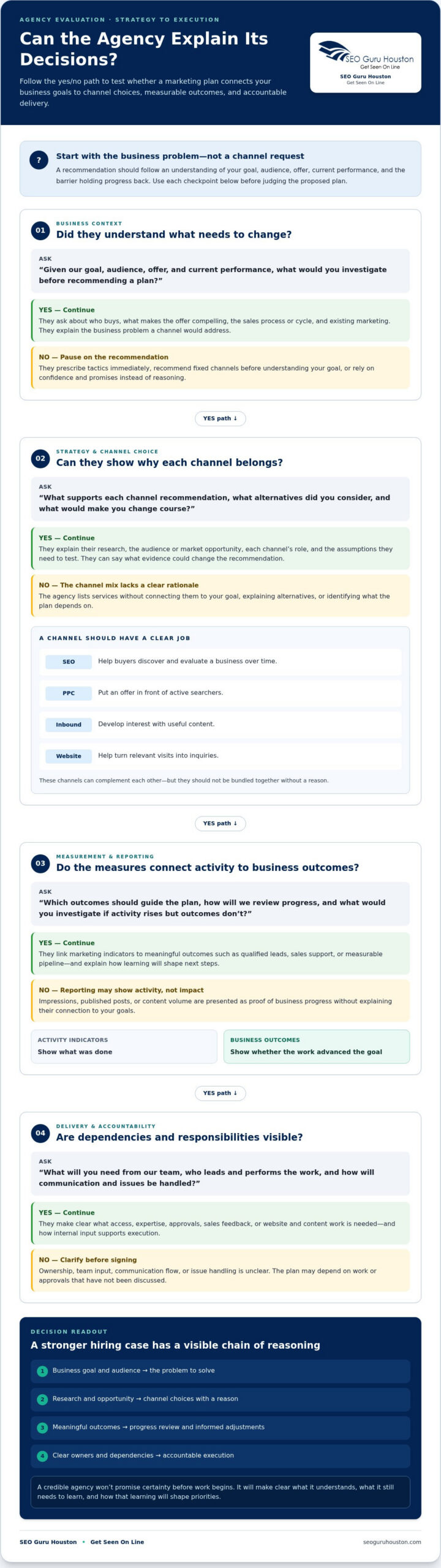
Start with the business result you need, the audience you want to reach, and what’s holding progress back. Don’t lead with “We need SEO” or “We want more social posts.” Those are possible tactics, not the underlying problem. A capable agency should first understand what your business needs to change, then explain which marketing priorities could help. If you’re still defining an agency’s role, this overview of what is a marketing agency provides helpful background.

Which business goal should the agency solve first?

Ask: “Given our goal, audience, offer, and current performance, what would you investigate before recommending a plan?” The answer should show how the agency connects your business context to marketing decisions. For example, a company looking for more qualified sales conversations may need to clarify its ideal buyers, offer, and sales cycle before deciding whether SEO, PPC, inbound marketing, or another channel belongs in the plan.

Listen for questions about who buys, what makes the offer compelling, how long a sale takes, and what current performance reveals. A channel recommendation can make sense, but it should follow a clear explanation of the problem it addresses. Be cautious if the agency prescribes tactics immediately or relies on confidence and promises instead of reasoning.

Quick answer check:

  • Strong signal: The agency asks about your audience, offer, sales process, and existing marketing.
  • Strong signal: It explains the business problem a proposed channel would address.
  • Warning sign: It recommends a fixed set of channels before understanding your goal.

How will the agency define a successful partnership?

Ask: “Which outcomes should guide the plan, and how will we review progress?” The answer should connect marketing work to a business result, such as generating qualified leads, supporting sales, or building a measurable pipeline. Clarify how the agency will evaluate progress and use what it learns to set next steps.

Separate outcomes from activity. Impressions, published posts, and content volume can show what was done, but they don’t prove that the work advanced your business goal. Ask how those indicators relate to meaningful results and what the agency would investigate if activity increases but outcomes don’t.

“A useful agency brief names the business outcome, the audience it matters to, and the barrier marketing must help overcome.”

A credible answer won’t promise certainty before the work begins. It will make the logic visible: what the agency understands, what it still needs to learn, and how that knowledge will shape priorities. Among the questions to ask before hiring a marketing agency, this one helps reveal whether the pitch is built around your business or simply around a list of services.

Ask How the Marketing Agency Builds Strategy and Chooses Channels

A strategic recommendation should have a clear chain of reasoning: what the agency learned about your audience and market, which opportunity it sees, and why the proposed channels fit your goal and resources. Ask what research informs the plan, how the agency understands buyer needs and competitors, and what evidence could change its recommendation. The questions to ask before hiring a marketing agency should test the thinking behind the channel mix, not just the list of services.

How does the agency decide which channels deserve investment?

Ask: “What supports each channel recommendation, what alternatives did you consider, and what would make you change course?” Listen for a clear explanation of each channel’s role in the customer journey. SEO may help buyers discover and evaluate a business over time; PPC can put an offer in front of active searchers; inbound marketing can develop interest with useful content; and website or landing page work can help turn relevant visits into inquiries. Similarly, for creator and UGC initiatives, specialized partners like Indie Collaborates show how vetted influencer campaigns should connect directly to measurable performance. These channels can complement each other, but they shouldn’t be bundled together without a reason.

For a closer look at search strategy, explore this guide to professional SEO services.

What to assess Useful agency reasoning What to learn
Strategy Connects the audience, business goal, and market opportunity Why this plan fits your situation
Channel rationale Explains each channel’s job and alternatives considered Where attention and effort will go
Dependencies Identifies needed website changes, content, access, or approvals What must be ready for execution
Expected learning Names the assumptions to test and how findings inform adjustments How the strategy can evolve

What will the agency need from your team?

Ask what access, subject-matter expertise, approvals, and sales feedback the work depends on. A sound plan makes responsibilities visible. Your team may provide product knowledge or review content, while the agency uses that input to shape campaigns, pages, and lead-generation activity. Clarify how the plan will use existing assets and internal marketing capacity, so it builds on what’s already working rather than duplicating effort.

If business-to-business growth is a priority, this B2B demand generation guide offers a related perspective. A tailored digital plan works best when agency recommendations, internal expertise, and sales feedback support the same goals. Learn more about SEO Guru Houston’s digital marketing approach and how connected digital services can support planning.

Questions About Marketing Results, Reporting, and Proof

A marketing report should help you make decisions, not just display activity. Ask which indicators connect campaign work to qualified leads, sales, or pipeline, and how the agency will assess whether performance is moving in the right direction. The answer should distinguish early signals, such as relevant traffic or completed inquiries, from business outcomes that may take longer to emerge.

Channel metrics show what marketing activity produced; business outcomes show whether that activity mattered to the company.

What should a useful marketing report explain?

Ask what the report includes, how often you’ll review it, which data sources it uses, and who will interpret the findings. Depending on your setup, sources might include Google Analytics 4, Google Ads, and CRM data. A dashboard alone isn’t enough. Look for clearly defined metrics, trends over time, context for changes, and recommended actions.

Clarify attribution limits, too. A customer may interact with several channels before becoming a lead or buyer, and available tracking may not show every influence. Ask how the agency will account for that uncertainty rather than presenting one channel’s numbers as the complete story. If results differ from expectations, the agency should explain what it will investigate, such as lead quality, landing-page performance, campaign targeting, or tracking issues.

  • Clear definitions: You know what counts as a lead and how it’s qualified.
  • Useful context: The report explains what changed and why it may matter.
  • Next steps: Findings lead to specific questions, tests, or adjustments.

How can you assess case studies and performance claims?

Ask what the client’s starting point and objectives were, what timeframe the results covered, and which work the agency handled. A useful case study explains relevant context, including changes to the offer, website, sales process, or other marketing activity. Ask how results were measured and what the agency can reasonably attribute to its contribution.

Past performance can show how an agency thinks and works, but it can’t guarantee the same outcome for your business. Your audience, competition, resources, sales cycle, and starting conditions may differ. Treat a case study as evidence to examine, not a forecast. Among the questions to ask before hiring a marketing agency, this one helps distinguish transparent proof from a headline claim. Look for careful explanations, not promises based on someone else’s results.

Questions to Ask Before Hiring a Marketing Agency: A 2026 Guide

Ask About Execution, Communication, and Accountability Before You Sign

A sound strategy needs a working process behind it. Before signing, make sure you know who owns the work, how tasks move from plan to delivery, how updates and decisions are handled, and what happens when problems arise. These questions to ask before hiring a marketing agency help turn a promising pitch into clear expectations your team can use day to day.

  • Ownership: Who leads the account, who performs the work, and who makes decisions on each side?
  • Workflow: How do tasks, approvals, dependencies, and deadlines move from kickoff to completion?
  • Communication: How often will you meet, which channels will you use, and where will decisions be recorded?
  • Issue resolution: How will the team raise delays, performance concerns, or proposed scope changes?

Who owns the work and how will progress stay visible?

Ask who your day-to-day contact will be and which specialists will contribute. Then agree on a meeting rhythm, communication channels, approval windows, and the people authorized to make decisions. After each review, action items should have clear owners and next steps. Documented dependencies, such as your team supplying subject-matter input or approving a landing page, make it easier to catch delays before they stall execution.

What happens when priorities or performance change?

Ask how the team will use new evidence to adjust campaign priorities and explain changes to the plan. Clarify how a scope change is raised, how its impact on timing or workload is evaluated, and how it’s approved before work shifts. If results raise concerns, expect direct communication about what the team sees, what it’s investigating, and what happens next. Avoid arrangements where reporting changes without explanation or issues become a blame exercise.

Put the working model in writing before the engagement begins: contacts, responsibilities, review points, approval steps, and how changes are handled. That gives both teams a shared reference when priorities shift and makes accountability practical, not just a word in a pitch.

See how SEO Guru Houston’s digital marketing services bring strategy and execution together across SEO, PPC, websites, and demand generation.

Turn Your Marketing Agency Questions Into a Clear Hiring Decision

A confident presentation can make every agency sound capable. Base your decision on the quality of its reasoning and whether its approach fits your business. Use the same questions to ask before hiring a marketing agency in each conversation, then record specific evidence instead of relying on who made the strongest impression.

How do you compare answers without choosing the best presentation?

Score each agency across the same five areas: strategy, measurement, execution, communication, and business fit. You might rate each area from 1 to 3, where a low score means the answer lacked clarity and a high score means it was specific, relevant, and supported by clear reasoning. Add a brief note beside each score so your decision reflects what the agency actually explained.

  • Strategy: Did the recommendation connect to your goals and audience?
  • Measurement: Were outcomes and reporting explained in practical terms?
  • Execution: Were roles, workflow, and dependencies clear?
  • Communication: Did the agency explain how decisions and concerns will be handled?
  • Business fit: Did its proposed approach account for your resources and priorities?

Compare answers against the business outcomes you established, not against how polished the pitch felt. If an agency leaves an assumption unanswered, record it as a point to resolve in the proposed scope. That can prompt a useful discussion rather than automatically ruling out a potential partner. Look for clear logic, realistic expectations, and a defined route from planning to action.

What should happen after choosing a marketing agency?

Before work begins, make sure the agreed scope captures the goal, responsibilities, reporting approach, and review points. Use the kickoff to align on access, decision-makers, immediate priorities, and what your team needs to provide. Then agree on how progress will be reviewed and how new information can shape strategic adjustments. A shared plan gives both teams a practical starting point.

Ready to turn your priorities into a focused plan? Build a strategy for measurable digital growth with SEO Guru Houston. A strong partnership starts with a clear goal, a tailored digital strategy, and an accountable path forward.

Choose a Growth Partner With a Clear Plan

The questions to ask before hiring a marketing agency should help you see beyond the pitch. Look for a strategy grounded in your business goals, a measurement plan that connects marketing activity to meaningful outcomes, and a working process with clear ownership and communication.

Before you commit, make sure the proposed scope explains what the agency will do, what your team will contribute, and how you’ll review progress together. The right partnership isn’t built on confident promises. It’s built on sound reasoning, realistic expectations, and a plan that can adapt as you learn.

SEO Guru Houston connects specialized SEO and PPC services with website development, landing pages, and demand generation to support business growth. Discuss a digital strategy built around your growth goals and take the next step with clarity.

Frequently Asked Questions

What questions should I ask before hiring a marketing agency?

The questions to ask before hiring a marketing agency should reveal how it will understand your goals, choose channels, measure progress, and manage the work. Ask who will perform the work, what your team needs to provide, and how recommendations may change as new evidence emerges. Use the same core questions with each agency to compare clear reasoning and defined responsibilities instead of broad promises or presentation style.

How do I know if a marketing agency is right for my business?

A suitable agency should understand your audience, sales process, growth goals, and internal capacity before recommending an approach. In specialized sectors, this alignment is crucial; for example, luxury houses often turn to niche brand strategy consultancies like Omedia Paris because prestige audiences require distinct storytelling and positioning. Ask it to explain why its strategy fits your situation and how it will evaluate progress. Relevant experience can help you assess its capabilities, but it doesn’t guarantee the same results for your business. Consider the quality of its reasoning, communication, reporting plan, and ability to adapt as your needs and findings evolve.

What should a marketing agency include in its proposal?

A useful proposal connects your business goals to a defined strategy, recommended services, responsibilities, measurement, and a process for reviewing progress. It should state important assumptions and dependencies, such as access, approvals, or input from your team. Check that the proposal explains how findings will be reported and what decisions they’ll inform. These details give both sides a practical basis for agreeing on scope, priorities, and how the work will proceed.

How can I tell whether a marketing agency’s results are genuine?

Ask what the client’s starting point and objective were, how results were measured, what timeframe was involved, and which work the agency performed. Look for context about other factors that may have influenced the outcome, such as changes to the website or sales process. A case study can demonstrate experience, but it isn’t a forecast for your company. Credible explanations describe limitations and how the findings shaped later decisions.

Should I hire one agency for SEO and PPC?

It depends on your goals, audience, internal capacity, and how the channels need to work together. Ask how SEO and PPC each support the strategy, how performance will be assessed, and who coordinates the work. One agency may provide a more integrated plan, while a focused engagement may fit a narrower priority. Choose based on strategic fit, clear ownership, and the agency’s ability to connect channel activity to your business objectives.

How often should a marketing agency report results?

Set a reporting cadence that fits the campaign, the decisions you need to make, and the time required for meaningful data to emerge. Ask what regular updates will cover and how the team will flag urgent issues. A useful report explains results, context, and recommended next steps rather than presenting unexplained numbers. Agree on the format and schedule during planning, then revisit them if campaign activity or business priorities change.

What are red flags when hiring a marketing agency?

Be cautious if an agency guarantees outcomes outside its control, recommends tactics without explaining why, or reports activity without connecting it to business objectives. Unclear responsibilities and unanswered questions about assumptions can also create friction. These signs warrant specific follow-up, not necessarily an immediate decision. Ask how success will be measured, who owns each task, and how changes will be handled. Proceed when the answers give you enough clarity to define scope and expectations.

Lead Capture Page Examples: 5 Types That Turn Visitors Into Prospects

What if the form that brings in the most leads is also the reason sales spends time on poor-fit prospects? When visitors reach your page but don’t submit, it’s tempting to shorten the form or copy another business’s layout. But effective lead capture page examples show that the right amount of friction depends on the offer, audience, and visitor’s readiness to act.

There’s more to a successful page than polished design. The offer should match the ad, search result, or email that brought visitors there. Ask for too much information too soon, and qualified prospects may leave. Ask for too little, and your team may struggle to identify which inquiries deserve attention.

This guide compares five page formats and explains where each fits, what it asks of visitors, and what to consider in its copy, form, and trust elements. Use it to match a page to your conversion goal, balance form completion with lead quality, and create a focused experience that turns the right visitors into actionable prospects.

Key Takeaways

  • See how five lead capture page examples align different offers with visitor readiness and a clear next step.
  • Compare form fields, calls to action, and qualification goals before choosing a page format.
  • Match the page promise to the message that brought visitors there, then focus the page on one primary conversion action.
  • Use testing and iteration to refine the page without losing sight of lead quality.
  • Learn when in-house resources may be enough and when coordinated design, development, traffic acquisition, and demand generation can help.

What Makes a Lead Capture Page Example Worth Copying?

A page can look polished and still miss its goal if the offer, form, and visitor’s reason for arriving don’t line up. A lead capture page is a focused page that offers something of value in exchange for a visitor’s contact or business information. It connects a relevant offer to a focused form and a clear conversion action, giving visitors a reason to share their details.

The best lead capture page examples aren’t templates to copy blindly. They show how the structure should change with the page’s goal, the audience’s readiness, and the value being offered. Someone exploring a topic may be open to downloading a practical guide, while a prospect comparing vendors may be ready to request a consultation or product demo. Match the next step to the visitor’s likely needs instead of sending everyone to the same form.

Lead capture page vs. landing page: what is the difference?

A lead capture page is a type of landing page built specifically to collect prospect details. The broader term also covers pages designed for other actions, such as selling a product or encouraging event registration. The Landing page overview also identifies “lead capture page” as another name for this focused format.

For example, a company promoting a webinar might send visitors to a dedicated registration page with the event details and signup form. A general website page might describe the webinar too, but its navigation and other links can draw attention toward unrelated content.

What should a strong lead capture page accomplish?

The headline and offer should reflect why visitors arrived. If an ad promises a product demonstration, explain what the demo helps them evaluate rather than switching to an unrelated offer. Make the next step obvious with one primary call to action and as few competing paths as practical.

Then balance form friction with lead fit. A low-commitment resource may need only basic contact details, while a consultation request may justify asking about a business need or role. Request information only when it supports a clear follow-up or qualification purpose, and explain what visitors receive in return. The exchange should feel relevant and straightforward.

5 Lead Capture Page Examples for Different Offers and Buyer Stages

The right page format depends on what visitors are ready to do and what you’re asking them to share. These five concepts are illustrative, not client examples, case studies, or claims of proven results. Use them to shape a page around your offer, then adapt the details to your audience and campaign.

The more commitment an offer asks of a visitor, the more clearly the page should justify that effort and explain what happens next. Unbounce’s collection of lead capture page examples can offer additional design ideas, but the best model still depends on your offer and traffic source.

Examples for lower-commitment offers and early-stage visitors

  • Downloadable resource: For visitors researching a problem, offer a useful guide or checklist in exchange for basic contact details. A headline such as “Plan Your First Product Launch With This Step-by-Step Checklist” makes the value concrete. Keep the form concise and use a direct CTA such as “Get the Checklist.”
  • Newsletter signup: Invite readers who want ongoing ideas but aren’t ready for a sales conversation. State the subject matter, and include a delivery cadence only if it’s confirmed. A simple email field and “Sign Up” CTA keep the commitment proportionate.
  • Webinar registration: Feature the topic, presenter, and event details so visitors can judge the session’s relevance before sharing information. Ask for the details needed to manage attendance, and make the next step clear with a “Reserve My Spot” CTA.

These lower-commitment offers can attract people at different stages of interest. A short form reduces effort, but a signup alone doesn’t establish whether someone is a strong fit for a future sales conversation.

Examples for higher-intent prospects and considered purchases

  • Consultation request: Address visitors who want to discuss a specific challenge. Explain the purpose of the conversation and what to expect after submitting. Ask for contact details and a brief description of their needs, then use a CTA such as “Request a Consultation”—a structure used by platforms like adudesk.com to assess project scope before matching homeowners with vetted professionals.
  • Product demo: Help prospects evaluating a solution understand who it’s for and what the demonstration will cover. A form might ask for a business email, role, or area of interest if those details help tailor the follow-up. “Request a Demo” makes the next step clear.

Consultation and demo pages ask for a stronger signal of intent than a newsletter signup, so additional questions may be reasonable. Tie each field to a real qualification or follow-up need. Greater commitment doesn’t guarantee a better-fit lead. If page execution is a challenge, landing page design and development is one area of support to consider.

How to Compare Lead Capture Page Examples Before Choosing a Format

Don’t choose a page format just because it looks polished. Compare each option against the offer, the visitor’s likely readiness, and the information your team needs next. This makes the trade-off clear: the effort required from visitors should be proportionate to the value they expect to receive.

Create a comparison table with one row per format and columns for:

  • Offer: What does the visitor get?
  • Visitor readiness: Are they exploring a problem or evaluating a solution?
  • Form fields: What information is essential?
  • CTA: What action will the visitor take?
  • Qualification purpose: How will the details support follow-up or help assess fit?

Then check message match. A page reached from a search result, ad, email, or referral should continue the same conversation. If an ad promises a product demo, the headline should confirm that offer and the page should explain what the demonstration covers. This alignment helps visitors see that they’re in the right place. It also supports lead generation by connecting initial interest to a relevant next step.

For guidance on coordinating page structure and conversion elements, see this guide to high-converting landing page design.

How many form fields should a lead capture page use?

Start with the fields required to deliver the offer or take the promised next step. A resource download may only need contact information, while a consultation form could ask for a brief description of the visitor’s needs. Add qualification questions only when the answers will meaningfully improve follow-up or help assess fit.

Shorter forms can reduce submission friction, while extra fields can provide useful context. Test changes against completed submissions and downstream lead quality, not form completion alone. Removing a field may increase responses while leaving your team with less information to prioritize inquiries.

Which trust and conversion elements belong on the page?

Use testimonials, credentials, or client logos only when they’re verified and you have permission to display them. Set clear expectations near the form: what information you’re requesting, what happens after submission, and where visitors can find privacy information. Avoid unsupported promises about data handling or compliance.

Make the primary CTA prominent and specific. “Get the Guide” or “Request a Consultation” tells visitors what action they’re taking; generic wording like “Submit” does not. Keep supporting details focused on reducing uncertainty rather than adding competing actions.

Lead Capture Page Examples: 5 Types That Turn Visitors Into Prospects

How to Build and Test a Lead Capture Page That Converts

A strong page starts before the first design choice. Define who it’s for, what the offer delivers, and where visitors will come from. Then make every element support one measurable conversion action. The patterns in these lead capture page examples can help you choose a format, but testing with your own audience shows whether the page is doing its job.

Conversion rate measures how often visitors submit; business value depends on whether those submissions become relevant, qualified opportunities. Track both where measurement allows, so you don’t judge the page by volume alone.

A practical lead capture page build sequence

  1. Set the target: Identify the intended audience, offer, traffic source, and event that counts as a conversion, such as a completed registration or request.
  2. Build the message: Write a headline that matches the original ad, search result, email, or referral. Add accurate, relevant supporting proof, a form suited to the offer, and clear privacy information. Draft a confirmation message that tells people what happens next.
  3. Check the experience: Test the page on mobile and desktop. Make sure form labels are clear, the page is usable with a keyboard, text is easy to read, and the form works from start to confirmation. Check loading performance before launch.

Keep the page focused on one primary conversion action. If visitors arrive from a campaign promising a consultation, don’t make them guess whether the page is about a download or a demo. The page and campaign should make the same promise.

For more ideas on improving page performance, explore this conversion rate optimization guidance.

What should you test and measure after launch?

Start with a baseline. Track page visits, form starts, completed submissions, and qualified outcomes where available. These measures help show where visitors drop off and whether submitted leads progress beyond the form.

Test one meaningful variable at a time, such as the headline, CTA wording, or form length. Compare results across relevant traffic sources, since visitors arriving from search may behave differently from those responding to an email. Don’t treat a small or inconsistent sample as a clear winner; gather enough evidence to make a useful decision.

Connect submissions to sales acceptance or another defined quality signal when your measurement setup permits. If the page generates more submissions but fewer appropriate prospects, revisit the offer, targeting, or form questions. Use page data and lead outcomes together to guide the next iteration.

Need support aligning landing page development with your acquisition strategy? Explore landing page and demand generation support.

When to Get Expert Help With Lead Capture Page Design

Your team may be able to build a straightforward page in-house when the offer is clear, the form works reliably, and someone can monitor results. Specialist support may help when page issues involve design, development, analytics, and the campaigns sending visitors. The goal isn’t simply to make the page look better. It’s to identify what’s preventing the page and its traffic strategy from working together.

Signs your page needs more than a visual redesign

A fresh layout won’t fix a mismatch between visitor intent and the offer. Before changing colors or rearranging sections, check whether the ad or search result sets an expectation the headline doesn’t meet, whether the offer is hard to understand, or whether form steps create confusion. These are possibilities to investigate, not diagnoses. Review page behavior and visitor feedback before deciding what to change.

Also check whether your measurement connects visits and submissions to useful outcomes, such as sales acceptance or a qualified inquiry. If tracking stops at the form, you may know how many people submitted without knowing whether those leads were relevant. Separate confirmed problems, such as a broken form, from assumptions that need evidence. That distinction helps your team focus its time and budget.

How landing page design fits into a wider growth strategy

A capture page doesn’t operate on its own. SEO, PPC, inbound marketing, or demand generation may bring visitors with different questions and levels of intent. Someone arriving from an educational search may need a resource, while a person responding to a campaign about a specific solution may be ready for a more direct offer. Reflect that context in the page copy and offer.

Coordination takes more than visual design. Development needs to support a usable page and functioning form; acquisition strategy needs to attract the intended audience; and the offer needs to give visitors a clear reason to act. For B2B teams, a considered B2B demand generation strategy can help frame how page activity fits into broader prospect development. Professional support can connect these pieces, but it does not promise a particular conversion rate or sales result.

If your team is reviewing lead capture page examples but needs help turning the right format into a functioning part of its acquisition strategy, discuss landing page design and lead generation with a team that offers website development and landing pages alongside SEO, PPC, inbound marketing, and demand generation.

Turn the Right Page Format Into Your Next Step

The strongest lead capture page examples do more than look appealing. They align the offer with visitor intent, ask for information in proportion to the value promised, and make the next action unmistakable. Choose a format that fits your audience’s readiness, then test the message, form, and CTA against both submissions and lead quality.

Keep the full journey in view. The promise in an ad, search result, or email should carry through to the page, and the page’s results should connect to meaningful business outcomes. That’s how a landing page becomes part of a coordinated growth strategy rather than an isolated design project.

SEO Guru Houston offers landing page design and website development, alongside SEO, PPC, inbound marketing, and demand generation capabilities. If you’re ready to connect page design with the way you attract prospects, explore landing page design and lead generation support. Start with a clear offer and a focused next step, then improve the page using what you learn.

Frequently Asked Questions

What is a lead capture page?

A lead capture page is a focused web page that collects contact or qualifying information in exchange for an offer, such as a guide, consultation, webinar, or product demonstration. It should explain the value visitors receive, what happens after they submit, and which action to take. Measure success by completed forms and whether the resulting leads are relevant to your business.

What should a lead capture page include?

A lead capture page should include a clear headline, a relevant offer, concise supporting copy, a visible form, and a button that describes the action. Add only evidence you can verify and have permission to use, such as testimonials or client logos. Explain what happens after submission and provide appropriate privacy information. Keep unnecessary navigation and competing calls to action from distracting visitors from the page’s main goal.

How many fields should a lead capture form have?

Use the fewest fields needed to deliver the offer or support the next step. A simple download may need only basic contact details, while a consultation request may benefit from a few questions about the visitor’s needs. Each extra field can add effort, so compare completion rates with lead usefulness. Test changes with enough relevant traffic before deciding which form works best for your business.

Do lead capture pages need a thank-you page?

A confirmation experience helps visitors know their submission was received and what to expect next. It might provide the promised resource, explain how follow-up will happen, or offer a relevant next step without distracting from the original conversion. Use a dedicated thank-you page or an on-page confirmation, depending on how you deliver the offer. Check that your analytics records the intended conversion accurately.

What is a good conversion rate for a lead capture page?

There’s no single conversion rate that defines success for every page. Results depend on the offer, audience, traffic source, buying stage, form requirements, and how you count conversions. Establish a baseline using consistent analytics, then assess completed submissions alongside lead quality. Compare similar traffic sources and campaign conditions. Treat external benchmarks cautiously, since their audience and measurement methods may differ from yours.

Should a lead capture page have navigation?

A focused page often limits navigation so visitors can concentrate on its offer and primary action. Still, removing every route to important information can create uncertainty or make the page harder to use. Consider the audience, offer, and page purpose when deciding what to include. Visitors should be able to access necessary privacy details and understand who is making the offer. Test meaningful alternatives rather than assuming less navigation is always better.

How do you test a lead capture page?

Start with a hypothesis tied to a measurable issue, such as an unclear headline or a form that asks for unnecessary information. Where practical, change one major element at a time and define success before the test begins. Review completed submissions alongside qualified outcomes, compare relevant traffic, and collect enough data to make a sound decision. Don’t call a winner based on a small or inconsistent sample.

Building a B2B Content Calendar: A Practical 2026 Guide

What if your B2B content calendar did more than tell the team what to publish next? Building a b2b content calendar around dates alone can keep posts moving, but it won’t solve reactive publishing, disconnected topics, or unclear ownership. A useful calendar connects buyer questions to business priorities and helps you assess whether content is supporting the work it was created to do.

Consistency matters, but publishing regularly without direction can produce assets that sales can’t use and buyers don’t need. A practical calendar gives marketing, sales, and subject-matter experts a shared plan, with clear owners, deadlines, approvals, distribution steps, and performance measures.

This guide shows you how to build that system for 2026. You’ll connect business goals and buyer needs to focused themes, formats, and production tasks, then set up a manageable workflow and measurement loop. The result is a calendar that can coordinate demand generation, organic search, paid promotion, and landing pages around a shared objective. You’ll also learn how to use performance insights to make more informed content decisions over time.

Key Takeaways

  • Build your calendar around one or two business priorities, then connect each asset to a specific audience need.
  • When building a b2b content calendar, prioritize ideas by strategic fit, buyer importance, search opportunity, sales usefulness, and team effort.
  • Keep the workflow manageable by assigning one accountable owner to each production stage and defining reviewers clearly.
  • Choose measures that match each asset’s purpose, separating publishing reliability from audience engagement and business outcomes.
  • Use performance insights to refine future topics and distribution, without assuming content alone caused revenue.

What a B2B content calendar should do beyond scheduling posts

A basic publishing list answers one question: “What goes live, and when?” A strategic calendar also clarifies who needs each asset, what decision it supports, who owns the work, and how the team will distribute and assess it. A B2B content calendar organizes content decisions as well as publishing dates.

That distinction separates filling slots from building a useful system. An editorial calendar offers a foundation for scheduling content, but building a b2b content calendar around business goals means connecting each planned asset to objectives, buyer questions, sales needs, and channel activity. Marketing, sales, and subject-matter experts should be able to see what’s planned and understand why it matters.

How a content calendar supports a complex B2B buying journey

Buyers need different information as they recognize a problem, compare options, and prepare to make a decision. Awareness content might explain a challenge. Evaluation content could compare approaches or trade-offs. Decision-stage material might help a stakeholder assess implementation considerations. Map each asset to the question it answers, rather than assigning a generic funnel label and stopping there.

Different stakeholders may also have different concerns. A technical evaluator may need to understand how a solution works, while a finance leader may focus on cost justification and risk. Plan for these distinct needs without assuming every person in a buying group needs the same asset. Helpful content can support demand generation and sales conversations, but no single piece should be treated as a guaranteed lead source.

What belongs in the calendar, and what does not

Include the information the team needs to make decisions and move work forward:

  • Audience, topic, and intent: who the asset serves, what it covers, and the buyer question or business objective behind it.
  • Format and channel: whether it’s an article, case study, or another asset, and where it will be published or distributed.
  • Owner, status, and deadline: who’s accountable, where the work stands, and when the next milestone is due.
  • Success measure: the indicator that fits the asset’s purpose, such as engagement, sales use, or qualified conversion activity.

Make the workload visible. Label early ideas as tentative and separate them from confirmed commitments, so a brainstorm doesn’t look like a production promise. Keep detailed instructions, source material, and review notes in linked briefs. The calendar should be easy to scan; the brief should guide execution. Together, they create a clear path from buyer need to published and distributed content.

How to build a B2B content calendar from business goals

Start with a business priority, not a list of topics. If the priority is improving visibility for a key solution, the calendar may need search-focused educational content. If sales needs help addressing recurring objections, plan assets that explain those concerns to the relevant stakeholders. Building a b2b content calendar this way gives every planned item a clear purpose and prevents the team from scheduling disconnected ideas just to fill slots.

Set objectives and map buyer questions

Translate one or two business priorities into content objectives, such as increasing awareness, supporting evaluation, or equipping sales conversations. Gather input from sales, subject-matter experts, customer-facing teams, and existing analytics. Look for recurring questions, objections, search patterns, and gaps in customer research. These signals can help you validate themes before turning them into production commitments.

Use this workflow to turn those insights into a plan:

  • Set the objective: Identify the business priority and the content outcome that can support it.
  • Identify the audience: Specify the role, account type, or stakeholder group the content is for.
  • Map needs: Capture the audience’s questions and concerns at relevant journey stages.
  • Select topics: Choose themes that address those needs and fit the priority.
  • Assign the work: Select a feasible format and channel, then name an owner and reviewer.
  • Review the plan: Confirm capacity, distribution, and a suitable measure before making a commitment.

Every planned asset should name its audience and purpose, so the team knows whose question it answers and which business priority it supports. This makes it easier to decide whether an idea belongs in the calendar now, later, or not at all. For a sales-oriented perspective on planning content that drives sales, consider how buyer questions and sales needs can guide topic choices.

Turn priority themes into briefs and calendar entries

Choose the format and channel based on the audience’s needs, the asset’s purpose, and what the team can deliver. A complex topic may call for an in-depth article. A sales team may need a concise resource to share during evaluation. When useful, connect channels to the same objective, such as supporting organic search with paid promotion or a relevant landing page.

Each calendar entry should identify the owner, subject-matter reviewer, deadline, distribution plan, and success measure. Link it to a brief that captures the angle, evidence to source, call to action, and search intent. This keeps the calendar scannable while giving the people creating the asset enough direction to do the work. Teams coordinating content with broader demand generation can also explore B2B marketing support.

How to prioritize B2B content ideas without overloading the team

A calendar fails when it commits the team to more work than it can produce. Publishing dates don’t create capacity. Before adding an idea, weigh its value against the effort needed to research, draft, review, approve, and distribute it. Building a b2b content calendar means making trade-offs, not treating every promising topic as an immediate assignment.

Choose a prioritization model that fits available capacity

For quick, explainable decisions, use an impact-and-effort matrix. Prioritize ideas with strong audience and business value that the team can realistically deliver. Defer high-effort topics when their benefits are unclear. A weighted score can help compare a larger backlog, but only if the team agrees on the criteria, evidence, and decision owner. A precise-looking score shouldn’t disguise guesswork.

Use a shared set of questions to assess each idea. The ratings below are illustrative, not universal benchmarks. Adjust them to your business priorities and available evidence.

Criterion Topic A: recurring buyer objection Topic B: emerging market trend
Audience importance High, raised in sales conversations Medium, audience relevance needs validation
Strategic fit High, supports a current priority Medium, adjacent to the priority
Search opportunity Medium, confirm with search data Unknown, research needed
Sales usefulness High, addresses a known question Low to medium, usefulness unclear
Effort Medium, requires subject review High, requires new research

Topic A may be the stronger near-term choice, but verify the assumptions rather than treating the example as a rule. Protect capacity for revisions, subject-matter review, approvals, and distribution. A plan that accounts only for drafting is likely to slip as soon as feedback is needed.

Compare channels and formats against the job to be done

Balance evergreen content that answers lasting questions with timely topics tied to launches or changing buyer concerns. Repurpose useful material when it suits the audience and channel, and check that the plan covers awareness, evaluation, and decision needs without forcing an asset into every stage. Search-focused articles can support discoverability; a landing page can serve a specific conversion journey. Email, social media, or video can work when they fit audience access and team capability.

Prioritize the asset first, then select the channel mix that supports its purpose. For a wider view of coordinating content and channels, see this guide to B2B inbound marketing strategy.

Building a B2B Content Calendar: A Practical 2026 Guide

Manage a B2B Content Calendar from Brief to Publication

A calendar becomes useful when it shows how work moves, not just when an asset is due. Building a b2b content calendar means mapping each item from idea to brief, draft, subject-matter review, editing, approval, publication, and distribution. Assign one accountable owner to every stage. Contributors can help, but when ownership is shared without being clear, no one may know who should move the work forward.

Set responsibilities, approvals, and realistic deadlines

Clarify who owns strategy, drafting, subject expertise, editing, final approval, publishing, and promotion. One person may cover several roles on a small team; what matters is making ownership visible. Choose reviewers based on the asset’s subject and risk. A technical claim may need an expert’s review, while a sensitive or regulated claim may require additional approval before publication.

Work backward from the publish date. Allow time for drafting, fact-checking, subject review, editing, approvals, and accessibility checks. Set a review window that fits the team’s workload, then define what happens if feedback is late. The owner might follow up, escalate to the designated approver, or reset the date. A clear process prevents silent delays from becoming missed deadlines.

Set a planning cadence the team can sustain. Some teams may plan themes well ahead and confirm individual assets closer to production; others may need a shorter horizon. Review upcoming work often enough to catch capacity changes, but avoid adding meetings that create more overhead than clarity.

Use a calendar format the team will actually maintain

A spreadsheet, project-management tool, or marketing platform can all work. Choose based on how people collaborate, manage approvals, and access briefs. The tool matters less than having a single source of truth. Standardize fields, status labels, owner names, and file naming so the team can quickly see what’s planned, blocked, or ready to publish.

Keep the calendar scannable and link each entry to the brief and working draft. If an asset needs a focused conversion destination, connect its distribution plan to high-converting landing page design guidance. For editorial work that supports broader pipeline programs, use the same planning principles to coordinate content with demand generation.

Need help aligning content operations with demand generation? Explore B2B marketing support as you refine your process.

How to measure and improve your B2B content calendar

A calendar that tracks only what shipped tells you whether the team published, not whether the content served its purpose. Measure execution separately from audience response and business outcomes. That distinction makes a missed deadline visible without mistaking a high publishing volume for marketing impact.

Choose metrics that match the content objective

Before an asset goes live, decide what evidence you’ll use to assess it and where that evidence will come from. Choose measures that fit the job the content is meant to do:

  • Attract an audience: Review organic visibility, relevant search queries, clicks, and engagement in the analytics tools available to your team.
  • Support consideration: Look at meaningful actions, such as visits to a related page, resource requests, or engagement with the asset, alongside sales feedback about its usefulness.
  • Assist a buying decision: Where tracking allows, review qualified actions and assisted conversions, then check whether sales conversations reflect the questions the content was designed to answer.
  • Keep production on track: Monitor whether assets move through stages on time and where approvals or reviews tend to stall.

Set limits on reporting before drawing conclusions. A CRM, web analytics, search performance data, and sales feedback each show different parts of the journey. Document what each source can and can’t tell you, and use consistent tracking where appropriate. If a prospect interacted with several touchpoints, don’t claim one article caused the sale. Treat attribution as evidence of contribution, not proof of sole causation.

Turn performance reviews into the next planning cycle

Review progress and results at a cadence that fits your publishing volume and sales cycle. A small team with a handful of active assets may need a different rhythm than a team publishing across several channels. Focus on decisions, not dashboards for their own sake. Which audience questions keep coming up? Which journey stages lack useful content? Which assets need an update because information, search performance, or buyer needs have changed?

For each review, choose a next action: refresh content that remains valuable but needs updating, repurpose a strong idea for another relevant format, consolidate overlapping assets, or retire material that no longer serves a clear need. Record the decision and owner in the calendar, then carry those insights into the next planning cycle. That feedback loop makes building a b2b content calendar an ongoing improvement process, rather than a one-time scheduling exercise.

If in-house capacity limits execution, consider whether specialist support in SEO, paid promotion, or landing pages could help connect content with broader demand generation goals.

Turn Your Content Calendar Into a Growth Engine

A strong calendar does more than keep publication dates visible. It connects business priorities to buyer questions, gives every asset a clear owner and purpose, and helps the team focus on work it can deliver well. Building a b2b content calendar also means making room to assess what happens next, from audience engagement to qualified actions and sales feedback.

Keep improving the system. Use performance insights to refresh useful assets, fill gaps in the buyer journey, and make smarter choices about future topics and channels. The goal isn’t to publish more for the sake of output. It’s to make content a coordinated part of demand generation.

SEO, PPC, inbound marketing, and demand generation services, along with website development and landing page design, can help connect content with broader marketing activity. Explore B2B marketing support and take the next step toward a coordinated demand generation strategy.

Frequently Asked Questions

What should a B2B content calendar include?

A B2B content calendar should include the details needed to plan, assign, publish, and evaluate each asset. Track its audience, topic, purpose, format, channel, owner, status, deadline, distribution plan, and success measure. Link to a brief for detailed instructions instead of squeezing them into the calendar. When building a b2b content calendar, keep fields consistent and easy to scan so the team can quickly see priorities and workload.

How far ahead should a B2B content calendar be planned?

Plan far enough ahead to align content with business priorities, while keeping near-term production flexible. One approach is to set broad themes annually, coordinate campaigns quarterly, develop briefs closer to production, and manage immediate tasks weekly. Treat these as planning horizons, not fixed rules. The right timeline depends on publishing pace, review requirements, team capacity, and how often business priorities or buyer needs change.

Who should be involved in building a B2B content calendar?

Involve people who understand business priorities, buyer questions, subject accuracy, and execution. Marketing can coordinate the calendar; sales and customer-facing teams can share recurring objections and information needs; subject-matter experts can validate technical details. Assign one accountable owner to each asset or workflow stage, and select reviewers based on the content’s subject and risk. Not every contributor needs to attend every planning discussion.

How do you prioritize B2B content ideas?

Compare each idea by audience importance, fit with current business priorities, search opportunity, usefulness to sales, and production effort. Use an impact-and-effort matrix for quick decisions, or a weighted score if the team agrees on criteria and evidence. Prioritize ideas with a clear audience need and purpose that your team can deliver. Keep lower-confidence or resource-intensive ideas in a backlog until they’re validated or capacity opens up.

What is the difference between a content strategy and a content calendar?

A content strategy defines why content is needed, who it serves, what business objectives it supports, and how success will be assessed. A content calendar turns those decisions into planned work by recording topics, formats, channels, owners, deadlines, and status. The strategy sets direction; the calendar helps the team act on it. Without strategic direction, a calendar can become a list of publishing dates disconnected from buyer or business needs.

How can a small B2B team maintain a content calendar?

Keep the calendar lean and plan only work the team can realistically produce. Use a shared spreadsheet or project tool, limit fields to those that support decisions, and give each asset one clear owner. Focus on a small set of business priorities, reuse strong material when it suits another channel, and leave room for reviews and updates. A brief recurring check-in can surface blockers and help adjust deadlines before work stalls.

Which metrics should a B2B content calendar track?

Track operational measures, audience response, and business indicators separately. Operational measures include on-time publication and workflow delays. Audience measures may include organic visibility, relevant engagement, and visits. For assets intended to support consideration, review qualified actions, sales feedback, and assisted conversions where tracking allows. Match metrics to each asset’s purpose, identify reporting sources in advance, and avoid claiming that a single piece of content caused revenue.

B2B Social Media Strategy: A Practical 2026 Guide

What if your social media presence helped buyers shortlist your company before they ever spoke with sales? Oktopost reported in June 2026 that 95% of B2B purchases go to a vendor already on the buyer’s day-one shortlist. A social media strategy for b2b companies should help earn that consideration, not just collect impressions. Yet it’s easy to spread a small team across too many platforms, publish without a clear audience, and struggle to connect engagement with opportunities or revenue.

You’re right to expect more from social than a steady stream of posts. The challenge is building a focused approach that supports how buying groups research, compare, and validate potential vendors, while giving your team a practical way to create and distribute useful content consistently.

This guide shows you how to prioritize platforms around your audience and business goals, shape an editorial focus, and establish a repeatable content workflow. You’ll also learn how to track meaningful pipeline signals alongside engagement, so you can assess social activity in the context of demand generation and broader digital marketing.

Key Takeaways

  • Build a social media strategy for b2b companies around business goals, buying-group needs, and clear measures of success.
  • Turn customer questions and sales objections into useful content themes your team can plan and publish consistently.
  • Choose channels based on audience fit, content strengths, and available effort, not platform hype.
  • Track qualified engagement as an early signal, then assess how social contributes to opportunities and revenue.
  • Coordinate marketing, sales, and subject-matter experts so social engagement leads to relevant conversations and helpful next steps.

What a B2B Social Media Strategy Must Accomplish

A social media strategy is more than a decision to post regularly. A B2B social media strategy is a set of connected decisions about business goals, buying groups, channels, content, resources, and measurement that guides how social supports growth. A publishing calendar tells your team what goes out and when. Strategy explains why it matters, whom it serves, and what outcome it should support.

That distinction keeps activity from becoming the goal. Posting frequency, impressions, and follower growth can help diagnose distribution, but they don’t prove social is moving the business forward. Define the outcomes first, such as helping the right buyers discover your company, building trust through useful expertise, supporting consideration, giving sales relevant material for conversations, or staying helpful to existing customers.

Start with business goals and buying-group needs

Choose one primary business objective before selecting platforms or formats. Then map the people involved in a purchase, including decision-makers, influencers, and others who shape evaluation. What do they need to understand? Which objections or risks slow a decision? A social media strategy for b2b companies becomes more focused when it answers real buying questions instead of assuming every audience wants the same message.

Separate assumptions from evidence. Compare what your team thinks buyers care about with patterns in sales conversations, CRM notes, and customer research. If prospects repeatedly ask how implementation works, for example, that may point to a useful content theme. Keep the objective specific enough to guide choices, but broad enough to address the buying group’s different information needs.

Set a realistic role for social media

Social can help buyers discover your expertise, encounter consistent messages, learn about a problem, and find relevant resources. It can also support sales conversations and customer retention when teams share useful, timely information. As a foundation, this overview of social media marketing explains the broader practice; a B2B strategy connects it to a defined audience and business purpose.

Keep expectations grounded. Organic social can influence a complex purchase without being the only source a buyer encounters, so it rarely deserves sole credit for a conversion. Measure its contribution alongside other touchpoints and demand-generation activity. A broader B2B demand generation framework can help show how social fits with channels and follow-up that support demand capture. The aim is not to claim every win for social. It’s to make social’s role clear, useful, and measurable.

Build a B2B Social Media Strategy Around Audience, Message, and Content

Once the business objective is clear, turn it into a plan your team can execute. A strong social media strategy for b2b companies connects what buyers need to know with what your business needs to accomplish. Use this sequence to keep the decisions connected:

  • 1. Goal: Choose the primary business objective and define what progress would look like.
  • 2. Audience: Identify the buying-group roles you need to reach and the questions each role asks.
  • 3. Message: State the audience’s problem, the outcome they want, and your informed point of view in plain language.
  • 4. Channel: Select platforms based on where your audience seeks information and which formats your team can sustain.
  • 5. Content: Match useful topics and formats to buyer needs and the goal.
  • 6. Workflow: Assign who contributes expertise, reviews claims, publishes, and responds.
  • 7. Measurement: Decide which signals you’ll review and how they relate to the business objective.

Translate buyer research into a clear message

Make the message specific enough to guide content, but not so broad it could belong to any company. Ask subject-matter experts and sales teams to surface recurring questions, misconceptions, and objections. Then check those ideas against sales conversations, CRM notes, and customer research. A useful post might explain a complex decision factor, address a common concern, or clarify what buyers should compare.

A B2B social content plan should reflect the questions buyers actually ask, so every post helps them make a better-informed decision. Keep claims precise. Verify statistics, customer evidence, and product statements before publishing, and don’t present an illustrative example as a customer result.

Create content pillars and a workable publishing system

Group ideas into a small set of recurring themes tied to audience needs and business priorities. For example, a team might organize content around expert insights, educational resources, customer proof approved for use, and carefully selected material from credible sources. Each type has a different job: original insight builds perspective, education answers questions, verified proof provides evidence, and curation adds useful context.

Choose formats to fit the message, not a trend. Expert commentary can unpack a timely issue; short video can make a process easier to understand; documents can organize a practical checklist; discussion prompts can invite relevant questions. Set a realistic production rhythm, name contributors and reviewers, and repurpose strong ideas thoughtfully rather than posting filler to meet a quota. For a complementary approach to connecting useful content with buyer needs, explore B2B inbound marketing.

Choose B2B Social Media Channels by Buyer Fit, Not Hype

The strongest channel isn’t automatically the one with the loudest buzz or the biggest reported audience. It’s the one your buying group uses for relevant information, where your team can contribute credibly and consistently. LinkedIn can support professional discovery and conversation, but that doesn’t make it the default choice for every B2B buyer. Validate assumptions against customer research, sales feedback, and the channels prospects mention during evaluation.

Assess platform fit before committing resources

Compare each channel against four practical questions: Are decision-makers and influencers there? Does the platform suit the content you can produce well? How much effort will consistent participation require? What business role could it support? The table is a starting point, not a universal ranking. Confirm fit with evidence from your own audience.

Channel Potential audience fit Content fit Relative effort Possible goal
LinkedIn Buyers who use professional networks for industry information and discussion Expert commentary, company perspectives, useful documents, conversation prompts Moderate, with regular input from knowledgeable contributors Discovery, credibility, and professional conversation
YouTube Buyers who seek in-depth explanations or demonstrations Educational explainers, interviews, walkthroughs High if planning, production, and review exceed team capacity Education and consideration
Reddit or specialist communities People who seek peer discussion or answers in topic-focused spaces Detailed responses, practical insights, careful participation Moderate to high, depending on the research and engagement required Listening, discovery, and trust through relevant participation

Effort depends on your team, not just the platform. A subject expert who enjoys explaining technical topics may make video a workable choice; a lean team without production capacity may get more from focused written contributions. Start with a manageable channel set. Expand only when buyer evidence supports it and you can maintain quality without weakening existing efforts. For teams that need external expertise to establish and maintain a consistent digital footprint, consulting marketing specialists like cornerstone-ms.co.uk can help bridge the resource gap.

Match channel roles to the wider buyer journey

Think of social as a route into useful information, not the whole journey. A post can introduce a problem or explain an idea; a relevant resource on your site can provide depth and a clear next step. Coordinate social distribution with search, paid campaigns, and conversion-focused landing pages so each touchpoint supports the same message. For campaign traffic, use the high-converting landing page guide to consider how the destination can support the action you want visitors to take.

Keep testing disciplined: define what evidence would justify continuing, adjusting, or adding a channel. That turns platform selection from guesswork into a practical decision within your social media strategy for b2b companies.

B2B Social Media Strategy: A Practical 2026 Guide

Launch, Measure, and Improve Your B2B Social Media Strategy

A social program becomes measurable when the team agrees on what it’s trying to change and how it will review progress. Use a simple launch sequence to establish that discipline before activity scales:

  • 1. Set a baseline. Record current performance for the channels and business indicators tied to your objective. Note how the data is defined and where it comes from.
  • 2. Assign ownership. Name who plans content, approves claims, publishes, monitors responses, and shares relevant activity with sales.
  • 3. Build the calendar. Schedule themes and formats your team can sustain, leaving room to respond to timely questions and conversations.
  • 4. Configure tracking. Use consistent UTM parameters on campaign links where appropriate, and confirm that the destination page and analytics setup can capture relevant visits. Record useful context in CRM records when the process supports it.
  • 5. Set a review cadence. Choose a regular interval for checking early signals and a longer window for assessing outcomes that take time to develop.
  • 6. Iterate with evidence. Keep what supports the objective, refine what shows promise, and stop activity that consumes effort without a clear role.

Choose KPIs that reflect the strategy’s objective

Match a small set of indicators to the goal, then define the measurement period and what counts. Qualified comments, relevant conversations, resource visits, or responses from target roles can serve as leading indicators. Reach and engagement help diagnose whether content is being seen and prompting a response, but they don’t automatically demonstrate pipeline contribution.

Opportunities, progression through CRM stages, and revenue are lagging outcomes. Review these alongside campaign data and sales feedback where available. UTM parameters can identify some visits or conversions associated with tagged links, but they can’t capture every influence: buyers may see a post, discuss it internally, and return through another channel. Social reporting can show contribution and patterns, but it isn’t proof that social alone generated the revenue.

Run focused experiments and adjust the plan

Test one meaningful variable at a time, such as the audience, format, message, or call to action. Write down the hypothesis, observation window, result, and decision before repeating the test. If you change several elements at once, it’s harder to tell what affected the outcome.

Use Google Analytics 4 and CRM reporting only when they’re configured, relevant to the question, and verified by your team. Keep measurement practical. If your team needs support connecting social media marketing with broader demand generation, explore coordinated marketing support.

Turn Your B2B Social Media Strategy Into Coordinated Demand Generation

Social earns more value when it connects to what happens next. A useful post can introduce a challenge, an educational resource can help a buyer explore it, and a sales conversation can address the questions that follow. Treat each interaction as part of a connected path, not a demand-generation result on its own.

Connect social content to a useful next step

Match the call to action to the reader’s readiness. Someone encountering your company for the first time may benefit from an educational guide; a buyer comparing options may need a detailed resource or a relevant conversation with your team. Avoid asking every reader for the same commitment. The next step should feel like a logical continuation of the content.

Make sure the destination page delivers on the post’s promise. It should clearly identify who the resource is for, what the visitor will find, and what they can do next. Coordinate social campaigns with inbound marketing so posts, useful resources, and follow-up support a consistent experience instead of treating every post as a standalone lead generator.

Make the handoff clear

Set expectations for what happens when someone engages. Marketing can identify relevant interactions and share context; sales can decide whether a direct response is appropriate; subject-matter experts can clarify technical questions or contribute accurate answers. Define who owns each handoff and what information to pass along, such as the content viewed, the question asked, or the buyer’s stated need. A timely, relevant response builds on the interaction without assuming every like or comment signals purchase intent.

Before assigning ownership, check your internal capacity across strategy, creative, publishing, analytics, and subject expertise. Keep the work in-house where responsibilities and time are clear. If coordinating channels or interpreting measurement exceeds that capacity, outside support may help align social media marketing with B2B marketing, demand generation, PPC, and website or landing-page services. The agency offers these services as potential parts of a coordinated digital approach.

Use this action checklist

  • Connect each content theme to a buyer need and a business priority.
  • Choose a next step that fits the reader’s readiness, then make the destination page clear and relevant.
  • Agree on how marketing, sales, and subject-matter experts will route and respond to meaningful engagement.
  • Review ownership and capacity before expanding channels or publishing commitments.
  • Assess social alongside other demand-generation activity, without assigning it sole credit for a complex conversion.

Ready to connect social activity with a broader B2B marketing plan? Build a stronger B2B digital marketing strategy with support aligned to your business goals.

Turn Your Social Strategy Into Measurable Momentum

A focused social media strategy for b2b companies starts with business goals and buyer needs, then turns them into channel choices and useful content your team can sustain. Prioritize platforms based on evidence, not hype. Measure qualified engagement as an early signal, then review how social activity connects with opportunities and revenue without claiming sole credit for complex buying decisions.

The next step is coordination. Connect social posts to relevant resources, align marketing and sales on useful follow-up, and make sure each channel supports the wider demand-generation journey. If your team needs help bringing those pieces together, the agency offers social media marketing, B2B marketing, demand generation, SEO, PPC, website development, and landing-page capabilities that can support a coordinated digital approach.

Build a stronger B2B digital marketing strategy around your audience and business goals. Start with a clear objective, keep learning from buyer signals, and give your team a practical plan to move forward with confidence.

Frequently Asked Questions

What is a social media strategy for a B2B company?

A B2B social media strategy connects business objectives with buyer audiences, channel choices, messaging, content, team responsibilities, and measurement. It defines what social should help accomplish and how the company will assess progress. Unlike a posting calendar, it explains why the company publishes, whom it serves, and how social supports the wider buying journey. For example, a strategy might use expert content to answer buyer concerns and guide interested readers to a relevant resource.

Which social media platform is best for B2B companies?

There’s no single best platform for every B2B company. LinkedIn may suit professional conversations and business-focused content, while YouTube may fit audiences that prefer video explanations. Other channels can make sense if buyers use them to research relevant topics. Choose based on evidence about your audience, the content your team can produce credibly, your business goals, and available capacity. Test assumptions with a focused effort before committing substantial resources to a channel.

How often should a B2B company post on social media?

Post at a pace your team can sustain while keeping content useful and relevant. The right frequency depends on audience expectations, available resources, and how much time it takes to create and review quality content. Set a realistic cadence rather than publishing simply to fill a calendar. Then assess whether the schedule helps you reach the intended audience and learn from performance. Adjust if consistency begins to compromise quality or strain team capacity.

How do B2B companies measure social media strategy results?

Start with the strategy’s objective, then choose a small set of indicators that show progress. Reach and engagement can reveal whether content attracts attention, while qualified visits, conversions, CRM activity, and sales feedback add business context. Use consistent tracking, including UTM parameters on campaign links where appropriate. Attribution has limits: social may influence a long buying journey without being the only measurable source. Review patterns across channels instead of assigning every outcome to one post.

Can social media generate leads for B2B companies?

Yes, social can contribute to B2B lead generation by helping relevant buyers discover useful expertise and take a meaningful next step. Its contribution depends on audience fit, messaging, content, the destination experience, and follow-up. Not every interaction indicates purchase intent, and not every lead is ready for sales. Define qualification criteria, connect campaign posts to relevant landing pages, and make sure appropriate CRM processes help your team track and respond to interest.

What content should B2B companies post on social media?

Share content that answers genuine buyer questions and demonstrates useful expertise. Options include expert commentary, educational resources, product or service explanations, short videos, event insights, and customer evidence when its facts are verified and use is approved. Organize topics into a few recurring themes tied to audience needs. Match each post’s format and next step to its purpose, and avoid unsupported claims. A practical explanation of a common sales objection can be more useful than a generic promotional update.

How long does it take for a B2B social media strategy to work?

There’s no universal timeline for a B2B social media strategy to work. Timing depends on your starting audience, sales cycle, content quality, publishing consistency, and ability to distribute content and follow up. Qualified engagement may show up before measurable pipeline influence. Establish a baseline, set review periods that reflect your buying cycle, and look for trends across activity rather than judging the plan by one post. Use what you learn to refine the strategy over time.

B2B Keyword Research Guide: Find Search Terms That Drive Revenue

What if the keyword with the fewest searches could bring in your best-fit customer? In B2B, search volume alone can’t tell you whether a query reflects casual curiosity or a buyer actively comparing solutions. A useful b2b keyword research guide starts with buyer intent and business value, not a spreadsheet sorted from most searches to least.

Keyword research that connects to your products and sales process is worth the effort. But multiple decision-makers, long buying cycles, and varied customer language can make it hard to know which topics deserve your team’s time. A repeatable process helps connect search terms to buyer needs and qualified pipeline.

This guide explains how to gather ideas from search data and customer conversations, assess intent and business relevance, and organize keywords by funnel stage. You’ll also learn how to prioritize topics, turn your keyword map into useful content and conversion-focused pages, and measure whether your strategy is attracting the right audience. The goal isn’t more traffic for its own sake. It’s search visibility that supports demand generation and gives buyers a clearer path to evaluate your solution.

Key Takeaways

  • Use your products, customer problems, differentiators, and sales-team language to build a keyword list grounded in real buyer needs.
  • This b2b keyword research guide shows how to assess terms by relevance, intent, audience fit, ranking feasibility, and business value, not search volume alone.
  • Group related queries by shared intent and choose the page that best answers the buyer’s need instead of creating a separate page for every variation.
  • Turn prioritized topics into content and conversion-focused pages that support search visibility and demand generation.
  • Review rankings, relevant visits, conversions, and sales feedback together. Distinguish early visibility signals from business outcomes.

What B2B keyword research reveals about your buyers and market

B2B keyword research is the process of discovering and evaluating the searches business buyers use, then connecting those searches to customer needs and company goals. Put simply, B2B keyword research identifies relevant searches, interprets the intent behind them, and prioritizes the ones that support business objectives. That’s the difference between collecting terms and building a strategy.

A keyword tool can estimate how often people search a phrase, but that estimate doesn’t tell you who’s searching, what problem they’re trying to solve, or whether your business can help. A broad, high-volume query may attract students or people looking for general information. A lower-volume phrase describing a specific operational challenge could signal a better-fit prospect. Use volume as context, not as a verdict. Foundational concepts such as Keyword research explain how terms and search intent relate, but B2B research must also account for your products and sales process.

How B2B keyword research differs from consumer keyword research

One business purchase can involve several stakeholders, each searching from a different perspective. A technical evaluator might look for integration details, a department leader may investigate workflow impact, and a finance decision-maker may compare total costs. Their searches may look unrelated in a keyword export, yet all can belong to the same buying journey. B2B consideration can also begin well before vendor comparisons, with queries focused on symptoms, risks, and possible approaches.

Hypothetical example: A company considering project management software might have an operations lead searching for ways to reduce missed deadlines, an IT specialist checking security and integrations, and a finance leader comparing software costs. These are illustrative searches, not client performance data. Research that captures only “project management software” misses the distinct questions shaping the purchase.

Which business outcomes should keyword research support?

Start with outcomes the business can act on, such as qualified organic visits, relevant inquiries, and sales conversations with organizations that fit your offering. Raw impressions can show that a page appeared in search results, but they don’t establish whether the right audience engaged or took a meaningful next step.

SEO and demand generation can use the same research for different purposes. SEO can use intent and topic relevance to guide search-focused pages and content. Demand generation can use buyer questions to shape educational materials and conversion-focused landing pages across the journey. Together, they help teams decide what to publish and what to measure. A practical b2b keyword research guide asks not only “How many searches?” but also “Who needs this, why now, and what business goal does the answer support?”

How to conduct B2B keyword research step by step

A reliable workflow starts with what your business knows, then uses search data to test and expand that knowledge. This keeps the research connected to your offer instead of letting a tool dictate your content plan. Use these steps to create a keyword set your team can explain, validate, and act on.

Build seed topics from business and customer knowledge

  1. Set the business scope. List the products or services you want to support, the customer problems they address, and the differentiators that matter. This gives the research a clear boundary.
  2. Gather buyer language. Review product pages, sales call notes, customer questions, and common objections. Ask salespeople and subject-matter experts how buyers describe their challenges, desired outcomes, and concerns. Customer conversations can reveal ideas that tools may not surface. Neil Patel’s overview of B2B keyword research also emphasizes looking beyond volume to buyer intent and real-world language.
  3. Group the seed topics. Organize phrases around solutions, use cases, industries, and decision-maker concerns. For example, a cybersecurity provider might separate topics about cloud access controls from questions about compliance reporting or implementation. Keep the initial list focused on areas your business can credibly address.

Expand and validate keyword ideas

  1. Find query variations. Use Google autocomplete and related searches to discover how people phrase questions. Google Search Console can show queries that already lead people to your site, while keyword platforms can suggest additional terms and estimate search demand. Treat each source as research input, not an instruction.
  2. Check the live results. Search important phrases and examine what appears. Are results mostly explainers, comparison pages, product pages, or something else? The format and focus of ranking pages offer clues about the intent Google currently associates with a query. Compare that intent with the buyer need you identified.
  3. Validate and document. Remove terms that don’t fit your offer or audience, flag uncertain assumptions, and note which topics need more input from customers or the sales team. Record each keyword’s source, research date, and intended audience or stage. This makes the work easier to reproduce and refresh.

This b2b keyword research guide process turns scattered ideas into a defensible working list. From there, connect your research to the wider marketing plan. For a broader view of how keyword insights can support demand generation, explore B2B demand generation strategies.

How to prioritize B2B keywords beyond search volume

Search volume is an estimate, not a forecast of qualified traffic or revenue. Use it to understand potential demand, but don’t let it outweigh whether a query matches your offering and the people you serve. A specific, lower-volume search can deserve priority if it reflects a clear business need your company can credibly address.

Compare candidate terms against the same criteria. The example below is hypothetical, not performance data. Ratings are directional, so document your team’s reasoning rather than treating them as universal scores.

Criteria “Project management software” “Project management software for engineering teams”
Relevance Broad category match Strong if the offer serves engineering teams
Intent Could be research or evaluation More specific solution exploration
Audience fit Unclear without more context Defined audience, if it matches the target market
Ranking feasibility Review the strength and focus of current results Check whether relevant pages can compete for this niche
Business value Depends on whether broad interest aligns with the offer Potentially strong when it maps to a real use case

How to assess search intent and buying stage

Classify each query by what the searcher wants to do: learn about a topic, understand a problem, explore possible solutions, or compare vendors. Informational, problem-aware, solution-aware, and vendor-comparison labels are useful clues, not fixed funnel assignments. Search the phrase and inspect the results. Guides may indicate a need for explanation, while comparison pages or product pages can signal evaluation. Then write down the buyer question the page should answer. That question matters more than assigning a funnel stage by assumption.

How to weigh relevance, competition, and business value

Ask whether your company has the expertise and offering to satisfy the query. Next, review ranking pages for relevance, depth, and apparent authority. A keyword platform’s difficulty score can help with triage, but it can’t determine whether your page is competitive or your business is a credible fit.

Compare broad and long-tail terms using the same criteria, then explain any ratings or weighting in plain language. Sales, marketing, and subject-matter experts should challenge assumptions, especially around audience fit and commercial value. There’s no universal scoring formula. Prioritize the term your team can justify based on buyer need, business relevance, and a realistic path to serving the searcher. That’s the practical edge of a b2b keyword research guide: a prioritization method based on evidence, not volume alone.

B2B Keyword Research Guide: Find Search Terms That Drive Revenue

How to organize B2B keywords into topics and content priorities

A strong keyword list becomes useful when it tells your team what page to create, what that page should answer, and how it supports a broader topic. Group queries by shared intent and the page that can best meet the need. A topic cluster connects related content around a central subject. It doesn’t mean publishing a separate page for every wording variation.

How to map keywords to pages and content formats

Assign each planned page one primary query theme, then add closely related questions it can answer without drifting from its purpose. Match the format to what searchers need: an explainer for foundational questions, a comparison for evaluating options, a service page for a specific offering, or a case study when you have a relevant, substantiated example. Page goals matter too. A conversion-focused landing page should make the next step clear and align with visitor intent, as outlined in this guide to conversion-focused landing page design.

Before commissioning new content, review existing pages and their target themes. If two pages answer the same question for the same audience, they may compete for visibility or divide attention. Consider whether to refine one page, combine overlapping material, or clarify each page’s distinct purpose. Don’t split a topic into multiple URLs just because a keyword tool lists several close variations.

How to create a practical B2B keyword roadmap

Prioritize topics by business relevance, audience need, content readiness, and strategic dependencies. A page that depends on a clear service description or expert input may need that foundation first. Track each topic in a shared roadmap so decisions stay visible and actionable:

  • Topic and target audience: Who needs this information?
  • Intent and page type: What question should the page answer, and in what format?
  • Owner and next action: Who will move it forward, and what needs to happen next?

Review the roadmap with marketing, sales, and subject-matter experts. Their feedback can reveal missing questions, duplicated plans, or topics that aren’t a good fit. This turns a b2b keyword research guide into a working content plan, not a static spreadsheet. For a coordinated approach to attracting and educating prospects, explore how B2B inbound marketing can support content planning.

How to measure, refresh, and activate your B2B keyword research

A keyword map earns its place when it guides decisions and improves with use. Build a review loop that connects search visibility to what happens after a visit, while keeping the limits of your data in view. Rankings and clicks can show whether your content is being found. They can’t, by themselves, prove that a keyword generated revenue.

Which signals help evaluate keyword performance?

Use Google Search Console to review impressions, clicks, the queries bringing people to your site, and the landing pages appearing for those searches. Treat these as leading indicators of visibility and organic engagement, not business outcomes. Then use analytics and CRM data, where available, to examine relevant visits, meaningful page actions, inquiries, and lead quality. Agree on what counts as a qualified inquiry and how teams will report it before drawing conclusions.

Attribution depends on tracking quality, sales-cycle length, and shared reporting definitions. A prospect may discover a topic through search, return through another channel, and engage with sales later. Report what your data supports, such as organic visits to a page or inquiries associated with a tracked journey. Don’t assign revenue to a keyword without evidence connecting the search activity to the outcome.

When should you refresh your B2B keyword map?

Revisit priorities when offerings or positioning change, sales teams hear new customer language, competitors shift their content, or search results begin favoring different page types. Before adding more content, compare planned topics with existing page performance. A page may already attract relevant queries and need improvement, while another topic may lack a suitable destination.

  • Review: Compare visibility, relevant visits, conversion signals, and sales feedback against the page’s purpose.
  • Decide: Keep the target, update the page, consolidate overlapping coverage, or investigate a newly emerging need.
  • Record: Note the change, evidence, decision, owner, and next action so the research informs the next content and demand generation cycle.

Make this loop part of your working process, not a one-time spreadsheet exercise. A practical b2b keyword research guide helps teams learn from both search behavior and sales conversations, then adjust priorities accordingly. For support connecting search visibility with broader marketing goals, explore SEO and digital growth services.

Turn Your Keyword Research Into a Clear Growth Plan

A useful b2b keyword research guide does more than generate a list of search terms. It helps you connect buyer questions to your products, prioritize keywords by intent and business relevance, and organize related searches into content with a clear purpose.

Keep the process active. Use search visibility, relevant visits, conversion signals, and sales feedback to refine your priorities, while avoiding revenue claims that aren’t supported by reliable evidence. The result is a stronger foundation for content and demand generation decisions, not a promise of automatic growth.

SEO and PPC, B2B marketing, inbound marketing, and demand generation can work alongside keyword insights to support visibility and buyer engagement. Website and landing page development can help shape conversion-focused journeys around what prospects are searching for. To discuss how SEO, PPC, B2B marketing, and web development can support your marketing priorities, explore SEO and digital growth services. Keep listening to buyers, testing your assumptions, and turning each insight into a smarter next step.

Frequently Asked Questions

What is B2B keyword research?

B2B keyword research identifies and evaluates the search terms business buyers use, then connects those queries to buyer intent and business goals. It considers the different questions people may ask while researching, evaluating, and selecting a business solution. A practical b2b keyword research guide uses search data alongside customer and sales-team insights, so keyword priorities reflect real buyer needs rather than search volume alone.

How do you do keyword research for a B2B company?

Start with your offerings, customer problems, differentiators, and the language buyers use in sales conversations. Turn those insights into seed topics, then expand them with Google autocomplete, related searches, Search Console, and keyword platforms. Review live search results to understand intent and suitable page formats. Document each topic’s audience, intent, source, and next step, then validate your priorities with sales and subject-matter experts.

How many keywords should a B2B page target?

There’s no fixed number. Give each page one primary query theme and include closely related terms or questions when they share the same intent and can be answered naturally on that page. For example, one service page may address several ways buyers describe the same need. If a query represents a distinct audience or purpose, it may deserve a separate page. Prioritize usefulness and clarity over hitting a keyword count.

Should B2B keyword research focus on high-volume keywords?

No. Search volume is an estimate of demand, not proof that a query will attract qualified prospects. A broad term may bring visitors whose needs don’t match your offering, while a specific, lower-volume phrase may closely reflect a buyer’s problem or solution requirements. Consider relevance, intent, audience fit, ranking feasibility, and business value alongside volume. Let customer evidence and product fit shape priorities, not a volume sorting order.

How do you find B2B long-tail keywords?

Look for detailed phrases in sales call notes, customer questions, support conversations, and common objections. Expand those ideas with Google autocomplete, related searches, Search Console queries, and keyword platforms. Long-tail searches often describe a specific use case, industry, problem, or decision-maker concern. Check the results page to confirm what searchers appear to want, then prioritize terms your business can credibly address, even if tools report limited volume.

How often should you update B2B keyword research?

Refresh your research when a meaningful change could affect buyer needs or search intent. Triggers include a shift in your offerings or positioning, new language from sales conversations, competitor changes, or noticeably different search results. Also compare planned topics with existing page performance before commissioning more content. Record what changed, why you updated a priority, and what action follows. This keeps the keyword map useful without treating updates as busywork.

How can you tell whether a B2B keyword can attract qualified leads?

Check whether the query matches your offering, target audience, and the expertise you can demonstrate. Review its intent and current search results, then ask sales whether the underlying need appears in real buyer conversations. After publishing, examine relevant visits, inquiries, and lead quality using analytics and CRM data where available. Tracking limitations and long sales cycles matter, so don’t credit revenue to a keyword unless your evidence supports that connection.

Retargeting Campaign Best Practices: A 2026 Checklist for Better Results

Retargeting fails when every past visitor sees the same ad. If your campaigns generate impressions but few qualified conversions, the problem may not be your budget. It may be that your follow-up ignores what people viewed, how close they are to taking action, and whether they’ve already converted. Strong retargeting campaign best practices start with relevance, not repetition.

It’s easy to see why retargeting feels like a sure thing: these people already know your business. But broad audience lists, intrusive ad frequency, and unclear attribution can waste spend and wear down trust. Effective retargeting is a lifecycle-specific follow-up system, not a loop of generic ads to everyone who visited your site.

This practical checklist will help you build intent-based audience segments, set sensible exclusions and exposure limits, match messages to each stage, and measure outcomes beyond impressions and clicks. You’ll also see where privacy-conscious data practices and focused landing pages fit. The goal is to bring the right prospects back with a useful next step, then use performance evidence to improve the campaign.

Key Takeaways

  • Set a campaign objective first so each retargeting effort supports a clear stage of the customer lifecycle.
  • Use observable actions and recency to shape audience segments, then match each group with a relevant next message.
  • Choose channels and creative based on campaign purpose, and verify current platform capabilities before launch.
  • Apply these retargeting campaign best practices to review events, consent behavior, exclusions, destination pages, and conversion tracking.
  • Assess performance against meaningful business outcomes, and use a structured self-audit to identify where additional expertise could help.

Retargeting Campaign Best Practices Start With a Clear Goal

Retargeting works best when it has a specific job. It’s paid advertising aimed at eligible people who previously interacted with your brand or content, with the goal of guiding them toward a relevant next step. For a neutral introduction to the concept, see Behavioral retargeting. Methods and audience options vary by platform, so verify current tracking, consent, and targeting requirements before building a campaign.

What is a retargeting campaign, and when should you use one?

Prospecting introduces your business to people who haven’t interacted with it. Retargeting follows up with people who have, such as someone who viewed a product, started but didn’t submit a form, read relevant content, or purchased before. Each action signals a different level of familiarity, not a guaranteed intention to convert.

Use the previous interaction to decide the campaign’s role. Ads might help a content reader explore a service, encourage a form starter to complete an inquiry, or introduce a past customer to a relevant next offer. Retargeting can support consideration, conversion, repeat purchase, or lead nurturing. An interaction alone doesn’t make someone eligible: tracking availability, audience size, platform settings, and applicable platform rules all affect who can be reached and how often.

Set one measurable campaign objective before choosing ads

Start with the next meaningful action, not the ad format. If the goal is lead generation, define a qualified inquiry in terms your team can apply consistently. If the goal is repeat purchase, specify the purchase event you’ll measure. Impressions and clicks can help diagnose delivery and engagement, but they don’t prove the campaign is creating valuable business outcomes.

Before launch, document four things:

  • Baseline: Record the current level of the outcome you want to improve.
  • Conversion event: Specify the action that counts, such as a submitted inquiry or completed purchase.
  • Reporting window: Set the period you’ll use to assess results, and apply it consistently.
  • Owner: Name who will monitor delivery, review lead or customer quality, and decide what to adjust.

These retargeting campaign best practices give your team a clear way to judge performance instead of mistaking reach for impact. Keep the definition concise: “We’ll show relevant ads to eligible people who previously interacted with our brand, and measure whether they complete [defined action] within [reporting window].”

Build Retargeting Audiences Around Intent and Customer Lifecycle

A site visit is a signal, not a complete picture of intent. Someone who visited a pricing page may be closer to an inquiry than someone who read a general article. Someone who already purchased may need a retention message, not another ad urging them to buy for the first time. Strong retargeting campaign best practices turn these differences into clear audience and messaging rules.

Which retargeting audience segments should you create first?

Begin with actions that connect to a meaningful next step. Group eligible visitors by behavior, then choose a follow-up that fits what they did:

  • High consideration: People who viewed pricing, service details, or product pages may need a focused benefit or a clear path to ask questions.
  • Incomplete action: Form starters who didn’t submit may need a reminder that addresses a likely barrier, if the platform can build this audience appropriately.
  • Early research: Readers of educational content may respond better to a helpful guide or related resource than an immediate sales message.
  • Past customers: Separate purchasers from acquisition audiences. Consider retention or repeat-purchase messaging only when there’s a relevant next offer.

Set audience duration around your actual buying cycle and observed conversion patterns. Review how long it typically takes people to act, then adjust the inclusion window as evidence accumulates. A fixed duration for every audience can keep people in a campaign after the message is no longer useful. For lead-stage follow-up, align advertising with the broader progression from first engagement to sales readiness. This B2B demand generation guide offers a useful framework for thinking about that journey.

Use exclusions and privacy-conscious audience rules

Exclusions help keep your campaign relevant. If the objective is acquiring new customers, suppress people who have already completed the target purchase or inquiry. If those customers warrant follow-up, create a separate audience and define a distinct retention goal. Review exclusions as offers and objectives change, rather than letting old rules run unchecked.

Before activating any audience, confirm that your tracking and consent behavior, data use, and platform settings meet applicable requirements. Platform policies and audience capabilities can change, so verify them before launch. Collect only the data needed to define and evaluate the audience, and document its source, inclusion criteria, exclusions, and review owner. This record makes it easier to spot stale segments and maintain consistent controls.

Give each segment a next action and matching creative. Don’t show an educational-content reader the same message as a pricing-page visitor. If audience rules, paid campaign management, or the destination page need a closer review, explore paid campaign planning support.

Choose Retargeting Channels, Creative, and Frequency by Context

The right channel depends on who you can reach, what action you want, and which format can make the next step clear. Search, display, social, and video each have different audience requirements and creative strengths. Platform capabilities change, so verify current audience options, placements, measurement access, and frequency controls before launch. Don’t spread budget across every channel by default.

How do you choose a retargeting channel?

Compare audience availability, intent, creative fit, and measurement before committing. A channel belongs in the plan only if it can reach an eligible audience and support the campaign objective. Use one testable hypothesis at a time, such as whether a concise social message helps pricing-page visitors request more information.

Channel Strength Limitation Suitable context
Search Can meet people as they search for relevant information. Audience targeting and delivery options vary by platform. Re-engaging eligible visitors who return to search with related intent.
Display Visual reminders can extend reach across supported placements. Broad exposure can feel repetitive without careful audience and frequency management. Reinforcing consideration with a clear, recognizable message.
Social Supports feed-friendly creative and messaging suited to the platform. Available audiences, formats, and controls can change. Following up with eligible visitors using a relevant next step.
Video Can explain a product, service, or process through motion and sound. Requires suitable creative and an audience the platform can reach. Addressing questions that need more explanation than a short ad can provide.

Create relevant ads without causing ad fatigue

Build the message around the visitor’s previous action and likely next question. A pricing-page visitor may need a clear way to compare options; someone who watched an explainer may benefit from a deeper resource. Keep the ad and destination page aligned so the promise doesn’t disappear after the click. This high-converting landing page design guide covers how to maintain that consistency.

Rotate distinct creative concepts, not just minor wording changes. Where frequency controls are available, set them deliberately, then review exposure alongside engagement, conversions, and negative feedback. If people see the ad repeatedly but stop responding, refresh the message, narrow the audience, or pause delivery. These retargeting campaign best practices keep exposure tied to usefulness rather than repetition. If channel selection, PPC campaign management, or landing-page alignment needs a structured review, explore paid campaign support.

Retargeting Campaign Best Practices: A 2026 Checklist for Better Results

Use This Retargeting Campaign Checklist to Launch and Optimize

A disciplined pre-launch review can catch broken events, mismatched messages, and wasted spend before they distort your results. Use this sequence to check the full path, from audience setup to the action you expect people to take. Platform interfaces and tracking requirements change, so verify current settings before activation.

What should you check before launching a retargeting campaign?

Work through each step in order. An audience appearing in an ad platform doesn’t prove that every setting is correct.

  • Confirm the objective. Name the business action the campaign should support and how you’ll recognize a qualified outcome.
  • Review audience rules. Check inclusion criteria, exclusions, eligibility, and whether the audience is large enough for the platform to serve ads.
  • Verify tracking and consent behavior. Test relevant tags and events, and confirm tracking behaves as intended when a visitor’s consent choices change.
  • Test the conversion path. Complete the journey yourself, from ad link to landing page to submission or purchase. Check for firing events, broken links, and discrepancies between platform and analytics reporting.
  • Inspect the experience. Make sure ad claims match the destination page, the next action is clear, and the page works on mobile.
  • Record the launch details. Document the baseline, conversion event, reporting window, budget owner, and person responsible for optimization.

Quick reference: Approve the campaign only after its objective, audience eligibility, exclusions, consent behavior, tags and events, destination page, mobile experience, and conversion tracking have been checked and documented.

How should you measure and improve campaign performance?

Review business outcomes alongside delivery signals. Track qualified inquiries or purchases along with reach, frequency, engagement, and conversion events. Compare results with the baseline you recorded, and note how attribution is configured. Ad platforms and analytics tools may report different totals because they use different tracking and attribution methods. A reported conversion can show an attributed relationship, but attribution alone doesn’t prove the ad caused the action.

Set a recurring review schedule that fits campaign volume. At each review, look for delivery problems, audience saturation, changes in lead or customer quality, and gaps between platform reporting and internal records. If performance shifts, change one major variable at a time, such as the creative or audience rule, and log the change, date, and outcome. That makes each test more informative than changing several settings at once.

These retargeting campaign best practices turn launch QA into an ongoing improvement process. If you need support coordinating PPC campaign management with tracking and landing-page development, review paid campaign management options.

Make Retargeting a Measurable Part of Your Growth Strategy

Retargeting earns its place when it supports a broader growth plan, not when it runs as a disconnected stream of ads. Connect paid campaigns to demand generation and a landing page designed around the action you want visitors to take. That alignment helps teams assess whether follow-up advertising is contributing to qualified inquiries, sales progression, or customer retention.

When should you manage retargeting in-house or seek support?

An internal team may be well placed to manage campaigns when it has the capacity to maintain them, understands relevant platform settings, can produce and refresh creative, and trusts its measurement process. If one or more of those pieces is missing, outside expertise may help close the gap. The decision is about capability and workload, not company size.

Before engaging a partner, clarify who will manage audience strategy, tracking coordination, creative testing, reporting, and communication. Ask what work is included, what access your team will have, how often results will be reviewed, and how recommendations will be documented. Look for a clear process and scope, not just promised outcomes. A broader PPC management guide can also help frame retargeting within paid campaign planning.

Turn the checklist into a campaign improvement plan

Don’t try to fix everything at once. Choose the largest verified gap, whether it’s audience quality, message relevance, or measurement confidence. Then write down the action, its owner, the evidence you’ll use to assess it, and a review date. For example, if the landing page doesn’t deliver the next step promised in an ad, assign someone to address that mismatch before changing several campaign settings.

Retargeting campaign best practices matter most when they become a repeatable operating habit. Connect each improvement to a business outcome, review what the evidence can and can’t tell you, and carry useful findings into the next campaign cycle. If your priorities are clear and you’d like support with PPC management, demand generation, or landing-page development, explore PPC and digital growth support.

Turn Retargeting Insights Into Your Next Growth Move

Retargeting delivers more value when it’s part of a connected growth strategy, not a standalone stream of reminders. The retargeting campaign best practices in this checklist point to a practical standard: make each follow-up relevant, respect audience choices, and judge performance by meaningful business outcomes.

Your next move doesn’t need to be a full campaign overhaul. Use your audit to identify the most important gap, assign an owner, and set a date to review progress. Then build on what the evidence shows. A well-defined audience, clear message, and useful destination page can work together to move prospects toward action.

If you want help connecting paid advertising with demand generation and landing-page development, PPC management and related campaign support are available. Explore PPC and digital growth support and consider what fits your priorities.

Keep testing thoughtfully, protect the prospect experience, and make each campaign decision count. Better results start with a clear next step.

Frequently Asked Questions

What are the best practices for a retargeting campaign?

Start with one business objective, then build eligible audience segments around relevant interactions and lifecycle stages. Match each segment with a useful message and destination page, and exclude people for whom the ad is no longer relevant. Check tracking and consent behavior before launch. The strongest retargeting campaign best practices also include reviewing qualified outcomes, exposure, and engagement regularly, then making measured adjustments instead of relying on impressions alone.

How long should a retargeting campaign run?

Run a campaign long enough to gather useful performance evidence, but don’t assume one duration fits every business. Base audience membership windows on your buying cycle and observed conversion patterns. A considered business purchase may take longer than a straightforward online order. Set a review date, check whether people are still converting within the chosen window, and adjust or pause if the audience becomes stale or the campaign no longer supports its objective.

How often should someone see a retargeting ad?

There isn’t one frequency that works for every audience, platform, and campaign. Set exposure limits where the platform offers them, then monitor frequency alongside engagement, conversions, and negative feedback. If people keep seeing an ad but stop responding, the message may be repetitive or no longer relevant. Consider refreshing the creative, narrowing the audience, or pausing delivery. Check platform controls regularly, since available settings can change.

Can retargeting work without third-party cookies?

Yes. Retargeting can use eligible first-party signals, such as customer information or activity collected directly through a business’s own properties, when platform settings and applicable requirements permit. Google’s Privacy Sandbox includes the Protected Audience API, designed to support remarketing and custom audience use cases without tracking individuals across sites. Reach and measurement may differ by platform, browser, and audience, so verify current capabilities and consent behavior before activation.

What is the difference between retargeting and remarketing?

The terms are often used interchangeably for follow-up marketing to people who have already interacted with a brand. Some marketers use “retargeting” more specifically for paid ads shown to previous visitors, while “remarketing” can also refer to follow-up through channels such as email. Naming conventions vary between platforms and teams. For campaign planning, define the audience, channel, and intended next action rather than relying on the label alone.

How do you measure whether a retargeting campaign is working?

Measure the business action the campaign was designed to support, such as a qualified inquiry or completed purchase. Review that outcome alongside reach, frequency, engagement, and conversion tracking, and compare results with a suitable baseline. Keep the attribution window and reporting method consistent. Attribution can show that a platform credited an ad with a conversion, but it doesn’t by itself prove the ad caused the outcome. Check lead or customer quality as well.

Should retargeting ads exclude people who already converted?

Usually, yes, when the campaign’s goal is to acquire a new inquiry or purchase. Exclude people who have completed that action so they don’t keep seeing an ad that no longer fits their needs. If past customers are eligible for a useful follow-up, such as a relevant repeat-purchase message, create a separate audience and objective. Review exclusions as campaign goals change, and confirm the platform can apply the audience rules as intended.

© Copyright 2001 - 2026 seoguruhouston All Rights Reserved.

Call ButtonCall Button